Showing posts with label Regolith. Show all posts

Thursday, June 6, 2013

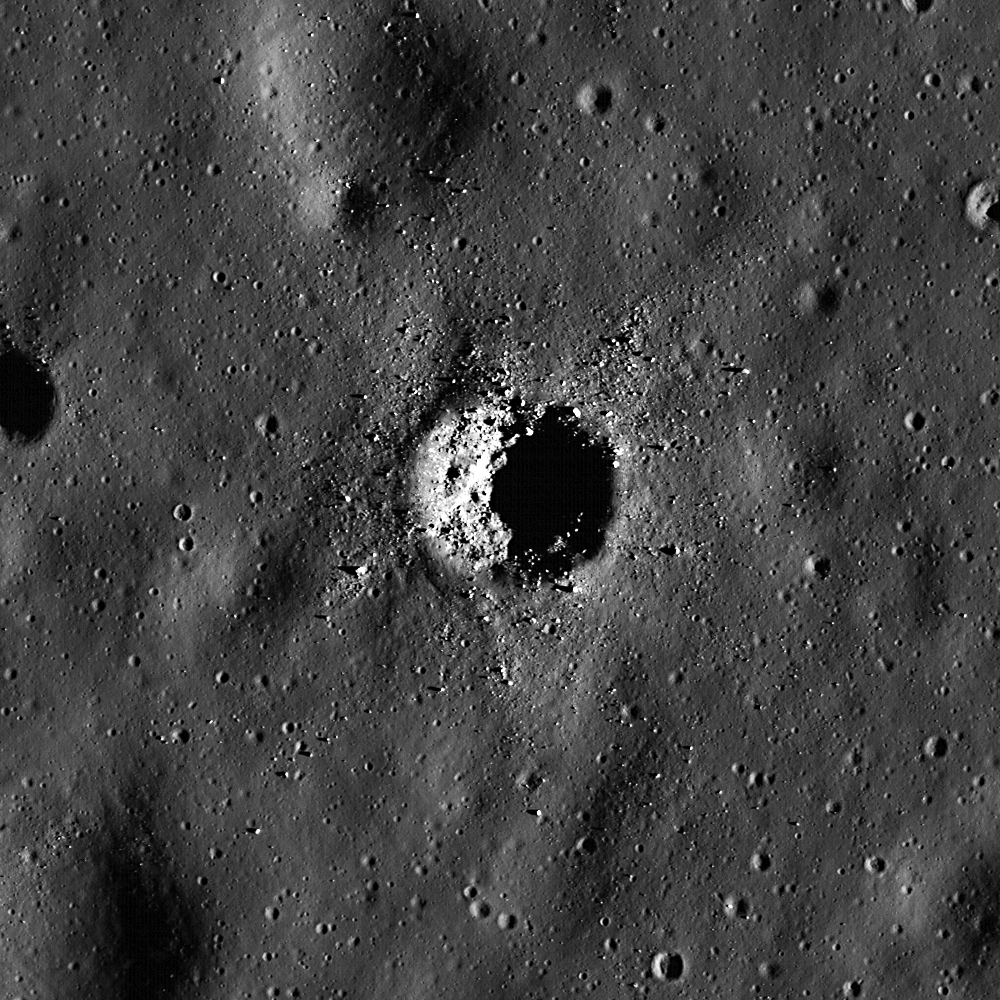
Imbrium Bench Crater: Regolith all the way down?

A small crater hides a bench of bedrock within its walls. Boulders sit just outside the rim. LROC Narrow Angle Camera (NAC) observation M162447033R, LRO orbit 9074, June 11, 2011; 78° angle of incidence, resolution 0.78 meters per pixel, image field of view 800 meters across from 37.5 km [NASA/GSFC/Arizona State University].
Drew Enns
LROC News System

Today's Featured Image shows a bench crater in the lunar mare. Bench craters are so called because they have a small bench lining the interior of the crater wall. In fact, this bench is interpreted to be the contact between the bottom of the regolith and the basaltic bedrock below.

The regolith is a layer of brecciated material that develops as a result of micrometeorite bombardment, it consists mostly of a fine powder containing numerous angular fragments.

The regolith and the coherent basalt both have different strengths, with the regolith being easier to displace than the underlying basalt during an impact event. The result of a moderate impact (in this case one that produced a 160 meter diameter crater) into this area then gave us a spectacular view of the local stratigraphy.

Another Narrow Angle Camera view of the unnamed crater of interest in Mare Imbrium, from a higher altitude later in the LRO mission. LROC NAC frame M190738110R, orbit 13152, May 4, 2012; 52.37° incidence angle, resolution 1.44 meters from 145.83 km [NASA/GSFC/Arizona State University].
Context LROC Lunaserv view showing the location of the small unnamed crater of interest, east-southeast of McDonald crater in Mare Imbrium. The bench crater is near the center of Mare Imbrium at 30.165° N, 339.493°E. Image width is 100 km [NASA/GSFC/Arizona State University].
Regolith development takes time, and many meteor impacts. Since the impact flux (the number of meteors and comets hitting the Moon) has not been constant in the past, the mare have a thinner regolith than the highlands.

Can you find any more bench craters in the full LROC NAC, HERE?

Related Posts:
New Impact Crater on the Moon!
Regolith on Basalt
Fresh Bench Crater in Oceanus Procellarum

Wednesday, March 20, 2013

Landing Site at Tycho North (Science Concept 7)

A Ready-Made Landing Site?   One among many 'flash-frozen' impact melt ponds, a flow over the rugged ejecta immediately north of Tycho crater halted in place 109 million years ago. This one is 800 meters long along its north-south axis, and apparently level, nested about half the distance between the 1968 unmanned Surveyor 7 lander and a geologically interesting breach on Tycho's rim. LROC Narrow Angle Camera (NAC) observation M111668133RE, LRO orbit 1590, October 31, 2009; resolution 51 cm per pixel, angle of incidence 47.88° photographed from 49.39 km [NASA/GSFC/Arizona State University].
Second in a series of posts highlighting newly-proposed lunar landing sites selected to address high-priority science goals - from a remarkable landing site study published by the Center for Lunar Science and Exploration (CLSE):

Another image, less close-up, of the proposed 'Tycho North' landing zone, at slightly less granular resolution (0.65 meters per pixel), the nominally level melt pond is visible in greater context, nested in the rough and debris-strewn Tycho ejecta. The local slope runs from east to west but, overall, lower north and away from 86.2 km Tycho. From a mosaic, LROC NAC M106950070LR, spacecraft orbit 901, September 7, 2009; from 63.18 km altitude, angle of incidence 45.55° [NASA/GSFC/Arizona State University].
Joel Raupe
Lunar Pioneer

On February 5 we discussed a proposed landing site in Amundsen crater selected to support "Science Concept 4" as outlined in the commissioned National Research Council (NRC) study The Scientific Context for the Exploration of the Moon (2007).

In this second of a planned series we move to an area north of Tycho visited by Surveyor 7 in 1968. Material from the region was also very likely sampled by Apollo 17 in 1972, as Eugene Cernan and Harrison Schmidt explored Tortilla Flats in Taurus Littrow Valley, 2200 kilometers away.

While working with those same samples at the Johnson Space Center's Lunar Sample Laboratory Facility, Jack Schmidt soon helped estimate the age of samples collected at the base of South Massif directly opposite from Tycho at 109 million years. When the Tycho event happened, only 44 millions years remained before a similar impact ended the long reign of dinosaurs on nearby Earth. When offered as an example of the Moon's young craters the immense differences between terrestrial and lunar timescales and surface preservation rates are made stark. Such differences make it easy to forget that Earth and Moon have essentially shared the same location in the inner Solar System for 4.5 billion years (with Earth being a larger target and deeper gravity well). A study of the impact history and space weathering environment preserved on the Moon is a study of a much better preserved record of Earth's history.

This landing zone was proposed to address "Science Concept 7," a site that first presented to the Lunar and Planetary Science Conference in 2012 (Abstract #1387), from work produced by the Lunar & Planetary Institute Summer Intern Program the previous year. More detail emerged in the final CLSE landing site study of each of the NRC's 2007 lunar science goals, last fall. The LPSC 2012 abstract and contribution to the final CLSE study are credited to director David A. Kring and LPI 2011 interns Sarah Crites, Agata Przepiórka, Stephanie Quintana, Claudia Santiago and Tiziana Trabucchi.

"Science Concept 7" outlined in the National Research Council's NASA-commissioned Scientific Context for the Exploration of the Moon (2007). The Center for Lunar Science and Exploration (CLSE) released "A Global Lunar Landing Site Study to Provide the Scientific Context for the Exploration of the Moon" in late 2012, an exhaustive study of possible landing sites selected to address NRC 2007 lunar science concepts and goals [CLSE/LPI/NLSI].
The sites appearing in the new CLSE study might be broadly separated into two sets, ranked lists of many possible landing sites picked to fulfill all or overlapping part of the goals under the Science Concepts or individual targets picked in hopes of addressing all goals within one Science Concept and possibly overlapping with one or more of the other Concepts.

In other words, the ranks of possible landing sites in the new study range from those picked to accomplish much within practical, logistical and budget constraints over the next two decades to a long list of sites that may require 50 to 100 years to directly sample, along with a few lists falling somewhere in between. This might be a reflection of the political changes occurring over the years since the study began, when renewed exploration and establishing an extended human presence on the Moon went from being National Space Policy to falling by the wayside.

The new study is highly useful, regardless. Along with the Lunar Impact Crater Database, an even more detailed picture of the origins, ages and compositions of the Moon's complex features has been coming into focus, reflecting the astounding range of detailed information about the Moon collected in recent years.

Another full resolution LROC NAC view of the proposed landing zone, from a mosaic of the left and right frames of LROC NAC observation M111668133LR, LRO orbit 1590, October 31, 2009; incidence angle 47.82° from 49.39 km [NASA/GSFC/Arizona State University].
Since the goal is to establish definitive baselines, the actual ground truth of the upper few centimeters of the Moon's surface, why land near Tycho, the 86.2 km-wide astrobleme (41.49°S, 348.23°E) that is so much younger than its counterparts from earlier eras that have long faded into the albedo background? As it turns out, it's precisely because of such notably pristine.conditions, a comparatively youthful impact upon a region older than Mare Imbrium, that led Kring and his colleagues to seek this place out - along with proximity with Surveyor 7.

Understanding the dynamics of the upper few centimeters of the Moon's surface, most of which is turned-over, or "gardened" every couple of million years - involves more than dust mitigation or the charging and levitation of sub-micron dust as it interacts with radiation from the Sun and deep space or the Moon's nested crustal magnetic fields. Researcher will need a better understanding of this blasted layer of fine particles on wildly different timescales.

A really outstanding oblique view shows the proposed Tycho North Landing Zone from up over a spot 100 km west of Tycho, offerring even more perspective on the complex terrain surrounding the target melt pond (near center). Inset (see rectangle below) from an oblique (59° east of nadir) LROC NAC mosaic of from LROC NAC M1101317790, LRO orbit 14632, September 3, 2012 [NASA/GSFC/Arizona State University].
Thumbnail of the entire LROC NAC M1101317790RLR mosaic shows the area of the target melt terrace (the field of view in the immediately preceding full-resolution crop is framed by the yellow rectangle) in relation with Surveyor 7 and the rim of Tycho, 20 km south (to the right). Incredibly - at full resolution - the Surveyor 7 lander is actually visible in the full image. A proposed science station on the rim of Tycho is just outside this view at lower right [NASA/GSFC/Arizona State University].
Up, over and just beyond Tycho's 1200 meter high rim, the proposed LZ pictured above sits roughly at 620 meters elevation above the lunar geode (near 41.49°S, 348.233°E), the Moon's mean elevation, just out of sight from the sharp 800 meter drop down the crater wall (check this). The familiar crater's complex ejecta blanket extends 110 km from the central peaks, and its famous rays, visible to the naked eye, extend past 2000 km.

Beyond the debris piled high on the Tycho rim, the area of interest north by northwest of the crater, is characterized by slopes from 4.5 to 6° - safe for manned and unmanned landers. The specific Landing Zone is approximately 20 km from the rim fall off, where ancient pre-impact regolith appears to be exposed in layers visible in LROC NAC photography.

Because Tycho excavated pre-Imbrium nearside Southern Highlands, "any paleoregolith layers in Tycho's walls will also have a pre-Imbrium age," Kring and his colleagues note.

"Tycho's crater walls are the best target for sampling," though the upper reaches of the mountainous rim between the landing zone and the crater wall retain slopes greater than 25° "a navigable route to access layered deposits can probably be found."


Clementine multi-spectral mosaic color-coding overlaid on LROC Wide Angle Camera (WAC) 100 meter global mosaic shows the Science Concept 7 proposed landing site (arrow) is near the border between two widely different surface compositions [NASA/GSFC/DOD/ASU].
"The site provides access to regolith produced from substrates of different compositions (see image above)," from the coherent melt pond of the landing site itself to "rubbly ejecta... in a highlands area far from" the unique Procellarum, Potassium and Rare Earth (PKT, or 'Procellarum KREEP') terrain, covering so much of the nearside's west quarter.

Because the Tortilla Flats formation, sampled by Apollo 17, and nearby Surveyor 7 sampled materials related to the Tycho impact event "we can leverage these previous missions to compare properties of regolith of the same age formed from different types of ejecta."

Fifty km-wide LROC WAC field of view barely hints at the complexity of the terrain around the rim of Tycho. The suggested "Science Concept 7" landing site is an equidistant 10 km 'walk-back' distance (as the orbiter flies) from the 1968 landing site of Surveyor 7 (the last unmanned U.S. lander) and a suggested science station, a rare, dramatic breech in the sharp wall of the 'young' 109 million year old crater. The peninsula of melt piled into a comma below and to the right of Surveyor, was shown at very high resolution in "Giant Flow of Tycho Impact Melt," LROC Featured Image released August 14, 2012. LROC WAC (M168272917-9335CE) monochrome (643nm) mosaic   [NASA/GSFC/Arizona State University].
One of the best all-around LROC NAC images of Surveyor 7 (below left, arrow, and at full-resolution in the inset), from M150598504L, LRO orbit 7327, January 25, 2011; spacecraft and camera slew -15.17° from nadir, resolution 0.52 meters per pixel, angle of incidence 69° from 45 km. This roughly 300 meter wide field of view also includes another Tycho melt pond, the landing site Surveyor project manager Gene Shoemaker had hoped for as eventual landing site for this last vehicle of the program. The tripod lander's square sail, atop a supporting mast, casts a distinctive shadow [NASA/GSFC/Arizona State University].
Nearby Tycho's Rim - A possible breech in Tycho's high rim - within walking distance of the proposed Landing Zone, in the opposite direction from Surveyor 7 - may provide sampling access to the layered regolith visible above center-right. This angled corner on the north-northwest rim of Tycho was clearly modified very soon after the crater formed. Whether the slope below is too great to allow men and machines invaluable direct access to Tycho's equally interesting interior is still uncertain. LROC NAC mosaic M160029952LR   [NASA/GSFC/Arizona State University].
Some perspective to the proposed Science Concept 7 science station, on Tycho's rim (arrow) and the crater rim, wall and floor. Melt ponds dot the region. (In this oblique view, the landing zone and Surveyor 7 locations are outside this frame.) Still from video prepared from JAXA photography and data collected by the SELENE-1 (Kaguya) [JAXA/SELENE].
Establishing the rate and manner space weathering leads to the optical maturing (OMAT) of the Moon's surface will help researchers understand processes ranging from the interaction of reactive dust with crustal magnetism - the age and deposition rates of the Moon's swirl phenomena - the deposition of lunar volatiles and tighter estimates of the age of craters between one and two billion years old, past the time needed for optical maturity to do its work. 

Tycho, a recent rich excavation of the Moon's nearside Southern Highlands, and sights along a potentially valuable ingress to the crater's interior demonstrating the potential value of a single rather multiple expeditions. LROC WAC mosaic stitched from four sequential orbital overflights  LROC WAC (M168272917-9335CE) monochrome (643nm) mosaic   [NASA/GSFC/Arizona State University].
Remote sensing maturity maps hint the proposed landing site is characterized "by both very immature and intermediately mature soils," according to Kring and colleagues, "providing an opportunity to see the evolution of space weathering processes."
 
Proximity with Surveyor 7, about 20 km away, in the opposite direction from Tycho's rim, allows study of a known surface, and for a known amount of time (since 0600 UT, 7 January 1968), a stated goal in the NRC's 2007 commissioned report.
 
It's hoped the 20 km distance from the proposed landing site will prevent Surveyor 7, as a valuable 'long-duration exposure facility," from being undermined like Surveyor 3, ultimately swept clean by the descent of Apollo 12 only 183 meters away in 1969.Surveyor 7 may provide a "more pristine" baseline for measuring short-term space weathering.
 
The Tycho North landing site clear of any known crustal magnetism, free of space weathering processes both accelerated and slowed, as they appear to have been at Reiner Gamma, for example. Samples should therefore be "better representative of the lunar highlands."
 
The rate of solar-wind production of volatiles "can also be nicely calibrated here," Kring and his colleagues have noted, since "the exposure age is known and the orbital relationship between the Moon and the Sun is unlikely to have changed significantly over that period."
 
Chemical traces of the object that created Tycho Crater may be be found in the melt-rich rocks at the landing site, along with the shattered pieces of more distant and much older events in the 'recently' exposed paleoregolith uplifted in layers at Tycho's rim.

Some Related Posts:
Amundsen crater and the CLSE Landing Site Study (February 5, 2013)
Rippled Pond on Tycho's Wall (September 13, 2012)
Breached Levee at Tycho (September 11, 2012)
Giant Flow of Impact Melt (August 14, 2012)
River of Rock (June 20, 2012)
View from the Other Side (May 21, 2012)
Impact Melt Fingers (May 8, 2012)
Melt on a Rim (May 3, 2012)
Tycho Central Peak Spectacular (July 5, 2011)
Chaotic crater floor in Tycho (June 19, 2011)
Polygonal fractures on Tycho ejecta deposits (June 15, 2011)
Ejecta on slumped wall of Tycho (December 9, 2010)

When the Moon is full, Tycho's bright ray system is among the few lunar features visible to the naked eye. A testimony to its youth, a low degree of steady space weathering when compared to hundreds of similar but older crater,s from before the time when dinosaurs ruled the earth. The "miracle boys of Minsk" (Astronominsk) captured this local late morning image of Tycho, part of a full disk monochrome mosaic, captured from Belarus, September 20, 2010.  One of their fabulous color images of Тихо can be viewed HERE [Astronominsk].

Monday, May 21, 2012

Lunarcrete, transforming hazard into habitat

Fine as talcum, abrasive as jagged glass, clinging and ubiquitous, lunar dust mitigation is on everybody's list of the biggest challenges facing extended human (and robotic) activity on the surface of the Moon. One essential strategy involves sintering, or otherwise transforming, regolith into native pavement. In a NASA simulation above the shelved Altair manned lander concept is shown landed and parked near the lunar South Pole where a permanent landing pad has been constructed [NASA].
Keith Veronese
io9.com

So, you are on the moon and need to build a new structure. As one of the first lucky colonists there, what are you going to use? Lunarcrete of course.

Lunarcrete is a mixture similar to concrete that could be created using the loose layer of dust and rock covering the surface of the moon. Creating structures from lunarcrete will be one of the keys to cutting colonization costs and increasing self sufficiency of colonies. Terrestrial experiments show that creating a concrete-like substance from lunar rock is possible, but is it practical?

Continue reading the full article HERE

Monday, March 19, 2012

Cosmic ray flux effects lunar ice

Space scientists from the University of New Hampshire and colleagues report they have quantified levels of radiation on the Moon's surface from galactic cosmic ray (GCR) bombardment that over time causes chemical changes in water ice and can create complex carbon chains similar to those that help form the foundations of life.

The radiation process causes the lunar regolith to optically mature (OMAT), or darken, over time; important in understanding the geologic history of the Moon.

Scientists present their findings online in the American Geophysical Union's Journal of Geophysical Research. "Lunar Radiation Environment and Space Weathering from the Cosmic Ray Telescope for the Effects of Radiation (CRaTER)," is based on measurements made by the CRaTER instrument on-board NASA's Lunar Reconnaissance Orbiter (LRO). 

The paper's lead author is Nathan Schwadron, an associate professor of physics at the UNH Space Science Center within the Institute for the Study of Earth, Oceans, and Space (EOS). Co-author Harlan Spence is the director of EOS and lead scientist for the CRaTER instrument.

The telescope provides the fundamental measurements needed to test our understanding of the lunar radiation environment and shows that "space weathering" of the lunar surface by energetic radiation is an important agent for chemical alteration. CRaTER measures material interactions of GCRs and solar energetic particles (SEPs), both of which present formidable hazards for human exploration and spacecraft operations. CRaTER characterizes the global lunar radiation environment and its biological impacts by measuring radiation behind a "human tissue-equivalent" plastic.

Serendipitously, the LRO mission made measurements during a period when GCR fluxes remained at the highest levels ever observed in the space age due to the Sun's abnormally extended quiet cycle. During this quiescent period, the diminished power, pressure, flux and magnetic flux of the solar wind allowed GCRs and SEPs to more readily interact with objects they encountered -- particularly bodies such as our Moon, which has no atmosphere to shield the blow.
The arrival of cosmic rays at Earth, far more of a threat to survival than solar radiation, more than doubles on average when the Sun is relatively quiet. The peak in neutron flux since 1958 (at right) occurred during the unusually long solar minima 2009-2010, "serendipitously" coincident to the beginning of LRO's mission and the CRaTER instrument on-board [Moscow Neutron Monitor].
"This has provided us with a unique opportunity because we've never made these types of measurements before over an extended period of time, which means we've never been able to validate our models," notes Schwadron. "Now we can put this whole modeling field on more solid footing and project GCR dose rates from the present period back through time when different interplanetary conditions prevailed." This projection will provide a clearer picture of the effects of GCRs on airless bodies through the history of the solar system.

Moreover, CRaTER's recent findings also provide further insight into radiation as a double-edge sword. That is, while cosmic radiation does pose risks to astronauts and even spacecraft, it may have been a fundamental agent of change on celestial bodies by irradiating water ice and causing chemical alterations. Specifically, the process releases oxygen atoms from water ice, which are then free to bind with carbon to form large molecules that are "prebiotic" organic molecules.

In addition to being able to accurately gauge the radiation environment of the past, the now more robust models can also be used more effectively to predict potential radiation hazards spawned by GCRs and SEPs.

Says Schwadron, "Our validated models will be able to answer the question of how hazardous the space environment is and could be during these high-energy radiation events, and the ability to do this is absolutely necessary for any manned space exploration beyond low-Earth orbit."

Indeed, current models were in agreement with radiation dose rates measured by CRaTER, which together demonstrates the accuracy of the Earth-Moon-Mars Radiation Environment Module (EMMREM) being developed at UNH. EMMREM integrates a variety of models describing radiation effects in the Earth-Moon-Mars and interplanetary space environments and has now been validated to show its suitability for real-time space weather prediction.

Tuesday, January 10, 2012

Regolith on Basalt

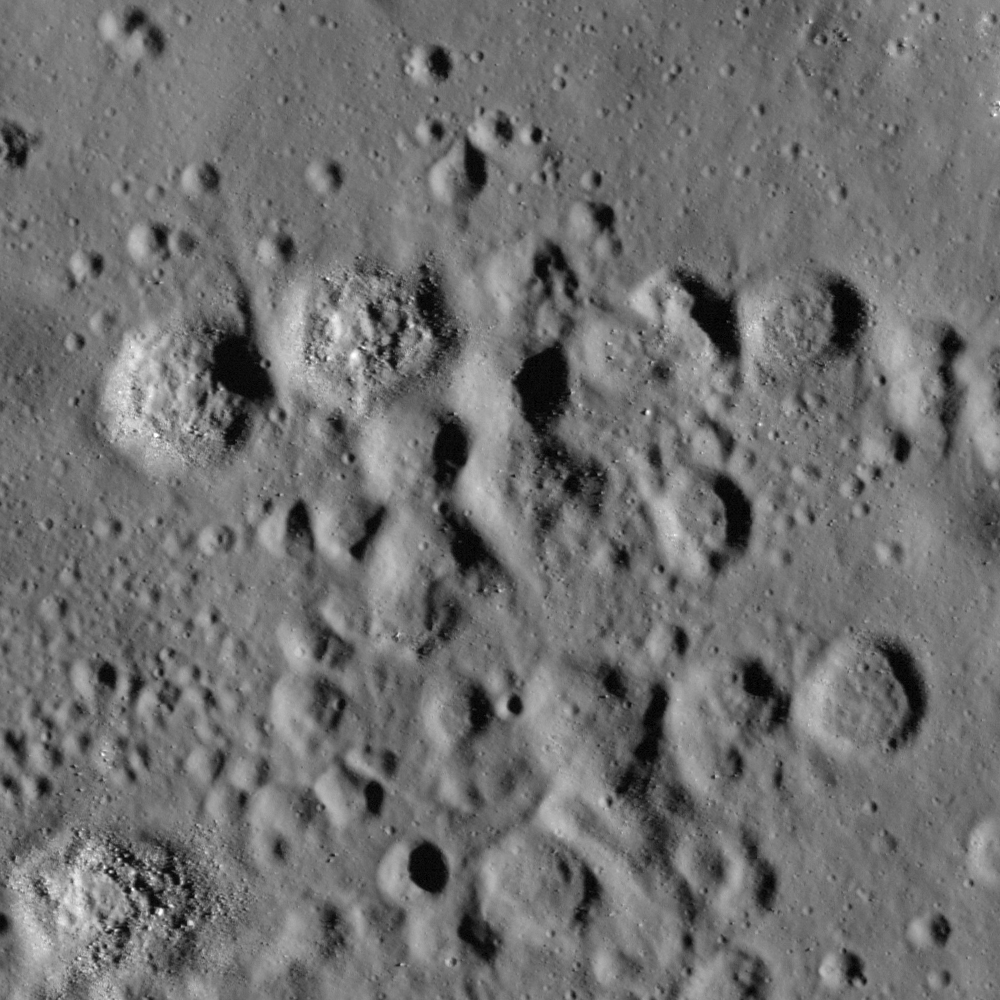
Clusters of possible secondary craters on the north edge of the mare deposits inside Tsiolkovskiy crater. LROC Narrow Angle Camera (NAC) observation M161475783R, LRO orbit 8930, May 31, 2011; incidence angle 67.51° with a resolution of 0.61 meters per pixel from 58.99 km. Image field of view is 610 meters. View the larger LROC Featured Image HERE [NASA/GSFC/Arizona State University].

Hiroyuki Sato
LROC News System

Tsiolkovskiy is a large and spectacular crater on the farside of the Moon (diameter is 180 km). Some time after the impact event that created Tsiolkovskiy, low viscosity lava erupted and flooded the bottom portion of the crater; forming the dark, flat, smooth plain that stands against the bright background of anorthositic highlands.

The age of this mare is estimated, through crater-counting techniques, to be about 3.5 billion years old. The initial solid surface of the solidified lava sheet has slowly been dug up and churned by small impact events. These small impacts build up a layer of loose, crushed rock, similar to a soil on the Earth. On the Moon this layer is called regolth. Today's Featured Image highlights a cluster of relatively young and small craters on the Tsiolkovsiky mare (formed in the regolith). These small craters are probably secondary craters formed as material was thrown out of a nearby primary impact. Did you notice that some of these craters have unusual shapes? Instead of the usual bowl shape of small craters, these examples have very flat floors. Why?

Context for the full LROC NAC frame (rectangle) under the polar orbit of LRO, superimposed on the USG/JAXA digital elevation model and the recently completed Apollo J mission orbital camera survey mosaic in Google Earth [NASA/USGS/JAXA/GSFC/ASU/Google].
Secondary impacts hit the Moon with much lower velocities than primary impacts, so there is less energy (for the same size impactor) available to excavate a crater. Also there is a strength difference between the regolith and the still solid bedrock that it covers. The upper layer is unconsolidated (loose), which is easily excavated and swept out. The lower layer is more solid, and requires more energy to excavate. The flat floor is thus thought to represent the boundary between the regolith and the still solid basalt. By measuring the depth of the flat floor craters, scientists can estimate the depth of the regolith.

LROC Wide Angle Camera (WAC) monochrome 100 meter per pixel mosaic with false-color DLR elevation data (LROC QuickMap) centered over Tsiolkovskiy. The crater's central peak (20.32°S, 128.68°E), at nearly a kilometer above the Moon's mean elevation, rises more than 2000 meters over the mare covered crater floor. [NASA/GSFC/Arizona State University].

Explore these odd craters in the full NAC frame!

Related Posts:
Terraced Craters in Aitken Crater
Fresh Bench Crater in Oceanus Procellarum
Just Another Crater?
Bench Crater in Plato

Thursday, January 6, 2011

Regolith: The "Other" Lunar Resource


The Pantheon of Rome, a 2000-year old concrete structure.

Paul D. Spudis

The Once & Future Moon
Smithsonian Air & Space

In civil engineering, one of the most important material resources on Earth is “construction aggregate” – the sand, gravel and cement building materials that make up the infrastructure of modern industrial life. Aggregate is easily one of the biggest, most valuable economic resources of all mined terrestrial materials – more so than gold, diamonds, or platinum. We depend on aggregates for many different types of objects; they are the fundamental building block of roads and structures. The use of aggregates in building goes back to ancient civilizations; concrete was used in buildings of ancient Egypt. The Romans devised a recipe for a concrete so durable that the molded arches, walls and self-supporting dome of the Pantheon (made over 2000 years ago) stand today. Aggregates in terrestrial use typically depend on a lime-based cement that bonds the particulate material together. Both lime (CaO) and abundant water are needed to make concrete on Earth.

On this blog and elsewhere I have detailed the importance and significance of water at the poles of the Moon. Water is indeed the most important early product to produce from lunar materials but there are other resources on the Moon. A permanent presence on the Moon will require infrastructure that must by necessity use as much local material as possible. Aggregate materials probably will become the primary building blocks of industrial society off planet, just as it has on the Earth. The composition and conditions of local materials will require some adjustments as to how we use lunar aggregate. A little thought reveals some interesting parallels and differences with terrestrial use.

On Earth, gravel pits are carefully located to take advantage of the sorting and layering produced by natural fluvial (river water-eroded) activity. We harvest gravels from alluvial plains and old river beds, where running water has concentrated rocks, sand and silt into deposits that can be easily excavated, loaded, and transported to sites of construction. The highly variable currents, as well as the velocities of flow of our terrestrial streams and rivers, sort the aggregate by size, creating layers of gravel-sized up to cobble-sized stones for the fastest flowing waters. Finer grained material is likewise concentrated where water speeds are low and sand and silt settles out from the suspended sediment (the “bed load”).

No natural process on the Moon creates such deposits, but the lunar surface rock has already been disaggregated by impact into a chaotic upper surface layer called regolith. Regolith is basically ground-up bedrock; impacts of all sizes constantly pummel the surface, breaking, fracturing and grinding up the Moon’s bedrock. Impact both breaks up and creates rock. An impact will destroy a rock both by shock (catastrophic rupture) and through cratering (fragmentation and excavation). The effect of such destruction is to make “soil,” fine-grained rocky material made up of the mineral grains of the bedrock. But impact also creates heat and this heat can weld small fragments into glass-rich aggregate rocks (regolith breccias) as well as quickly cooled fragments of melt that contain mineral inclusions (agglutinates, or glass). In broad terms, impacts destroy and disaggregate more than they create and weld together. Thus, on a given surface, regolith thickness increases with time – older surfaces have thicker regoliths.

The ground up regolith is a readily available building material for construction on the lunar surface. It is an aggregate in the same sense as on Earth, but with some significant differences. We could make lime and water from the surface materials of the Moon but it is very time and energy intensive. Thus, we must adapt and modify terrestrial practice to take advantage of the unique nature of lunar materials. The fractal grain size in the regolith means that we can obtain any specific size fraction we want through mechanical sorting (raking and sieving). Instead of water-set lime-based cement, we can use glass to cement particulate material together. Regolith can be sintered into bricks and blocks, as well as roads and landing pads, using thermal energy (passive solar, concentrated by focusing mirrors) or microwaves that can melt grain edges into a hard, durable ceramic.

The use of aggregate materials on the Moon will likely be gradual and incremental. Our initial presence on the Moon will be supported almost entirely by materials and supplies brought from Earth. As we gain facility using lunar resources, we can incorporate more and more local materials into structures. Simple, unmodified bulk soil is an early useful product. It can be used to build berms to protect an outpost from the rocket blast of arriving or departing spacecraft and to cover surface assets for thermal and radiation protection. The next phase will be to pave roads and pads to keep down randomly thrown dust and provide good traction for the multitude of wheeled vehicles supporting the outpost. Fabrication of bricks from regolith will allow us to construct large buildings, initially consisting of open, unpressurized workspaces and garages but ultimately, habitats and laboratories. Making glass by melting regolith can produce building materials of extreme strength and durability; anhydrous glass made from lunar soil is stronger than alloy steel with a fraction of its mass.

Eventually, we may be able to export these lunar building materials into space. A major drawback is the gravity well of the Moon – its escape velocity is about 2.38 km/s, smaller than that of the Earth but substantial. To use large quantities of lunar materials for space construction, we need to develop an inexpensive means to get material off its surface. Fortunately, the small size and no atmosphere of the Moon make this possible by literally throwing stuff off the Moon into space. A “mass driver” can launch objects off the lunar surface by accelerating them along a rail track using electromagnetic coils that hurl capsulated material into space at specific velocities and directions. We can collect such thrown material at a convenient location, such as one of the libration points. From there, it is a relatively simple matter to send the material to wherever it is needed in cislunar space.

Water remains the most important first lunar product, but the “other” lunar material regolith is almost as important. Lunar rock and soil will be the paving stones of the Solar System. As once all roads led to Rome, all new roads in cislunar space lead to – and from – the Moon.

Wednesday, October 14, 2009

2009 Regolith Excavation Challenge

Keith Cowing
OnOrbit.com

A record number of entrants have signed up to compete in the 2009 Regolith Excavation Challenge and its whopping $750,000 prize money. Twenty-three teams have fulfilled the application requirements to compete in the October 17 and 18 event at the NASA Ames Research Park at Moffett Field in Mountain View.

Read the Story, HERE.

Saturday, September 26, 2009

Lunar Regolith Challenge, Oct. 17-18


The California Space Authority is hosting the 2009 Lunar Regolith Excavation Challenge Saturday and Sunday, October 17 and 18, 2009 at NASA Ames Research Center in Mountain View, CA. with the California Space Education and Workforce Institute spearheading the event.

Heads-Up to Jack Kennedy @Spaceports

Friday, September 25, 2009

Case & NASA find key to unlocking oxygen from the lunar surface

Key process for space outpost proved on 'vomit comet' ride


The celestial body has no atmosphere like Earth's, holding the precious element just a breath away. But, oxygen to breathe, grow food, create water and burn rocket fuel - to make a space outpost a reality - is trapped in its soils.

Scientists from NASA and Case Western Reserve are designing and testing components of an oxygen generator that would extract the element from silicon dioxide and metal oxides in the ground. They have designed sifters needed to produce a consistent supply of oxides. But, how would the sifters work in the moon's gravity, which is about one-sixth as strong as the Earth's?

To find out, Katie Fromwiller, a senior civil engineering student, and Julie Kleinhenz, an assistant research professor of aerospace and mechanical engineering, spent two days flying in high arcs off the Texas coast last month.

This was Fromwiller's first trip on the plane, which space researchers refer to as the "vomit comet," due to the unsettling ride. Inside the plane, the pull of gravity approximated the moon's weak gravity during the rapid drop in each arc. The riders felt twice the pull of the Earth's gravity on the way back up. During two runs, they floated in zero gravity.

"Not in a million years would I have ever expected to do something like this with NASA," said Fromwiller, who is also a member of the Case Western Reserve women's soccer team and the Voices of Glory chorus.

But, the space agency wants to learn how to work with the soils, and Fromwiller's focus is geotechnical engineering. She teamed with Kleinhenz, a veteran of more than 1,000 hours on the vomit comet.

"It was as if they were working on the moon, 20 seconds at a time," said David Zeng, Frank H. Neff Professor and Chair of Civil Engineering from the Case School of Engineering and one of the principal investigators of the study.

NASA engineers were testing other components of the oxygen generator on the same flight.

NASA, Kleinhenz explained, has plans to build a system that includes a rover that would dig, carry and dump moon soil into a hopper or holding vessel. Sifters would separate particles by size, collecting those that can be converted most efficiently. The particles can also be separated by composition. For example, an electrostatic charger can be used to isolate iron oxides from other soil materials.

The wanted particles would then be blown into a reactor with hydrogen and heated to 2,000 degrees Fahrenheit. At this time, the oxygen released from the oxides would attach to the hydrogen and be collected.

While in flight, the pair tested two kinds of devices, a vibro-sieve and a sifter. As the plane reached lunar gravity, Fromwiller switched on a vibration table that shook a sieve, similar to a perforated pan used to pan for gold. As on Earth, the process worked.

Kleinhenz worked a sifter that operates much like a flour sifter. It, too, was able to separate particles in low gravity.

Zeng and his team are continuing to analyze data produced over the two days. Ultimately, NASA will decide which kind of device to use in the oxygen generator.

Funding for the continued project may be in jeopardy now that a White House advisory panel concluded NASA would need an additional $3 billion annually to return to the moon by 2020 and the funding might be better used elsewhere. But, the panel also said Mars should be the ultimate destination for manned missions.

"The technology is useful outside the lunar system," Kleinhenz said. "It's applicable to Mars."

Monday, August 24, 2009

Moon may light man's future

Emotive illustration by Pang Li, heading up interview by China Daily's Ma Chao with Ouyang Ziyuan, academician at China Academy of Sciences and chief scientist of China's moon exploration project.

Ma Chao: Between October 2007 and March of this year, the Chang'e 1 spacecraft circled the moon for nearly 18 months. As chief scientist, what do you think has been achieved with Chang'e 1? And what has the spacecraft meant to the future of China's moon exploration project?

Ouyang: Though China's moon exploration project began much later than other countries, it is at the cutting-edge in several aspects and is unique in many ways without excessive expenditures of money.

The Chang'e 1 has successfully achieved four scientific targets. The first was to formulate a two-dimensional as well as a three-dimensional map of the entire moon. We have now formulated a two-dimensional map encompassing the surface of the entire moon without any omissions. It is a high-quality map and is available to anyone in the world.

The Chang'e 1 scanned the moon's surface with three laser beams, measuring the height or altitude of more than 9 million points on the moon. Based on our data, a stereoscopic map will be accomplished before the end of this year.

The second target is to explore the composition of the moon's surface and minerals it contains. Using instruments of remote sensing, the Chang'e 1 has obtained data of the allocation of chemical elements, as well as types of minerals and stones on the surface. We are currently processing the data and working to draw a geological map of the moon.

The third mission is to explore the soil layer on the moon, a pioneering work that has not been done by any other country. The Chang'e 1, using microwave technology, measured the depth of the soil layer across the moon.

One focus of the soil examination is to detect how much helium-3, a crucial element for nuclear fusion, is on the moon. Since the fossil energy on Earth might be exhausted in a century or less, we have to find an alternative energy source. Nuclear fusion would be an important option. There is an abundance of helium-3, perhaps millions of tons on the moon, which could be used to generate energy once the technology matures. The moon might fundamentally change the pattern of energy generation for humans.

Last but not least, the Chang'e 1 was commissioned to probe and record the environment on the moon, such as its electromagnetic features and solar wind, which are crucial for future landings.

Within these four aspects, an enormous amount of data has been collected. Before Chang'e 1, Chinese scientists had to depend on data from foreign countries. Now we have original data. In line with the international convention, Chinese scientists will study the data collected by Chang'e 1 for a year and then release the data to the world.

The Chang'e 1 is the first step in China's moon exploration project. The second step would be landing on the moon, i.e. sending a lunar lander and a lunar rover onto the moon's surface. The third step would be not only landing but also returning part of the landing apparatus with collected samples back to Earth. Only after all these steps are successfully accomplished, will it be possible to carry out a manned moon landing.

Ma Chao: When will Chinese astronauts be able to land on the moon?

Ouyang: This is what many are very eager to know. There are many speculations on when China can achieve this feat. The India media have claimed that China will be able to land its astronauts on the moon in 2024. Michael Griffin, former administrator of NASA, said China will be able to achieve a manned moon landing in 2020. Chinese scientists have many dates, too, such as 2020, 2025 or 2030. However, the State has not announced any specific schedule for the manned moon landing.

Ma Chao: Is there then a schedule for landing the lunar rover?

Ouyang: According to the State's plan, China's lunar rover will be carried by the Chang'e 3 spacecraft to the moon before the end of 2013.

Ma Chao: You have mentioned the significance of moon exploration in relation to future energy supplies for mankind. In addition to this point, what can the exploration contribute to the economic development of China, and how will it affect the lives of ordinary people?

Ouyang: The project will definitely advance our economy. For instance, the US' Project Apollo - which gathered around 400,000 people, about 20,000 firms and more than 200 universities - cost $25.6 billion. But it guided almost all the cutting-edge technologies in the 1960s and 70s, and has created an economic value amounting to 17 times the cost.

Since China's exploration project has just been a few years old, it is still too early to measure the costs and benefits. But it has already helped many Chinese firms improve their product quality. Because the environment on the moon is extremely harsh and volatile, we have set strict criteria for our component suppliers. To meet the criteria, the suppliers had to spend a great deal of effort in research and development (R&D) and consequently improve the quality of their products as well as lower costs.

Another great benefit of the Chang'e 1 is the dissemination of knowledge about the moon and space. It spurs public interest in space exploration, and is a great opportunity to raise the scientific literacy among people.

Ma Chao: Many countries, such as the US, Russia, India, and Japan, are planning to send astronauts to the moon, too. In comparison, where is the position of China in terms of technology?

Ouyang: That is a tricky question, since it is impossible to evaluate exactly how big the gaps are, or to make an exact ranking. To say how many years a country is ahead or behind other countries is not scientific. What we know is that the US and Russia, with their advanced technology and rich experience, are definitely at the first tier. China, India and Japan all have distinguished features and special technological edges.

Actually it is not wise to pay too much attention to who is superior to whom. I hope all countries could succeed in moon exploration and contribute to the understanding of the moon.

Ma Chao: You have created a concept called "harmonious earth-moon relations." Could you please specify this concept?

Ouyang: The moon has been a loyal guard of Earth for billions of years. It has inspired the philosophy, thoughts and aesthetics of mankind for thousands of years. With progress in moon exploration, the moon will become a great treasure to sustain the development of mankind. It will be an ideal transshipment station if people want to explore or even migrate to another planet. In the future, Earth and the moon can develop harmoniously together.

Thursday, August 14, 2008

Helium-3 powering the future?

Updated August 30, 2010, 2036 UT
Michael Schirber
Special to LiveScience

The moon is once again a popular destination, as several space-faring nations are talking about setting up bases there. One reason would be to mine fuel for future fusion reactors.

The fuel in this case is helium-3, a lighter isotope of the helium used in balloons. In high energy collisions, helium-3 fuses with other nuclei to release more energy and less waste than the reactions in traditional nuclear reactors.

"If we can show that we can burn helium-3, it is a much cleaner and safer energy source than other nuclear fuels," said Gerald Kulcinski, director of the Fusion Technology Institute at the University of Wisconsin at Madison.

Just 40 tons of this stuff has enough potential energy to meet the total U.S. electricity demand for a year. However, there is almost no helium-3 on Earth. The closest supply is on the moon.

Several space agencies, notably in China, Russia and India, have mentioned helium-3 as a potential payoff for their lunar projects.

"I don't think that the main motivation to go back to the moon is helium-3," Kulcinski said. "But over the long-term, we do face an energy problem."

Fusion solution

All current nuclear power is based on fission, in which a large nucleus (such as uranium) breaks apart into smaller nuclei.

The alternative is fusion, in which two small nuclei come together to form a bigger nucleus and release copious amounts of energy.

A commercial fusion reactor has never been built, but a prototype called the International Thermonuclear Experimental Reactor (ITER) has just begun construction in Cadarache, France. The plan is to generate the needed 100 million degree plasma by the year 2016, but a power plant that can supply electricity might not come online for another 20 years after that.

The reaction that will occur in ITER is the fusing of two hydrogen isotopes: deuterium and tritium. One concern is that tritium is radioactive and a component of nuclear weapons, so care must be taken in dealing with it.

Another problem is the highly energetic neutrons emitted from the deuterium-tritium reaction. These neutrons slam into the reactor walls and cause structural damage. It is expected that the walls in ITER will have to be replaced every one to two years, Kulcinski said.

This is why Kulcinski and others advocate trading the tritium with non-radioactive helium-3.

"The advantage is that it makes very few neutrons," said Rich Nebel of Emc2 Fusion, a company based in Santa Fe, N.M. "This reduces radiation issues and also greatly simplifies the engineering."

Furthermore, the reaction products of helium-3 fusion are charged, so their energy can be directly converted into electricity without having to go through the inefficient step of boiling water to make steam.

Helium sources

Despite its apparent attractiveness, helium-3 is often neglected by fusion researchers. One reason is that the Earth has very little of it. A small portion of helium-3 is collected as an unwanted by-product inside nuclear weapons and sold for about $1,000 per gram, Kulcinski said.

A continuous supply of helium-3 can be found in the solar wind, but our planet's magnetic field deflects these particles away. The same is not true on the moon. The moon has collected 1 million to 5 million tons of helium-3, from the solar wind, over its 4.5 billion year history, Kulcinski said.

Evidence for this was found in the lunar rocks (brought back by the Apollo astronauts and Russian rovers) at a level of 10 to 20 parts per billion.

"Helium-3 is present on the moon, but in very small concentration levels, meaning that many hundreds of millions of tons of soil must be processed to extract a ton of helium-3," said Paul Spudis of the Lunar and Planetary Institute, a NASA-funded research institution.

This extraction requires heating lunar dust particles to around 1,300 degrees Fahrenheit (700 degrees Celsius), Spudis said.

Kulcinski and his colleagues have designed rovers that could move along the surface, scraping up lunar soil and heating it with concentrated sunlight.

Such a mining operation would retrieve 300 times more energy than it uses (including all the energy to fly to the moon and back), Kulcinski estimates. In comparison, mining coal returns 15-20 times the energy put in. His team has estimated that it might cost around $800 million to bring back each ton of lunar helium-3.

This might sound like a lot, but if you could sell the fusion energy at a price comparable to gasoline based on oil at $100 per barrel, the helium-3 would be worth $10 billion per ton.

"Our real challenge is not obtaining the helium-3; it is demonstrating that we can burn it," Kulcinski said.

Tough to burn

Burning helium-3 requires higher initial energy than burning hydrogen isotopes. This is why ITER is not considering helium-3 as a possible fuel at this time.

However, Kulcinski's group works on a different method — called inertial electrostatic confinement (IEC) — for achieving fusion reactions. Instead of using magnetic fields to confine a very hot plasma like ITER plans to do, IEC works by accelerating nuclei towards each other with electric fields.

Kulcinski and his collaborators have managed to sustain nuclear fusion in their small prototype system. The company Emc2 Fusion is also working on a similar design.

However, all of these IEC demonstrations, at least for now, require much more input energy than they can deliver. Most researchers agree that helium-3 is unlikely to be the first fuel used in fusion reactors.

"One should never say never — it may come to pass that helium-3 could become an important source of energy in the coming century," Spudis said. "That time has not come yet. And I suspect that it is still some time off."