Showing posts with label NASA HQ. Show all posts

Monday, October 13, 2014

LRO: widespread evidence of young lunar volcanism

The feature called Maskelyne is one of many newly discovered young volcanic deposits on the Moon. Called irregular mare patches, these areas are thought to be remnants of small basaltic eruptions that occurred much later than the commonly accepted end of lunar volcanism, 1 to 1.5 billion years ago [NASA/GSFC/Arizona State University].
Dwayne Brown
NASA HQ

NASA’s Lunar Reconnaissance Orbiter (LRO) has provided researchers strong evidence the moon’s volcanic activity slowed gradually instead of stopping abruptly a billion years ago.

Scores of distinctive rock deposits observed by LRO are estimated to be less than 100 million years old. This time period corresponds to Earth’s Cretaceous period, the heyday of dinosaurs. Some areas may be less than 50 million years old. Details of the study are published online in Sunday’s edition of Nature Geoscience.

“This finding is the kind of science that is literally going to make geologists rewrite the textbooks about the moon,” said John Keller, LRO project scientist at NASA’s Goddard Space Flight Center in Greenbelt, Maryland.

The deposits are scattered across the moon’s dark volcanic plains and are characterized by a mixture of smooth, rounded, shallow mounds next to patches of rough, blocky terrain. Because of this combination of textures, the researchers refer to these unusual areas as irregular mare patches.

The features are too small to be seen from Earth, averaging less than a third of a mile (500 meters) across in their largest dimension. One of the largest, a well-studied area called Ina, was imaged from lunar orbit by Apollo 15 astronauts.

Ina appeared to be a one-of-a-kind feature until researchers from Arizona State University in Tempe and Westfälische Wilhelms-Universität Münster in Germany spotted many similar regions in high-resolution images taken by the two Narrow Angle Cameras that are part of the Lunar Reconnaissance Orbiter Camera, or LROC. The team identified a total of 70 irregular mare patches on the near side of the moon.

The large number of these features and their wide distribution strongly suggest that late-stage volcanic activity was not an anomaly but an important part of the moon's geologic history.

The numbers and sizes of the craters within these areas indicate the deposits are relatively recent. Based on a technique that links such crater measurements to the ages of Apollo and Luna samples, three of the irregular mare patches are thought to be less than 100 million years old, and perhaps less than 50 million years old in the case of Ina. The steep slopes leading down from the smooth rock layers to the rough terrain are consistent with the young age estimates.

In contrast, the volcanic plains surrounding these distinctive regions are attributed to volcanic activity that started about 3 1/2 billion years ago and ended roughly 1 billion years ago. At that point, all volcanic activity on the moon was thought to cease.

Several earlier studies suggested that Ina was quite young and might have formed due to localized volcanic activity. However, in the absence of other similar features, Ina was not considered an indication of widespread volcanism.

The findings have major implications for how warm the moon’s interior is thought to be.

An oblique, novel view of the Ina formation (3 km across, 18.65°N, 5.3°E) from the LROC narrow angle camera (resolution 2.5 meters per pixel [NASA/GSFC/Arizona State University].
“The existence and age of the irregular mare patches tell us that the lunar mantle had to remain hot enough to provide magma for the small-volume eruptions that created these unusual young features,” said Sarah Braden, a recent Arizona State University graduate and the lead author of the study.

The new information is hard to reconcile with what currently is thought about the temperature of the interior of the moon.

“These young volcanic features are prime targets for future exploration, both robotic and human,” said Mark Robinson, LROC principal investigator at Arizona State University.

LRO is managed by Goddard for NASA’s Science Mission Directorate at NASA Headquarters in Washington. LROC, a system of three cameras, was designed and built by Malin Space Science Systems and is operated by Arizona State University.

To access the complete collection of LROC images, visit http://lroc.sese.asu.edu/

For more information about LRO, visit http://www.nasa.gov/lro

Some Related Posts:
Hansteen α -   January 15, 2014
Small-scale volcanism on the lunar mare, July 13, 2013
Unassuming volcanic vent north of Aristarchus Plateau, April 1, 2013
New views of the hollows of Rimae Sosigenes, March 28, 2013
Inside Rima Hyginus, June 12, 2012
Ina of the Meniscus Hollows, March 21, 2012
LUNAR MENISCUS HOLLOWS. P. J. Stooke, Department of Geography and Centre for Planetary Science and Exploration, University of Western Ontario, London, Ontario, Canada; 43rd Lunar and Planetary Science Conference (2012), #1011.
Whale of a Hollow, March 20, 2012
It's a gas, man, Paul Spudis, Smithsonian Air & Space, October 6, 2011

Saturday, January 18, 2014

NASA announces partnership opportunities for U.S. commercial lunar lander capabilities

Orion-based lander concept
Other than development of the Ares booster, the only essential program actually tossed under the bus, when Congress and the administration scrapped Constellation, was the Altair lunar lander.  Now NASA will conduct a "Pre-proposal teleconference," January 27, 2014, at 1600 (UT) and proposers will have an opportunity to ask questions about the "Lunar CATALYST" unmanned program, discussed HERE. [NASA].
Trent J. Perrotto
NASA HQ Washington

Building on the progress of NASA's partnerships with the U.S. commercial space industry to develop new spacecraft and rockets capable of delivering cargo, and soon, astronauts to low Earth orbit, the agency is now looking for opportunities to spur commercial cargo transportation capabilities to the surface of the moon.

NASA has released an announcement seeking proposals to partner in the development of reliable and cost-effective commercial robotic lunar lander capabilities that will enable the delivery of payloads to the lunar surface. Such capabilities could support commercial activities on the moon while enabling new science and exploration missions of interest to NASA and the larger scientific and academic communities.

NASA's new Lunar Cargo Transportation and Landing by Soft Touchdown (Lunar CATALYST) initiative calls for proposals from the U.S. private sector that would lead to one or more no-funds exchanged Space Act Agreements (SAA). NASA’s contribution to a partnership would be on an unfunded basis and could include the technical expertise of NASA staff, access to NASA center test facilities, equipment loans, or software for lander development and testing.

"As NASA pursues an ambitious plan for humans to explore an asteroid and Mars, U.S. industry will create opportunities for NASA to advance new technologies on the moon," said Greg Williams, NASA's deputy associate administrator for the Human Exploration and Operations Mission Directorate. "Our strategic investments in the innovations of our commercial partners have brought about successful commercial resupply of the International Space Station, to be followed in the coming years by commercial crew. Lunar CATALYST will help us advance our goals to reach farther destinations."

The moon has scientific value and the potential to yield resources, such as water and oxygen, in relatively close proximity to Earth to help sustain deep space exploration. Commercial lunar transportation capabilities could support science and exploration objectives, such as sample returns, geophysical network deployment, resource prospecting, and technology demonstrations. These services would require the ability to land small (66 to 220 pound, or 30 to 100 kilogram) and medium (551 to 1,102 pound, or 250 to 500 kg) class payloads at various lunar sites.

"In recent years, lunar orbiting missions, such as NASA’s Lunar Reconnaissance Orbiter, have revealed evidence of water and other volatiles, but to understand the extent and accessibility of these resources, we need to reach the surface and explore up close," said Jason Crusan, director of Advanced Exploration Systems at NASA Headquarters in Washington. "Commercial lunar landing capabilities could help prospect for and utilize these resources."

Lunar CATALYST supports the internationally shared space exploration goals of the Global Exploration Roadmap (GER) NASA and 11 other space agencies around the world released in August. The GER acknowledges the value of public-private partnerships and commercial services to enable sustainable exploration of asteroids, the moon and Mars.

Commercial lunar cargo transportation systems developed through Lunar CATALYST could build on lessons learned throughout NASA's 50 years of spaceflight. New propulsion and autonomous landing technologies currently are being tested through NASA's Morpheus and Mighty Eagle projects.

NASA will host a pre-proposal teleconference on Monday, Jan. 27 during which proposers will have an opportunity to ask questions about the announcement. Proposals from industry are due by March 17. The announcement of selections is targeted for April with SAAs targeted to be in place by May.

The Advanced Exploration Systems Division in NASA's Human Exploration and Operations Mission Directorate manages Lunar CATALYST. Advanced Exploration Systems pioneers new approaches for rapidly developing prototype systems, demonstrating key capabilities and validating operational concepts for future human missions beyond Earth orbit.

As NASA works with U.S. industry to develop the next generation of U.S. spaceflight services, the agency also is developing the Orion spacecraft and the Space Launch System (SLS), a crew capsule and heavy-lift rocket to provide an entirely new capability for human exploration. Designed to be flexible for launching spacecraft for crew and cargo missions, SLS and Orion will expand human presence beyond low-Earth orbit and enable new missions of exploration across the solar system, including to a near-Earth asteroid and Mars.

For more information about the announcement and teleconference, visit: http://www.nasa.gov/lunarcatalyst.

trent.j.perrotto@nasa.gov
- (202) 358-1100

Wednesday, December 11, 2013

Earth and Moon from Juno fly-by

"Earth and Moon as seen from passing spacecraft"
D C Agle
Jet Propulsion Laboratory

Steve Cole
NASA Headquarters 

When NASA’s Juno spacecraft flew past Earth on October 9, 2013, it received a boost in speed of more than 7.3 kilometers per second, which set it on course for a July 4, 2016 rendezvous with Jupiter. One of Juno's sensors, a faint star tracking camera, also had a unique view of the Earth-Moon system. The result was an intriguing, if low-resolution, glimpse of what it would be like to approach our worlds from a distance.

“In the movie, you ride aboard Juno as it approaches Earth and then soars off into the blackness of space," said Scott Bolton, Juno principal investigator at the Southwest Research Institute (SwRI) in San Antonio. "No previous view of our world has ever captured the heavenly waltz of Earth and Moon."

The Juno Earth flyby movie is available on YouTube HERE. The original score is by Vangelis.

Earth-Moon from Juno October 9, 2013
Ancient cosmic pirouette of Earth and Moon from the Jovian-bound spacecraft Juno as it flew by Earth, October 9, 2013 [NASA/JPL-Caltech].
The cameras that took the images for the movie are located near the pointed tip of one of the spacecraft's three solar-array arms. They are part of Juno's Magnetic Field Investigation (MAG) and are normally used to determine the orientation of the magnetic sensors. These cameras look away from the sunlit side of the solar array, so as the spacecraft approached, the system's four cameras pointed toward Earth. Earth and Moon came into view when Juno was about 966,000 kilometers away -- about thrice the Earth-Moon separation.

During the flyby, timing was everything. Juno was traveling about twice as fast as a typical satellite, and the spacecraft itself was spinning at 2 RPM.

To assemble a movie that wouldn't make viewers dizzy, the star tracker had to capture a frame each time the camera was facing Earth at precisely the right instant. The frames were then sent to Earth, where they were processed into video.

"Everything we humans are and everything we do is represented in that view," said the star tracker's designer, John Jørgensen of the Danish Technical University, near Copenhagen.

Amateur Radio signal from Juno Fly-By
The Waves instrument aboard NASA's Juno spacecraft recorded amateur radio signals from ham radio operators from around the world [NASA/JPL-Caltech/University of Iowa].

Also during the flyby, Juno's Waves instrument, which is tasked with measuring radio and plasma waves in Jupiter's magnetosphere, recorded amateur radio signals. This was part of a public outreach effort involving ham radio operators from around the world. They were invited to say "HI" to Juno by coordinating radio transmissions that carried the same Morse-coded message. Operators from every continent, including Antarctica, participated.

"With the Earth flyby completed, Juno is now on course for arrival at Jupiter on July 4, 2016," said Rick Nybakken, Juno project manager at NASA's Jet Propulsion Laboratory in California

Moon from Juno fly-by
Moon from Juno star-tracking camera, October 9, 2013 [NASA/JPL/SwRI/MSSS/Ken Kremer/Marco Di Lorenzo].
The Juno spacecraft was launched from Kennedy Space Center in Florida on August 5, 2011. Juno’s launch vehicle was capable of giving the spacecraft only enough energy to reach the asteroid belt, at which point the Sun’s gravity pulled it back toward the inner solar system. Mission planners designed the swing by Earth as a gravity assist to increase the spacecraft’s speed relative to the Sun, so it could reach Jupiter. (The spacecraft’s speed relative to Earth before and after the flyby was unchanged.)

EFB12_7s_Juno-Earth-mosaic_Ken-Kremer-1000x1414
Earth - over the coast of Namibia, from mosaic of images captured from the Juno spacecraft's on-board Junocam, near the Jupiter-bound probe's close encounter with Earth and Moon, October 9, 2013 [NASA/JPL/SwRI/MSSS/Ken Kremer/Marco Di Lorenzo].
After Juno arrives and enters into orbit around Jupiter the spacecraft will circle the planet 33 times, from pole to pole, and use its collection of science instruments to probe beneath the gas giant's obscuring cloud cover. Scientists will learn about Jupiter's origins, internal structure, atmosphere and magnetosphere.

Juno's name comes from Greek and Roman mythology. At times personified in Earth's Moon, Juno was the goddess of the civil state.

More information about Juno is online, HERE

Monday, August 19, 2013

Good things delivered in small packages

Mighty Eagle Aces Exam (NASA, International Space Station, 09/05/12)
Overcast skies didn't deter the "Mighty Eagle," flying high over the historic F-1 test stand and completing a milestone round of flight test objectives, September 5, 2012. One of two NASA robotic prototype landers, the vehicle was flown to an altitude of 30.48 meters and descended gently to a controlled landing during a successful free flight Marshall Space Flight Center in Huntsville, Alabama. Nicknamed the "Mighty Eagle" after one of the characters in the popular "Angry Birds" game, the vehicle is a three-legged prototype,  that resembles an actual flight lander design. It is 1.219 meters high, 2.438 in diameter and, when fueled, weighs 317.5 kg. It's a, so-called, “green” vehicle, 90 percent fueled by pure hydrogen peroxide, guided by an onboard computer [NASA/MSFC].
Paul D. Spudis
The Once and Future Moon
Smithsonian Air & Space


Wanted: lander spacecraft to deliver payloads to the Moon.  Must be cheap and reliable.

NASA recently issued an “RFI” – a Request for Information – a method used by the agency to solicit concepts from various companies and gauge their ability to fulfill a future anticipated need.  In this case, the need is for a small robotic lander, one capable of delivering two classes of payloads to the lunar surface: small (from 30 to 100 kg) and medium (from 250 to 450 kg).

Probably focused near-term with the RESOLVE (Regolith and Environment Science and Oxygen and Lunar Volatiles Extraction) payload, the intent of this RFI is to survey existing capabilities for the commercial delivery of a variety of payloads to the Moon.  RESOLVE is a NASA experiment designed to test and demonstrate some techniques of in situ resource utilization (ISRU) on the Moon, specifically the generation of oxygen and the extraction of volatile elements (such as hydrogen) from lunar soil.  The RESOLVE package consists of several highly integrated experiments designed to collect soil on the Moon, heat this feedstock to various temperatures and measure the amount and type of volatile elements released, and practice some techniques of processing the soil into useful products (such as water or oxygen).

Though we’ve been talking about using off-planet resources for years, this is the first time the agency would fly an experiment designed to evaluate the processes and difficulties involved.  Some of us contend that until it is proven possible (by demonstrating it in space), space-based resource utilization (ISRU) will remain classified as “too risky” to incorporate into an architecture.  Engineers don’t doubt the chemistry or physics behind ISRU, but to evaluate risk and return, they want demonstrations using real hardware versus theoretical concepts and paper studies.

Although it will not answer all ISRU questions, RESOVLE can provide useful data and would be an important milestone.  Our ignorance is particularly vast in regard to the nature of the polar volatile deposits.  Some near-polar sites are under consideration for RESOLVE, but because the lander must be able to communicate with Earth, sites near the poles must be in radio view of Earth.  This eliminates the most promising polar volatile sites (permanently dark, out of radio sight) from consideration, at least for the first mission.  However, we know that water ice occurs in some areas in view of Earth, so careful targeting will permit us to get ground truth for a critical area near the one of poles.

There are a wide variety of possible payloads (scientific and resource utilization) for lunar missions using small landers.  A key priority for the lunar science community has been the deployment of a global network of geophysical instruments.  Such a package would include a seismometer (to monitor and measure moonquakes), a heat flow probe (to take the Moon’s temperature) and other instruments, such as a magnetometer and a laser reflector.  The five-station surface network laid out during the Apollo missions was operational for more than 7 years and gave us a first-order understanding of the nature of the deep lunar interior.  A new global network – widely spaced and operating longer with more stations – would vastly improve on that knowledge.

The success of a network mission necessitates a long-lived power source to operate instruments during the very cold, 14-day lunar night (the Apollo network used nuclear power supplies), along with an inexpensive way to deploy the network stations.  New technologies have developed small, reliable radioisotope generators that operate for many years.  A small lander could deliver geophysical stations across the entire globe; each station is low mass, so the smaller (and presumably cheaper) the lander, the more likely that this mission will be realized.  A global seismic network would decipher the crust and mantle structure of the Moon and could monitor its surface for large impacts.  A precise measurement of lunar heat flow (measuring the abundance of radioactive elements in the Moon) will give us more information about the bulk composition of the Moon and advance our understanding of lunar origin.  Laser ranging will also be useful in addressing some critical geophysical and astrophysical problems.


Project Morpheus vehicle "Morpheus Bravo," executes a successful tether test August 7, 2013 at Johnson Space Center. The combined Morpheus/JPL team met all their objectives including engine ignition, ascent, a 3 meter lateral translation over simulated Mars regolith simulant from JPL to help with plume study, 40 seconds of hover at apex and a slant descent to "landing" using free flight guidance. The entire flight duration was around 80 seconds. All though the Mars surface simulant was not typical for Morpheus test fires, it "sure made for a spectacular show"

Single-point landers, making simple measurements, can investigate the surface composition and geology at select landing sites.  If the landing sites and investigations are carefully chosen, they could significantly advance science by answering key questions.  For example, a critical issue in the cratering history of the Moon is knowledge of the absolute age of some of the youngest craters on the Moon.  The formation of the crater Copernicus marks a key time horizon in lunar history (the Copernican Period).  We know its relative age very well but are uncertain about its absolute age.  A small lander can be sent directly to the crater floor, where the impact melt is exposed and accessible, to analyze crater melt rocks for chemical composition and to learn the nature of the impact target (as well as determining the age of the rock by measuring the radiogenic potassium and argon in the rock). Although the potassium-argon technique is not the most precise method of radiometric dating, it can distinguish among the different proposed absolute ages, which vary over a billion years.  By determining this age more precisely, we will better understand the impact flux in the Earth-Moon system, knowledge that will help us better interpret the surface ages of units on other terrestrial planets.

Small landers could deliver a variety of long-lived assets for future surface operations and resource utilization experiments.  Techniques for making oxygen from lunar soil have been proposed but no comparative demonstration has been done on the Moon.  A small laboratory could be send to the Moon to conduct simultaneous experiments on oxygen manufacture.  The advantage of this experiment would be the use of identical feedstock under identical thermal and time constraints to compare their relative efficacy and identify any problems.  This experiment would fit on a small lander (~ 50 kg capacity) and by using solar power, within the span of a single lunar day (2 weeks) could quickly complete its evaluation.

The larger version of the RFI lander opens up other possibilities.  With a payload capacity on the order of 500 kg, this lander could deliver an advanced, automated surface rover (powered by an RTG – nuclear battery) able to undertake extensive and protracted exploration of the polar cold traps.  Equipped with instruments utilizing well established technology, this rover would characterize the physical, chemical and isotopic make up of the polar volatiles – a task critical for mapping the extent and purity of deposits of water ice on the Moon, and evaluating their mining and extraction potential.

The Canadian Space Agency test platform Artemis, Jr. fitted with NASA's RESOLVE instrument package, Day 3 of field testing on Mauna Kea, Hawai'i, July 2012 [CSA].
At this scale, it’s possible to deliver an ascent vehicle to the Moon to retrieve and return samples to Earth.  Scientists have a long list of desired targets for sample return and the potential for low cost, commercial landers to deliver payloads simply and inexpensively to the Moon could revolutionize our understanding of the Moon’s (and Earth’s) history and processes.  From remote sensing data, we know that many fascinating areas on the Moon display rocks either unrepresented or unrecognized in the existing collections from the American Apollo, Soviet Luna, and lunar meteorite samples.  Samples from the oldest impact feature on the Moon – the floor of the South Pole-Aitken basin – are especially desired.  Although a simple “grab” sample won’t answer all of our questions, rocks from this site could address major questions about the bombardment history of the Moon and the early Earth.

Small lander spacecraft will open up new horizons for science and exploration.  Critical to their success is making them simple, robust and inexpensive.  That’s been a tall order for NASA.  Whether the commercial sector can provide this capability more effectively remains to be seen.

Related Posts:
CHONDROBOT-2: Simple, Efficient Semi-Autonomous Lunar Excavator (January 4, 2013)
Technical Readiness (November 17, 2012)
Marshall's new-generation lunar lander flies again (September 11, 2012)
Update: ISRU mission simulations on Hawai'i (July 30, 2012)
'A RESOLVE to mine the Moon' (July 15, 2012)
KSC shows off RESOLVE, ISRU and lunar analog study platform (June 13, 2012)
Mighty Eagle lander's 100 foot flight at Redstone (November 4, 2011)
New Robotic Lander Prototype skates tests (January 29, 2011)
NASA update: ILN Anchor Nodes and Robotic Lunar Lander Project (August 17, 2010)
Field testing of In-Situ Resource Utilization (July 1, 2010)
The Lunar Quest Program and the International Lunar Network (September 6, 2009)
Spotlight on Carnegie-Mellon's SCARAB (April 10, 2009)

Originally published August 17, 2013 at his Smithsonian Air & Space blog The Once and Future Moon, Dr. Spudis is a senior staff scientist at the Lunar and Planetary Institute. The opinions expressed are those of the author but are better informed than average

Monday, January 7, 2013

NASA, ESA televised briefing on Orion-MPV Service Module, Wednesday, January 16

Following unmanned testing beginning in September 2014, the Orion-MPV stack may begin crewed flights two years later. The Service Module design above represents designs from 2006 [NASA].
NASA and the European Space Agency (ESA) will hold a joint news conference Wednesday, January 16, at 1630 UT to discuss details of an agreement for ESA to provide the Service Module portion of the Orion-MPV manned vehicle, still scheduled to begin unmanned flight testing in September 2014.

NASA-TV will carry the briefing live from Johnson Space Center in Houston.

The agreement, according to NASA, "expands on the successful partnership between the agencies on the International Space Station and other activities," and "ensures continued international collaboration as humans explore new frontiers in the solar system."

The Orion Service Module (SM) is not presently a planned part of crew capsule tests, beginning in 2014. Exploration Test Mission-1 (EMT-1) will be lofted into high-Earth orbit on a Delta-IV heavy booster. NASA's next "man-rated" booster, the Space Launch System (SLS), may not be ready before 2017.

The news conference participants will include Bill Gerstenmaier, NASA associate administrator for Human Exploration and Operations; Thomas Reiter, ESA director of Human Spaceflight and Operations; Mark Geyer, Orion Program manager and Bernardo Patti, ESA manager of International Space Station operations.

Presently scratched into "out years" of NASA funding are proposed manned flights of the Orion-MPV system ferrying crews to the International Space Station as early as 2017, with a possible return to lunar orbit, a Hubble Space Telescope servicing mission and long duration flights in the decade following.

The Orion system is all that remains of the crewed segment of the cancelled Constellation program, whose trailing legacy includes the Lunar Reconnaissance Orbiter (LRO), the now-completed GRAIL lunar gravity mapping mission and the Lunar Atmosphere and Dust Environment Explorer (LADEE) scheduled for launch later this year.

Thursday, May 31, 2012

Students to exhibit GRAIL MoonKAM images

Forward view from a MoonKAM camera on-board GRAIL Ebb looks down into 29.6 kilometer Titov and south-southwestward over surrounding floor of Mare Moscoviense, in the northern lunar farside. MoonKam image 8108, Robert McCall School, May 19, 2012 [NASA/Caltech-JPL/MIT/SRS].
Reporters have been invited to an exhibit of student-directed MoonKam images of the lunar surface captured by NASA's GRAIL twin spacecraft, Ebb and Flow, Friday, June 1, from 10 am until Noon, EDT, at the Ronald Reagan Building and International Trade Center, 1300 Pennsylvania Avenue NW, Washington, DC.

The event will showcase the MoonKAM (Moon Knowledge Acquired by Middle school students) education and public outreach project flying in lunar orbit on the GRAIL spacecraft. 

MoonKAM provides students around the world with an opportunity to identify and choose images of the moon's surface using small cameras aboard NASA's Gravity Recovery and Interior Laboratory (GRAIL) mission. Thousands of images of lunar targets have been selected by fifth to eighth-grade students since.the GRAIL twins arrived in lunar orbit with the New Year.

MoonKAM is operated by Sally Ride Science in collaboration with undergraduate students at the University of California in San Diego. 

Sally Ride, CEO of the science education company (and America's first woman in space) will host the event and provide opening remarks. Event presenters include NASA deputy administrator Lori Garver and GRAIL principal investigator Maria Zuber of the Massachusetts Institute of Technology, Cambridge, Massachusetts.

Meanwhile, it was announced earlier this week that the primary science mission of the GRAIL mission was completed ahead of schedule. An extended mission will continue at least through December.

Thursday, April 12, 2012

Bolden: Moon to be a private colony

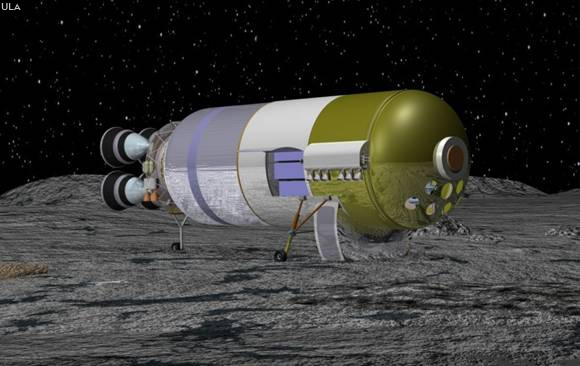
The Crewed United Launch Alliance DTAL (Dual Thrust Axis Lander), as proposed in 2010 [ULA].
Doug Conway
The Australian/AAP

When mankind colonizes the moon, it's likely to be led by a commercial enterprise rather than a government. So says NASA administrator Charles Bolden, who believes nations will no longer venture into space alone, but in collaboration with each other and with private industry.

Maj-Gen Bolden, who flew into orbit four times on the US space shuttle program which ended last year, says governments will lead the way in space exploration, but not in getting access to space.

"We have now got to the point where NASA should have nothing to do with it (access to space)," he said in an address today at Sydney University.

"We have run the tests, we have been flying for 50 years, we know basically how to get humans off the planet and into low-earth orbit. Our private industry partners have built every single space craft we have ever flown.

"NASA has never built a single human-rated space craft."

Read the article HERE.

Friday, January 13, 2012

GRAIL twins to be officially renamed January 17

Follow GRAIL A and B, along with the full range
of robotic probes in orbit and deep space through
the JPL
Eyes on the Solar System web
application
[NASA/JPL].
NASA will host a news conference at 1800 UT, Tuesday, January 17, to announce the names selected from a nationwide student contest for twin spacecraft that will study the moon in unprecedented detail. The event will be held at NASA Headquarters in Washington.

Nine hundred classrooms and more than 11,000 students from 45 states, as well as Puerto Rico and the District of Columbia, participated in the contest that began in October 2011.

The agency's twin Gravity Recovery And Interior Laboratory (GRAIL A/B) spacecraft successfully achieved lunar orbit on New Year's Eve and New Year's Day, respectively. The status of the spacecraft and upcoming plans for science operations also will be discussed.

NASA Television and the agency's website will broadcast the live event.The participants will be John Grunsfeld, associate administrator, Science Mission Directorate, NASA HQ; Leland Melvin, associate administrator for Education, NASA HQ; Maria Zuber, GRAIL principal investigator, MIT, Cambridge, MA & Sally Ride, president and CEO, Sally Ride Science, San Diego along with the teacher and students who submitted the selected contest-winning names for the GRAIL spacecraft.

The event will be carried live on Ustream, with a live chat box available, at: http://www.ustream.tv/nasajpl2 .

For more information about GRAIL, visit: http://grail.nasa.gov/ - http://www.nasa.gov/grail/ or the GRAIL science site at MIT http://moon.mit.edu/.

For NASA TV streaming video, downlink and schedule information, visit: http://www.nasa.gov/nasatv .

NASA's Jet Propulsion Laboratory in Pasadena, CA manages the GRAIL mission for NASA's Science Mission Directorate, Washington. The GRAIL mission is part of the Discovery Program managed at NASA's Marshall Space Flight Center in Huntsville, Ala. Lockheed Martin Space Systems in Denver built the spacecraft. JPL is a division of the California Institute of Technology in Pasadena.

Thursday, September 16, 2010

LRO transitions from exploration to science


Images of the Apollo 11 landing site from the Lunar Reconnaissance Orbiter clearly show the descent stage, the footprints of Armstrong & Aldrin and various equipment they deployed in July 1969 (including Buzz Aldrin's brief stroll to the edge of the crater east of the lunar module Eagle. Beyond the usefulness to science, LRO's first images of all six manned landing sites provide a poignant reminder of the manned lunar exploration legacy of the United States. Before the close-orbiting precision supporting the LRO Narrow Angle Camera operated by Arizona State University, this clear evidence of human activity on the Moon remained just beyond the camera resolutions of unmanned cameras in the decades since the Apollo orbital mapping cameras. At less than one half meter per pixel resolution, the LROC NAC clearly reveal not simply the LM descent stages of the six Apollo mission but lunar rover tracks and the foot paths of the twelve astronauts who explored the lunar surface between 1969 and 1972 [NASA/GSFC/ASU].

Michael Braukus
NASA HQ

Nancy Neal Jones
NASA GSFC

The United States' Lunar Reconnaissance Orbiter (LRO) will complete the exploration phase of its mission on September 16, after a series of successes that added to the transformation of our understanding of Earth's nearest neighbor.

LRO completed a year-long exploration mission in a nearly circular polar orbit approximately 54 kilometers above the Moon's surface, comprehensively mapping the lunar surface in unprecedented detail, searching for resources and safe landing sites and measuring surface temperatures and radiation levels.

LRO's attentions will now turn from exploration objectives to scientific research as program management moves from NASA's Exploration Systems Mission Directorate (ESMD) to the Science Mission Directorate at the agency's headquarters in Washington.

"LRO has been an outstanding success," said Doug Cooke, associate administrator of the ESMD. "The spacecraft has performed brilliantly, and LRO science and engineering teams achieved all mission's objectives. The incredible data LRO gathered will provide discoveries about the moon for years to come."

LRO teams operating its instruments will continue forwarding data gathered during the last year to the Planetary Data System (PDS), which archives and distributes scientific information from NASA planetary missions, astronomical observations and laboratory measurements.


Thirty-five meter boulder among a sea of detail previously unseen in the two Constellation Regions of Interest on the Moon's Aristarchus Plateau. From LROC principal investigator Mark Robinson's report to the Third Annual NASA Lunar Science Institute Conference (Presentation - 17.5 mg PDF) [NASA/GSFC/Arizona State University].

By the time LRO achieves full mission success in March 2011, with data processed and released to the scientific community, it will have sent more information to the Planetary Data System than all previous planetary missions combined.

During its new phase of discovery, LRO will continue to map the moon for two to four more years.

"The official start of LRO's science phase should write a new and intriguing chapter in lunar research," said Ed Weiler, associate administrator for the Science Mission Directorate.

LRO was launched from Kennedy Space Center carrying a suite of seven instruments, June 18, 2009. After an initial Commissioning phase, LRO formally began a highly detailed survey of the Moon the following September.

Among results collected thus far from the mission are original observations of the Apollo landing sites; indications that permanently shadowed and nearby regions harbor water and hydrogen and other volatiles; observations that large areas in the permanently shadowed regions are colder than anywhere in the Solar System; detailed information about lunar terrain, and the first evidence of a globally distributed population of thrust faults, evidence the Moon has recently contracted and may still be shrinking.

Among other achievements, LRO captured high resolution pictures of Lunokhod 1, the first robotic lunar rover the Soviet Union used to explore withing Mare Imbrium in 1970, subsequently lost for nearly 40 years.

The rover was located to within 30 meters using the LROC Narrow Angle Camera, and this highly accurate position data enabled researchers to captured laser light bounced and clearly reflected back again from the French-built retro-reflector situated on the dormant Soviet lunar rover for the first time. This addition to the long incomplete laser reflector array left on the Moon by the U.S. and U.S.S.R. during the Apollo era should finally enable a precision in Earth-Moon distance measurements to within 3 cm, a target some cosmologists hope will aid in answering questions about "locality" of physical laws in the universe.

LRO also supported the Lunar Crater Observation and Sensing Satellite (LCROSS) impact, as the companion mission was sued to determined if the Moon's permanently shadowed craters harbor water ice, to select the Cabeus crater impact site and to observe the wispy fast expanding plume and to study an evolving temperature at the site soon after the LCROSS impact last October 9.


The previously eternally elusive comprehensive details of the "permanently darkened regions" inside and around the Moon's south pole, situated on the rim of 10 km-wide Shackleton crater. Though aspects of Shackleton interior were first unveiled by Japan's SELENE-1 (Kaguya), the suite of instruments on LRO are singularly equipped to eventually detail the entire Moon's surface, whether by Sun or starlight [Maria Zuber/NLSI/LOLA].

NASA's Goddard Space Flight Center (GSFC) in Greenbelt, Maryland built and will continue to manage LRO for the Exploration Systems Mission Directorate.

Michael Braukus - michael.j.braukus@nasa.gov
Nancy Neal Jones - nancy.n.jones@nasa.gov

Friday, July 16, 2010

NASA seeks rover that goes all night

Researchers at the Field Robotics Center at Carnegie Mellon University in Pittsburgh, Pennsylvania have designed a new lunar rover capable of being both a full scientific research platform and a drilling platform. Designed to operate in wildly changing terrain, drive autonomously in full darkness, and consume very low amounts of power, Scarab was designed from the start for conditions on the moon [TheFutureofThings.com].

Rachel Courtland
New Scientist

A rover that can roam in darkness could win as much as $1.5 million in NASA prize money.

The night rover competition is one of three new "Centennial Challenges" from the agency. NASA hopes it will encourage the development of technology to explore the moon, where a solar-powered robotic explorer may face as much as two weeks of darkness.

"The motivation is energy storage technology for exploration," says Andrew Petro, Centennial Challenge programme manager at NASA in Washington DC. "We're hoping that a range of different technical solutions are brought forward, and we're not assuming it will only be batteries and photovoltaic arrays."

In addition to the night rover prize, NASA plans to offer another $1.5 million for robots that can automatically find and retrieve samples, and a $2 million purse for teams that can place a small satellite into orbit twice in one week.

Read the article, HERE.

Wednesday, November 4, 2009

Esther Dyson appointed NASA advisor

Lewis Page
The Register

Famed techbiz journo and investor Esther Dyson has been named as chairperson of a new "Technology and Innovation Committee" formed to help advise the senior management of NASA.

The space agency has announced a "restructuring" of its Advisory Council, featuring four new committees looking into "key areas of importance to the agency's future" - namely Commercial Space, Education and Public Outreach, Information Technology Infrastructure, and Technology 'n' Innovation.

Read the story, HERE.

Saturday, September 26, 2009

YouTube Video of the NASA Press Conference, "A New Moon"

In the hours immediately after the press conference at NASA HQ in Washington, Thursday, Sept. 24, announcing confirmation by three missions of a new and more widespread lunar hydrology, Lunar Pioneer posted the tale tell slides presented, with contextual commentary below. Nevertheless, it's likely readers may have missed the event itself, which was worth the viewing.

Google-Partner Blog Discovery Enterprise was kind enough to post the YouTube clips of the event, in three parts, which can now been watched, HERE.