New ESA video, an excellent, if not quite comprehensive, overview of a possible future history of lunar exploration, the Agency's present vision of an ambitious future.

Showing posts with label ESA. Show all posts
Showing posts with label ESA. Show all posts
Monday, January 19, 2015


Thursday, December 11, 2014
ESA to explore lunar probe partnership with Russia
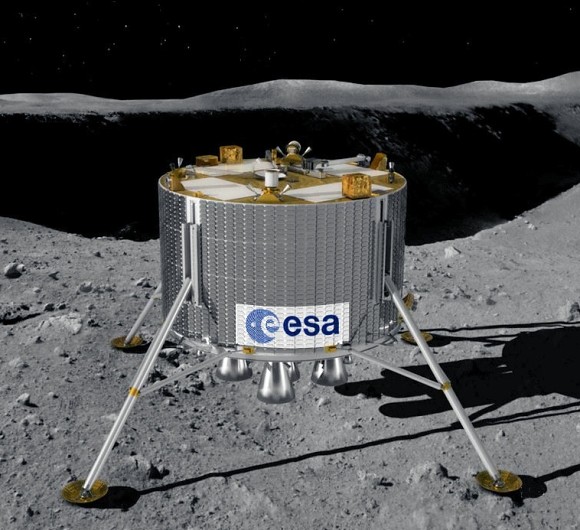 |
| Ten years after planning got underway to place an ESA lander on the rim of Shackleton crater, the design of the MoonNEXT probe was improved by development of the ESA's ATV resupply ship. Still the program was scrapped. But, even as tensions continue between European Union partners and Russia, ESA's managers have agreed to investigate joining forces with Roscosmos in Russia's lunar program, forestalled by loss of partnership with India, the problem-plagued Fregat vehicle and tight budgets [ESA/Astrium]. |
NATURE
Science ministers in Europe have resurrected plans to explore the Moon’s surface — and the only strategy currently on the table is to join two uncrewed Russian missions. The developments, which follow the shelving of a proposed European Space Agency (ESA) Moon lander two years ago, come amid growing political tensions between Russia and Western nations.
On 2 December, at a meeting in Luxembourg to determine ESA’s policy, the space agency got the go-ahead and funding to investigate “participation in robotic missions for the exploration of the Moon”. Science ministers from the ESA member states did not approve collaboration with Russia specifically, but at the meeting, ESA scientists presented a proposal to join Russia on its missions to put a lander and a rover on the Moon’s south pole.
Money for lunar exploration will come from a pot of €800 million (US$980 million) contributed by ESA’s member states and dedicated to international space exploration; the pot will primarily pay for activities on the International Space Station and the development of a propulsion module for NASA’s Orion spacecraft, which is eventually designed to carry astronauts to deep space, and was tested on 5 December in an uncrewed space flight.
 |
| "There be dragons here," no longer applies to the Moon's nearly always, or permanently, shadowed areas at polar latitudes. The Vision for Space Exploration, before it also was scrapped, developed inertia for a brief second golden age of lunar exploration, and it prioritized scientific goals there. Above, the state of our knowledge about the Moon's south pole in 1994 is compared with where this knowledge base stands today, illustrating one vast improvement in our understanding of the Moon gained at low cost and with great efficiency [NASA/GSFC/JPL/DOD/USGS/Caltech/Arizona State University]. |
Read the full article at NATURE, HERE.
Wednesday, July 31, 2013
ESA prepares for LADEE
 |
| Artist's view of NASA's Lunar Atmosphere and Dust Environment Explorer (LADEE) observatory as it approaches lunar orbit [NASA]. |
An advanced laser system offering vastly faster data speeds is now ready for linking with spacecraft beyond our planet following a series of crucial ground tests. Later this year, ESA’s observatory in Spain will use the laser to communicate with a NASA Moon orbiter.
The laboratory testing paves the way for a live space demonstration in October, once NASA’s Lunar Atmosphere and Dust Environment Explorer – LADEE – begins orbiting the Moon.
LADEE carries a terminal that can transmit and receive pulses of laser light. ESA’s Optical Ground Station on Tenerife will be upgraded with a complementary unit and, together with two US ground terminals, will relay data at unprecedented rates using infrared light beams at a wavelength similar to that used in fiber-optic cables on Earth.
“The testing went as planned, and while we identified a number of issues, we’ll be ready for LADEE’s mid-September launch,” says Zoran Sodnik, manager for ESA’s Lunar Optical Communication Link project.
“Our ground station will join two NASA stations communicating with the LADEE Moon mission, and we aim to demonstrate the readiness of optical communication for future missions to Mars or anywhere else in the Solar System.”
The laboratory testing paves the way for a live space demonstration in October, once NASA’s Lunar Atmosphere and Dust Environment Explorer – LADEE – begins orbiting the Moon.
LADEE carries a terminal that can transmit and receive pulses of laser light. ESA’s Optical Ground Station on Tenerife will be upgraded with a complementary unit and, together with two US ground terminals, will relay data at unprecedented rates using infrared light beams at a wavelength similar to that used in fiber-optic cables on Earth.
“The testing went as planned, and while we identified a number of issues, we’ll be ready for LADEE’s mid-September launch,” says Zoran Sodnik, manager for ESA’s Lunar Optical Communication Link project.
“Our ground station will join two NASA stations communicating with the LADEE Moon mission, and we aim to demonstrate the readiness of optical communication for future missions to Mars or anywhere else in the Solar System.”
Read the illustrated ESA article, HERE.
 |
| ESA's Optical Ground Station (OGS) is 2400 meter above sea level on the volcanic island of Tenerife, in the Canary Islands. Visible green laser beams are used for stabilizing the sending and receiving telescopes on Tenerife and neighboring La Palma. The OGS facility is utilized for extensive experiments with entangled photons, quantum communication and teleportation. OGS is also used for standard laser communication with satellites, tracking space debris and finding new asteroids. The image above includes Tenerife's Teide volcano with the Milky Way in the background [ESA/IQOQI Vienna, Austrian Academy of Sciences]. |
Related Posts:
LADEE arrives at Wallops Island (June 5, 2013)
LADEE ready to baseline dusty lunar exosphere (June 5, 2013)
First laser comm system ready for launch on LADEE (March 16, 2013)
LADEE project manager update (February 6, 2013)
The Mona Lisa test for LADEE communications (January 21, 2013)
Expectations for the LADEE LDEX (March 23, 2012)
LADEE architecture and mission design (July 6, 2010)
NASA applies low cost lessons to LADEE (January 18, 2010)
LADEE launch by Orbital from Wallops Island (April 14, 2009)
LADEE arrives at Wallops Island (June 5, 2013)
LADEE ready to baseline dusty lunar exosphere (June 5, 2013)
First laser comm system ready for launch on LADEE (March 16, 2013)
LADEE project manager update (February 6, 2013)
The Mona Lisa test for LADEE communications (January 21, 2013)
Expectations for the LADEE LDEX (March 23, 2012)
LADEE architecture and mission design (July 6, 2010)
NASA applies low cost lessons to LADEE (January 18, 2010)
LADEE launch by Orbital from Wallops Island (April 14, 2009)
Thursday, January 31, 2013
ESA: Building a Lunar Base with 3D Printing
 |
| For ESA's 3D-printed lunar base concept, Foster+Partners devised a weight-bearing ‘catenary’ dome design with a cellular structured wall to shield against micrometeoroids and space radiation, incorporating a pressurised inflatable to shelter astronauts [ESA/Foster+Partners]. |
Setting up a lunar base could be made much simpler by using a 3D printer to build it from local materials. Industrial partners including renowned architects Foster + Partners have joined with ESA to test the feasibility of 3D printing using lunar soil.
“Terrestrial 3D printing technology has produced entire structures,” said Laurent Pambaguian, heading the project for ESA.
“Our industrial team investigated if it could similarly be employed to build a lunar habitat.”
Foster + Partners devised a weight-bearing ‘catenary’ dome design with a cellular structured wall to shield against micrometeoroids and space radiation, incorporating a pressurised inflatable to shelter astronauts.
A hollow closed-cell structure – reminiscent of bird bones – provides a good combination of strength and weight.
The base’s design was guided in turn by the properties of 3D-printed lunar soil, with a 1.5 tonne building block produced as a demonstration.
“3D printing offers a potential means of facilitating lunar settlement with reduced logistics from Earth,” added Scott Hovland of ESA’s human spaceflight team.
“The new possibilities this work opens up can then be considered by international space agencies as part of the current development of a common exploration strategy.”
“As a practice, we are used to designing for extreme climates on Earth and exploiting the environmental benefits of using local, sustainable materials,” remarked Xavier De Kestelier of Foster + Partners Specialist Modelling Group. “Our lunar habitation follows a similar logic.”
The UK’s Monolite supplied the D-Shape printer, with a mobile printing array of nozzles on a 6 m frame to spray a binding solution onto a sand-like building material.
3D ‘printouts’ are built up layer by layer – the company more typically uses its printer to create sculptures and is working on artificial coral reefs to help preserve beaches from energetic sea waves.
“First, we needed to mix the simulated lunar material with magnesium oxide. This turns it into ‘paper’ we can print with,” explained Monolite founder Enrico Dini.
“Then for our structural ‘ink’ we apply a binding salt which converts material to a stone-like solid.
“Our current printer builds at a rate of around 2 m per hour, while our next-generation design should attain 3.5 m per hour, completing an entire building in a week.”
Italian space research firm Alta SpA worked with Pisa-based engineering university Scuola Superiore Sant’Anna on adapting 3D printing techniques to a Moon mission and ensuring process quality control. The effect of working in a vacuum was also assessed.
“The process is based on applying liquids but, of course, unprotected liquids boil away in vacuum,” said Giovanni Cesaretti of Alta.
“So we inserted the 3D printer nozzle beneath the regolith layer. We found small 2 mm-scale droplets stay trapped by capillary forces in the soil, meaning the printing process can indeed work in vacuum.”
Simulated lunar regolith is produced for scientific testing by specialist companies, typically sold by the kilogram. But the team required many tonnes for their work.
“As another useful outcome, we discovered a European source of simulated lunar regolith,” added Enrico.
“Basaltic rock from one volcano in central Italy turns out to bear a 99.8% resemblance to lunar soil.”
“This project took place through ESA’s General Studies Programme, used to look into new topics,” Laurent commented.
“We have confirmed the basic concept, and assembled a capable team for follow-on work.”
Factors such as controlling lunar dust – hazardous to breathe in – and thermal factors will require further study.
3D printing works best at room temperature but over much of the Moon temperatures vary enormously across days and nights lasting two weeks each. For potential settlement, the lunar poles offer the most moderate temperature range.
“Terrestrial 3D printing technology has produced entire structures,” said Laurent Pambaguian, heading the project for ESA.
“Our industrial team investigated if it could similarly be employed to build a lunar habitat.”
Foster + Partners devised a weight-bearing ‘catenary’ dome design with a cellular structured wall to shield against micrometeoroids and space radiation, incorporating a pressurised inflatable to shelter astronauts.
 |
| The UK’s Monolite supplied the D-Shape printer for ESA's 3D-printed lunar base study, with a mobile printing array of nozzles on a 6 meter frame to spray a binding solution onto a sand-like building material. 3D ‘printouts’ are built up layer by layer – the company more typically uses its printer to create sculptures and is working on artificial coral reefs to help preserve beaches from energetic sea waves. First the simulated lunar material with magnesium oxide – turning it into ‘paper’ to print with. Then for structural ‘ink’ a binding salt is applied which converts material to a stone-like solid [ESA/Monolite]. |
The base’s design was guided in turn by the properties of 3D-printed lunar soil, with a 1.5 tonne building block produced as a demonstration.
“3D printing offers a potential means of facilitating lunar settlement with reduced logistics from Earth,” added Scott Hovland of ESA’s human spaceflight team.
 |
| Sculpture produced by Monolite using 3D printing [ESA/Monolite]. |
“As a practice, we are used to designing for extreme climates on Earth and exploiting the environmental benefits of using local, sustainable materials,” remarked Xavier De Kestelier of Foster + Partners Specialist Modelling Group. “Our lunar habitation follows a similar logic.”
The UK’s Monolite supplied the D-Shape printer, with a mobile printing array of nozzles on a 6 m frame to spray a binding solution onto a sand-like building material.
 |
| This 1.5 metric tonne building block was produced as a demonstration of 3D printing techniques using lunar soil. The design is based on a hollow closed-cell structure – reminiscent of bird bones – to give a good combination of strength and weight [ESA]. |
“First, we needed to mix the simulated lunar material with magnesium oxide. This turns it into ‘paper’ we can print with,” explained Monolite founder Enrico Dini.
“Then for our structural ‘ink’ we apply a binding salt which converts material to a stone-like solid.
“Our current printer builds at a rate of around 2 m per hour, while our next-generation design should attain 3.5 m per hour, completing an entire building in a week.”
Italian space research firm Alta SpA worked with Pisa-based engineering university Scuola Superiore Sant’Anna on adapting 3D printing techniques to a Moon mission and ensuring process quality control. The effect of working in a vacuum was also assessed.
“The process is based on applying liquids but, of course, unprotected liquids boil away in vacuum,” said Giovanni Cesaretti of Alta.
“So we inserted the 3D printer nozzle beneath the regolith layer. We found small 2 mm-scale droplets stay trapped by capillary forces in the soil, meaning the printing process can indeed work in vacuum.”
Simulated lunar regolith is produced for scientific testing by specialist companies, typically sold by the kilogram. But the team required many tonnes for their work.
“As another useful outcome, we discovered a European source of simulated lunar regolith,” added Enrico.
“Basaltic rock from one volcano in central Italy turns out to bear a 99.8% resemblance to lunar soil.”
“This project took place through ESA’s General Studies Programme, used to look into new topics,” Laurent commented.
“We have confirmed the basic concept, and assembled a capable team for follow-on work.”
Factors such as controlling lunar dust – hazardous to breathe in – and thermal factors will require further study.
3D printing works best at room temperature but over much of the Moon temperatures vary enormously across days and nights lasting two weeks each. For potential settlement, the lunar poles offer the most moderate temperature range.
 |
| Setting up a future lunar base could be made much simpler by using a
3D printer to build it from local materials. Industrial partners
including renowned architects Foster+Partners have joined with ESA to
test the feasibility of 3D printing using lunar soil. The base is first unfolded from a tubular module that can be easily transported by space rocket. An inflatable dome then extends from one end of this cylinder to provide a support structure for construction. Layers of regolith are then built up over the dome by a robot-operated 3D printer (right) to create a protective shell [ESA/Foster+Partners]. |
Thursday, January 17, 2013
NASA, ESA agree on new Orion-MPV SM
This animation shows NASA's Orion spacecraft as it will appear on its Exploration Mission-1 in 2017, complete with a service module to be provided by the European Space Agency. After Orion blasts off atop a Space Launch System rocket, the ESA-provided service module will fuel and propel the capsule on its journey through space. Exploration Mission-1 in 2017 will be the first mission to incorporate both the Orion vehicle and NASA's new Space Launch System. It will follow the upcoming Exploration Flight Test-1 in 2014, in which an uncrewed Orion will launch atop a Delta IV Heavy rocket and fly 3,600 miles above Earth's surface, farther than a human spacecraft has gone in 40 years.
NASA-ESA agreement on Orion Service Module
Marcia Smith
SpacePolicyOnline.com
NASA and the European Space Agency (ESA) provided more details today of their agreement for ESA to provide the service module for NASA's Orion spacecraft.
ESA Director General Jean-Jacques Dordain announced the plan following ESA's ministerial meeting in November. Dordain extolled its significance both in terms of demonstrating ESA's commitment to partner with NASA in human exploration of space beyond low Earth orbit and in NASA allowing other countries to be in the "critical path" of the U.S. human spaceflight program.
At a press conference today, NASA and ESA officials continued to tout the importance of the agreement, although as details emerge it seems less dramatic than at first glance.
NASA-ESA agreement on Orion Service Module
for one unit, plus spares
Marcia SmithSpacePolicyOnline.com
NASA and the European Space Agency (ESA) provided more details today of their agreement for ESA to provide the service module for NASA's Orion spacecraft.
ESA Director General Jean-Jacques Dordain announced the plan following ESA's ministerial meeting in November. Dordain extolled its significance both in terms of demonstrating ESA's commitment to partner with NASA in human exploration of space beyond low Earth orbit and in NASA allowing other countries to be in the "critical path" of the U.S. human spaceflight program.
At a press conference today, NASA and ESA officials continued to tout the importance of the agreement, although as details emerge it seems less dramatic than at first glance.
Read the full article, HERE.
Wednesday, November 21, 2012
ESA Lunar Lander mission axed
 |
| The EADS Astrium - European Space Agency (ESA) Lunar Lander, clinging to a 2018 landing, possibly on the rim of lunar South Pole crater Shackleton, is likely scrubbed [EAS/Astrium]. |
Germany dropped further efforts to secure joint European funding for Lunar Lander at an ESA budget meeting in Naples in favor of upgrades to the Ariane 5.
Meanwhile, following NASA's exit from the ExoMars orbiter-rover mission, in development since 2005, Russia's Federal Space Agency Roscosmos has become ESA's new launch partner, set to launch the orbiter half of that mission in 2016 and its tandem six-wheeled rover two years later.
Related Posts:
ESA input sought on multi-purpose lunar lander (March 2, 2009)
Astrium study of ESA NEXT lunar lander underway (June 10, 2009)
Remembering SMART-1 (September 17, 2009)
ESA: Fly us to the Moon's South Pole (March 31, 2010)
NEXT step for ESA's first lunar lander (September 16, 2010)
Astrium tests ESA Lunar Lander thrusters (March 5, 2012)
ESA's MoonNEXT boosted by ATV development (April 30, 2012)
ESA Lunar Lander still on target for 2018 (July 27, 2012)
Thursday, September 20, 2012
Peek-a-blue Moon
 |
| Europe’s latest weather satellite got a glimpse of the Moon before our celestial neighbor disappeared from view behind Earth at 1130 UT on August 31, 2012. The MSG-3 spacecraft, reports ESA, "has been working well and is on its way to entering service" [ESA]. |
The image shows the second full Moon of the month – a ‘blue’ Moon – before disappearing from sight behind the southern hemisphere. Brazil’s eastern coast along the South Atlantic Ocean is also visible, with clouds forming over the water. The image was captured by the Spinning Enhanced Visible and Infrared Imager (SEVIRI).
The imager scans Earth’s surface and atmosphere every 15 minutes in 12 different wavelengths to track cloud development and measure temperatures.
Launched on 5 July, the third Meteosat Second Generation satellite is in a six-month commissioning phase by Eumetsat, the European Organisation for Exploitation of Meteorological Satellites. This process includes checking that the imaging service works fully and delivers high-quality products for weather forecasting, sometimes, as has become a standard for new remote sensing missions, using the Moon as a well-understood baseline.
ESA developed the satellite in close cooperation with Eumetsat, and was responsible for initial operations after launch. It was then handed over to Eumetsat on 16 July.
Launched on 5 July, the third Meteosat Second Generation satellite is in a six-month commissioning phase by Eumetsat, the European Organisation for Exploitation of Meteorological Satellites. This process includes checking that the imaging service works fully and delivers high-quality products for weather forecasting, sometimes, as has become a standard for new remote sensing missions, using the Moon as a well-understood baseline.
ESA developed the satellite in close cooperation with Eumetsat, and was responsible for initial operations after launch. It was then handed over to Eumetsat on 16 July.
The first satellite in the series, MSG-1 – also known as Meteosat-8 – was launched in 2002. MSG-2 followed three years later. Both have continued the legacy of the operational meteorological satellites that started with Meteosat-1 in 1977. The MSGs offer more spectral channels and are sensing Earth more frequently and at a higher resolution than their predecessors.
LRX: Radio astronomy from ESA Lunar Lander
 |
| LRX, a single tripole radio antenna to engage in baseline radio astronomy from the ESA Lunar Lander after 2017. Figure 6 from Radio astronomy with the Lunar Lander: opening up the last unexplored frequency regime, Wolf, et al (2012). |
Wolt, Aminaei, Zarka, Schrader, Boonstra and Falcke
arXiv: 1209.3033 Sept. 17, 2012
The active broadband (1 kHz - 100 MHz) tripole antenna (LRX) on the European Lunar Lander, located at the Lunar South Pole, will allow for sensitive measurements of the lunar exosphere and ionosphere, and their interaction with the Earths magnetosphere, solar wind and coronal mass-ejections (CMEs). In addition, the LRX will allow studies of radio communication on the moon, essential for future exploration.
In addition, the lunar South pole provides an excellent opportunity for radio astronomy. Placing a single radio antenna in an behind a mountain near the Moon's south or north pole would provide "perfect shielding" from man-made radio interference (RFI), and, with an absence of ionospheric distortion with high-temperature and antenna gain stability, allow the detection of 21 cm wavelength emission from the primordial hydrogen that formed after the Big Bang into the era when the first stars formed.
 |
| MACS1149-JD, a galaxy of the Cosmic Dark Ages, formed only 500 million years after the Big Bang [HST]. |
Detection of the 21 cm line from the Moon would allow, for the first time, clues on the distribution and evolution of mass in the early universe, between the Epoch of Recombination and Epoch of Reionization. Next to providing a cosmological breakthrough, a single lunar radio antenna would allow for studies of the effect of solar flares CMEs on the solar wind at distances close to earth (space weather) and open up the study of low frequency radio events (flares and pulses) from Jupiter and Saturn and the other planets, known to emit bright radio emission below 30 MHz (The Shortwave and Medium Wave bands, highly-attenuated by the ionosphere on Earth).
Finally, a single radio antenna on the ESA Lunar Lander would pave the way for a large lunar radio interferometry; demonstrating the long-anticipated possibilities of radio astronomy from the lunar surface while opening up "the last unexplored radio regime." Baseline studies of data collected by a simple experiment affected by its important location will also allow a determination of the limitations of lunar radio science by measuring the local radio background.
Read the full study, HERE.
Related Posts:
Characterization of potential landing sites for the ESA Lunar Lander (August 31, 2012)
Characterization of potential landing sites for the ESA Lunar Lander (August 31, 2012)
ESA Lunar Lander still on target for 2018 (July 27, 2012)
Farside offers radio-quiet to probe cosmic dark age (July 2, 2012)
The Moon as a platform for Astrophysics (April 24, 2012)
Solar radio burst imaging from the lunar surface (February 27, 2012)
Naval Research Laboratory to design Farside DALI (March 11, 2008)
MIT to lead development of Lunar Array for Radio Cosmology (February 18, 2008)
Tuesday, September 11, 2012
Canadian Lunar Exploration Light Rover prototype
 |
| Stylized View of the Lunar Exploration Light Rover (LELR) Design, Figure 3 from "A Canadian Lunar Exploration Light Rover Prototype," McCoubry & Langley, et al, (Sept. 2012). |
McCoubrey & Langley, et al
MacDonald, Dettwiler, and Associates, CANADA
Centre de technologies avancées BRP – Universite de Sherbrooke
University of Toronto Institute for Aerospace Studies
CANADA
In 2010, the Canadian Space Agency (CSA) commenced the Lunar Exploration Light Rover (LELR) project as part of its Exploration Surface Mobility program. The LELR project consists of building rovers, integrating them with tools and instruments, and executing representative mission deployments. The LELR is designed for mobility tasks related to science prospecting, in-situ resource utilization (ISRU), and future upgrades for crew transportation. The vehicle is based on a rugged, custom mobility platform built by Bombardier Recreational Products Centre for Advanced Technology.
Onboard sensors provide feedback and situational awareness for tele-operation, autonomy, and onboard control (future upgrade). Modular onboard software is used to ensure future upgradeability, and offers such features as localization without external aids and visual teach and repeat software developed by the University of Toronto. Future work may involve adding onboard human control, further integration with payloads and deployments in coordination with the international space exploration community.
In the context of returning systems to the surface of the Moon, there have been several recent developments in the area of Lunar mobility. The Chariot rover is a large-class system designed to carry astronauts and perform regolith moving tasks such as bulldozing. The Eurobot Ground Prototype (EGP) rover is a medium-class system designed to accomplish both science exploration and transport of a single standing astronaut. The Scarab rover is a small-class rover designed to carry resource prospecting instruments and sensors. The goal of the Lunar Exploration Rover (LELR) program is to develop a mobility solution that can accomplish all of these tasks and thereby provide a flexible and versatile platform for development and testing including integration with exploration tools and instruments. This will then allow development and simulation of analogue mission scenarios. The LELR vehicle is a key part of the Canadian Space Agency (CSA) Exploration Surface Mobility program.
The remainder of this paper will discuss the mission scenarios used to define the LELR requirements, the LELR design, and the current program status and upcoming test plan.
MacDonald, Dettwiler, and Associates, CANADA
Centre de technologies avancées BRP – Universite de Sherbrooke
University of Toronto Institute for Aerospace Studies
CANADA
In 2010, the Canadian Space Agency (CSA) commenced the Lunar Exploration Light Rover (LELR) project as part of its Exploration Surface Mobility program. The LELR project consists of building rovers, integrating them with tools and instruments, and executing representative mission deployments. The LELR is designed for mobility tasks related to science prospecting, in-situ resource utilization (ISRU), and future upgrades for crew transportation. The vehicle is based on a rugged, custom mobility platform built by Bombardier Recreational Products Centre for Advanced Technology.
Onboard sensors provide feedback and situational awareness for tele-operation, autonomy, and onboard control (future upgrade). Modular onboard software is used to ensure future upgradeability, and offers such features as localization without external aids and visual teach and repeat software developed by the University of Toronto. Future work may involve adding onboard human control, further integration with payloads and deployments in coordination with the international space exploration community.
 |
| Figure 2: "Artist’s Concept of the Lunar Exploration Light Rover’s Various Mission Configurations." |
The remainder of this paper will discuss the mission scenarios used to define the LELR requirements, the LELR design, and the current program status and upcoming test plan.
View the full paper, HERE.
Some Related Posts
Update: ISRU mission simulations on Hawai'i 2012 (July 30, 2012)
'A Resolve to mine the Moon' (July 14, 2012)
O Canada! CSA lunar rovers under construction (February 21, 2012)
Friday, August 31, 2012
Characterisation of Potential Landing Sites for the European Space Agency's Lunar Lander Project
 |
| Figure 5.Map of the South Polar Region based on a LOLA DEM, with the locations of the Regions of Interest analyzed in this study. Isolines (circles) are every degree of latitude. |
This article describes the characterization activities of the landing sites currently envisaged for the Lunar Lander mission of the European Space Agency.
These sites have been identified in the South Pole Region (-85{\deg} to -90{\deg} latitude) based on favorable illumination conditions, which make it possible to have a long-duration mission with conventional power and thermal control subsystems, capable of enduring relatively short periods of darkness (in the order of tens of hours), instead of utilizing Radioisotope Heating Units. The illumination conditions are simulated at the potential landing sites based on topographic data from the Lunar Orbiter Laser Altimeter (LOLA), using three independent tools.
 |
| ESA Lunar Lander project still on-track for 2018 (July 2012) |
Risk assessment of the identified sites is also being performed through independent studies. Long baseline slopes are assessed based on LOLA, while craters and boulders are detected both visually and using computer tools in Lunar Reconnaissance Orbiter Camera (LROC) images, down to a size of less than 2 m, and size-frequency distributions are generated. Shadow hazards are also assessed via LROC images.
The preliminary results show that areas with quasi-continuous illumination of several months exist, but their size is small (few hundred metres); the duration of the illumination period drops quickly to less than one month outside the areas, and some areas present gaps with short illumination periods. Concerning hazard distributions, 50 m slopes are found to be shallow (few degrees) based on LOLA, whereas at the scale of the lander footprint (~5 m) they are mostly dominated by craters, expected to be mature (from geological context) and shallow (~11{\deg}).
The preliminary conclusion is that the environment at the prospective landing sites is within the capabilities of the Lander design.
 |
| Figure 10. LQCIP map for the six best RoI’s, with RoI name and geodetic coordinates (in the Mean Earth/Polar Axis reference system). Colour-code is in days, height above the surface is 2 m, filter for short darkness periods is 60 hours, filter for short illumination periods is 10 hours, and year is 2019. The spacing is 40 m. X, Y coordinates are in polar stereographic projection. |
-Characterization of Potential Landing Sites for the European Space Agency's Lunar Lander Project
D. De Rosa, B. Bussey, J.T. Cahill, T. Lutz,
I. Crawford, T. Hackwill, S. van Gasselt, G. Neukum, L.Witte, A. McGovern, J.D. Carpenter
arXiv.org (Submitted on 28 Aug 2012) arXiv:1208.5587v1 [astro-ph.EP]
D. De Rosa, B. Bussey, J.T. Cahill, T. Lutz,
I. Crawford, T. Hackwill, S. van Gasselt, G. Neukum, L.Witte, A. McGovern, J.D. Carpenter
arXiv.org (Submitted on 28 Aug 2012) arXiv:1208.5587v1 [astro-ph.EP]
Friday, July 27, 2012
Scientific Preparations for Lunar Exploration with the European Lunar Lander
 |
| Working schematic of the ESA Lunar Lander [Astrium]. |
James Carpenter, et al
ESA
Abstract - Recent Lunar missions and new scientific results in multiple disciplines have shown that working and operating in the complex lunar environment and exploiting the Moon as a platform for scientific research and further exploration poses major challenges. Underlying these challenges are fundamental scientific unknowns regarding the Moon’s surface, its environment, the effects of this environment and the availability of potential resources. The European Lunar Lander is a mission proposed by the European Space Agency to prepare for future exploration. The mission provides an opportunity to address some of these key unknowns and provide information of importance for future exploration activities.
Areas of particular interest for investigation on the Lunar Lander include the integrated plasma, dust, charge and radiation environment and its effects, the properties of lunar dust and its physical effects on systems and physiological effects on humans, the availability, distribution and potential application of in situ resources for future exploration. A model payload has then been derived, taking these objectives to account and considering potential payloads proposed through a request for information, and the mission’s boundary conditions. While exploration preparation has driven the definition there is a significant synergy with investigations associated with fundamental scientific questions.
This paper discusses the scientific objectives for the ESA Lunar Lander Mission, which emphasize human exploration preparatory science and introduces the model scientific payload considered as part of the on-going mission studies, in advance of a formal instrument selection.
ESA
Abstract - Recent Lunar missions and new scientific results in multiple disciplines have shown that working and operating in the complex lunar environment and exploiting the Moon as a platform for scientific research and further exploration poses major challenges. Underlying these challenges are fundamental scientific unknowns regarding the Moon’s surface, its environment, the effects of this environment and the availability of potential resources. The European Lunar Lander is a mission proposed by the European Space Agency to prepare for future exploration. The mission provides an opportunity to address some of these key unknowns and provide information of importance for future exploration activities.
 |
| Approach and Landing Profile The baseline design of the ESA Lunar Lander mission is unchanged since development began in 2010. In addition to real world testing and evaluation of robotic navigation, terminal descent and hazard avoidance, the array of on-board experiments and instruments eventually carried to the lunar surface in 2018 have continually been updated to match the growing knowledge base accumulated by an international fleet of spacecraft. The Carpenter study details the surface mission as projected in July 2012 [Astrium]. |
This paper discusses the scientific objectives for the ESA Lunar Lander Mission, which emphasize human exploration preparatory science and introduces the model scientific payload considered as part of the on-going mission studies, in advance of a formal instrument selection.
Download arXiv study 1207.4965.pdf
ESA Lunar Lander still on target for 2018
|
| Lunar Lander is a robotic explorer that will demonstrate key European technologies and conduct science experiments. The mission is a forerunner to future human and robotic exploration of the Moon and Mars. Like the SMART-1 program, the ESA Lunar Lander is intended to establish European expertise and encourage "strong international partnerships in exploration" [ESA]. |
HT: Jason Major, Universe Today
European Space Agency - After more than 30 years, the Moon is once again in the spotlight of space agencies worldwide, as a destination for both robotic missions and human explorers. Europe’s ambitions for lunar exploration begin with a lander on the Moon in 2018.
Plans call for launching the ESA Lunar Lander on board a newly designed Soyuz 2.1B, attached to a high-performance fregat upper stage, from the Russian launch facility adjacent to Europe's busy Guiana Space Centre at Kourou, French Guiana, near the equator on the Atlantic coast of South America. Utilizing a low energy transfer orbit, boosting the height of perigee in successive orbits, the Lunar Lander will rendezvous with the Moon and brake into a polar orbit.
Lunar Lander is a robotic explorer that will demonstrate key European technologies and conduct science experiments. The mission is a forerunner to future human and robotic exploration of the Moon and Mars. It will establish European expertise to allow strong international partnerships in exploration.
Lunar Lander’s primary goal is to demonstrate the advanced technologies needed to land precisely and safely. The spacecraft will find its landing site without human intervention, recognising and avoiding hazards such as craters and boulders autonomously.
On the Moon, it will prove European technologies for surviving and working while exploring the environment around the landing site. The choice of the high rim of Shackleton crater, location of the Moon's south pole, should allow long periods of near-constant availability of solar energy.
Before operating more ambitious equipment and conducting human activities on the Moon, many questions need to be answered. How hazardous is lunar dust to equipment and astronauts? Does the Moon offer resources that could be used by future missions?
Plans call for launching the ESA Lunar Lander on board a newly designed Soyuz 2.1B, attached to a high-performance fregat upper stage, from the Russian launch facility adjacent to Europe's busy Guiana Space Centre at Kourou, French Guiana, near the equator on the Atlantic coast of South America. Utilizing a low energy transfer orbit, boosting the height of perigee in successive orbits, the Lunar Lander will rendezvous with the Moon and brake into a polar orbit.
Lunar Lander is a robotic explorer that will demonstrate key European technologies and conduct science experiments. The mission is a forerunner to future human and robotic exploration of the Moon and Mars. It will establish European expertise to allow strong international partnerships in exploration.
Lunar Lander’s primary goal is to demonstrate the advanced technologies needed to land precisely and safely. The spacecraft will find its landing site without human intervention, recognising and avoiding hazards such as craters and boulders autonomously.
On the Moon, it will prove European technologies for surviving and working while exploring the environment around the landing site. The choice of the high rim of Shackleton crater, location of the Moon's south pole, should allow long periods of near-constant availability of solar energy.
Before operating more ambitious equipment and conducting human activities on the Moon, many questions need to be answered. How hazardous is lunar dust to equipment and astronauts? Does the Moon offer resources that could be used by future missions?
Lunar Lander will touch down near to the Moon’s south pole, an interesting location for future exploration missions, where no craft has landed before. The technologies developed to reach this site, together with a deeper understanding of this challenging environment, will equip Europe’s scientists and engineers for future cooperation on even more ambitious exploration missions.
Related Posts:
ESA: more about its Lunar Rover (March 16, 2008)
ESA input sought on multi-purpose lunar lander (March 2, 2009)
ESA demonstrates lunar life support system (June 6, 2009)
Astrium study of ESA NEXT lunar lander underway (June 10, 2009)
Russia comes to South America (June 18, 2009)
Remembering SMART-1 (September 17, 2009)
ESA: Fly us to the Moon's South Pole (March 31, 2010)
NEXT step for ESA's first lunar lander (September 16, 2010)
Scientific Preparations for Lunar Exploration Workshop (November 14, 2011)
Astrium tests ESA Lunar Lander thrusters (March 5, 2012)
ESA's MoonNEXT boosted by ATV development (April 30, 2012)
Monday, July 2, 2012
Toxicity of lunar dust
 | |
| Gene Cernan, soon after the completion of the third and last EVA of Apollo 17, also the final EVA of the Apollo program. His moon suit carries a heavy accumulation of lunar dust, as does his skin. Three years earlier mission planners had been worried about astronauts, along with their spacecraft, sinking into the accumulation of dust on the surface. After Apollo, and decades later, mitigating the clinging affect of dust on equipment and human life remains a problem evading easy solution [Schmitt/AS17-145-22224]. |

Dag Linnarsson, et al.
Karolinska Institutet, Stockholm/ESA
Karolinska Institutet, Stockholm/ESA
Abstract - The formation, composition and physical properties of lunar dust are incompletely characterized with regard to human health. While the physical and chemical determinants of dust toxicity for materials such as asbestos, quartz, volcanic ashes and urban particulate matter have been the focus of substantial research efforts, lunar dust properties, and therefore lunar dust toxicity may differ substantially. In this contribution, past and ongoing work on dust toxicity is reviewed, and major knowledge gaps that prevent an accurate assessment of lunar dust toxicity are identified. Finally, a range of studies using ground-based, low-gravity, and in situ measurements is recommended to address the identified knowledge gaps. Because none of the curated lunar samples exist in a pristine state that preserves the surface reactive chemical aspects thought to be present on the lunar surface, studies using this material carry with them considerable uncertainty in terms of fidelity. As a consequence, in situ data on lunar dust properties will be required to provide ground truth for ground-based studies quantifying the toxicity of dust exposure and the associated health risks during future manned lunar missions.
Introduction - The current renewed interest in human exploration of the Moon is driven not only by an urge to expand the human presence to other celestial bodies, but also by genuine scientific interest. Many aspects of the origin and evolution of the Earth and the other bodies in our solar system remain unclear. The Moon is thought to hold important information about the time when our own planet was formed, and humans remain capable of much more intelligent and adaptive exploration of the Moon than even the most sophisticated robotic and remote-controlled devices (e.g., Crawford et al., 2012). Identification and retrieval of representative or exotic mineral specimens, and drilling deep into the lunar subsurface are examples of tasks for which astronauts are superior to machines. The most compelling argument for human exploration is the unique ability of humans to identify and quickly assess the unexpected, enabling real time adjustment of a pre-planned exploration strategy.
Although humans have landed on and returned from the Moon during the Apollo era, it is still a formidable challenge to secure the health and safety of astronauts during Moon missions. Challenges for future missions include long-term low- or microgravity, radiation exposure, and the maintenance of a number of life support systems during a much longer period than was the case during the Apollo flights (e.g., Cain, 2010, 2011).
One of the biggest challenges may be related to the presence of dust on the lunar surface. The ubiquity of fine dust particles on the surface of the Moon plays an important and often dual role in many aspects of human lunar exploration. On the one hand, identifying the mineralogical and chemical composition of the dust fraction of lunar soils can provide in situ geological context for both robotic and human landing sites. In addition, lunar dust may be an ideal starting material for a range of future in situ resource utilization activities on the Moon (e.g., Taylor et al., 2005), and dust is an important component of the lunar exosphere (Horanyi and Stern, 2011).
On the other hand, dust can adversely affect the performance of scientific and life-support instruments on the lunar surface. Fine dust was spread over all parts of the Apollo astronauts space suits, ending up in the habitat (Figure 1a), resulting in astronaut exposure times of several days. The Apollo astronauts reported undesirable effects affecting the skin, eyes and airways that could be related to exposure to the dust that had adhered to their space suits during their extravehicular activities, and was subsequently brought into their spacecraft (Figure 1b).
Dust exposure and inhalation could have a range of toxic effects on human lunar explorers, especially if longer exposure times become the norm during future manned exploration missions. There is therefore a need to assess the risks to health. The physical and chemical determinants of dust toxicity for terrestrial materials such as asbestos, quartz, volcanic ashes and urban particulate matter have been studied in great detail, and lunar dust simulant (synthesized from terrestrial volcanic material) has been found to exhibit toxic effects (Lam et al., 2002; Latch et al., 2008; Loftus et al., 2010). Unique features of actual lunar dust (described in more detail in section 3), resulting from its formation by (micro)meteoroid impacts and its extended radiation exposure in the absence of oxygen and humidity, could lead to toxic effects significantly exceeding those of simulants made from Earth materials. At present, the formation, composition and physical properties of lunar dust remain incompletely characterized with regard to human health.
In a micro-/hypo-gravity environment the risk of inhalation of dust is increased due to reduced gravity-induced sedimentation. Inhaled particles tend to deposit more peripherally and thus may be retained in the lungs for longer periods in reduced gravity as will be the case in a future lunar habitat (Darquenne and Prisk, 2008; Peterson et al., 2008). Inhalation of particles of varying size may affect the respiratory and cardiovascular systems in deleterious ways leading to airway inflammation and increased respiratory and cardiovascular morbidity (Frampton et al., 2006; Sundblad et al., 2002).
In this contribution, we review our knowledge of the physical chemistry determinants of dust toxicity, of the composition and size of lunar dust, and all aspects related to its toxicity. We identify a number of knowledge gaps that need to be filled to constrain the required extent of mitigation activities protecting astronauts from the potentially toxic effects of lunar dust during and after a stay on the Moon. We also recommend a range of future studies using ground-based, low-gravity, and in situ measurements on the lunar surface to better constrain lunar dust toxicity.
Although humans have landed on and returned from the Moon during the Apollo era, it is still a formidable challenge to secure the health and safety of astronauts during Moon missions. Challenges for future missions include long-term low- or microgravity, radiation exposure, and the maintenance of a number of life support systems during a much longer period than was the case during the Apollo flights (e.g., Cain, 2010, 2011).
One of the biggest challenges may be related to the presence of dust on the lunar surface. The ubiquity of fine dust particles on the surface of the Moon plays an important and often dual role in many aspects of human lunar exploration. On the one hand, identifying the mineralogical and chemical composition of the dust fraction of lunar soils can provide in situ geological context for both robotic and human landing sites. In addition, lunar dust may be an ideal starting material for a range of future in situ resource utilization activities on the Moon (e.g., Taylor et al., 2005), and dust is an important component of the lunar exosphere (Horanyi and Stern, 2011).
On the other hand, dust can adversely affect the performance of scientific and life-support instruments on the lunar surface. Fine dust was spread over all parts of the Apollo astronauts space suits, ending up in the habitat (Figure 1a), resulting in astronaut exposure times of several days. The Apollo astronauts reported undesirable effects affecting the skin, eyes and airways that could be related to exposure to the dust that had adhered to their space suits during their extravehicular activities, and was subsequently brought into their spacecraft (Figure 1b).
 |
| Figure 2. Steps of cell and tissue interaction with nano and micron-sized particles in the lung. When attained the alveolar space the particle may react with endogenous molecules (step 1). The particle may then be cleared out of the lung either through the mucociliary escalator (step 2) or through alveolar macrophage (AM) clearance (step 3). If reactive, AM activation will follow with release of several factors and recruitment of other immune cells (AM and polymorphonucleate cells, PMN), eventual cell death and establishment of permanent cycles of ingestion (step 4). This process produces chronic inflammation (step 5). Combined with the direct action of the particle (step 6) this will cause damage to the target cells (epithelial, endothelial). If the particle is nano-sized, it may easily escape from the lung to the pleura and to systemic circulation (step 7). |
 |
| Figure 3. The role of particle and cell derived free radicals and reactive oxygen species (ROS) in cell damage, oxidative stress and diseases. |
In a micro-/hypo-gravity environment the risk of inhalation of dust is increased due to reduced gravity-induced sedimentation. Inhaled particles tend to deposit more peripherally and thus may be retained in the lungs for longer periods in reduced gravity as will be the case in a future lunar habitat (Darquenne and Prisk, 2008; Peterson et al., 2008). Inhalation of particles of varying size may affect the respiratory and cardiovascular systems in deleterious ways leading to airway inflammation and increased respiratory and cardiovascular morbidity (Frampton et al., 2006; Sundblad et al., 2002).
In this contribution, we review our knowledge of the physical chemistry determinants of dust toxicity, of the composition and size of lunar dust, and all aspects related to its toxicity. We identify a number of knowledge gaps that need to be filled to constrain the required extent of mitigation activities protecting astronauts from the potentially toxic effects of lunar dust during and after a stay on the Moon. We also recommend a range of future studies using ground-based, low-gravity, and in situ measurements on the lunar surface to better constrain lunar dust toxicity.
Monday, April 30, 2012
ESA's MoonNEXT boosted by ATV development
 |
| MoonNEXT - EADS-Astrium Bremen's proposed lunar lander for the European Space Agency, under development for a landing near the Moon's south pole, possibly in 2018.. |
Dan Thisdell
Flightglobal
European Space Agency plans for a robotic Moon landing have been boosted by successful testing of a rocket motor which ESA engineers plan to use to control the lander's descent on the 2018 expedition.
The thruster is the same unit as used on ESA's Automated Transfer Vehicle (ATV), selected to save development cost and for its known reliability - as demonstrated on International Space Station resupply missions. But specific testing at EADS Astrium's facility in Lampoldshausen, Germany to simulate a lunar descent and touchdown in a vacuum has convinced ESA the ATV thruster will do the job.
According to mission study manager Bérengère Houdou, the landing will take about 90 minutes from a 100km lunar orbit, but the final 10 minutes will be extremely challenging, with dynamics similar to those experienced at launch. In the lunar vacuum, all the braking is carried out by rocket power, which means a huge fuel burn.
Thus, says Houdou, thrust must be adjustable to account for a tremendous change in the lander's mass as it approaches the Moon, as a rocket powerful enough to slow the craft's early descent would be powerful enough to cause it to "bounce back" off the surface.
However, while much of the purpose of the mission is to prove European technologies suitable for use on later, manned international missions - for cargo supply, for example - Europe does not have a single engine capable of such modulation.
So, says Houdou, the lander will carry a cluster of motors which can be switched on or off individually to vary the total thrust. One of the key milestones achieved in the latest tests was to show that the ATV engine is accurately controllable in high-frequency pulses.
The next stage of testing, she says, will attempt to verify the interaction of several engines and their performance when connected by shared fuel lines. A design review should, in the coming months, outline the mission requirements and cost. Pending budget approval at this November's meeting of ESA member-state government ministers, Houdou hopes to have the mission ready for final preparation in 2015.
Unlike for a manned mission, ESA's flightplan is leisurely. A Soyuz-Fregat launch from Kourou, French Guiana will carry the lander to Earth orbit about halfway to the Moon, followed by a one- or two-month cruise to lunar orbit.
The landing site will be near the south pole, where "several months" of constant sunshine would allow a lengthy mission by sparing the spacecraft the devastating effects of temperatures that can plunge as low as -170˚C.
Flightglobal
European Space Agency plans for a robotic Moon landing have been boosted by successful testing of a rocket motor which ESA engineers plan to use to control the lander's descent on the 2018 expedition.
The thruster is the same unit as used on ESA's Automated Transfer Vehicle (ATV), selected to save development cost and for its known reliability - as demonstrated on International Space Station resupply missions. But specific testing at EADS Astrium's facility in Lampoldshausen, Germany to simulate a lunar descent and touchdown in a vacuum has convinced ESA the ATV thruster will do the job.
According to mission study manager Bérengère Houdou, the landing will take about 90 minutes from a 100km lunar orbit, but the final 10 minutes will be extremely challenging, with dynamics similar to those experienced at launch. In the lunar vacuum, all the braking is carried out by rocket power, which means a huge fuel burn.
Thus, says Houdou, thrust must be adjustable to account for a tremendous change in the lander's mass as it approaches the Moon, as a rocket powerful enough to slow the craft's early descent would be powerful enough to cause it to "bounce back" off the surface.
However, while much of the purpose of the mission is to prove European technologies suitable for use on later, manned international missions - for cargo supply, for example - Europe does not have a single engine capable of such modulation.
So, says Houdou, the lander will carry a cluster of motors which can be switched on or off individually to vary the total thrust. One of the key milestones achieved in the latest tests was to show that the ATV engine is accurately controllable in high-frequency pulses.
The next stage of testing, she says, will attempt to verify the interaction of several engines and their performance when connected by shared fuel lines. A design review should, in the coming months, outline the mission requirements and cost. Pending budget approval at this November's meeting of ESA member-state government ministers, Houdou hopes to have the mission ready for final preparation in 2015.
Unlike for a manned mission, ESA's flightplan is leisurely. A Soyuz-Fregat launch from Kourou, French Guiana will carry the lander to Earth orbit about halfway to the Moon, followed by a one- or two-month cruise to lunar orbit.
The landing site will be near the south pole, where "several months" of constant sunshine would allow a lengthy mission by sparing the spacecraft the devastating effects of temperatures that can plunge as low as -170˚C.
Monday, March 5, 2012
Astrium tests ESA lunar lander thrusters
 |
| The European Space Agency (ESA) is developing MoonNEXT, a lunar lander mission to the Moon's south pole set for 2018 [ESA]. |
Europe’s ambition of touching down at the Moon’s south pole by 2018 has been boosted by recent test firings of the craft’s thrusters. The robot lander will prove new techniques for sending humans to the Moon and assess lunar hazards. One of these thrusters was recently put through its paces at Astrium’s specialized facility in Lampoldshausen, Germany.
The test chamber was configured to reproduce the vacuum and temperatures that Lunar Lander will face on its way down to the Moon’s surface. A complete descent and touchdown was simulated, with the thruster firing in a series of short bursts, reaching a white-hot 1100ºC.
According to ESA’s Bérengère Houdou, the results are positive: “The thruster operations were smooth and stable, with great performance, even under the stress of a lunar lander’s operating conditions.”
To save the cost of developing a new engine, ESA engineers looked to the tried-and-tested thrusters of Europe’s proven Automated Transfer Vehicle (ATV) space ferry.
The test chamber was configured to reproduce the vacuum and temperatures that Lunar Lander will face on its way down to the Moon’s surface. A complete descent and touchdown was simulated, with the thruster firing in a series of short bursts, reaching a white-hot 1100ºC.
According to ESA’s Bérengère Houdou, the results are positive: “The thruster operations were smooth and stable, with great performance, even under the stress of a lunar lander’s operating conditions.”
To save the cost of developing a new engine, ESA engineers looked to the tried-and-tested thrusters of Europe’s proven Automated Transfer Vehicle (ATV) space ferry.
Monday, November 14, 2011
Scientific Preparations for Lunar Exploration Workshop
 |
| Notional (2010) node of the International Lunar Network (ILN) NASA/MSFC |
We are pleased to announce, on behalf of the organisers, that the Scientific Preparations for Lunar Exploration Workshop will take place on 6 and 7 February 2012 at ESA/ESTEC, Noordwijk, The Netherlands.
Objective: The objective of the workshop is to explore the scientific challenges associated with enabling future exploration of the Moon and the ways in which these challenges can be addressed through:
- Terrestrial research activities
- Experiments in Low Earth Orbit and in reduced/micro gravity
- Investigations on in situ precursor missions
Call for papers
Authors are kindly invited to submit their abstract by using the online abstract submission form, posted on the workshop website http://www.congrex.nl/
More relevant information can be found on the above mentioned website.
We are looking forward to welcoming you at ESA/ESTEC.
Monday, October 11, 2010
Offloading operations using a Heavy-Lift LSMS

Sharon A. Jefferies, William R. Doggett
John T. Dorsey, Thomas C. Jones &
Michael E. Haddad
NASA Langley & KSC
Jonathan Chrone, Scott Angster
David A. Helton & Darrell L. Caldwell, Jr.
Analytical Mechanics Associates
This study investigates the feasibility of using a heavy-lift variant of the Lunar Surface Manipulator System (LSMS-H) to lift and handle a 12 metric ton payload. Design challenges and requirements particular to handling heavy cargo were examined. Differences between the previously developed first-generation LSMS and the heavy-lift version are highlighted. An in-depth evaluation of the tip-over risk during LSMS-H operations has been conducted using the Synergistic Engineering Environment and potential methods to mitigate that risk are identified. The study investigated three specific offloading scenarios pertinent to current Lunar Campaign studies. The first involved offloading a large element, such as a habitat or logistics module, onto a mobility chassis with a lander-mounted LSMS-H and offloading that payload from the chassis onto the lunar surface with a surface-mounted LSMS-H. The second scenario involved offloading small pressurized rovers with a lander-mounted LSMS-H. The third scenario involved offloading cargo from a third-party lander, such as the proposed ESA cargo lander, with a chassis-mounted LSMS-H. In all cases, the analyses show that the LSMS-H can perform the required operations safely. However, Chariot-mounted operations require the addition of stabilizing outriggers, and when operating from the Lunar surface, LSMS-H functionality is enhanced by adding a simple ground anchoring system.

Lunar Surface Manipulator System (LSMS) naming conventions.
As we consider returning humans to the Moon with a view towards building an outpost to enable a permanent human presence, it is important to consider the means by which lunar surface system elements and other cargo will be offloaded from the lunar lander as well as handled on the surface. In particular, methods to offload heavy cargos, such as surface habitats, from lunar landers and to manipulate that cargo on the surface of the Moon need to be investigated. Previous studies have focused on using a Lunar Surface Manipulator System1 to offload cargo up to ~ 6 metric tons and the All-Terrain Hex-Legged Extra-Terrestrial Explorer (ATHLETE) for offloading cargos up to the maximum lander capacity. In this study, we investigated the use of a Lunar Surface Manipulator System (LSMS) that has been modified to handle a 12 metric ton payload, which is consistent with the estimated mass of the largest payloads currently used in NASA’s Lunar Campaign Analysis.
This study focused on two key areas: a) identifying necessary design modifications to enable the LSMS to handle the heavier cargo mass and to ensure the LSMS could reach all potential cargos from lander, chassis, and surface mounted locations, and b) analyzing payload handling operations with the Heavy-lift LSMS (LSMS-H) to ensure the operations could safely be performed while avoiding a potential tip over situation. As part of the analysis, preliminary calculations were made to identify the safe operation envelope, or tip over boundaries, for several cargo handling scenarios. These initial calculations helped to identify necessary design modifications to expand the safe-operating zone and reduce the likelihood of tip over. The results were then fed into the Synergistic Engineering Environment (SEE). The SEE was used to simulate each offloading scenario, dynamically calculating the system center of gravity (CG) (assuming a constant gravity field) and comparing the CG location to the tip over boundary.
In addition to the operational focus areas described above, this study also sought to understand the correlation between lunar cargo handling equipment and procedures using their terrestrial equivalents, particularly those that may facilitate remote offloading operations without the presence of crew on the lunar surface. As several of the payload handling operations will potentially occur in preparation for crewed missions, it is essential that payload acquisition and release be as simple and safe as possible to reduce risk to lunar equipment. Several benefits are identified that may be realized by incorporating commonality into the development of lunar and terrestrial flight handling hardware and procedures.
Devices for lifting, translating and precisely placing payloads are critical for efficient Earth-based construction operations. Recent and past studies have demonstrated that devices with similar functionality will be needed to support lunar outpost operations.
This study focused on two key areas: a) identifying necessary design modifications to enable the LSMS to handle the heavier cargo mass and to ensure the LSMS could reach all potential cargos from lander, chassis, and surface mounted locations, and b) analyzing payload handling operations with the Heavy-lift LSMS (LSMS-H) to ensure the operations could safely be performed while avoiding a potential tip over situation. As part of the analysis, preliminary calculations were made to identify the safe operation envelope, or tip over boundaries, for several cargo handling scenarios. These initial calculations helped to identify necessary design modifications to expand the safe-operating zone and reduce the likelihood of tip over. The results were then fed into the Synergistic Engineering Environment (SEE). The SEE was used to simulate each offloading scenario, dynamically calculating the system center of gravity (CG) (assuming a constant gravity field) and comparing the CG location to the tip over boundary.
In addition to the operational focus areas described above, this study also sought to understand the correlation between lunar cargo handling equipment and procedures using their terrestrial equivalents, particularly those that may facilitate remote offloading operations without the presence of crew on the lunar surface. As several of the payload handling operations will potentially occur in preparation for crewed missions, it is essential that payload acquisition and release be as simple and safe as possible to reduce risk to lunar equipment. Several benefits are identified that may be realized by incorporating commonality into the development of lunar and terrestrial flight handling hardware and procedures.
Devices for lifting, translating and precisely placing payloads are critical for efficient Earth-based construction operations. Recent and past studies have demonstrated that devices with similar functionality will be needed to support lunar outpost operations.
Download (PDF) the Study, HERE.
American Institute of Aeronautics and Astronautics
Thursday, September 16, 2010
NEXT step for ESA's first lunar lander

NEXT, ESA's lunar lander mission, is under development for a landing in the mountainous, heavily cratered terrain near lunar south pole, possibly in 2018. The ‘Phase-B1’ study is going on under the leadership of EADS-Astrium Bremen, where some key technologies will be developed and tested for the first time. The project will be presented to the ESA Ministerial Council in 2012 for final approval [ESA].
BERLIN - Sept. 16. What's being planned as the first soft landing in the Moon's south polar region took a step forward today when a further study contract was signed with EADS-Astrium in Berlin, Germany.
The mission aims to land in the mountainous and heavily cratered terrain of the lunar south pole in 2018. The region may be a prime location for future human explorers because it offers almost continuous sunlight for power and potential access to vital resources such as water-ice.
To reach the surface safely, the lander must precisely navigate its way to a mountain peak or crater rim, carefully avoiding boulders and steep slopes before gently setting down to take in one of the most spectacular views in the Solar System.
The Moon is a favored target for the human exploration missions outlined in the ‘Global Exploration Strategy’ (pdf) by 14 space agencies around the world. The strategy supports international space exploration and calls for further studies of the Moon and Mars – places where humans will one day live and work.
18-month effort begins in Berlin today
The contract was signed by Simonetta Di Pippo, ESA’s Director of Human Spaceflight, and Michael Menking of EADS-Astrium, in the presence of Peter Hintze, Parliamentary State Secretary in the German Federal Ministry of Economics and Technology.
"It is a great pleasure to see progress being made in Europe in the field of space exploration relying on key technologies developed for human spaceflight," affirmed Mrs Di Pippo.
"As we prepare ourselves to join the United States, Russia and Japan in the decision to utilize the International Space Station for 10 more years and beyond," she added, "we are preparing the next steps, and we are working to position Europe at the level of its competences and capabilities within the global exploration undertaking. With a strong and successful presence in low orbit, the Moon is the next natural goal on our common path to further destinations. Europe is actively and successfully present in these global projects, like ISS and exploration, which contribute to affirm our role as a modern, dynamic and innovation-driven continent."
"The proven capabilities of the Automated Transfer Vehicle as a technology demonstration are representative of Astrium’s skills and experience in automated rendezvous and docking procedures," said Dr. Menking, Astrium’s Senior Vice President Orbital Systems and Space Exploration.
"The concept of the new study is based on the technologies of ATV and this unique expertise will enable us to develop the key technologies; it would not be possible to envisage landing a robotic vehicle on the Moon without them."
From a design concept to hardware realityThe mission aims to land in the mountainous and heavily cratered terrain of the lunar south pole in 2018. The region may be a prime location for future human explorers because it offers almost continuous sunlight for power and potential access to vital resources such as water-ice.
To reach the surface safely, the lander must precisely navigate its way to a mountain peak or crater rim, carefully avoiding boulders and steep slopes before gently setting down to take in one of the most spectacular views in the Solar System.
The Moon is a favored target for the human exploration missions outlined in the ‘Global Exploration Strategy’ (pdf) by 14 space agencies around the world. The strategy supports international space exploration and calls for further studies of the Moon and Mars – places where humans will one day live and work.
18-month effort begins in Berlin today
The contract was signed by Simonetta Di Pippo, ESA’s Director of Human Spaceflight, and Michael Menking of EADS-Astrium, in the presence of Peter Hintze, Parliamentary State Secretary in the German Federal Ministry of Economics and Technology.
"It is a great pleasure to see progress being made in Europe in the field of space exploration relying on key technologies developed for human spaceflight," affirmed Mrs Di Pippo.
"As we prepare ourselves to join the United States, Russia and Japan in the decision to utilize the International Space Station for 10 more years and beyond," she added, "we are preparing the next steps, and we are working to position Europe at the level of its competences and capabilities within the global exploration undertaking. With a strong and successful presence in low orbit, the Moon is the next natural goal on our common path to further destinations. Europe is actively and successfully present in these global projects, like ISS and exploration, which contribute to affirm our role as a modern, dynamic and innovation-driven continent."
"The proven capabilities of the Automated Transfer Vehicle as a technology demonstration are representative of Astrium’s skills and experience in automated rendezvous and docking procedures," said Dr. Menking, Astrium’s Senior Vice President Orbital Systems and Space Exploration.
"The concept of the new study is based on the technologies of ATV and this unique expertise will enable us to develop the key technologies; it would not be possible to envisage landing a robotic vehicle on the Moon without them."

European Space Agency Next lunar lander breaks a polar orbit a few hundred kilometers past perilune and begins its carefully timed and calculated Terminal Descent to the lunar surface, perhaps in 2018 [ESA].
The start of this ‘Phase-B1’ study is an important milestone because now, after the preliminary planning and feasibility studies, the mission’s design will be continued under the leadership of EADS-Astrium Bremen and some of the key technologies will be developed and tested for the first time.
The robotic lander will be designed down to the level of its various subsystems, such as propulsion and navigation. The contract will culminate in a ‘Preliminary System Requirements Review’ in 2012, which will provide the basis for the final design of the mission and lander.
The robotic lander will be designed down to the level of its various subsystems, such as propulsion and navigation. The contract will culminate in a ‘Preliminary System Requirements Review’ in 2012, which will provide the basis for the final design of the mission and lander.

The bright rim of 10 km-wide Shackleton crater, surrounding its permanently shadowed interior, supports the southern axis of the Moon's rotation. The pole itself presents a very small profile for a landing ellipse for a stationary lander. From "Lunar South Pole: Out of the Shadows," a mosaic of LROC Narrow Angle Camera frames M105824863L & R, LRO orbit 744, August 25, 2009 [NASA/GSFC/Arizona State University].
Wednesday, March 31, 2010
ESA: Fly us to the Moon's South Pole

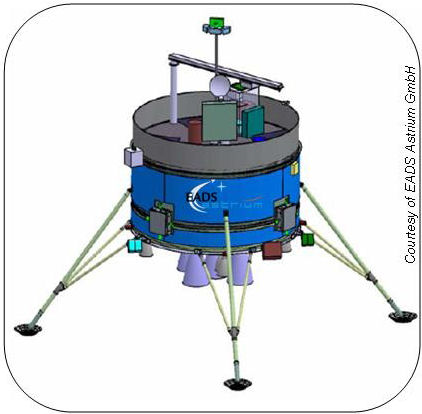
The south polar region of the Moon, with dark craters and high ridges, is a world away from the relatively smooth terrain visited by Apollo astronauts four decades ago. This rugged moonscape is the target for Europe’s next leap into space.

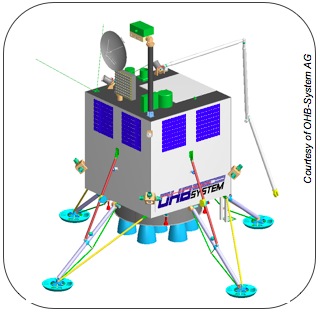
A Lunar Lander concept from OHB-System AG [ESA].
Monday, February 15, 2010
French Stimulus includes $1 billion for CNES
Space News
The French space agency, CNES, is counting on an unforeseen cash injection of up to $1 billion from France’s economic stimulus package in the coming weeks to enable it to start programs that otherwise would not be funded even as it finances and reduces its debt to the European Space Agency (ESA), CNES officials said Feb. 11.
France’s planned government bond issue, the details of which are expected to be confirmed by the French parliament by March, sets aside up to 750 million euros ($1.03 billion) for space-related programs.
The money is divided into two parts. A line reserved for space programs totaling 500 million euros appears to be intended for CNES-led projects, with the start of work on a next-generation launch vehicle to succeed today’s heavy-lift Ariane 5 rocket all but certain to be included. This Ariane 6 preparatory work will be presented to the 18-nation ESA in 2011 or 2012 as part of an ESA-run program to develop the vehicle.
The French space agency, CNES, is counting on an unforeseen cash injection of up to $1 billion from France’s economic stimulus package in the coming weeks to enable it to start programs that otherwise would not be funded even as it finances and reduces its debt to the European Space Agency (ESA), CNES officials said Feb. 11.
France’s planned government bond issue, the details of which are expected to be confirmed by the French parliament by March, sets aside up to 750 million euros ($1.03 billion) for space-related programs.
The money is divided into two parts. A line reserved for space programs totaling 500 million euros appears to be intended for CNES-led projects, with the start of work on a next-generation launch vehicle to succeed today’s heavy-lift Ariane 5 rocket all but certain to be included. This Ariane 6 preparatory work will be presented to the 18-nation ESA in 2011 or 2012 as part of an ESA-run program to develop the vehicle.
Read the article, HERE.
Subscribe to:
Posts (Atom)