Showing posts with label Lunokhod. Show all posts

Thursday, December 11, 2014

ESA to explore lunar probe partnership with Russia

Ten years after planning got underway to place an ESA lander on the rim of Shackleton crater, the design of the MoonNEXT probe was improved by development of the ESA's ATV resupply ship. Still the program was scrapped. But, even as tensions continue between European Union  partners and Russia, ESA's managers have agreed to investigate joining forces with Roscosmos in Russia's lunar program, forestalled by loss of partnership with India, the problem-plagued Fregat vehicle and tight budgets [ESA/Astrium].
Elizabeth Gibney
NATURE

Science ministers in Europe have resurrected plans to explore the Moon’s surface — and the only strategy currently on the table is to join two uncrewed Russian missions. The developments, which follow the shelving of a proposed European Space Agency (ESA) Moon lander two years ago, come amid growing political tensions between Russia and Western nations.

On 2 December, at a meeting in Luxembourg to determine ESA’s policy, the space agency got the go-ahead and funding to investigate “participation in robotic missions for the exploration of the Moon”. Science ministers from the ESA member states did not approve collaboration with Russia specifically, but at the meeting, ESA scientists presented a proposal to join Russia on its missions to put a lander and a rover on the Moon’s south pole.

Money for lunar exploration will come from a pot of €800 million (US$980 million) contributed by ESA’s member states and dedicated to international space exploration; the pot will primarily pay for activities on the International Space Station and the development of a propulsion module for NASA’s Orion spacecraft, which is eventually designed to carry astronauts to deep space, and was tested on 5 December in an uncrewed space flight.

"There be dragons here," no longer applies to the Moon's nearly always, or permanently, shadowed areas at polar latitudes. The Vision for Space Exploration, before it also was scrapped, developed inertia for a brief second golden age of lunar exploration, and it prioritized scientific goals there.

Above, the state of our knowledge about the Moon's south pole in 1994 is compared with where this knowledge base stands today, illustrating one vast improvement in our understanding of the Moon gained at low cost and with great efficiency
 
[NASA/GSFC/JPL/DOD/USGS/Caltech/Arizona State University].
In the 45 years since astronauts first walked on the Moon, no European country or space agency has launched a mission to the Moon’s surface. And no lander or astronaut has been to the lunar south pole, a region thought to contain ice and thus deemed a probable spot for any future permanent lunar base. A 12-kilometre-deep crater there might provide access to material from the Moon’s interior, also making it attractive for scientific study, says Ian Crawford, a lunar scientist at Birkbeck, University of London. The ancient material could reveal details of the collision between a Mars-sized planet and early Earth that is thought to have produced the Moon. “The idea that we've ‘been there and done that’ did last for a long time, but that’s gone away now,” says Crawford. “The Moon still has a lot to tell us.”

Read the full article at NATURE, HERE.

Tuesday, July 3, 2012

Craters near Lunokhod-1 officially named

Luna 17, the lander that carried Lunokhod 1 to the surface; debarking ramps for the rover visible extending down to the surface to the right. Many rover tracks are visible around the lander and throughout LROC Narrow Angle Camera (NAC) frame M175502049RE, LRO orbit 10998, November 9, 2011. View the original contextual image with enlarged inset, HERE [NASA/GSFC/Arizona State University].
Olga Zakutnyaya
The Voice of Russia
 

A number of moon craters in the vicinity of Lunokhod–1 lunar rover have been given their own names. They were named in honor of the crew members of the first self-propelled vehicle on the surface of the celestial body.

The experiment carried out more than 40 years ago is to be repeated in the course of “Luna-Resource” expedition which should be launched no earlier than 2015.

The International Astronomical Union has approved 12 new names for small craters on the Moon, and now they have names of the members of the first lunar expedition and scientists who were involved in the project. Despite the fact that these people were not able to walk on the Moon’s surface themselves, they were the ones who led Lunokhod–1 – the first planet rover on the surface of an alien celestial body. All craters are located in the area of the “Sea of Rain” (Mare Imbrium) where the landing vehicle of Luna-17 interplanetary automatic station soft-landed in November 1970. It delivered Lunokhod lunar rover onto the Moon’s surface. All craters are comparatively small, their diameter ranging from 100 to 400 meters.

Thus, the names of Albert, Borya, Gena (in honor of the navigator Gabdulkhai Latypov), Igor, Kolya, Kostya, Leonid, Nikolya, Slava, Valera, Vasya, and Vitya appeared on the Moon.

The Luna-17 spacecraft was built by the design and construction bureau of the machine-engineering plant named after S.A. Lavochkin (now NPO Lavochkin). Lunokhod-1 was equipped with a set of scientific devices to explore the lunar soil. In the course of 10 months that it was working on the Moon, the rover traveled over 10.5 kilometers and sent back to Earth information about the mineral composition and characteristics of the lunar surface.

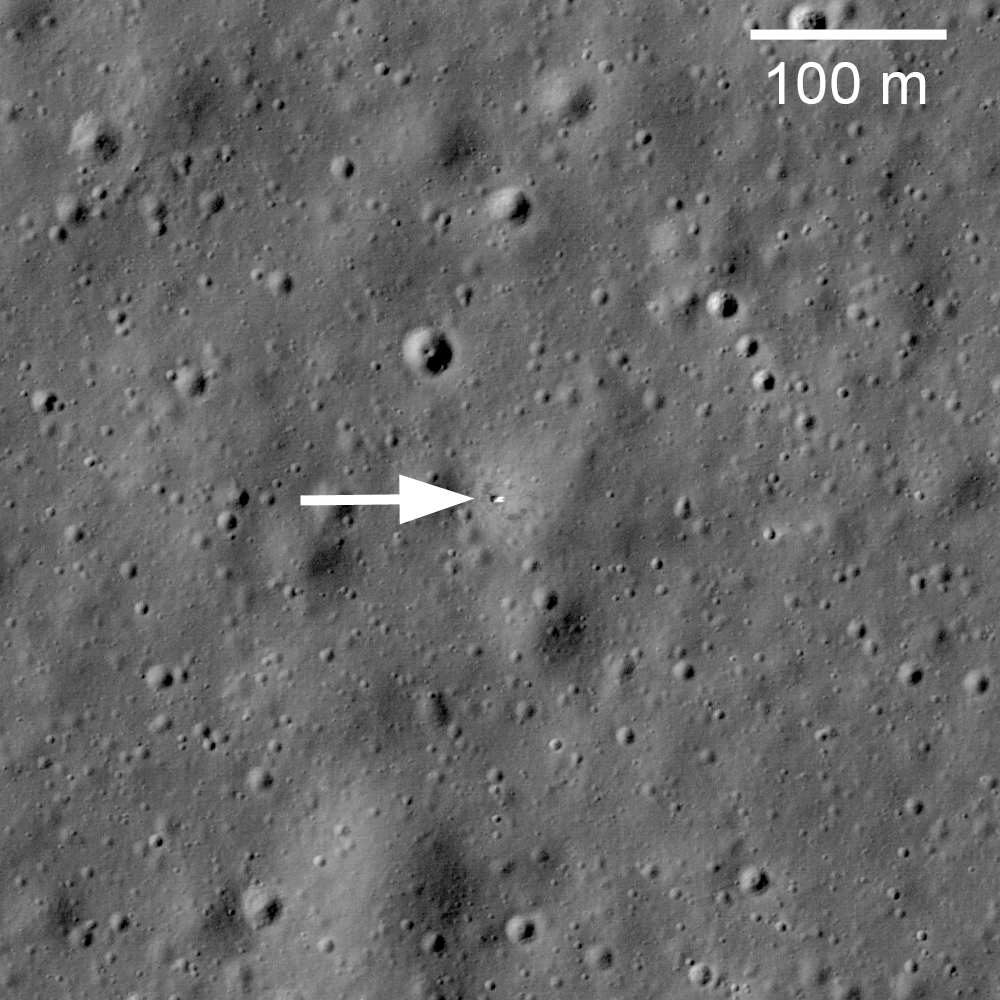
Lunokhod 1 rover in its final parking place (38.315°N, 324.992°E) on the surface of Mare Imbrium. LROC Narrow Angle Camera (NAC) observation M175502049RE, orbit 10998, November 9, 2011, resolution 33 cm per pixel. View original Featured Image released March 14, 2012 (with enlarged inset) HERE. [NASA/GSFC/Arizona State University].
Lunokhod-1 was controlled remotely via the center for space communications by two crews – five people each who worked in shifts. Each crew consisted of a commander, a driver, a navigator, a flight engineer, and a high gain antenna operator. Thus there were 10 people all together, plus a reserve driver and reserve high gain antenna operator.

Even though by the time Lunokhod-1 was launched American astronauts had already landed on the Moon, the soviet rover was no less a remarkable scientific and technical achievement. Unfortunately, at that time, the meaning of this achievement was overshadowed by the defeat in the race to put a man on the moon. Lunokhod-1, with all its novelty and complexity, was more of a consolation prize. At least that was the general attitude – and analysts might object, of course. Sadly, it was what determined the further development of the lunar program. After the improved version Lunokhod-2 in 1973, there was Lunokhod-3 which never made it to the Moon. As a result, the Lunar Program of the USSR was suspended. Forty years on there has been little progress.

Today it can be said that it was a mistake. Weak consolation might be the fact that space programs in other countries primarily in the United States have also been suspended. However, the comparison might not be accurate – paradoxically as it may sound as though the soviet moon explorations at the end of the “manned moon race” were in a better state (if not financially from the strategic point of view). A continuation of manned expeditions demanded huge resources and clear goals, which probably did not exist at that time. Autonomous expeditions were easier from the point of view of their preparation but brought back much more scientific results. Besides, by that time, complicated initial stages with lots of failures were overcome and so reliability was higher.

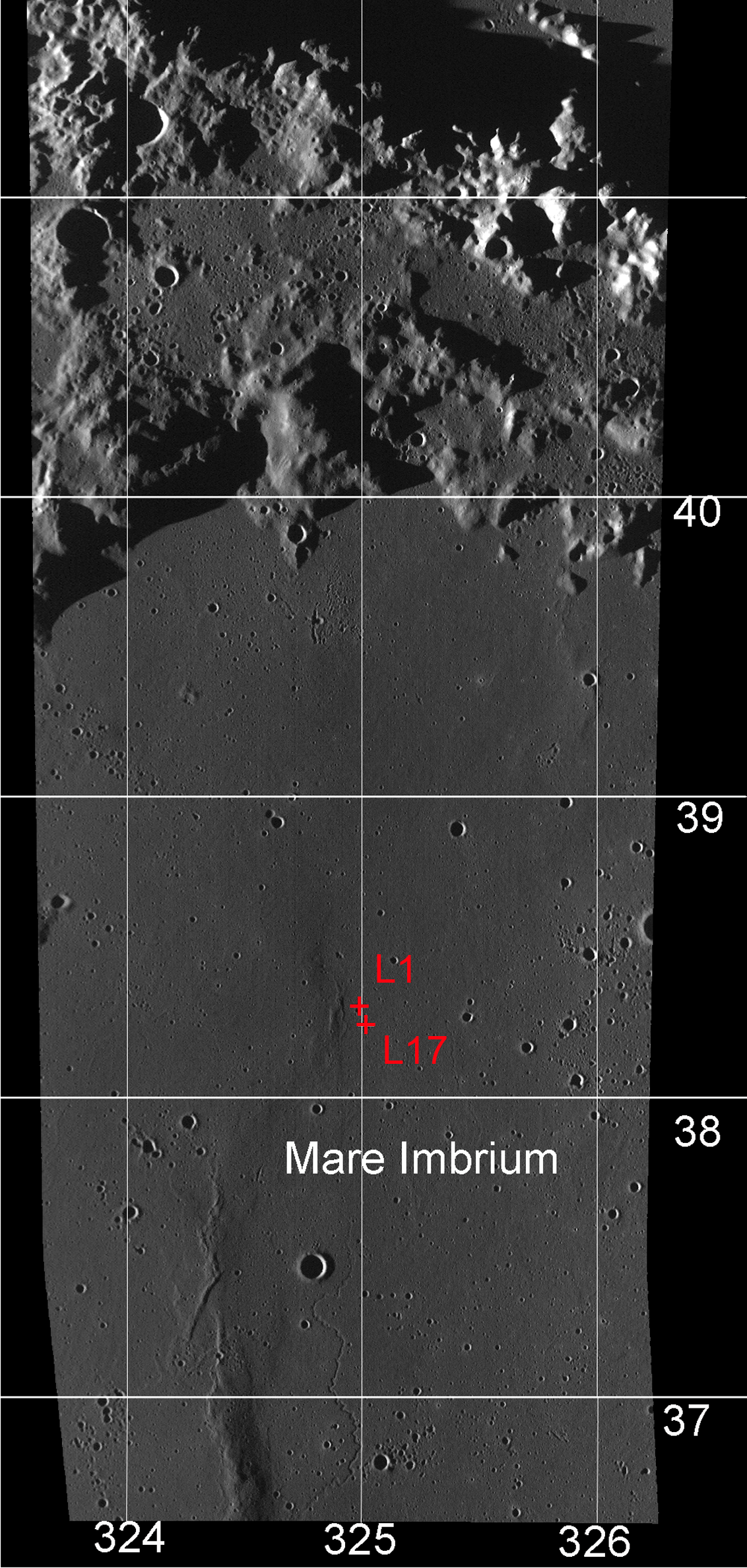
Far western 1970 Landing Zone of the Soviet Union's Luna 17, and the final parking spot of the first remote-operated lunar rover, Lunokhod-1. The French-built laser reflector array deployed from the Lunokhod eluded detection for four decades until its precise location was reacquired by the LROC Narrow Angle Camera in 2009. It's relocation added vital precision to measurements of the Earth-Moon distance that may answer important questions in astrophysics. LROC Wide Angle Camera 100 meter Global Mosaic overlaid upon LOLA topography and assembled using the NASA LMMP ILIADS application [NASA/GSFC/LMMP/Arizona State University].
Something similar is happening to NASA’s Mars exploration program. A long and ongoing exploration of the planet with more and more sophisticated and complex tasks resulted in the fact that the US became a true leader in the Mars programs. That was, in fact, the main argument by scholars who objected to cuts in NASA’s planetary space budget in 2013. In their opinion to lose such an important scientific and technical foundation would be a poor strategic move.

The current plans of Russia in the area of space exploration include returning to the Moon with landing vehicles and a mini-rover – a self-propelled machine which is being developed by an Indian organization for the purposes of the Luna-Resource program. It is planned to repeat lunar soil collection considering previous experiences. If in the course of the first expeditions the soil was collected only in the places of landing – now the goal is to combine the operation of the mini-rover and returning spacecraft. The mini-rover is to determine the most interesting spots and collect soil from them and then the spacecraft should return the samples to the Earth.

New Names Approved for Twelve Small Lunar Craters - The Working Group for Planetary System Nomenclature has approved 12 new names for small craters on the Moon: Albert, Borya, Gena, Igor, Kolya, Kostya, Leonid, Nikolya, Slava, Valera, Vasya, and Vitya. For details, see the map of LAC 24 and the Lunokhod-1 traverse map in the Gazetteer of Planetary Nomenclature [USGS].
Yet as of now these are only plans. Information from the Moon is coming daily. NASA LRO and GRAIL spacecraft continue to work in the Moon’s orbit (two spacecraft which measure lunar gravity fields). Several days ago, the NASA LRO mission published recent images of the lava fields formed as a result of asteroid impacts. The images were taken by LROC – Lunar Reconnaissance Orbiter Camera. This camera is also connected to the Lunokhods – in 2010, the first high resolution images were printed and it was possible to see Lunokhod-1 and the landing spacecraft and the wheel tracks. Interesting that in the same year a group of American scientists announced that they had managed to intercept a pulse from a laser retroreflector on Lunokhod-1.

It is probable that these circumstances have raised the interest in the Lunokhod program again. Naturally, recognition of the achievements of the soviet scientists is satisfying on the one hand, but on the other the interest is mostly coming from western institutions and space lovers. Without the LROC images, the “favourite lunar tractor” would be remembered only by those who are truly loyal to space science. That is why one of the tasks of the future lunar program is not only to learn again how to land and control spacecraft on the Moon, but also how to inform people about it in plain language, and on a regular basis.

Related: Lunokhod-1 revisited (March 15, 2012)

Monday, April 30, 2012

Will China deploy the first lunar rover since 1976?

China's third unmanned lunar spacecraft Chang'e-3 deploys only the thrid teleoperated lunar rover on the Moon, the first in 37 years, in 2013 [CNTV/CLEP].
The United States scrubbed plans to land a robotic lunar rover on the Moon as unnecessary, originally an extension of the successful Surveyor program (1966-1968), in favor of concentrating all effort on carrying out the Apollo missions. Between 1968 and 1972 a total 24 Americans left Earth orbit to visit the Moon's vicinity (three of these went the distance twice), and 12 astronauts explored the lunar surface. Though the U.S. deployed three Mars rovers, with a fourth on the way, Russia alone holds the distinction of having landed and operated the only robotic rovers on the Moon.

Though many U.S. and international teams are competing for the Google Lunar X-Prize, and the U.S. presently has a total of five sophisticated probes in lunar orbit, it now seems almost certain that China will become the first nation to soft land anything on the Moon since the Soviet sampler Luna 24 came to rest in the far eastern Mare Crisium in 1976.

The U.S. has no hard commitment to land a vehicle on the Moon at present, though the International Lunar Network and a South Pole-Aitken basin farside sampling mission continue in the planning stages. Internal challenges in both Russia and India have caused delays to ambitious plans for lunar surface missions set alone and in tandem with one another. Japan's SELENE program, which at one time called for lunar rover, continues to muddle through severe budget challenges.

Though China admits to being somewhat behind on the timeline it has set for building its third lunar mission, Chang'e-3, intended as a rover deployed following a soft landing on the Moon, the PRC does not express concern over plans to carry out that mission in 2013. Articles about Chang'e-3 published by China's state-owned media continue to surface regularly.


Xin Dingding
China Daily

Only 12 Americans have so far walked on the moon. The next person to do so could be from China. 

According to a white paper, China's Space Activities in 2011, released in December, preliminary research on a manned moon landing will be carried out in the next five years, along with research on a heavy-thrust carrier rocket, vital for launching manned spacecraft to the moon.

Scientists expect a manned moon landing could be achieved by China in 20 years, though there is no fixed timetable yet.

Experts, however, say that before taking the giant step, China needs to complete its robotic lunar exploration program, as it will lay the platform for successful moon landings.

The chief scientist for the lunar exploration program, Ou-yang Ziyuan, has already indicated that China has the ability to launch men to moon, but it's "a single-trip ticket", meaning the nation does not have the capability to ensure that astronauts can return to Earth.

"The three steps set in the unmanned lunar exploration program are something China must undertake before commencing the plan to send men to the moon," he says.

China adopted the robotic lunar exploration program in 2004, which includes three steps - circling the moon, landing on the moon and returning with a sample.

China has completed the first step by launching the Chang'e-1 probe in 2007 to orbit around the moon, thereby becoming the fifth country in the world to independently launch lunar orbiters.

It is now in the second phase of achieving a soft landing on the moon. Chang'e-2, the backup satellite for Chang'e-1, was modified and launched in 2010 to test some key technologies for soft landing.

"Next year, the country's third lunar probe, Chang'e-3, is expected to be launched as planned and will conduct a soft landing on the moon," says Ye Peijian, chief designer of Chang'e-1 and chief commander of the satellite system of the Chang'e-2 and Chang'e-3 missions.

The orbiter will carry a lunar rover and other instruments for territory survey, assessment of living conditions and space observations.

"Chang'e-3 will be the first spacecraft with the first-ever China-designed 'legs' The lunar rover is also the first of its kind to be tested in the harsh environment on the moon," he says.

Preparations have also been advanced for the third phase, which aims to bring soil samples back to Earth before 2020.

Both the United States and the former Soviet Union have already sent spacecraft to the moon, but in two different ways. Hu Hao, chief designer of the program's third step, says that scientists have finally decided on how to achieve the goal of returning soil samples from the moon.

According to Hu, China will carry out a "Lunar Orbit Rendezvous" - the mode used by the Apollo Programs - to collect as many samples as possible.

Under the plan, a rocket will be launched from Earth that will put four modules into the lunar orbit. Two modules will land on the moon, while one will scoop up soil. The soil sample will be placed into the ascending module that will blast off from the lunar surface and dock with the orbiting module. The sample will then be transferred from this module to another one that will be jettisoned for Earth re-entry.

Though the US has done this kind of exercise more than four decades ago, the Chinese aerospace scientists have no one to count on, but rely on themselves to solve the major technical problems, Hu says.

China plans to scoop up as much as 2 kilograms of soil samples, but how to do it could also be a tricky problem.

The Automatic Lunar Surface Exploring Vehicle, China's planned Chang'e-3 lunar rover, "a solar powered vehicle designed and built by the China Academy of Space Technology (CAST). The six-wheeled rover has a designed life of 90 days to explore three square kilometers, a total mass of 120 kg (with a 20kg payload capacity) designed to travel up to 10 kilometers."

"The vehicle is capable of autonomously navigating around obstacles, selecting optimal routes and areas of interest. On-board equipment includes subsurface radar and an optical telescope. An on-board camera can capture images of the lunar surface and a mechanical arm, designed by Hong Kong Polytechnic University, will allow the vehicle to collect samples for analysis. The vehicle can transmit image and data back to the Earth in real-time and all on-board equipment are capable of operating normally during the 14 day-long lunar night."

The former Soviet Union's three missions collected just over 300 grams of lunar soil. The US had better success and returned 381.7 kg of rocks and other material from the moon, thanks to astronauts' participation.

"China's mission is also a robotic one. The probe could land on an unknown spot that could be rocky, and drills could fail to deeply penetrate the lunar surface, just like a mission by the former Soviet Union," he says.

The difficulties also include how to launch the ascending module from the lunar surface and how to conduct rendezvous and docking operations in the lunar orbit.

"China conducted its first spacecraft rendezvous and docking operation in the low-Earth orbit successfully last year. But how to do it in a lunar orbit more than 300,000 km away from Earth is a new challenge," he says.

The space docking last year relied on the global positioning system, which, however, will not be of much use during a lunar orbit rendezvous. The docking ports on the ascending module and the orbiting module need to be redesigned and tested, as the modules are much smaller in size.

Finally, scientists also have to solve the problem to have the probe re-enter the Earth atmosphere safely.

China also lacks experience in how to make the sample-carrying capsule re-enter the Earth atmosphere safely, he says.

While previous re-entries of unmanned and manned spacecraft were made at 7.9 km per second, the return capsule with the lunar soil sample will be hurtling to Earth at, or close to, speeds of 11.2 km per second.

He says that the third phase will launch two orbiters to achieve the goals before 2020. Earlier reports said that the first of these is likely to be launched around 2017.

"We are under pressure as only a short time is left," he says.

Scientists are also stressed due to the public's unrealistic high expectations for success, he says. In recent years, consecutive successes in the space sector have buoyed expectations for more missions.

"People now tend to underestimate risks in space activities. They think it is easy and have little tolerance for failure. But even space powers like the US and Russia have had several failures," he says, adding that more tolerance is essential for the healthy development of China's aerospace industry.

Related Posts, HERE

Sunday, April 29, 2012

Russia outlines spaceflight plans to 2030

Marcia S. Smith
SpacePolicyOnline

Russia's space agency, Roscosmos, has posted its long term plans for human and robotic spaceflight on its website.  The plan outlines Russia's space goals through 2030.

The document is in Russian, but Anatoly Zak of Russianspaceweb.com provides a summary of its key points in English along with his analysis of their feasibility.

Read the article, HERE.

Tuesday, April 24, 2012

The Moon as a platform for astrophysics

Darks Ages Radio Explorer (DARE), utilizing the radio-quiet of the lunar farside to explore the earliest period on the cosmic time line, 200 million years between the primordial Big Bang and the emergence of the earliest luminous sources and the structure of the present universe. "The lunar Farside is potentially the only site in the inner solar system for high precision radio cosmology.” [NLSI].
Joel Raupe
and from reports

The Moon has been used as a platform for astrophysics research since laser range reflectors were deployed by three of the six Apollo surface expeditions and also as part of the Soviet two Lunokhod robotic rovers. A lunar laser range reflector (LLRR) has now been orbiting the Moon as part of the Lunar Reconnaissance Orbiter (LRO) mission since June 2009.

A welcome added bonus to the LRO mission came after photographing Lunokhod-1. The 1970 mission's French-built LLRR had been lost almost immediately after the rover was parked for the last time in 1970.

Before LRO, with only four arrays bouncing back mere photons from powerful laser pulses from Earth beginning in 1969, the distance to the Moon was measured with increasing accuracy down to a 3 centimeter margin of error. With the addition of the LRO reflector and after definitively locating Lunokhod-1 astrophysicists sharpened  measurements even further, finally with precision enough to rule out the idea that the astounding newly discovered increasing rate of the universe's expansion might be a “local” phenomenon, or a kind of optical illusion.

The Naval Research Laboratory (NRL), together with the Massachusetts Institute of Technology (MIT), has been building on the age old dream of utilizing the “radio quiet” of the Moon’s Farside to peer into the elusive Cosmic Dark Age, the period between the Big Bang and the “Epoch of Reionization,”  when an intergalactic medium composed mostly of neutral gases was “ionized by the emergence of the first luminous sources.”

Continuing with this description supplied by the MIT Haystack Observatory, “The sources may have been stars, galaxies, quasars, or some combination.  By studying  Reionization we can learn a great deal about the process of structure formation in the Universe, and find the evolutionary links between the remarkably smooth matter distribution at early times revealed by (Cosmic Background Radiation) studies and the highly structured universe of galaxies and clusters of galaxies” astronomers can peer more than 10 billion light years into the past.

Exploring that early “Dark Age” will almost certainly require radio telescopes able to detect sources radiating at frequencies red-shifted to wavelengths typical of the noise created by human civilization.

A solution offered by MIT and the NRL suggested an immense antenna farm deployed robotically on the wide floor of Tsiolkovskiy crater. The Dark Age Lunar Interferometer array was discussed in some detail in 2008, when achieving “extended human activity” on the Moon was national space policy.

The NASA Lunar Science Institute (NLSI) reports two of their collaborating working groups are suggesting putting a radio telescope in orbit around the Moon where it can put a significant part of its time exploring this cosmic Dark Age, the Darks Ages Radio Explorer (DARE). The mission concept is one of two ideas being pursued by the Lunar University Network for Astrophysical Research (LUNAR) “addressing the question of how the Moon can be used as a platform to advance important goals in astrophysics,” according to the NLSI.

The other suggestion by the LUNAR group proposes, “technology development for future lunar surface telescopes, which can help detect and characterize Earth-like planets orbiting nearby starts.

“Both approaches leverage the Moon as a science platform. The lunar Farside is potentially the only site in the inner solar system for high precision radio cosmology.”

DARE will use the highly-redshifted hyperfine 21 cm transition from neutral hydrogen to track the formation of the first luminous objects by their impact on the intergalactic medium during the end of the Dark Ages and during Cosmic Dawn. The science instrument is composed of a low frequency radiometer, a receiver, and a digital spectrometer. The various sub-systems have been constructed and are in the process of system integration. After check-out, the system will be deployed and tested at the Murchison Radio Observatory in Western Australia—one of the most radio quiet locations on the planet.

The Lunar Radio Telescope Array (LRTA) is a concept for a telescope located on the far side of the Moon where it is protected from radio frequency interference (RFI). It would detect magnetically generated radio emissions to provide insights into the interior structure of planets— information likely to be difficult to obtain by other means.

The Apollo 15 laser ranger reflector, 4x the area of
the LLRR arrays deployed by Apollo 11 & 14, is
the most reliable of the 5 units placed on the Moon.
Furthermore, the Lunar Laser Ranging (LLR) component of the LUNAR team has taken a two-fold approach toward testing theories of gravity. Not only are they continuing precise measurements of the Earth-Moon distance via laser ranging, but they are also leading efforts to develop a next-generation retroreflector package that could be emplaced on the Moon by future missions.

While the three retroflector arrays deployed during Apollo era were an incredible success, the reduced return from the arrays over the years has limited advanced investigation into general relativity. At present, there are a number of stations that can access Apollo 15 arrays but not the Apollo 11 and 14 arrays; the new retroreflectors will have signals that can be accessed by a large number of lunar laser ranging ground stations. A next generation retroreflector would improve precision measurements for gravitational physics and for understanding the lunar interior.

As a classical theory, general relativity and quantum mechanics are fundamentally inconsistent; there must be a breakdown at some level of accuracy in general relativity or a problem with quantum mechanics. A much higher ranging accuracy would improve scientific results in testing the theory of general relativity by more than two orders of magnitude. 

This post was derived in part from the NLSI release,
NLSI Teams Conduct Astrophysics Research

Related Posts:
MIT to lead development of new radio telescope
array on lunar farside
(February 19, 2008)
Naval Research Laboratory to design Farside DALI (March 11, 2008)
What better view? (March 26, 2008)
New model of lunar motion from Apollo LLRR (December 27, 2008)
MacDonald LLR defunded by NSF (June 21, 2009)
The continued importance of lunar laser ranging (August 3, 2009)
Laser Ranging and the LRO (August 12, 2009)
Dust accumulation on Apollo laser reflectors may
indicate a surprisingly fast and more dynamic
lunar exosphere
(February 16, 2010)
Long term degradation of optics on the Moon (March 4, 2010)
A Fundamental Point on the Moon (April 13, 2010)
Acquisition Lunokhod-1 (April 27, 2010)

Thursday, April 12, 2012

Selenokhod GLXP rover ready by summer

Team activity - The implementation of such a large-scale project is impossible without cooperation of various specialists. In team discussions we find powerful incentive to progress it’s extremely exciting and useful for professional development [Selenokhod].
The Team Selenokhod GLXP lunar rover prototype will be finished by summer, developers said on Thursday. Selenokhod is the only Russian entrant among the 26 teams competing for the Google Lunar X Prize.

Selenokhod will move on flats instead of wheels, a design developed for the 4.5-kg Prop-M rovers that traveled on-board the identical Mars 2 and Mars 3 missions. After Mars 2 crashed on the martian surface, Mars 3 achieved the first soft landing there, December 2, 1971. But, for reasons still unknown, all contact was lost with Mars 3 after only 14.5 seconds.

RIA Novosti has posted a video showing
the Selenokhod lunar rover in action
.
Though neither Prop-M rover was successfully deployed on Mars, the Russians are apparently working hard to live up to an inherited legacy of having landed and operated the only robotic rovers on the Moon, in 1970 and 1973.

The team is planning to deliver its 5-kg Selenokhod to the moon on-board Luna-Glob, though that mission was recently delayed until sometime after 2015, past the present X-Prize deadline, and the team reports that contest organizers have not yet indicated whether using a government-funded platform is acceptable.

Monday, April 9, 2012

Russian Academy plans Lunokhod-3 and 4

Schematic representation of the Luna-LD-Rover concept, as presented to the Lunar Exploration Analysis Group (LEAG) annual meeting in 2010. The overall robust rover and experiments, designed for long-duration exploration through several lunar days and nights, builds on the successful Lunokhod scenarios [Institute for Space Research - Moscow].
The Russian Academy of Sciences has prepared early plans for two Lunokhod-class unmanned lunar rovers, "Lunokhod 3 and Lunokhod-4," to “work the Moon” between 2020 and 2023, this according to a document obtained by the news agency RIA Novosti. A stationary “landing station” is pegged for 2024 “as the first steps to form the future manned lunar base” sometime later.

As the heart of the Soviet Union, Russia was the first and only nation to deploy unmanned rovers on the Moon, Lunokhod-1 in 1970 and Lunokhod-2 in 1973.

Russia completed the last soft landing and sample-return mission on the Moon, Luna 24, in 1976.

The Luna-Glob polar lander, together with its Russian orbiter, originally planned for 2012, and the Luna Resurs polar lander, with India's Chandrayaan-2 orbiter and mini-rover were planned for 2013. Set backs caused by systemic problems, highly manifested in the Phobos-Grunt failure, have resulted in a national reexamination of Russia's unmanned and manned space exploration plans, beyond participation in the International Space Station [IKI].
Missions originally developed for 2012 and 2013, Luna-Resurs and Luna-Glob, are apparently to be pushed back to after 2015. Whether India will continue to participate in those early missions is a question still up in the air. In February the India Space Research Organisation (ISRO) postponed indefinitely the Chandrayaan-2 lunar orbiter and rover combination. India’s rover was designed to be ferried to the surface on Luna-Resurs.

“Under the document," obtained by RIA Novosti, core aims of the Russian scientists are to study polar regions of the Moon and gas-dust exosphere,” according to the April 7 news account. An overall goal of the Academy is to collect samples “and find the most comfortable areas for lunar base deployment.

“The lunar rovers and the landing station will form first elements of space infrastructure for a lunar testing area with prospects of deployment of Russia’s lunar base.”

Thursday, March 15, 2012

LROC: Lunokhod 1 revisited, too

Lunokhod 1 rover in its final parking place (38.315°N, 324.992°E) on the surface of Mare Imbrium. LROC Narrow Angle Camera (NAC) observation M175502049RE, orbit 10998, November 9, 2011, resolution 33 cm per pixel. View original Featured Image with enlarged inset HERE. [NASA/GSFC/Arizona State University].
Jeff Plescia
LROC News System

Luna 17, carrying Lunokhod 1, landed on the flood basalt surface of Mare Imbrium on November 17, 1970, after entering orbit on November 15. 

Today's Featured Image of Luna 17 and Lunokhod 1 was obtained during a low altitude (33 km) pass providing the highest resolution view yet of the landing site.

The same LROC Narrow Angle Camera frame captured both the lander and the Lunokhod 1 lunar rover, and nearly all the wheel tracks the rover left behind, just shy of 42 years afterward.

Luna 17, the lander that carried Lunokhod 1 to the surface; debarking ramps for the rover visible extending down to the surface to the right. Many rover tracks are visible around the lander and throughout LROC NAC frame M175502049RE. View the original contextual image with enlarged inset, HERE [NASA/GSFC/Arizona State University].

Artist’s conception of Luna 17 on the lunar surface, with Lunokhod descending to the surface [Anatoly Zak/Russian Space Web].
Once Luna 17 landed, ramps were deployed on two sides of the lander allowing for two possible directions for the rover to drive to the surface. In this case, the rover drove down the ramps on the east side of the lander. Rover tracks can be seen extending away from and around the rover. Also note the bright area around the Luna 17 lander; the surface was modified by the exhaust gases from the descent engines such that it appears brighter. This increased contract makes the rover tracks more obvious near the lander.

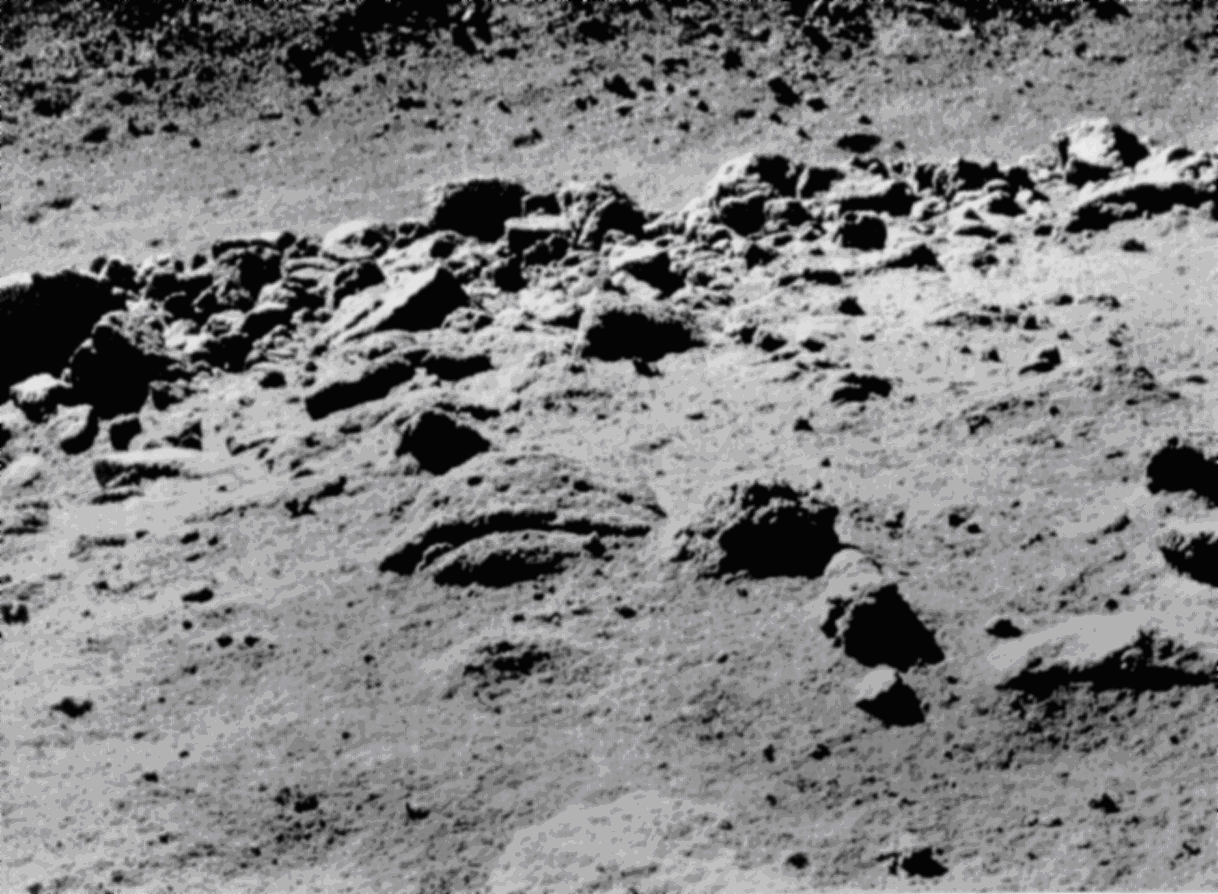
View of the Luna 17 from the Lunokhod 1. The rover descended from the lander on the opposite side. The wide variety of images, including many other firsts, from the Cold War era Soviet lunar program can be viewed HERE.

Lunokhod 1 traveled a total distance of 10.5 km. It was first commanded to drive south from the Luna 17 lander, making a loop across the mare surface, and then returning north to Luna 17. The rover was then directed to proceed farther north, making a small loop to the west, then returning to its track and continuing northward. The payload consisted of a suite of television cameras, a cone penetrometer to determine physical properties of the regolith, and an X-ray spectrometer to determine the chemistry of the regolith. An X-ray telescope and cosmic ray detector were also part of the payload.

Like Lunokhod 2, Lunokhod 1 carried a French-built laser retroreflector. The vehicle was tracked for a short period during the mission then lost. Once the vehicle was located using LRO/LROC images by the LROC team, it was targeted and recovered using the lunar lasers at the Apache Point Observatory. Because of its location away from the Apollo retroreflectors and Lunokhod 2, recovering Lunokhod 1 is important for lunar geophysical studies.

The rover’s journey across the surface formally ended on October 4, 1971, after 11 lunar day-night cycles (322 Earth-days). Attempts to contact the rover after the lunar night that began on September 14, 1971 were unsuccessful, apparently due to a failure of some component of the rover during the lunar night.

Northern Mare Imbrium showing the location of the Luna 17 landing site and the final position of the Lunokhod 1 rover. View the larger LROC WAC context image HERE. [NASA/GSFC/ Arizona State University].

Explore the Lunokhod 1 site on your own HERE.

Revisit about the earlier LROC "rediscovery" of Lunokhod 1 HERE.

Tuesday, March 13, 2012

LROC: Lunokhod 2 revisited

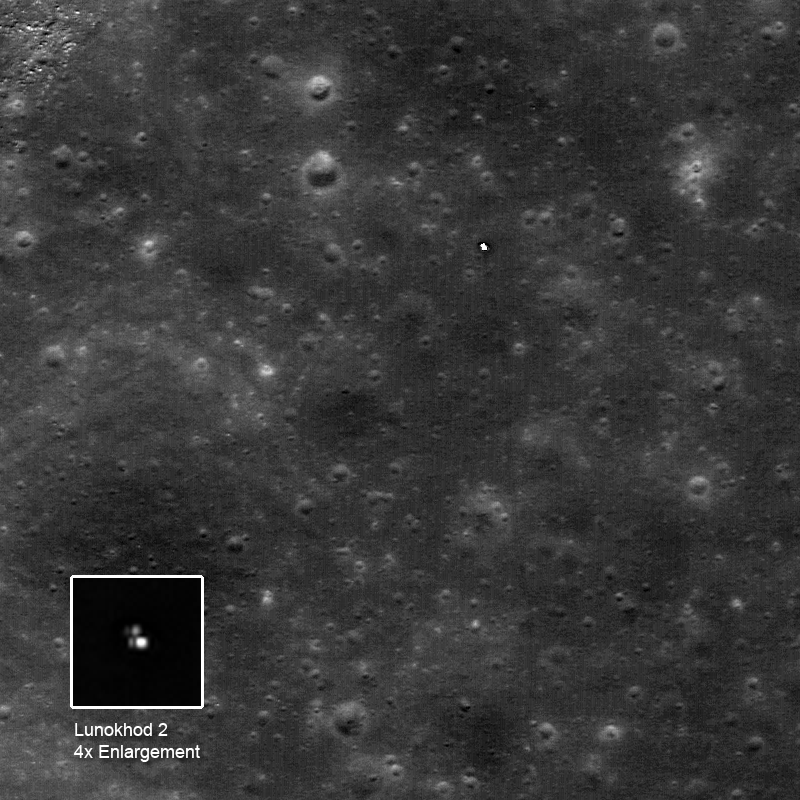
The tele-operated Soviet Lunokhod 2 rover, the last lunar rover deployed on the Moon, parked facing southeast with the lid still open 39 years later. Rover tracks extend north to this final parking place. The inset is a zoomed in view, the main body is labeled B and open lid labeled L, with the instrument suite (including its French-built laser-ranging retro-reflector array, still in use) on the front labeled I. LROC Narrow Angle Camera (NAC) observation M175070494, orbit 10934, November 4, 201; resolution 30 cm per pixel [NASA/GSFC/Arizona State University].
Mark Robinson
Principal Investigator
Arizona State University

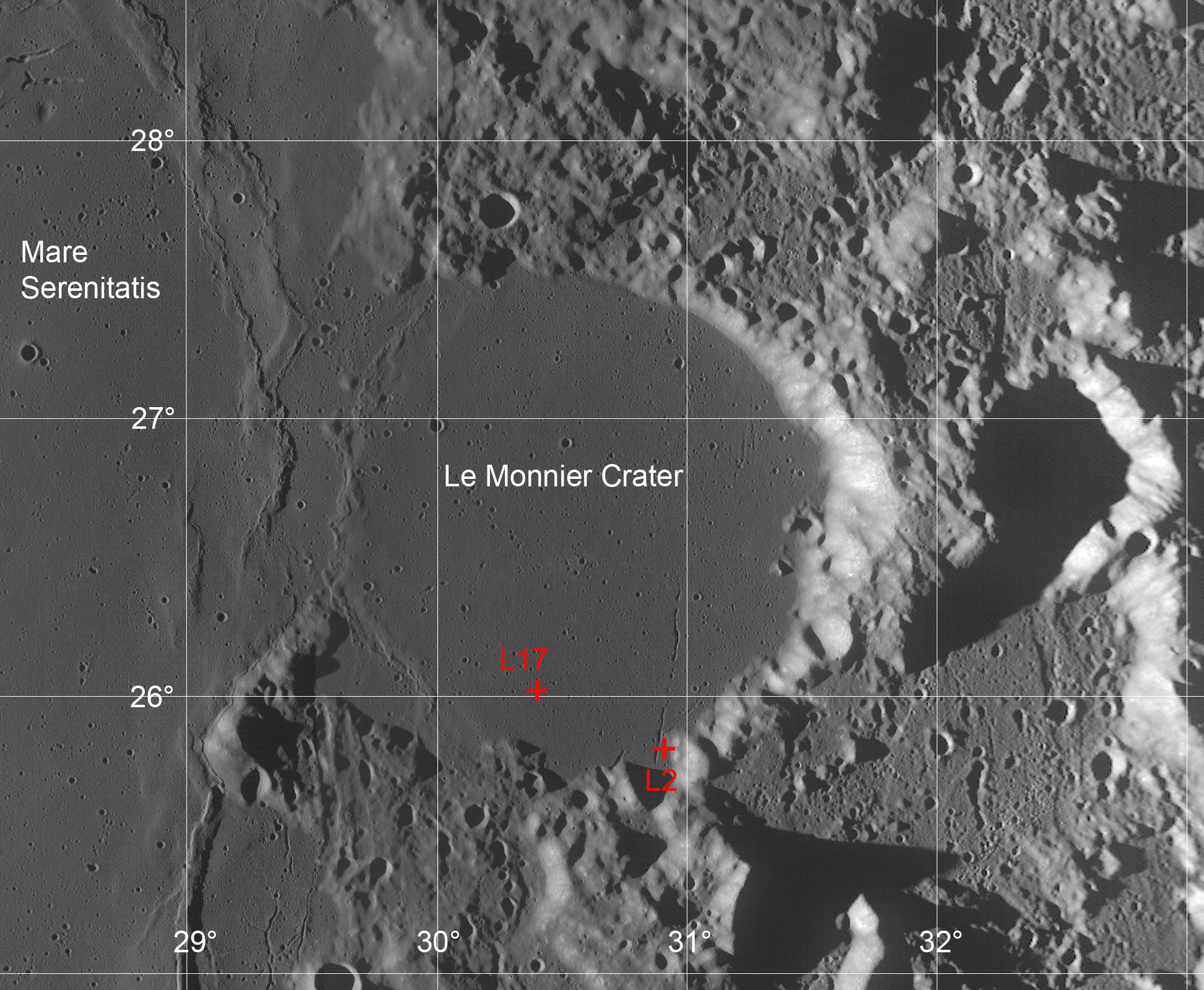
The Lunokhod 2 rover is still parked on the floor of the crater Le Monnier (25.830°N, 30.914°E). This NAC image was taken when the spacecraft was only 24 km above the surface, zipping along at about 1.6 km/sec (about 3600 mph). The spacecraft had to turn on its axis 27° to view the rover. The resolution is about two times higher than usual!

The Lunokhod 2 rover was carried to the surface on board the Luna 21 spacecraft. Lunokhod is the English translation of the Russian word “Луноход”, meaning Moon Walker. The ensemble was launched on 11 January 1973 and the landing occurred on 15 January in Le Monnier crater on the eastern margin of Mare Serenitatis. The coordinates of the landing site are 26.005°N, 30.406°E (on the basis of nine observations) at an elevation of -2769 m (1734630.9 m radius).

Le Monnier crater lies on the eastern wall of the Serenitatis basin. Lavas that compose Mare Serenitatis also flooded the floor of this 61 kilometer diameter ancient crater. The two red crosses indicate the locations of the Luna 21 lander (L21) and the ultimate  parking spot of the Lunokhod 2 rover (L2) after enduring three full lunar nights. View the original full resolution context image HERE [NASA/GSFC/Arizona State University/USGS/JAXA/Phil Stooke/Google].
Lunokhod 2 is about 170 cm (5’ 7”) long x 160 cm (5’ 3”) wide x 135 cm (4’ 5”) tall, and it is almost circular when viewed from above. The vehicle had eight wheels and could travel at either 1 km/hr or 2 km/hr (0.6 and 1.2 mph). The lid on the top of the rover served to provide solar power and to keep the vehicle warm at night. When the lid was opened, the solar cells collected energy to operate the rover. At night, the lid was closed and a fluid heated by the decay of Polonium-210 kept the rover warm. The rover was controlled remotely by a team of Soviet controllers on Earth.

Lunokhod rover in publicity still. Note the mesh wheel design and LRRR on the extended instrument suite housing [Russian Space Academy].
During its 37 km traverse, Lunokhod 2 headed south from the landing site and into the highlands from the southern rim of Le Monnier crater. Lunokhod 2 had difficulty on the slopes of the southern rim so it was turned northward and commanded to backtrack to the flat mare basalts that form the floor of Le Monnier. It then continued eastward across the crater floor eventually encountering a 250 wide north-northeast trending rille named Fossa Recta (Straight Rille).

The Luna 21 lander with ramps deployed on both sides,
to the northwest and to the southeast. LROC NAC
M122007650L [NASA/GSFC/Arizona State University].
Lunokhod 2 drove off the lander to the northwest and circled around to the east. Several turns were made as the rover photographed the lander. It then departed and headed south.

The rover had to work its way down the rille wall and across the floor before finally climbing out on the east side. Lunokhod 2 continued north before reaching its final position. The mission officially ended on 4 June 1973 due to a failure of the rover. Apparently on 9 May, the rover’s lid touched a crater wall and become covered with fine-grained lunar regolith. That regolith was dumped onto the radiators when the lid closed. Subsequently, when the lid opened, the rover overheated and failed.

The scientific payload on the rover included three television cameras for navigation, four panoramic cameras, a cone penetrometer to test the lunar regolith, a solar X-ray experiment, a magnetometer, radiometer, and laser ranging retroreflector.
Luna 21 lander as seen from the Lunokhod 2 rover. This view as taken from south of the lander looking to the northwest. The tracks around the east side of the lander are quite apparent, note the small berms of regolith that were pushed up as the rover turned. Lunation 1, Session 4, Panorama 12 [RSA]..
Examine the regional geology that Lunokhod 2 was exploring, HERE (hint: sample 4493, line 15645; look to the south for some spectacular rover tracks).

First LROC Featured Image of the Lunokhod rovers.

Tuesday, April 27, 2010

Acquisition Луноход 1

From Lunar Pioneer
It might seem easy to spot after cameras on-board the Lunar Reconnaissance Orbiter (LRO) found Lunokhod 1 late last year. Nevertheless, after years of searching, before last November little hope remained that it's French-built laser reflectors would ever assume their important place with four other reflector stations on the Moon. With the help of LRO researchers have now acquired a reflection, tallied in photons, from the old Russian vehicle, a big bonus for theoretical cosmology and planetary science. In the images above and below Lunakhod 1 is set within the context of true surroundings. Above, a high ridge is visible on the north-northwest horizon, beyond the flat vastness of Mare Imbrium. These are the foothills southwest of Promontorium Heraclides. The closest of these are about 42 kilometers away. Click here for a better look.
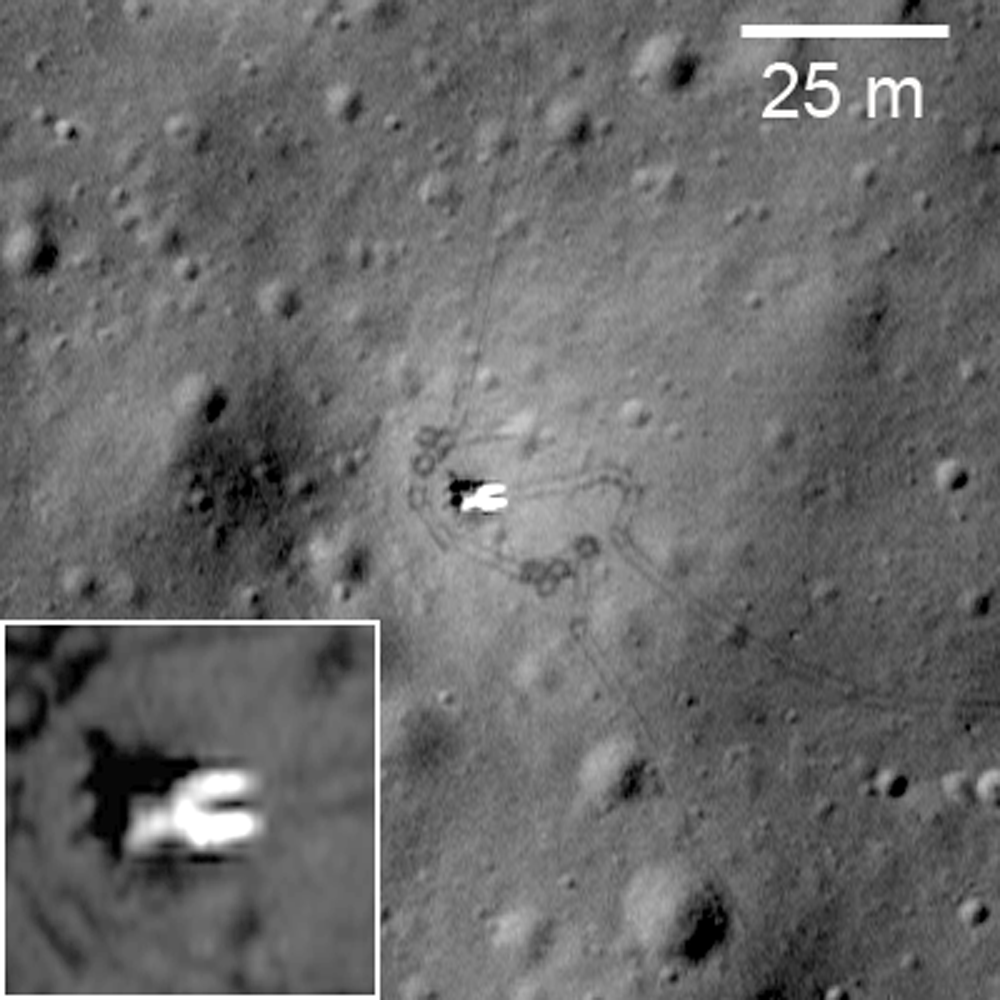

Can you find Lunokhod 1 in the top image, maybe from clues in the enhanced close-up below it? The Russian lunar rover parked on the western shore of Mare Imbrium hadn't been detected since September 1971. More important than just locating Lunokhod 1, with the essential help of the LROC team at Arizona State, researchers very recently detected it's French-built laser range reflector. LRO (LROC) Narrow-Angle Camera M114185541RE (Orbit 1961, November 30, 2009, alt. 48.4 km. & resolution = 51.3 cm per pixel.) [NASA/GSFC/Arizona State University].

Researchers at the University of California at San Diego have acquired a reflection from the Laser Range Retro-Reflector on Lunokhod 1, the Soviet lunar rover that went missing from September 1971 until being found last November through the narrow-angle cameras on LRO.

The addition of a fifth working laser reflector is a windfall for physicists who believe measuring an even finer Earth-Moon distance could solve important puzzles about the cosmos, things like the locality of physical laws, for example. Putting a point on the Earth-Moon distance finer than three centimeters is thought to be the key.

As early as December 1969 McDonald Observatory gauged the Earth-Moon distance to within 30 centimeters by timing reflection of laser light to and from the Apollo 11 landing site. A pencil-thin laser beam is a kilometer-wide after a 1.5 light-second trip to the Moon. The LRRR deployed at Tranquility Base was designed to reflect light precisely in the direction from which it arrives. After an additional 1.5 seconds the laser light returned to Earth is measured by the photon, enough over many sessions to measure Earth-Moon distance with great precision.

An additional LRRR, identical to the one at Tranquility, was deployed at Fra Mauro by Apollo 14 and another, four-times larger than these, was set up north of the equator near Hadley Rille by Apollo 15. The latter, deployed in 1971, is still the most reliable of the LRRR's set up during the Apollo era.

The Soviet Union landed two RTG-powered lunar rovers, in 1970 and 1973, and both Lunokhod 1 and 2 were equipped with smaller French-built LRRR's. After ten months of successful operation the Soviets lost contact with Lunokhod 1 in 1971. Despite problematic thermal issues and limitations due to its smaller size the LRRR on Lunokhod 2, parked on the eastern side of Mare Serenitatis, has been periodically detected since its mission ended in 1973.

Lunokhod 1 was thought to be parked properly, to the west of it's carrier landing site near the western edge of Mare Imbrium. Instead it appears the rover was properly parked to the north of its last known location, enough for a wide miss. No confirmed detection of its LRRR had been cataloged in over 39 years, until now.


Laser Range Retro-Reflector array at the Moon. Apollo 11 (1969) & Apollo 14 (1971), near the equator and 27 degrees of longitude apart, each one quarter the size of the unit deployed by Apollo 15 (1972). Not detected until 2010 is the french-built triangular array on the Soviet rover Lunokhod 1. The design repeated on the Lunokhod 2 robotic rover has experienced "thermal drawbacks" that hinder daylight detection, conversely sometimes aiding its detection during the lunar night. In addition, NASA/Goddard Space Flight Center is presently keeping close track of LRO using laser ranging from a telescope in Maryland.

In 2005 McDonald Observatory shut down its laser and U.S. work moved to the more powerful and more sensitive system at the Apache Point Observatory in New Mexico. As work has progressed there, high hopes have been held that, at last, Lunokhod 1 might be added to the network. With the help of LRO, which swept up the definite location of the long-lost Soviet rover last November, four decades of patience have been rewarded.

Read Monday's University of California/San Diego news release through the report from NASA's Astrobiology Institute, HERE.

Read NASA's recent report on the LRO surveys of the Lunokhod landing sites, HERE.

Some other Laser Range Retro-Reflector posts:

A Fundamental Point on the Moon (April 13, 2010)

Long-term degradation of optics on the Moon (March 4, 2010)

Laser Ranging and the LRO (August 12, 2009)

Thursday, April 1, 2010

Absentee ownership of Lunokhod 2


Garriott Crater? Even when a story is picked up and echoed in multiple corners of the Blogosphere, and may or may not be sprinkled with facts, doesn't make it true, especially but not exclusively on All Fools Day. Perhaps the video-mogul and space tourist from a family of astronauts does have a claim on this corner of the Moon. If so, his claim is staked between the Luna 21 lunar lander carrier and writ in the tracks of Lunokhod 2, with a location long-verified by laser reflection and most recently photographed in situ by the Lunar Reconnaissance Orbiter [Google Earth].

Richard Garriott now thinks the possibility of one day visiting the last rover to land on the Moon, which he bought for $68,000 in 1993, has gone from a zero probability to a long shot.

Andy Chalk
the escapist

In 1993 Richard Garriott purchased the former Soviet Union's Luna 21 moon lander and its Lunokhod 2 moon rover at a Sotheby's auction for $68,000... Luna 21 landed on the lunar surface on January 15, 1973, and its Lunokhod passenger remained operational until May 9, when it accidentally rolled into a crater and was buried under dust, ending its mission.

[Ed Note: This last piece of information is definitely not completely accurate. The french-built lunar laser range reflector on Lunokhod 2 continues to return the occasional photon, defying the author's inference that the vehicle was "buried under dust."]

Or so it was thought. But last week, a camera on NASA's Lunar Reconnaissance Orbiter sent home pictures of the wayward rover, parked safe and sound on the surface of the moon. "It's great to actually have a contemporary photograph of my property on the moon," Garriott said. He's clearly thinking beyond just a unique piece of memorabilia, however; according to Space.com, he's also had "casual conversations with lawyers about international law and property rights on the moon."

"I think I can truly make the only private, legitimate claim to territory - at the very least around my rover and, potentially, along its point of travel, to give me some actual property rights on the moon," Garriott said. And while he admitted that his claim is "somewhat tongue in cheek," he added, "It is interesting speculation... And I think that there's already international framework to support that territorial claim."

Unfortunately for Garriott, Joanne Irene Gabrynowicz, the director of the National Center for Remote Sensing, Air and Space Law and Research Professor of Law at the University of Mississippi, said his claim is off-base. "A contention that buying a space object that landed on the lunar surface from a sovereign nation gives rise to a property right to the territory under it is wrong," she said. "The U.S.S.R. was and Russia is a party to the Outer Space Treaty. It did not acquire the territory under the object when it landed. One cannot sell what one does not own. Since U.S.S.R./Russia did not have a property right to the territory under the landed object, there was nothing to sell."

Regardless of whose legal opinion prevails, Garriott now holds a new hope: That one day he'll get to see his lunar rover in person. "If you would have asked me [about going to the moon] in 1993 when I acquired Lunokhod 2 I would have said [the odds are] pretty close to zero. It's still a very low probability... But the probability is dramatically higher than it was," Garriott said. But the new "private space race" has changed all that. "As long as I keep myself healthy," Garriott said, "there's reasonable odds I can get a chance to go visit it. It has gone from zero probability to just a long shot."

Read the balance of this fanciful opinion piece, HERE.

Wednesday, March 17, 2010

LROC: Lunokhod I & Lunokhod II


Soviet robotic lander Luna 17 still sitting on Mare Imbrium where it delivered the Lunokhod 1 Rover in November 1970, LROC NAC Image M114185541RE [NASA/GSFC/Arizona State University].

Mark Robinson
LROC News System

An amazing spacecraft gently settled to the lunar surface on 17 November 1970. It carried the first successful robotic lunar rover -- Lunokhod 1. For the next ten months the rover was driven by operators in the Soviet Union, with the total distance traveled exceeding 10 km. For comparison, in six years of operation the Mars Exploration Rover Opportunity has traveled about 12 km.

The Lunokhod rovers are approximately 2.3 meters long and 1.5 meters tall.

After landing, the rover drove down a ramp onto the lunar surface and tested its eight wheels. The rover was driven by solar power during the day; at night it parked and relied on thermal energy from a polonium-210 radioisotope heater to survive the cold (-150°C).


Lunokhod 1 Rover in its final parking spot, LROC NAC Image M114185541RE [NASA/GSFC/Arizona State University].

The intrepid rover sent back valuable data concerning the composition of the regolith (soil), close up views of the local topography, and important engineering measurements of the regolith. Examine the full NAC image and trace out the path of Lunokhod 1.

Two years later (January 1973) Luna 21 landed in Le Monnier crater, delivering an upgraded Lunokhod 2. It sported higher resolution cameras and an improved scientific payload. Like its predecessor, it was driven by engineers on Earth during the day, and parked at night. Lunokhod 2 explored the Moon for about four months. Unfortunately, the mission was brought to an early end due to overheating, perhaps when soil got on the rover and covered key components.


Lunokhod 2 rover, note its tracks tracing its route southward. The enlargement is specially stretched to show the form of the rover, the brightest area may be the open clam shell lid; NAC Image M109039075LE [NASA/GSFC/Arizona State University].

The two Lunokhods showed the value of robotic explorers on the surface of another world. It would be another 24 years before the next robotic rover, Sojourner, drove on another world - this time Mars. The next lunar rover, 40 years later, is scheduled for 2013, a joint venture between India and Russia.

Old friends receive a visitor

Recently the LROC Science Operations Center received an unexpected visitor - Ruslan Kuzmin. He was one of the scientists who had actually participated in the Lunokhod missions! We were able to show him LROC pictures of the hardware on the surface and he was gracious enough to write down some of thoughts upon seeing his "old friends".

"Thank you very much for showing me the excellent LROC images of the Lander platform from “Luna-21”, as well as the robotic lunar rover “Lunokhod-2” in its last and eternal parking place after a 37-km, 4 month journey of research.

"To see the images with Lunokhod-2 and its tracks on the lunar surface is a very special feeling for me. In the time of the Lunokhod-2 operation, I was a young planetologist who was participating in the mission, and I analyzed the images received by the rover’s TV- cameras. In actual fact, this was the first successful mission in which I was involved. It was 37 years ago (in the last century!) when the Lunokhod-2 traveled for four months within the crater Le Monnier at the eastern edge of the Mare Serenitatis."

"While looking at LROC images of the Lunokhod-2 rover, I felt a deep interior excitement due to the welled up memories of the earliest “pages” of my science career. It is very exciting that the Lunokhod-2, as well as many other American and Soviet Union Landers, which operated many tens of years ago, now might be imaged by LROC so clearly, and viewed by millions of people around the world. The LRO camera is without any doubt a really fantastic instrument that simultaneously brings our eyes close to the lunar surface, while reminding us of pioneering results from historical missions.

"P.S. In attachment I sent the fragment of the Lunokhod-2 panoramic image of the Fossa Recta - the last object of its research."


Fragment of last Lunokhod 2 panorama, image courtesy of Ruslan Kasmin.

Find the Lunokhod 2 and its tracks in the full resolution NAC image.

Tuesday, January 26, 2010

The Development of Wheels for the Lunar Roving Vehicle

Vivake Asnani, Damon Delap, and Colin Creager
NASA - Glenn Research Center

Abstract - The Lunar Roving Vehicle (LRV) was developed for NASA’s Apollo program so astronauts could cover a greater range on the lunar surface, carry more science instruments, and return more soil and rock samples than by foot. Because of the unique lunar environment, the creation of flexible wheels was the most challenging and time consuming aspect of the LRV development. Wheels developed for previous lunar systems were not sufficient for use with this manned vehicle; therefore, several new designs were created and tested. Based on criteria set by NASA, the choices were narrowed down to two, the wire mesh wheel developed by General Motors (GM), and the hoop spring wheel developed by the Bendix Corporation. Each of these underwent intensive mechanical, material, and terramechanical analyses, and in the end, the wire mesh wheel was chosen for the LRV. Though the wire mesh wheel was determined to be the best choice for its particular application, it may be insufficient towards achieving the objectives of future lunar missions that could require higher tractive capability, increased weight capacity, or extended life. Therefore lessons learned from the original LRV wheel development and suggestions for future Moon wheel projects are offered.

Read the full report (Adobe Reader) HERE.


Soviet Lunokhod (Luna 17, Nov 1970 & Luna 21, Jan 1973). Teleoperated from Earth, 8 traction wheels, 800 kg with a max speed of 2 kph and a range of 37 kilometers.


MET
- (Apollo 14, Feb 1971). Seventy-five kilos on two free wheels, towed by EVA crew with an approximate range of three kilometers.


LRV
- (Apollo 15, July 1971; Apollo 16, April 1972 & Apollo 17, Dec 1972) Operated by astronauts on-board with a joystick, on four traction wheels, a maximum speed of 16 kph, a loaded mass 700 kg and a range 36 kilometers.