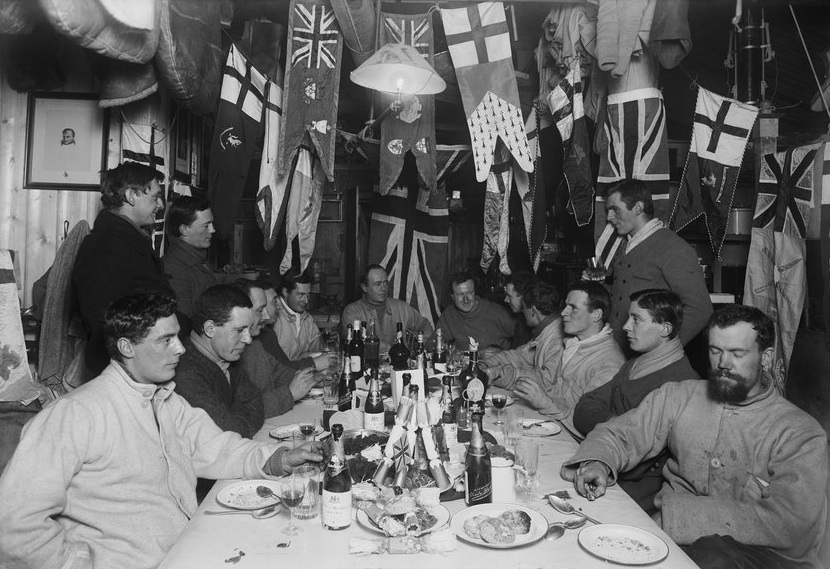
Robert Falcon Scott and the crew of the Terra Nova enjoy a celebratory dinner, Midwinter's Day, Antarctica, June 22, 1911.
Paul D. SpudisThe Once & Future Moon
Smithsonian Air & Space“Now is the winter of our discontent” – Richard III, Act 1, scene 1
There is a good piece in today’s Telegraph UK by David Robson of a fateful one-hundredth anniversary – the Midwinter Dinner — June 22, 1911 held in Robert Falcon Scott’s Ross Island hut. A year earlier, Scott and the crew of the Terra Nova had set off for the Antarctic and the south pole. It was a carefully planned and perilously financed expedition, a classic journey of the “golden age” of polar exploration. At the time, Scott had no idea that Roald Amundsen, the famous Norwegian polar explorer, had turned his north pole-bound Fram due south and unknown to Scott and his men, was at that moment camped on the opposite side of the Ross Sea, carefully planning a summer dash to the south pole.
Of what relevance is this story to space and the Moon? To me, it encompasses and restates several themes I have developed on this blog about the nature of exploration and sustainable presence in a hostile environment. The theme of the Telegraph article is that Scott’s expedition was all about science. His team included geographers, geologists, biologists and meteorologists. They collected specimens, documented phenomena, made observations, and conducted experiments. Scott’s expedition was organized like a carefully planned military campaign. Although conducted under the command structure of the Royal Navy, it was a civilian expedition, funded by subscription. No tax money was used and financing was always a major headache for Scott.
A theme running through Robson’s article has been a recurring motif in polar literature for many years – that while Scott and his team were honorable scientists, conducting true “exploration,” Amundsen and his men were publicity-seeking interlopers, cads and bounders who treacherously misled the noble and long-suffering Scott about their true intentions, and who then had the cheek to actually race ahead to beat Scott to the south pole. This theme has long been a part of British polar exploration literature – the sting of Amundsen’s victory in the race to the south pole still hurts. A book and television series on the polar race published over 20 years ago attempted to deconstruct this myth and was roundly blasted in the British press at the time.
But the Telegraph piece contains a fundamental contradiction. It takes great pains to show Scott’s expedition as a scientific, scholar’s investigation, as opposed to the “PR stunt” of Amundsen’s polar dash. If this is true, then of what importance was priority in attainment of the south pole anyway? The pole is merely one more data point on a string of measurement stations. Scott’s purpose was science, not stunts. He led a carefully planned and documented expedition to unravel the secrets of the Antarctic. By arriving at the pole after Amundsen, what could it matter? He still had his fossils, rock samples and observations, did he not?
Obviously there was much more at stake than admitted, both then and now. The great age of polar exploration was not about science, any more than Apollo to the Moon was about our first visit to another world. Large public spectacles like polar exploration were both theater and geopolitical struggles. In the decades leading to the Scott and Amundsen efforts, many had tried (and failed) to take the north pole. An entire subculture of polar explorers had developed, each group knowing of the other groups’ efforts in the desperate competition to be the first to stand on top of the world. Establishing priority became an obsession with many and proof was difficult to obtain (the Frederick Cook-Robert Peary controversy over who was the first at the north pole continues to this day).
Both Scott and Amundsen lived in this milieu. But they were also Edwardian gentlemen and sporting conduct was natural and expected behavior. Amundsen’s “sin” was that he discarded the fig leaf of “science” and exposed to public view the raw power politics involved in exploration. In the words of the President of the Royal Geographic Society Leonard Darwin (son of Charles), Amundsen had not “played the game.”
The idea that exploration is for scientific purposes stems largely from this golden age of polar exploration. In part, the conflation developed because of the need for Britain to attribute a noble and uplifting rationale to Scott’s polar trip. His tragic death on the way back from the south pole was made especially bitter by the loss of priority – when Scott arrived at the pole, he found that Amundsen had beaten him there. One way to make this unpleasant pill more palatable was to assign noble motives to Scott and base ones to Amundsen. Hence, a mythos developed, sanctifying Scott as a martyr for science and depicting Amundsen as a crass interloper. An unnoticed side-effect of this storyline was the simultaneous sanctification of science as the rationale for exploration. This attitude is typified by a comment from an astronomer in the early days of implementation of the Vision for Space Exploration in 2004 that “exploration without science is tourism.” Scott’s hagiographer could not have put it better.
But this concept, developed one hundred years ago to salve the outrage and hurt feelings of a disappointed nation, does not serve us well as we contemplate the exploration of our Solar System. Exploration traditionally has a much broader meaning. Columbus, Balboa and Magellan did not undertake their expeditions for science. They sought wealth and power; they envisioned new lands for settlement and the spread of their own culture. In short, the view of “exploration” prior to being redefined during the golden age of polar exploration had little to do with science and much to do with wealth creation, power projection and settlement.
Science is great and knowledge always has both practical and intangible value, but it is a small part of the motivation for exploration. The Antarctic is a continent for science but only by mutual agreement of the international community. The riches of Antarctica remained locked up as scientists hunt its surface for fallen asteroids and evidence for global warming. Some think this is a template for space exploration; others find such an idea anathema. Science stagnates when exploration stalls. If we were exploring the Moon, scientists would find a bounty of extraterrestrial samples and have an unparalleled opportunity to study the record of Earth’s climate locked in eons of undisturbed solar wind in the lunar regolith. Once humanity and technology are able to utilize the Moon’s resources to break the tyranny of the rocket equation, the vast riches of our Solar System will open to explorers, entrepreneurs, settlers, and scientists alike.
We explore for many reasons. There are many valid and important national interests of which science is but one. Scott understood this; hence, his disappointment at his own failure to reach the pole first. As we prepare to leave the Earth on a more permanent basis, it is well to look back at this curious and (I would say) singular interval in history – a time (so we are told) when science became the rationale for exploration. It wasn’t true then and isn’t true now.
Related side-note: Videos of my Space Pioneer Award talk at the recent 2011 International Space Development Conference in Hunstville AL have been posted in two parts, HERE and HERE. This talk touches on several of the themes I mention above. The slides from my talk are available for download HERE.


 Drew Enns