Showing posts with label Commercial Moon. Show all posts

Saturday, January 18, 2014

NASA announces partnership opportunities for U.S. commercial lunar lander capabilities

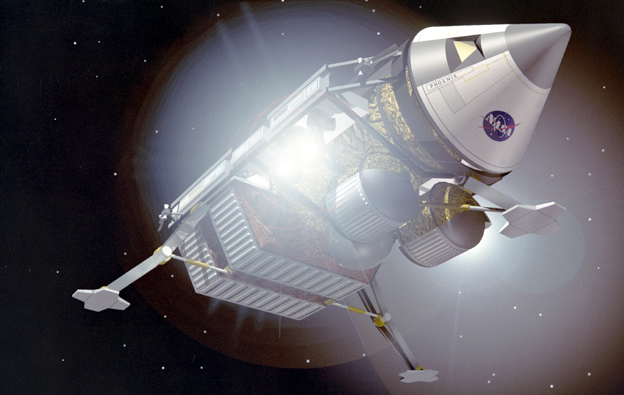
Orion-based lander concept
Other than development of the Ares booster, the only essential program actually tossed under the bus, when Congress and the administration scrapped Constellation, was the Altair lunar lander.  Now NASA will conduct a "Pre-proposal teleconference," January 27, 2014, at 1600 (UT) and proposers will have an opportunity to ask questions about the "Lunar CATALYST" unmanned program, discussed HERE. [NASA].
Trent J. Perrotto
NASA HQ Washington

Building on the progress of NASA's partnerships with the U.S. commercial space industry to develop new spacecraft and rockets capable of delivering cargo, and soon, astronauts to low Earth orbit, the agency is now looking for opportunities to spur commercial cargo transportation capabilities to the surface of the moon.

NASA has released an announcement seeking proposals to partner in the development of reliable and cost-effective commercial robotic lunar lander capabilities that will enable the delivery of payloads to the lunar surface. Such capabilities could support commercial activities on the moon while enabling new science and exploration missions of interest to NASA and the larger scientific and academic communities.

NASA's new Lunar Cargo Transportation and Landing by Soft Touchdown (Lunar CATALYST) initiative calls for proposals from the U.S. private sector that would lead to one or more no-funds exchanged Space Act Agreements (SAA). NASA’s contribution to a partnership would be on an unfunded basis and could include the technical expertise of NASA staff, access to NASA center test facilities, equipment loans, or software for lander development and testing.

"As NASA pursues an ambitious plan for humans to explore an asteroid and Mars, U.S. industry will create opportunities for NASA to advance new technologies on the moon," said Greg Williams, NASA's deputy associate administrator for the Human Exploration and Operations Mission Directorate. "Our strategic investments in the innovations of our commercial partners have brought about successful commercial resupply of the International Space Station, to be followed in the coming years by commercial crew. Lunar CATALYST will help us advance our goals to reach farther destinations."

The moon has scientific value and the potential to yield resources, such as water and oxygen, in relatively close proximity to Earth to help sustain deep space exploration. Commercial lunar transportation capabilities could support science and exploration objectives, such as sample returns, geophysical network deployment, resource prospecting, and technology demonstrations. These services would require the ability to land small (66 to 220 pound, or 30 to 100 kilogram) and medium (551 to 1,102 pound, or 250 to 500 kg) class payloads at various lunar sites.

"In recent years, lunar orbiting missions, such as NASA’s Lunar Reconnaissance Orbiter, have revealed evidence of water and other volatiles, but to understand the extent and accessibility of these resources, we need to reach the surface and explore up close," said Jason Crusan, director of Advanced Exploration Systems at NASA Headquarters in Washington. "Commercial lunar landing capabilities could help prospect for and utilize these resources."

Lunar CATALYST supports the internationally shared space exploration goals of the Global Exploration Roadmap (GER) NASA and 11 other space agencies around the world released in August. The GER acknowledges the value of public-private partnerships and commercial services to enable sustainable exploration of asteroids, the moon and Mars.

Commercial lunar cargo transportation systems developed through Lunar CATALYST could build on lessons learned throughout NASA's 50 years of spaceflight. New propulsion and autonomous landing technologies currently are being tested through NASA's Morpheus and Mighty Eagle projects.

NASA will host a pre-proposal teleconference on Monday, Jan. 27 during which proposers will have an opportunity to ask questions about the announcement. Proposals from industry are due by March 17. The announcement of selections is targeted for April with SAAs targeted to be in place by May.

The Advanced Exploration Systems Division in NASA's Human Exploration and Operations Mission Directorate manages Lunar CATALYST. Advanced Exploration Systems pioneers new approaches for rapidly developing prototype systems, demonstrating key capabilities and validating operational concepts for future human missions beyond Earth orbit.

As NASA works with U.S. industry to develop the next generation of U.S. spaceflight services, the agency also is developing the Orion spacecraft and the Space Launch System (SLS), a crew capsule and heavy-lift rocket to provide an entirely new capability for human exploration. Designed to be flexible for launching spacecraft for crew and cargo missions, SLS and Orion will expand human presence beyond low-Earth orbit and enable new missions of exploration across the solar system, including to a near-Earth asteroid and Mars.

For more information about the announcement and teleconference, visit: http://www.nasa.gov/lunarcatalyst.

trent.j.perrotto@nasa.gov
- (202) 358-1100

Thursday, May 9, 2013

Northrop Grumman Completes Golden Spike Lunar Lander Study

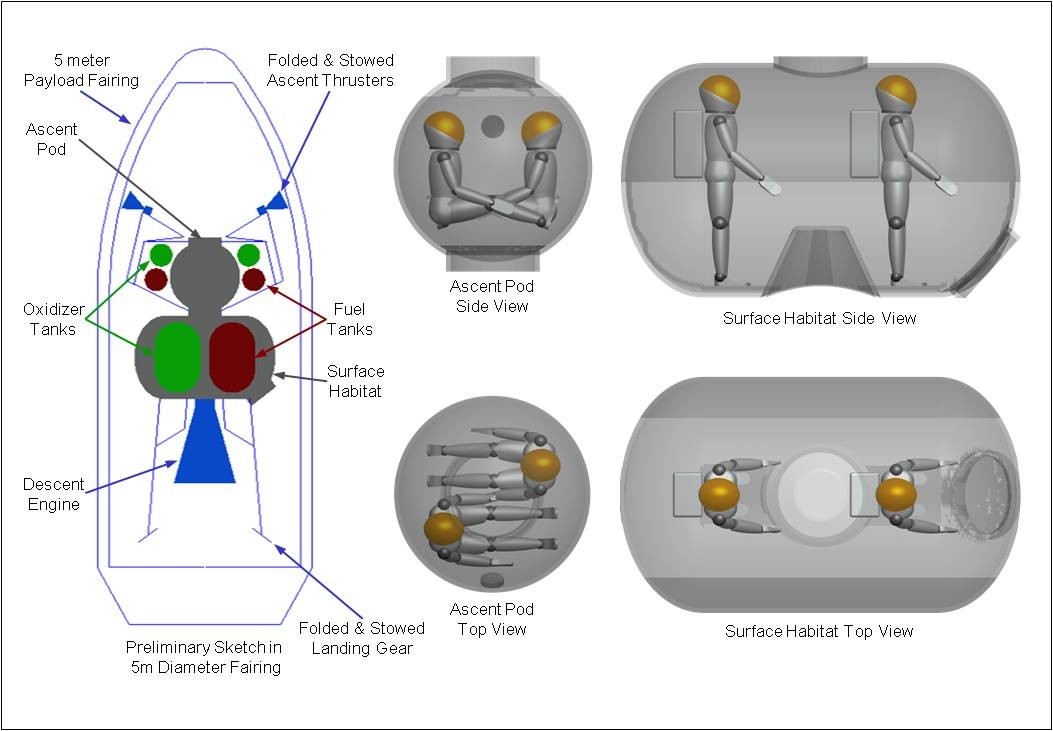
Northrop Grumman preliminary schematic shows a 'minimalist' ascent pod with surface habitat concept packaged in a 5-meter payload fairing. The pressurized compartments and propellant tanks easily fit in available space. Ascent thrusters are mounted on outriggers that are folded up to fit in the payload fairing and the landing gear is folded inward. Also shown are initial side and top views of the ascent pod “Pumpkin” and the surface habitat with crew members in pressure suits [Northrop Grumman].
Ben Evans
AmericaSpace

More than four decades since its last human-piloted craft touched down on the Moon, Northrop Grumman has concluded a feasibility study of a new commercial landing vehicle for the Golden Spike Company. It includes a novel, low-mass ascent stage concept, dubbed “Pumpkin”, and centers on the need to be packaged within a 5-meter payload fairing envelope, as well as offering insights into the kind of propellants necessary to accomplish Golden Spike’s goal of bootprints on the lunar surface by 2020.

Unveiled to the world last December, after several months of excited speculation, Golden Spike was founded by Alan Stern, associate administrator for NASA’s Science Mission Directorate in 2007-2008 and principal investigator for the agency’s New Horizons voyage to Pluto, and includes former Apollo flight director Gerry Griffin as chair of the board. It seeks to develop a capability to send astronauts from U.S. and foreign space agencies, corporations, governments and even private individuals on two-person expeditions to the Moon, at a cost of $1.5 billion. Within weeks, in January 2013, Golden Spike announced that it had contracted with Northrop Grumman to begin lunar lander design studies.

It was a notable move, for the Falls Church, Virginia-based aerospace and defense contractor is the only organization in the world to have successfully developed and flown a piloted craft to the surface of the Moon. Its Apollo lunar module ferried six pairs of astronauts to the dusty surface of our closest celestial neighbor between July 1969 and December 1972.

Tuesday, April 16, 2013

Golden Spike, no longer 'Waiting for Godot'

Rather than continuing to wait on a traditional government space exploration program, Golden Spike believes it’s time to turn to commercial ventures to enable human space exploration. In their scenario, using the lunar orbit rendezvous and return method, a single stage lander would be launched separately from crews and remain in lunar orbit for future expeditions [Golden Spike].
S. Alan Stern and Homer Hickam
The Space Review

We’ve both had long careers in the space field. And almost all of that time, most people in our industry have been waiting for government space agencies to return humans to the Moon and to go on to Mars—boldly exploring new worlds, inspiring a new generation, and creating a robust future for space exploration.

It hasn’t happened.

 Why? The reasons are many, but after observing a long series of false starts and dashed attempts, we’ve concluded that relying on the 1950s and 1960s model of space exploration led primarily by central governments, is a little like Samuel Beckett’s play Waiting for Godot. In that story line, two characters, Vladimir and Estragon, endlessly wait in vain for the arrival of a character named Godot. Well, it’s not just in Beckett’s novel, because in space exploration the 1950s–1960s model, Godot isn’t coming either.

Fortunately, 21st century industry and entrepreneurs are stepping up to the plate, creating exciting new models for how human space explorations can be launched commercially.

Just read the papers, it sounds like science fiction—companies planning suborbital space lines, private space stations, and a private expedition to fly past Mars. In the case of our company, Golden Spike, privately mounted lunar surface expeditions to be sold primarily to foreign space and science agencies, but also to US and international corporations, and wealthy individuals.

And why not? Back in the heady days of Apollo’s Moon race, the hard part was the technologies that had to be invented to make it all possible. Today, those technologies are well in hand. The hard part of today’s Moon shots and other commercial space exploration is raising the capital for large ventures.

Read the full article, new this week at The Space Review, HERE

Monday, March 18, 2013

Golden Spike and LPI schedule 2013 conference

Notional view of NASA's recently-abandoned Altair lunar lander, on a pad in the Moon's high northern latitudes formed from sintered regolith. Golden Spike Company announced in January Altair's designer Northrup Grumman to initiate design work on a manned lunar lander to return to the Moon by 2020.
The Golden Spike Company of Boulder, Colorado has announced an international workshop next October "to explore the kinds of landing sites, experiments, and geological traverses their astronauts should undertake on the Moon starting in 2020."

The two-day seminar will be held at the Lunar and Planetary Science Institute (LPI) in Houston, October 3-4, 2013.  

The program committee includes Alan Stern, Golden Spike CEO and President, Steve Mackwell of the Lunar and Planetary Institute, Clive Neal of Notre Dame, William McKinnon of Washington University, Amand Mahesh of Open University, Dr. Daniel Durda of the Southwest Research Institute (SwRI) and James Carpenter of the European Space Agency.

“We’re excited to announce this workshop, which will seek input from lunar researchers from across the world regarding scientific priorities for Golden Spike expeditions, Stern said. "We also expect this workshop to multiply interest in our missions from science and space agencies across the globe.”

“It is great to be part of the beginning of a new age of space exploration where commercial entities step up as key enablers of manned exploration of the solar system, and it is so appropriate this first meeting will be held at the Lunar and Planetary Science Institute, with its roots in the Apollo era,” Mackwell added.

The workshop will consist of plenary and a poster sessions organized around topical themes, invited presentations, and discussion panels. Stern and Golden Spike’s board chair Gerry Griffin, former director of the Johnson Space Center in Houston, will offer a public presentation about Golden Spike, Thursday evening, October 3.

More information about this workshop, including an opportunity to provide an expression of interest in attending and potentially speaking, can be found HERE.

Related Posts:
Golden Spike taps Northrup Grumman to design manned lunar lander
(Ben Evans, AmericaSpace, January 13, 2013)
Turning science fiction to science fact (Jeff Foust, The Space Review, December 11, 2012)

Tuesday, December 11, 2012

Turning science fiction to science fact: Golden Spike makes plans for human lunar missions

Golden Spike proposes to land humans on the surface of the Moon commercially as soon as 2020, for a price tag that has raised eyebrows—and some skepticism [Golden Spike Company].
Jeff Foust
The Space Review

The last 12 months has seen the unveiling of a number of commercial space ventures whose audacious plans can’t be immediately dismissed given the technical and financial pedigree of their founders and backers. Almost exactly a year ago, Microsoft co-founder Paul Allen announced the formation of Stratolaunch Systems, an air-launch system that requires the development of the world’s largest airplane. Allen assembled a team that included Scaled Composites and, originally, SpaceX (since replaced by Orbital Sciences), with a board that included Burt Rutan and former NASA administrator Mike Griffin (see “Stratolaunch: SpaceShipThree or Space Goose?”, The Space Review, December 19, 2011). In April, Planetary Resources announced plans for a series of robotic missions to prospect and, eventually, mine asteroids. That company has an impressive list of investors, including Google’s Larry Page and Eric Schmidt as well as Ross Perot Jr. and former Microsoft executive and two-time space tourist Charles Simonyi (see “Planetary Resources believes asteroid mining has come of age”, The Space Review, April 30, 2012).

Yet, the goals of these startups—a giant air-launch system and missions to prospect and mine asteroids—pale in comparison to the goal of another new space startup: sending people to the surface of the Moon. That feat has been accomplished only six times, and by one nation, the United States, with the last such mission, Apollo 17, flying 40 years ago this month. At the time, it was a potent symbol of America’s capabilities, and one of the signature achievements of the 20th century. The scale of that accomplishment, in many respects, grows as the decades stretch on without anyone else repeating it.

Given those factors, the idea that a human landing on the Moon could be done commercially, and for a fraction of the cost of Apollo or any more recent proposal, hardly seems credible. However, like those other firms, the plans of Golden Spike, the company that formally announced last week its desire to carry out such missions starting as soon as 2020, can’t be easily dismissed. The company has assembled an impressive team, including an Apollo veteran and others with experience in technology, science, policy, and finance. But can this lunar A-team overcome what are likely to be giant technical and financial obstacles?

Read the full article at The Space Review, this week, HERE.

Thursday, December 6, 2012

Golden Spike Company's formal announcement, plans privately-funded commercial exploration of the Moon


Golden Spike Company announces plan for privately-funded commercial exploration of the Moon.

From the December 5 press release:

On the eve of the 40th anniversary of the launch of Apollo 17, the last human exploration of the Moon, Former Apollo Flight Director and NASA Johnson Space Center Director, Gerry Griffin, and planetary scientist and former NASA science chief, Dr. Alan Stern, will unveil "The Golden Spike Company" – the first company planning to offer routine exploration expeditions to the surface of the Moon by the end of the decade. The executives will describe its team of leading aerospace engineers and world-class scientists, the mission architecture, and the business model at a media conference at the National Press Club, Bloomberg Room, from 2-3pm on December 6. The Golden Spike Company is a US-based commercial space company incorporated in 2010. It is named after the ceremonial final spike that joined the rails of the First Transcontinental Railroad across the United States, on May 10, 1869, and opened up the frontier to new opportunities. Similarly, Golden Spike intends to break new ground and create an enduring link to the next frontier, providing regular and reliable expeditions to the Moon at prices that are a fraction of any lunar program ever conceived of before.

Monday, July 16, 2012

Changing the Conversation about the Economic Development of the Moon

Dennis Wingo, from video interview,
May 2010
[moonandback media].
Dennis Wingo
SkyCorp

It is time to throw down the gauntlet as they say, regarding the Moon. It is my firm conviction that the industrialization of the Moon is the necessary and logical first goal of the second American space age.  The industrial capability of the Moon and its near space environs can now be developed. The industrialization of the Moon paves the way for reusable human interplanetary spacecraft, large communications and remote sensing platforms in geosynchronous orbit, and the settlement of Mars.  By introducing reusability of the in space segment of all of the elements we transform the first human landing on Mars from a heroic flags and footprints publicity stunt into the first wave of human economic development and colonization of the solar system.  By enabling the development of large platforms in GEO orbit we further leverage the existing $300 billion per year existing economic value of this space real estate.  In short, we transform our current primitive level of space technological development away from the throw away space junk creating model to one wherein we can finally develop the potential of the space economy.

Adapting New Technological Advances to Lunar Industrialization and Mars Settlement - It is my position that we have the technological wherewithal to utilize the most recent and unheralded dramatic advances in robotics, computer controlled manufacturing, and 3D printing technologies. These developments have pushed us pass the critical mass necessary to create a flourishing lunar manufacturing outpost. An example of this is a three D printer that can print metal.


Many of the superalloys used in advanced military systems have a heavy vacuum as one of the processing steps. Most if not all of the base elements needed are plentiful on the Moon.

http://www.feinguss-blank.de/english/technologies-solutions/casting/superalloys/


With the abundant titanium, aluminum and other elements on the Moon coupled to e-beam and other additive 3D printing technologies it is easily possible with the technology we have in hand that to build large, super strong structures on the Moon, launch them into orbit with a reusable lunar RLV and assemble them into a Mars cycler that can be used multiple times as a ferry to move people to Mars, and then return to Earth orbit (probably Earth Moon Libration point 1), where the next set of people and or cargo can be sent.

In this fashion Mars would be transformed into a viable destination for human settlement.
Catch the full article, HERE.

Thursday, April 12, 2012

Staking a claim on the Moon


Jeff Foust
The Space Review

A long-running cause célèbre of some elements of the space advocacy movement has been the issue of private property rights, or the lack thereof, beyond Earth. Despite the existence of many private ventures that are happy to sell you plots of land on the Moon or other worlds, there are no recognized claims of property on those celestial bodies. The Moon Treaty of 1979, for example, explicitly prohibits any entity, government or commercial, from claiming any territory on the Moon.

While that treaty has been ratified or acceded to by only a handful of countries, the older Outer Space Treaty (OST), widely accepted by all major spacefaring countries, prohibits countries from making any claims of national sovereignty over the Moon or other celestial bodies. Without any nation claiming territory on the Moon, the conventional wisdom goes, there is no national government that can register or recognize claims made by individuals or companies to property there. Changing that situation would require amending the OST, a process that would likely be drawn-out, messy, and unpredictable.

Or does it? A white paper released last week argues that private property claims to territory in outer space could be consistent with the OST, provided the US passed legislation to recognize those claims. Such legislation could enable private entities inside and outside the US to claim property of the Moon, thus enabling greater private development in space. Others, though, while acknowledging the need for private property rights on the Moon, say the loophole that this proposal exploits doesn’t actually exist.


A loophole in the OST? Read the article HERE.

Bolden: Moon to be a private colony

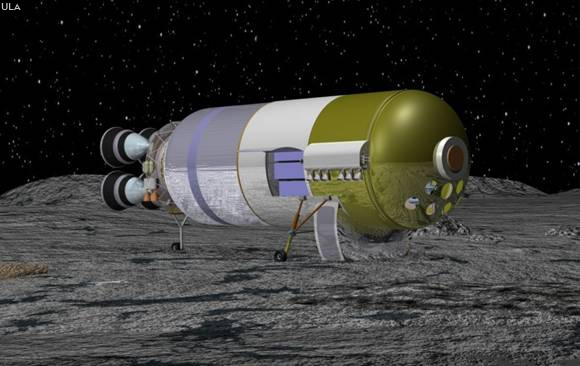
The Crewed United Launch Alliance DTAL (Dual Thrust Axis Lander), as proposed in 2010 [ULA].
Doug Conway
The Australian/AAP

When mankind colonizes the moon, it's likely to be led by a commercial enterprise rather than a government. So says NASA administrator Charles Bolden, who believes nations will no longer venture into space alone, but in collaboration with each other and with private industry.

Maj-Gen Bolden, who flew into orbit four times on the US space shuttle program which ended last year, says governments will lead the way in space exploration, but not in getting access to space.

"We have now got to the point where NASA should have nothing to do with it (access to space)," he said in an address today at Sydney University.

"We have run the tests, we have been flying for 50 years, we know basically how to get humans off the planet and into low-earth orbit. Our private industry partners have built every single space craft we have ever flown.

"NASA has never built a single human-rated space craft."

Read the article HERE.

Wednesday, June 15, 2011

"One small step" to settlement


Learning to live off the land on the Moon. A strategic human necessity.

Paul D. Spudis

The Once & Future Moon
Smithsonian Air & Space

At the recent International Space Development Conference in Huntsville, Augustine committee member and CEO of XCOR Aerospace Jeff Greason gave a talk on the goals of human spaceflight. While he discussed many things that I agree with (in particular, making the use of off-planet resources a high priority), one idea in particular stood out. Greason said that we need some type of long-range goal or objective for our national civil space program. Picking up on a statement by his Augustine colleague Chris Chyba, Greason suggested that “settlement” should be the goal of human spaceflight; if not, “what the hell are we doing it for?”

This observation naturally went over well with the crowd at the ISDC and the subsequent posting of a video of Jeff’s talk sent many space cadets of the internet into spasms of joy that someone would finally state in public the True Belief – humanity’s destiny is among the stars. Finally, out of all the confusion and bickering about heavy lift launch vehicles, depots, destinations, and crew vehicles, we have at last a clear articulation of the direction and purpose for the human space program.

There’s only one problem: it’s not the right goal for NASA.

First, let there be no misunderstanding. I agree that settlement and the expansion of humanity into space is indeed a noble and desirable thing — I call it the “ultimate rationale” for human spaceflight. By that, I mean that the idea of people going into space to live there, wherever our desires and aspirations may lead, is an objective of our species, a desire to spread human culture beyond its planetary cradle into the cosmos. That’s a different concept than making space settlement the objective of NASA’s human spaceflight program. I do not think such is an appropriate goal for a federal program that competes with all the other projects in the discretionary budget.

To most outside space circles (as well as to a surprisingly sizable number within the space community), space is a hostile, barren wilderness, with no harbor for man and his works. Their solution is to build machines that can be sent to return information from which we will decipher the secrets of the universe. Moreover, these people can think of at least two dozen different things they would rather spend that money on; you can bet that dreams of space settlement would fare poorly in comparison.

Another problem with “settlement” as an objective is that the metrics for success are difficult to define. When is space “settled” – when a single human lives permanently off planet? When a community is thriving on another world? How large a community and where? Buying into settlement as our goal means making a permanently moving target your objective; no matter what milestone is reached, you’ve never actually achieved your “goal” of settlement (for a current implementation of this mentality, see “Search for Extraterrestrial Life”).

Finally, settlement is a poor goal for a federal space program because it is so distant. No one seriously believes that humans will live in space or on another world permanently within the next several decades. Government programs can barely tolerate time horizons beyond one presidential term, let alone a multi-decadal trek through near-space. True enough, we can devise a program that delivers significant milestones toward the goal of space settlement within such time frames, but with such a nebulous end point receding into the distant future, it will lose its luster and consequent political support very quickly.

In contrast to Greason’s proposed “settlement strategy,” I have tried to frame a slightly different path for our national space program. Our “goal” is to expand human reach beyond LEO, first into cislunar space and then into interplanetary space (by “reach,” I mean the routine access of people and machines to any point in space where we need or want these capabilities to do whatever job we need to.) The “strategy” to accomplish this extension is to establish a resource-processing base on the Moon to make fuel for a cislunar space transportation system. A “tactical” implementation of this strategy is a robotic ISRU architecture, which will create our first foothold on another world.

What is the advantage of this path over Greason’s settlement sequence? For one thing, we can accomplish it much sooner than human settlement of space will ever occur; an operational lunar resource processing base can be up and running within 10-20 years of program initiation. Second, a space faring transportation system is relevant to critical national needs, specifically, our ability to maintain and extend the constellation of economic, scientific, and national strategic satellite assets that reside in cislunar space. By adopting this goal, we start from a position of political strength: we don’t have to convince Congress about our destiny among the stars, we just have to point out the critical dependence of modern technological civilization on our satellite assets in the volume of space between LEO and the Moon. Right now, those satellites are all designed as one-offs: build, launch, use, and discard. We want to change that template to build, extend, maintain and expand. Developing lunar resources to fuel a space transportation system allows us to do this and more.

By doing these things we lay the groundwork for space settlement. All agree that settlement requires the ability to access and use local planetary resources. Going to the Moon to harvest its polar water begins that process. If you want to look upon this as the first step in the settlement of the Solar System, be my guest. But I suggest that making lunar return relevant to important national economic and security objectives is more likely to help consolidate political support than setting the goal of “settlement” as NASA’s objective. NASA’s founding charter, the Space Act of 1958, lays out many different objectives and goals for the agency; space settlement is not one of them. But routine access to cislunar space is; cislunar space is specifically mentioned in the new NASA Authorization Act of 2010.

Settlement is a valid long-term goal for humanity in space – but we must have something with a practical and political payoff in the near-term.

Originally published June 3, 2011 at The Once & Future Moon, (Smithsonian Air & Space). Dr. Spudis is a Senior Staff Scientist at the Lunar and Planetary Institute in Houston. The opinions expressed are more informed than average.

Wednesday, May 4, 2011

Designed for the Moon, ready for Fukushima?


According to DigiInfo, Japan is considering sending in the Tri-Star IV into the plants. Originally developed to collect rock samples from the moon, the Tri-Star IV's light and simplistic design along with its sheet metal and canvas wheels would be more than capable of overcoming any rugged terrain. Follow the story HERE.

Tuesday, April 12, 2011

A Rationale for Cislunar Space


Hughes communications satellite HGS-1, left in a useless transfer orbit by launch vehicle failure in 1997, finally reached GEO in 1998 by using lunar flyby gravity assists, the first commercial use of the Moon in history [Hughes].

Paul D. Spudis
The Once & Future Moon
Smithsonian Air & Space

At a recent workshop on lunar return, a critical part of the discussion focused on the need for a statement of purpose – a value proposition for the Moon. Over the years I’ve attempted to distill my rationale for lunar return (my “elevator speech” if you will) into a clearly stated and persuasive argument about the need for enabling human reach beyond low Earth orbit – into all the areas between Earth and Moon (cislunar space) where all of our satellite assets reside. So, as the elevator doors are closing, I will state my Rationale for Cislunar Space:

1. Space satellite assets in orbit beyond LEO benefit society. Modern industrial life depends on satellites of various types and purposes – space assets for global communications, weather monitoring, scientific exploration and national security.

2. Earth’s deep gravity well is a significant cost deterrent to expanded activities in space. Beyond LEO mission launch mass is mostly propellant. We remain mass- and power-limited and therefore capability-limited as long as we are tied to the current spaceflight template of launching everything we need from Earth’s surface. Regardless of launch costs, the size and capability of a given space asset is dictated by the size of available launch vehicles.

3. Human- and machine-assembled satellites can be as big and as capable as needed and unlimited by launch vehicle size. The advent of human servicing and assembly in space, for which we now have documented proof (after 30 years of the Shuttle program and construction of the International Space Station) gives us options and frees us from launch vehicle constraints on volume and mass. Once we are able to get people and machines to those places in space where assets are needed, we can build expanding, maintainable and extensible space systems on site.

4. Currently we cannot routinely access orbits beyond LEO with people and machines to build and maintain such satellites. We use all the propellant of a given launch vehicle just getting people to LEO. At LEO, a new vehicle – already fueled – will be needed to reach various “high” orbits of cislunar space (home to current and future satellites) including geosynchronous orbit, the 36,000 km high orbits at which communications and other global monitoring satellites orbit. At these spots, a single orbit takes 24 hours, the same time as the rotation period of Earth. Such satellites appear to “hover” over one spot on the ground and a dish antenna pointed at their location in the sky never has to be moved to track it.

5. The manufacture and use of propellant made from lunar materials allows for a system that will lower the cost for new space activities, enable routine access to and from the surface of the Moon – give access to all other points in cislunar space, including GEO and other orbits useful for space assets – and open up an avenue for routine human interplanetary flight (i.e., to Mars and beyond). Making propellant from water retained at the lunar poles permits us to set up a logistics base on the Moon, creating routine access throughout cislunar space. In terms of energy, there is very little difference between going from LEO to the aforementioned geosynchronous orbit and lunar orbit.

6. The Moon offers other material and energy resources needed to create new space faring capability, including regolith aggregate, glass and ceramics, metals and solar cell fabrication. We can make composite and ceramic materials from lunar soil by sintering the regolith into parts and structures. Metals can be extracted from lunar rocks and used for construction on the Moon and in space. Engineers have created a roving vehicle that uses lunar soil to make in-place solar cells for the generation of electricity. This ability allows us to create vast photovoltaic arrays for the generation of gigawatts of electrical power. These resources, in addition to the water used for propellant production, are all present and available on the Moon.

7. Both robotic and human presence is required on the Moon to enable and maintain production from lunar resources. I’ve worked in “unmanned” spaceflight for over 30 years. While a firm believer in the utility and possibilities of robotic operations controlled from Earth, I also know that sometimes these robots require human ingenuity and interdiction to work properly. The servicing of the Hubble Space Telescope by Shuttle astronauts has shown us how important people can be to the success of space operations. We can start a lunar return through the use of teleoperated robots, but ultimately people will be necessary to creatively manage operations as well as for getting them back on track when they falter.

8. By establishing a permanent presence on the Moon, we create a “transcontinental railroad” for cislunar space – a reusable, extensible and maintainable (thus, affordable) transportation system. Virtually any scenario for human missions beyond LEO requires a spacecraft carrying hundreds of tons of propellant. This propellant can be made off-Earth from lunar resources and launched from the Moon’s weak gravity well to depots in cislunar space. No rational technical argument can be made that the Moon is a roadblock. And from a monetary perspective, building an extensible cislunar transportation infrastructure gives us both capability and return on our investment.

9. Developing a program to utilize off-planet resources will drive new technology, expand economic growth and assure democratic pluralism survives on the frontiers of space (neither totalitarianism nor corporatism). For fifty years the U.S. civil space program has served national prestige, launched massive economic and scientific growth through technological innovation, and nurtured international cooperation in many areas. We cannot however, continue to assume that free market capitalism will remain the dominant political paradigm in space. There are other space powers that do not share our views about individual freedoms and economic opportunity, nor do they necessarily care about the importance or need for property rights and contract law – values needed to maintain free societies. There may be no individual liberty or free market enterprise if America does not maintain a strong leadership presence on the growing space frontier.

The report of the Augustine committee concluded that human expansion into space was the ultimate (and in fact only) rationale for manned spaceflight. I agree. The elevator doors are opening now so I hope my argument for lunar return has persuaded you that America has the opportunity to prosper, to create a space economy and help shape humanity’s future by utilizing the Moon to develop cislunar space.

Thursday, March 3, 2011

Astrobotic's Guide for lunar payload developers


Lander-rover architecture by Astrobotic Technology, a leading competitor for the Google Lunar X-Prize [Astrobotic Technology, Inc.]

Astrobotic Technology today released a new guide for researchers on preparation of their instruments for the company's planned December 2013 robotic expedition to the surface of the Moon.

The expedition, based on technology from Carnegie Mellon University, will carry up to 240 pounds of science, engineering, and marketing payloads. Any university, government agency or company is eligible to purchase payload accommodations on the December 2013 flight.

"To get their sensors and experiments to the lunar surface, researchers have had to propose entire missions to space agencies such as NASA or the European Space Agency," said Astrobotic president David Gump.

"This initiative allows engineers and scientists to focus on just their own instruments, with Astrobotic providing the delivery and support utilities like power and communications. They can buy just what they need from us by the pound, watt, and byte."

Last month Astrobotic announced that it has signed a contract with SpaceX to launch its mission on a Falcon 9 rocket, the same vehicle that NASA will use to send supplies to the International Space Station. The Falcon 9 will throw the Astrobotic spacecraft into a lunar trajectory for a four-day cruise to the Moon.
Read the full release, HERE.

Monday, March 15, 2010

Astrobiotics has 'Space Available'

Astrobotic Technology has carry 109 kilograms-capacity for sale as part of a payload the company is preparing to fly on a maiden voyage to the lunar surface in a 2012 bid to win the Google Lunar X Prize.

"Science instruments, prototype exploration devices and commercial packages will be carried at $700,000 per pound, plus a $250,000 fee per payload to cover engineering" costs of integrating the package with either the expedition’s solar-powered surface rover or landing bus.

"The company posted a technical description of the service on its Web site, along with a “Request for Information” asking potential users to characterize how they would use this capability," according to Astrobiotic's David Gump

"Celestis Incorporated has already reserved 11 of the 240 pounds on the initial Moon mission," Gump wrote. "Houston-based Celestis operates a space burial service for cremated remains, with eight missions thus far to the Moon, Earth orbit or a suborbital trajectory.

Read the Story HERE.

Wednesday, December 9, 2009

Branson wants to fly customers to the moon

John Gapper
FT.com/gapperblog

Richard Branson is an ambitious man. Ask him about the potential for his Virgin Galactic business – as I did at the unveiling of his space capsule in the Mojave desert in California on Monday – and he does not hold back.

Virgin Galactic has ordered five vehicles that can take six passengers into sub-orbital flight about 110km above the earth’s surface at a time. But Sir Richard thinks that, in 10 years’ time, it could have 40 of the six-passenger craft flying twice a day each.

And that is only the start: Jump HERE.

Wednesday, October 28, 2009

Australian astronaut says Ares test 'could help put tourists on the Moon by 2020'

Carly Crawford
news.com.au

The test launch of Ares I-X, now expected to take place Wednesday morning, will deliver NASA vital technical information that could help set up a manned space station on the moon within a decade. Australian astronaut Andy Thomas says the groundbreaking booster test could help put tourists on the moon by 2020.

Thomas, 58, said moves towards commercial funding for NASA could mean tourists would have the chance to experience space soon after professional astronauts arrived on the moon.

"Once we have that kind of commercial activity, it's inevitable that we'll see space tourism," he said.

He said existing space tourism – such as the kind promoted by Virgin boss Richard Branson – was not true space exploration.

"What he's doing is really high altitude aircraft," Adelaide-born Thomas said.

A high-level US government review of NASA's human space program last week suggested using private money to send astronauts into space.

"It is very much in the interest of the US to commercialize access to low Earth orbit," he said.

Thomas was aware of a select few entrepreneurs and financing firms that had flagged their interest in sponsoring space programs with the US government.

If skies clear at Cape Canaveral the $382 million Ares I-X will blast off on a two-and-a-half-minute flight designed to test a new five-segment Solid Rocket Booster and a controversial configuration hopefully settling disputes about possible crew-threatening thrust oscillation.

A presidential panel last week supported the Ares I-X test flight, but questioned the need to use the Ares I rocket, part of the Constellation program. The panel questioned the cost and design of the craft as well as its necessity.

Saturday, September 5, 2009

"Actually, it will be the Congress..."

NASA may outsource amid budget woes
Andy Pasztor
Wall Street Journal

"While the Obama administration is still mulling options and hasn't made any final decisions, such a move would represent a major policy shift away from decades of government-run rocket and astronaut-transportation programs such as the current space-shuttle fleet. By some estimates, the Administration's current spending blueprint for manned space exploration over the next decade is between $30 billion and $50 billon less than federal officials first projected when President George W. Bush unveiled a plan to return astronauts to the moon."

"Responding to questions, on Saturday the White House press office said the President "has confirmed his commitment to human space exploration" and is reviewing various options. "But at the end of the day, the President will make the decision, not a committee."

Read the article HERE.

Saturday, August 22, 2009

Outsourcing the Moon and ISS

The private sector and
the future of Space Exploration


James Heiser
The New American

An article at Wired.com (“Rocket Booster: Let Private Sector help NASA”) keeps a free-market focus on the future of American space exploration: “After leading the way in the human exploration of space for nearly 50 years, the future of U.S. manned space flight is in question. The space shuttle makes its last flight next year. After that, NASA must rely on the Russians to put astronauts in space. Unless the country looks to the private sector.”

With delays in the manned space program that have pushed the development of NASA’s replacement for the shuttle to 2015, the future of the space agency is at a crossroads. One possible direction that could be chosen leads toward the private sector: “So with manned space flight going on hiatus next year and some saying NASA needs a big infusion of cash to continue manned space flight, another option is emerging: NASA could use commercial ventures like SpaceX to deliver cargo and people to the space station.”

Read the full analysis HERE.

NASA may outsource amid budget woes

Andy Pasztor
The Wall Street Journal

For the first time since the advent of manned space exploration, the U.S. appears ready to outsource to private companies everything from transporting astronauts to ferrying cargo into orbit.

Proposals gaining momentum in Washington call for contractors to build and run competing systems under commercial contracts, according to federal officials, aerospace-industry officials and others familiar with the discussions.

While the Obama administration is still mulling options and hasn't made any final decisions, such a move would represent a major policy shift away from decades of government-run rocket and astronaut-transportation programs such as the current space-shuttle fleet. The White House press office didn't have any immediate comment.

In the face of severe federal budget constraints and a burgeoning commercial-space industry eager to play a larger role in exploring the solar system and perhaps beyond, these people said, a consensus for the new approach seems to be building inside the White House as well as the National Aeronautics and Space Administration.

Under this scenario, a new breed of contractors would take over many of NASA's current responsibilities, freeing the agency to pursue longer-term, more ambitious goals such as new rocket-propulsion technology and manned missions to Mars.

Read the full article HERE.

Friday, August 21, 2009

Out of the Cradle interviews Will Pomerantz on Google Lunar X PRIZE

Second in a series of Lunar Editions of EVA Interviews:
The Business of the new Space Age
Read the Interview, HERE.

Thursday, August 13, 2009

Burt Rutan talks about commercial Moon-orbit

"I want to see people flying their kids in space," the engineer said. "Kids should be inspired by phenomenal things that happen." He also said the space-tourist business should be based on volume. "(Volume) is the only thing that hasn't been done in space," he said. The visionary designer hopes such a volume business will fund his ultimate goal — an orbiting hotel. The hotel could provide shuttle trips to orbit the Moon at extremely low altitudes."

Read the Feature in "Astronomy,"
by executive editor Dick McNally