Showing posts with label Mare Humorum. Show all posts

Thursday, April 4, 2013

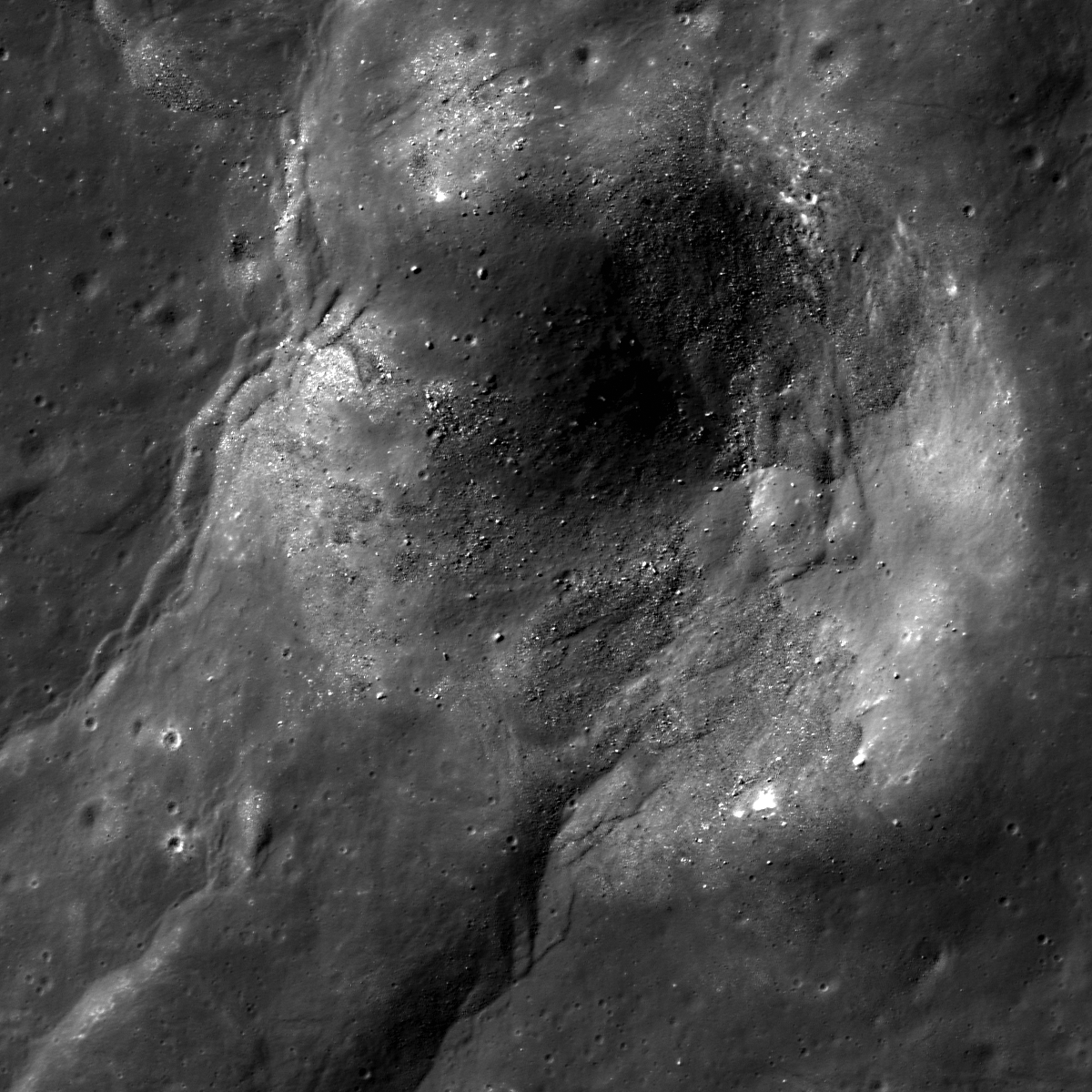
Downhill creep or flow on the floor of Vitello?

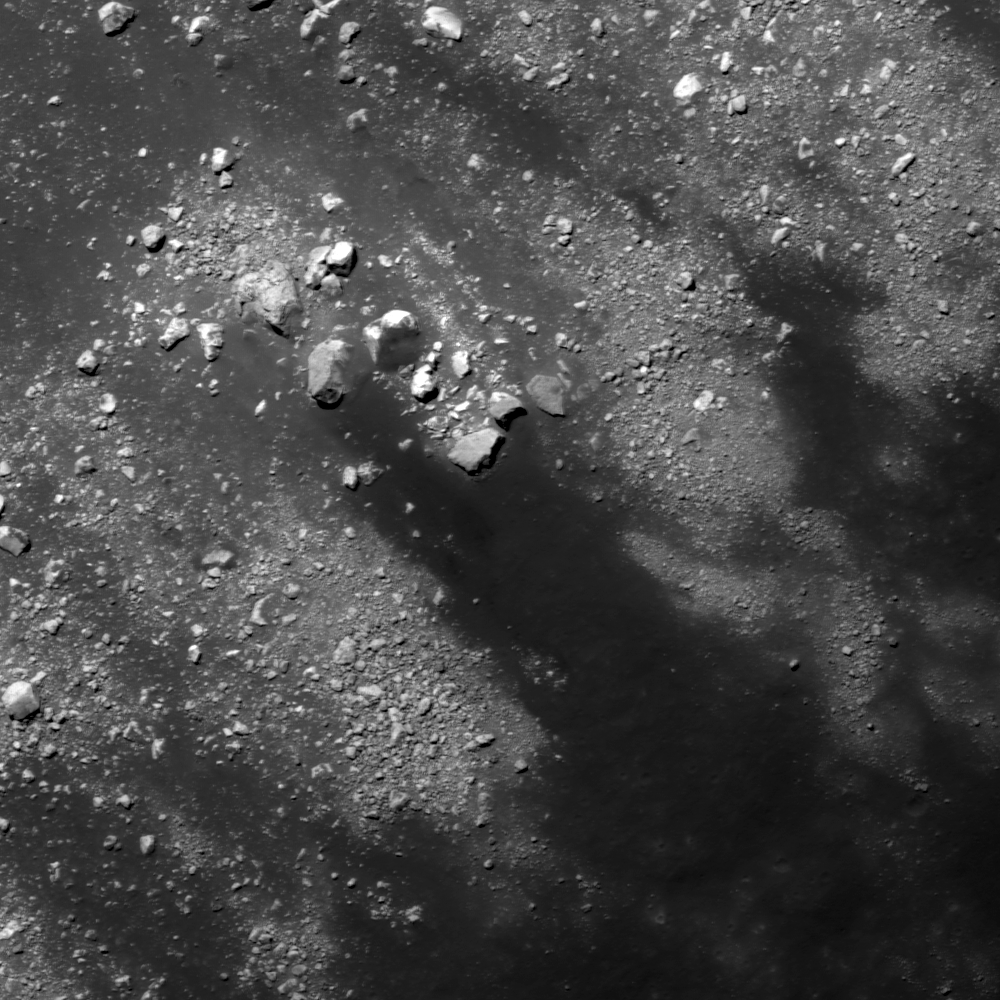
Southern slope of a fracture developed in the floor of Vitello crater, on the south side of Mare Humorum. Downward slope is toward upper left in a 640 meter wide field of view centered on 30.214°S, 322.352°E, LROC NAC M1101460425L, LRO orbit 14652, September 5, 2012; angle of incidence 31.65° over 0.64 meters resolution, from 61.86 km  [NASA/GSFC/Arizona State University].
Hiroyuki Sato
LROC News System

Vitello crater is a floor-fractured crater (42.5 km in diameter), located at the south edge of Mare Humorum.

As seen in the LROC Wide Angle Camera (WAC) context view further down, there is a circular network of fractures, with numerous branches, throughout the crater floor.

The opening images (above and immediately below) highlights a portion of north facing slopes inside one of these fractures (yellow box and arrow).

Full with of LROC NAC M1101460425L, from the corrected exploration link at the bottom of this post. The yellow square encompasses the area within the LROC Featured Image, released April 4, 2013 [NASA/GSFC/Arizona State University].
The dark materials on the floor of the crater partially cover the upper part of this fracture. The dark materials extend from the bottom right to upper left and are detoured around of a large boulder (30 by 20 meters) at the center of opening image, indicating that these materials flowed down the slope. With occasional events of slope failures or meteorite impacts, they might have flowed at once or little by little over a long period of time. But of what is this dark material composed?

The origin of floor-fractured craters on the Moon is still under discussion, but volcanic intrusions are suspected, and some of the fractures are associated with Dark Mantle Deposits (DMD), that are likely pyroclastic in origin. In Vitello crater, no clear DMD have been documented. But since the circular cracks are well developed in this crater, pyroclastics or any low reflectance materials of volcanic origin might have covered the fractured floor surface, supplying the dark materials flowing into the open cracks as seen in the opening image. 

Vitello crater and surrounding areas in LROC WAC monochrome (604nm) mosaic (70 meters per pixel) centered on 30.393°S, 322.43°E, stitched from three LROC WAC observations, from three sequential orbital passes, February 6, 2010, from just above 50 km altitude. The locations of area  in the LROC Featured Image (yellow arrow) is indicated once again [NASA/GSFC/Arizona State University].
Explore the slopes of the floor-fractured crater on the Moon in full NAC frame yourself, HERE.

Related Posts:
Rimae Posidonius
DMD Excavations
Pyroclastics and Vent
Pyroclastic Excavation
Pattern of dark deposits
Alphonsus crater mantled floor fracture
Low Reflectance Deposits on the Lassell Massif

Friday, June 8, 2012

LROC: 'A Wrinkly Crater'

An unnamed crater deformed by tectonic forces. LROC Narrow Angle Camera (NAC) M183760209L, LRO orbit 12175, February 13, 2012; image field of view 960 meters, resolution 0.8 meters. View the more detailed LROC Featured Image HERE [NASA/GSFC/Arizona State University].
Drew Enns
LROC News System

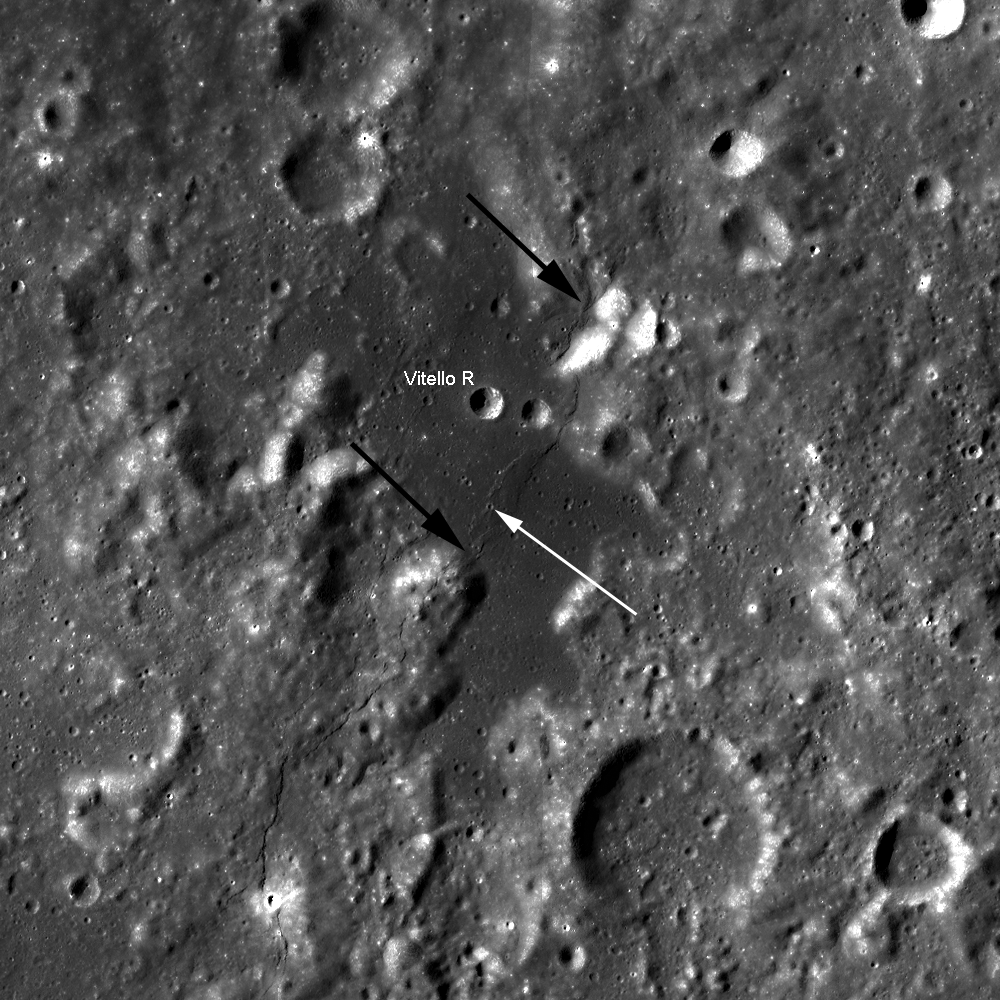
Wrinkle ridges are one of the most common tectonic features on the Moon, and they are found in the lunar maria. Today's Featured Image focuses on one wrinkle ridge, designated Vitello R from the nearby crater, deforming a small mare crater located just south of Mare Humorum. We can tell the wrinkle ridge, and associated tectonic deformation, is much younger than the mare pond as it cross-cuts and modifies the crater (the crater formed after the mare was deposited). Crater counting indicates Mare Humorum is ~3.5 billion years old, but can we say anything more definite about the timing of this wrinkle ridge's formation? Looking at the entirety of the wrinkle ridge may give us more clues.

LROC Wide Angle Camera mosaic as context for the LROC Featured Image released June 8, 2012 (FOV marked with white arrow). The wrinkle ridge can be seen transitioning into a lobate scarp when it exits the mare pond (black arrows). Field of view 58 km across. View the 100 km FOV in image accompanying the Featured Image HERE [NASA/GSFC/Arizona State University].

The wrinkle ridge shows a peculiar change in morphology as it crosses from the mare to the nearby highlands. The wrinkle ridge transitions to a lobate scarp both in the north and south! While wrinkle ridges are characterized by a broad arch with smaller associated ridges, lobate scarps are generally asymmetric landforms with a steep scarp face and shallow tailing end. Both landforms are interpreted as the surface manifestation of thrust faulting in different tectonic settings, so the wrinkle ridge and lobate scarps are probably related. A fresh crater in the bottom-left of the context image erases a portion of the western lobate scarp, but everywhere else the scarp deforms the surface. We can then infer from these observations that the wrinkle ridge-lobate scarp is both caused by a single thrust fault and is fairly young!

Explore more of the wrinkle ridge in the full LROC NAC HERE!

Related Posts:
Not Your Average Scarp
Bulging Wrinkle
Tectonics in Mare Frigoris

Tuesday, June 7, 2011

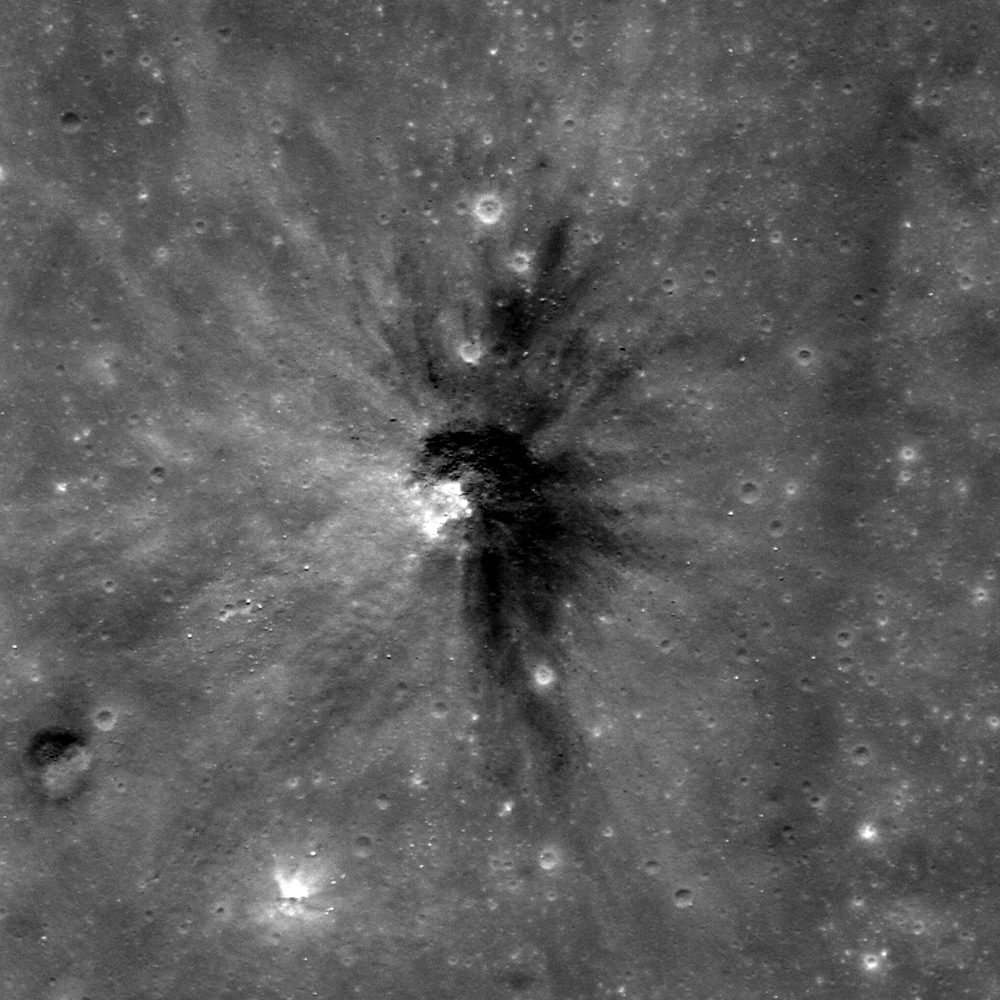
Dark-haloed crater in Mare Humorum


Dark- and light-toned lunar regolith contrasts sharply in this striking image of a dark-haloed crater in Mare Humorum (24.8°S, 315.0°E).LROC Narrow Angle Camera (NAC) observation M140203430R; solar incidence angle 24° LRO orbit 5795, September 27, 2010; field of view is around 180 meters across. See the full-size LROC Featured Image HERE [NASA/GSFC/Arizona State University].

James Ashley
LROC News System

Features such as this "dark-haloed" crater are not common on the Moon, but where found there tend to be occurrences of both mature volcanic deposits, and fresher (more recent) impact ejecta deposits. This circumstance provides clues for solving the light/dark mystery in a straightforward manner. For example, this crater is located to the north of Liebig J, a relatively young, bright-rayed crater in Mare Humorum.

The Featured Image impact clearly occurred within the Liebig J ejecta blanket, which is less mature and therefore of higher albedo than the surrounding dark mare rock. When the small impact took place, it penetrated the Liebig J ejecta and excavated the darker material from beneath.

Note that some of the material within the crater wall is actually brighter than surrounding material. This is not too unusual with fresh craters. But why was the dark ejecta not distributed in a perfectly even and symmetrical way? It would probably require the collection of samples and field mapping on the ground to answer this completely. But part of the story may be due to textural heterogeneity (clumpiness) of the Liebig J ejecta deposit in this area. When the dark-halo impact occurred, such clumpiness may have caused the impact energy to disperse in an uneven way. Note also that more recent, smaller craters have punctured through the dark ray pattern to re-expose the brighter deposits beneath. The end result is a complex local stratigraphy, but one which can be unraveled through a careful study of the effects of impacts, their energies, and locations. The context image below shows the albedo difference between the Liebig J ejecta deposits and the surrounding mare deposits.


A portion of the global WAC mosaic showing the Liebig J crater region of western Mare Humorum and its bright ejecta [NASA/GSFC/Arizona State University].

Explore the full NAC image HERE; notice the ejecta of the prominent Liebig J crater. How many similar dark-haloed features can you find?

Saturday, May 21, 2011

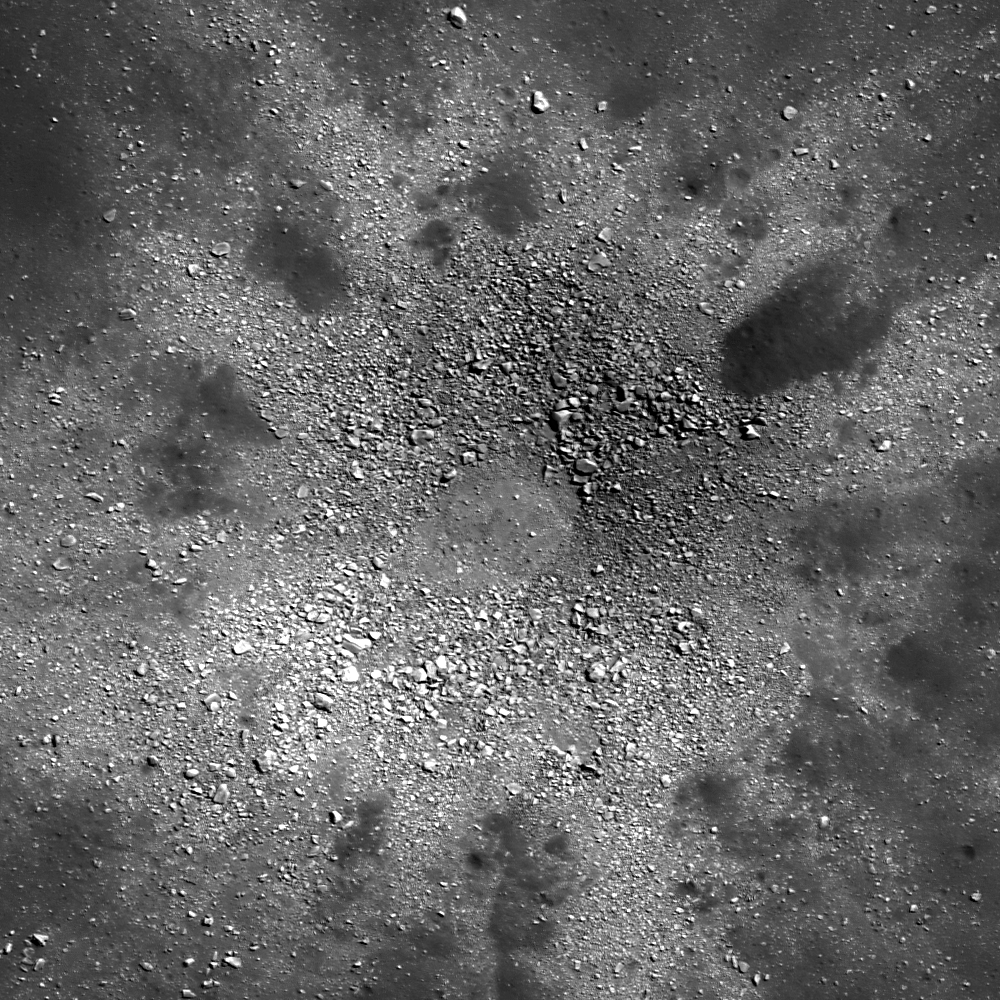
Crater in Mare Humorum


This crater, located in Mare Humorum, is relatively fresh and very bouldered. LROC Narrow Angle Camera (NAC) M157851844LE, LRO orbit 8396, April 19, 2011; field of view is 500 meters. See the full-size Featured Image HERE [NASA/GSFC/Arizona State University].

Drew Enns
LROC News System

Why is this crater so bouldered?

Bouldery craters are primarily the result of bolides impacting solid material. More cohesive materials produce larger boulders when they are impacted. Craters like these can give clues as to the thickness of the regolith. As craters increase in diameter, they excavate further into the surface. So if a crater has no boulders, it has probably excavated only regolith. This impact though has punched through the overlying regolith and fragmented the underlying mare basalt into large boulders.


An intermediate view of the subject crater belies the loss of granularity in what only appears to be the relatively smooth background of the basin floor in the LROC Wide Angle Camera (WAC) contextual view below. In high sun myriad far older craters of similar size are visible [NASA/GSFC/Arizona State University].


LROC WAC context image of the LROC Featured Image, May 20, 2011. It's field of view is the white square in this 100 km-square scene. See the full-size context image HERE [NASA/GSFC/Arizona State University].

Can you find the transition between unbouldered and bouldery craters in the full LROC NAC!

Related Posts:
Bouldery crater near Mare Australe
Fresh crater on Oceanus Procellarum
Buckland Boulders

Friday, April 9, 2010

Graben and Pyroclastics in SW Mare Humorum

A small graben (28 m in width) in a pyroclastic mantling deposit in the SW portion of Mare Humorum. The image width is 500 m. NAC frame M111885077L obtained at an altitude of 44.7 km, illumination is from the right. [NASA/GSFC/Arizona State University]

Thomas Giguere

LROC News System

Two small black arrows on today's image show the location of a small graben. A degraded impact crater (108 m in diameter) can be seen centered on the graben between the arrows. Graben are extensional tectonic features formed by the downward movement of a crustal block between two normal faults. This small graben is parallel to a much larger graben (Rima Doppelmayer I) which is 1100 m wide and located only 800 m to the west. You can also see other small graben that are parallel to Rima Doppelmayer I. All of these graben may have formed during the episode of regional extension associated with the final filling of Mare Humorum with dense mare basalt deposits. To learn more about lunar graben, visit the Featured Image for December 16, 2009.

Finally, it should be noted that the entire area shown in the image is mantled by a relatively thick (greater than 10 m) deposit of pyroclastic glass. It has been suggested that pyroclastic debris would be an excellent lunar resource, and that pyroclastic deposits would be prime sites for the establishment of lunar bases. For more information concerning lunar pyroclastic deposits, visit the LROC Featured Image for January 21, 2010.

Visit this exciting area of Southwest Mare Humorum in greater detail!