Showing posts with label Dennis Wingo. Show all posts

Wednesday, February 25, 2015

Lunar Orbiter Image Restoration Project: Last Mile

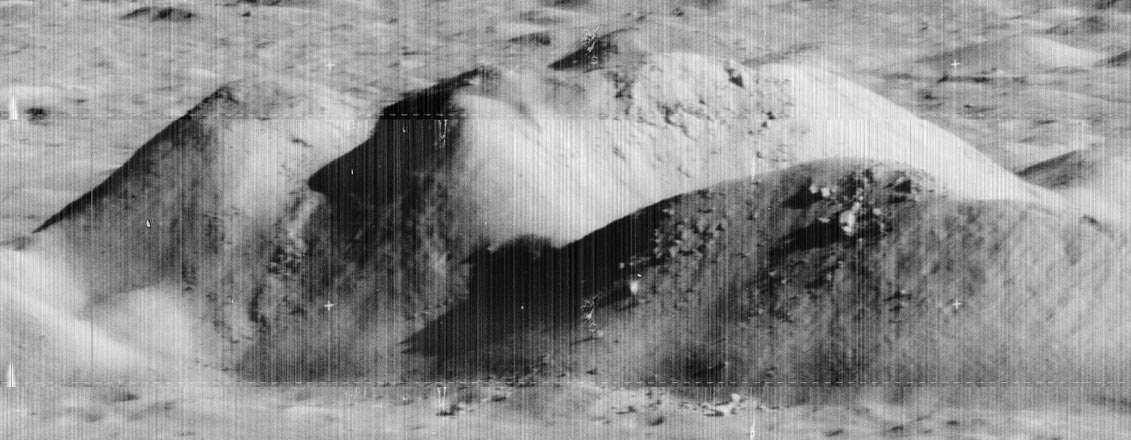
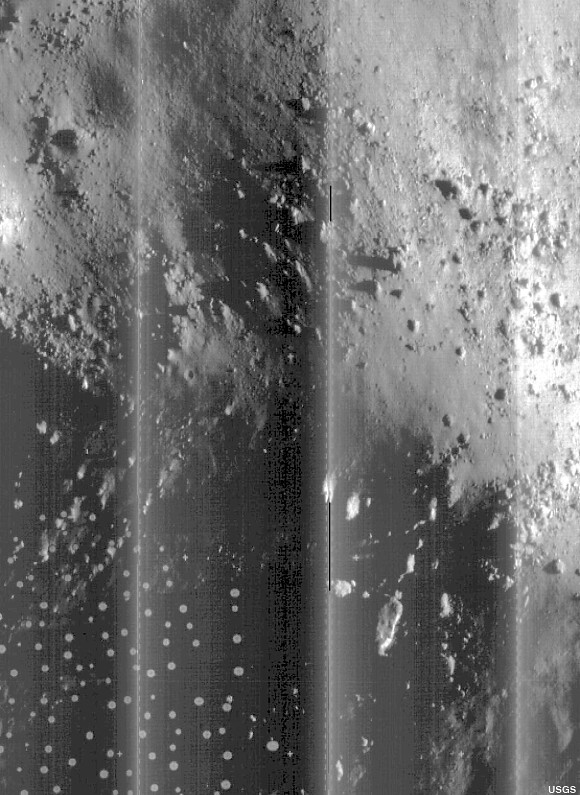
Until the original tapes were found, stored in an abandoned McDonalds Restaurant on site at Ames Research Center, and subsequently read and remastered using totally unavailable equipment built from scratch, this represents our best view of of the rugged slopes of the central peaks of Copernicus crater, a facsimile of a photograph developed in lunar orbit and radioed back to Earth from Lunar Orbiter V, August 17, 1967. For comparison, see the photographs that follow below [USGS]. 
From moonandback video, May 2010
Dennis Wingo

The Lunar Orbiter Image Recovery Project (LOIRP) is a public/private project to recover, from the original master tapes, the image data from the five spacecraft NASA sent to the moon in the 1960’s and provide it to the scientific community and the public.  The first is done through a peer review process and then the data is provided to the National Space Science Data Center (NSSDC) for archiving.  We also have a public website through NASA at the Solar System Exploration Research Virtual Institute (SSERVI) at the NASA Ames Research Center.  This missive is to explain the background of the mission, the character of the data, and why it is important to our scientific and national history.

At this time we have completed over 90% of the work necessary to archive and publish these images.  However, sometimes that last 10% is the hardest and we have in the dozens of terabytes of data to complete the processing of our image captures.  Why doesn't NASA pay for this?  They have paid for the vast majority of our work.  NASA’s Space Science Mission Directorate, NASA Ames, and and SSERVI have been magnificent in support of our work.  However, NASA’s budget is severely constrained, and for legacy projects like this, it is our work in technoarchaeology (literally the archaeology of technology) that is saving this data for posterity.
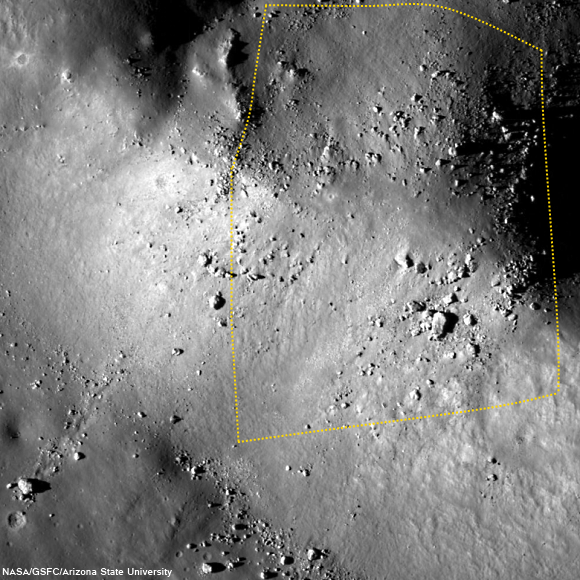
Field of view captured in by Lunar Orbiter V in 1967, shown in the image further above, outlined on a more recent photographic survey by the Lunar Reconnaissance Orbiter (LRO), LROC M181302109R, spacecraft orbit 11832, January 15, 2012 [NASA/GSFC/Arizona State University].
When we started this project, it was only to save the images of Lunar Orbiter’s II and III.  However, in 2011 NASA asked us how much it would cost to complete all five orbiters.  We estimated $400,000.  NASA provided $300,000 of this, leaving a gap of $100,000.  This is why we ask for your support in our crowdfunding effort, to complete this task.  These images, provided on the SSERVI website, will be free to the public with no copyright.  The American taxpayer paid for this effort and even though our company has also contributed materially to the effort and we are extending this through your generous donations through crowdfunding, we want this to be provided free of charge, or any intellectual property right restrictions.

Detail from LOIRP Lunar Orbiter V (Image 151-H1 -Copernicus Central Uplift) The LOIRP Image was derived from the original analog tapes from the LO ground stations and has 4x the dynamic range of the LO film archive. This image with a resolution of about 2 meters, taken on August 16, 1967 from 103 km. This version of the LO-V-151-H image is from the original ground station tape from the Woomera ground station in Australia (tape W5-58).
NASA had stored these original analog data tapes for over four decades, but if it were not for our project and former NASA archivist Nancy Evan’s preservation of the tape drives in her barn, this archive at its best quality would be lost to history.  Following is a description of the Lunar Orbiters, their camera, the images and what we are doing to preserve this legacy of the early Apollo program.

Background on the Lunar Orbiter

In 1966-67 NASA sent five spacecraft to the Moon to do a high resolution photo reconnaissance of the surface in preparation for the manned Apollo lunar landings.  This was the first time in human history, other than a few closeups before impact from the Ranger spacecraft, that the moon had been seen up close and personal.

Enjoy the full post from Dennis Wingo, HERE.

Related Posts:
The LOIRP time machine looks back 43 years (June 3, 2010)
New releases from Lunar Orbiter II (1966) - (May 7, 2010)
Boulders of Copernicus (December 11, 2009)
LOIRP: Boulder Trails on the Moon (December 10, 2009)
Lunar Orbiter's originals vs. LOIRP restorations (December 9, 2009)
New restored detail from Lunar Orbiter II (December 8, 2009)
LOIRP configures second FR-900 tape drive (November 12, 2009)
The importance of lunar water (September 28, 2009)
LOIRP remasters the Moon's South Pole (August 14, 2009)
Lockheed Martin donates Clean-Room to LOIRP (August 12, 2009)
LOIRP astounds again, re-release of LO-II0162 (1967)
with each of three high-res sub-frames
 (August 10, 2009)
Full Earth, as seen by Orbiter V (August 7, 2009)
Lunar Orbiter III-154-H2 (June 16, 2009)
LOIRP recovers Lunar Orbiter IV lunar South Pole image from 1967 (June 16, 2009)
LOIRP recovers detail of Fra Mauro and future landing site of Apollo 14 (June 11, 2009)
New LOIRP high res Lunar Orbiter image of western Oceanus Procellarum (June 10, 2009)
LOIRP recovers image of Ranger 8 impact (June 9, 2009)
LOIRP's "Pictures of the Century" (March 23, 2009)
More astounding new detail from LOIRP (February 26, 2009)
Breakthrough in Lunar Orbiter photograph remastering (February 20, 2009)

Saturday, January 18, 2014

Another original earthrise, recovered

LOIRP-4123_M-19670517-20140117L
On the left is a newly recovered and enhanced image of the Earth and Moon taken by Lunar Orbiter IV on 19 May 1967. On the right is how the image has looked in NASA's records - until now [LOIRP/Moonviews.com].
Keith Cowing
Lunar Orbiter Image Restoration Project
Moonviews.com

The other day, as we were going through tapes from Lunar Orbiter IV we came across a picture of the Earth and the Moon - one that was not instantly familiar to us.

Read the full description,
and familiarize yourself with
the important work
of the LOIRP,
HERE.
Lunar Orbiter IV-123-M

Monday, August 19, 2013

"Abandoned McDonald's" key to Lunar Orbiter legacy

August 15 (Bloomberg) -- In an installment of "Secret Valley" Bloomberg Businessweek's Ashlee Vance visits NASA's Ames Research Center (ARC) where a "forgotten McDonald's," nicknamed "McMoon's," serves as headquarters for the Lunar Orbiter Image Restoration Project (LOIRP), a donation-driven labor of love designed  to digitize and rescue the fifty year old photographic record of the Lunar Orbiter project (1966-1967) [Bloomberg].
View the Video (2:50) HERE. (HT: Keith Cowing)

Monday, July 16, 2012

Changing the Conversation about the Economic Development of the Moon

Dennis Wingo, from video interview,
May 2010
[moonandback media].
Dennis Wingo
SkyCorp

It is time to throw down the gauntlet as they say, regarding the Moon. It is my firm conviction that the industrialization of the Moon is the necessary and logical first goal of the second American space age.  The industrial capability of the Moon and its near space environs can now be developed. The industrialization of the Moon paves the way for reusable human interplanetary spacecraft, large communications and remote sensing platforms in geosynchronous orbit, and the settlement of Mars.  By introducing reusability of the in space segment of all of the elements we transform the first human landing on Mars from a heroic flags and footprints publicity stunt into the first wave of human economic development and colonization of the solar system.  By enabling the development of large platforms in GEO orbit we further leverage the existing $300 billion per year existing economic value of this space real estate.  In short, we transform our current primitive level of space technological development away from the throw away space junk creating model to one wherein we can finally develop the potential of the space economy.

Adapting New Technological Advances to Lunar Industrialization and Mars Settlement - It is my position that we have the technological wherewithal to utilize the most recent and unheralded dramatic advances in robotics, computer controlled manufacturing, and 3D printing technologies. These developments have pushed us pass the critical mass necessary to create a flourishing lunar manufacturing outpost. An example of this is a three D printer that can print metal.


Many of the superalloys used in advanced military systems have a heavy vacuum as one of the processing steps. Most if not all of the base elements needed are plentiful on the Moon.

http://www.feinguss-blank.de/english/technologies-solutions/casting/superalloys/


With the abundant titanium, aluminum and other elements on the Moon coupled to e-beam and other additive 3D printing technologies it is easily possible with the technology we have in hand that to build large, super strong structures on the Moon, launch them into orbit with a reusable lunar RLV and assemble them into a Mars cycler that can be used multiple times as a ferry to move people to Mars, and then return to Earth orbit (probably Earth Moon Libration point 1), where the next set of people and or cargo can be sent.

In this fashion Mars would be transformed into a viable destination for human settlement.
Catch the full article, HERE.

Friday, February 24, 2012

Space Quarterly preview: Future Lunar Bases

Why, Where and How, By Dennis Wingo

Paired concept of nomadic extended human sortie Constellation-attendant architecture as envisioned by NASA in 2009 [NASA/Frassinito & Associates].
Marc Boucher at SpaceRef has posted a "free preview from the March issue of Space Quarterly magazine," an article "only available in the U.S. edition."

Lunar bases and their location is a subject that has been discussed and argued about for decades, without any real consensus, because each interest group is driven to a different area. Some think little of the Moon and see it as nothing more than a distraction on the way to Mars. The thesis of this article is that not only is the Moon vitally important for developing a sustainable infrastructure to support the eventual settlement of Mars, it is vitally important for the overall future of mankind and for the economic development of the solar system. It is far beyond time for our community to make this intellectual commitment and then develop our thoughts and plans from there. In order for mankind to prosper on the Earth in the long term, the resources of our solar system, beginning at the Moon, are crucial, and it is time to quit apologizing for this stance. To provide structure three general regions of interest will be discussed, based upon utility, cost, and long-term viability.

Read the extensive preview HERE.

Sunday, July 18, 2010

Link to YouTube presentation by Dennis Wingo, on LOIRP utilization and the future of lunar exploration, posted to Moonviews.com by Keith Cowing (47:27).

Monday, September 28, 2009

The Importance of Lunar Water

Dennis Wingo
SpaceRef.com

It has been a few days now since the public revelations concerning the results from Cassini, Deep Impact, and the Brown University Moon Mineralology Mapper (mcubed) hosted on the Indian Chandryaan lunar orbiter. There has been much discussion and debate, some of it heated, between those who think that these revelations change the arguments of lunar versus Martian exploration by humans. Those on the lunar side think that this will greatly lower the cost and increase the viability of lunar development, and those who think that the Moon is still a wasteland that should be bypassed on the road to Mars. Amusingly, in the same Science issue, an article about how much more water that there is on Mars was included and was seized upon as "proof" that Mars is a more compelling target of exploration. However, in this argument between the two camps, it seems that the most important point is being missed. If, after 40 years of off and on again remote sensing that is just now finding the magnitude and extent of the water, what else have we not found?

The last mission to the Moon that landed was the Soviet Luna-24 mission of August 1976. It was a sample return mission. Prior to this, between the last Apollo landing in 1972, the only missions to the Moon were Soviet in origin (four of them). It is highly unfortunate that the data from these missions has never been fully disclosed as the Soviet rovers covered tens of kilometers worth of terrain over multiple lunar days. It will be very valuable to pore over that data to see if there is any surface confirmation of the lunar water found specifically by Cassini and Deep Impact. It was this checking of the archives of the Cassini data that provided some of the confirmation of the M3 data.

With this announcement and confirmation of water data it is probably necessary to go back and reexamine other data as well from the Apollo era. Dr. Larry Taylor from the University of Tennessee has reportedly taken a second look at the water data from the Apollo samples that was originally discarded as it was considered to be terrestrial contamination. What else in the existing archive should we reexamine?

Recommended Reading, HERE.

Monday, March 23, 2009

LOIRP's "Pictures of the Century"

Dennis Wingo has fired up today's Lunar and Planetary Science Conference presentation on the Origin and Evolution of the Moon with LOIRP's latest "Picture of the Century," a 1-meter per pixel resolution restoration of Lunar Orbiter II's famous oblique view of the interior of Copernicus. Detail from the Lunar Orbiter Image Restoration Project (LOIRP) is breathtaking, and can be seen at LOIRP's Moonviews website.

Wingo is presenting his abstract Monday. Recent breakthroughs in restoring remastered data from the forty-three-year-old Lunar Orbiter project have caused an appropriate sensation, offering up what amounts to a new lunar mission. He co-leads LOIRP, funded by NASA's Exploration Mission Systems Directorate and NASA's Innovative Partnership's Program, with support from Odyssey Moon, Skycorp Inc., SpaceRef Interactive Inc., ACES, and the NASA Lunar Science Institute, and is housed at NASA Ames Research Center at Moffet Field.

The project utilized original analog data and restored tape drives to digitize original Lunar Orbiter project imagery using technology unavailable when were originally photographed (and developed by the Orbiters) producing images greatly exceeding the resolution as first seen in 1966 and 1967.

Lunar Pioneer Networks is presenting direct links to those studies related to the Moon on this blog presented this week at the Lunar and Planetary Science Conference (2009), which runs through Friday in The Woodlands, Texas.

Thursday, April 24, 2008

Dennis Wingo and a Missive Manifesto

Because it is a genuine plea from the heart, clearly written in a rhetorical and personal style, I won’t fault Dennis Wingo for mistaking the notorious Congressman Barney Frank (D-MA) for a U.S. Senator.

Congressman Frank makes that mistake often enough himself.

He can also be forgiven for a certain non-linearity in his passing mention of this nation’s important debate over “Internal Improvements” and the context of that debate. I commend it to you because we definitely agree more than we disagree over NASA’s disconnect with the American People. We apparently share the same ambivalence and reluctance to allow Political Will to break our hearts a second time.

If anything, I am perhaps more radical in refusing to be anything other than leery of Team NASA, a creature of Congress after all, but I don't wear this on my sleeve. As a facility of pure genius, I am awestruck by the individuals that this Sea of Relationships continually tosses up, and sometimes even for the bureaucracy itself and its taxonomies. It is alone among government agencies I admire, and is more effective and cost-efficient, and spends far less than newer agencies with ten times its budget that accomplish no lasting legacy.

As joyful as I was at the President’s Vision four years ago, my hope has been and continues to be invested in a long held contingency plan should NASA be made to fail, in much the same way Wingo warns.

Wingo is right in much that he sets before us in this "missive." Holding together a "movement" is self-contradictory, the timescale is too long, and the returns are poorly spelled out. Like Wingo, I could spell them out on a legal pad. Unlike Wingo, I've not been content to wait on NASA since 1977.

But enough commentary, because I've posted this so you might stumble upon this mostly well-written, mostly rational and cogent "missive" by Dennis Wingo. I recommend it as well worth your valuable time.

Mr. Wingo, represented elsewhere as "Space entrepreneur" and "founder of SkyCorp and co-founder of Orbital Recovery," has in this article written something heartfelt which is being picked up all over the Internet and circuitously self-referenced back to SpaceRef where it apparently originated the day before yesterday.

Establishing the Vision for Space Exploration
by Dennis Wingo

(Those who do not learn from history are doomed)

To those of us who have committed our lives to the proposition that the exploration and development of space as the means by which we can build a prosperous global civilization that will last far beyond our current limits to growth, recent events have a familiar and depressing feel. There is a principle in the entrepreneurial world that if you present a business plan to an investor that does not meet their criterion for funding, you dont get funded. The same principle applies to government spending with the congress, executive branch and the people fulfilling the role of the investor. Our national space agency has been trying to sell a business plan to the American people for almost forty years that they have continually decided not to fund. The investor has continually given feedback to the NASA entrepreneur with little or no indication that NASA has listened. This missive will provide examples of this forty year phenomenon and hopefully provide insight to NASAs leadership on what can be done within the context of the Vision for Space Exploration to establish a lasting effort to achieve national goals.

This is not a criticism about a rocket development effort, it is about the goal, the vision, and the return on investment for the American people. The investor does not care exactly how a company carries out its business plan, they just care about results and the exit plan. Successful great and noble efforts by nations follow this same path. The canals of the early American frontier opened up the Midwest to settlement and commerce. The national railroad of the 1860s was built in a time of desperate civil war but was funded because our leaders understood that the result would bind together and unify the nation for communications, settlement, and commerce. The Panama canal, the interstate system, the seaports, the airports, all of these government funded or supported efforts had a simple goal, increase our national wealth through the creation of an infrastructure unparalleled in world history in support of commerce and freedom of movement for our people. These are things that people readily understand and that congress willingly funds. These are templates and lessons that NASA must incorporate into its plans or the Vision for Space Exploration (VSE) will join the other acronyms of space plan failure in the dustbin of history.
Read more HERE.