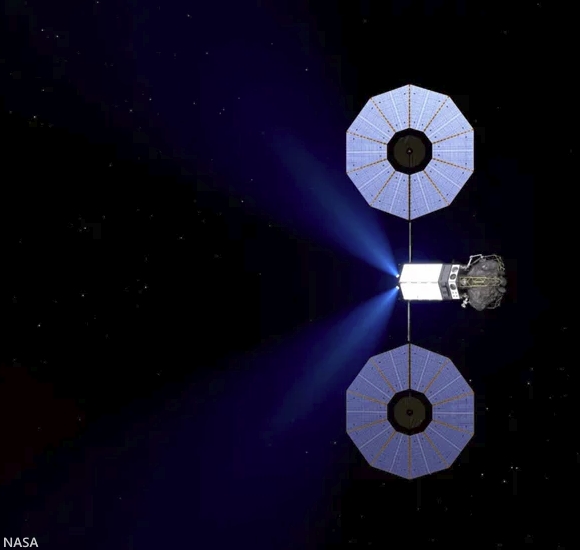
The current controversy over the direction of our national space program has many dimensions but most of the discourse has focused on the means (government vs. commercial launch vehicles) not the ends (destinations and activities).
Near-Earth objects (NEO, i.e., asteroids) became the next destination for human exploration as an alternative to the Moon when
the Augustine committee advocated a “
flexible path” in their 2009 report. The reason for going to an asteroid instead of the Moon was that it
costs too much money to develop a lunar lander whereas asteroids, having extremely low surface gravity, don’t require one. The administration embraced and supported this change in direction and since then, the agency has been studying possible NEO missions and how to conduct them.
On the surface, it might seem that NEO missions answer the requirements for future human destinations. NEOs are beyond low Earth orbit, they require long transit times and so simulate the duration of future Mars missions, and (wait for it)… we’ve never visited one with people. However, detailed consideration indicates that NEOs are not the best choice as our next destination in space. In this post and two additional ones to come, I will consider some of the operational, scientific and resource utilization issues that arise in planning NEO missions and exploration activities and compare them to the lunar alternative.
Most asteroids reside not near the Earth but in a zone between the orbits of Mars and Jupiter,
the asteroid belt. The very strong gravity field of Jupiter will sometimes perturb the orbits of these rocky bodies and hurl them into the inner Solar System, where they usually hit the Sun or one of the inner planets. Between those two events, they orbit the Sun, sometimes coming close to the Earth. Such asteroids are called near-Earth objects and can be any of a variety of different types of asteroids. Typically, they are small, on the order of tens of meters to a few kilometers in size. As such, they do not have significant gravity fields of their own, so missions to them do not “land” on an alien world, but rather rendezvous and station-keep with it in deep space. Think “formation flying” with the International Space Station (ISS) without the option to dock.
The moniker “near Earth” is a relative descriptor. These objects orbit the Sun just as the Earth does and vary in distance to the Earth from a few million km to hundreds of millions of km, depending upon the time of year. Getting to one has nothing to do with getting to another, so multiple NEO destinations in one trip are unlikely. Because the distance to a NEO varies widely, we cannot just go to one whenever we choose – launch windows open at certain times of the year and because the NEO is in its own orbit, these windows occur infrequently and are of very short duration, usually a few days. Moreover, due to the distances between Earth and the NEO, radio communications will not be instantaneous, with varying time-lags of tens of seconds to several minutes between transmission and reception. Thus, the crew must be autonomous during operations.
Although there are several thousand NEOs, few of them are possible destinations for human missions. This is a consequence of two factors. First, space is very big and even several thousand rocks spread out over several billion cubic kilometers of empty space results in a very low density of objects. Second, many of these objects are unreachable, requiring too much velocity change (“
delta-v”) from an Earth departure stage; this can be a result of either too high of an
orbital inclination (out of the plane of the Earth’s orbit) or an
orbit that is too eccentric (all orbits are elliptical). These factors result in reducing the field of possible destinations from thousands to a dozen or so at best. Moreover, the few NEOs that can be reached are all very small, from a few meters to perhaps a km or two in size. Not much exploratory area there, especially after a months-long trip in deep space.
That’s another consideration – transit time. Not only are there few targets, it takes months to reach one of them. Long transit time is sold as a benefit by asteroid advocates: because a trip to Mars will take months, a NEO mission will allow us to test out the systems for Mars missions. But such systems do not yet exist. On a human mission to a NEO, the crew is beyond help from Earth, except for radioed instructions and sympathy. A human NEO mission will have to be self-sufficient to a degree that does not now exist. Parts on the ISS fail all the time, but because it is only 400 km above the Earth, it is relatively straightforward to send replacement parts up on the next supply mission (unless your supply fleet is grounded, as currently it has been). On a NEO mission, a broken system must be both fixable and fixed by the crew. Even seemingly annoying malfunctions can become critical. As ISS astronaut Don Pettit puts it, “If your toilet breaks, you’re dead.”
Crew exposure is another consequence of long flight times, in this case to
the radiation environment of interplanetary space. This hazard comes in two flavors – solar flares and galactic cosmic rays. Solar flares are massive eruptions of high-energy particles from the Sun, occurring at irregular intervals. We must carry some type of high-mass shielding to protect the crew from this deadly radiation. Because we cannot predict when a flare might occur, this massive solar “storm shelter” must be carried wherever we go in the Solar System (because Apollo missions were only a few days long, the crew simply accepted the risk of possible death from a solar flare). Cosmic rays are much less intense, but constant. The normal ones are relatively harmless, but high-energy versions (heavy nuclei from ancient supernovae) can cause serious tissue damage. Although crew can be partly shielded from this hazard, they are never totally protected from it. Astronauts in low Earth orbit are largely protected from radiation because they orbit beneath the van Allen radiation belts, which protect life on the Earth. On the Moon, we can use regolith to shield crew but for now, such mass is not available to astronauts traveling in deep space.
When the crew finally arrives at their destination, more difficulties await. Most NEOs spin very rapidly, with rotation periods on the order of a few hours at most. This means that the object is approachable only near its polar area. But because these rocks are irregularly shaped, rotation is not the smooth, regular spin of a planet, but more like that of a wobbling toy top. If material is disturbed on the surface, the rapid spin of the asteroid will launch the debris into space, creating a possible collision hazard to the human vehicle and crew. The lack of gravity means that “walking” on the surface of the asteroid is not possible; crew will “float” above the surface of the object and just as occurs in Earth orbit, each touch of the object (action) will result in a propulsive maneuver away from the surface (reaction).
We need to learn how to work quickly at the asteroid because we don’t have much time there. Loiter times near the asteroid for most opportunities are on the order of a few days. Why so short? Because the crew wants to be able to come home. Both NEO and Earth continue to orbit the Sun and we need to make sure that the Earth is in the right place when we arrive back at its orbit. So in effect, we will spend months traveling there, in a vehicle with the habitable volume of a large walk-in closet (OK, two walk-in closets maybe), a short time at the destination and then months for the trip home. Is it worth it? That will be the subject of my next post.
 |
| People at an asteroid: What will they do there? [Lockheed-Martin] |
Part II: Scientific Considerations
In my last post, I examined some of the operational considerations associated with a human mission to a near Earth asteroid and how it contrasted with the simpler, easier operations of lunar return. Here, I want to consider what we might do at this destination by focusing on the scientific activities and possible return we could expect from such a mission. Some of the operational constraints mentioned in the previous post will impact the scientific return we expect from a human NEO mission.
Asteroids are the left over debris from the formation of the Solar System. Solid pieces of refractory (high melting temperature) elements and minerals that make up the rocky planets have their precursors in the asteroids. We actually have many pieces of these objects now – as
meteorites. The rocks that fall from the sky are overwhelmingly from the small asteroids that orbit the Sun (the exception is that in meteorite collections, some come from larger bodies, including the Moon and Mars).
Moreover, we have flown by almost a dozen small bodies, orbited two, impacted one and “landed” on two others. Thousands of images and spectra have been obtained for these rocky objects. The chemical composition of the asteroids Eros and Vesta have been obtained remotely. We have cataloged the craters, cracks, scarps, grooves and pits that make up the surface features of these objects. We have seen that some are highly fragmental aggregates of smaller rocks, while others seem to be more solid and denser. In addition to these spacecraft data, thousands of asteroids have been cataloged, mapped and spectrally characterized from telescopes on the Earth. We have recognized the compositional variety, the various shapes, spin rates and orbits of these small planetoids. We now know for certain that the most common type of meteorite (
chondrite) is derived from the most spectrally common type of asteroid (
S-type) as
a result from the Hayabusa mission, the world’s first asteroid sample return.
 |
| Annotated rubble-strewn surface of Asteroid 25143-Itokawa. Circles outline debris-flow sources, arrows indicate debris flow channels, white/black circle indicates a possible hydrological sink. Talus accumulations can be seen between the two sets of arrows with southeasterly orientation on an arbitrary grid. Anastomosing shallow channels to right of the Muses-C fine debris area, outlined in white tone, may indicate release of meltwater from permafrost and emplacement of slope wash. Parabolic lines outline stone-banked lobe ridges. Two fairly recent impacts, judging from tonal contrast, are labelled A and B. IAG Geomorphology Working Group, Oct. 2009 [JAXA]. |
In short, we know quite a bit about the asteroids. What new knowledge would we gain from a human mission to one?
Although we have (literally)
tons of meteorites, extraterrestrial samples without geological context have much less scientific value than those collected from planetary units with regional extent and clear origins. Many different processes have affected the surfaces of the planets and understanding the precise location and geological setting of a rock is essential to reconstructing the history and processes responsible for its formation and by inference, the history and processes of its host planet.
Most asteroids are made up of primitive, undifferentiated planetary matter. They have been destroyed and re-assembled by collision and impact over the last 4.5 billion years of Solar System history. The surface has been ground-up and fragmented by the creation of regolith and some details of this process remain poorly understood. But in general terms, we pretty much know what asteroids are made of, how they are put together, and what processes operate upon their surfaces. True enough, the details are not fully understood, but there is no reason to suspect that we are missing a major piece of the asteroid story. In contrast, planetary bodies such as the Moon have whole epochs and processes that we are just now uncovering – in the case of the Moon, water has been recently found to be present inside, outside and in significant quantity at the poles, relations that have enormous implications for lunar history and about which we were nearly totally ignorant only a couple of years ago.
Most NEOs will be simple ordinary chondrites – we know this because ordinary chondrites make up about 85% of all meteorite falls (an observed fall of a rock from the sky). This class of meteorite is remarkable, not for its diversity but for its uniformity. Chondrites are used as a chemical standard in the analysis of planetary rocks and soils to measure the amounts of differentiation or chemical change during geological processing. In themselves, chondrites do not vary (much) except that they show different degrees of heating subsequent to their formation, but not enough heating to significantly change their chemical composition.
 |
|
| This composite image shows the comparative sizes of eight asteroids. Until the arrival of NASA's DAWN in orbit around Vesta, Lutetia (130 kilometers) was the largest asteroid visited by a spacecraft. Vesta dwarfs all other small bodies in this image with diameter of 530 km [NASA/JPL/ESA]. |
|
Some NEO asteroids are pieces of bigger objects that experienced chemical and mineral change or differentiation.
Vesta (not a NEO, but a main belt asteroid) has reflection spectra similar to known, evolved meteorites, the
eucrite group. These rocks suggest that some asteroids are small, differentiated planetoids, having volcanic activity that dates from the very beginning of Solar System history. Moreover, since we have pieces of the Moon and Mars as meteorite fragments, some NEOs may consist of material blasted off these planets. However, given that most NEOs are inaccessible to human missions, the likelihood that we could visit one of planetary derivation is small (curious that the most interesting of the NEOs appear to be those derived from some bigger (planet-sized) object.) In broad terms of meteorite science, multiple small samples from a variety of asteroid types are preferable to many bigger samples of a single specimen, exactly the opposite of what a human mission will provide.
What specifically would a crew do during a NEO visit? An astronaut on a planet typically would explore the surface, map geological relations where possible, collect representative samples of the units and rock types that can be discerned, and collect as much mapping and compositional data as possible to aid in the interpretation of the returned samples. In the case of a NEO, many of these activities would not be particularly fruitful. The asteroid is either a pile of rubble or a single huge boulder. Chondritic meteorites are uniform in composition, so geological setting is not particularly instructive. We do have questions about the processes of space weathering, the changes that occur in rocks as a result of their exposure to space for varying lengths of time. Such questions could be addressed by a simple robotic sample collector, as the recently approved
OSIRIS mission plans to do.
One question that could be addressed by human visitors to asteroids is their internal make-up and structure. Some appear to be rubble piles while others are nearly solid – why such different fates in different asteroids? By using active seismometry (acoustic sounding), a human crew could lay out instruments and sensors to decipher the density profile of an asteroid. Understanding the internal structure of an asteroid is important for learning how strong such objects are; this could be an important factor in devising mitigation strategies in case we ever have to divert a NEO away from a collision trajectory with the Earth. As mentioned in my preceding post, the crew had better work quickly – loiter times at the asteroid will probably be short, on the order of a few days at most.
Although we can explore asteroids with human missions, it seems likely that few significant insights into the origins and processes of the early Solar System will result from such exploration. Such study is already a very active field, using the samples that nature has provided us – the meteorites. Sample collection from an asteroid will yield more samples of meteorites, only without the melted fusion crusts that passage through the Earth’s atmosphere creates. In other words, from this mission, scientific progress will be incremental, not revolutionary.
In contrast, because they yield information on geological histories and processes at planet-wide scales, sample collection and return from a large planetary body such as the Moon or Mars could revolutionize our knowledge of these objects in particular and the Solar System in general. Many years prior to the Moon missions, we had meteorites that showed impact metamorphic effects but the idea of impact-caused mass extinctions of life on Earth only came after we had fully comprehended the impact process recorded in the Apollo samples from the Moon.
The significance of impact-related mineral and chemical features were not appreciated until we had collected samples with geological context to understand what the lunar samples were telling us.
Of course, science being unpredictable, some major surprise that could revolutionize our knowledge may await us on some distant asteroid. But such surprises doubtless await us in many places throughout the Solar System and the best way to assure ourselves that we will eventually find them is to develop the capability to go anywhere in space at any time. That means developing and using the resources of space to create new capabilities. I will consider that in my next post.
 |
| SEV, the Space Exploration Vehicle variant on the Crew Exploration Vehicle (CEV) originally developed as part of the Constellation program [NASA]. |
In Part I and Part II of this series, I examined some of the operational and scientific issues associated with a human mission to a near Earth asteroid (NEO) and contrasted them with the simpler operations and greater scientific return of a mission to the Moon. To continue the discussion of what we might do at an asteroid, I will now consider using the local resources offered by asteroids, how they differ from those of the Moon, and offer some practical considerations on accessing and using them.
To become a truly space faring species, humanity must learn how to use what we find in space to survive and thrive. Tied to the logistics chain of the Earth, we are now and always will be limited in space capability. Our ultimate goal in space is to develop the capability to go anywhere at any time and conduct any mission we can imagine. Such capability is unthinkable without being able to obtain provisions from resources found off-planet. That means developing and using the resources of space to create new capabilities.
One of the alleged benefits of asteroid destinations is that they are
rich in resource potential. I would agree, putting the accent on the word “potential.” Our best guide to the nature of these resources comes from the study of
meteorites, which are derived from
near Earth asteroids. They have several compositions, the most common being the ordinary chondrite, which makes up about 85% of observed meteorite falls. Ordinary chondrites are basically rocks, rich in the elements silicon, iron, magnesium, calcium and aluminum. They contain abundant metal grains, composed mostly of iron and nickel, widely dispersed throughout the rock.
The resource potential of asteroids lies not in these objects, but in the minority of asteroids that have more exotic compositions.
Metal asteroids make up about 7% of the population and are composed of nearly pure iron-nickel metal, with some inclusions of rock-like material as a minor component. Other
siderophile (iron-loving) elements including platinum and gold make up trace portions of these bodies. A metal asteroid is an extremely high-grade ore deposit and potentially could be worth billions of dollars if we were able to get these metals back to Earth, although one should be mindful of the possible catastrophic effects on existing precious metal markets – so much gold was produced during
the 1849 California Gold Rush that
the world market price of gold decreased by a factor of sixteen.
From the spaceflight perspective, water has the most value. Another type of relatively rare asteroid is also a chondrite, but
a special type that contains carbon and organic compounds as well as clays and other hydrated minerals. These bodies contain significant amounts of water. Water is one of the most useful substances in space – it supports human life (to drink, to use as radiation shielding, and to breath when cracked into its component hydrogen and oxygen), it can be used as a medium of energy storage (fuel cells) and it is the most powerful chemical rocket propellant known. Finding and using a water-rich NEO would create a logistics depot of immense value.
A key advantage of asteroids for resources is a drawback as an operational environment – they have extremely low surface gravity. Getting into and out of the Moon’s
gravity well requires a change in velocity of about 2380 m/s (both ways); to do the same for a typical asteroid requires only a few meters per second. This means that a payload launched from an asteroid rather than the Moon saves almost 5 km/s in delta-v, a substantial amount of energy. So from the perspective of energy, the asteroids beat the Moon as a source of materials.
There are, however, some difficulties in mining and using asteroidal material as compared to lunar resources. First is the nature of the feedstock or “ore.” We have recently found that
water at the poles of the Moon is not only present in enormous quantity (tens of billions of tons) but is also in a form that can be easily used – ice. Ice can be converted into a liquid for further processing at minimal energy cost; if the icy regolith from the poles is heated to above 0° C, the ice will melt and water can be collected and stored. The water in carbonaceous chondrites is chemically bound within mineral structures. Significant amounts of energy are required to break these chemical bonds to free the water, at least 2-3 orders of magnitude more energy, depending on the specific mineral phase being processed. So extracting water from an asteroid, present in quantities of a few percent to maybe a couple of tens of percent, requires significant energy; water-ice at the poles of the Moon is present in greater abundance (up to 100% in certain polar craters) and is already in an easy-to-process and use form.
The
processing of natural materials to extract water has many detailed steps, from the acquisition of the feedstock to moving the material through the processing stream to collection and storage of the derived product. At each stage, we typically separate one component from another; gravity serves this purpose in most industrial processing. One difficulty in asteroid resource processing will be to either devise techniques that do not require gravity (including related phenomena, such as thermal convection) or to create an artificial gravity field to ensure that things move in the right directions. Either approach complicates the resource extraction process.
The large distance from the Earth and poor accessibility of asteroids versus the Moon, works against resource extraction and processing. Human visits to NEOs will be of short duration and because radio time-lags to asteroids are on the order of minutes, direct remote control of processing will not be possible. Robotic systems for asteroid mining must be designed to have a large degree of autonomy. This may become possible but presently we do not have enough information on the nature of asteroidal feedstock to either design or even envision the use of such robotic equipment. Moreover, even if we did fully understand the nature of the deposit, mining and processing are highly interactive activities on Earth and will be so in space. The slightest anomaly or miscalculation can cause the entire processing stream to break down and in remote operations, it will be difficult to diagnose and correct the problem and re-start it.
The accessibility issue also cuts against asteroidal resources. We cannot go to a given asteroid at will; launch windows open for very short periods and are closed most of the time. This affects not only our access to the asteroid but also shortens the time periods when we may depart the object to return our products to near-Earth space. In contrast, we can go to and from the Moon at any time and its proximity means that nearly instantaneous remote control and response are possible. The difficulties of remote control for asteroid activities have led some to suggest that we devise a way
to “tow” the body into Earth orbit, where it may be disaggregated and processed at our leisure. I shudder to think about being assigned to write the environmental impact (if you’ll pardon the expression) statement for that activity.
So where does that leave us in relation to space resource access and utilization? Asteroid resource utilization has potential but given today’s technology levels, uncertain prospects for success. Asteroids are hard to get to, have short visit times for round-trips, difficult work environments, and uncertain product yields. Asteroids do have low gravity going for them. In contrast,
the Moon is close and has the materials we want in the form we need it. The Moon is easily accessible at any time and is amenable to remote operations controlled from Earth in near-real time. My perspective is that it makes the most sense to go
to the Moon first and learn the techniques, difficulties and technology for planetary resource utilization by manufacturing propellant from lunar water. Nearly every step of this activity – from prospecting, processing and harvesting – will teach us how to mine and process materials from future destinations, both minor and planetary sized-bodies. Resource utilization has commonality of techniques and equipment, the requirement to move and work with particulate materials, and the ability to purify and store the products. Learning how to access and process resources on the Moon is a general skill that transfers to any future space destination.
There was a reason that the Moon was made our first destination in the original
Vision for Space Exploration. It’s close, it’s interesting, and it’s useful. Establishing
a foothold on the Moon opens up cislunar space to routine access and development. It will teach us the skills of a space faring people. It makes sense to go there first and create a permanent space transportation system. Once we have that, we get everything else.
Originally published August 31, September 1 and September 2, 2011 at his Smithsonian Air & Space blog The Once and Future Moon, Dr. Paul Spudis is a Senior Staff Scientist at the Lunar and Planetary Institute in Houston. The opinions expressed are those of the author and are better informed than average.