Showing posts with label Bolden. Show all posts

Wednesday, April 10, 2013

General Bolden on the Moon

EDITORIAL : The Space Community experienced a minor brush fire late last week, set accidentally perhaps, by NASA administrator Charles Bolden and his reaction to the National Research Council's congressional-commissioned review of NASA’s "strategic vision."

It’s a sad fact of American politics that the release of the NRC report might have passed largely unnoticed had Bolden been as cryptic about the Moon’s place in NASA’s future as the rest of the administration has been from is beginning.

Instead he confirmed for us one line of reasoning into the administration’s actual rationale for erasing the Moon from National Space Policy, three years ago.

“I don’t know how to say it any more plainly,” Bolden said. “NASA does not have a human lunar mission in its portfolio, and we are not planning for one.”

He warned the next administration not to change course “again” back to the Moon. That would mean, he said, the U.S. would “never again see Americans on the Moon, on Mars, near an asteroid, or anywhere. We cannot continue to change the course of human exploration.”

“NASA will not take the lead on a human lunar mission,” Bolden said. “NASA is not going to the Moon with a human as a primary project probably in my lifetime,” because “we can only do so many things, and NASA’s focus will remain on human missions to asteroids and Mars.”

“All that was 'a given,' three years ago,” Apollo 17 commander Gene Cernan said afterward on Tuesday, perhaps forgetting along with General Bolden, that "going to the Moon as a primary project" has not been a goal of the American government since 1969, and this was never "a primary project" of the Vision for Space Exploration in 2004 or of those who recognize the Moon's strategic and scientific value and who still support restoring the Moon back into scientific context today.

On the surface there did seem little that was new in Bolden’s protests. All the superficial reasons for dropping the Moon as an intermediate objective on the way to Mars spread abroad by the administration and its supporters still make little sense. No one who seriously supported a return to the Moon as an essential objective on the way to Mars ever hoped simply to recreate Apollo. 

And if it’s asteroids you want, the Moon has been an asteroid magnet for about 4.575 billion years.

Aside from the glaring hole left by having had the Moon erased from National Space Policy, three years after the cancellation of Constellation, America's deep space efforts are really little different from what they were at the end of the Bush administration, with little actual progress having been made not already set in motion before President Obama's Inauguration.. 

Aside from the missing Altair lander, and the R&D required to build it, together with a simple recognition of the Moon’s clear strategic value in overcoming tremendous technological challenges facing any manned mission to Mars, very little has actually changed.

The end goal of landing astronauts on Mars, someday, some way, in budgetary “out years,” is still the same, as was retiring the Space Shuttle and planned development and use of commercial transportation to ISS. These were integral to the Vision for Space Exploration introduced in 2004. Though some seem determined to credit the administration with having dreamed up subsidized commercial space, and certainly for popularizing the idea, that too was integral to the VSE and as far as presidents go the initiative dates back to Ronald Reagan.

From a political perspective, with unwitting help from General Bolden, we no longer have to simply make educated guessed as to why the Moon was edited out of NASA’s strategy. As it turns out, it was not the “been there, done that” argument offered by the President, after all..

Bolden has finally confirmed for us one line of investigation into the mysterious missing Moon by simply telling us that the Obama administration just does not want the American governmentto take the leadon any manned return to the Moon.

Thus, it was a political decision, dressed up and oversold with some of the tired arguments originally heard forty years ago.

That's not a crime, of course. Thankfully Bolden has also communicated that the administration is not opposed to "leading from behind" on a manned mission to the Moon, perhaps lead by a different nation, nor does he rule out robotic exploration, though the nation has so far committed only to finishing or fulfilling the precursor robotic lunar missions that were either already underway or already long in the pipeline.

We are genuinely grateful the administration appears unwilling to stand in the way of any commercial manned or unmanned landings in the Moon.

But why this passionate and now very specfic opposition to America leading while exploring and using the Moon as a stepping stone to Mars and as a Rosetta Stone for the rest of the Solar System?

In light of all the other alterations made to the President's 'asteroid initiative' over the past three years, was the administration's unyielding position the original and still primary reason the whole Constellation program was cancelled?

The Moon, and those of us still urging policy makers to take another look at its advantages over manned asteroids exploration, are apparently occasionally being heard in the White House. In the past three years the administration has occasionally floated tantalizing trial balloons, future efforts involving the Moon, but specifically without any  human landing.

One thing is different in the past three years. The small flotilla of remote sensing spacecraft, from Japan, China and India, as well as the U.S. sent to the Moon, and inspired by the lead America had taken with in 2004, after a long national drought five American spacecraft in lunar orbit simultaneously for most of this past year, and planetary scientists have learned more about the Moon since 2004 than in the two decades previous.

This new look at the Moon has by now strongly confirmed the Moon's strategic importance and its usefulness to science, and as a logical support for future manned missions to Mars.
"Just after it has been relegated to a “been there, done that” status, the Moon again shows us we have a lot to learn about its history, physical state and the potential value of its resources. We must take the initiative to learn more as the Moon is crucial in developing and advancing a sustainable space faring infrastructure." -   Paul D. Spudis

Why then, like Arthur C. Clarke’s Europa, are American astronauts to “attempt no landing there?” If we are taking the lead going to Mars, our role in a return to the Moon along that path would seem to be irrelevant.

This much is clear. Leaving the Moon out as an intermediate goal, as a place where America already has a momentary and essential lead, is a stubbornly held position dear to the administration.From Bolden’s statements late last week one might think someone had suggested NASA’s strategy for building a path to Mars should be renamed back to “Constellation.”

Though only occasionally experienced, if America’s history and the nation's storied history of manned space exploration has succeeded in teaching us anything it has taught history has a very tight turning radius.

Monday, September 24, 2012

NASA floats parking at Lagrange Point 2

One of many proposed configurations for the Gateway architecture, shown above the lunar farside "parked" at Lagrange Point 2 [NASA].
Mark K. Matthews
Orlando Sentinel

Top NASA officials have picked a leading candidate for the agency's next major mission: construction of a new outpost that would send astronauts farther from Earth than at any time in history.

The so-called "gateway spacecraft" would hover in orbit on the far side of the moon, support a small astronaut crew and function as a staging area for future missions to the moon and Mars.

At 277,000 miles from Earth, the outpost would be far more remote than the current space station, which orbits a little more than 200 miles above Earth. The distance raises complex questions of how to protect astronauts from the radiation of deep space — and rescue them if something goes wrong.

NASA Chief Charlie Bolden briefed the White House earlier this month on details of the proposal, but it's unclear whether it has the administration's support. Of critical importance is the price tag, which would certainly run into the billions of dollars.

Documents obtained by the Orlando Sentinel show that NASA wants to build a small outpost — likely with parts left over from the $100 billion International Space Station — at what's known as the Earth-Moon Lagrange Point 2, a spot about 38,000 miles from the moon and 277,000 miles from Earth.

At that location, the combined gravities of the Earth and moon reach equilibrium, making it possible to "stick" an outpost there with minimal power required to keep it in place.

To get there, NASA would use the massive rocket and space capsule that it is developing as a successor to the retired space shuttle. A first flight of that rocket is planned for 2017, and construction of the outpost would begin two years later, according to NASA planning documents.

Read the full article HERE.

Related Post:

Thursday, April 12, 2012

Bolden: Moon to be a private colony

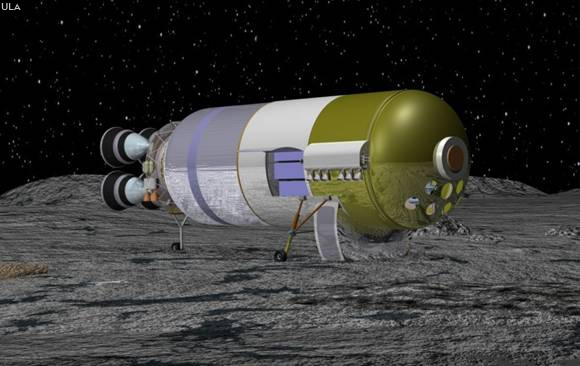
The Crewed United Launch Alliance DTAL (Dual Thrust Axis Lander), as proposed in 2010 [ULA].
Doug Conway
The Australian/AAP

When mankind colonizes the moon, it's likely to be led by a commercial enterprise rather than a government. So says NASA administrator Charles Bolden, who believes nations will no longer venture into space alone, but in collaboration with each other and with private industry.

Maj-Gen Bolden, who flew into orbit four times on the US space shuttle program which ended last year, says governments will lead the way in space exploration, but not in getting access to space.

"We have now got to the point where NASA should have nothing to do with it (access to space)," he said in an address today at Sydney University.

"We have run the tests, we have been flying for 50 years, we know basically how to get humans off the planet and into low-earth orbit. Our private industry partners have built every single space craft we have ever flown.

"NASA has never built a single human-rated space craft."

Read the article HERE.

Friday, July 16, 2010

NASA's new mission and the cult of management


Paul D. Spudis
Smithsonian Air & Space

During a recent interview on Al Jazeera television, NASA Administrator Charles Bolden outlined NASA’s new priorities. His remarks became headlines as the previously ignored story about the redirection of the space agency toward international diplomatic outreach and global climate change research finally reached the many who still hold NASA in high regard. Beyond the inane and vacuous policy comments, one statement by Administrator Bolden went virtually unnoticed: “We’re not going to go anywhere beyond low Earth orbit as a single entity,” he revealed, “The United States can’t do it.” If it’s possible to shock Americans into paying attention to NASA and our national space program, those words might do it.

It’s one thing to assert that the Unites States desires more international collaboration as a matter of policy for reasons of fostering alliances, developing new cultural ties, or even to promote world peace. It’s an entirely different proposition to assert that the United States has lost the ability to reach for the stars, that America is incapable of exploring space alone. Have we become comfortable with the idea that it’s politically incorrect to have pride in our nation’s abilities – past, present and future?

The natural reaction of many Americans is to strongly protest such a notion by asserting that our technology is the greatest in the world and that we can design and build anything we choose to. However, one can not escape the reality that the statement quoted above was made by the head of the agency charged with sending U.S. astronauts into space, a task that Americans have watched NASA carry out for almost 50 years. A more troubling thought is that maybe he is right.

I’ve worked with NASA for 25 years on experiments, research, and advanced planning and missions. I’ve been involved with studies to put a base on the Moon since 1984 (the year of the first conference on lunar bases at the National Academy of Sciences in Washington DC). In all of these efforts, I believed that our future in space was at stake and that we were preparing for humanity’s return to the Moon, followed by journeys to the planets.

As the years wore on, it began to dawn on some of us that some within and outside the agency really didn’t want to go anywhere or do anything in space. Working for NASA means being involved in the process of working. How you structure a project, who gets assigned what work and how many meetings you conduct is the formula that elevates you faster than when (or even if) you deliver a product, a mission or a program. This culture becomes even more evident as one ascends the chain of command. The farther up the organizational ladder you go, the further removed from the productive segment of the agency you are, with product being replaced by an ever multiplying and bewildering variety of workshops, seminars and management training retreats. There exists in America today a thriving industry dedicated to convincing people who have no organizational or management skills that in fact, they are all excellent organizers and managers. Much of this sub-culture is accurately (and hilariously) portrayed in the comic strip Dilbert.

Management fads like Total Quality Management regularly come and go. NASA has dabbled in Faster-Cheaper-Better, Spiral Development, Earned Value Management, and many others. Each new initiative is unveiled as The Answer, the magic beans solution that will re-establish the NASA of our forefathers – smart, productive, innovative, and competent. Management thrives by producing more middle managers. People joke about highway projects where one guy digs a hole while five others lean on their shovels, watching him work. That old chestnut always gets a laugh because we’ve all seen it at some point. You see it a lot within NASA. As administrative cost consumes more and more of the budget pie, the slice that represents funding for the productive sector of the agency keeps shrinking.

Bolden’s comment is tragic, not in its misunderstanding but in its verity. America cannot go back to the Moon by itself not because we lack the wealth or the technical skills but because we have developed a culture of management bloat and process-orientation that proliferates bureaucracy. NASA is comfortably cushioned from the reality of their organizational maladies by the amazing legacy inherited from those who did great things in the past. They may believe they’re immune to the Cult of Management, but as evidenced by Bolden’s statements, the agency has changed. NASA has become a “feel-good” bureaucracy, stuck on the idea of doing one-off stunts in space for public approval and a guaranteed institutional lifetime, paid for by the public. This attitude both inside and outside of the agency has lead to the demise of our national spaceflight capabilities. Stagnant entities reflexively dwell on past glory; dynamic ones build upon them to create something both significant and permanent.

Occasionally, I’m asked why I stay in the space business. I do so because I believe in the mission of space exploration and in the importance of moving humanity into the Solar System. Every now and then, an opportunity arises outside the boundaries of normal business to do something productive and create a lasting legacy – a time when the stars align and a leader refuses to follow the established rules or to unimaginatively subscribe to the conventional wisdom.

Currently, the “right stuff” manifests itself as a pattern of waiting for a propitious political opportunity and a few far-seeing people to seize the day and push through something that otherwise would be buried by “process.” In my opinion, the Vision for Space Exploration was such an opportunity – a path forward, achievable in stages, that would have created a legacy of space faring capability. The idea of actually doing something made the Vision a nonstarter to many within the agency – it challenged their worldview of process over product. They are content to merely manage an organization. The goal of leading America and the world into the Solar System has become a slogan in a strategic plan, an ever-fading banner over an office door.

Is any of this fixable? Perhaps. For now, the opportunity to strengthen the U.S. space program, an endeavor that has traditionally pushed technology development and stoked our economic engine, has been kicked aside. But by their very nature, new opportunities arise unbidden and unforeseen at irregular intervals. I wonder if we’ll do better next time.

Americans need to wonder.

Thursday, May 27, 2010

'Child of Apollo' Jeff Hanley ousted as head of Constellation program

Mark K. Matthews &
Robert Block
Orlando Sentinel

NASA ousted the outspoken head of its Constellation moon program on Wednesday, prompting an immediate protest from congressional lawmakers who again accused the White House of taking steps to kill the project.

Word that Constellation Manager Jeff Hanley was moved to a deputy position at Johnson Space Center reached Congress just as the House science committee was meeting with NASA chief Charlie Bolden to debate White House plans to replace the space shuttle with commercial rockets.

"It is a great concern to us that you take the manager out of his position and reassign him to another position," said U.S. Rep. Gabrielle Giffords, an Arizona Democrat who has fiercely opposed White House efforts to shut down Constellation and its aims to return astronauts to the moon.

Read the article, HERE.

Thursday, March 4, 2010

Bolden commissions "Plan-A" (v.2.0)

Nicholas Patrick during configuration of the newly installed cupola in February [NASA].

Ed. Note: By Friday, March 5 General Bolden was spinning the following and other stories relating to a 'Plan B' and referred to additions or changes made by Congress to the administration's proposed national space policy as Plan A, "version 2.0." Mark Matthews of the Orlando Sentinel picks up on that Follow-Up, Friday HERE.

Andy Pasztor
Wall Street Journal

NASA chief Charles Bolden has asked senior managers to draw up an alternate plan for the space agency after members of Congress indicated they wanted to reject a White House proposal to hire private companies to ferry U.S. astronauts into orbit and beyond.

In an internal National Aeronautics and Space Administration memo viewed by The Wall Street Journal, Mr. Bolden ordered officials to map out "what a potential compromise might look like" to satisfy critics on Capitol Hill. By calling for an alternative plan, Mr. Bolden threatened to undercut White House efforts to get its proposed NASA budget through Congress.

The White House is seeking to cancel major existing programs intended to build a new generation of government spacecraft and rockets to carry astronauts into space.

Read the full article HERE.

Sunday, February 7, 2010

Bolden: No Heavy-Lift until 2020-2030

NASA Administrator Charlie Bolden spoke with reporters Saturday at Kennedy Space Center on the eve of the launch of the STS-130 mission, answering questions that focused mainly on the new 2011 NASA budget and the cancellation of the Constellation program.

Nancy Atkinson of Universe Today has the story HERE.

Friday, October 16, 2009

Open Letter to NASA Administrator Charles Bolden from Robert Bigelow

"When the commercial crew transportation debate is artificially limited to only the two current participants of NASA's Commercial Orbital Transportation Services program, and the Atlas 5 is ignored, as it was during the congressional hearing in the House several weeks ago, this leads to a flawed discussion and problematic conclusions. We don't know if the House authorizers avoided talking about the Atlas due to bias, ignorance or a combination of both..."

"As you are well aware, future U.S. access to space will soon be entirely dependent on Russia. The Russians are excellent capitalists, and you should expect prices to rise above the already stunning $51 million per seat that NASA is currently paying during every subsequent Soyuz contract negotiation. A robust commercial crew program represents this nation's only hope of reversing this deplorable situation and reviving America's human spaceflight capabilities. If you choose this path, it will free NASA both in terms of substance and financing to look beyond LEO, leaving the agency to again become a trailblazer to the stars."

Full Text at SpaceRef.com

Wednesday, October 14, 2009

"Heavy-Lift yes, EELV no?"

Jeff Foust
SpacePolitics.com

"While the Augustine committee wraps up its final report, NASA hasn’t been standing still waiting for it. In an article in Monday’s issue of The Space Review, I wrote about Bolden’s statements in his Space Transportation Association speech on Thursday about what NASA’s internal planning:"

"While Bolden didn’t mention any specifics in Washington, he did let slip a few details about what might be included on Monday at the IAC in Daejon, South Korea, Flightglobal.com reports. Bolden was clearly interested in developing a heavy-lift vehicle, saying that NASA was “costing” such a launcher, which the report believes is the Ares 5 “Lite” vehicle mentioned in the Augustine committee report instead of a shuttle-derived alternative or even simply re-estimating the development cost of the Ares 5 itself."

Read the Post, HERE.

Tuesday, July 21, 2009

NASA seeks its place in space

Ambitions in collision with costs, naysayers

By David R. Sands

The future of NASA is very much up in the air.

The agency behind the spectacular triumph of the 1969 moon landing and the equally spectacular Challenger and Columbia space shuttle disasters is getting a new chief -- former astronaut Charles F. Bolden Jr. -- at a time when it faces major budget and technological uncertainties, a looming five-year "gap" in manned space flights when the shuttle program is retired for good next year, and the scrutiny of a high-powered outside panel ordered up by President Obama to chart the future of the U.S. space exploration program.

Read the article HERE.

Ed. Note: The future of NASA may, indeed, be very much in doubt, a saga more telling of the Manifest Destiny of the United States than of mankind. History alone will tell if, like Portugal, the U.S. blazed a trail, showing what human could accomplish, only to abandon a new age of exploration to others.

It isn't a question of whether humans should or even whether they will travel further into Deep Space, or even whether the Moon is essential to that progress. The only question the American People and their Congress must ultimately answer is whether the United States is a partner or a pioneer in the destiny of Human Beings.

That destiny is settled, because in the end, the grim reality is that the Human Race will survive life in a Cosmos we now know to be materially hostile to carbon-based life forms if we are to survive at all.

This may also prove true for freedom and liberty in a shrinking political world, also, because in the end, just like war, space exploration really is a matter of life or death for the nation and all mankind. All the peace we might accomplish among ourselves here on Earth will not protect us from the manifold dooms the history of our planet shows clearly must eventually return in one form or another.

"Behold, today I set before you life and death.
Therefore, choose life."

Monday, May 25, 2009

Space Foundation Applauds NASA Leadership Nominations

The Space Foundation welcomes the nominations of Major General Charles Bolden, USMC (retired), and Lori Garver to serve as NASA Administrator and Deputy Administrator, respectively.

"By announcing nominations for both Administrator and Deputy Administrator, the White House has demonstrated that it appreciates the importance of both of these key positions to the future of America's space agency," said Space Foundation Chief Executive Officer Elliot Pulham. "Charlie Bolden is an American hero who brings deep NASA knowledge and experience, and unsurpassed leadership skills to the key position of NASA Administrator. Lori Garver is an experienced space policy professional with significant previous NASA experience, strong knowledge of the space industry, and the political and communication skills that are crucial to communicating with the administration, Congress and the public."

"Together they should make a dynamic leadership team at a crucial juncture when NASA will be more important than ever to U.S. leadership," Pulham said. "As our posture as a global leader in space continues to be challenged by decades of insufficient investment and the rise of able competitors around the globe, NASA will be more relevant to U.S. leadership and economic rebuilding than ever before. Charlie Bolden and Lori Garver are solid candidates to lead NASA going forward."

Saturday, May 23, 2009

Bolden gets nod to run NASA

By Andy Pasztor and T.W. Farnam
Wall Street Journal
WASHINGTON -- President Barack Obama is expected to pick former astronaut and retired Marine Corps Gen. Charles Bolden Jr. to head the National Aeronautics and Space Administration, but controversy over his background and NASA's future direction could complicate his job.

Gen. Bolden's nomination would cap months of political maneuvering, which has left some major agency decisions in limbo. It also has become a flash point for a broad debate over how NASA should conduct future human space-exploration programs.

Gen. Bolden was a NASA official in the early 1990s and more recently worked for two major NASA contractors. His critics contend he's too closely tied to existing NASA programs.

These people, who want to shake up the agency's priorities, include officials of smaller aerospace firms hoping to snare NASA business and some Obama advisers likely to play a role in charting NASA's direction. Gen. Bolden has supported some startup space ventures, but they still want a nominee with a more-unconventional background.

White House officials said Gen. Bolden wasn't available for comment. In a meeting with Mr. Obama in the White House Tuesday, the former astronaut spoke about his "vision for NASA's future," among other topics, according to a White House statement. Before the meeting, Press Secretary Robert Gibbs said the president "hopes that [Gen. Bolden] is the right person to lead NASA in the coming years and through its evolving role."

People familiar with the nomination process said Gen. Bolden has pledged to give weight to the recommendations of an independent commission recently set up by Mr. Obama to look at NASA's future that's expected to report back by summer's end.

Read the Wall Street Journal analysis HERE.

Sunday, May 17, 2009

Nelson credited for Bolden

Robert Block, posting at the The Write Stuff, is crediting U.S. Senator Bill Nelson (D-FL) for doggedly lobbying the Obama White House for the pending appointment of Maj. Gen. Bill Holden (USMC Ret.) as NASA Administrator.

"Nelson has tirelessly -- some might say obnoxiously -- pushed for his old friend and the man who piloted the shuttle that Nelson flew on in 1986, where he earned the nickname “Ballast” from fellow astronauts.

In fact, Nelson not only stumped for Bolden, he also actively lobbied against alternative candidates.

Though highly regarded by the aerospace community and NASA insiders, Bolden, 62, was never the White House's first choice for the NASA job. But for three months, other names that the White House floated for the job were knocked out of the running or withdrew from consideration.

Much of the resistance was spearheaded by Nelson."

Read the Block's observations HERE.

Friday, May 15, 2009

Bolden likely NASA administrator

Five months after reports in January, Maj. Gen. Charles F. Bolden (USMC Ret.) is likely to be appointed NASA administrator as early as Monday.

There's not much more to be added to THIS.