Showing posts with label RTG. Show all posts

Monday, August 19, 2013

Good things delivered in small packages

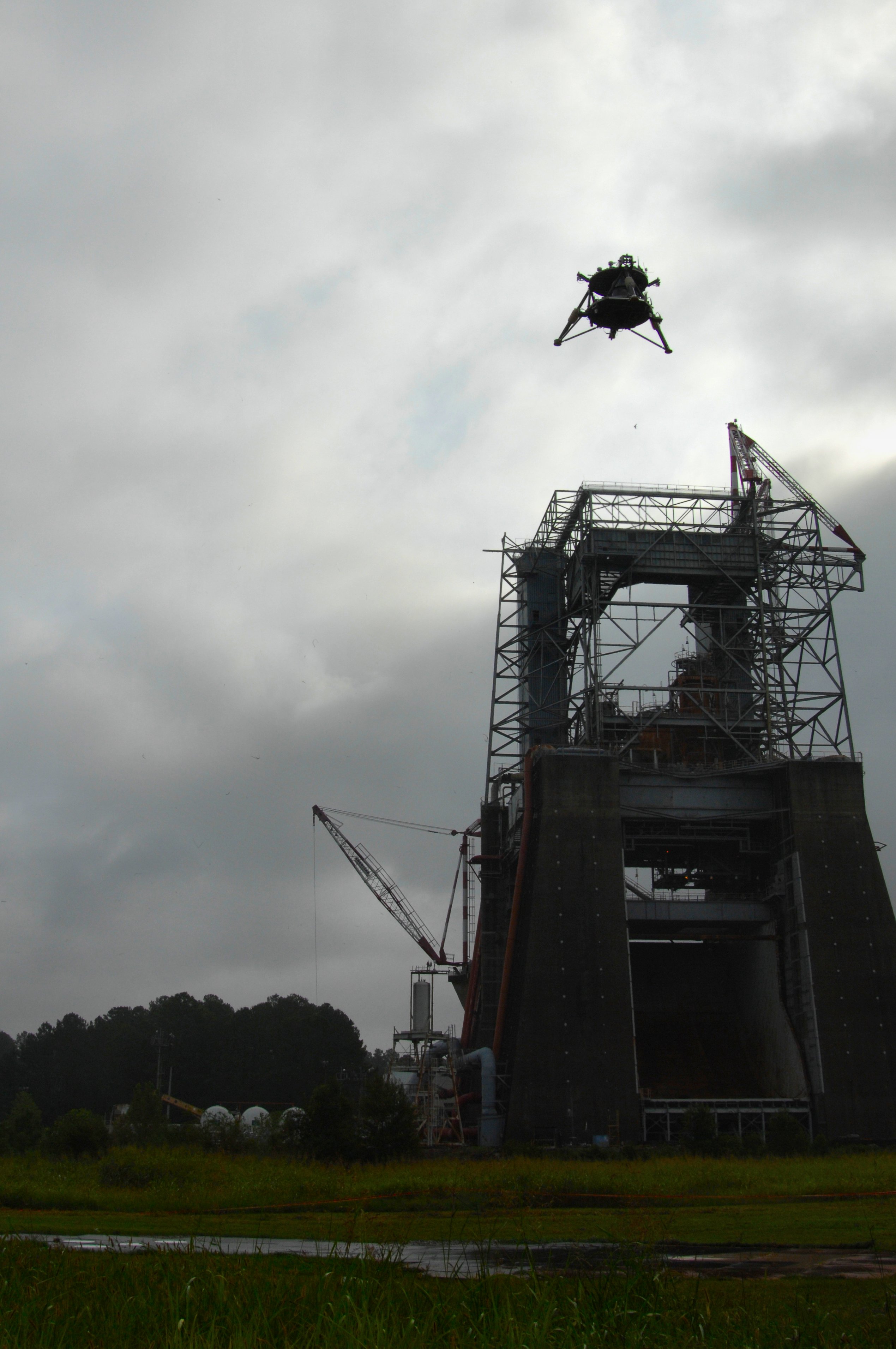
Mighty Eagle Aces Exam (NASA, International Space Station, 09/05/12)
Overcast skies didn't deter the "Mighty Eagle," flying high over the historic F-1 test stand and completing a milestone round of flight test objectives, September 5, 2012. One of two NASA robotic prototype landers, the vehicle was flown to an altitude of 30.48 meters and descended gently to a controlled landing during a successful free flight Marshall Space Flight Center in Huntsville, Alabama. Nicknamed the "Mighty Eagle" after one of the characters in the popular "Angry Birds" game, the vehicle is a three-legged prototype,  that resembles an actual flight lander design. It is 1.219 meters high, 2.438 in diameter and, when fueled, weighs 317.5 kg. It's a, so-called, “green” vehicle, 90 percent fueled by pure hydrogen peroxide, guided by an onboard computer [NASA/MSFC].
Paul D. Spudis
The Once and Future Moon
Smithsonian Air & Space


Wanted: lander spacecraft to deliver payloads to the Moon.  Must be cheap and reliable.

NASA recently issued an “RFI” – a Request for Information – a method used by the agency to solicit concepts from various companies and gauge their ability to fulfill a future anticipated need.  In this case, the need is for a small robotic lander, one capable of delivering two classes of payloads to the lunar surface: small (from 30 to 100 kg) and medium (from 250 to 450 kg).

Probably focused near-term with the RESOLVE (Regolith and Environment Science and Oxygen and Lunar Volatiles Extraction) payload, the intent of this RFI is to survey existing capabilities for the commercial delivery of a variety of payloads to the Moon.  RESOLVE is a NASA experiment designed to test and demonstrate some techniques of in situ resource utilization (ISRU) on the Moon, specifically the generation of oxygen and the extraction of volatile elements (such as hydrogen) from lunar soil.  The RESOLVE package consists of several highly integrated experiments designed to collect soil on the Moon, heat this feedstock to various temperatures and measure the amount and type of volatile elements released, and practice some techniques of processing the soil into useful products (such as water or oxygen).

Though we’ve been talking about using off-planet resources for years, this is the first time the agency would fly an experiment designed to evaluate the processes and difficulties involved.  Some of us contend that until it is proven possible (by demonstrating it in space), space-based resource utilization (ISRU) will remain classified as “too risky” to incorporate into an architecture.  Engineers don’t doubt the chemistry or physics behind ISRU, but to evaluate risk and return, they want demonstrations using real hardware versus theoretical concepts and paper studies.

Although it will not answer all ISRU questions, RESOVLE can provide useful data and would be an important milestone.  Our ignorance is particularly vast in regard to the nature of the polar volatile deposits.  Some near-polar sites are under consideration for RESOLVE, but because the lander must be able to communicate with Earth, sites near the poles must be in radio view of Earth.  This eliminates the most promising polar volatile sites (permanently dark, out of radio sight) from consideration, at least for the first mission.  However, we know that water ice occurs in some areas in view of Earth, so careful targeting will permit us to get ground truth for a critical area near the one of poles.

There are a wide variety of possible payloads (scientific and resource utilization) for lunar missions using small landers.  A key priority for the lunar science community has been the deployment of a global network of geophysical instruments.  Such a package would include a seismometer (to monitor and measure moonquakes), a heat flow probe (to take the Moon’s temperature) and other instruments, such as a magnetometer and a laser reflector.  The five-station surface network laid out during the Apollo missions was operational for more than 7 years and gave us a first-order understanding of the nature of the deep lunar interior.  A new global network – widely spaced and operating longer with more stations – would vastly improve on that knowledge.

The success of a network mission necessitates a long-lived power source to operate instruments during the very cold, 14-day lunar night (the Apollo network used nuclear power supplies), along with an inexpensive way to deploy the network stations.  New technologies have developed small, reliable radioisotope generators that operate for many years.  A small lander could deliver geophysical stations across the entire globe; each station is low mass, so the smaller (and presumably cheaper) the lander, the more likely that this mission will be realized.  A global seismic network would decipher the crust and mantle structure of the Moon and could monitor its surface for large impacts.  A precise measurement of lunar heat flow (measuring the abundance of radioactive elements in the Moon) will give us more information about the bulk composition of the Moon and advance our understanding of lunar origin.  Laser ranging will also be useful in addressing some critical geophysical and astrophysical problems.


Project Morpheus vehicle "Morpheus Bravo," executes a successful tether test August 7, 2013 at Johnson Space Center. The combined Morpheus/JPL team met all their objectives including engine ignition, ascent, a 3 meter lateral translation over simulated Mars regolith simulant from JPL to help with plume study, 40 seconds of hover at apex and a slant descent to "landing" using free flight guidance. The entire flight duration was around 80 seconds. All though the Mars surface simulant was not typical for Morpheus test fires, it "sure made for a spectacular show"

Single-point landers, making simple measurements, can investigate the surface composition and geology at select landing sites.  If the landing sites and investigations are carefully chosen, they could significantly advance science by answering key questions.  For example, a critical issue in the cratering history of the Moon is knowledge of the absolute age of some of the youngest craters on the Moon.  The formation of the crater Copernicus marks a key time horizon in lunar history (the Copernican Period).  We know its relative age very well but are uncertain about its absolute age.  A small lander can be sent directly to the crater floor, where the impact melt is exposed and accessible, to analyze crater melt rocks for chemical composition and to learn the nature of the impact target (as well as determining the age of the rock by measuring the radiogenic potassium and argon in the rock). Although the potassium-argon technique is not the most precise method of radiometric dating, it can distinguish among the different proposed absolute ages, which vary over a billion years.  By determining this age more precisely, we will better understand the impact flux in the Earth-Moon system, knowledge that will help us better interpret the surface ages of units on other terrestrial planets.

Small landers could deliver a variety of long-lived assets for future surface operations and resource utilization experiments.  Techniques for making oxygen from lunar soil have been proposed but no comparative demonstration has been done on the Moon.  A small laboratory could be send to the Moon to conduct simultaneous experiments on oxygen manufacture.  The advantage of this experiment would be the use of identical feedstock under identical thermal and time constraints to compare their relative efficacy and identify any problems.  This experiment would fit on a small lander (~ 50 kg capacity) and by using solar power, within the span of a single lunar day (2 weeks) could quickly complete its evaluation.

The larger version of the RFI lander opens up other possibilities.  With a payload capacity on the order of 500 kg, this lander could deliver an advanced, automated surface rover (powered by an RTG – nuclear battery) able to undertake extensive and protracted exploration of the polar cold traps.  Equipped with instruments utilizing well established technology, this rover would characterize the physical, chemical and isotopic make up of the polar volatiles – a task critical for mapping the extent and purity of deposits of water ice on the Moon, and evaluating their mining and extraction potential.

The Canadian Space Agency test platform Artemis, Jr. fitted with NASA's RESOLVE instrument package, Day 3 of field testing on Mauna Kea, Hawai'i, July 2012 [CSA].
At this scale, it’s possible to deliver an ascent vehicle to the Moon to retrieve and return samples to Earth.  Scientists have a long list of desired targets for sample return and the potential for low cost, commercial landers to deliver payloads simply and inexpensively to the Moon could revolutionize our understanding of the Moon’s (and Earth’s) history and processes.  From remote sensing data, we know that many fascinating areas on the Moon display rocks either unrepresented or unrecognized in the existing collections from the American Apollo, Soviet Luna, and lunar meteorite samples.  Samples from the oldest impact feature on the Moon – the floor of the South Pole-Aitken basin – are especially desired.  Although a simple “grab” sample won’t answer all of our questions, rocks from this site could address major questions about the bombardment history of the Moon and the early Earth.

Small lander spacecraft will open up new horizons for science and exploration.  Critical to their success is making them simple, robust and inexpensive.  That’s been a tall order for NASA.  Whether the commercial sector can provide this capability more effectively remains to be seen.

Related Posts:
CHONDROBOT-2: Simple, Efficient Semi-Autonomous Lunar Excavator (January 4, 2013)
Technical Readiness (November 17, 2012)
Marshall's new-generation lunar lander flies again (September 11, 2012)
Update: ISRU mission simulations on Hawai'i (July 30, 2012)
'A RESOLVE to mine the Moon' (July 15, 2012)
KSC shows off RESOLVE, ISRU and lunar analog study platform (June 13, 2012)
Mighty Eagle lander's 100 foot flight at Redstone (November 4, 2011)
New Robotic Lander Prototype skates tests (January 29, 2011)
NASA update: ILN Anchor Nodes and Robotic Lunar Lander Project (August 17, 2010)
Field testing of In-Situ Resource Utilization (July 1, 2010)
The Lunar Quest Program and the International Lunar Network (September 6, 2009)
Spotlight on Carnegie-Mellon's SCARAB (April 10, 2009)

Originally published August 17, 2013 at his Smithsonian Air & Space blog The Once and Future Moon, Dr. Spudis is a senior staff scientist at the Lunar and Planetary Institute. The opinions expressed are those of the author but are better informed than average

Wednesday, March 7, 2012

LROC: Pinpoint Landing on the Moon (Apollo 12)


Descent and landing of Apollo 12 in Oceanus Procellarum, November 1969.

The Apollo 12 landing site (3.0119°S, 336.585°E) in Oceanus Procellarum, imaged during the second LRO low-altitude campaign, orbit 10,987, November 11, 2011. Field of view width = 225 meters, LROC Narrow Angle Camera (NAC) observation M175428601R  View the full size LROC Featured Image HERE [NASA/GSFC/Arizona State University].

Samuel Lawrence
LROC News System

The LRO mission continues to collect observations that are enabling ground-breaking new scientific discoveries about the Moon. As geologists, whenever we look at remotely sensed data collected from another planet, in a sense we are staring back in time. But this is the “deep time” of geology, where we are trying to understand natural processes that (at least on the Moon, anyway) could have happened billions of years ago. But the LRO mission is unique because we can also see human history. Not just any history, either, but one of humanity's greatest accomplishments, our first steps on another world. Twelve astronauts explored the lunar surface, directly seeing things with their own eyes, making observations, and collecting samples with their own hands. These samples and observations revolutionized our understanding of our solar system.

This “snapshot in time” effect is especially evident at the Apollo 12 landing site in Oceanus Procellarum, now known as Statio Cognitum. Here, you can see the remnants of not one, but two missions to the Moon. Astronauts Pete Conrad and Alan Bean demonstrated that a precision lunar landing with the Apollo system was possible, enabling all of the targeted landings that followed. Bean and Conrad collected rock samples and made field observations, which resulted in key discoveries about lunar geology. They also collected and returned components from the nearby US Surveyor 3 spacecraft, which landed at this site almost two and half years previously, providing important information to engineers about the how materials survive in the lunar environment.

Annotated low altitude LROC NAC image of the Apollo 12 landing site (view the glorious 2438 x 2109 image HERE). The informal names of craters visited by the astronauts, the positions of the ALSEP, Intrepid descent stage, and Surveyor 3 spacecraft are highlighted. LROC NAC M175428601R [NASA/GSFC/Arizona State University].
In the image above, you can see the remnants of the scientific experiments the astronauts set up on the surface, the first long-term Apollo Lunar Surface Experiments Package (ALSEP).  Powered by a Radioisotope Thermoelectric Generator (RTG), the ALSEP included a seismometer to record "moonquakes" and several experiments designed to make measurements of the lunar environment, including a Solar Wind Spectrometer, a Cold Cathode Ion Gauge, and a Suprathermal Ion Detector (see if you can find each piece of hardware). The Apollo 12 ALSEP returned data and measurements to Earth for over seven years following the mission and was turned off in September 1977. From the lower altitude you can pick out the shadow of the still standing flag, the High Gain Antenna (HGA), and the discarded Portable Life Support System (PLSS) backpacks.

Apollo 12 photograph of the ALSEP central station, with Intrepid and S-band High Gain Antenna (HGA) in the background. The ribbon cables in this image are clearly visible in the first low-altitude LROC image of the Apollo 12 landing site, below [NASA high-resolution photograph AS12-47-6928].
After deploying the ALSEP, the astronauts moved to the northwest, eventually stopping to take a series of photographs of the crater dubbed “Middle Crescent”. The boulders the astronauts observed on the surface are visible in the LROC image above.

Apollo 12 photograph of the interior of Middle Crescent crater, taken during the first Apollo 12 EVA [NASA high-resolution photograph AS12-46-6838].
During the second EVA, the astronauts performed a geologic traverse on foot covering almost 1.5 km. In today’s image, you can clearly follow the path they took edging around Head crater, proceeding to Bench and Sharp craters with a brief stop at Halo crater, visiting the Surveyor spacecraft, and then returning to the Lunar Module.

Apollo 12 photograph of the interior of Sharp crater taken by astronaut Pete Conrad, whose shadow you can see in the lower right [NASA high-resolution photograph AS12-49-7271].
One of the most common questions prior to the launch of LRO was: will you be able to see the American flags that were left on the Moon by the astronauts? The flags themselves are too small to be seen by the NACs, even with the small pixel scales enabled by the low-altitude orbit.  However you can see the shadow being cast by the flag. This is especially evident in this movie [15 MB Quicktime file] of LROC images of a complete lunar day, shown sequentially from dawn to dusk. Watch the rotation of the shadows carefully, and you can see the shadow cast by the flag! Question answered, yes you can find the flag - but what does it look like? Have the stars and stripes faded? That question will remain for a future landed spacecraft.

LRO was placed in low periapse orbits during two months last year: 8 August 2011 to 6 September 2011 and 31 October to 27 November 2011. In each month, LROC was able to obtain low altitude images of the Apollo 12 site. For comparison, the first low-altitude image is shown below. When this image was acquired, the Sun was 54° above the horizon (early-afternoon) and in today's Featured Image the Sun was 45° above the horizon (mid-morning). Incredibly, you can even see the ribbon cables connecting the ALSEP instruments to the central station in this first low-altitude Apollo 12 image (below). The cables appear as bright, straight lines leading from the SIDE and LSM, and are visible because, despite being narrower than the 25-cm pixel scale, they are highly reflective.

First NAC low altitude image of Apollo 12 site, larger area version linked below [NASA/GSFC/Arizona State University].
Forty-two years ago, using technologies that many people today would probably (and erroneously) find hopelessly antiquated, the crew of Apollo 12 executed a flawless precision landing  on another world. Imagine how much more today’s astronauts will accomplish when we return to the Moon with 21st century technology!

Explore the Ocean of Storms in our newest NAC observation, and be sure to check out this YouTube video showing the Apollo 12 landing site:


Other LROC Images of the Apollo 12 Landing Site:
First Look: Apollo 12 and Surveyor 3
Apollo 12 Second Look: Midday on the Ocean of Storms
First Low Altitude Apollo 12 NAC Image

Monday, September 28, 2009

RTG power for deep space, long lunar nights 'strugglling in Congress'

GPHS-RTG that are used for Galileo, Ulysses, Cassini-Huygens and New Horizons [NASA-JPL]

Heads up to RLV and Space Transportation News, for "Effort to restart plutonium-238 production struggling in Congress."

"A request of $30 million by the administration to initiate a program to restart production has been eliminated in Senate legislation and reduced to $10 million in the U.S. House," Topspacer reports.

The National Academies of Science issued an alarm, earlier this year, calling radioisotope power systems, "an imperative for maintaining United States leadership in space exploration."

In a report available online, issued jointly, the Aeronautics and Space Engineering and Space Studies boards wrote, "for nearly 50 years, the United States has led the world in the scientific exploration of space. U.S. spacecraft have circled Earth, landed on the Moon and Mars, orbited Jupiter and Saturn, and traveled beyond the orbit of Pluto and out of the ecliptic. These spacecraft have sent back to Earth images and data that have greatly expanded human knowledge, though many important questions remain unanswered."

"Spacecraft require electrical energy. This energy must be available in the outer reaches of the solar system where sunlight is very faint. It must be available through lunar nights that last for 14 days, through long periods of dark and cold at the higher latitudes on Mars, and in high-radiation fields such as those around Jupiter. Radioisotope power systems (RPSs) are the only available power source that can operate unconstrained in these environments for the long periods of time needed to accomplish many missions, and plutonium-238 (238Pu) is the only practical isotope for fueling them. The success of historic missions such as Viking and Voyager, and more recent missions such as Cassini and New Horizons, clearly show that RPSs—and an assured supply of 238Pu—have been, are now, and will continue to be essential to the U.S. space science and exploration program."

"Multi-Mission Radioisotope Thermoelectric Generators (MMRTGs) are the only RPS currently available."

Cassini's mission to Saturn has been sending spectacular images of that planet's rings as they pass through a near-perfect solar phase-angle as that planet travels through equinox, revealing never-before-seen details of that mysterious system five years after the school-bus sized probe arrived in Saturnian orbit and and ten years after it launch from Kennedy Space Center.

Meanwhile, ten years after it's fastest-ever departure from Earth, New Horizons will encounter Pluto and it's three known moons in 2015.

Friday, May 8, 2009

Deep space missions may get new jolt of fuel

Apollo 12 lunar module pilot Al Bean unloads RTG
fuel cell from descent stage. With negligible power
loss, the mission's Apollo Lunar Surface Experiment
Packages (ALSAP) continued to return data, until
de-funded and shut-down in 1977.
(NASA Pete Conrad, Nov. 1969 - AS12-46-6790)

John Johnson, Jr. - Los Angeles Times - The Department of Energy plans to restart its program of making radioactive fuel for NASA's deep space missions, the agency announced Thursday, a decision that came only hours after the National Research Council warned that the nation is fast running out of the fuel.

Jen Stutsman, a spokeswoman for the Energy Department, said the agency has requested $30 million in its fiscal 2010 budget proposal to restart the fuel-making process. In its budget statement, the agency said it had "a long and successful history" of supporting NASA's needs. It said it welcomes the National Research Council findings.

In a 74-page report, entitled "Radioisotope Power Systems: An Imperative for Maintaining U.S. Leadership in Space Exploration," the National Research Council pointed out that American leadership in space has depended in part on the ability to power spacecraft on deep space missions, in which the sun's rays are too weak to make solar power.

For such research, which include the New Horizons mission now heading for Pluto and the Cassini mission now orbiting Saturn, the electricity that powers onboard instruments comes from devices called radioisotope power generators. The RPGs make electricity with the heat from the radioactive decay of small amounts of plutonium-238 carried on board.

Read the Article HERE.

Friday, August 15, 2008

Unreasonable fear of RTG's

Prototype Modular Common Spacecraft Bus undergoes tests at Ames

The specter of "nuclear powered" lunar landers is being raised, though Radioactive Thermal Generators (RTG's) have been a vital part of NASA's successes, from the Moon to the farthest flung Voyagers still transmitting data from Interstellar Space thirty years after their launch.

Each Apollo lunar landing carried RTG's, Plutonium decay powered generators to power years worth of experiments on the Moon, left behind at all six landing sites. NASA is committed to launching the Lunar Atmosphere Dust and Exosphere Explorer, in 2011, and afterward at least eight landers as part of the International Lunar Network. NASA is considering RTG's to power these important surface experiments through the two-week lunar night.

But, it's looking for high and low for alternatives, even RTG's powered by something a little less "hot" than Plutonium.

Rob Coppinger, over at FlightGlobal Hyperbola has a great outline of the particulars.

At Saturn, the Cassini explorer has just completed its primary mission. It's hard to remember the terror raised by the fashionably anti-nuke crowd, a decade ago, when Cassini was first launched. A small band of protestors threatened to toss themselves under a bus, to stop the launch, originally planned as a payload on-board the Space Shuttle. The crowd was quite a bit smaller in December 1997 than those that showed up to protest Galileo's launch to Jupiter.

Solar power just won't cut the mustard much past Mars, outside the inner solar system. Cassini's long, flawless tour and mission at Saturn just wouldn't have been possible without RTG power, and neither would fantastic data and photographs, like the ones taken this week as it flew sixteen miles through the Ice Fountains of Enceladus.

New Horizons, speeding toward its way toward it's encounter with the remarkable Four-Body System Kuiper Belt Object formally known as "the Planet Pluto," in 2015, would already be a cold chunk of solid waste, out past Saturn now.

It's laudatory to know NASA's looking at alternatives for powering the essential ILN. Before extended human activity on the Moon can begin, we will have learned more about the Moon in the next few years than during the last three decades. The Russians still deny splattering a RTG Mars probe in the Andes, rather than the South Pacific, many years ago. The Rock collector who comes up on that wreckage may not live to tell about it.

In order to find and test safer atomic technologies, eventually 3He or Thorium plants in situ on the Moon, we're going to have to make some trade offs. Either that, or we can all stay home and grow corn.