Showing posts with label Earth. Show all posts

Thursday, May 15, 2014

Earth rising

The vastness of space, and the inviting terra firma of Earth and Moon. LROC Featured Image, May 7, 2014. LROC WAC M1145896768C, LRO orbit 20898, February 1, 2014 [NASA/GSFC/Arizona State University].
Paul D. Spudis
The Once and Future Moon
Smithsonian Air & Space

The LRO Camera Team recently released a newly obtained, beautiful image of the Earth above the north pole of the Moon.  In the history of lunar exploration, Earthrise photos have always been widely displayed and admired. Capturing the iconic image of a magnificent blue and white Earth hanging over the barren, gray surface of the Moon is one of the most memorable moments of man’s first flight to the Moon by Apollo 8 in December 1968.

This picture graced the covers of newspapers and magazines everywhere; it inspired a million words of prose and created the modern environmental movement as we know it. Few single images have had such pervasive and lasting power.
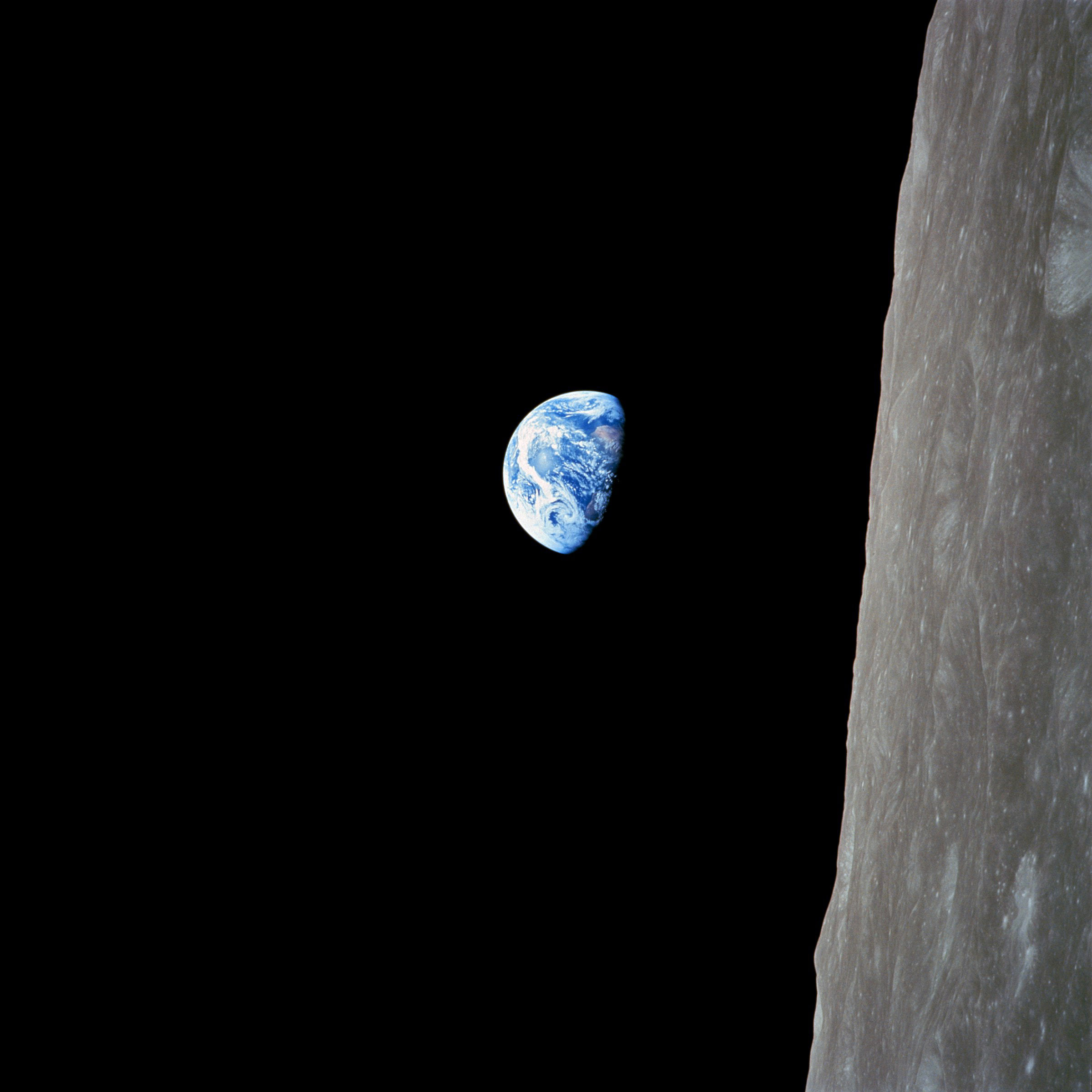
Apollo 8's overview effect: Iconic Earthrise image, AS08-14-2383, Bill Anders' serendipitous photograph of Earth as the first manned flight to the Moon swung around from the farside, December 24, 1968 [NASA/JSC].
The Apollo 11 crew landed on the lunar surface a few months after that Earthrise photo was circulated. During this and subsequent missions (all on the central near side of the Moon), it was reported by the media that Earth always appears stationary in the same part of the sky as seen from the Moon’s surface.

In November 1969, the Apollo 12 crew put up a large inverted umbrella antenna to improve communication data rates from the lunar surface; it had to be set-up and aligned, but once pointed at Earth, it remained pointed at it forever.

Simulated time-lapse view of Earth from the vicinity of the Moon's north pole, where the significance of the Moon's libration creates changes in a notional viewers perspective. Earth appears to swing through a Lissajous figure in the sky. Three lunar days are squeezed into 1:45 using Celesta.

Because the Moon orbits the Earth and is in synchronous rotation with its orbital period, we always see the same side.  Hence, there is a near side (the hemisphere we see from Earth) and a far side (the side we cannot see from Earth; it is often mistakenly called the “dark side”).

A consequence of this synchronous rotation is that from the Moon, the Earth appears stationary in the sky, just as the hub of a bicycle wheel remains stationary from the viewpoint of one of its spokes. Thus, while the Sun rises and sets according to the slow rotation rate of the Moon (one complete rotation every 708 hours, half day and half night), the Earth is always in the same spot in the sky. Of course, because it is illuminated by the Sun, it changes its phase on the same timescale as does the Moon as seen from Earth, although reversed (a full Moon on Earth is a new Earth from the Moon and vice versa.)  From the far side of the Moon, one does not see the Earth at all.

Are spectacular views of Earthrise only visible from spacecraft in orbit about the Moon? Not quite.

Two points about the Moon’s orbit make the story a bit more complicated. First, the Moon’s orbit around the Earth is not circular but elliptical, its distance ranging from 363,000 km up to 405,000 km from the Earth. Second, the plane of the Moon’s orbit is inclined about 5 degrees to the ecliptic (the plane of the Earth-Moon system’s orbit around the Sun). These two facts mean that the Moon librates, or “wobbles” both left and right (an effect of its elliptical orbit) and up and down (an effect of the inclination of its orbital plane). These librations are not overwhelmingly significant, but result in some interesting effects around the limb of the Moon – the great circle made up by the 90 degrees east and west longitude lines, including both poles.
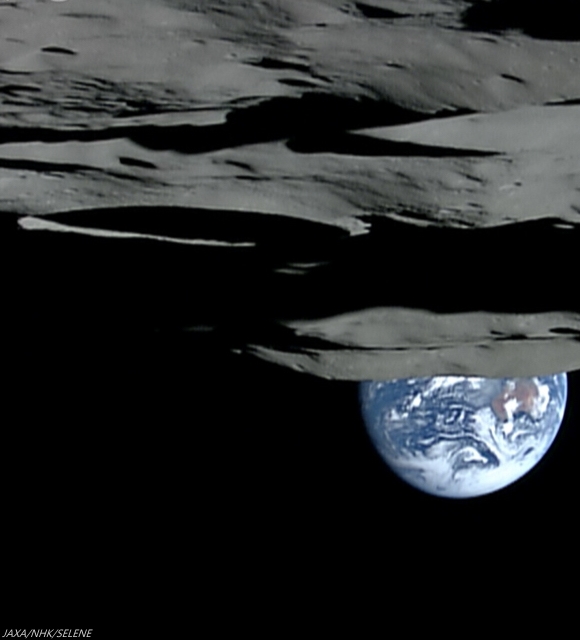
Earthset, from 1080p video captured from Japan's lunar orbiter SELENE-1 (Kaguya) October 31, 2007, as spacecraft and camera, in polar orbit, began its track north from the south pole (on the rim of Shackleton crater, center left) over the Moon's farside, leaving Earth to set behind Malapert massif, a nearside fragment of the rim of immense South Pole-Aitken impact basin [JAXA/NHK/SELENE].
The Earth as seen from the Moon is about 2 degrees in angular width (about 4 times the apparent diameter of the Moon and Sun as seen from Earth). Earth’s disk is roughly equivalent to the size of a quarter held out at arm’s length; the Moon’s apparent disk is pea-sized. Because of the Moon’s longitudinal libration, the “limb” areas near the 90 degree meridians are sometimes visible to Earth and other times not. Thus, the Earth will sometimes appear in the sky and sometimes be hidden below the Moon’s horizon – in other words, an observer along this line of longitude will see an Earthrise and an Earthset.

The longitudinal libration is about 8 degrees, so the observer on the lunar limb would see the Earth slowly rise above the horizon and clear it by its apparent diameter, then slowly sink below the horizon by the same amount. That Earthrise will be slow indeed – it will take a couple of days for the full disk of the Earth to rise above the horizon. This cycle would repeat on a monthly timescale, as the Moon completes one revolution around the Earth.

Similarly, one would also see the Earth rise and set at the poles of the Moon, although to a different magnitude. The polar view is almost completely dominated by the latitudinal libration, caused by the inclination of the Moon’s orbital plane. This variation is about 6.5 degrees (it includes the Moon’s spin axis obliquity of 1.5 degrees) and would vary on a similar monthly timescale. These variations will become important if future lunar inhabitants live at the poles, as I think likely. As the Earth will sometimes be out of direct view, it is likely that we will depend on relay satellites for continuous communication. Polar inhabitants will also see a “different” Sun from what they’re accustomed to on Earth – at the lunar poles, the sun rotates around the horizon, rather than rising and setting.
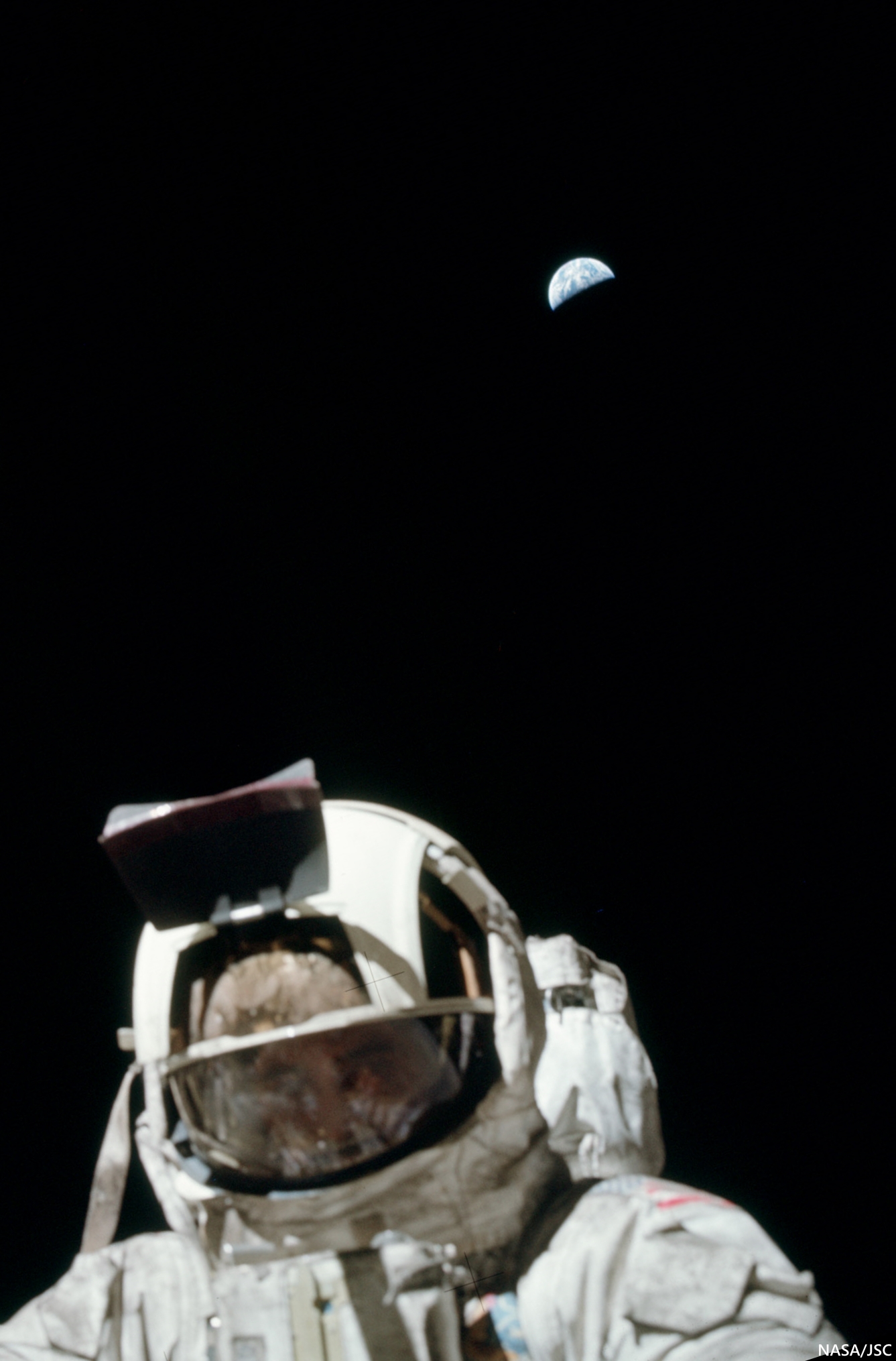
Cernan and Earth. At Taurus Littrow, Earth maintains its position. Ground controllers did occasionally admonished Apollo 17 Cmdr. Gene Cernan's partner Jack Schmidt for lifting his solar visor to get a better look at a rock, from time to time, during the last walks on the Moon. But at this point, however, as he traded poses with Schmidt using Earth as a backdrop, Cernan did briefly lift his visor halfway, allowing posterity an atypical view of an actual human face on the Moon in December 1972 (AS17-134-20471) [NASA/JSC].
Thus, there are places on the Moon from which we can stand and contemplate the sheer beauty and magnificence of a slowly rising Earth. Given the sea change in global perspective provided by the famous Earthrise picture taken by the Apollo 8 crew almost fifty years ago, what societal impacts will occur when a human being stands on the lunar surface and watches the Earth slowly rise above the horizon? I suspect that a similar shift in planetary perspective will occur. If history is any guide, such a shift will have profound psychological and political implications  – both positive and negative – in our reach for the stars.

Dr. Paul D. Spudis is a senior staff scientist at the Lunar and Planetary Institute in Houston. This column was originally published by Smithsonian Air & Space online, and his website can be found at www.spudislunarresources.com. The opinions he expressed here are his own, but these are better informed than most.

Wednesday, December 11, 2013

Earth and Moon from Juno fly-by

"Earth and Moon as seen from passing spacecraft"
D C Agle
Jet Propulsion Laboratory

Steve Cole
NASA Headquarters 

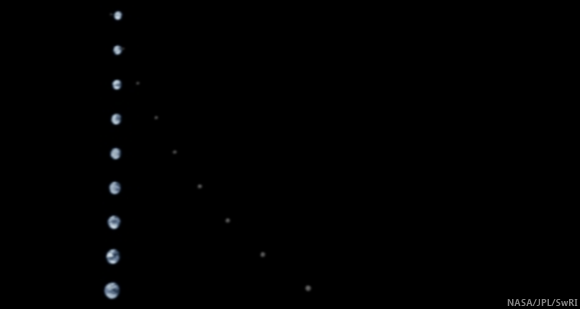
When NASA’s Juno spacecraft flew past Earth on October 9, 2013, it received a boost in speed of more than 7.3 kilometers per second, which set it on course for a July 4, 2016 rendezvous with Jupiter. One of Juno's sensors, a faint star tracking camera, also had a unique view of the Earth-Moon system. The result was an intriguing, if low-resolution, glimpse of what it would be like to approach our worlds from a distance.

“In the movie, you ride aboard Juno as it approaches Earth and then soars off into the blackness of space," said Scott Bolton, Juno principal investigator at the Southwest Research Institute (SwRI) in San Antonio. "No previous view of our world has ever captured the heavenly waltz of Earth and Moon."

The Juno Earth flyby movie is available on YouTube HERE. The original score is by Vangelis.

Earth-Moon from Juno October 9, 2013
Ancient cosmic pirouette of Earth and Moon from the Jovian-bound spacecraft Juno as it flew by Earth, October 9, 2013 [NASA/JPL-Caltech].
The cameras that took the images for the movie are located near the pointed tip of one of the spacecraft's three solar-array arms. They are part of Juno's Magnetic Field Investigation (MAG) and are normally used to determine the orientation of the magnetic sensors. These cameras look away from the sunlit side of the solar array, so as the spacecraft approached, the system's four cameras pointed toward Earth. Earth and Moon came into view when Juno was about 966,000 kilometers away -- about thrice the Earth-Moon separation.

During the flyby, timing was everything. Juno was traveling about twice as fast as a typical satellite, and the spacecraft itself was spinning at 2 RPM.

To assemble a movie that wouldn't make viewers dizzy, the star tracker had to capture a frame each time the camera was facing Earth at precisely the right instant. The frames were then sent to Earth, where they were processed into video.

"Everything we humans are and everything we do is represented in that view," said the star tracker's designer, John Jørgensen of the Danish Technical University, near Copenhagen.

Amateur Radio signal from Juno Fly-By
The Waves instrument aboard NASA's Juno spacecraft recorded amateur radio signals from ham radio operators from around the world [NASA/JPL-Caltech/University of Iowa].

Also during the flyby, Juno's Waves instrument, which is tasked with measuring radio and plasma waves in Jupiter's magnetosphere, recorded amateur radio signals. This was part of a public outreach effort involving ham radio operators from around the world. They were invited to say "HI" to Juno by coordinating radio transmissions that carried the same Morse-coded message. Operators from every continent, including Antarctica, participated.

"With the Earth flyby completed, Juno is now on course for arrival at Jupiter on July 4, 2016," said Rick Nybakken, Juno project manager at NASA's Jet Propulsion Laboratory in California

Moon from Juno fly-by
Moon from Juno star-tracking camera, October 9, 2013 [NASA/JPL/SwRI/MSSS/Ken Kremer/Marco Di Lorenzo].
The Juno spacecraft was launched from Kennedy Space Center in Florida on August 5, 2011. Juno’s launch vehicle was capable of giving the spacecraft only enough energy to reach the asteroid belt, at which point the Sun’s gravity pulled it back toward the inner solar system. Mission planners designed the swing by Earth as a gravity assist to increase the spacecraft’s speed relative to the Sun, so it could reach Jupiter. (The spacecraft’s speed relative to Earth before and after the flyby was unchanged.)

EFB12_7s_Juno-Earth-mosaic_Ken-Kremer-1000x1414
Earth - over the coast of Namibia, from mosaic of images captured from the Juno spacecraft's on-board Junocam, near the Jupiter-bound probe's close encounter with Earth and Moon, October 9, 2013 [NASA/JPL/SwRI/MSSS/Ken Kremer/Marco Di Lorenzo].
After Juno arrives and enters into orbit around Jupiter the spacecraft will circle the planet 33 times, from pole to pole, and use its collection of science instruments to probe beneath the gas giant's obscuring cloud cover. Scientists will learn about Jupiter's origins, internal structure, atmosphere and magnetosphere.

Juno's name comes from Greek and Roman mythology. At times personified in Earth's Moon, Juno was the goddess of the civil state.

More information about Juno is online, HERE

Friday, May 25, 2012

LROC captures Earth "In the Shadow of the Moon"

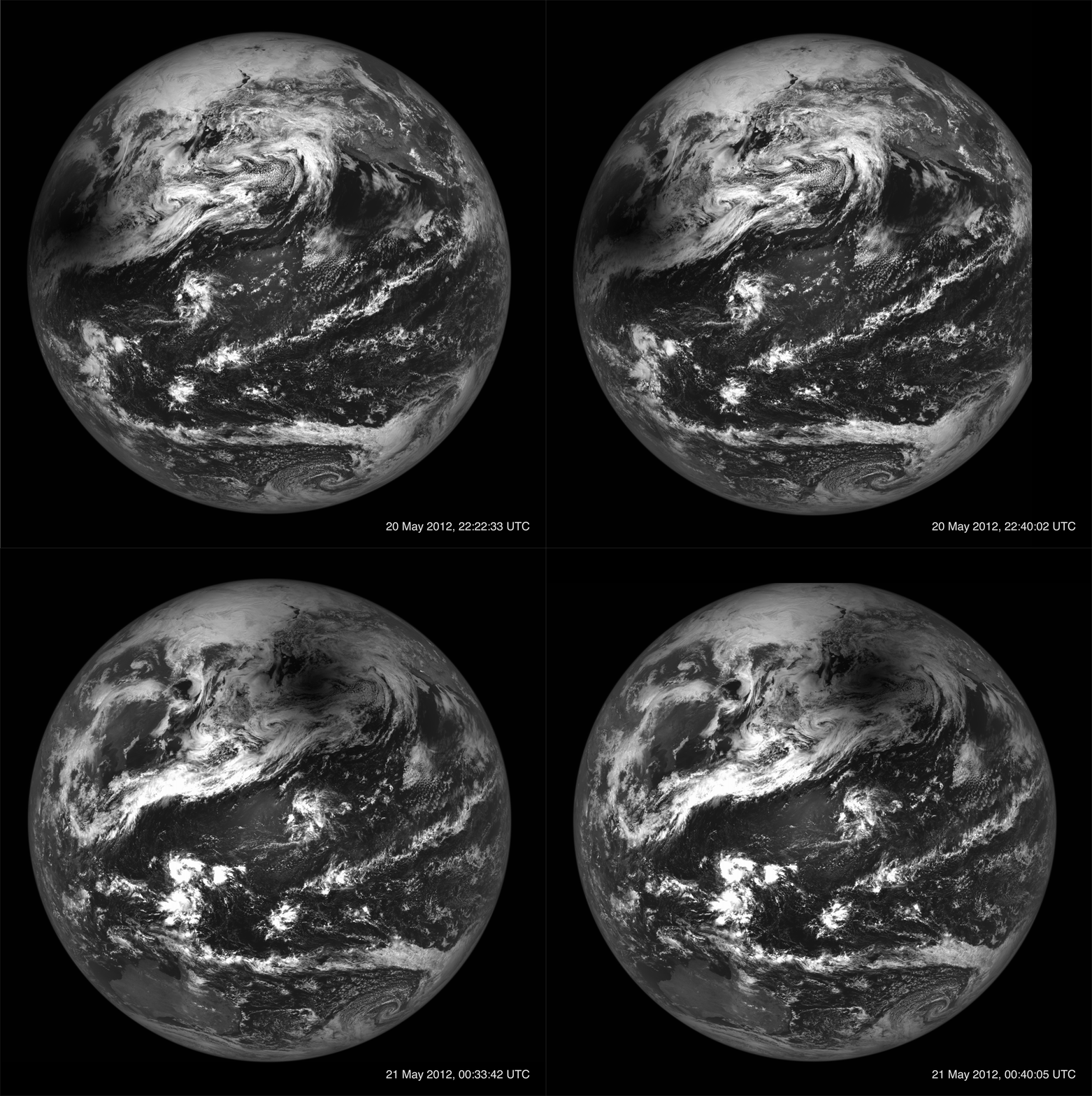
Animated compilation of the four images collected by the LROC NAC during the Annular Solar Eclipse of May 2012. Two images were collected during each of two successive orbits. (NAC images E192192490L, E192192869L, E192199689L, E192200072L) View the full size image accompanying the LROC release HERE [NASA/GSFC/Arizona State University].
Brett Denevi
LROC News System

A solar eclipse occurs, from the Earth’s perspective, when the Moon passes directly between the Earth and the Sun. This alignment results in a shadow of the Moon passing across the Earth. In a total eclipse, the Moon blocks the entire disk of the Sun, and viewers on Earth witness only the the Sun's faint corona that extends thousands of miles into space. However, in an annular (or "ring of fire") eclipse like the one that occurred on 20-21 May 2012, the apparent size of the Moon is smaller than that of the Sun, so terrestrial viewers can see a bright ring or annulus of the Sun around the Moon. Which type of eclipse you experience, total or annular, depends on where the Moon is in its orbit. The Moon's orbit isn't perfectly circular, so sometimes it is closer to the Earth, and bigger in the sky (resulting in a total eclipse), and sometimes it is farther from the Earth and smaller in the sky (an annular eclipse).

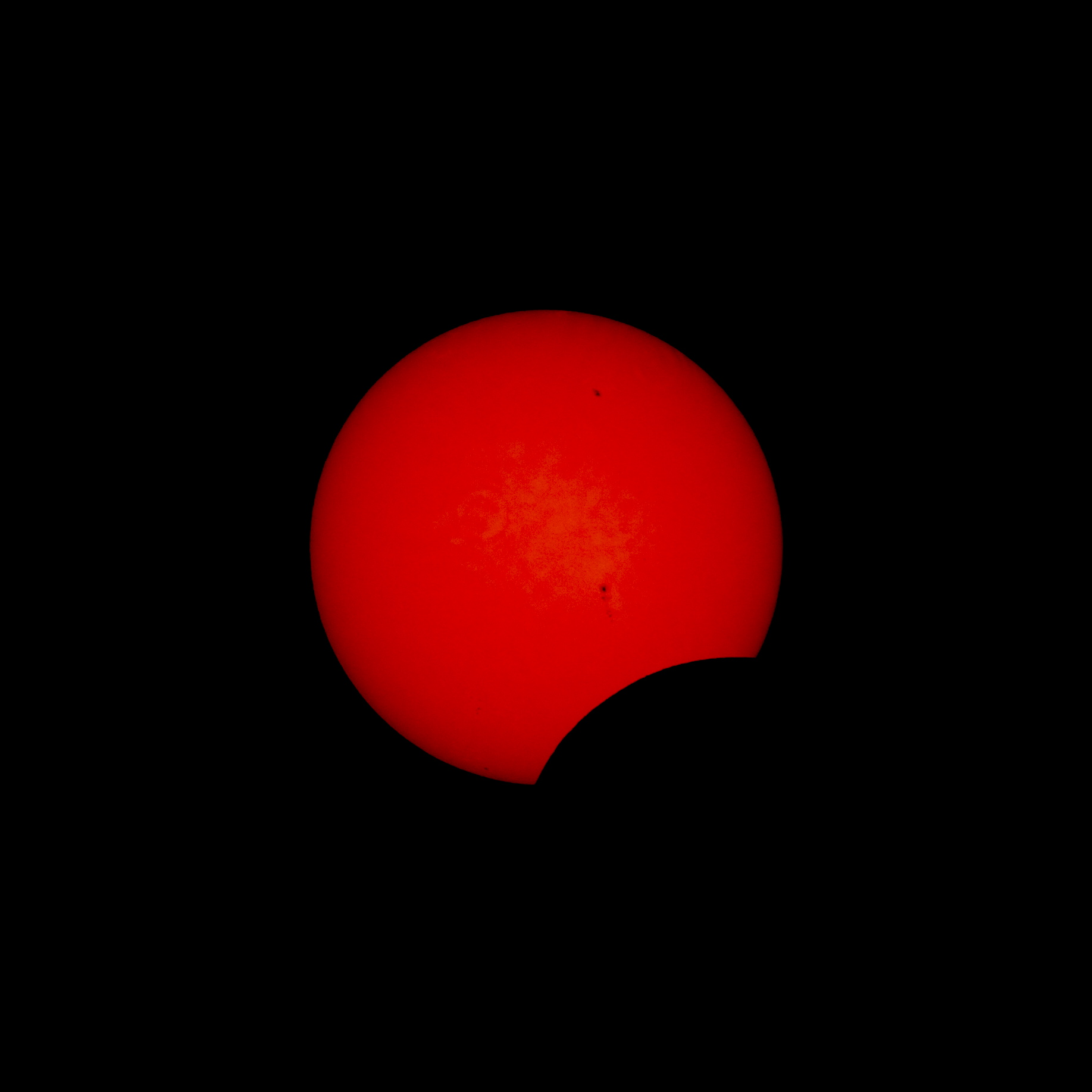
The Annular Eclipse, by E. Speyerer, from Kanarraville, Utah, May 20, 2012 (UT) View the spectacular 1667 px original accompanying the LROC image released May 25, 2012 HERE.
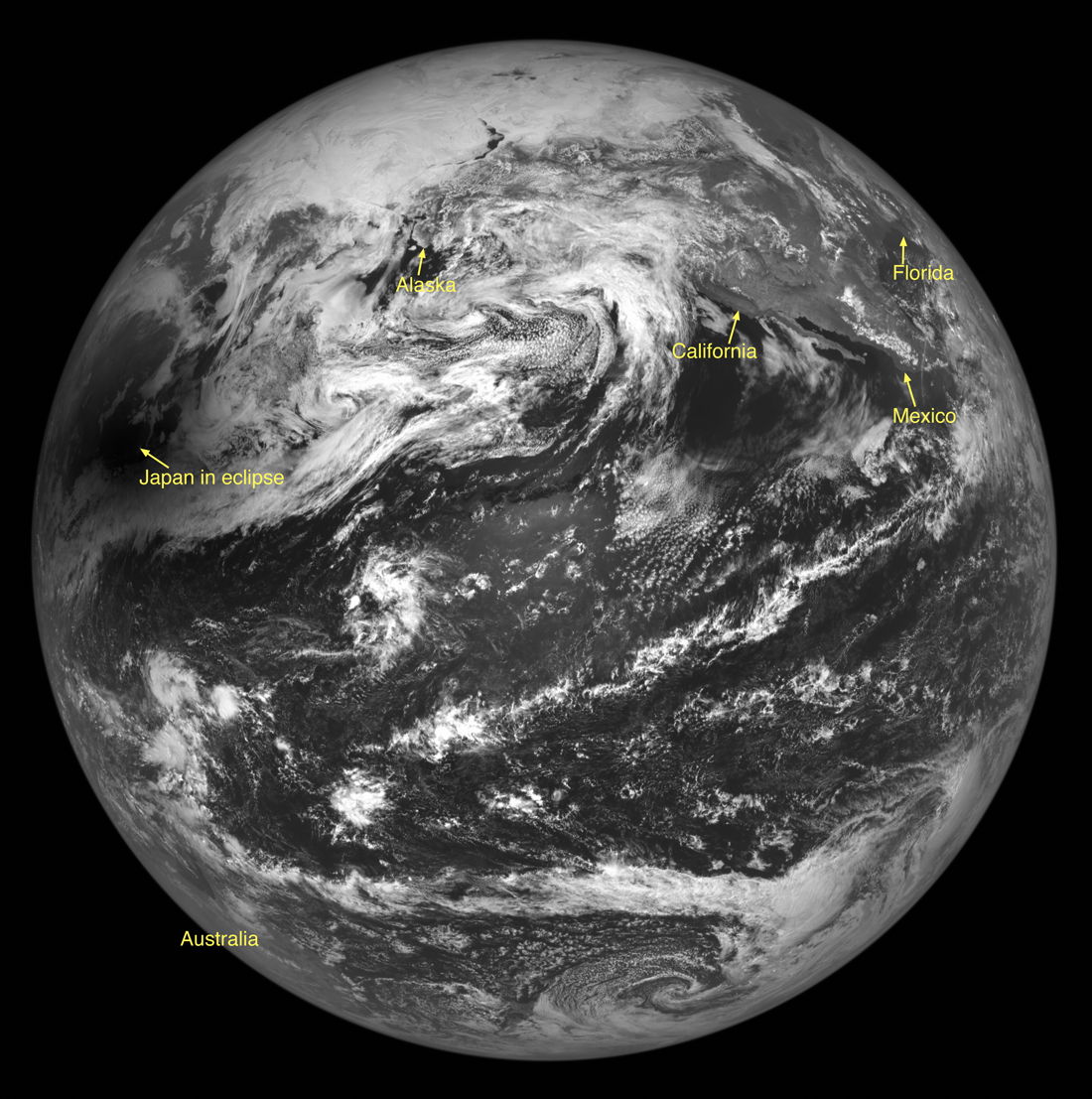
What does a solar eclipse look like from the Moon? The LROC NAC captured four images of the Earth, two on each of two successive orbits, during this solar eclipse. In these images you can see the Moon's shadow passing over the Earth over a period of about two hours. The image above shows the eclipse as it progressed over the Aleutian Islands, below you can see it a bit earlier as the Moon's shadow passed over Japan.

The first of four images captured by the LROC Narrow Angle Camera (NAC) during the Annular Eclipse of May 2012, as the Moon's shadow passed over Japan. Annotated NAC image E192192490L. View the original image accompanying the LROC release HERE [NASA/GSFC/Arizona State University].
The LROC NAC cannot easily acquire images of the Earth, and acquiring Earth views requires a significant amount of planning. The NAC is a line scanner, meaning that it has only one row of 5064 pixels per camera. Instead of snapping a single frame, an image is built up by the motion of the spacecraft in orbit about the Moon (about 1600 meters per second). To obtain an image of the Earth the spacecraft is turned 180° to face the Earth, then the spacecraft is pitched as quickly as possible (one-tenth of a degree per second), so that the image is built up line by line. You can see that two of the frames in the animated image below are slightly clipped, because LRO's timing wasn't perfect and the NAC ran out of lines before completing the scan (the NAC buffer is filled up after 52,240 lines, which is 256 Mbytes of data).

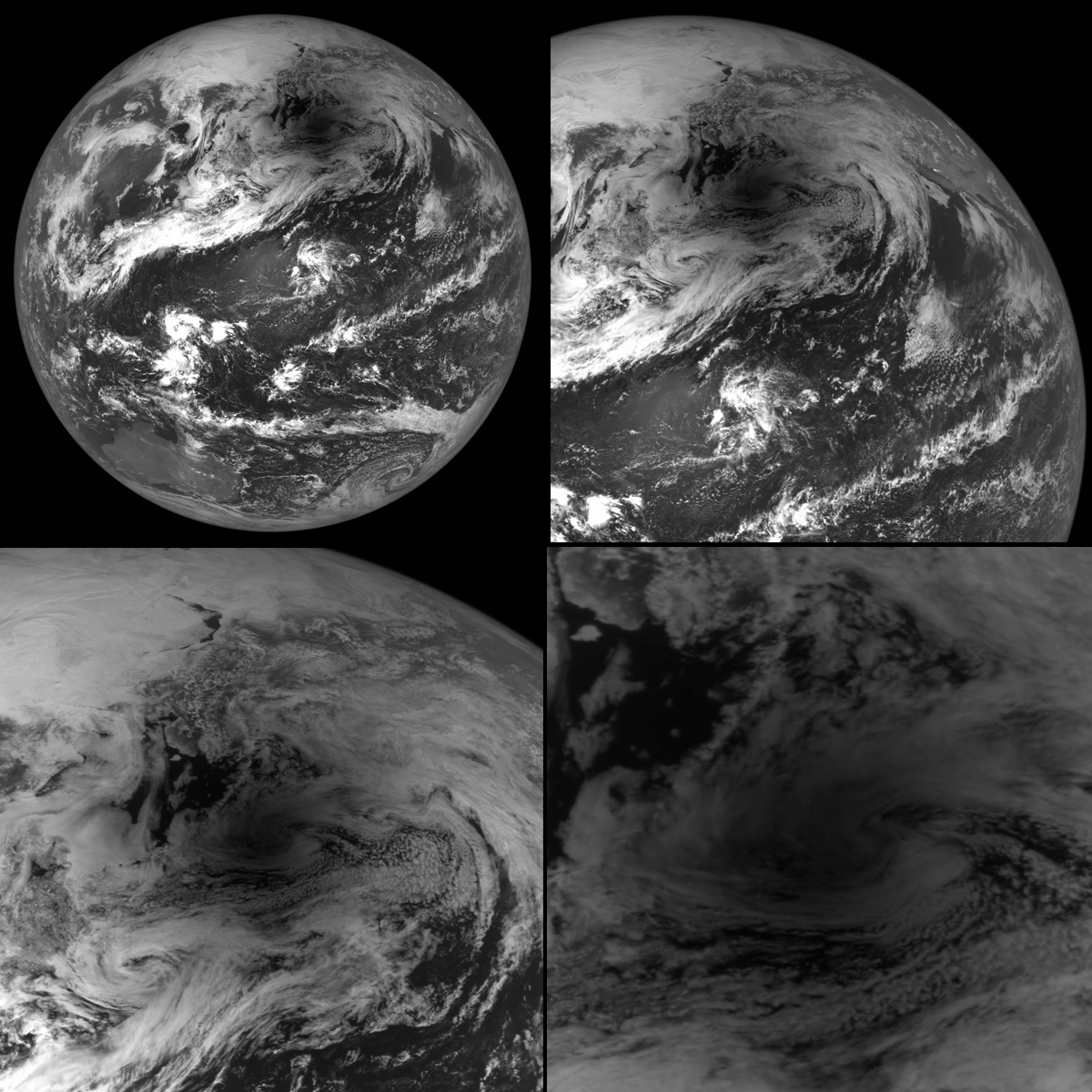
Zooming in on the Moon's shadow during the solar eclipse. NAC Image E192199689L. View the full size assembly HERE [NASA/GSFC/Arizona State University].
Because it was an annular eclipse, the shadow isn't totally dark; some sunlight still made it down to viewers of the eclipse as it passed over. The image below provides a zoomed in view of the Moon's shadow.

The eclipse was spectacular from the Moon, but it was also quite a view from within the Moon's shadow!

"Just barely," by E. Speyerer. A partial eclipse captured at the same moment as the LROC Featured Image "first of four," above (2012-142 00:33:41.036) from Kanarrville, Utah. The full eclipse had not quite reached Utah, thus the Moon is seen blocking only a small portion of the Sun. View the full size original accompanying the LROC image release HERE [E. Speyerer].
View the full resolution NAC eclipse image, HERE.

Revisit Earlier NAC images of the Earth from the Moon: