Showing posts with label SLS. Show all posts

Thursday, January 22, 2015

Marshall plans eleven cubesats on 2018 SLS debut

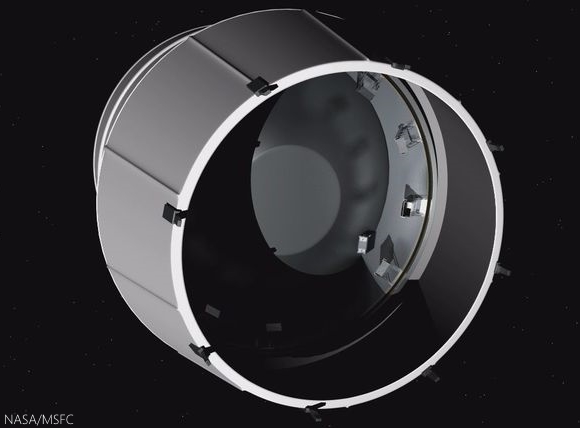
The MSA with cubesats tucked away [NASA/MSFC].
Josh Barrett
SpaceAlabama.com

Exploration Flight Test-1, which launched on December 5, 2014 tested the Orion spacecraft.  The capsule that would take people to Mars went to space for the first time, and it was one of NASA's biggest accomplishments in 2014.  In 2018, the next flight of Orion will be on the Space Launch System (SLS), and it will again be an unmanned test flight.  But this time around, there's going to be some extra things sent to space.

The Marshall Space Flight Center is working on getting the most out of the SLS's tremendous lift capability.  NASA had the novel idea of tucking away eleven different scientific missions on Exploration Mission-1, which would provide otherwise costly access to deep space.

"What we're really excited about is the fact that we're able to take this test flight and actually get science out of it, and we're expanding the capability," said Joseph Pelfry, a deputy project manager at Marshall, who was instrumental in this idea.  "SLS is designed for a lot more payload capability, but we're trying to take advantage of every bit of capability the vehicle has."

Three of the eleven missions have already been selected.  The science payloads must fit in to six-unit cubesats, which are efficient and versatile.  They will be hidden in the multi-vehicle stage adapter (MSA), which is the ring that connects Orion's service module to the top stage of SLS.  Once Orion and the service module disconnect and continue on to orbit the moon, compartments in the MSA will launch the science missions at certain times depending on particular mission.

"Flying these secondary payloads is something we're going to do for missions to come and really provide the science community an opportunity that they haven't had before," Pelfrey said.  "That's what the SLS enables beyond the journey to Mars."

Two missions are being designed at Marshall.  The Near-Earth Asteroid (NEA) Scout and Lunar Flashlight are already approved.  Both will make use of solar sail technology - which uses energy from photons emitted by the sun to create a highly efficient, propulsionless way to explore the solar system. 

Read the full post at SpaceAlabama.com, HERE.

Tuesday, February 4, 2014

Why not return to the Moon? (Part 1)

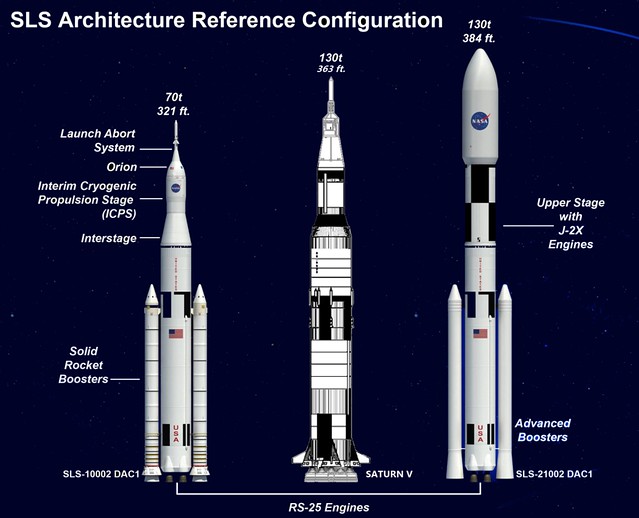
NASA SLS Architecture v SV
All trussed up, with nowhere to go? NASA's Space Launch System (SLS) heavy-lift launcher compared with the Saturn V used to send Apollo to the Moon, forty years ago.
Anthony Young
The Space Review

For the first time in nearly half a century, the United States will, in a matter of a few years, have the launch capability to send crewed spacecraft to the Moon. The launch vehicle that could make that possible is the Space Launch System (SLS). However, while the Moon was once a goal of exploration under the Vision for Space Exploration and Project Constellation, much further destinations are currently under consideration by NASA.

 There have been several incisive articles in The Space Review against the SLS, primarily against the cost of its development and projected operation. Even the former deputy administrator of NASA, Lori Garver, has now publicly come out against the SLS, stating the launch vehicle design embraces decades-old propulsion technology (which it does) and that America can do better.

For better or worse, the heavy lift launch vehicle in America’s future will be the SLS. There is, as yet, no funded mandate—that is, program—to send crews to a near Earth asteroid, and the cost of mounting a crewed mission to Mars would give the Congressional Budget Office fits. Funding for such programs are for future congressional hearings to debate.

Under NASA’s website heading “Human Spaceflight Missions” is the subheading “Future Exploration Plans” with the following items: Asteroid Redirect Initiative, Commercial Space, Orion Crew Vehicle, and Space Launch System. Only the first item is a mission: the remaining three are not. You will not find a definitive mission goal for the SLS, only nebulous statements about taking astronauts deeper into space than ever before.

Crisium - Constellation ROI - Tier 1
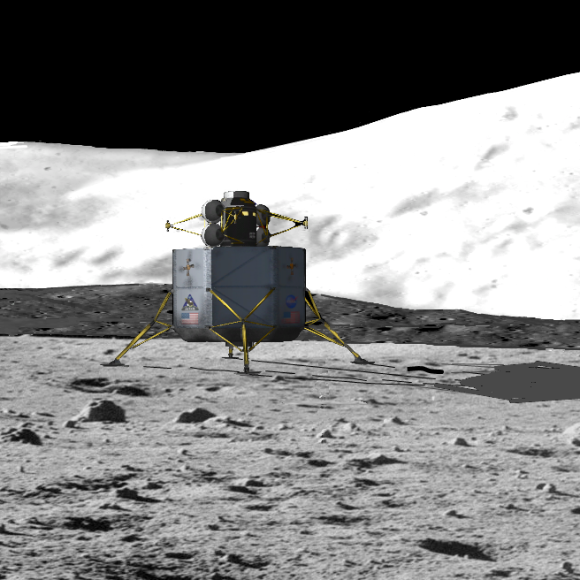
The Constellation Altair lunar lander (as conceived in 2010) After the scrubbing of the Constellation program, the only vehicle still missing from it renamed replacements was a manned landing vehicle, along with plans for "extended human activity on the Moon."
NASA also has an impressive science website. The tabs to go to specific pages regarding the space agency’s primary scientific thrust. They are (bypassing the Big Questions tab) Earth, Heliophysics, Planets, Astrophysics, Missions, Technology, and Science News. Conspicuously absent is a tab for the Moon. It is only under the Heliophysics tab one finds information related to lunar scientific exploration, in the form of a 2007 report titled “Heliophysics Science and the Moon: Potential Solar and Space Physics Science for Lunar Exploration.”

However, prior to this heliophysics-centric publication, the National Research Council (NRC) published “The Scientific Context for Exploration of the Moon”. The interim report was published in 2006 and the final report was released in 2007. It laid out the scientific rationale for the resumption of exploration of the Moon. There have, in fact, been many such strategy documents published over the decades since the end of Apollo by NASA, the NRC, and other organizations supportive of America’s return to the Moon.

It is clear, judging from the above-mentioned websites and documents, the current emphasis for scientific exploration is focused on the Sun, the Earth, and the planets, with seemingly cursory attention to the Moon. However, with the development of the SLS, the Moon may yet come back into favor.

Read the full article at The Space Review, HERE.

Monday, January 28, 2013

WSJ Op-Ed calls for scrapping SLS


In an essay in Monday’s issue of the Wall Street Journal, Robert Walker and Charles Miller make a pitch to President Obama: complete the job he started in his first term in handing over space transportation entirely in the private sector. “Just as the government does not design or build automobiles, ships, trains or airplanes, NASA should not be designing, building or launching rockets to go to low Earth orbit,” they argue. 

Specifically, they want the President to kill the Space Launch System, the heavy-lift rocket that emerged from the 2010 compromise about the administration’s policy, saying that those launches should be turned over to the private sector. 

Read the summary, HERE.

Thursday, January 17, 2013

NASA, ESA agree on new Orion-MPV SM


This animation shows NASA's Orion spacecraft as it will appear on its Exploration Mission-1 in 2017, complete with a service module to be provided by the European Space Agency. After Orion blasts off atop a Space Launch System rocket, the ESA-provided service module will fuel and propel the capsule on its journey through space. Exploration Mission-1 in 2017 will be the first mission to incorporate both the Orion vehicle and NASA's new Space Launch System. It will follow the upcoming Exploration Flight Test-1 in 2014, in which an uncrewed Orion will launch atop a Delta IV Heavy rocket and fly 3,600 miles above Earth's surface, farther than a human spacecraft has gone in 40 years.

NASA-ESA agreement on Orion Service Module
for one unit, plus spares

Marcia Smith
SpacePolicyOnline.com

NASA and the European Space Agency (ESA) provided more details today of their agreement for ESA to provide the service module for NASA's Orion spacecraft.

ESA Director General Jean-Jacques Dordain announced the plan following ESA's ministerial meeting in November.  Dordain extolled its significance both in terms of demonstrating ESA's commitment to partner with NASA in human exploration of space beyond low Earth orbit and in NASA allowing other countries to be in the "critical path" of the U.S. human spaceflight program.

At a press conference today, NASA and ESA officials continued to tout the importance of the agreement, although as details emerge it seems less dramatic than at first glance.

Read the full article, HERE.

Wednesday, December 26, 2012

September 2014 EFT-1 after 2-chute Orion test

Artist’s illustration of the EFT-1 Orion in orbit, following a planned launch atop a Delta-IV Heavy booster in September 2014 [NASA].
Ben Evans
AmericaSpace

In less than two years’ time, NASA intends to loft its first unmanned Orion spacecraft on the long-awaited Exploration Flight Test (EFT)-1 mission atop United Launch Alliance’s gigantic Delta IV Heavy booster. The mission, which will rise to a maximum altitude of 3,600 miles—the highest a human-capable vehicle has flown since the end of the Apollo era—will serve to wring out many of Orion’s systems in readiness for its first Exploration Mission in late 2017. NASA took one step toward the EFT-1 goal yesterday (Thursday), by completing the latest in a series of parachute drop tests of a mock-up vehicle at the US Army’s Yuma Proving Ground in Arizona. The test confirmed that Orion could land safely even if one of its two parachutes failed to open during the critical final stages of descent.

Read the full article, HERE.

Monday, September 24, 2012

NASA floats parking at Lagrange Point 2

One of many proposed configurations for the Gateway architecture, shown above the lunar farside "parked" at Lagrange Point 2 [NASA].
Mark K. Matthews
Orlando Sentinel

Top NASA officials have picked a leading candidate for the agency's next major mission: construction of a new outpost that would send astronauts farther from Earth than at any time in history.

The so-called "gateway spacecraft" would hover in orbit on the far side of the moon, support a small astronaut crew and function as a staging area for future missions to the moon and Mars.

At 277,000 miles from Earth, the outpost would be far more remote than the current space station, which orbits a little more than 200 miles above Earth. The distance raises complex questions of how to protect astronauts from the radiation of deep space — and rescue them if something goes wrong.

NASA Chief Charlie Bolden briefed the White House earlier this month on details of the proposal, but it's unclear whether it has the administration's support. Of critical importance is the price tag, which would certainly run into the billions of dollars.

Documents obtained by the Orlando Sentinel show that NASA wants to build a small outpost — likely with parts left over from the $100 billion International Space Station — at what's known as the Earth-Moon Lagrange Point 2, a spot about 38,000 miles from the moon and 277,000 miles from Earth.

At that location, the combined gravities of the Earth and moon reach equilibrium, making it possible to "stick" an outpost there with minimal power required to keep it in place.

To get there, NASA would use the massive rocket and space capsule that it is developing as a successor to the retired space shuttle. A first flight of that rocket is planned for 2017, and construction of the outpost would begin two years later, according to NASA planning documents.

Read the full article HERE.

Related Post:

Wednesday, September 19, 2012

Orion and SLS: Where Are They Now?

Amy Teitel
AmericaSpace.com

It’s been a little over a year since NASA announced its intention to build the Space Launch System or SLS, the rocket that will be bigger and more powerful than the Saturn V. Its payload is set to be the Orion Multi-Purpose Crew Vehicle, the Apollo-inspired capsule that is slated to take men to the Moon, Mars, and asteroids at some still-undefined point in the future. Last Wednesday, the Republican Subcommittee on Space and Aeronautics held a hearing to examine ongoing developments of Orion and SLS. The word from NASA is that both projects are moving forward. But schedules are starting to slip, and things will only get worse if the agency faces further budget cuts.

Testifying at the September 12 hearing were Cleon Lacefield, Vice President and Orion Program Manager from Lockheed Martin; Boeing Space Exploration Vice President and SLS Stages Program Manager Jim Chilton; NASA Deputy Associate Administrator for Exploration Systems Development Daniel L. Dumbacher; and Matt Mountain, Director of the Space Telescope Science Institute.

Read the full article, HERE.

Sunday, July 29, 2012

NASA's Space Launch System Passes Major Agency Review, Moves to Preliminary Design

Artist rendering of the various configurations of NASA's Space Launch System (SLS) together with a quick comparison with the Saturn V (1967-1972) [NASA].
The rocket that will launch humans farther into space than ever before passed a major NASA review Wednesday. The Space Launch System (SLS) Program completed a combined System Requirements Review and System Definition Review, which set requirements of the overall launch vehicle system. SLS now moves ahead to its preliminary design phase.

The SLS will launch NASA's Orion spacecraft and other payloads, and provide an entirely new capability for human exploration beyond low Earth orbit.

These NASA reviews set technical, performance, cost and schedule requirements to provide on-time development of the heavy-lift rocket. As part of the process, an independent review board comprised of technical experts from across NASA evaluated SLS Program documents describing vehicle specifications, budget and schedule. The board confirmed SLS is ready to move from concept development to preliminary design. 

Read the NASA announcement, HERE.

Thursday, July 19, 2012

Another successful Orion drop test

The Orion team loads a test version of the spacecraft into a C-17 in preparation for a parachute drop test at the U.S. Army Yuma Proving Ground in Arizona. The main objective of the latest drop test is to determine how the entire system would respond if one of the three main parachutes inflated too quickly [NASA].
NASA completed another successful test Wednesday of the Orion crew vehicle's parachutes high above the Arizona desert in preparation for the spacecraft’s orbital flight test in 2014. Orion will carry astronauts deeper into space than ever before, provide emergency abort capability, sustain the crew during space travel and ensure a safe re-entry and landing.

Watch a video of the parachute drop test

A C-17 plane dropped a test version of Orion from an altitude of 25,000 feet above the U.S. Army Yuma Proving Ground in southwestern Arizona. This test was the second to use an Orion craft that mimics the full size and shape of the spacecraft.

Orion's drogue chutes were deployed between 15,000 feet and 20,000 feet, followed by the pilot parachutes, which deployed the main landing parachutes. Orion descended about 25 feet per second, well below its maximum designed touchdown speed, when it landed on the desert floor.

Read the full NASA Feature article, HERE.

Wednesday, July 11, 2012

Checking up on the Space Launch System

The most recent publicly released artist's rendering of the Orion/SLS Block-1 architecture, now intended for a hoped-for 2017 debut. Success by streamlined commercial manned space companies filling America's low-Earth orbit manned spaceflight gap with the retirement of the Space Shuttle in 2011, the Space Launce System heavy-lift architecture will revive American manned spaceflight access to Cis-Lunar Space and beyond. Until then, NASA will utilize the work-horse Delta-IV heavy lift booster to begin unmanned flight testing of the Orion spacecraft beginning in 2014  [NASA].
Jason Davis
The Planetary Society Blog
 
When SpaceX's Dragon capsule returned from its historic trip to the International Space Station this May, it proved that -- in theory -- the idea of having private spaceflight companies relieve NASA of its low-Earth orbit taxi duties can succeed. Meanwhile, work continues on the Space Launch System, the next-generation deep space vehicle slated to take humans beyond Earth for the first time since 1972.

Orion arrives at KSC -- Amid much pomp and circumstance, the first space-bound Orion capsule arrived at Kennedy Space Center at the end of June. Orion sat naked during its official unveiling, baring its sea foam-green hull that was constructed using friction stir welding, a process in which metal is 'mixed' at the joint rather than melted (other space vehicles have used this technique, including SpaceX's Falcon 9 rocket). NASA officials, astronauts and politicians attended the official unveiling, including U.S. Senator Bill Nelson, who is fond of referring to the SLS by a different moniker: the "Monster Rocket."

Read the complete post HERE.

Related:
Orion Drop Test (April 18. 2012)

Friday, May 18, 2012

Delta IV second stage chosen for Orion tests

Delta IV upper stage utilized on a variety of
configurations
[NASA/USAF].
Todd Halverson
Florida Today

NASA intends to use a modified Delta IV second stage to launch Orion spacecraft on an unmanned test flight in 2017 and then a human expedition to lunar orbit four years later.

The Boeing upper stage is “the only means available to support the immediate in-space propulsion needs” for the excursions, NASA said in a procurement notice issued early this month.

The missions both are to be launched from complex 39B at Kennedy Space Center on early versions of NASA’s new heavy-lift Space Launch System.

The second stage for the first flight must be delivered to KSC no later than the fourth quarter of 2016, the notice said. The fourth quarter of 2020 is the deadline for delivery of the upper stage for the second mission.

NASA performed an internal market study of in-space propulsion systems available in the U.S., Europe and Japan, the notice said. From that research, NASA determined that the Delta IV upper stage “is the only known in-space stage requiring relatively minor modifications” to meet mission requirements as well as the launch schedule, the notice said.

Moreover, NASA said no other in-space propulsion system – “either existing with flight proven performance, or planned” – could be upgraded to fly astronauts with “relatively minor modifications.”

A single Pratt & Whitney RL-10B2 engine powers the Delta IV second stage. The engine runs on supercold liquid hydrogen and liquid oxygen.

The RL-10 was the first liquid hydrogen rocket engine built in the United States and has been flying for 50 years. Versions of it still power Atlas V and Delta IV upper stages.

Read the full article HERE.

Thursday, March 1, 2012

EM1: 2017 SLS/Orion lunar mission outlined

It's baseline development all but complete, the Orion MPV is on track to be the capstone of a return to American civilian heavy-lift spaceflight in 2017, if the US commitment to commercial low-Earth orbit crew transfers lives up to it hopes [NASA].
Chris Bergin
NASASpaceflight.com

The debut of the Space Launch System (SLS) will send the Orion (MPCV) on a 7-10 day mission to the Moon, with an aim to qualify the Heavy Lift Launch Vehicle (HLV) and Beyond Earth Orbit (BEO) Orion to carry humans into deep space. Exploration Mission 1 (EM-1) involves sending Orion around the far side of the Moon, prior to a splashdown in the Pacific Ocean.

Pitch over, at T L I-plus 20 minutes
SLS-1 – EM-1: With a launch date of December 17, 2017, the historic mission will aim to hand NASA a Christmas present of becoming a successful pathfinder for crewed flights on the new spacecraft, in turn providing a baseline for a return to exploration in deep space for the first time since the 1970s.

Launch date slips are a natural part of the space launch business, although the development roadmap for the SLS shows a large amount of schedule mitigation through the key review milestones leading up to the opening mission.

Ironically, the main threat to the schedule target may be due to problems unrelated to Orion or the SLS. This is due to the law of the 2010 Authorization Act, which requires SLS and Orion to provide a back-up role for the International Space Station (ISS), in the event of major disruption in the Commercial Crew arena.

This would be an undesirable situation for all concerned, not least because the 70mt SLS and BEO Orion would be vastly overpowered – and economically overpriced – for the role of lofting astronauts to the orbital outpost in Low Earth Orbit. At the same time, it would mean the Commercial Crew partners would have failed to achieve their designated role several years after the initial target of 2015.

Read the full article HERE.