Showing posts with label John Young. Show all posts

Sunday, December 30, 2012

Forever Young, Memoir of the Astronaut's Astronaut

Charlie Duke catches Apollo 16 commander John Young as he salutes Old Glory in mid-jump, demonstrating the Moon's low gravity. See the original at NASA's Apollo Lunar Surface Journal, HERE (MET: 120:25:42 - AS17-113-18339).

"He is off the ground about 1.45 seconds which, in the lunar gravity field, means he launched himself at a velocity of about 1.17 meters per second and reached a maximum height of 0.42 meters. Although the suit and backpack weighed as much as he did his total weight was only about 65 pounds (30 kg). To get to this height he only had to bend his knees slightly and push up with his legs." Video Clip ( 3 min 21 sec 0.9 Mb RealVideo or 30 Mb MPEG ) [NASA].
Ben Evans
AmericaSpace

In the days before his first mission into space, way back in March 1965, John Young was asked by a journalist if he minded flying into orbit with the fiery Virgil ‘Gus’ Grissom as his Gemini 3 crewmate. Without blinking, the 34-year-old Young replied: “Are you kidding? I’d go with my mother-in-law!” It was an indicator not only of Young’s intense dry wit, but of his equally intense devotion to the exploration of the final frontier – an exploration which consumes 400 pages in his long-awaited memoir, Forever Young, co-authored with Auburn University history professor and Neil Armstrong biographer James R. Hansen.

Long-awaited because Young has earned himself a reputation over the past five decades which cannot be surpassed. True, there are astronauts who have flown more times into space than him. True, there are other astronauts who have walked on the Moon, besides him. True, there are astronauts who have commanded more missions and flown longer in space than him. But for sheer longevity within the astronaut business, John Watts Young is unrivaled. Selected as a member of NASA’s second intake of spacefarers in September 1962 – an intake which former chief astronaut Deke Slayton once described as “probably the best all-around group ever put together” – he spent more than 40 years with NASA and flew six times, across three separate programs: Gemini, Apollo and the Shuttle. Even Jerry Ross, who became the first human to record a seventh voyage into space, has described Young as his hero.

Read the full review at AmericaSpace, HERE.

Monday, July 23, 2012

Charlie Duke commemorates Aldrin communion

Apollo 11 capcom and Apollo 16 lunar module pilot Charlie Duke addresses Monte Sano Methodist Church in Alabama, July 22, 2012. Congregants snacked on Moon Pies and Tang before heading into the sanctuary to commemorate Buzz Aldrin's "lunar communion" 43 years ago, Friday [Glenn Baeske/The Huntsville Times].
Steve Doyle
The Huntsville Times
 

"It seemed only appropriate that astronaut Charlie Duke - the 10th human to set foot on the moon - was the guest of honor at the church's "Lunar Communion" service Sunday morning.

Pastor Dale Clem said Monte Sano United Methodist is one of just two U.S. churches that commemorate astronaut Buzz Aldrin taking communion on the moon July 20, 1969 - 43 years ago Friday. Aldrin's church, Webster Presbyterian in Houston, is the other.Before heading into the sanctuary, worshipers snacked on Moon Pies, crescent-shaped cantaloupe slices and, of course, Tang.

Selected for the astronaut program in 1966, Duke was in mission control as Aldrin and Neil Armstrong delicately maneuvered their Apollo 11 lunar landing module toward the moon's surface.

"Roger, copy you down, Eagle...We're
breathing again." As Apollo 11 capcom,
Duke was first to talk directly with
another on the Moon [NASA].
Duke, the lunar landing module pilot, said his heart was racing at 144 beats per minute as the Saturn V took to the heavens. Commander John Young, making his second space voyage, was a relaxed 70 beats per minute.

When Duke's heart finally stopped hammering, wonder took over. He said he'll never forget the first time he gazed back toward home from 20,000 miles away.

"That jewel of Earth - the browns of the land and the crystal blue of the oceans and the pure white of the snow and clouds - is indelibly imprinted upon my mind."

Duke said he didn't have a spiritual experience, per se, during the 20 hours he spent combing the moon's surface.

But after returning to a hero's welcome and diving back into the business world, he said he began longing for something more.

Duke said he found what he was looking for when he reluctantly agreed to attend a three-day Bible study at a tennis club in New Braunfels, Texas.

Read the full article, HERE.

Tuesday, June 19, 2012

Astronaut's eye view of the Apollo 16 landing site

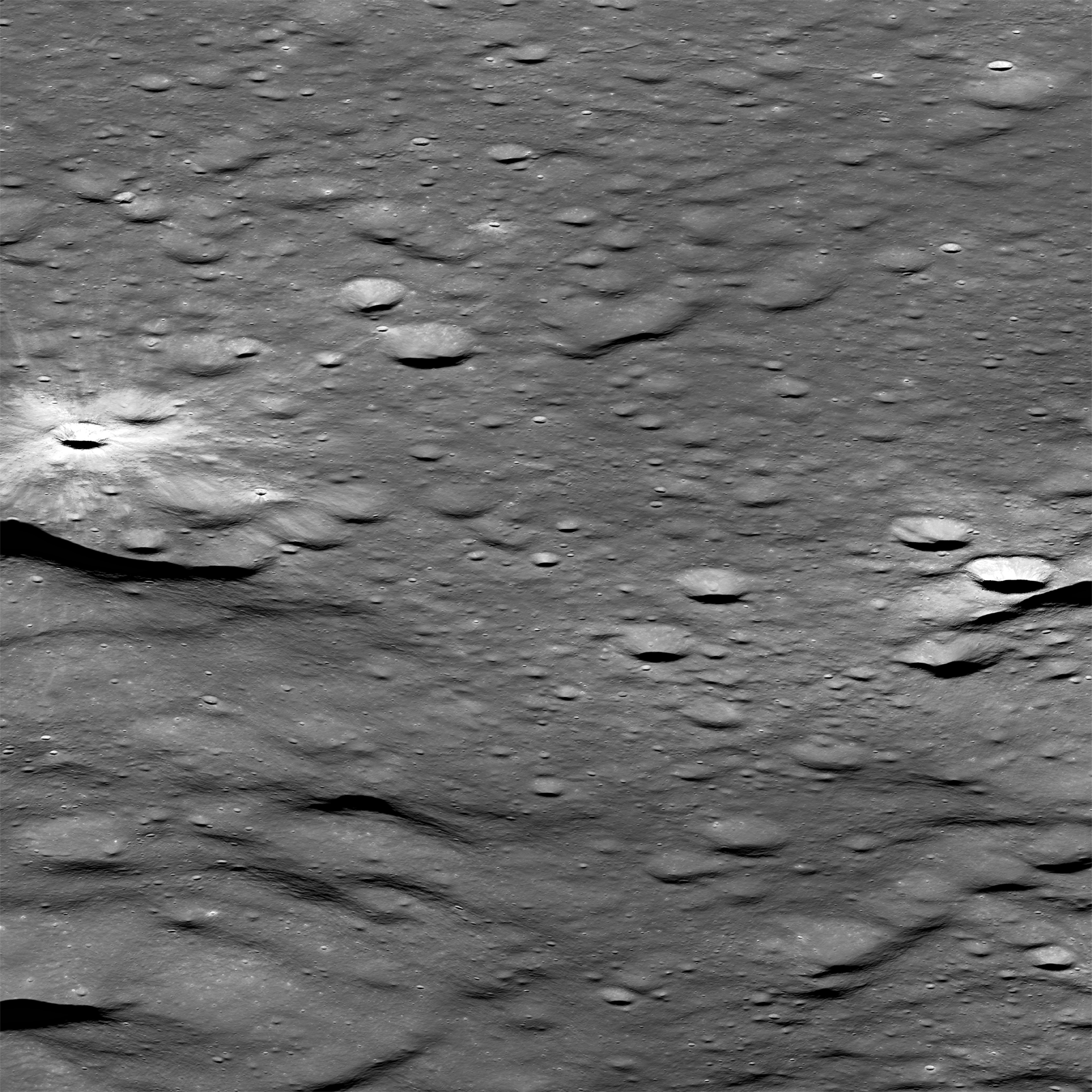
Oblique LROC Narrow Angle Camera (NAC) image of the Apollo 16 landing site, viewed from east to west.  Brighter South Ray crater is center left and North Ray crater center right, and the distance between the two landmark crater centers is 10.5 km. LROC NAC montage M192817484LR, LRO orbit 13442, May 28, 2012. View the 1600 x 1600 full-size 4 meter resolution LROC Featured Image HERE [NASA/GSFC/Arizona State University].
Mark Robinson
Principal Investigator
Lunar Reconnaissance Orbiter Camera
Arizona State University

On May 28 LRO was slewed 59° to the west, from an altitude of 92 km (57 miles) and captured a dramatic view of the Apollo 16 landing site.

During the Apollo 16 mission Ken Mattingly passed over the site several times at an altitude of 120 km (75 miles).  If you imagine yourself in the Command Module, then this view is close to what you would have seen.

The lighting is nearly identical to that of when the Lunar Module Orion set down on the Moon.

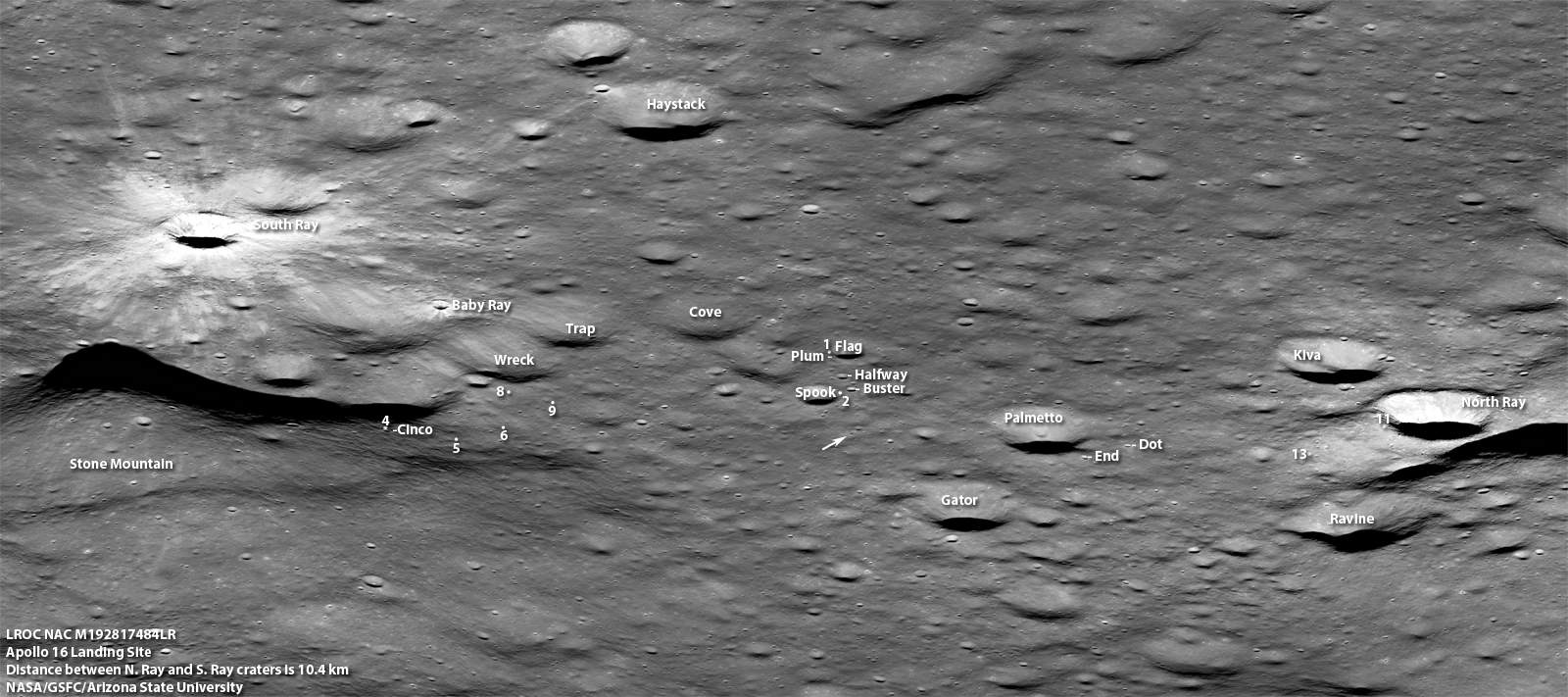
Subsampled subimage centered on Apollo 16 site, key craters and astronaut sampling stations are labeled (arrow shows location of lunar module descent stage and lunar rover), field of view 11 km across. View the 1600 px, full-size annotated image HERE [NASA/GSFC/Arizona State University]
On the second day of surface activities John Young and Charlie Duke headed south to sample material from Stone mountain and ejecta from South Ray crater. They headed south and turned east climbing up the flank of Stone Mountain. Imagine the view that Young and Duke had from Cinco crater (Station 4)! From their vantage point some 300 meters above the LM, the astronauts could see all the way from South Ray crater to North Ray crater.

Full resolution details from the Apollo 16 oblique image. Upper left: Lunar Module descent stage above and to the left of the forever parked Lunar Rover (arrows). Upper right: House Rock on the rim of North Ray crater. Lower left: Baby Ray crater. Lower Right: Shadow Rock (arrow). Each view is 530 meters wide and 1240 meters deep [NASA/GSFC/Arizona State University].
Full resolution field of view from a LROC Wide Angle Camera (WAC) monochrome (604nm) montage, swept up from a mere 38.27 kilometers, in orbit 11299, December 3, 2011; 52.3 meters resolution. Like the Featured Image, the illumination from the east, at a 69.57° angle of incidence, is similar to the lighting during the Apollo 16 expedition in April 1972 [NASA/GSFC/Arizona State University].
With the annotated version you can easily retrace the routes followed by Young and Duke as they spent three days exploring this highland landing site. Read a detailed reconstruction of the astronaut activities through the Apollo Lunar Surface Journal

What did they find at House Rock? Why was Shadow Rock an important science target? Is Baby Ray crater older or younger than South Ray crater? Then imagine yourself picking up where the Apollo astronauts left off over forty years ago!

When will we return to the Moon?

Dive into the full resolution oblique shot of the Apollo 16 site, HERE.

Retrace the astronaut traverses in an annotated version of oblique image, HERE.

Previous Apollo 16 LROC Featured Images
How Young is Young?


Friday, April 27, 2012

Forty years ago

Diver crews off the carrier U.S.S. Ticonderoga hustle recover Apollo 16 command module soon after splashdown in the Pacific (0°43′S 156°13′W), April 27, 1972. Along with the distinct scarring of their fiery direct-return re-entry John Young, Charlie Duke and Ken Mattingly return, arrive following 11 days in Space with 95.71 kg of lunar samples. During their mission the U.S. House of Representatives directed development of a Space Shuttle transportation system to debut in 1976. The next and last expedition to the lunar surface would take place the following December, and Young commanded the first orbital flight of Space Shuttle Columbia in 1981 [NASA/JSC/ALSJ].

Tuesday, April 24, 2012

LROC: Orion, Up Close

40 years parked on the Cayley plain northwest of the Descartes formation.
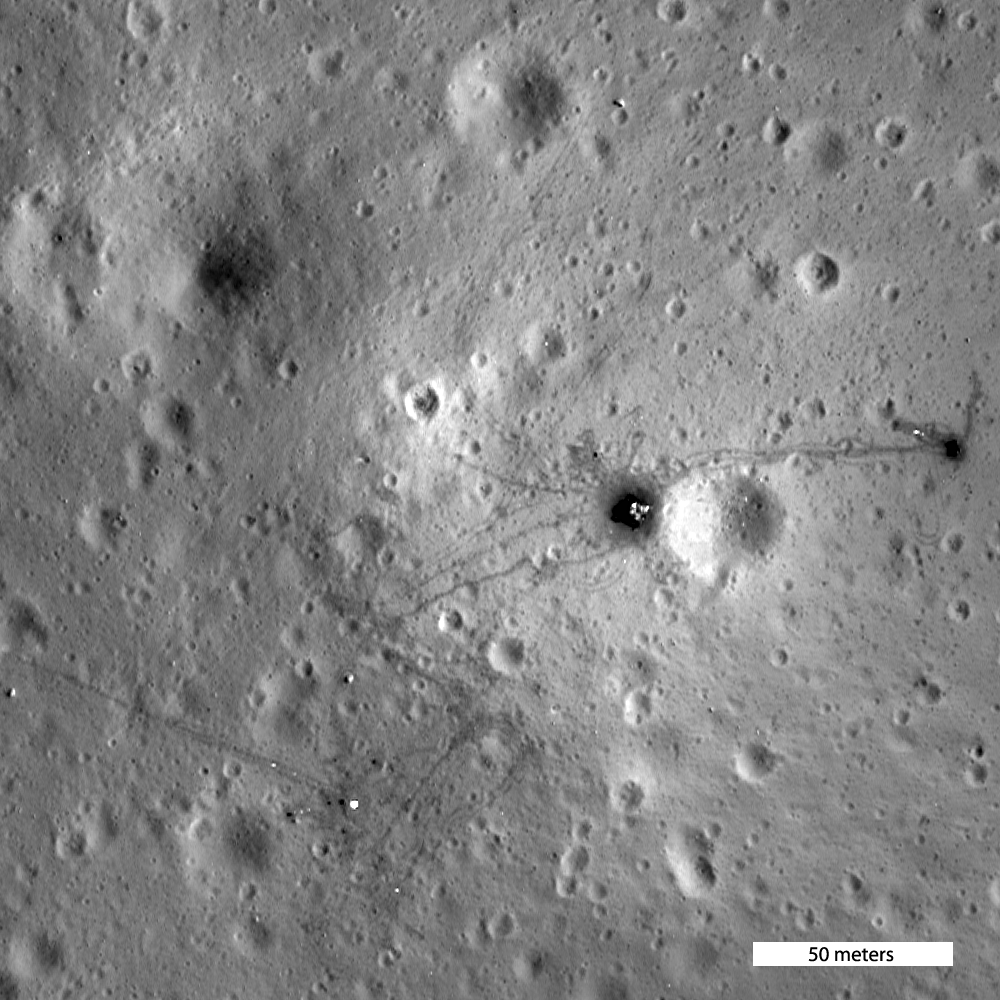
The second of two narrow periapsis orbital passes afforded the LROC team an opportunity to capture this astounding view of the Apollo 16 landing site, orbit 10950, November 6, 2011. LROC Narrow Angle Camera (NAC) mosaic M175179080; field of view above = 145 meters. See the 250 meter FOV in the LROC Featured Image, released on the 40th anniversary of the lift-off from the Moon of the Apollo 16 lunar module ascent stage Orion, April 22, 2012, HERE [NASA/GSFC/Arizona State University].

Mark Robinson
Principal Investigator
Lunar Reconnaissance Orbiter Camera
Arizona State University

The Apollo 16 Lunar Module Orion set down on the lunar surface 40 years ago (21 April 1972) after remaining in a holding pattern for six hours while technical issues with the Command Module Casper were resolved.

Here John Young and Charlie Duke undertook the first and only exploration of a highlands site; their main goal was to sample the enigmatic light plains deposits that geologists had interpreted as remnants of a large scale explosive volcanic eruption.

These proposed volcanic rocks were to be very different than the volcanic mare basalts sampled at previous sites (Apollo missions 11, 12, and 15).

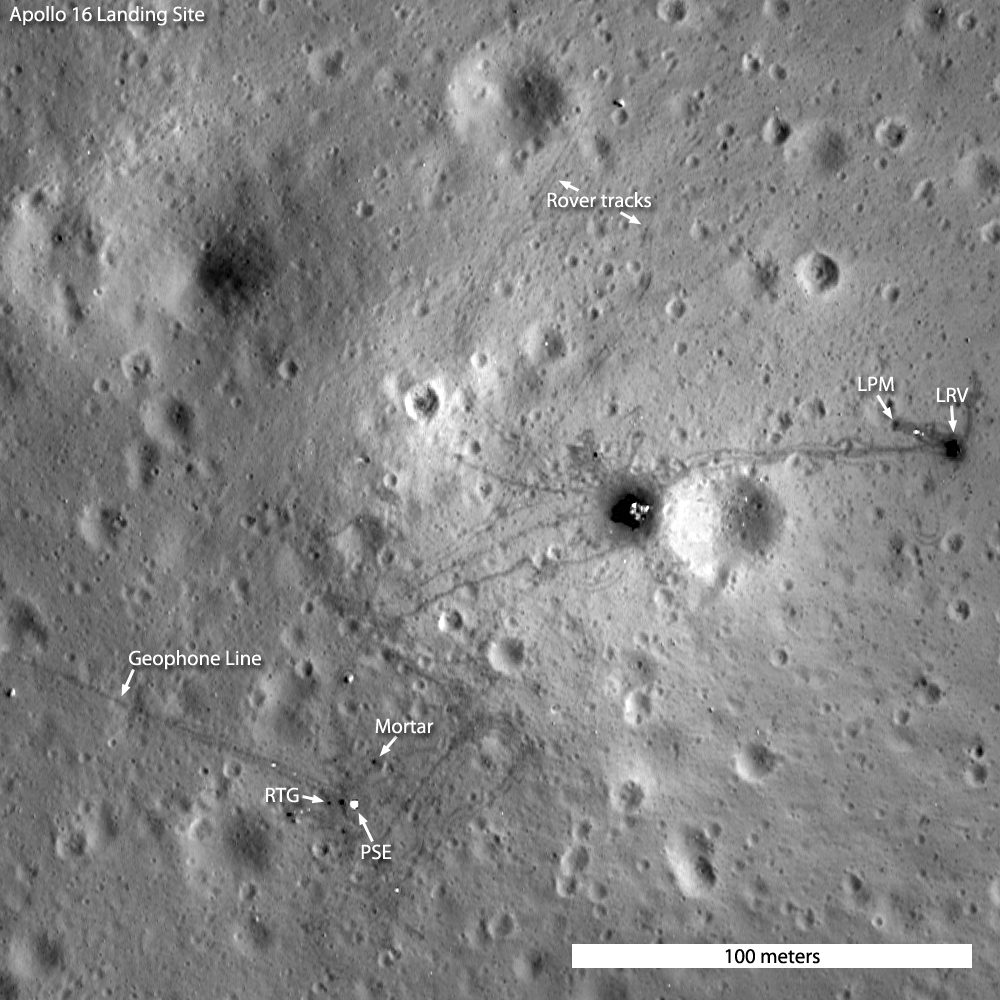
Annotated version of the LROC commemorative Featured Image of the Apollo 16 landing site, full image release 250 meters field of view (M175179080) HERE [NASA/GSFC/Arizona State University].
Once Young and Duke started looking at rocks near Orion, it became clear that there were no strange highland volcanic rocks. What they found were breccias, breccias, and more breccias. Why breccias, and how did they form? The Apollo 16 rocks were most similar to those collected by Apollo 14 astronauts Al Shepard and Ed Mitchell. As it turns out, the breccias formed as part of massive flows of ejecta from the Imbrium and Nectaris basin-forming events. Young and Duke were sampling crushed rocks that flowed hundreds of kilometers from their source!

Enlargement of Apollo 16 site, the Lunar Portable Magnetometer (LPM) is in the center of the dark spot below the annotation, the arrow shows Sun glint off an electronics cable, M175179080 [NASA/GSFC/Arizona State University].
Similar to the other Apollo missions, the Apollo 16 crew set up science instruments to measure varied aspects of the Moon and its environment. Most science instruments were part of the Apollo Lunar Surface Experiments Package, or ALSEP. The Apollo 16 crew also carried with them on their geology traverses the Lunar Portable Magnetometer (LPM) that measured variations in the strength of the Moon's weak magnetic field. Some of the ALSEPs (Apollo missions 12, 15, 16) carried a stationary Lunar Surface Magnetometer (LSM) that provided a point measurement for the landing site as a whole.

On April 22, 1972, minutes before the end of their third and final EVA, John Young took this photograph from his vantage over the lunar rover, parked for the final time so it's color television camera, controlled from Houston, could capture the ascent stage lift off. The LPM is just outside the full-size picture (AS16-116-18716) to the right, and the ALSEP site is in the distance on the left. [NASA]. 
Still image from the televised feed, after nearly 21 hours out on the lunar surface, at Mission Elapsed Time (MET) 175 hours, 31 minutes, 49 seconds, Young and Duke lift off in the Orion ascent stage, headed for rendezvous with Tom Mattingly awaiting them in the Command Module, and home [NASA/Apollo 16 Lunar Surface Journal]. 
The LSMs showed that from site-to-site the magnetic field varied by about a factor of fifty, from a low of 6 gammas (Apollo 15) to a high of 313 gammas (Apollo 16). From the LPM station-to-station measurements within the Apollo 16 traverses, the magnetic low was 121 gammas and high the high was 313 gammas; a factor of nearly three over a distance of 7 km.

The Apollo 16 Lunar Portable Magnetometer in its final configuration beside the parked rover. Note lunar sample rock 60335 is  temporarily perched on the magnetometer for calibration purposes. AS16-116-18721 [NASA].
The magnetometer on Lunar Prospector (1998-99) mapped
what may be the most intense crustal magnetism on the Moon
80 kilometers south of the Apollo 16 landing site, associated
with the bright albedo north of ancient Descartes crater
[Richmond, et al., (2003)].

After setting up the LPM, a final experiment was performed by measuring the magnetic field before and while a small rock was perched on the experiment. This experiment returned two important results: a) the local rocks had a remnant magnetic field so weak that the LPM could not detect it, and b) that the LPM was still working as before launch. These results came from the fact that the astronauts brought the sample (60335) back to Earth, and it was measured by an identical LPM as well as well as even more sensitive instruments.

What did these varied magnetic readings tell us about the Moon? The Moon's magnetic field comes from crustal and mantle materials, has no dipole signature, and is very weak. 

This is a magnetic field very different from the dipole field generated in the Earth's core. Right now scientists do not understand the origin of the lunar magnetic field or its variations. Perhaps the signature of an early, but now extinct, dipole field was captured in ancient lunar rocks as they cooled from a magma ocean. 

Perhaps basin-forming impacts induced local fields in the crust. These Apollo area measurements do tell us that the interior of the Moon is heterogeneous and complicated: the Moon is not a simple body. The two GRAIL spacecraft, Ebb and Flow, that are now in orbit about the Moon will provide gravity measurements that geophysicists will use to deepen our understanding of the lunar interior; the Apollo era magnetic readings will be part of that unfolding story.

Find the LPM and the rest of the ALSEP hardware in the full NAC image, HERE.

Previous LROC Apollo 16 Featured Images:
Apollo 16, Footsteps Under High Sun
How Young is Young?
Apollo 16 First Look
Apollo 16 North Ray crater

Young put the Orion ascent stage into a slow roll so Tom Mattingly could photograph the buckled skin of the spacecraft first noticed after the lunar module was retrieved from the SIVB after trans-lunar injection. The damage was made much worse by the force of its lift-off from the Moon. Back in lunar orbit, the distinctive craters Messier and Messier A can be seen at right. AS16-122-19535 [NASA/JSC].
Previous Low Altitude LROC Image Releases:
Apollo 11
Apollo 12
Apollo 14
Apollo 15
Apollo 17, Shorty crater

A fanciful edit of AS16-107-17435, showing how the Orion descent stage may look forty years after the brief, but productive expedition of Apollo 16.

Saturday, April 21, 2012

Forty years ago: 'a big ol' Navy salute.'

Joy - The second of two 'mid-air' salutes. (Detail from AS16-113-18340, April 21, 1972, Apollo 16, EVA 1) by Cmdr. John Young answering Charlie Duke's request that he to pose for a photograph with two jumps, accompanying each with 'a big ole Navy salute.' [NASA/JSC/ALSJ].
From the Apollo Lunar Surface Journal: 120:25:42 "John Young jumps off the ground and salutes for this superb tourist picture. He is off the ground about 1.45 seconds which, in the lunar gravity field, means that he launched himself at a velocity of about 1.17 m/s and reached a maximum height of 0.42 m. Although the suit and backpack weigh as much as he does, his total weight is only about 65 pounds (30 kg) and, to get this height, he only had to bend his knees slightly and then push up with his legs. In the background, we can see the UV astronomy camera, the flag, the LM, the Rover with the TV camera watching John, and Stone Mountain. Journal Contributor Joe Cannaday notes that high-point of John's first jump was at a time close to 120:25:49 and the second was almost exactly three seconds later."


After trading places for Young to capture Duke's 'Air Force salute' Houston passes along 'good news.' The U.S. House of Representatives has authorized the Space Shuttle program. 

Young, who will command the first Space Shuttle mission 9 years later, answers, "Beautiful. Wonderful. The country needs that Shuttle mighty bad. You'll see."

From the Apollo Lunar Surface Journal: "John became the Chief of the Astronaut Office in 1975 and, later, appointed himself to command the first Shuttle flight. STS-1 was 36-orbit mission launched on April 12, 1981, the twentieth anniversary of Yuri Gagarin's Vostok flight. The pilot - and only other crewmember - on STS-1 was Robert Crippen.".
Landing site of Apollo 16, between North Ray and South Ray craters, northwest of the Descartes Formation ("Stone Mountain, at lower right) in the nearside lunar highlands. Full 52 meter resolution detail from LROC Wide Angle Camera monochrome (604nm) observation M177535094C, LRO orbit 11299, December 3, 2011; angle of incidence 69.4° from 38.2 kilometers altitude [NASA/GSFC/Arizona State University].

Forty years ago

Lunar module pilot Charlie Duke captured this view, through Apollo 16 commander John Young's window, April 21, 1972 (UT). To the left is Stone Mountain, northwest extreme of the Descartes Formation, where the astronauts would gather samples during their second of three EVA's. On the right is the bright ejecta blanket of South Ray crater, easy to spot through modest amateur telescopes from Earth, and a relatively recent impact that had conveniently excavated some of the oldest rocks in the lunar highlands. AS16-113-18300 [NASA/JSC].

Follow the Mission at the Apollo 16 Lunar Surface Journal

The latest released and indexed LROC Narrow Angle Camera (NAC) image of the Apollo 16 landing site was swept up in local morning lighting (incidence angle = 69.64°) not very different than the conditions encountered by Young and Duke forty years ago. The Orion descent stage, the astronaut's dusty boot-trails churned through optically immature regolith just exposed by the descent stage engine and the lunar rover parked just to the east are all visible. LROC NAC M177535538L, orbit 11299, December 3, 2011 from 38.6 kilometers [NASA/GSFC/Arizona State University].
Related Posts:

Friday, March 9, 2012

LROC: How Young is Young? (Apollo 16)

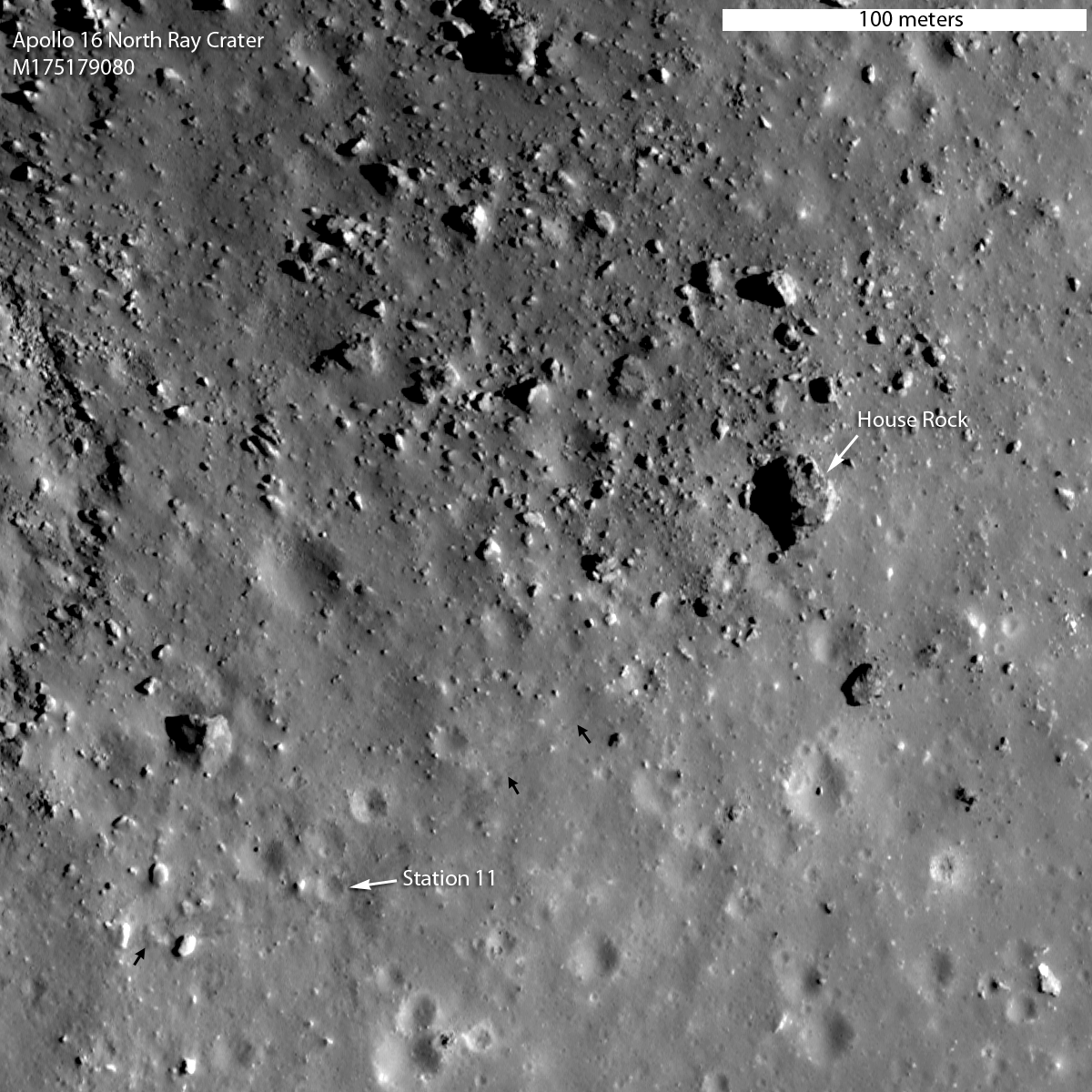
Area on the southeastern rim of North Ray crater explored by Apollo 16 astronauts John Young and Charlie Duke, revealed in striking resolution in recent low altitude LROC Narrow Angle Camera (NAC) mosaic M175179080NR, orbit 10,950, November 6, 2011. The above detail from the field of view in the release is 300 meters wide, (small arrows show the foot tracks of Young & Duke left behind during their traverse from the rover, to and from House Rock. View the full size Featured Image HERE. (Compare this image with John Young's picture of Home Rock taken from Stone Mountain in 1972 at the end of this post) [NASA/GSFC/Arizona State University].
Mark Robinson
Principal Investigator
Lunar Reconnaissance orbiter Camera
Arizona State University

One of the main goals of the Apollo 16 mission was to explore and sample a young bright rayed crater aptly named North Ray crater (890 m diameter). Its high albedo is due to its young age. During an impact event geologic material from depth is excavated and spread around a crater. The deepest material ends up near the rim, and the shallower material is thrown out farther. The pre-existing surface was mature, meaning that its albedo was diminished over time due to solar wind and micrometeorite bombardment (space weathering).

The fresh material from depth had not suffered these effects, thus its high albedo. If you wait, you can observe the North Ray crater's albedo decrease over time - but you would have to be very patient, since this space weathering process takes hundreds of millions of years to complete. At the time of the Apollo 16 mission scientists did not know the age of North Ray crater, nor did they know as much as we know today about the details of the space weathering process, so an important goal was to learn what young really means on the Moon.

North and South Ray craters are familiar companions in the southern nearside lunar Highlands in earthbound telescopes, making it unusually easy to spot the landing site of Apollo 16, at least in the mind's eye, situated directly between them. This detail is from a large November 6, 2011 mosaic put together by Yuri Goryachko, Mikhail Abgarian, Konstantin and Konstantin Morozov of Astronominsk, in Minsk, Belarus [Astronominsk].
From 400,000 to a mere 43 kilometers away, an LROC Wide Angle Camera (WAC) monochrome (643 nm) mosaic of North and South Ray craters, and the landing site of Apollo 16, April 21, 1972; LRO orbits 6778 and 6779, December 13, 2010, incidence angle 74.6° with a resolution of 60 meters from 43 kilometers [NASA/GSFC/Arizona State University].
Apollo 16 traverse map, overlain on Apollo
metric camera mosaic in Google Earth. View the
map accompanying the Featured Image HERE.
North Ray crater, which is almost 250 m deep, was the largest and deepest crater visited during the Apollo 16 mission, and its rim was the stop known as Station 11, visited on the third and final EVA. Because the rim sloped off gradually into the crater, and the crater was so deep (relative to its diameter), the astronauts could not actually see the bottom of the crater while standing on its rim.

It was hoped by pre-mission planners that the astronauts would look into the crater and see discrete layers of highlands volcanic rocks.

When John Young and Charlie Duke actually got to North Ray, the astronauts saw no evidence for lava layering in its walls. Rather, the samples they collected from the rim were almost all impact breccias, or rocks formed from the pieces of other rocks during a much larger impact event.

Since the crater is so deep, it excavated long-buried lithologies, so sampling North Ray rim materials provided important information about the geology of the Apollo 16 site.

The samples from the rim of North Ray almost certainly included material from the Descartes formation, one of two major geologic units at the Apollo 16 landing site.

John Young geologizing on the rim of North Ray crater.
Their next destination will be House Rock, seen behind
Young, above his right shoulder, AS16-106-17336 [NASA].
A particularly important sampling location on the rim of North Ray crater was dubbed “House Rock”, so-named because it appeared to be the size of a house to the astronauts. 

As it turns out this house sized rock is actually 24 meters by 20 meters (79 by 65 feet)! A smaller rock (9 meters or 30 feet) directly to the south was dubbed “Outhouse Rock”, and several samples were collected at this location. 


The samples collected on the rim of North Ray crater, including those from House Rock, represent our best look at the lunar highlands and the awesome process of basin ejecta emplacement. The breccias that were sampled by Young and Duke were all formed as massive flows of rock that traveled across the Moon's surface as result of the formation of the Imbrium basin and the Nectaris basin. The formation of North Ray crater brought breccias up from depths greater than 200 meters, allowing Young and Duke to sample a three-dimensional section of the local stratigraphy.

From these samples we now know that the region is not formed of unusual lavas, but rather basin ejecta. Now believed to represent materials that were excavated from near the bottom of North Ray crater, both of these rocks originally formed as part of giant impact breccias. Age-dating these samples back on Earth revealed that the materials that comprise House and Outhouse rocks formed about 3.9 billion years ago, although the North Ray impact that excavated House Rock itself occurred only about 50 million years ago. So we now know the age of formation of the massive ejecta flows, and we have an answer to how young is young: the age of the youthful North Ray crater is an important point on our absolute age scale of lunar events.

Charlie Duke samples a shatter cone formation in Outhouse Rock, a large fragment shed off the southern end of House Rock during the third and final EVA of Apollo 16. Note the accumulation of lunar dust after totaling 20 hours on the lunar surface. AS16-116-18649 [John Young/NASA/JSC/ALSJ].
Geologists mapped out two major units in the area: the Cayley formation, which lies on top of the Descartes formation (remember what lies on top is younger). Tentatively, the Cayley formation is interpreted to have formed as ejecta from the Imbrium basin, while the Descartes formation is thought to represent ejecta from the older Nectaris basin. Since rim samples of North Ray crater likely came from the bottom of the crater, scientists believe they represent the stratigraphically lower Descartes formation (Nectaris ejecta).

In general, the age-dating of the breccias collected on the rim of North Ray crater is currently considered to provide the best available estimate for the formation age of Nectaris basin (estimates range from 3.85 to 3.92 billion years ago), an important anchor for lunar stratigraphy.

LROC NAC stereo derived topography of North Ray crater. View the full-sized LROC context image HERE [NASA/GSFC/
Arizona State University].
Up to two times a day the LROC NAC obtains stereo pairs of key science targets, including the Apollo 16 site. The stereo images provide the means to make detailed topographic maps, a powerful tool for unraveling the local geology and planning future missions to the Moon (robotic and crewed). If Young and Duke had the above LROC topographic map, they might have planned a traverse part way into the crater, or perhaps all the way to the bottom!

Inspect the whole of North Ray crater at 25 centimeter pixel scale, HERE. Note the faint and bright rover tracks indicated with small white arrows, small black arrows point to astronaut tracks.

Previous Low Altitude LROC Image Releases: Apollo 11, Apollo 12, Apollo 14, Apollo 15, Apollo 17

And just for fun: perspectives of North Ray crater made with NAC images and NAC topography at one-to-one vertical to horizontal scale (natural perspective). See if you can spot House Rock by comparing to the full resolution image map. Enjoy!

North to south perspective across North Ray crater. View the original HERE [NASA/GSFC/Arizona State University].
South to north perspective view of North Ray crater from close range, View the original HERE [NASA/GSFC/Arizona State University].
South to north perspective view of North Ray crater from far range. View the original HERE [NASA/GSFC/Arizona State University].
Looking north, 500mm high-resolution detail from AS16-108-17612 by John Young, taken from the heights of Station 4 on Stone Mountain across the Cayley plain toward the rim of North Ray crater. The Lunar Module Orion can be seen at lower left and at upper right, nearly twice as distant, is House Rock. Young and Duke would visit there the following day [NASA/GSFC/Arizona State University].

Saturday, January 7, 2012

Project Gemini comes to life

Early in the Space Age, there were some who firmly believed this was simply impossible. Tom Stafford took this picture on the evening of December 15, 1965. He was in the starboard seat of Gemini VI-A, commanded by Mercury veteran Wally Schirra, and in the fifth orbit of a one day flight they successfully rendezvoused with Frank Borman and Jim Lovell on-board Gemini VII. Borman and Lovell had three days remaining on a fourteen day flight, a world record at the time. The successful closed-loop rendezvous of piloted spacecraft was an essential skill that needed proving if the scenario in preparation for Apollo lunar landings was going to work [NASA/JSC/ASU].
Mark Robinson
Principal Investigator
Lunar Reconnaissance Orbiter Camera
Arizona State University


On 23 March 1965, the first of ten crewed Gemini spacecraft was launched carrying it's crew of two astronauts, Gus Grissom and John Young. The NASA Johnson Space Center and the School of Earth and Space Exploration at Arizona State University today proudly unveil the Project Gemini Online Digital Archive. The archive contains the first high-resolution digital scans of the original Gemini flight films, now available in several formats with a click of your mouse.

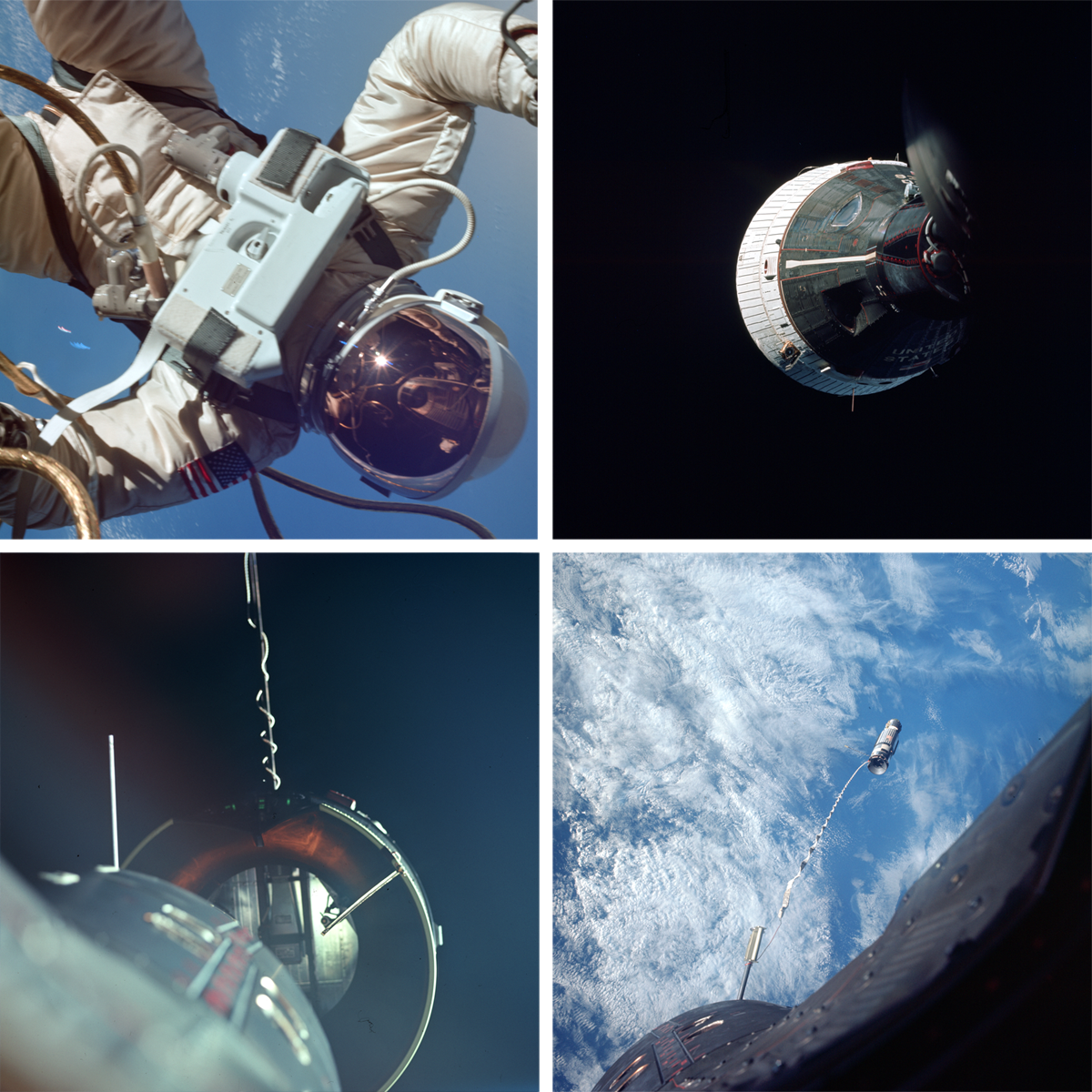
Project Gemini Highlights - Major milestones of the Gemini flights: Ed White performs the first US spacewalk (upper left), first rendezvous of two crewed spacecraft (upper right), first docking of two spacecraft (lower left), tethering of two spacecraft. Download the full-size commemorative image HERE (lower right) [NASA/JSC/Arizona State University].
Ed White (1930-1967), the first American to walk in space, photographed by Jim McDivitt during the Gemini IV mission [NASA/JSC/Arizona State University].
Project Gemini (1964-1966) was the second United States human spaceflight program, after Project Mercury (1960-1963). The overarching goal was to test systems and operations critical to the Apollo program (1961-1975), conceived with the purpose of "landing a man on the Moon and returning him safely to the Earth". Specific goals of Gemini included: perfecting rendezvous and docking between two crewed spacecraft, successfully undertaking extravehicular activities (space walking), perfecting precise reentry procedures, understanding the effects of the space environment on humans, and testing systems for Apollo. The Gemini spacecraft were launched on modified Titan II intercontinental ballistic missiles (ICBM) to low Earth orbit.

Gemini spacecraft and Titan missile display at NASA's Kennedy Space Center Visitor Complex [M. Robinson].
The successful NASA Gemini missions indeed provided critical space operations experience and directly enabled all American space achievements that followed, in particular the Apollo Moon landings and the first American space station, Skylab (1973-1974). Below is a short list of "firsts" from the Gemini missions.

- First US extravehicular activity (EVA)

- First EVA recovery and return of materials exposed to the space environment for long durations (Agena micrometeorite package)
 
- First use of fuel cells on a spacecraft

- First operation of two crewed US spacecraft simultaneously

- Longest US space mission until Skylab (Gemini 7, nearly two weeks)

- Development of coherent EVA techniques (culminating in Gemini 12)

- First on-orbit rendezvous and docking

- First demonstration of an orbital tether

- First demonstration of the scientific utility of systematic targeted Earth observation--these are some of the earliest color photos of Earth from orbit.

Buzz Aldrin, second seat on the last mission of the program, Gemini XII during his record 5 and one-half hour EVA [NASA/JSC/Arizona State University].
Go to the Project Gemini digital scan archive.

Also visit the ASU Project Mercury digital scan archive, and the Apollo archive.

Monday, September 19, 2011

A mission to find the missing lunar module


Tom Stafford and Gene Cernan in the Apollo 10 lunar module "Snoopy" prepare to dock with John Young, who snapped this picture on May 23, 1969. Away only eight hours Stafford and Cernan put the LM into a transfer orbit and descended to 14.4 km above the lunar surface before dropping the landing stage and firing the critical ascent stage six subsequent missions would depend upon to return them to ferry them back the Command Module and eventually to Earth. It was only the second time humans had visited the Moon's vicinity less than two months before Apollo 11. When later Jettisoned, the LM ascent stage engine was ignited remotely, on a trajectory placing the vehicle in orbit around the Sun, where it is presumed to remain to the present day. "Snoopy" is the only intact LM ascent stage remaining of the ten full Apollo lunar landers eventually launched into space [NASA/JSC].

Adrian West
Universe Today

Where is the Apollo 10 Lunar capsule? It’s somewhere out there — orbiting the Sun — and there’s a new initiative to try and find it!

The Apollo 10 mission launched on May 18, 1968 and was a manned “dry run” for its successor Apollo 11, testing all of the procedures and components of a Moon landing without actually landing on the Moon itself.

After carrying out a successful lunar orbit and docking procedure, the Lunar Module (called “Snoopy”) was jettisoned and sent into an orbit around the Sun.

After 42 years, it’s believed to still be in a heliocentric orbit and a team of UK and international astronomers working with schools are going to try and find it.

Read the full story HERE.

Wednesday, April 21, 2010

Apollo 16: 38 years on

Early in the first of three EVA's on the Cayley Plain terrain between North Ray and South Ray crater immediately northwest of the Descartes Formation, Apollo 16 lunar module pilot Charlie Duke suggested the lighting and backdrop, including the U.S. flag and "Stone Mountain" beyond was a beautiful photo opportunity. After a moment of hesitation, the famously sedate Cmdr. John Young jumped up and Duke took this now-famous image [NASA/ALSJ]. As cataloged by Eric Jones in the indispensable Apollo 16 Lunar Surface Journal:
"120:25:42 John Young jumps off the ground and salutes for this superb tourist picture. He is off the ground about 1.45 seconds which, in the lunar gravity field, means that he launched himself at a velocity of about 1.17 m/s and reached a maximum height of 0.42 m. Although the suit and backpack weigh as much as he does, his total weight is only about 65 pounds (30 kg) and, to get this height, he only had to bend his knees slightly and then push up with his legs. In the (full) background, we can see the UV astronomy camera, the flag, the LM, the Rover with the TV camera watching John, and Stone Mountain. Journal Contributor Joe Cannaday notes that high-point of John's first jump was at a time close to 120:25:49 and the second was almost exactly three seconds later."

Up the slope of "Stone Mountain," near the southern terminus of their second EVA, April 22, 1972, Charlie Duke photographed the bright highlands plain below, all the way to the northern terminus at North Ray and Kiva craters he and Young would visit the following day. In this inset from one in the telephoto panorama, the lunar module is seen from a perspective directly opposite from that seen in the "tourist shots" taken the previous day.


And also through "heavy lenses," from ~50 km overhead (and 37 years after Young and Duke completed their mission), the Descent Stage of their Orion lunar module was imaged in bright lunar mid-day; phase angle = 7.77° (~51.7 cm pp). LROC NAC M113853974LE [NASA/GSFC/Arizona State University].

Thirty Eight years ago today, Young and Duke began emerged on the Cayley Plains of the Moon northeast of Descartes and began three days of exploration. It's a good time to take advantage of the rich legacy of this second to last manned expedition to the Moon by sampling its still-studied science at the Apollo 16 Lunar Surface Journal.

Monday, May 18, 2009

Apollo 10 plus 40 years

On May 18, 1969, Apollo 10 was launched on a mission to orbit the moon. The flight was a test run, a crucial dress rehearsal leading up to the historic Apollo 11 mission that two months later carried the first people to walk on the moon.

"The three-man mission was a "dress rehearsal" for the lunar landing just a few months later. It tested the full Apollo spacecraft - both the mother ship (CSM) and lander (LM) - in lunar orbit, going down to within about 15 kilometres of the lunar surface at one point.

"So why stop there? The answer you'll find in simple accounts is that Apollo 10's lander was too heavy to land and take off again. The reality was more complex."

More Background from Henry Spencer, HERE.

Sunday, May 17, 2009

Oklahoma honors Stafford and Apollo 10

40th Anniversary of the wild "gyrations"

Ron Jackson - The Daily Oklahoman

Weatherford, OK — Disaster fell upon Apollo X astronauts Thomas P. Stafford and Eugene A. Cernan 40 years ago this month when their lunar module began spinning wildly during a low pass over the moon’s surface. No humans had ever been so close to another celestial body, and yet in that defining moment, the mission — and their lives — appeared in jeopardy.

The world listened anxiously to the spacecraft’s radio transmission to NASA’s Command Center in Houston. As the lunar module pitched and rolled in "wild gyrations,” Cernan bellowed his now-famous, "Son of a b----!”

Stafford mumbled something inaudible in his Oklahoma drawl and took action.

"When you see the surface of the moon flash before your eyes eight times in 15 seconds, it’s a bit unnerving,” recalled the retired Capt. Cernan, now 75 and living in Houston. "Luckily, Tom was able to shut it down completely and take over full control of the lunar module manually and get us back under control.”
Read the complete article HERE.

Thursday, March 6, 2008

In The Shadow Of The Moon

Documentary: US - 86 minutes
Sandra Hall, reviewer -The Sydney Morning Herald

Alan Bean of the Apollo 12 crew has always thought of himself as one of the more fearful astronauts. Lift-off sent his heart rate shooting up to 144 beats a minute. In contrast, the heart of John Young, the sleepy-eyed slow talker who captained the Apollo 16 flight, kept ticking away at a steady 70.

So astronauts are human - something that didn't dawn on the rest of us until Tom Wolfe dramatised the backstage story of America's first manned space missions in The Right Stuff. Since then, we've known the astronauts best through their on-screen alter egos. The real-life models have merged into that emblematic figure - Neil Armstrong setting foot on the moon while intoning those sonorous words: "That's one small step for man, one giant leap for mankind."

So this documentary, which combines film taken during the space voyages with footage of the era and interviews with the astronauts, arrives late in the day. Yet just a few minutes in, you begin to realise that the long gap between recollection and reality makes it all the more revealing.

The director, David Sington, has gathered crew members from every Apollo mission that flew to the moon and these men, with their space careers long behind them, prove a wry and reflective bunch who rejoice in bringing the wisdom of hindsight to their experiences. They belong to a select company. The Apollo program ended in 1972, which means they are still the only humans to have walked on the lunar surface.

All were former test pilots and they remind us that if they hadn't gone to the moon, they would have gone to Vietnam. Gene Cernan, who captained the last Apollo flight, still sounds rueful about this. "They were fighting my war for me," he says of the test pilots with whom he trained. He remembers, too, that they were being shot down on combat missions while he was front-page news as the latest spaceman.

The footage filmed by the astronauts has been transferred to high-definition tape and looks spectacular. None of them has a gift for poetry, but one finds the right words when he comments on the jewel-like nature of Earth hanging in the blackness of space. Others talk about how fragile it looks. There's nothing like leaving the Earth's atmosphere, I imagine, to sharpen your sense of attachment to the one place in the cosmos you can call home.

The moon elicits less poetry. Michael Collins, who flew with Neil Armstrong and Buzz Aldrin on Apollo 11, remembers it as a hostile, scary place. That was from above. He had no chance to get closer for he was the one who stayed aboard the spacecraft. Was he disappointed? It seems not. Rather, he relished his unique perspective. He was able to look down on Earth with its billions of people and on the moon with just two.

He also knew he could return to Earth - unlike Jim Lovell and the rest of the crew of Apollo 13, whose mission was cut short by a systems failure. The moon ceased to matter as they became consumed by the question of how to get home. Home. For all the astronauts, it seems, their trips into space intensified their love of Earth. As for their spiritual nourishment, some credit their lunar adventures with awakening or renewing their interest in religion. Others, such the humorous and very likeable Collins, say merely that after you've flown to the moon some of our terrestrial squabbles don't seem nearly as important.

See the Trailer HERE.