Showing posts with label Ken Mattingly. Show all posts

Tuesday, June 19, 2012

Astronaut's eye view of the Apollo 16 landing site

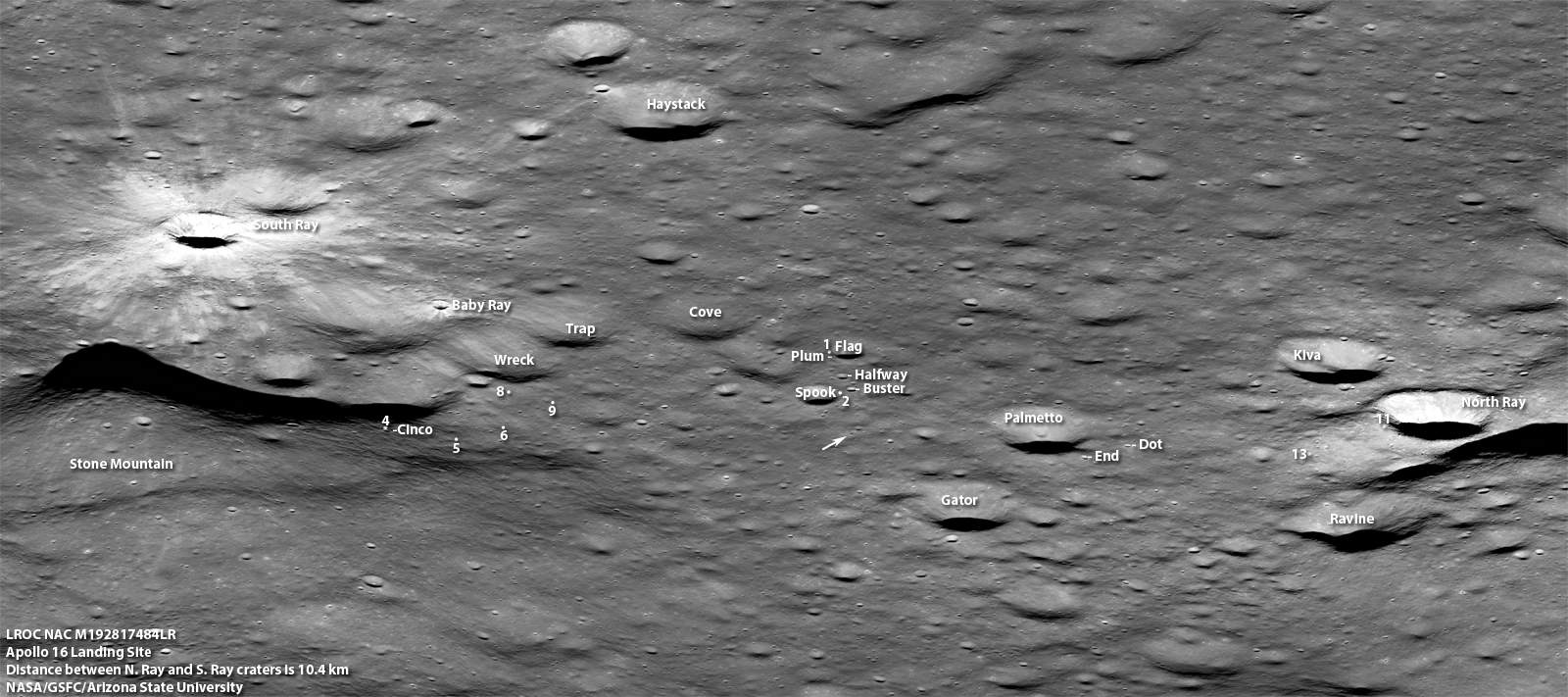
Oblique LROC Narrow Angle Camera (NAC) image of the Apollo 16 landing site, viewed from east to west.  Brighter South Ray crater is center left and North Ray crater center right, and the distance between the two landmark crater centers is 10.5 km. LROC NAC montage M192817484LR, LRO orbit 13442, May 28, 2012. View the 1600 x 1600 full-size 4 meter resolution LROC Featured Image HERE [NASA/GSFC/Arizona State University].
Mark Robinson
Principal Investigator
Lunar Reconnaissance Orbiter Camera
Arizona State University

On May 28 LRO was slewed 59° to the west, from an altitude of 92 km (57 miles) and captured a dramatic view of the Apollo 16 landing site.

During the Apollo 16 mission Ken Mattingly passed over the site several times at an altitude of 120 km (75 miles).  If you imagine yourself in the Command Module, then this view is close to what you would have seen.

The lighting is nearly identical to that of when the Lunar Module Orion set down on the Moon.

Subsampled subimage centered on Apollo 16 site, key craters and astronaut sampling stations are labeled (arrow shows location of lunar module descent stage and lunar rover), field of view 11 km across. View the 1600 px, full-size annotated image HERE [NASA/GSFC/Arizona State University]
On the second day of surface activities John Young and Charlie Duke headed south to sample material from Stone mountain and ejecta from South Ray crater. They headed south and turned east climbing up the flank of Stone Mountain. Imagine the view that Young and Duke had from Cinco crater (Station 4)! From their vantage point some 300 meters above the LM, the astronauts could see all the way from South Ray crater to North Ray crater.

Full resolution details from the Apollo 16 oblique image. Upper left: Lunar Module descent stage above and to the left of the forever parked Lunar Rover (arrows). Upper right: House Rock on the rim of North Ray crater. Lower left: Baby Ray crater. Lower Right: Shadow Rock (arrow). Each view is 530 meters wide and 1240 meters deep [NASA/GSFC/Arizona State University].
Full resolution field of view from a LROC Wide Angle Camera (WAC) monochrome (604nm) montage, swept up from a mere 38.27 kilometers, in orbit 11299, December 3, 2011; 52.3 meters resolution. Like the Featured Image, the illumination from the east, at a 69.57° angle of incidence, is similar to the lighting during the Apollo 16 expedition in April 1972 [NASA/GSFC/Arizona State University].
With the annotated version you can easily retrace the routes followed by Young and Duke as they spent three days exploring this highland landing site. Read a detailed reconstruction of the astronaut activities through the Apollo Lunar Surface Journal. 

What did they find at House Rock? Why was Shadow Rock an important science target? Is Baby Ray crater older or younger than South Ray crater? Then imagine yourself picking up where the Apollo astronauts left off over forty years ago!

When will we return to the Moon?

Dive into the full resolution oblique shot of the Apollo 16 site, HERE.

Retrace the astronaut traverses in an annotated version of oblique image, HERE.

Previous Apollo 16 LROC Featured Images
How Young is Young?


Friday, April 27, 2012

Forty years ago

Diver crews off the carrier U.S.S. Ticonderoga hustle recover Apollo 16 command module soon after splashdown in the Pacific (0°43′S 156°13′W), April 27, 1972. Along with the distinct scarring of their fiery direct-return re-entry John Young, Charlie Duke and Ken Mattingly return, arrive following 11 days in Space with 95.71 kg of lunar samples. During their mission the U.S. House of Representatives directed development of a Space Shuttle transportation system to debut in 1976. The next and last expedition to the lunar surface would take place the following December, and Young commanded the first orbital flight of Space Shuttle Columbia in 1981 [NASA/JSC/ALSJ].

Tuesday, March 17, 2009

EETimes Power Engineer - video interview with Ken Mattingly

You do not want to miss the multi-media opportunity presented by EETimes, put together by George Leopold, featuring modest giant of Apollo fame Admiral Ken Mattingly.

You may know him as the man played by Gary Sinese in Ron Howard's film Apollo 13 who "worked the problem" on the ground, tediously and repeatedly, to get Jim Lovell, Jack Swigert and Fred Haise back to Earth, searching for the last fraction of voltage from the crippled spacecraft to save the crew or the command module, but not both.

In the end, of course, he found the sequence that did save both, in April 1970, when trips to the Moon somehow became "routine." (Except for certain 13-year-old entusiasts who cried bloody murder when prime time was not interrupted for that last, casual trans-lunar coast television opportunity, minutes before all hell broke loose.)

In the course of explaining how he helped save the crew of Apollo 13, Ken Mattingly mentions, as an aside, that "in the process of going through all this [power-up procedures for the command module], somebody noticed that we could take any residual power we had in the [lunar module] batteries and run it backwards" to the Apollo command module. This was accomplished using a small-capacity power cable designed to provide power to the lunar module from the command module.

"We actually believe we topped off the [command module] batteries," Mattingly noted with understandable pride during an extended interview at his office here in mid-January

That "somebody" might have been Mattingly, and the estimated 4 amps of additional power provided by this kluge, along with a detailed power-up procedure developed by one of NASA's "steely-eyed missile men," John Aaron, allowed the Apollo 13 astronauts to restart a frozen command module that was their only means of getting home.

The off-handed manner in which Rear Adm. Thomas K. Mattingly, 73, presented this nugget of information is typical of his understated style, his modesty and his consummate ability as an engineer. These, along with the astronauts' dead-certain belief in their ability to overcome any technical hurdle, were precisely the traits that defined the Apollo program.

Referring to the painstaking development of the sequencing procedure needed to power up the hibernating Apollo 13 command module, Mattingly said, "You don't get technical answers by playing around."

The Apollo astronaut and Space Shuttle commander will be a keynote speaker on March 31 at the Embedded Systems Conference Silicon Valley 2009 (March 30-April 2) in San Jose, Calif.

Mattingly never got to walk on the Moon, and he acknowledged that every Apollo astronaut burned to do just that. "Everybody wants to go to the Moon. That means, go land on the Moon," Mattingly said. Hence, being a command module pilot was a bit like being a "bridesmaid."

Read the story HERE.

Direct Link to Video, Courtesy EETimes