|
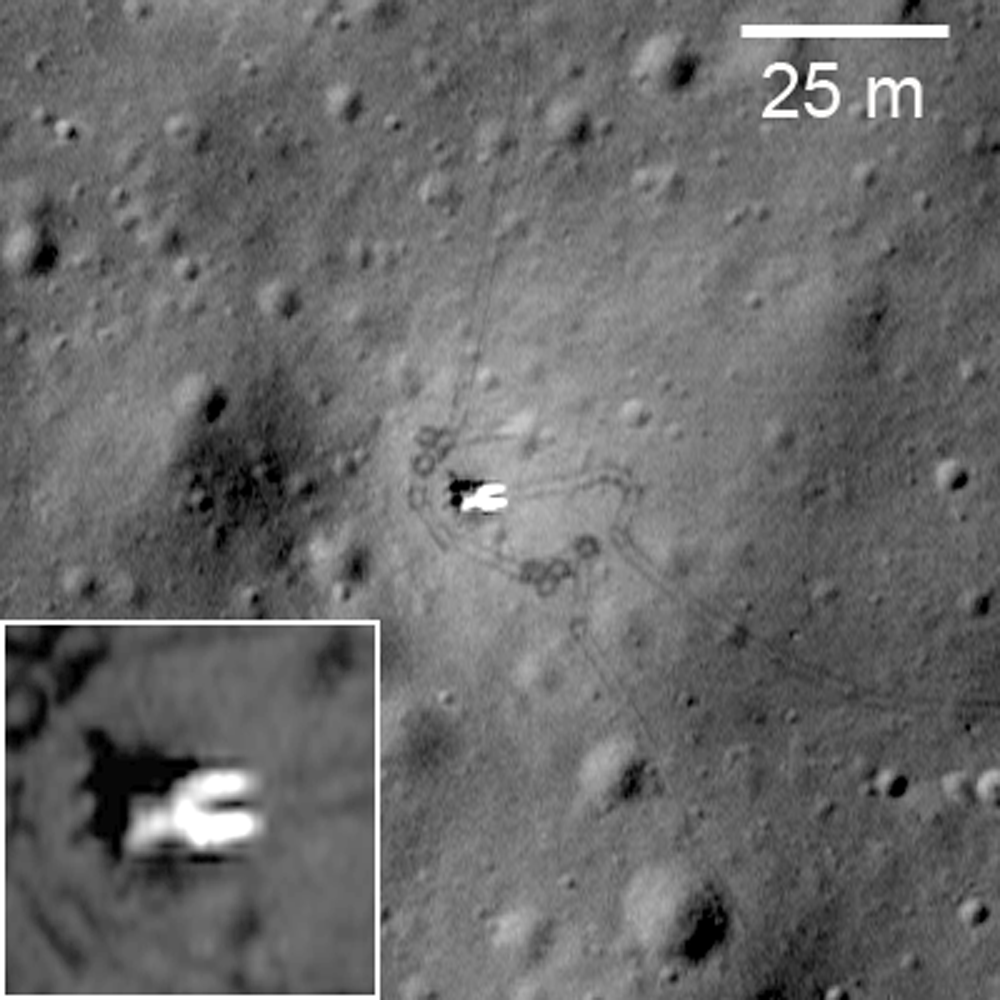
| Luna 17, the lander that carried Lunokhod 1 to the surface; debarking ramps for the rover visible extending down to the surface to the right. Many rover tracks are visible around the lander and throughout LROC Narrow Angle Camera (NAC) frame M175502049RE, LRO orbit 10998, November 9, 2011. View the original contextual image with enlarged inset, HERE [NASA/GSFC/Arizona State University]. |

The Voice of Russia
A number of moon craters in the vicinity of Lunokhod–1 lunar rover have been given their own names. They were named in honor of the crew members of the first self-propelled vehicle on the surface of the celestial body.
The experiment carried out more than 40 years ago is to be repeated in the course of “Luna-Resource” expedition which should be launched no earlier than 2015.
The International Astronomical Union has approved 12 new names for small craters on the Moon, and now they have names of the members of the first lunar expedition and scientists who were involved in the project. Despite the fact that these people were not able to walk on the Moon’s surface themselves, they were the ones who led Lunokhod–1 – the first planet rover on the surface of an alien celestial body. All craters are located in the area of the “Sea of Rain” (Mare Imbrium) where the landing vehicle of Luna-17 interplanetary automatic station soft-landed in November 1970. It delivered Lunokhod lunar rover onto the Moon’s surface. All craters are comparatively small, their diameter ranging from 100 to 400 meters.
Thus, the names of Albert, Borya, Gena (in honor of the navigator Gabdulkhai Latypov), Igor, Kolya, Kostya, Leonid, Nikolya, Slava, Valera, Vasya, and Vitya appeared on the Moon.
The Luna-17 spacecraft was built by the design and construction bureau of the machine-engineering plant named after S.A. Lavochkin (now NPO Lavochkin). Lunokhod-1 was equipped with a set of scientific devices to explore the lunar soil. In the course of 10 months that it was working on the Moon, the rover traveled over 10.5 kilometers and sent back to Earth information about the mineral composition and characteristics of the lunar surface.
 |
| Lunokhod 1 rover in its final parking place (38.315°N, 324.992°E) on the surface of Mare Imbrium. LROC Narrow Angle Camera (NAC) observation M175502049RE, orbit 10998, November 9, 2011, resolution 33 cm per pixel. View original Featured Image released March 14, 2012 (with enlarged inset) HERE. [NASA/GSFC/Arizona State University]. |
Even though by the time Lunokhod-1 was launched American astronauts had already landed on the Moon, the soviet rover was no less a remarkable scientific and technical achievement. Unfortunately, at that time, the meaning of this achievement was overshadowed by the defeat in the race to put a man on the moon. Lunokhod-1, with all its novelty and complexity, was more of a consolation prize. At least that was the general attitude – and analysts might object, of course. Sadly, it was what determined the further development of the lunar program. After the improved version Lunokhod-2 in 1973, there was Lunokhod-3 which never made it to the Moon. As a result, the Lunar Program of the USSR was suspended. Forty years on there has been little progress.
Today it can be said that it was a mistake. Weak consolation might be the fact that space programs in other countries primarily in the United States have also been suspended. However, the comparison might not be accurate – paradoxically as it may sound as though the soviet moon explorations at the end of the “manned moon race” were in a better state (if not financially from the strategic point of view). A continuation of manned expeditions demanded huge resources and clear goals, which probably did not exist at that time. Autonomous expeditions were easier from the point of view of their preparation but brought back much more scientific results. Besides, by that time, complicated initial stages with lots of failures were overcome and so reliability was higher.
 |
| Far western 1970 Landing Zone of the Soviet Union's Luna 17, and the final parking spot of the first remote-operated lunar rover, Lunokhod-1. The French-built laser reflector array deployed from the Lunokhod eluded detection for four decades until its precise location was reacquired by the LROC Narrow Angle Camera in 2009. It's relocation added vital precision to measurements of the Earth-Moon distance that may answer important questions in astrophysics. LROC Wide Angle Camera 100 meter Global Mosaic overlaid upon LOLA topography and assembled using the NASA LMMP ILIADS application [NASA/GSFC/LMMP/Arizona State University]. |
The current plans of Russia in the area of space exploration include returning to the Moon with landing vehicles and a mini-rover – a self-propelled machine which is being developed by an Indian organization for the purposes of the Luna-Resource program. It is planned to repeat lunar soil collection considering previous experiences. If in the course of the first expeditions the soil was collected only in the places of landing – now the goal is to combine the operation of the mini-rover and returning spacecraft. The mini-rover is to determine the most interesting spots and collect soil from them and then the spacecraft should return the samples to the Earth.
 |
| New Names Approved for Twelve Small Lunar Craters - The Working Group for Planetary System Nomenclature has approved 12 new names for small craters on the Moon: Albert, Borya, Gena, Igor, Kolya, Kostya, Leonid, Nikolya, Slava, Valera, Vasya, and Vitya. For details, see the map of LAC 24 and the Lunokhod-1 traverse map in the Gazetteer of Planetary Nomenclature [USGS]. |
It is probable that these circumstances have raised the interest in the Lunokhod program again. Naturally, recognition of the achievements of the soviet scientists is satisfying on the one hand, but on the other the interest is mostly coming from western institutions and space lovers. Without the LROC images, the “favourite lunar tractor” would be remembered only by those who are truly loyal to space science. That is why one of the tasks of the future lunar program is not only to learn again how to land and control spacecraft on the Moon, but also how to inform people about it in plain language, and on a regular basis.
Related: Lunokhod-1 revisited (March 15, 2012)