 |
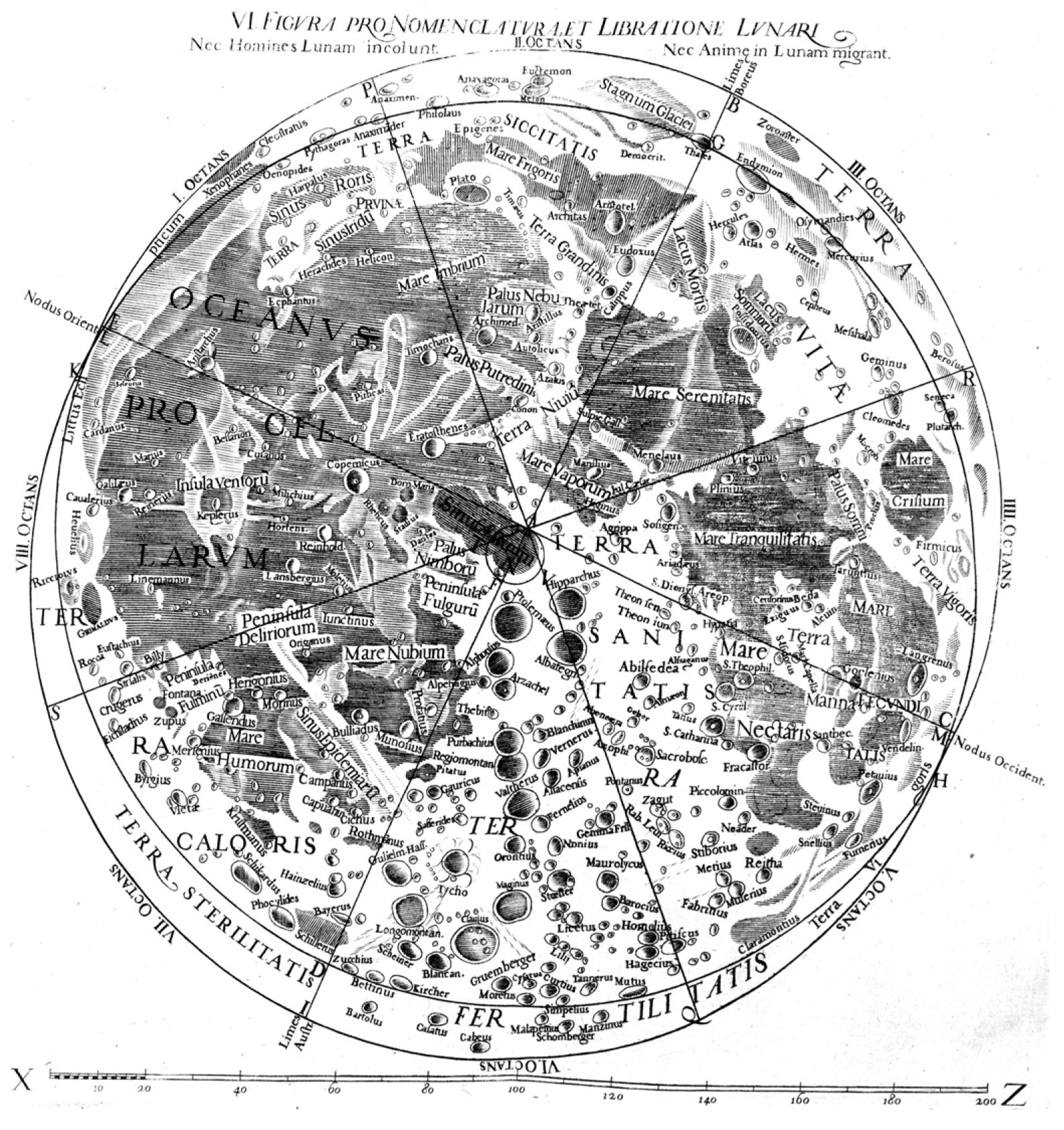
| Map of the Moon by Grimaldi and Riccioli, 1651. Most of the names on this map are still in use today. |
Paul D. Spudis
The Once & Future Moon
Smithsonian Air & Space
The Moon is remarkable for the variety and unusual nature of the names of its surface features. The dark, smooth maria are named for weather or states of mind (Sea of Rains, Sea of Tranquility) while many of the abundant craters of the Moon are named for famous scientists, philosophers, mathematicians and explorers. Before the advent of the space age, only the near side of the Moon was visible from Earth, although most scientists believed that the far side probably looked exactly like the facing one. (How wrong they were!) Naturally, once we had the ability to see uncharted lunar territory, a new era of name assignment commenced. But even now, many lunar craters and features await something more than mere coordinates.
The drawings of the Moon in 1610 by Galileo show craters and mountain ranges but he did not assign names to them. As telescopes improved, revealing finer surface details, several maps appeared with names bestowed by their astronomer authors to flatter patrons or express their nationalism. Most of those early names have been forgotten to history. In 1651, an influential map by Jesuit astronomers Grimaldi and Riccioli became the foundation for the official naming reference guide that we use today.
With the flight of the Luna 3 probe in 1959, the Soviet Union was the first nation to image the far side of the Moon. To the surprise of most, large regions of maria (so prominent on the near side) were mostly missing from the far side. Although the first images were of very low quality, the Soviets couldn’t resist the urge to name newly discovered features for a variety of Russian heroes and place names, such as Tsiolkovsky and the Sea of Moscow. Some new “features” were misidentified because of the low resolution – the name “Soviet Mountains” (no longer used) was given to a bright linear streak across the far side globe (a feature that turned out to be a long ray from the fresh crater Giordano Bruno and not a mountain range).
Over subsequent years, as both American and Soviet spacecraft filled in the far side coverage with increasingly higher quality images, most major far side craters received names of various scientists and engineers. From around the world, a mixed bag of names were submitted to the International Astronomical Union (IAU – the body of scientists who authorize the names of planetary surface features) for consideration and approval. Although some were historically significant, many were people with whom few were familiar.
Though NASA does not have the authority to assign names to features on the Moon, an informal practice of naming landmarks was common during the Apollo missions. Names were given to the small craters and mountains near each landing site (e.g., Shorty, St. George, Stone Mountain) but official names were used as well (e.g., Hadley Rille). NASA adopts informal names for the same reason that names are given to geographical features on Earth – as shorthand to refer to landmarks and other mapped features. The most recent illustration of this practice occurred on December 17, 2012 when NASA named the location where the deliberately de-orbited GRAIL spacecraft crashed onto the Moon near the crater Goldschmidt (73°N, 4°W) the Sally K. Ride Impact Site. Sally thus joins other women of science and note who have lunar features named for them – Hypatia, Caroline Herschel and Marie Curie, among others. Most of the informal names assigned during Apollo were later given “official” status by the IAU.
The Apollo basin (a 540 km diameter crater on the southwestern far side) was named to honor the Apollo missions – the only crater on the Moon so designated. Within a few years of their missions, smaller craters were named for the living crews of Apollo 8 (Borman, Lovell and Anders) and Apollo 11 (Armstrong, Aldrin and Collins). Also located around the Apollo basin are craters named for deceased astronauts and NASA employees, including the lost crews of Apollo 1 and the lost crews of the final missions of the Challenger and Columbia Space Shuttles. It is appropriate that some feature honors humanity’s first efforts to reach the Moon, as well as others who gave their lives pioneering space. In a similar vein, craters near the poles of the Moon tend to be named for famous polar scientists and explorers, such as Nansen, Shackleton, and Amundsen.
Other than these exceptions, the location of specifically named craters has little rhyme or reason. Neither scientific prominence nor contribution guarantees any crater-endowed immortality. Copernicus and Archimedes are rightly honored with spectacular craters named for them. But Galileo and Newton (titans in the history of science) are fobbed off with insignificant or barely detectable features. One of the most prominent craters on the Moon is named for the astronomer Tycho Brahe, an eccentric who spent most of his career trying to validate a variant of the Earth-centered, Ptolemaic model of the Solar System (Ptolemy also has a prominent crater in the center of the near side named for him). It’s not clear why Riccioli assigned the names he did to these craters, though he cannot be blamed for giving Newton short shrift, as the future Sir Isaac was only nine years old when the Grimaldi and Riccioli map was published.
It is possible to both suggest a name and to propose a crater for that name, though the IAU is not obliged to accept either. Often, a suggested name is approved but assigned to a different crater. Currently, the guidelines for submission and assignment of new names for lunar craters are: 1) a scientist or explorer who has made some significant contribution, preferably to the study of the Moon and planets; 2) deceased for at least three years before a crater name becomes official; 3) it cannot duplicate any existing lunar name.
In 2005, I proposed the name Ryder (to honor my colleague Graham Ryder, a lunar scientist who passed away in 2002) and suggested a small, bright crater on the far side to carry his name. Both suggestions were adopted. We have since found that Ryder crater is actually quite a geologically spectacular feature (Graham would be proud of his namesake). In a truly singular event, the crater Shoemaker (named in 2000 and located near the south pole of the Moon) actually contains some of Gene Shoemaker’s remains – a small portion of his ashes was carried aboard the Lunar Prospector spacecraft in 1998. At the conclusion of that mission, the vehicle was crashed into the south polar crater that was subsequently named for him.
We don’t know what the IAU will do concerning the designation of the Sally K. Ride Impact Site but as history suggests, granting of official status is not guaranteed. No matter – we will continue to assign names to features as needed and the IAU will do what they do. In the early 1970s, the IAU (by fiat) abolished the famous Mädler nomenclature system (wherein a small, nearby crater is given the name of a large neighbor plus a letter, such as Copernicus H). Most working lunar scientists stubbornly refused to accept this decision and continued using the old crater names. After 30 years of bureaucratic intractability, the IAU finally surrendered and formally adopted the Mädler system.
Official or not, with the passage of time, named lunar landmarks will become familiar to those visiting and working on our nearest neighbor. Perhaps interesting monikers will be attached by those locals, as is done here on Earth when we assign nicknames to places – like the Big Apple, the Windy City, the Big Easy and the City by the Bay.
Just published: The Clementine Atlas of the Moon, Revised Edition, an updated atlas and reference guide to lunar features, by Ben Bussey and yours truly.
Originally published at his Smithsonian Air & Space Magazine blog "The Once and Future Moon," Dr. Spudis is a senior staff scientist at the Lunar and Planetary Institute. The opinions expressed are those of the author and are better informed than average.
The drawings of the Moon in 1610 by Galileo show craters and mountain ranges but he did not assign names to them. As telescopes improved, revealing finer surface details, several maps appeared with names bestowed by their astronomer authors to flatter patrons or express their nationalism. Most of those early names have been forgotten to history. In 1651, an influential map by Jesuit astronomers Grimaldi and Riccioli became the foundation for the official naming reference guide that we use today.
With the flight of the Luna 3 probe in 1959, the Soviet Union was the first nation to image the far side of the Moon. To the surprise of most, large regions of maria (so prominent on the near side) were mostly missing from the far side. Although the first images were of very low quality, the Soviets couldn’t resist the urge to name newly discovered features for a variety of Russian heroes and place names, such as Tsiolkovsky and the Sea of Moscow. Some new “features” were misidentified because of the low resolution – the name “Soviet Mountains” (no longer used) was given to a bright linear streak across the far side globe (a feature that turned out to be a long ray from the fresh crater Giordano Bruno and not a mountain range).
Over subsequent years, as both American and Soviet spacecraft filled in the far side coverage with increasingly higher quality images, most major far side craters received names of various scientists and engineers. From around the world, a mixed bag of names were submitted to the International Astronomical Union (IAU – the body of scientists who authorize the names of planetary surface features) for consideration and approval. Although some were historically significant, many were people with whom few were familiar.
Though NASA does not have the authority to assign names to features on the Moon, an informal practice of naming landmarks was common during the Apollo missions. Names were given to the small craters and mountains near each landing site (e.g., Shorty, St. George, Stone Mountain) but official names were used as well (e.g., Hadley Rille). NASA adopts informal names for the same reason that names are given to geographical features on Earth – as shorthand to refer to landmarks and other mapped features. The most recent illustration of this practice occurred on December 17, 2012 when NASA named the location where the deliberately de-orbited GRAIL spacecraft crashed onto the Moon near the crater Goldschmidt (73°N, 4°W) the Sally K. Ride Impact Site. Sally thus joins other women of science and note who have lunar features named for them – Hypatia, Caroline Herschel and Marie Curie, among others. Most of the informal names assigned during Apollo were later given “official” status by the IAU.
The Apollo basin (a 540 km diameter crater on the southwestern far side) was named to honor the Apollo missions – the only crater on the Moon so designated. Within a few years of their missions, smaller craters were named for the living crews of Apollo 8 (Borman, Lovell and Anders) and Apollo 11 (Armstrong, Aldrin and Collins). Also located around the Apollo basin are craters named for deceased astronauts and NASA employees, including the lost crews of Apollo 1 and the lost crews of the final missions of the Challenger and Columbia Space Shuttles. It is appropriate that some feature honors humanity’s first efforts to reach the Moon, as well as others who gave their lives pioneering space. In a similar vein, craters near the poles of the Moon tend to be named for famous polar scientists and explorers, such as Nansen, Shackleton, and Amundsen.
Other than these exceptions, the location of specifically named craters has little rhyme or reason. Neither scientific prominence nor contribution guarantees any crater-endowed immortality. Copernicus and Archimedes are rightly honored with spectacular craters named for them. But Galileo and Newton (titans in the history of science) are fobbed off with insignificant or barely detectable features. One of the most prominent craters on the Moon is named for the astronomer Tycho Brahe, an eccentric who spent most of his career trying to validate a variant of the Earth-centered, Ptolemaic model of the Solar System (Ptolemy also has a prominent crater in the center of the near side named for him). It’s not clear why Riccioli assigned the names he did to these craters, though he cannot be blamed for giving Newton short shrift, as the future Sir Isaac was only nine years old when the Grimaldi and Riccioli map was published.
It is possible to both suggest a name and to propose a crater for that name, though the IAU is not obliged to accept either. Often, a suggested name is approved but assigned to a different crater. Currently, the guidelines for submission and assignment of new names for lunar craters are: 1) a scientist or explorer who has made some significant contribution, preferably to the study of the Moon and planets; 2) deceased for at least three years before a crater name becomes official; 3) it cannot duplicate any existing lunar name.
In 2005, I proposed the name Ryder (to honor my colleague Graham Ryder, a lunar scientist who passed away in 2002) and suggested a small, bright crater on the far side to carry his name. Both suggestions were adopted. We have since found that Ryder crater is actually quite a geologically spectacular feature (Graham would be proud of his namesake). In a truly singular event, the crater Shoemaker (named in 2000 and located near the south pole of the Moon) actually contains some of Gene Shoemaker’s remains – a small portion of his ashes was carried aboard the Lunar Prospector spacecraft in 1998. At the conclusion of that mission, the vehicle was crashed into the south polar crater that was subsequently named for him.
We don’t know what the IAU will do concerning the designation of the Sally K. Ride Impact Site but as history suggests, granting of official status is not guaranteed. No matter – we will continue to assign names to features as needed and the IAU will do what they do. In the early 1970s, the IAU (by fiat) abolished the famous Mädler nomenclature system (wherein a small, nearby crater is given the name of a large neighbor plus a letter, such as Copernicus H). Most working lunar scientists stubbornly refused to accept this decision and continued using the old crater names. After 30 years of bureaucratic intractability, the IAU finally surrendered and formally adopted the Mädler system.
Official or not, with the passage of time, named lunar landmarks will become familiar to those visiting and working on our nearest neighbor. Perhaps interesting monikers will be attached by those locals, as is done here on Earth when we assign nicknames to places – like the Big Apple, the Windy City, the Big Easy and the City by the Bay.
Just published: The Clementine Atlas of the Moon, Revised Edition, an updated atlas and reference guide to lunar features, by Ben Bussey and yours truly.
Originally published at his Smithsonian Air & Space Magazine blog "The Once and Future Moon," Dr. Spudis is a senior staff scientist at the Lunar and Planetary Institute. The opinions expressed are those of the author and are better informed than average.