Showing posts with label LRRR. Show all posts

Tuesday, July 3, 2012

Craters near Lunokhod-1 officially named

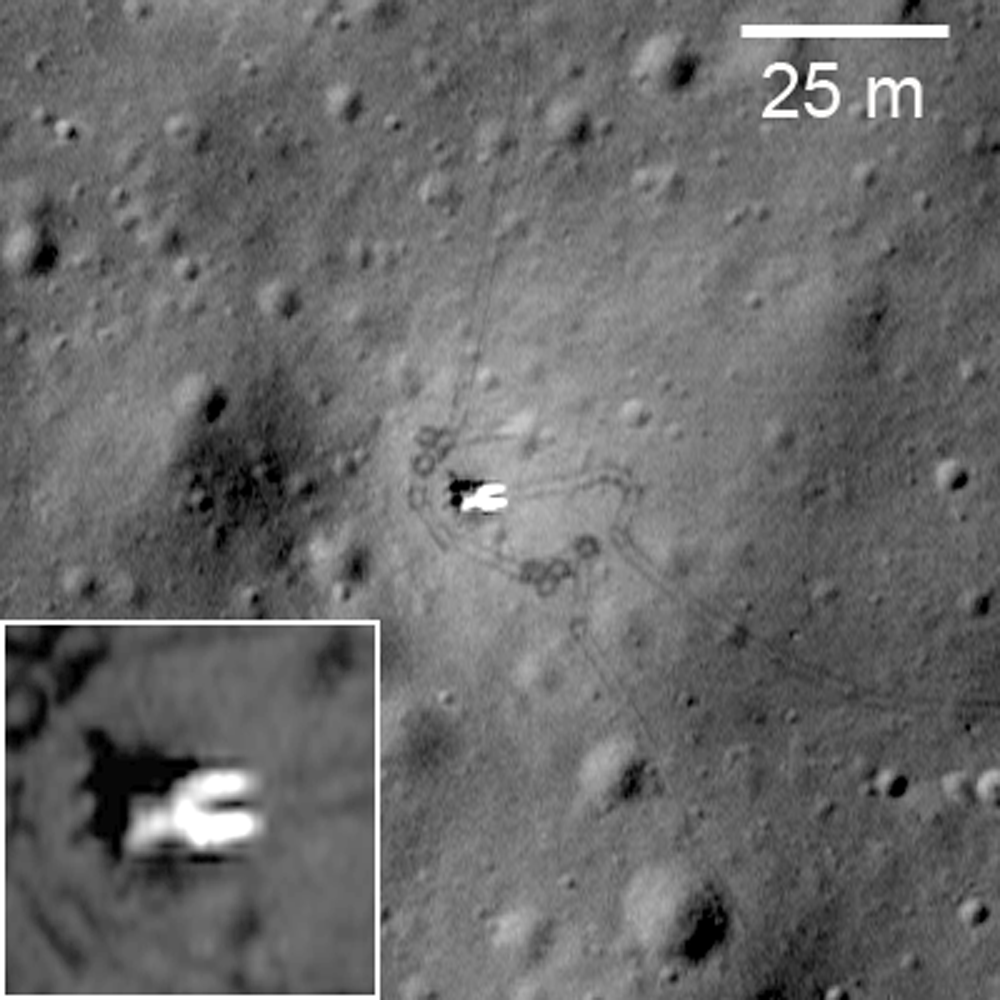
Luna 17, the lander that carried Lunokhod 1 to the surface; debarking ramps for the rover visible extending down to the surface to the right. Many rover tracks are visible around the lander and throughout LROC Narrow Angle Camera (NAC) frame M175502049RE, LRO orbit 10998, November 9, 2011. View the original contextual image with enlarged inset, HERE [NASA/GSFC/Arizona State University].
Olga Zakutnyaya
The Voice of Russia
 

A number of moon craters in the vicinity of Lunokhod–1 lunar rover have been given their own names. They were named in honor of the crew members of the first self-propelled vehicle on the surface of the celestial body.

The experiment carried out more than 40 years ago is to be repeated in the course of “Luna-Resource” expedition which should be launched no earlier than 2015.

The International Astronomical Union has approved 12 new names for small craters on the Moon, and now they have names of the members of the first lunar expedition and scientists who were involved in the project. Despite the fact that these people were not able to walk on the Moon’s surface themselves, they were the ones who led Lunokhod–1 – the first planet rover on the surface of an alien celestial body. All craters are located in the area of the “Sea of Rain” (Mare Imbrium) where the landing vehicle of Luna-17 interplanetary automatic station soft-landed in November 1970. It delivered Lunokhod lunar rover onto the Moon’s surface. All craters are comparatively small, their diameter ranging from 100 to 400 meters.

Thus, the names of Albert, Borya, Gena (in honor of the navigator Gabdulkhai Latypov), Igor, Kolya, Kostya, Leonid, Nikolya, Slava, Valera, Vasya, and Vitya appeared on the Moon.

The Luna-17 spacecraft was built by the design and construction bureau of the machine-engineering plant named after S.A. Lavochkin (now NPO Lavochkin). Lunokhod-1 was equipped with a set of scientific devices to explore the lunar soil. In the course of 10 months that it was working on the Moon, the rover traveled over 10.5 kilometers and sent back to Earth information about the mineral composition and characteristics of the lunar surface.

Lunokhod 1 rover in its final parking place (38.315°N, 324.992°E) on the surface of Mare Imbrium. LROC Narrow Angle Camera (NAC) observation M175502049RE, orbit 10998, November 9, 2011, resolution 33 cm per pixel. View original Featured Image released March 14, 2012 (with enlarged inset) HERE. [NASA/GSFC/Arizona State University].
Lunokhod-1 was controlled remotely via the center for space communications by two crews – five people each who worked in shifts. Each crew consisted of a commander, a driver, a navigator, a flight engineer, and a high gain antenna operator. Thus there were 10 people all together, plus a reserve driver and reserve high gain antenna operator.

Even though by the time Lunokhod-1 was launched American astronauts had already landed on the Moon, the soviet rover was no less a remarkable scientific and technical achievement. Unfortunately, at that time, the meaning of this achievement was overshadowed by the defeat in the race to put a man on the moon. Lunokhod-1, with all its novelty and complexity, was more of a consolation prize. At least that was the general attitude – and analysts might object, of course. Sadly, it was what determined the further development of the lunar program. After the improved version Lunokhod-2 in 1973, there was Lunokhod-3 which never made it to the Moon. As a result, the Lunar Program of the USSR was suspended. Forty years on there has been little progress.

Today it can be said that it was a mistake. Weak consolation might be the fact that space programs in other countries primarily in the United States have also been suspended. However, the comparison might not be accurate – paradoxically as it may sound as though the soviet moon explorations at the end of the “manned moon race” were in a better state (if not financially from the strategic point of view). A continuation of manned expeditions demanded huge resources and clear goals, which probably did not exist at that time. Autonomous expeditions were easier from the point of view of their preparation but brought back much more scientific results. Besides, by that time, complicated initial stages with lots of failures were overcome and so reliability was higher.

Far western 1970 Landing Zone of the Soviet Union's Luna 17, and the final parking spot of the first remote-operated lunar rover, Lunokhod-1. The French-built laser reflector array deployed from the Lunokhod eluded detection for four decades until its precise location was reacquired by the LROC Narrow Angle Camera in 2009. It's relocation added vital precision to measurements of the Earth-Moon distance that may answer important questions in astrophysics. LROC Wide Angle Camera 100 meter Global Mosaic overlaid upon LOLA topography and assembled using the NASA LMMP ILIADS application [NASA/GSFC/LMMP/Arizona State University].
Something similar is happening to NASA’s Mars exploration program. A long and ongoing exploration of the planet with more and more sophisticated and complex tasks resulted in the fact that the US became a true leader in the Mars programs. That was, in fact, the main argument by scholars who objected to cuts in NASA’s planetary space budget in 2013. In their opinion to lose such an important scientific and technical foundation would be a poor strategic move.

The current plans of Russia in the area of space exploration include returning to the Moon with landing vehicles and a mini-rover – a self-propelled machine which is being developed by an Indian organization for the purposes of the Luna-Resource program. It is planned to repeat lunar soil collection considering previous experiences. If in the course of the first expeditions the soil was collected only in the places of landing – now the goal is to combine the operation of the mini-rover and returning spacecraft. The mini-rover is to determine the most interesting spots and collect soil from them and then the spacecraft should return the samples to the Earth.

New Names Approved for Twelve Small Lunar Craters - The Working Group for Planetary System Nomenclature has approved 12 new names for small craters on the Moon: Albert, Borya, Gena, Igor, Kolya, Kostya, Leonid, Nikolya, Slava, Valera, Vasya, and Vitya. For details, see the map of LAC 24 and the Lunokhod-1 traverse map in the Gazetteer of Planetary Nomenclature [USGS].
Yet as of now these are only plans. Information from the Moon is coming daily. NASA LRO and GRAIL spacecraft continue to work in the Moon’s orbit (two spacecraft which measure lunar gravity fields). Several days ago, the NASA LRO mission published recent images of the lava fields formed as a result of asteroid impacts. The images were taken by LROC – Lunar Reconnaissance Orbiter Camera. This camera is also connected to the Lunokhods – in 2010, the first high resolution images were printed and it was possible to see Lunokhod-1 and the landing spacecraft and the wheel tracks. Interesting that in the same year a group of American scientists announced that they had managed to intercept a pulse from a laser retroreflector on Lunokhod-1.

It is probable that these circumstances have raised the interest in the Lunokhod program again. Naturally, recognition of the achievements of the soviet scientists is satisfying on the one hand, but on the other the interest is mostly coming from western institutions and space lovers. Without the LROC images, the “favourite lunar tractor” would be remembered only by those who are truly loyal to space science. That is why one of the tasks of the future lunar program is not only to learn again how to land and control spacecraft on the Moon, but also how to inform people about it in plain language, and on a regular basis.

Related: Lunokhod-1 revisited (March 15, 2012)

Thursday, March 15, 2012

LROC: Lunokhod 1 revisited, too

Lunokhod 1 rover in its final parking place (38.315°N, 324.992°E) on the surface of Mare Imbrium. LROC Narrow Angle Camera (NAC) observation M175502049RE, orbit 10998, November 9, 2011, resolution 33 cm per pixel. View original Featured Image with enlarged inset HERE. [NASA/GSFC/Arizona State University].
Jeff Plescia
LROC News System

Luna 17, carrying Lunokhod 1, landed on the flood basalt surface of Mare Imbrium on November 17, 1970, after entering orbit on November 15. 

Today's Featured Image of Luna 17 and Lunokhod 1 was obtained during a low altitude (33 km) pass providing the highest resolution view yet of the landing site.

The same LROC Narrow Angle Camera frame captured both the lander and the Lunokhod 1 lunar rover, and nearly all the wheel tracks the rover left behind, just shy of 42 years afterward.

Luna 17, the lander that carried Lunokhod 1 to the surface; debarking ramps for the rover visible extending down to the surface to the right. Many rover tracks are visible around the lander and throughout LROC NAC frame M175502049RE. View the original contextual image with enlarged inset, HERE [NASA/GSFC/Arizona State University].

Artist’s conception of Luna 17 on the lunar surface, with Lunokhod descending to the surface [Anatoly Zak/Russian Space Web].
Once Luna 17 landed, ramps were deployed on two sides of the lander allowing for two possible directions for the rover to drive to the surface. In this case, the rover drove down the ramps on the east side of the lander. Rover tracks can be seen extending away from and around the rover. Also note the bright area around the Luna 17 lander; the surface was modified by the exhaust gases from the descent engines such that it appears brighter. This increased contract makes the rover tracks more obvious near the lander.

View of the Luna 17 from the Lunokhod 1. The rover descended from the lander on the opposite side. The wide variety of images, including many other firsts, from the Cold War era Soviet lunar program can be viewed HERE.

Lunokhod 1 traveled a total distance of 10.5 km. It was first commanded to drive south from the Luna 17 lander, making a loop across the mare surface, and then returning north to Luna 17. The rover was then directed to proceed farther north, making a small loop to the west, then returning to its track and continuing northward. The payload consisted of a suite of television cameras, a cone penetrometer to determine physical properties of the regolith, and an X-ray spectrometer to determine the chemistry of the regolith. An X-ray telescope and cosmic ray detector were also part of the payload.

Like Lunokhod 2, Lunokhod 1 carried a French-built laser retroreflector. The vehicle was tracked for a short period during the mission then lost. Once the vehicle was located using LRO/LROC images by the LROC team, it was targeted and recovered using the lunar lasers at the Apache Point Observatory. Because of its location away from the Apollo retroreflectors and Lunokhod 2, recovering Lunokhod 1 is important for lunar geophysical studies.

The rover’s journey across the surface formally ended on October 4, 1971, after 11 lunar day-night cycles (322 Earth-days). Attempts to contact the rover after the lunar night that began on September 14, 1971 were unsuccessful, apparently due to a failure of some component of the rover during the lunar night.

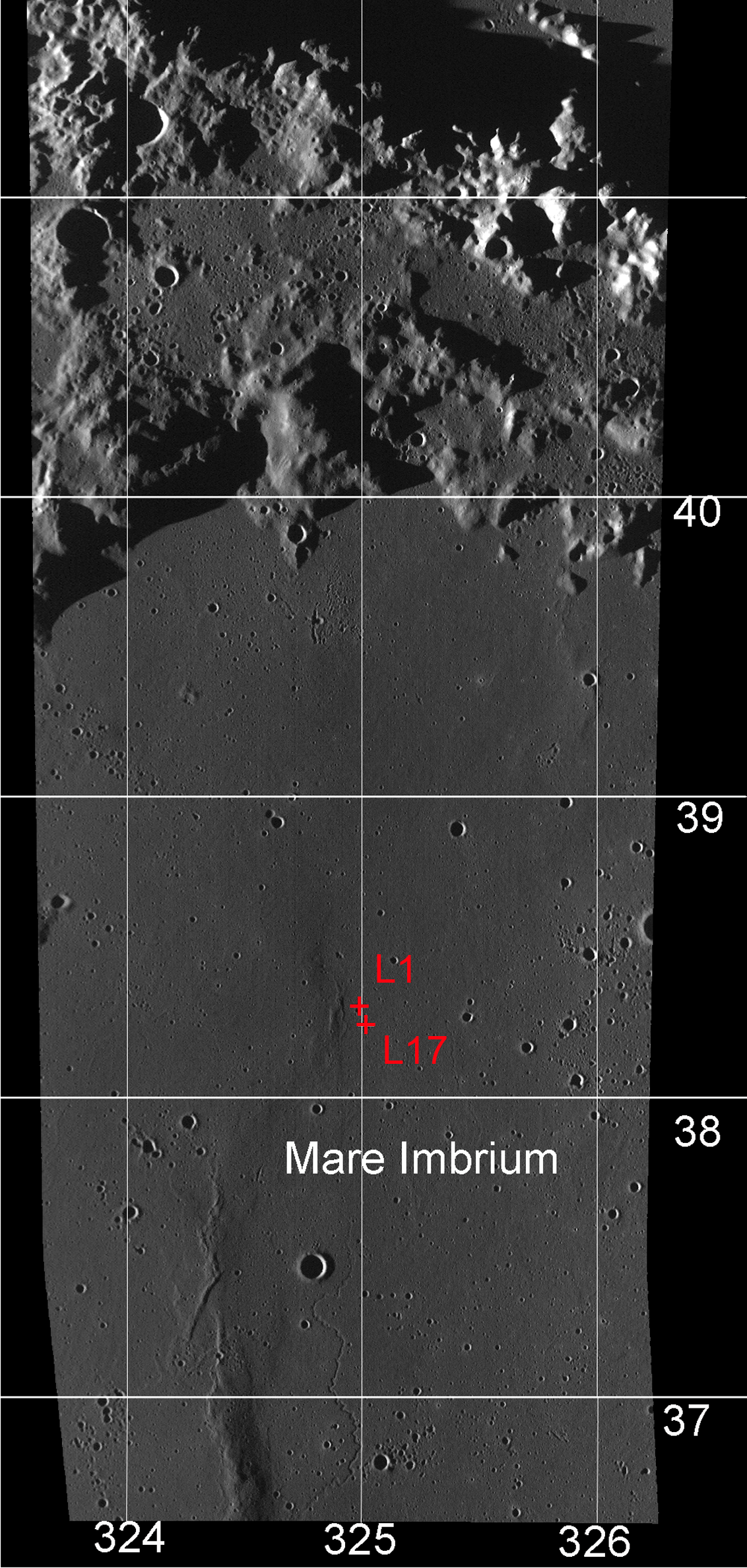
Northern Mare Imbrium showing the location of the Luna 17 landing site and the final position of the Lunokhod 1 rover. View the larger LROC WAC context image HERE. [NASA/GSFC/ Arizona State University].

Explore the Lunokhod 1 site on your own HERE.

Revisit about the earlier LROC "rediscovery" of Lunokhod 1 HERE.

Thursday, March 8, 2012

LROC's Closest look yet at Tranquillity Base

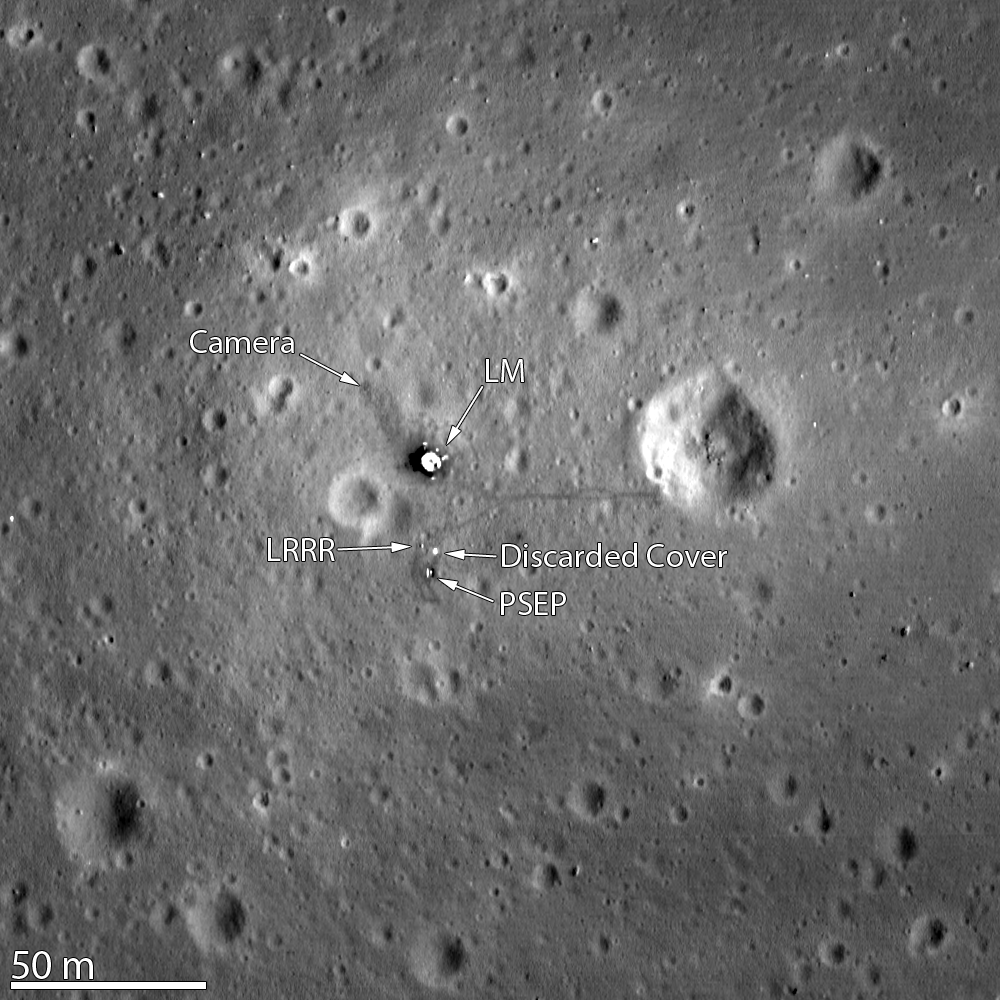
A Stark Beauty All Its Own, Apollo 11 from low altitude (~25km altitude), LROC's best look yet at the July 20, 1969 landing site (0.672°N, 23.483°E) in the southwestern corner of Mare Tranquillitatis - Remnants of Armstrong & Aldrin's historic first steps on the surface are clearly visible in darker paths around the Lunar Module Eagle Descent Stage, Lunar Ranging RetroReflector (LRRR) and Passive Seismic Experiment Package (PSEP) and Aldrin's short path behind the lander to the rim of Little West crater. LROC Narrow Angle Camera (NAC) observation M175124932R, LRO orbit 10,942, November 5, 2011; resolution 25 centimeters per pixel. View the wider field of view in the LROC Featured Image HERE  [NASA/GSFC/Arizona State University].
Mark Robinson
Principal Investigator
Lunar Reconnaissance Orbiter Camera (LROC)
Arizona State University

This image of the Apollo 11 landing site captured from just 24 km (15 miles) above the surface provides LRO's best look yet at humanity’s first venture to another world. When Neil Armstrong took his famous first steps onto the lunar surface, he kicked around the soil. “Yes, the surface is fine and powdery.” Gazing at the flat horizon, he took in the view. “Isn’t that something! Magnificent sight out here.” After collecting a contingency sample Neil looked around and observed, "it has a stark beauty all its own. It's like much of the high desert of the United States. It's different, but it's very pretty out here." A few minutes later Buzz Aldrin descended the ladder and joined Neil on the surface of the Moon!

You can see the remnants of their first steps as dark regions around the Lunar Module (LM) and in dark tracks that lead to the scientific experiments the astronauts set up on the surface. The Passive Seismic Experiment Package (PSEP) provided the first lunar seismic data, returning data for three weeks after the astronauts left, and the Laser Ranging RetroReflector (LRRR) allows precise measurements to be collected to this day. You can even spot the discarded cover of the LRRR.

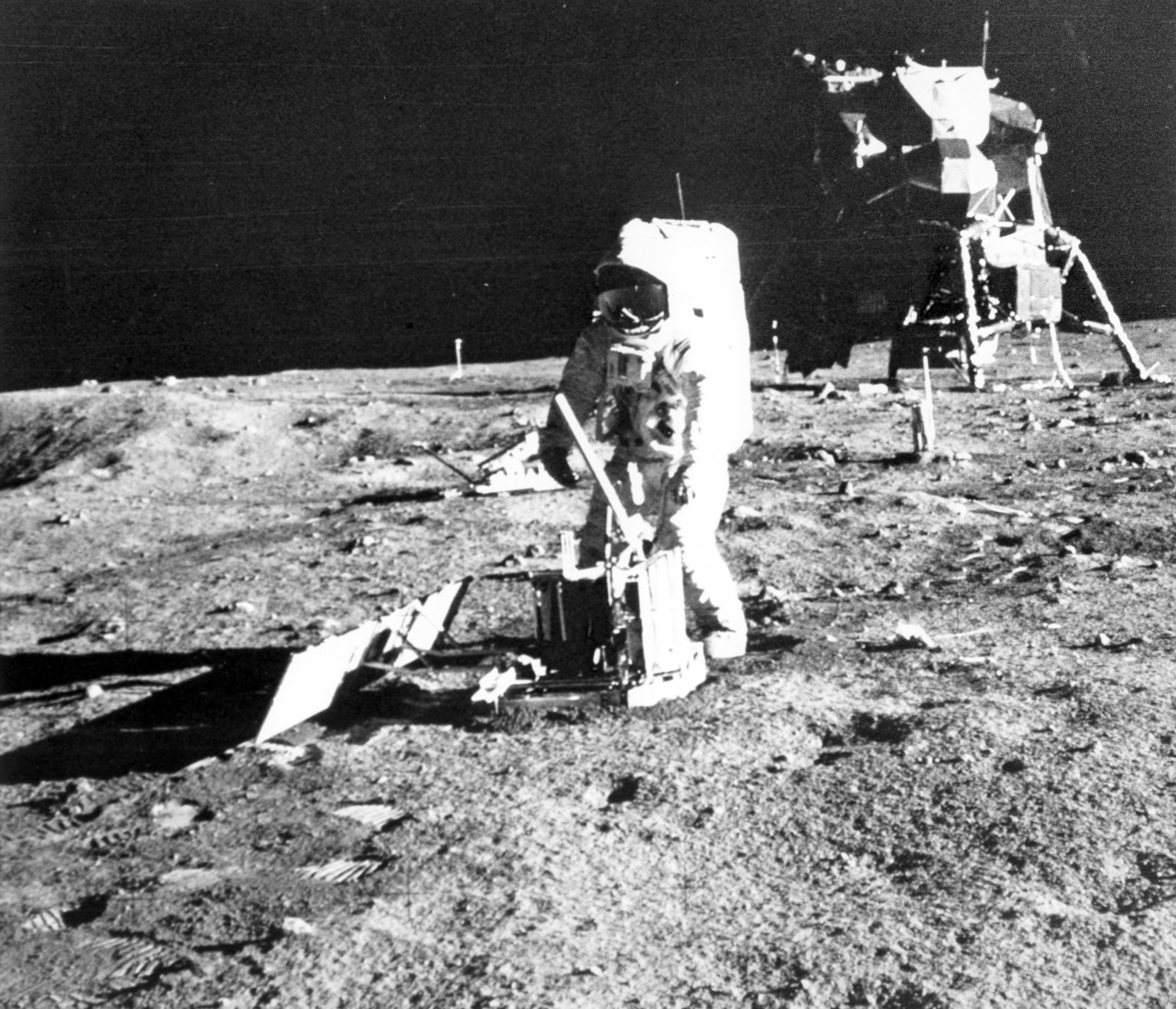
Aldrin deploys the solar array of the Passive Seismic Experiment Package (PSEP) at Mission Elapsed Time (MET) 111 hours, 6 minutes and 40 seconds, July 20, 1969. Behind him are other items noted in the LROC orbital close-up imaged 42 years later, including the lunar ranging retro-reflector (LRRR), Discarded Cover and television camera (AS11-40-5947) [Neil Armstrong/NASA JSC/ ALSJ].
Another trail leads toward Little West crater around 50 meters (164 feet) to the east of the LM. This was an unplanned excursion near the end of the two and a half hours spent on the surface. Armstrong ran over to get a look inside the crater, and this was the farthest either astronaut ventured from the landing site. Compared to Apollo 12 and 14, which allowed for more time on the surface, and Apollo 15, 16, and 17, which had the benefit of a Lunar Roving Vehicle, Armstrong and Aldrin's surface activities were quite restricted. Their tracks cover less area than a typical city block!

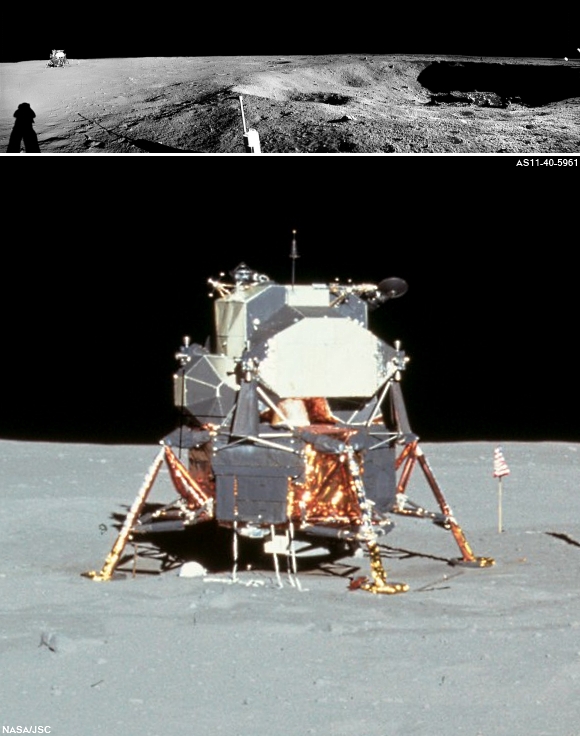
Full resolution detail from AS11-40-5961, part of a lunar surface "early-morning" down-sun panorama stitched from a series of photographs taken from the rim of Little West crater (MET 111:11:31). A very short Moon walk, the The entire area covered by Armstrong & Aldrin would fit in a standard basketball court [Neil Armstrong/NASA/ALSJ].
Not only was the landscape a place of "stark beauty", but also the source of rocks that revealed the Moon’s fiery past for the first time. The samples showed that the Apollo 11 landing site in Mare Tranquillitatis was once the site of volcanic activity, and the flat surface that afforded such an incredible vista was due to broad, thin flows of lava that flooded the region.

Check out past views of the Apollo 11 site at lower resolution (but complementary illumination angles):


Browse the full resolution NAC image HERE.

Thursday, March 4, 2010

Long-term degradation of optics on the moon


According to the Apollo 15 Surface Journal Comdr. Dave Scott observed that the LRRR looked "super clean" when he and Jim Erwin deployed the mission surface experiments July 31, 1971. He took the cross-Sun view of the LRRR above from the south, showing the orientation gnomon and bubble level. Four times the size of the retro-reflectors deployed by Apollo 11 and Apollo 14, the third and final U.S. LRRR deployed by Apollo 15 is the unit most often detected from Earth. Though lasers and photon detectors have improved many times over in the past four decades, and though First Look at the Apollo landing sites by the Lunar Reconnaissance Orbiter Camera (LROC) last summer showed equipment and astronaut footprints undisturbed, something has been steadily degrading the amount of light these important mirrors are returning back to Earth.

(A Follow-Up on "Dust accumulation on Apollo laser reflectors may indicate a surprizingly fast and more dynamic lunar exosphere," February 16, 2009)

T.W. Murphy, et.al.
University of California-San Diego

Abstract: Forty years ago, Apollo astronauts placed the first of several retroreflector arrays on the lunar surface. Their continued usefulness for laser-ranging might suggest that the lunar environment does not damage optical devices. However, new laser ranging data reveal that the efficiency of the three Apollo reflector arrays is now diminished by a factor of ten at all lunar phases and by an additional factor of ten when the lunar phase is near full moon. These deficits did not exist in the earliest years of lunar ranging, indicating that the lunar environment damages optical equipment on the timescale of decades. Dust or abrasion on the front faces of the corner-cube prisms may be responsible, reducing their reflectivity and degrading their thermal performance when exposed to face-on sunlight at full moon. These mechanisms can be tested using laboratory simulations and must be understood before designing equipment destined for the moon.

Long-term NASA plans (NASA Strategic Plan 2006) for placing scientific equipment on the moon face uncertainty regarding the environmental impact on such devices as hard information about the lunar environmental effect on scientific instruments has not been available. From a quantitative analysis of the performance of the laser reflectors, we find clear evidence for degradation of the retroreflectors, and note that degradation began within one decade of placement on the lunar surface.


Some lunar laser retro-reflector arrays are brighter than others, though all their detections on Earth are measured in photons counts. Pencil-thin laser beams leave Earth and widen by more than a kilometer by their arrival on the Moon. The smallest part of these wavefronts are gathered up and reflected back, making a second traverse of the Earth-Moon distance and through Earth's absorbing and refractive atmosphere. [AS15-95-11468 & AS15-85-11469].

From 1969–1985, the McDonald Observatory 2.7 m Smith Telescope (MST: Bender et al. 1973) dominated lunar laser ranging (LLR), using a 634 nm ruby laser.

Starting around 1985, the McDonald operation moved away from the competitively-scheduled MST to a dedicated 0.76 m telescope designed to perform both satellite and lunar laser ranging, becoming the McDonald Laser Ranging System. In 1984 other LLR operations began at the Observatoire de la Cˆote d’Azur in France and at the Haleakala site in Hawaii, that used 1.5 m and 1.74 m telescopes, respectively. These systems all operate Nd:YAG lasers at 532 nm.

In 2006, the Apache Point Observatory Lunar Laser-ranging Operation (APOLLO) began science operations using the 3.5 m telescope and a 532 nm laser at the Apache Point Observatory in New Mexico.

Primarily geared toward improving tests of gravity, APOLLO is designed to reach a range precision of one millimeter via a substantial increase in the rate of return photons. The large telescope aperture and good image quality at the site, when coupled with a 4x4 single-photon detector array, produces return photon rates from all three Apollo reflectors that are about 70 times higher than the best rates experienced by the previous LLR record-holder (OCA). Consequently, APOLLO is able to obtain ranges through the full moon phase for the first time since MST LLR measurements ceased around 1985.

We find that the performance of the reflectors themselves degrades during the period surrounding full moon. In this paper we describe the full-moon deficit, report its statistical significance, and eliminate the possibility that it results from reduced system sensitivity at full moon. We show that this deficit began in the 1970’s, and examine the significance of successful total-eclipse observations by OCA and MLRS. We see an additional factor-of-ten signal deficit that applies at all lunar phases, but this observation requires a detailed technical evaluation of the link, and is deferred to a later publication.

We briefly discuss possible mechanisms that might account for the observed deficits.

From arXiv 1003.0713v1.pdf, HERE.


Laser Range Retro-Reflector (LRRR) arrays at the Moon. Apollo 11 (1969) & Apollo 14 (1971) are nearer the Moon's equator (and 40 degrees apart) and each is a quarter the size of the unit deployed Scott and Irwin of Apollo 15 (1971). Undetected since it was parked in 1970 are the french-built triangular prisms affixed to the Soviet rover Lunokhod 1 (1970). A similar design on the Lunokhod 2 rover (1973) has thermal drawbacks, alternately both hindering and aiding a rare detection. More recently, Goddard Space Flight Center keeps track of LRO (2009) and the Moon using laser ranging from a telescope in Maryland (See "Laser ranging and LRO," August 12, 2009).