Showing posts with label Cislunar Space. Show all posts

Friday, November 15, 2013

"The Best of Times, the Worst of Times..."

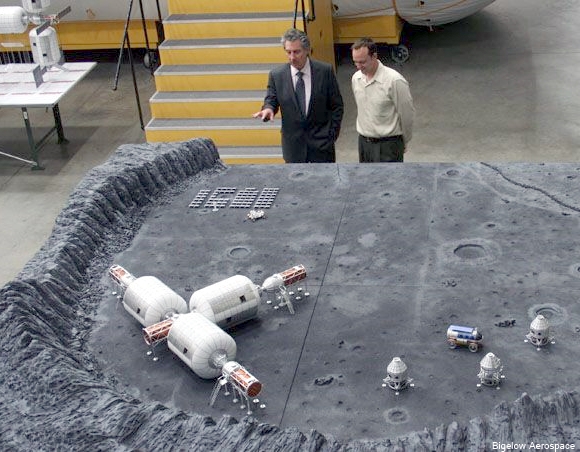
Robert Bigelow explains his commercial lunar habitat, being readied to undergo a test deployment in the Nevada desert, last May. More recently he's proposed using of the NASA COTS model to explore cislunar space and establish 'extended human activity' on the Moon [Bigelow Aerospace].
Doug Messier
Parabolic Arc

All the promise, perils and contradictions of America’s human spaceflight effort were on display earlier this week in Washington, D.C.

Things were looking good for a day or so, but then the proverbial other shoe dropped to remind everyone of the deep trouble that lies ahead as NASA attempts to restore its human spaceflight capability and send astronauts beyond low Earth orbit.

As NASA struggles to execute a series of ambitious programs on increasingly tight budgets, the main beneficiary appears to be the bumbling, crisis prone Russian space agency Roscosmos, which has reaped a financial windfall as a result of America’s equally bumbling human spaceflight policy. And matters could get worse before they get better (for NASA, at least).

The events of the week played out as follows:

Read the full post, HERE.

Also:
Bigelow urges use of COTS model for cislunar transportation
Jeff Foust, New Space Journal, November 15, 2013 

Wednesday, January 23, 2013

Cislunar transportation: the space trucking system

The concept of the way-station could be extended from cislunar space to Mars or elsewhere in the solar system, as needed For AIAA gathering in 2012, a lunar lander departs from L2 [John Frassanito & Associates].
John K. Strickland
The Space Review

Many people wonder what all the fuss is all about when they keep hearing the phrase “cislunar architecture.” Many of us are using the phrase to refer to what is essentially a space trucking system, with the equivalent of truck stops and cargo loading yards (freight terminals). Lets use the trucking analogy to explain what we are talking about.

You do not use an expensive truck to carry a load just a single time, and then immediately send the truck to the junkyard to be scrapped. Trucking businesses could not operate this way. Some truck cab and trailer combinations today are probably worth close to a quarter million dollars new. Some cabs alone are close to $100,000 used. Most of the current rockets used today cost over $100 million, so large rockets can be up to 1,000 times more valuable than a tractor-trailer, yet all of them smash into the ocean or desert and become scrap metal after just one flight.

For rockets that take off from the ground, one obvious way to allow re-use is for them to land on the ground intact. SpaceX and some other companies are trying to do just that. Quite a few rockets have now accomplished short flights and landed again safely. Without wings, the landings must be vertical. Re-use with a vertical landing was first done by the DC-X at White Sands on September 11, 1993.

For rocket vehicles in space, the problem is different. We do not want to bring the vehicle back to the ground to refuel, since it is extremely costly to get it up into space in the first place. Once it is in orbit, we want to be able to re-use that vehicle in space over and over again.

Read the full article HERE.

Thursday, July 19, 2012

Another successful Orion drop test

The Orion team loads a test version of the spacecraft into a C-17 in preparation for a parachute drop test at the U.S. Army Yuma Proving Ground in Arizona. The main objective of the latest drop test is to determine how the entire system would respond if one of the three main parachutes inflated too quickly [NASA].
NASA completed another successful test Wednesday of the Orion crew vehicle's parachutes high above the Arizona desert in preparation for the spacecraft’s orbital flight test in 2014. Orion will carry astronauts deeper into space than ever before, provide emergency abort capability, sustain the crew during space travel and ensure a safe re-entry and landing.

› Watch a video of the parachute drop test

A C-17 plane dropped a test version of Orion from an altitude of 25,000 feet above the U.S. Army Yuma Proving Ground in southwestern Arizona. This test was the second to use an Orion craft that mimics the full size and shape of the spacecraft.

Orion's drogue chutes were deployed between 15,000 feet and 20,000 feet, followed by the pilot parachutes, which deployed the main landing parachutes. Orion descended about 25 feet per second, well below its maximum designed touchdown speed, when it landed on the desert floor.

Read the full NASA Feature article, HERE.

Tuesday, June 19, 2012

China and the Moon

Shenzhou 9 lifts off for rendezvous and docking in space
Paul D. Spudis
The Once and Future Moon
Smithsonian Air & Space

With the weekend launch of the latest Shenzhou spacecraft and its successful rendezvous and docking with an orbiting space station, world attention is once again focused on China’s flourishing space program.  Although China’s human spaceflight efforts currently focus on low Earth orbit, in recent years they have sent two robotic orbital spacecraft to the Moon and have announced their intentions for a lunar lander/rover mission.  These efforts lead many in the west to speculate that a presence on the Moon is a likely and realistic goal for China’s space future.  In terms of the possible purpose for such lunar efforts, things are little more vague.  Most assume that China will go to the Moon for reasons similar to the geopolitical motives that impelled America to undertake the Apollo missions.  While some actually welcome China’s aspirations to conquer the Moon, other space observers smirk at their apparent willingness to (as they characterize it) “waste billions of dollars to repeat what America did thirty years ago.”  Others understand why China aims for the Moon.

The United States currently has no strategic space goal.  Many in the U.S. space community argue that the development of commercial launch services through federal subsidies is a goal.  To smooth the path for this approach, calls for consensus have been made by some New Space advocates.  Funding to support the research and development costs of these new commercial services would come by excising chunks of the rapidly dwindling NASA budget.   “Flat or declining” now describes the American civil space program budget and regularly reaching LEO to supply ISS has become our “new” vision.

In contrast, China is conducting an incremental, step-wise effort to gradually but inexorably extend their reach and influence in space, first into low Earth orbit and then into cislunar space and beyond.  Their approach uses a variety of hardware derived from existing systems while adding new capabilities over time.  China appears to be focused and following clear, long-range goals in space.  Because we do not look ahead on timescales of 20-30 years (accustomed instead to a 5-10 year timeframe), we have no long-range strategy to guide what we build or a plan for securing any long-term space goals.

Certainly wide-ranging concerns propel China’s push for human space access, some that can be envisioned now and some that cannot.  But fundamentally, they have accepted the proposition that freedom of space in the 21st century is equivalent to the principle of freedom of the seas that governed 19th and 20th century geopolitics.   In short, such a principle comprises the ability to project power and to protect national interests whenever and wherever China might be confronted within the strategic theater in question, in this case, the domain of cislunar space.

I have written before on the economic, strategic and scientific value of cislunar space, the zone in which virtually all of our space assets and satellites reside.  China intends to preserve her freedom of action by creating a spaceflight capability that can access and use any location of cislunar space, up to and including the lunar surface.  To build a sustainable space program using incremental, cumulative steps, it makes no sense to “leapfrog” over (or to ignore) the intermediate locations from which space faring capability and utility can be demonstrated, established and used.

Much of the published speculation on China’s interest in the Moon focuses on mining the Moon for the nuclear fusion fuel 3He or substances found on the lunar surface, such as titanium or rare earth elements.  In fact, one of the simplest substances found on the Moon has enormous value in space – water.  Water can be used to support human life, as a medium of energy storage, and as rocket propellant.  Water is the currency of spaceflight and one of the most valuable, usable substances we could obtain from any extraterrestrial object.

If I wanted to establish a secure foothold for my country in cislunar space, I would secure the territory near the poles of the Moon.  We know from the results of several recent probes that the lunar poles contain billions of tons of water, much of it chemically unbound as ice, a particularly easy form to harvest, concentrate and use. Material and energy resources, concentrated together in a compact location are assets of immense economic and strategic value.  Wars have been waged over less.

International treaty prohibits claims of extraterrestrial territory by national entities.  But treaties are “gentlemen’s agreements” and sometimes nations do not behave like gentlemen.  There is no mechanism to enforce the 1967 Outer Space Treaty except for a given country’s unwillingness to undergo international opprobrium.  Moreover, a country can withdraw from the treaty at will.  China tends to do what it wants to do, unless the economic or political price is perceived to be too high.  The potential of the Moon and cislunar space may outweigh their sense of geopolitical risk or concern about international ostracism.

What does this mean for the United States?  To listen to many in the space press, nothing.  A quick yawn and then back to propagandizing for more federal dollars to be passed on to new space companies.  But ultimately, it could mean that their libertarian dreams of a profit-making space frontier will never come to pass.  If free market capitalism and democratic political institutions are to have a future in the new frontier of space, entities, investors and consumers who share these values must secure a notable presence.  If the United States has a vigorous civil space program that creates a permanent presence there, such a system may have a chance to take root.  Conversely, our absence is almost a guarantee that our system and values will not be the guiding paradigm on the new frontier.

For many observers, an absent America (or with a mere supporting role) would be acceptable.  They believe America is what’s wrong with the world and that it’s high time that we step aside (in their opinion to one of subservience and irrelevance – certainly not one of power projection or as an economic engine and technology driver).  Parties (and countries) that lead make the rules.  While China has a great industrial base and a large, seemingly market-based economic system, it is actually a system of big government corporatism, where central planners decide which industries shall be allowed to grow and in what direction – capitalism, under total governmental control.

China is a rapidly advancing technically and is one of our largest trading partners, attributes beneficial in relationships between equals.  Historically, once a shift occurs in the status of partners, relationships change.  Because China’s influence in the world is growing, it is vital that we discuss and weigh these facts.  Our national economic and security interests cannot be jeopardized by a misguided rush to hand our space future over to companies who are in the imagining stage of what China just accomplished this weekend.

Originally published at his Smithsonian Air & Space blog The Once and Future Moon, Dr. Spudis is a senior staff scientist at the Lunar and Planetary Institute. The opinions expressed are those of the author and are better informed than average.

Thursday, May 3, 2012

AIAA Houston: Develop Cislunar Space Next

Spacecraft departs Earth-Moon L1 node for lunar surface mission [AIAA Houston/John Frassanito & Associates].
Paul D. Spudis
AIAA Houston Horizonscover story

"The real debate should not be about launch vehicles or spacecraft or even destinations, but about the long-term purpose of our civil space program. Different rationales have been proposed, including: scientific knowledge, technology development, creating enthusiasm for science and math education, societal inspiration and many others less tangible. Fundamentally, all of these ration-ales (not all of them mutually exclusive) may have merit to a greater or lesser extent, but in times of national fiscal uncertainty, only those projects providing clear practical value and understandable societal benefit have any reasonable expectation of long-term political and fiscal support."

Read the Horizons cover story, HERE..(PDF)

Controllers on Earth operate and maintain a propellant production plant on the Moon [AIAA/MIT/John Frassanito & Associates].

Monday, September 19, 2011

Let's argue about the right things.


President Theodore Roosevelt's "Big Stick," displayed in the form of sixteen gleaming modern battleships with 14,000 sailors that soon became known as "The Great White Fleet." Over 1908 it was a substantive pageant that circled the world, making 20 ports of call and signaling America's arrival as a world power.

Paul D. Spudis
The Once & Future Moon
Smithsonian Air & Space


We seem to be in one of those periods in which basic reasons for doing what we do as a nation are called into question.  This includes our national civil space program, which for the last few years has engaged in an extended period of back-biting and navel-gazing.  Much of this “debate” has focused on either or both of two points: what rocket to build and where to go, and not on sustainability.

In an era of limited resources, our challenge is to create a worthwhile space program with an expenditure rate that falls at or below a level perceived as affordable.  Given this reality (regardless of prevailing agency direction or assertions about projected deep space destinations) it is highly likely that cislunar space will be the sphere of space operations for the coming decade or two. Thus the questions should be:  What are we doing in space and why are we doing it?  If the answer is a series of space exploration “firsts” (flags-and-footprints forever), that model will require specific activities and missions.  If the answer is that an incrementally developed transportation infrastructure is desired, one that creates an expanding sphere of human operations, then such a model requires a different set of specific activities and missions.

Thus, the real debate is not about launch vehicles or spacecraft or even destinations; it is about the long-term – the paradigm or template of space operations.  One model requires mega-rockets to distant targets for touch-and-go missions; for convenience, I’ll call it the “Apollo” template (no denigration intended).  The other model is an incremental, go-somewhere-to-stay-and-then-expand-onwards mindset – call it the “Shuttle” template (again, same disclaimer).  The one that you adopt and follow depends on what purpose you believe human spaceflight serves.

Because Mars may harbor former or existing life, NASA has presumed that it is our “ultimate destination” in space.  In effect, the entire focus of the human spaceflight effort has devolved into a huge science project – “The Quest for Life” (which means finding pond scum, not ET).  Thus, debate about what to build, where to go and how to do it must be formulated towards attainment of Mars.

This unspoken assumption has been at the root of most space objective studies for the past 20 years.  Mars was the end point of President George H.W. Bush’s Space Exploration Initiative, President George W. Bush’s Vision for Space Exploration, of former Lockheed-Martin President Norm Augustine’s two reports, and a myriad of space groups and societies.  From the 1990′s to the present, a multi-billion dollar robotic campaign has sent mission after mission to Mars, each discovering that the red planet once had liquid water.  This mania for Mars and preoccupation with possible life there, has blinkered our perceptions of the space program and distorted our reality of what is possible or attainable on reasonable time scales with available resources.

Long term, the goal for human spaceflight is to create the capability to go anywhere we choose, for as long as we need, and do whatever we want to in space.  For the sake of argument, if one accepts such a goal, which model is more amenable to implementing it: the Apollo template or the Shuttle template?

If our goal is to “sail on the ocean of space,” we need a navy.  Navies don’t operate with just one class of ship because one class isn’t capable of doing all that is necessary.  Not all ships will look or operate the same because they have different purposes and destinations.  We need transports, way stations, supply depots, and ports.  In space terms, these consist of one to get people to and from space (LEO), one to get them to and from points beyond LEO, way stations and outposts at GEO, L-1, low lunar orbit, and to the lunar surface.  To fuel and provision our space navy, we require supply (propellant) depots in LEO, L-1 and on the lunar surface.  Ports of call are all the places we may go to with this system.  Initially, those ports are satellites in various orbits which require service, maintenance and replacement with larger, distributed systems.  Later, our harbor will be the surface of the Moon, to harvest its resources, thereby creating more capability and provisions from space.  Reliable and frequent access to the entire Solar System, not one or two destinations, should be our ultimate goal.

By designing and building mission-specific vehicles and elements, the “Apollo” template forfeits going everywhere and doing everything.  However, adopting the “Shuttle” model does not preclude going to Mars.  In fact, I contend that to go to Mars in an affordable manner that sustains repeated trips, one needs the infrastructure provided by a space faring navy.  Building a series of one-off spacecraft – huge launch vehicles to dash to Mars for expensive, public relations extravaganzas will eventually put us right back in the box we’re in now.

We have been arguing about the wrong things.  It is the mindset of the space program that needs re-thinking – not the next destination, not the next launch vehicle, and not the next spacecraft.  How can we change the discussion?  First, we need to understand and articulate the true choices so that people can see and evaluate the different approaches and requirements.  Second, we need to develop sample architectures that fit the requirements for “affordable incrementalism.”  Finally, we need to get such plans in front of the decision makers.  There is no guarantee that they will accept it or even listen to the arguments for it.  But right now, they are completely ignorant about it.

A cost-effective, sustainable human spaceflight program must be incremental and cumulative.  Our space program must continually expand our reach, creating new capabilities over time.  Moreover, it should contribute to compelling national economic, scientific and security interests.  Building a lasting and reusable space transportation system does that, whereas a series of PR stunt missions will not.  The original vision of the Shuttle system was to incrementally move into the Solar System – first a Shuttle to-and-from LEO, then Station as a jumping off platform and then beyond LEO into cislunar space.  We have the parts from the now retired Shuttle system and an assembled and working International Space Station.  We can use these legacy pieces to build an affordable system to access the near regions and resources of cislunar space.  In this new age of austerity, perhaps we will finally acquire the means to build our pathway to the stars.

Originally published September 17, 2011 at his Smithsonian Air & Space blog The Once and Future Moon, Dr. Paul Spudis is a Senior Staff Scientist at the Lunar and Planetary Institute in Houston. The opinions expressed are those of the author and are better informed than average.

Tuesday, April 12, 2011

A Rationale for Cislunar Space


Hughes communications satellite HGS-1, left in a useless transfer orbit by launch vehicle failure in 1997, finally reached GEO in 1998 by using lunar flyby gravity assists, the first commercial use of the Moon in history [Hughes].

Paul D. Spudis
The Once & Future Moon
Smithsonian Air & Space

At a recent workshop on lunar return, a critical part of the discussion focused on the need for a statement of purpose – a value proposition for the Moon. Over the years I’ve attempted to distill my rationale for lunar return (my “elevator speech” if you will) into a clearly stated and persuasive argument about the need for enabling human reach beyond low Earth orbit – into all the areas between Earth and Moon (cislunar space) where all of our satellite assets reside. So, as the elevator doors are closing, I will state my Rationale for Cislunar Space:

1. Space satellite assets in orbit beyond LEO benefit society. Modern industrial life depends on satellites of various types and purposes – space assets for global communications, weather monitoring, scientific exploration and national security.

2. Earth’s deep gravity well is a significant cost deterrent to expanded activities in space. Beyond LEO mission launch mass is mostly propellant. We remain mass- and power-limited and therefore capability-limited as long as we are tied to the current spaceflight template of launching everything we need from Earth’s surface. Regardless of launch costs, the size and capability of a given space asset is dictated by the size of available launch vehicles.

3. Human- and machine-assembled satellites can be as big and as capable as needed and unlimited by launch vehicle size. The advent of human servicing and assembly in space, for which we now have documented proof (after 30 years of the Shuttle program and construction of the International Space Station) gives us options and frees us from launch vehicle constraints on volume and mass. Once we are able to get people and machines to those places in space where assets are needed, we can build expanding, maintainable and extensible space systems on site.

4. Currently we cannot routinely access orbits beyond LEO with people and machines to build and maintain such satellites. We use all the propellant of a given launch vehicle just getting people to LEO. At LEO, a new vehicle – already fueled – will be needed to reach various “high” orbits of cislunar space (home to current and future satellites) including geosynchronous orbit, the 36,000 km high orbits at which communications and other global monitoring satellites orbit. At these spots, a single orbit takes 24 hours, the same time as the rotation period of Earth. Such satellites appear to “hover” over one spot on the ground and a dish antenna pointed at their location in the sky never has to be moved to track it.

5. The manufacture and use of propellant made from lunar materials allows for a system that will lower the cost for new space activities, enable routine access to and from the surface of the Moon – give access to all other points in cislunar space, including GEO and other orbits useful for space assets – and open up an avenue for routine human interplanetary flight (i.e., to Mars and beyond). Making propellant from water retained at the lunar poles permits us to set up a logistics base on the Moon, creating routine access throughout cislunar space. In terms of energy, there is very little difference between going from LEO to the aforementioned geosynchronous orbit and lunar orbit.

6. The Moon offers other material and energy resources needed to create new space faring capability, including regolith aggregate, glass and ceramics, metals and solar cell fabrication. We can make composite and ceramic materials from lunar soil by sintering the regolith into parts and structures. Metals can be extracted from lunar rocks and used for construction on the Moon and in space. Engineers have created a roving vehicle that uses lunar soil to make in-place solar cells for the generation of electricity. This ability allows us to create vast photovoltaic arrays for the generation of gigawatts of electrical power. These resources, in addition to the water used for propellant production, are all present and available on the Moon.

7. Both robotic and human presence is required on the Moon to enable and maintain production from lunar resources. I’ve worked in “unmanned” spaceflight for over 30 years. While a firm believer in the utility and possibilities of robotic operations controlled from Earth, I also know that sometimes these robots require human ingenuity and interdiction to work properly. The servicing of the Hubble Space Telescope by Shuttle astronauts has shown us how important people can be to the success of space operations. We can start a lunar return through the use of teleoperated robots, but ultimately people will be necessary to creatively manage operations as well as for getting them back on track when they falter.

8. By establishing a permanent presence on the Moon, we create a “transcontinental railroad” for cislunar space – a reusable, extensible and maintainable (thus, affordable) transportation system. Virtually any scenario for human missions beyond LEO requires a spacecraft carrying hundreds of tons of propellant. This propellant can be made off-Earth from lunar resources and launched from the Moon’s weak gravity well to depots in cislunar space. No rational technical argument can be made that the Moon is a roadblock. And from a monetary perspective, building an extensible cislunar transportation infrastructure gives us both capability and return on our investment.

9. Developing a program to utilize off-planet resources will drive new technology, expand economic growth and assure democratic pluralism survives on the frontiers of space (neither totalitarianism nor corporatism). For fifty years the U.S. civil space program has served national prestige, launched massive economic and scientific growth through technological innovation, and nurtured international cooperation in many areas. We cannot however, continue to assume that free market capitalism will remain the dominant political paradigm in space. There are other space powers that do not share our views about individual freedoms and economic opportunity, nor do they necessarily care about the importance or need for property rights and contract law – values needed to maintain free societies. There may be no individual liberty or free market enterprise if America does not maintain a strong leadership presence on the growing space frontier.

The report of the Augustine committee concluded that human expansion into space was the ultimate (and in fact only) rationale for manned spaceflight. I agree. The elevator doors are opening now so I hope my argument for lunar return has persuaded you that America has the opportunity to prosper, to create a space economy and help shape humanity’s future by utilizing the Moon to develop cislunar space.