
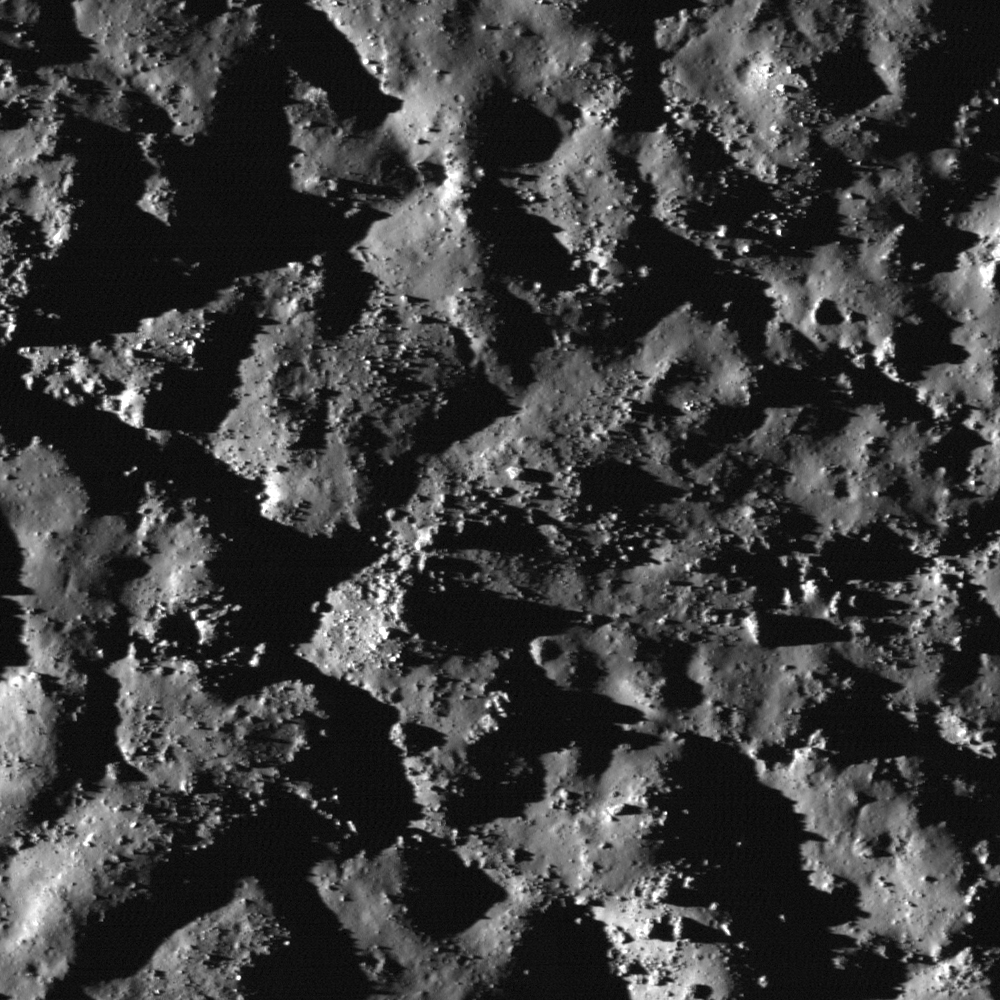
The floor of Tycho crater is covered in many places by a chaotic surface of impact melt forms. Image scale is 0.5 m/pixel, image width is 500m. Incidence angle 84°, LROC Narrow Angle Camera (NAC) observation M117568330R, LRO orbit 2459, January 9, 2010. View the full-size LROC Featured Image HERE [NASA/GSFC/Arizona State University].
 Hiroyuki Sato
LROC News System
The interior floor of Tycho is covered by blocks, boulders and impact melt textures. The impact melt deposits often show networks of fractures visible at the LROC Wide Angle Camera pixel scale of 100 meters.
At Narrow Angle Camera resolution with very illumination incidence angles (illuminated almost along the horizon), the extremely complicated and chaotic nature of the surface is striking.
At Narrow Angle Camera resolution with very illumination incidence angles (illuminated almost along the horizon), the extremely complicated and chaotic nature of the surface is striking.

Simulated view of Tycho's chaotic interior floor from high upon the craters sharp central peaks looking toward the southwestern rim beyond, from a still lifted from the magnificent Kaguya Terrain Camera panorama video, offering an breathtaking tour of Tycho's anatomy, released May 27, 2009 [JAXA/SELENE].
Impact melts have extremely complicated thermal histories. When the impacting meteoroid's kinetic energy is large enough, the initial temperature of an impact melt can be much higher than that of normal magma, which is driven by volcanic activity. The melts are mixed together with ejecta debris, flow down slopes and puddle; loosing heat and increasing in viscosity with time. Once settled in the crater floor, solidification starts at the top and the bottom (chilled margins), and continues little by little to the melt volume interior. Any kind of deformation during this time (for example, the isostatic rebound of the crater floor, uneven thermal contraction, or late flows pushing pre-existing melts) will disturb the solidifying melt surfaces to make the chaotic patterns and sometimes cause local "eruptions" of melt onto the newly solid layer.

LROC Wide Angle Camera (WAC) 100 meter/pixel mosaic of Tycho impact crater cavity, overlayed by WAC color Digital Terrain Model (DTM) 500 meter/pixel (DLR, Germany). Image center is about 43.32°S, 348.89°E. Blue rectangle and yellow star indicate the locations of the NAC M117568330R frame and the LROC Featured Image, June 15, 2011. See the full-sized context image HERE [NASA/GSFC/Arizona State University].
Explore the extremely chaotic melt surface in the full NAC frame!
The topographic color was produced as a by-product of stereo analysis of the WAC global dataset. Producing the global Digital Elevation Model (DEM) is a big job being led by LROC team members at the German Aerospace Center (DLR; English version) in Berlin.
The topographic color was produced as a by-product of stereo analysis of the WAC global dataset. Producing the global Digital Elevation Model (DEM) is a big job being led by LROC team members at the German Aerospace Center (DLR; English version) in Berlin.

Yuri Goryachko and friends at Astronominsk are among the premier lunar (and planetary) photographers on Earth. The image above, from a mosaic captured April 6, 2009, offers an enhanced color view of Tycho, the crater who's wide-ranging ray system dominates the Moon's southern hemisphere and beyond as seen with the naked eye. Tycho is not an unusual crater by any standard. It's rays and rough hewn appearance are indicative of its relative youth, only 109 million years old - and not yet "optically darkened" by the relentless bombardment of meteors, micrometerors and hard radiation that gardens and changes the composition of the Moon's immediate surface (and albedo) every 2 million years or so [ASTONOMINSK].
Related posts:
Rubble Pile on Fresh Crater Floor
Mounds in a melt pond
Impact melt features in Tycho crater's floor
More Impact Melt!


