Showing posts with label Secondary Cratering. Show all posts

Thursday, September 4, 2014

Secondary scatter over Haret C and the SPA interior

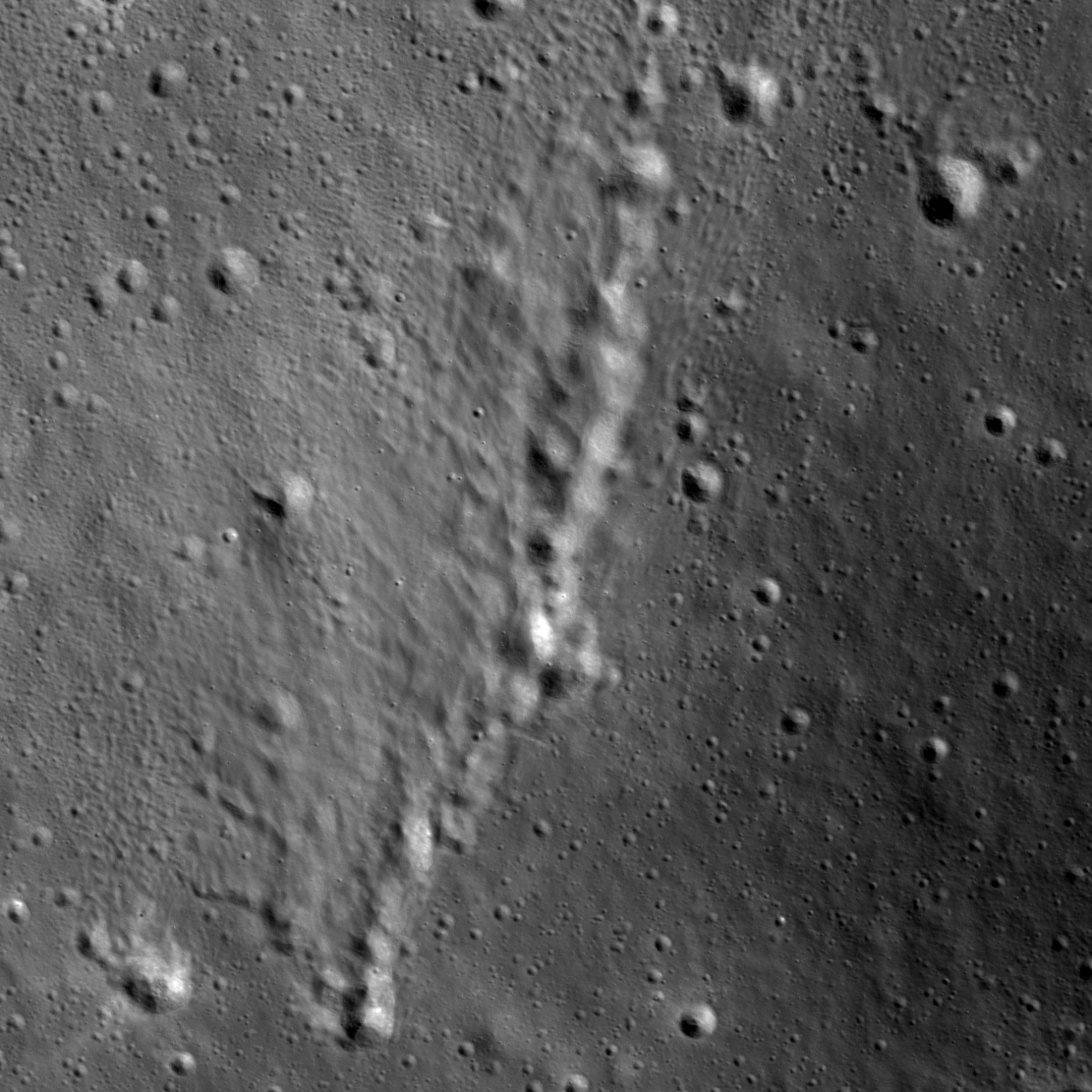
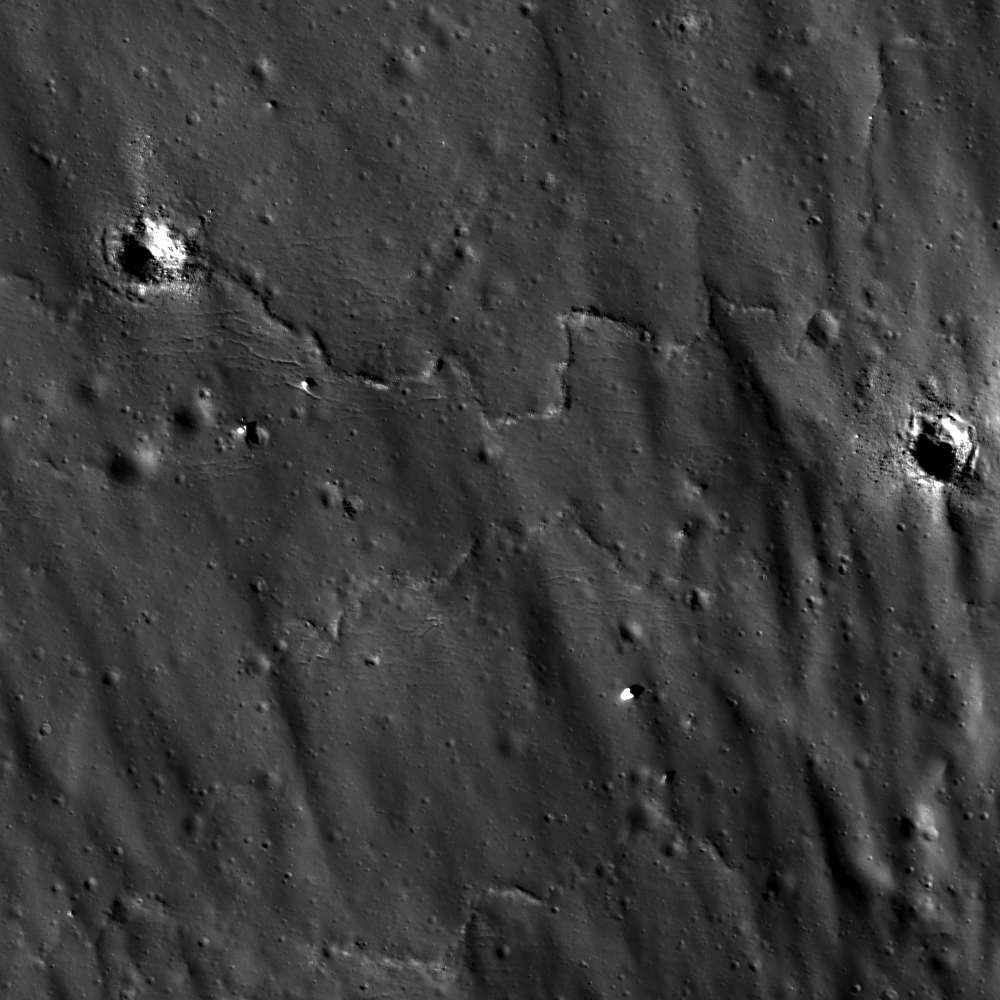
A stream of secondary craters crosses the rim of Haret C (28.47 km; 57.6°S, 186.3°E), stretching from the northeast exterior, southeast into the interior of the crater, deep within the South Pole-Aitken impact basin. 6.52 km-wide field of view from LROC NAC mosaic M1163623161LR, LRO orbit 23388, August 25, 2014; 56.75° incidence, resolution 68 cm from 63.63 km over 57.6°S, 185.26°E [NASA/GSFC/Arizona State University].
H. Meyer
LROC News System

Closely clustered or overlapping craters of similar size and morphology are likely secondary craters.

Secondary craters form when an impactor hits the surface (forming the primary crater) and throws out blocks of material that proceed to form their own craters (secondaries) as they hit the surface.

Sometimes, secondary craters can be difficult to identify if they do not occur in groups. Because craters are used to estimate the age of a surface (a process called crater counting), it is important that scientists are able to identify secondary craters.

Thankfully, in the case of Haret C, the secondary craters stand out from primary craters due to their proximity to each other. Random impacts typically do not form clusters like those draped over Haret C (28.47 km; 57.6°S, 186.3°E) .

A quick look at Haret C made possible by the international burst of lunar exploration briefly inspired by interest in the run-up to the Constellation program. The crater chain is easy enough to see in the medium resolution global albedo mosaic swept up from Chang'e-2. And the basics of the ranges and elevations of the region are displayed using the LROC Quickmap service.
Within high resolution images, smaller craters are used for crater counting. However, secondary craters become more common at smaller diameters introducing a problem for crater counters if the secondaries cannot be distinguished from primary craters. Secondaries counted as primaries result in higher crater counts per unit area, which in turn result in age estimates that are older than the true age of the surface.

Haret C does not dominate, but it is easy to pick out near the center of this HDTV still (larger view HERE) from Japan's lunar orbiter Kaguya (SELENE-1) in 2008. There are two other stills where Haret C and its crater chain are visible in context with central South Pole-Aitken basin and it's larger neighbors Bose (92.5 km; 53.95°S, 190.63°E) and Bhabha (70.52 km; 55.49°S, 194.69°E), HERE and HERE [JAXA/NHK/SELENE].
A key science goal is coming to a better understanding of the morphology or abundance of secondaries relative to primary craters so that more accurate age estimates can be made for smaller, younger terrains: especially important for panning at the scale of the NAC images for future missions to the Moon.

Seven minutes of video from GRAIL-A (Ebb) during orbit 1902 in 2012. Using the student-directed Forward MoonKAM video camera we can close in on the secondary crater chain at Haret C looking north from a perspective beginning at 30 km rising to 41 km over the surface at the end of the sequence. Starting in the polar latitudes of the southern farside the compressed view quickly passes up over the enigmatic interior of South Pole-Aitken basin, over Antoniadi (137.91 km; 69.3°S, 186.94°E, home of the Moon's lowest elevation) north 22° following the meridian that crater shares with Haret C [NASA/JPL/UCSD/SRSC].
Explore the full-width NAC mosaic HERE. Do you see any primary craters in the mix?

Related Posts:
Tuesday, June 10, 2014

Ready-made excavations near Lucretius C

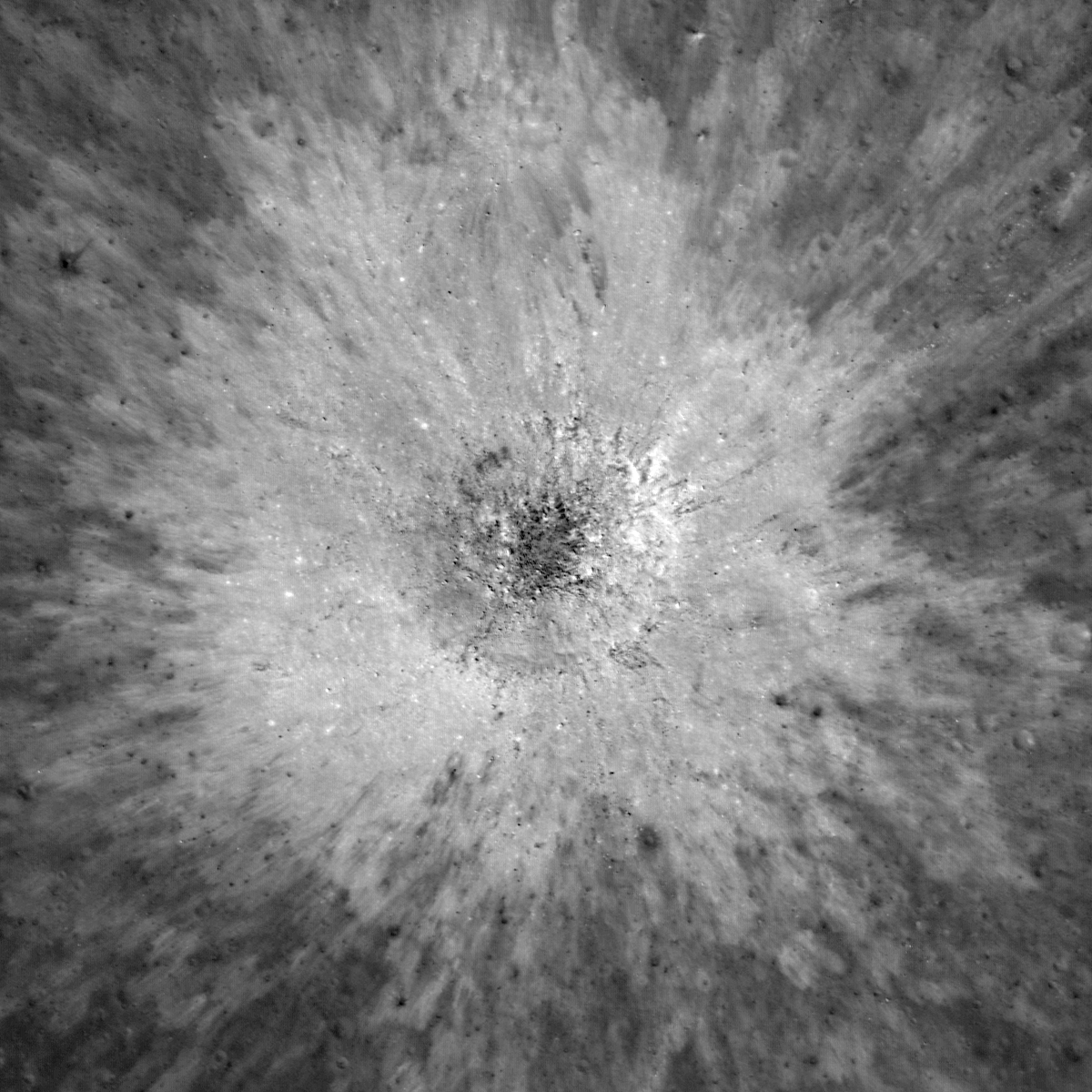
Self-secondary of a bright, relatively fresh crater northwest of Mare Orientale, in the wider highlands greatly affected by that basin-forming impact. The unnamed primary crater (between Lucretius C and Grachev craters, see below) is visible from a great altitude because of its relative low optical maturity. Full-resolution, 530 meter-wide field of view from LROC NAC observation M1132582647R, LRO orbit 19028, August 31, 2013; 9.47° incidence angle, resolution 92 cm, from 106.13 km over 3.09°S, 246.92°E [NASA/GSFC/Arizona State University].
Hiroyuki Sato
LROC News System

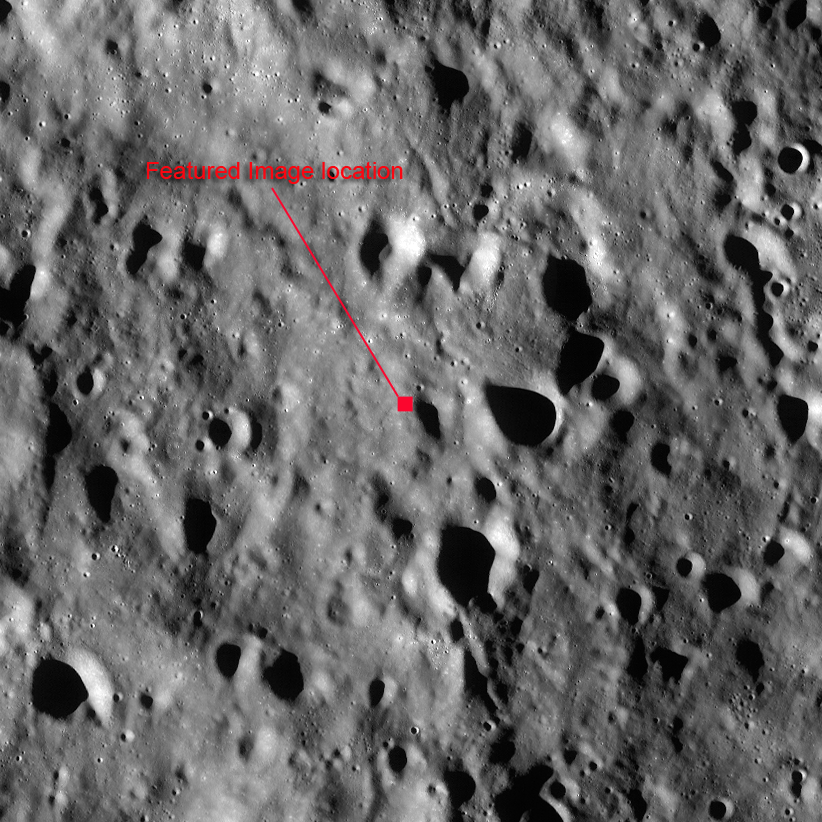
Today's Featured Image highlights the spectacular fresh ejecta from an unnamed crater (1.05 km; 3.06°S, 297°E), approximately 750 km northwest of Mare Orientale.

Subsequent impacts (possibly including self-secondaries) excavate through the ejecta sheet, leaving small craters, mostly less than 50 meters in diameter, and tiny ejecta splashes.

Some are lower and others are higher in reflectance than their surroundings, resulting in a variety of contrasts against the bright, optically immature ejecta field of the primary crater. 

Bright, relatively fresh primary to highlighted secondary crater at upper left northwest of Orientale basin, between Lucretius C and Grachev. 4.54 km-wide field of view from full-width of LROC NAC observation M1132582647R, visible HERE. [NASA/GSFC/Arizona State University].
In the opening image, many small high reflectance craters (~10 m) are clustered at the lower right side of the image, while nearby mid-sized craters (~50 m) are darker than their surroundings. The largest crater's ejecta (center-left in this image) is composed of two layers, the brighter layer on top of the darker layer.

Full-width mosaic, 13.357 km-wide field of view from a mosaic of both the left and right frames of LROC observation M1132582647.   Larger reproductions are available HERE [NASA/GSFC/Arizona State University].
These reflectance variations are likely due to the different excavation depths into the low and high reflectance surface and subsurface deposits. The mid-sized craters probably reached the original low reflectance materials below the upper higher reflectance ejecta sheet (from the unnamed ~1km diameter crater). The largest crater likely excavated high reflectance substrate that is also exposed on the unnamed crater's wall. 

250 meter resolution view shows the high visibility of the small crater of interest (1.05 km; 3.03°S, 297°E), against the ancient highlands, deeply scared by the energy of the Orientale basin-forming-impact. LROC Quickman WAC natural color beta over 100 meter global mosaic [NASA/GSFC/Arizona State University].
Context for high resolution LROC NAC view of bright fresh 1.05 km crater (3.06°S, 297°E) northwest of Mare Orientale [NASA/GSFC/SVS/Arizona State University].
Impacts serve as a natural excavation process which helps us to glimpse into the otherwise unreachable geological layers on the Moon. 

View full-width mosaic, HERE.

Related Posts

Tuesday, December 3, 2013

Smattering of Self-Secondaries

Self-secondary craters in ejecta
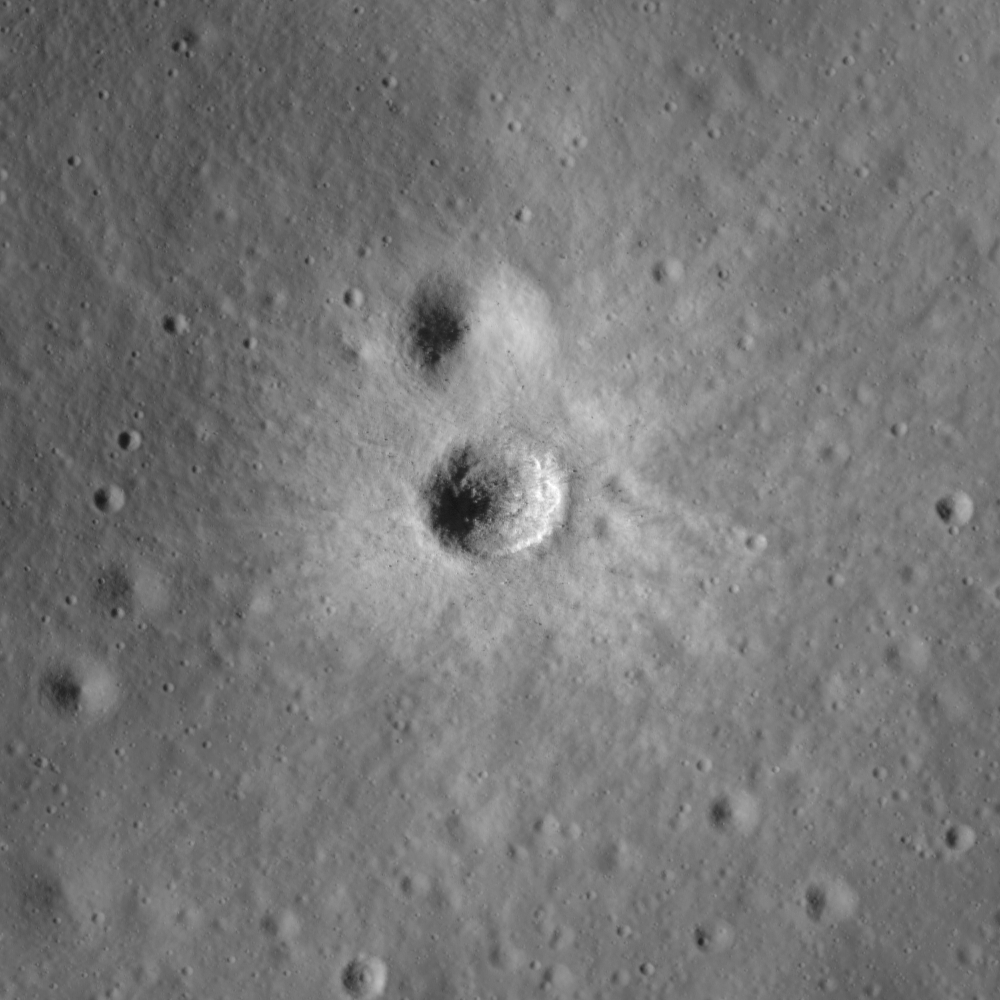
Self-secondaries within the ejecta blanket of a fresh crater. A roughly 2500 meter-wide field of view from LROC Narrow Angle Camera (NAC) observation M1120683999L, LRO orbit 17351, angle of incidence 34.85° at 0.88 meters per pixel resolution from 97 km over 2.21°S, 84.85°E, central Mare Smythii [NASA/GSFC/Arizona State University].
Sarah Braden
LROC News System

Today's Featured Image highlights a small (830 meter) fresh impact crater (located at 2.017°S, 84.948°E) with an ejecta blanket peppered with smaller impact craters. Two of the largest superposed impact craters excavated lower reflectance material (darker) from beneath the main ejecta blanket. This low reflectance material is more mature than the primary crater ejecta. The ejecta from the primary impact is higher reflectance since it is immature material that has not been darkened by space weathering processes. Some of the small impacts have higher reflectance ejecta, which means they did not puncture through the fresh primary crater ejecta blanket.

The craters seen in the Featured Image are a mix of self-secondary and small primary impacts. The term secondary crater describes impact craters formed by ejecta materials from larger impacts. Self-secondary craters form as late stage ejecta is superposed on early ejecta material from the same impact event and are for the most part found near the primary impact crater. The velocity of ejected material increases with distance from the primary crater; therefore, most self-secondary craters are created by low-velocity impacts. Secondary craters formed furthest from the primary crater result from higher velocity ejecta, which makes those secondary craters harder to discern from small primary craters. Secondary craters on the Moon are estimated to have a maximum size of ~4% of the primary crater diameter.

Planetary scientists use the density of craters on impact ejecta as an indicator of age of the impact, based on our understanding of the flux of primary impacts over time. Self-secondaries on crater ejecta are not primary impact craters and inclusion of self-secondary impacts in a measurement will give a higher crater density, and thus result in an older age estimate for that particular surface. The age estimate for the impact crater Giordano Bruno is an example where self-secondaries complicate our understanding of the relationship between surface age and crater density.  

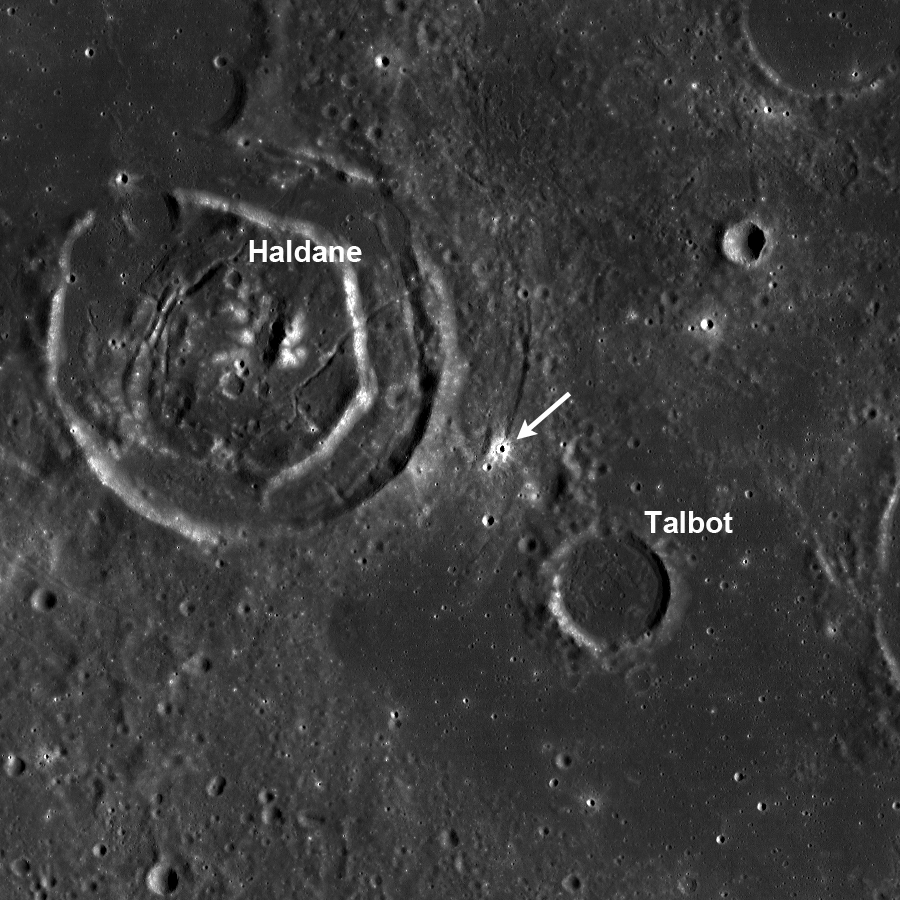
LROC WAC Haldane and Talbot (Context)
LROC WAC 643 nm reflectance mosaic of the area surrounding the fresh crater in the Featured Image (white arrow) [NASA/GSFC/Arizona State University].
The fresh impact crater in today's Featured Image is between two relatively older craters: Haldane (40 km diameter) and Talbot (12.4 km diameter). The crater Talbot has a visible rim, but the ejecta blanket was embayed by mare basalt. Talbot's floor is flooded with mare basalt as well. Haldane is also as old or older than Talbot since sections of Haldane's rim are completely destroyed.

Explore the full NAC image, HERE.

Related LROC Featured Images:
Polka-dot Ejecta
Action Shot
Impact Art
Ejecta sweeps the surface

HDTV-Mare-Smythii
HDTV still from Japan's lunar orbiter SELENE-1 (Kaguya, 2007) captured the western interior of Mare Smythii, straddling the libration zone between the Moon's near and far sides. The small, fresh crater of interest (east-southeast of Haldane, on the lower far right) is not as readily visible at high (sunrise) solar illumination angles. From Earth, the Moon was a thin, early evening crescent [JAXA/NHK/SELENE].

Tuesday, October 8, 2013

Secondaries of all sizes near Mare Moscoviense

M1104980770R_thumb-1000
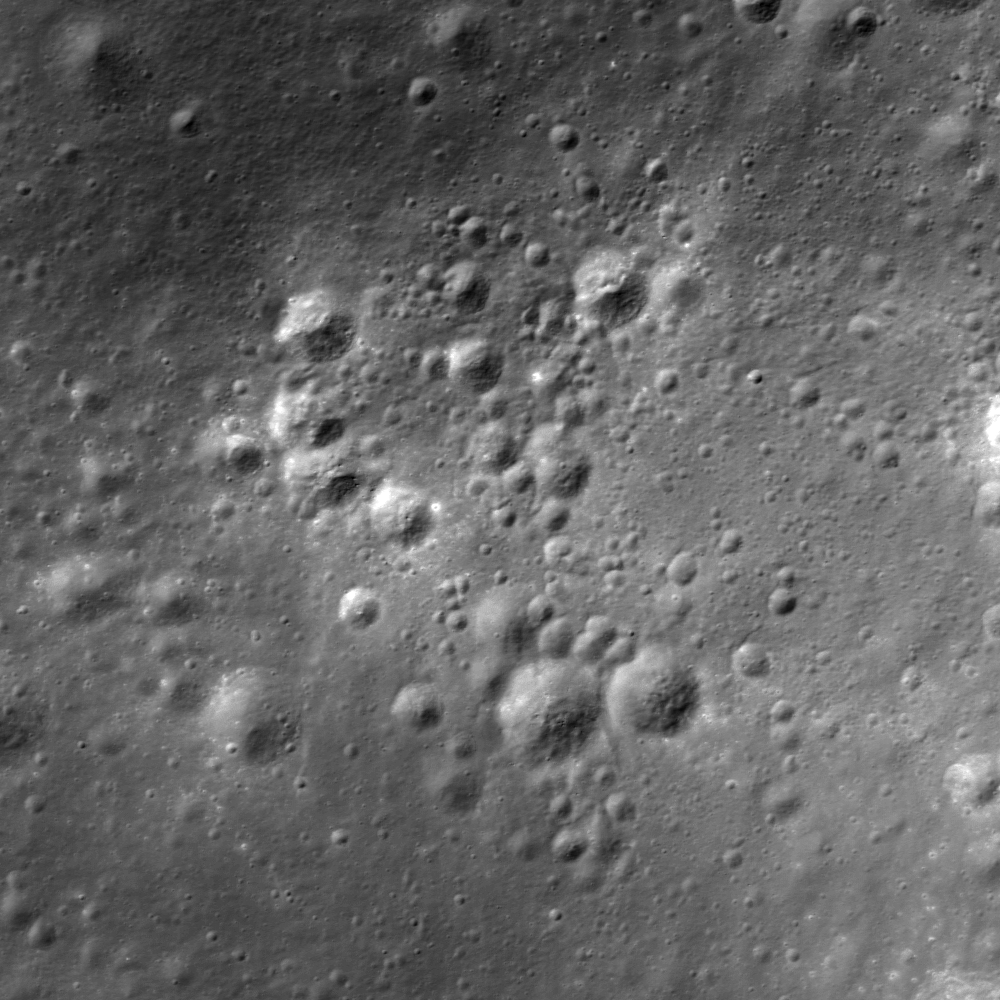
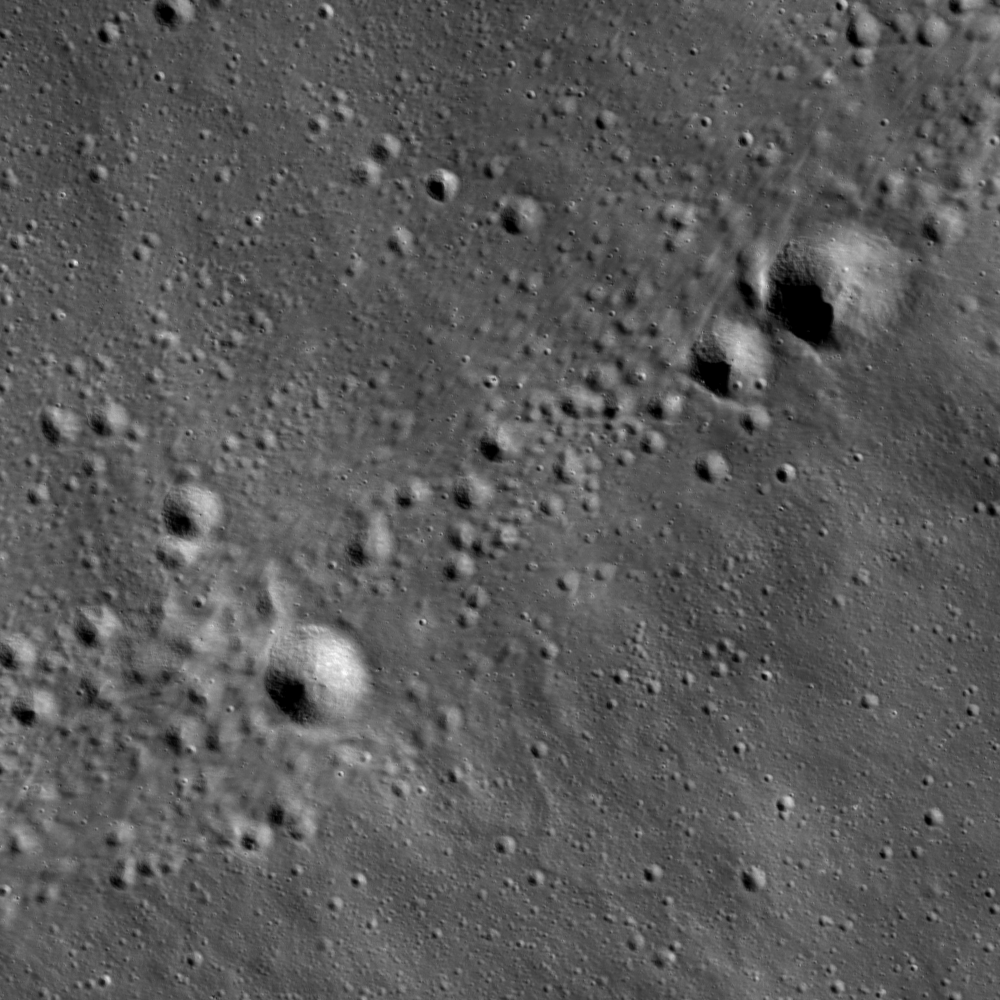
A cluster of secondary craters found in the highlands adjacent to Mare Moscoviense (28.803°S; 142.876°E). LROC Narrow Angle Camera (NAC) frame M1104980770R, LRO orbit 15145, October 15, 2012; 40.69° angle of incidence, resolution 1.08 meters per pixel, field of view about 1.4 km across [NASA/GSFC/Arizona State University].
James Ashley
LROC News System

Secondary craters are produced by debris lofted during excavation of primary impacts. They can be difficult to distinguish from primary impact craters if they are circular with well-developed ejecta patterns. That ambiguity is a concern to scientists when counting craters to determine the ages of planetary surfaces. This age dating approach assumes that impact flux has held steady throughout geologic time following the Late Heavy Bombardment period ending approximately 3.8 billion years ago. The model thus assumes that older surfaces present more craters than younger surfaces, and that one can determine relative ages by counting the number of impact craters per unit area.

M1109480770R at 50 percent
A wide field of view shows a wide variety of secondary crater cluster, from near and far, nearby. LROC NAC M1104980770R; about 2.14 km across [NASA/GSFC/Arizona State University].
Crater counts give reliable relative ages, but can also be translated to absolute ages using the radiometric age dates of rocks returned by the Apollo and Luna missions. Obviously counting statistics are skewed if secondary craters are included in the count; these "extra craters" create the false impression of an older surface.

M167267012CE_604nm-58b-792x1092
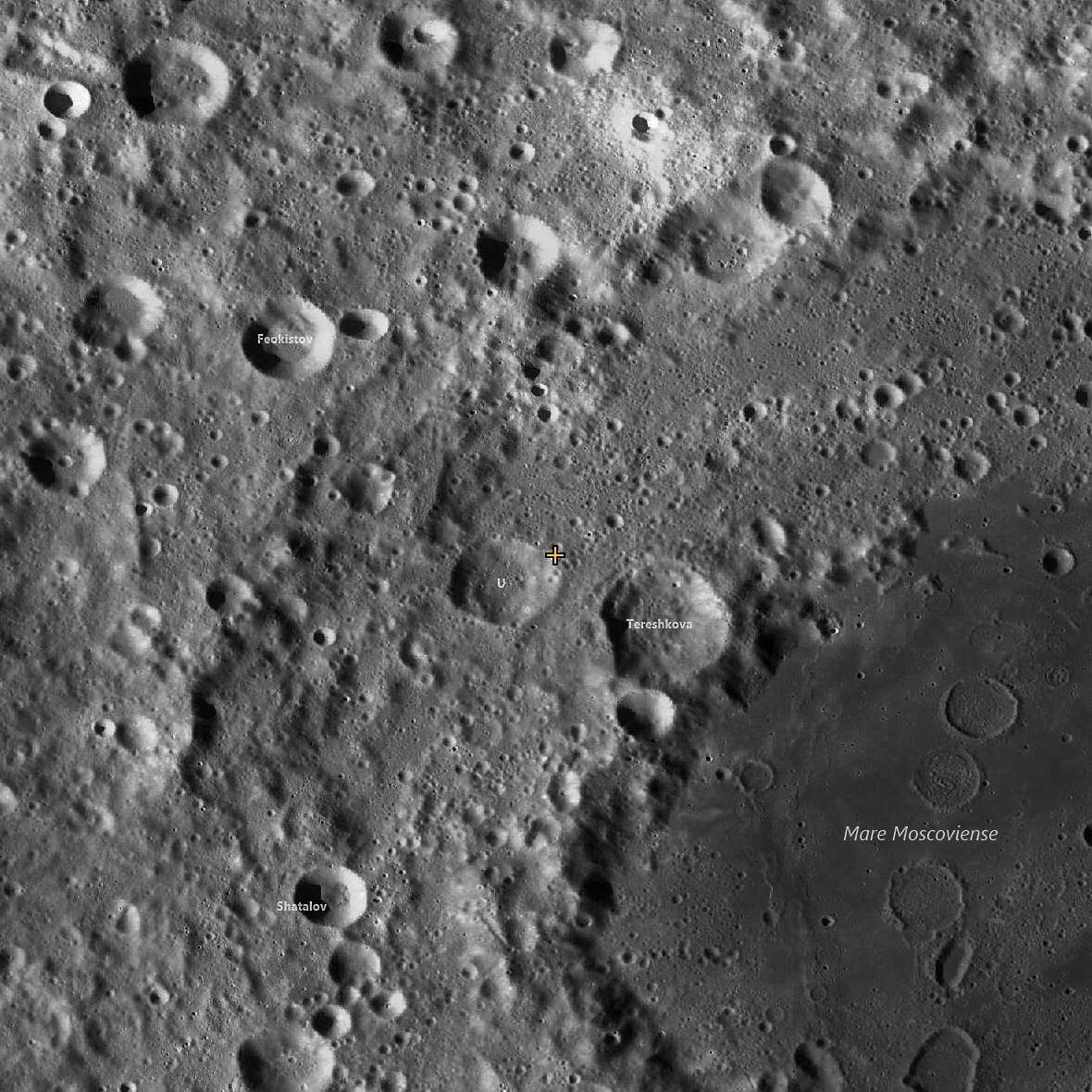
Swarms of secondaries abound. LROC Wide Angle Camera context for the LROC Featured Image, highlighting the area designated with the arrow, on the rim of Tereshkova U, in this 53.5 km field of view, the full width of LROC WAC monochrome (604 nm) observation M167267012CE, LRO orbit 9784, August 8, 2011; spacecraft and camera slewed 8.68° off nadir, angle of incidence 56.66° at 67.5 meters per pixel resolution from 50.59 km over 31.09°N, 142.86°E [NASA/GSFC/Arizona State University].
Often, as in today's Featured Image, the distinction between primary and secondary craters is unambiguous. Here we see a large number of impact craters in a tight cluster. Particularly apparent when exploring the full NAC frame, we can see a clear association within this cluster, not merely a coincidental grouping of separate features spaced in time across many eons. Their ejecta exhibit higher reflectance than most of the craters in the surrounding areas, and they form a tighter grouping than other fresh-looking craters seen elsewhere in the frame.  

LROCQM250-sec-Moscovienese-1180
At 500 meters per pixel, there's no let up in the secondaries peppering the relatively young Moscoviense basin. The cross at center further designates the location, on the rim of Tereshkova U, shown at high-resolution in the LROC Featured Image. LROC WAC mosaic (GLD100) through the LROC Quick Map feature [NASA/GSFC/Arizona State University].
More secondary impact features can be found across the full NAC frame, HERE. Other secondary craters can be explored in earlier LROC Featured Image releases "Swarm of Secondaries," "Dark Secondary Crater Cluster," and "The Rays of Messier A."

Tuesday, August 20, 2013

Karpinskiy, superpositioned on the farside north

Karpinskiy WACGLD 100m
LROC Wide Angle Camera (WAC) mosaic overlaid with WAC and NAC-derived GLD100 color-coded digital elevation model. Karpinskiy crater is approximately 90 kilometers across and nested within the remains of an even larger and more ancient crater [NASA/GSFC/Arizona State University].
Raquel Nuno
LROC News System


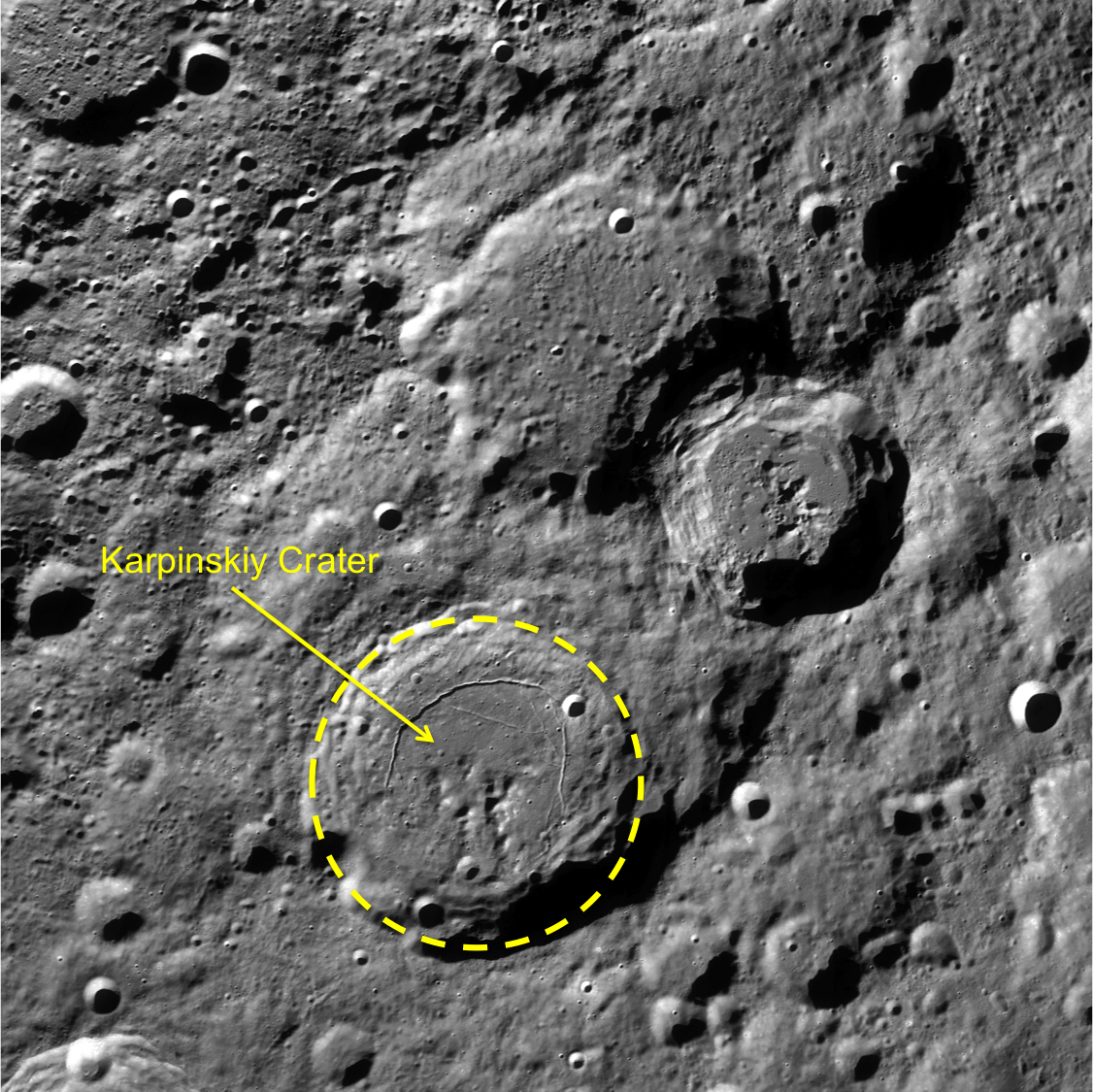
Karpinskiy crater, at 72.609°N, 166.801°E and (officially 91.403 km) in diameter, rests within a larger and far older unnamed crater. How do we know which crater is older? Stratigraphic studies, or the study of superposition of rock layers (or in this case, craters), will help determine the relative ages of craters here. Geologists derive relative ages between geological features by observing how they overlap - young formations will always overlie older formations, and on airless bodies, such as the Moon and Mercury, this method becomes particularly useful. Without wind to erode its surface, only four factors affect the lunar surface: space weathering, impacts, tectonism, and volcanic resurfacing. With respect to today’s Featured Image, the Moon accumulates impact craters over time. From the cratering record we can investigate not only stratigraphic relationships (which crater formed first), but we can also derive a quantifiable measure, or crater density, to determine relative ages on the Moon.

Karpinskiy passes under Kaguya
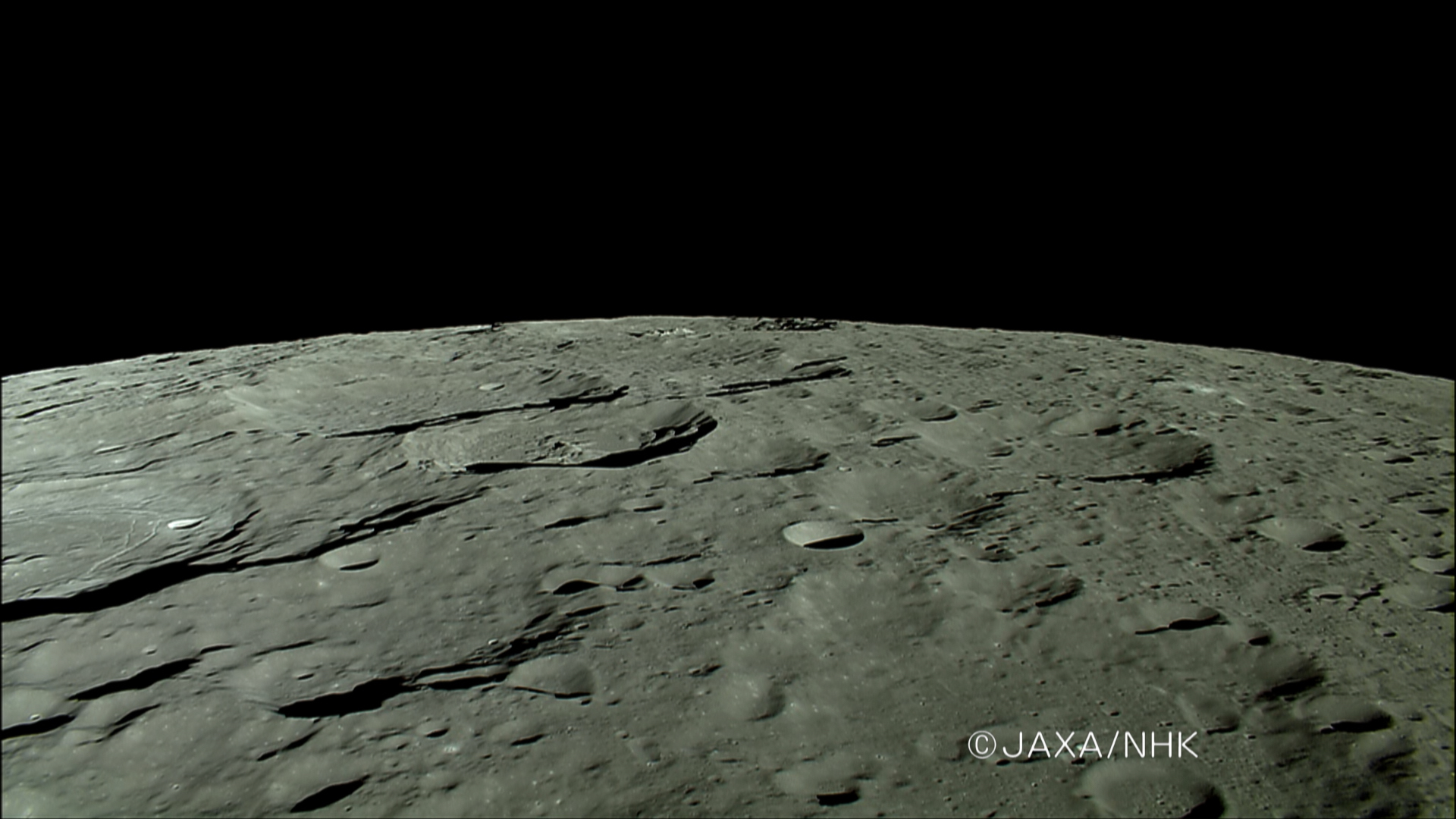
The HDTV camera onboard Japan's lunar orbiter Kaguya (SELENE-1) anticipates a rising Earth in 2007, looking north toward the Moon's north pole as it passes ancient craters of the Farside Highlands Terrain, including Karpinskiy, nested in a much older crater, passing out of view at left, followed by Milankovic and Plaskett. View the full-size image HERE [JAXA/NHK/SELENE].
Today’s Featured Image is a great example for stratigraphic studies. The LROC WAC mosaic of Karpinskiy crater overlaid with the GLD100 color topography presents a clearer outline of the older crater (WAC mosaic below). The top portion of the image is black because the GLD100 product does not have coverage at that latitude (>79°N). Karpinskiy crater is located inside a much older, degraded crater that does not have a well-defined rim and is somewhat difficult to see in the WAC mosaic. Karpinskiy is younger because it superposes, or formed on top, of the unnamed older crater. There are younger craters superposed on the floor of Karpinskiy, that must have formed later and are therefore younger based on the relative age relationships. Thus, using stratigraphic relations we are able to derive a relative age for Karpinskiy, but what if we want to determine the absolute age? The number of craters that formed on Karpinskiy can be used to estimate its absolute age, however with such a small area the crater size frequency distribution absolute age estimate has a large uncertainty. To accurately determine the absolute age of Karpinskiy crater we have to go there and acquire samples of impact melt rock that we can radiometrically date!

Karpinskiy WAC superposition context
LROC WAC context image. Karpinskiy crater outlined in yellow, with the two neighboring craters to the north and east are Ricco, Milankovic and Milankovic E[NASA/GSFC/Arizona State University].
Explore the full image, HERE.

Related Posts:
Absolute Time
Copernicus Crater and The Lunar Timescale
Dating an Impact

Tuesday, May 28, 2013

Coalescing Secondaries

A chain of impact features provides a picturesque tableau (48.659°N; 103.299°E). LROC Narrow Angle Camera (NAC) frame M18286833R, LRO orbit 12051, February 3, 2012; illumination is from the southwest (angle of incidence 63.07°), north is up, image field of view approximately 2 km across [NASA/GSFC/Arizona State University].
James Ashley
LROC News System

Today's Feature Image exhibits a chain of impact features that are so closely spaced as to lose their distinction as separate landforms, producing one continuous feature instead.

An asymmetry in the ejecta pattern can also be seen in the form of filamentary tendrils extending to the north.

Based on this ejecta distribution, the secondary bolides likely came from a southerly or southeasterly direction.

Another, earlier look at the same field of view, at slightly higher resolution. LROC NAC M123901314R, orbit 3393, March 22, 2010; angle of incidence 47.54° at 0.56 meters resolution from 53.96 km [NASA/GSFC/Arizona State University].
The WAC mosaic context image is approximately 83 km wide [NASA/GSFC/Arizona State University].
Zooming out to learn what this source might have been produces no obvious candidates, however. None of the medium-sized craters within 40 km of the featured crater chain appear to be particularly young -- a condition required to explain the chain's fresh appearance. Not until we expand our view even further do likely candidates crop up.

This larger scale WAC mosaic context image is just about 470 km wide [NASA/GSFC/Arizona State University].
But even here nothing unambiguous catches the eye. The secondary impacts could have resulted from one of any number of craters, or perhaps from an impact located even further away. A detailed surface study would be necessary before a definitive link could be made tying this ejecta with its crater of origin. Explore the full NAC frame HERE.

Other examples of ejecta interactions with the lunar surface can be found in Crater Chain near Rima T Mayer, Four of a Kind in Catena Davy, and Four Leaf Clover.

Bonus Context: The location of the field of view shown at high resolution in the LROC Featured Image, released May 29, 2013 in the north farside highlands. The terrain is representative of one of the four recognized lunar material groups, the farside anorthositic highland terrain, or FaHT [NASA/GSFC/SVS].

Tuesday, May 14, 2013

Swarm of Secondaries on the floor of Crüger

Western portion of Crüger crater floor. LROC Narrow Angle Camera (NAC) mosaic (M1108725909R and M1108725909L), LRO orbit 15669, November 28, 2012, centered near 16.759°S, 292.627°E, field of view 1670 meters, sunlight from the west, angle of incidence 72.32° at 1.67 meters per pixel resolution, from 79.83 km [NASA/GSFC/Arizona State University].
Hiroyuki Sato
LROC News Center

Crüger is a 45 km diameter crater located between Oceanus Procellarum and Orientale basin. The floor is completely covered in basaltic lava deposits, and is very flat. The western portion of the floor shows slightly high reflectance spots with clustered craters and disturbed surfaces, likely a field of secondary craters.

A unique feature of this grouping is the sharp topographic relief delimiting its southern boundary.

The upper half of the opening image, the relatively disturbed and hummocky part, corresponds to the cluster area. Note that the sunlight is from the right side, and the cluster area is topographically lower than the southern relatively smooth area along the delimiting boundary.

LROC NAC context mosaic M1108725909LR showing the Crüger crater floor, a 7.3 km-wide field of view, image centered on 16.736°S, 292.645°E [NASA/GSFC/Arizona State University].
Roughly 20 km-wide field of view from a 62 meter per pixel resolution LROC Wide Angle Camera (WAC) frame shows the 'chevron' of encapsulated secondary craters on the west central floor of 45 km Crüger. LROC WAC observation M129729786C (689 nm), spacecraft orbit 4251, May 28, 2010; angle of incidence 62.36° from 44.57 km [NASA/GSFC/Arizona State University].
WAC monochrome mosaic (100 m/pix) of Crüger crater and surrounding area. Image center is 17.15°S, 293.05°E. Two NAC footprints (blue boxes) and the location of today's Featured Image are indicated here [NASA/GSFC/Arizona State University].
As seen in the NAC context view, the southern end of this secondary cluster is surrounded by this sharp boundary. Likely a densely packed group of ejecta landed with a low angle, resulting in this unique deposition pattern.

Explore this unique secondary crater cluster patterns in full NAC frame yourself, HERE.

Related Posts:
Cluster of farside secondary craters
Stream of Secondary Craters
Chain of secondary craters in Mare Orientale
Regolith on Basalt
Clusters
Tres Amicis
Crater Chain near Rima T Mayer

Tuesday, January 8, 2013

Symmetric Ejecta in the Farside Highlands

A symmetric "starburst" ejecta blanket exposed with high Sun angle. Image is 660 m wide, LROC NAC frame M108108187L. LRO orbit 1066, September 20, 2009; angle of incidence 15.44° at 0.59 meters resolution from 56.52 km [NASA/GSFC/Arizona State University].
Renee French
LROC News System

The 180 meter diameter impact crater observed in the opening image (8.874°N, 171.899°E) formed in the farside highlands. Its location away from compositional boundaries (like the mare-highland boundary) suggests that the high albedo ejecta blanket is due to freshly exposed material, indicating a young impact. How do we know that? Because material of the same composition that has been exposed to less space weathering (i.e., material that is younger) is brighter. Additionally, images acquired with the Sun nearly overhead emphasize albedo contrasts, bringing out details of ejecta distribution and rays. The directions in which ejecta spread out from a crater tells us about the angle the bolide (comet or asteroid) hit the surface. A symmetric ejecta blanket like this one typically indicates that the bolide impacted at an angle of 45° or greater (90° is vertical); an impact angle less than 45° produces asymmetric ejecta blankets. It is important to have high Sun angle images because without them, it is harder to determine the extent of the ejecta blanket and other young features.


Same Featured Image crater but observed at a lower Sun angle, LROC NAC frame M103388681R, spacecraft orbit 404, July 28, 2009; angle of incidence 65.11° at 1.25 meters resolution from 123.36 km, image field of view is approximately 700 meters wide [NASA/GSFC/Arizona State University].
The above image is of the same crater but with a different Sun angle - just look at the difference! Can you tell how big the ejecta blanket is or the distribution of ejecta with distance? In the low Sun angle image, could you tell that there were two craters next to each other, or which craters might be considered secondary craters?

LROC Wide Angle Camera (WAC) monochrome 100 meter resolution shows the location of the LROC Featured Image field of view, in the farside highlands (red arrow). Ejecta from the unnamed crater of interest barely stands out, with only a slightly a higher albedo than the surrounding terrain [NASA/GSFC/Arizona State University].
Even at the resolution of the WAC mosaic, the crater is still visible due to its bright ejecta blanket!

To spot your own young craters, view the full LROC NAC, HERE.

Related Posts:
Dark Secondary Crater Cluster
The Rays of Messier A
Farside impact!
Ejecta Starburst
Minty Fresh

Friday, January 4, 2013

Tres Amicis

Three similar and relatively small impact craters (125-180 meters in diameter) in the nearside southern highlands may have formed in a contemporaneous impact event. LROC Narrow Angle Camera (NAC) observation M106827539L, LRO orbit 884, September 5, 2009; angle of incidence 27.64° at 1.09 meters resolution; field of view 995 meters wide, from 106.57 km [NASA/GSFC/Arizona State University].

Jeffrey Plescia
LROC News System

These three craters, located at 9.665°S, 7.646°E, appear to have formed more or less at the same time, certainly within a few minutes of each other. The southwest crater is 180 m diameter; the center crater is 150 m; and the northeast crater is 125 m across. 

From the northeast crater center to the southwest crater centers, they cover about 450 m. 

The projectiles were traveling from the east-northeast (the right side of the frame) and probably struck the surface at a relatively low angle, as indicated by the asymmetric ejecta patterns and the orientation of the ejecta rays. Bright ejecta extends as much as 1 km from the crater center.

Zoomed out view to include a larger area around the craters so that the long, thin bright ejecta rays are visible. Note that the ejecta is directed to the west (left side); little of it has gone to the east (right). NAC image M106827539L [NASA/GSFC/Arizona State University].
The morphology of the craters suggests that the southwest crater formed first, followed by the other two. The southwest crater may only have formed a few seconds or a few minutes before the other two; the timing is indicated by the ejecta from the middle crater that partly covers the southwest crater. The morphology of the two northeast craters (the low northwest-trending ridge between the craters) suggests that the projectiles hit the surface at the same time such that the excavation process of the two craters interacted, forming the ridge.

Same scene as above in afternoon lighting (angle of incidence 79.38°). The low Sun accentuates the subtle topography associated with the impact craters. LROC NAC observation M102107709R, spacecraft orbit 225, July 13, 2009; field of view 711 meters at 1.01 meters resolution from 98.73km [NASA/GSFC/Arizona State University].
This same crater morphology was created in laboratory experiments where multiple projectiles were simultaneously fired from a high velocity gun. One of the distinctive features of the simultaneous impact is the presence of a ridge (or septum) of material between the craters.

Experimental double simultaneous impact crater in the Ames Vertical Gun, from Oberbeck et al. (1972) Apollo 16 Preliminary Science Report, Fig 29-71, "Impact Craters Produced Simultaneously" [NASA/ALSJ].
Explore the entire LROC NAC frame, HERE.

Related Images:

Thursday, November 15, 2012

"Clusters"

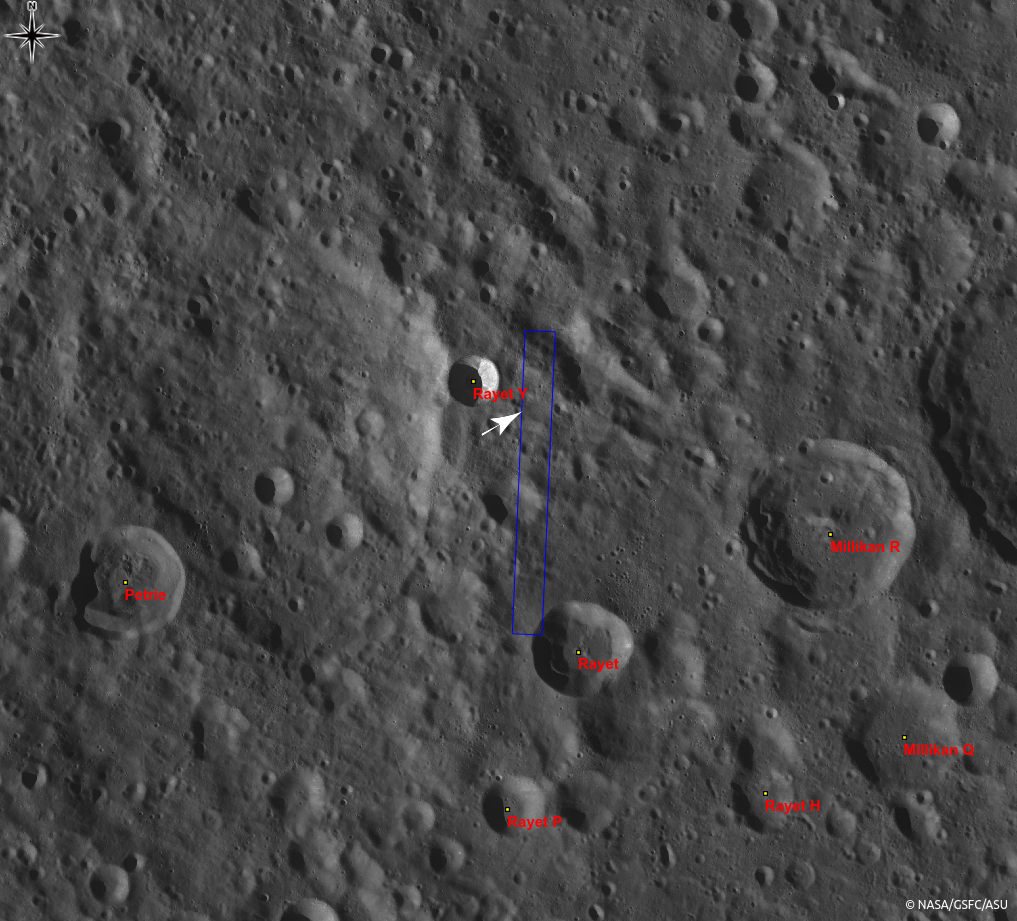
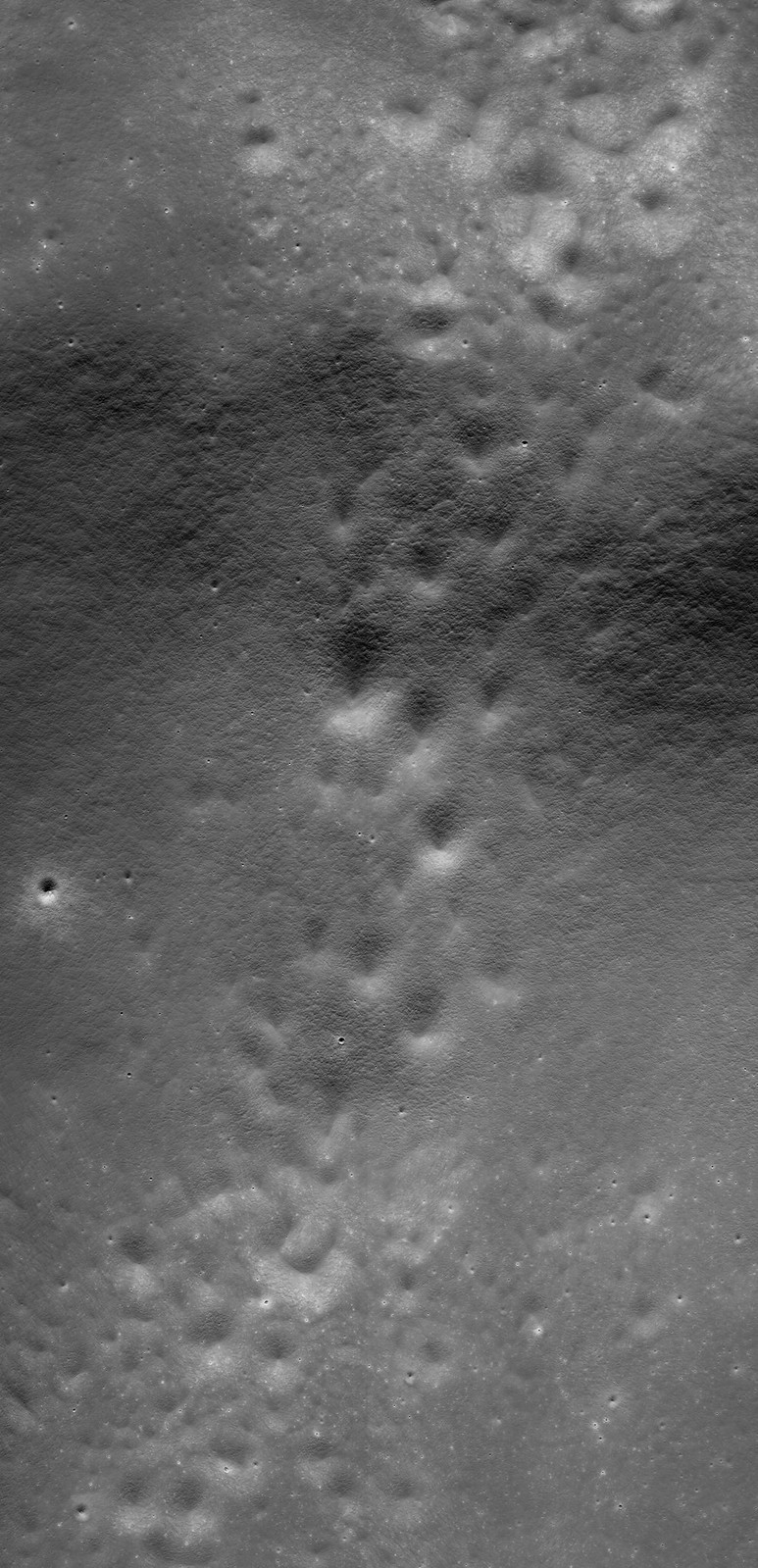
Cluster of secondary craters about 12 kilometers southeast of farside mid-latitude crater Rayet Y. LROC Narrow Angle Camera (NAC) observation M182796787R, LRO orbit 12041, February 2, 2012; field of view 1.68 km, centered on 46.892°N, 113.807°E, resolution 1.68 meters from 171.53 km overhead [NASA/GSFC/Arizona State University].
Hiroyuki Sato
LROC News System

Today's Featured Image displays a classic set of aligned craters, most likely formed as a swarm of secondary impactors hit the surface. The location of this cluster is only about 10 km southeast of Rayet Y crater (14.5 km in diameter). But since the cluster extends in a northeast-southwest direction that does not point back to Rayet Y, the source of these secondary craters must be another crater. Giordano Bruno is one possible candidates in terms of the direction and maturity (similar or younger in age than Rayet Y), even though it is over about 450 km away.

For age dating small and young surfaces with crater counts, secondary craters introduce a serious problem. As the image resolution increases, we can count more small craters from a small portion of the ground, giving the impression of an increase in the accuracy of age estimates. However, secondary craters are more common at small diameters and their distribution is not random over small areas, violating one of the principal assumptions of age dating via crater counting. Counting secondaries in addition to the normal random population of primary craters can result in an artificially older age estimate for a surface.

So how can we determine if secondaries are present? One of the definitive signs of secondary craters is the clustering shown in the opening image. Random impacts over time typically don't result in such local high densities. Secondary craters can also have a V-shaped pattern in their rays, known as a "herringbone" pattern, seen for some of the craters above. Counts of craters thus try to exclude clusters and irregularly shaped craters to minimize errors in age estimates introduced by secondaries.

Rayet Y crater and surrounding area from LROC Wide Angle Camera (WAC) monochrome mosaic (100 meters/pixel). Original image centered near 46.56°N, 113.42°E, cropped frame above covers a field of view approximately 168 kilometers across. The blue rectangle shows the full LROC NAC footprint of observation M182796787R and the white arrow indicates the location included in the LROC Featured Image released November 15, 2012 [NASA/GSFC/Arizona State University].

Explore the typical secondary craters in full NAC frame HERE.

Related Posts:
Stream of Secondary Craters
Regolith on Basalt
Impacts on the Melts
Dark Secondary Crater Cluster
Bench Crater
Cluster of farside secondary craters

A different perspective on secondary craters, a definite cluster of "secondaries" from an oblique LROC NAC observation of the Mee crater group far to the south of Mare Humorum on the near side. LROC NAC observation M127232206 [NASA/GSFC/Arizona State University].
A small chain of small secondary craters 12 kilometers southeast of Rayet Y are radiant from Giordano Bruno, nearly 400 km to the southwest [NASA/GSFC/LMMP/Arizona State University].

Tuesday, October 2, 2012

Secondary melt on the rim of Weiner F

A grooved surface is covered by a sheet of impact melt that has several parallel scarps. Two blocky craters superpose the melt and might be low velocity self-secondaries. LROC Narrow Angle Camera (NAC) frame M1097865095RE, illumination is from the southwest over a field of view 1500 meters across [NASA/GSFC/Arizona State University].
Drew Enns
LROC News System

The low afternoon lighting in today's Featured Image gives the impression that this surface has been sculpted or reshaped somehow.

When an impact occurs, ejecta is thrown out and can scour the exterior rim of the crater.

In this case, the scours are also covered by an impact melt veneer from the same event. Several parallel scarps in the impact melt imply that the melt was emplaced in discrete events.

How could this have happened?

A wider, roughly 4 kilometer-wide view of the interesting melt situated on the ledge within the wider rim of farside highland crater Weiner F [NASA/GSFC/Arizona State University].

LROC Wide Angle Camera (WAC) context image, with the location of the field of view highlighted in the LROC Featured Image released October 2, 2012 marked. Wiener F is located at 40.87° N, 149.91° E, WAC field of view roughly 58 km [NASA/GSFC/Arizona State University].
Impact melt is common in the interior of impact craters, covering the crater floor and crater terraces. Sometimes impact melt also sloshes over the rim of a crater, forming flows. In some cases, the ejected melt forms exterior melt ponds, and in the case of Wiener F an exterior melt pond has formed in an older crater! It is likely the exterior pond formed from several pulses of accumulating impact melt. As the impact melt sloshed around the crater interior, it repeatedly spilled out of the north rim, making several waves on its way down. Similar melt veneers are seen elsewhere on the Moon, such as exterior to King crater.

Explore more of the impact melt at Wiener F crater in the full LROC NAC, HERE

Related Posts:
King Crater's Unusual Melt Pond
Rippled Pond
Anaxagoras Exterior Melt

NASA Lunar Mapping and Modeling Project (LMMP) simulated southwestern perspective over Weiner F helps illustrate the distinctive topography inside and outside the farside highland crater. Is it possible Weiner F resulted from two craters, the second, and more recent offset to the south? [NASA/GSFC/LMMP/Arizona State University].