Showing posts with label ejecta. Show all posts

Wednesday, August 20, 2014

Frozen motion at Harbhebi J

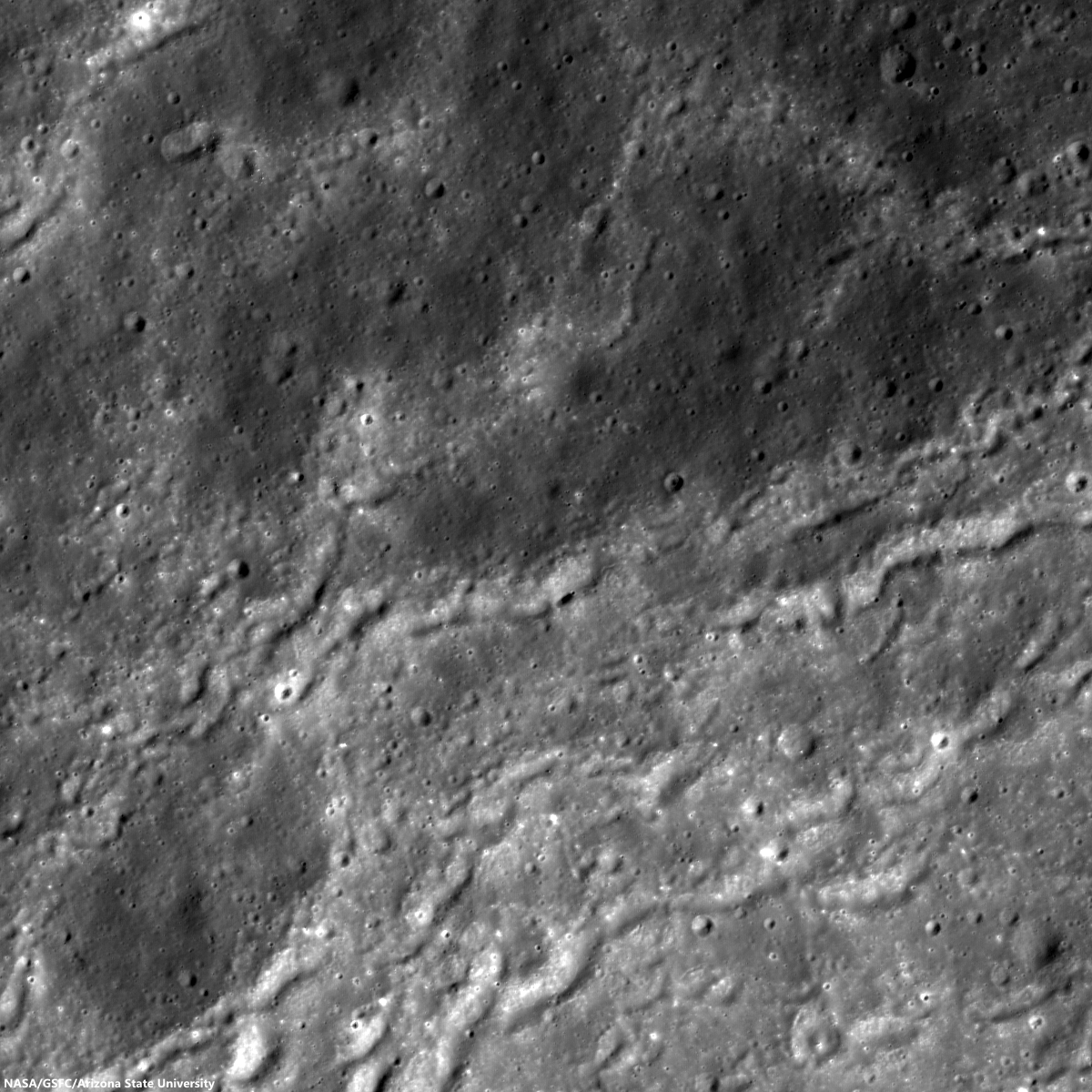
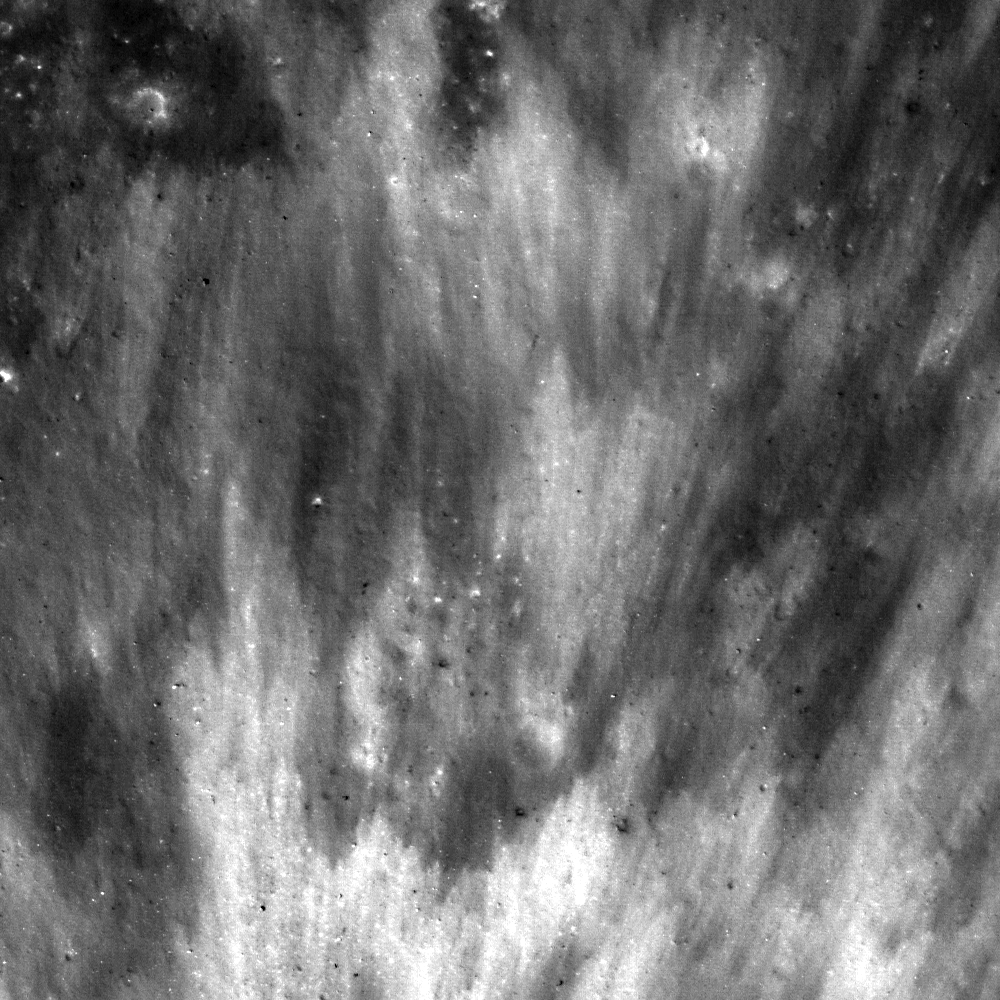
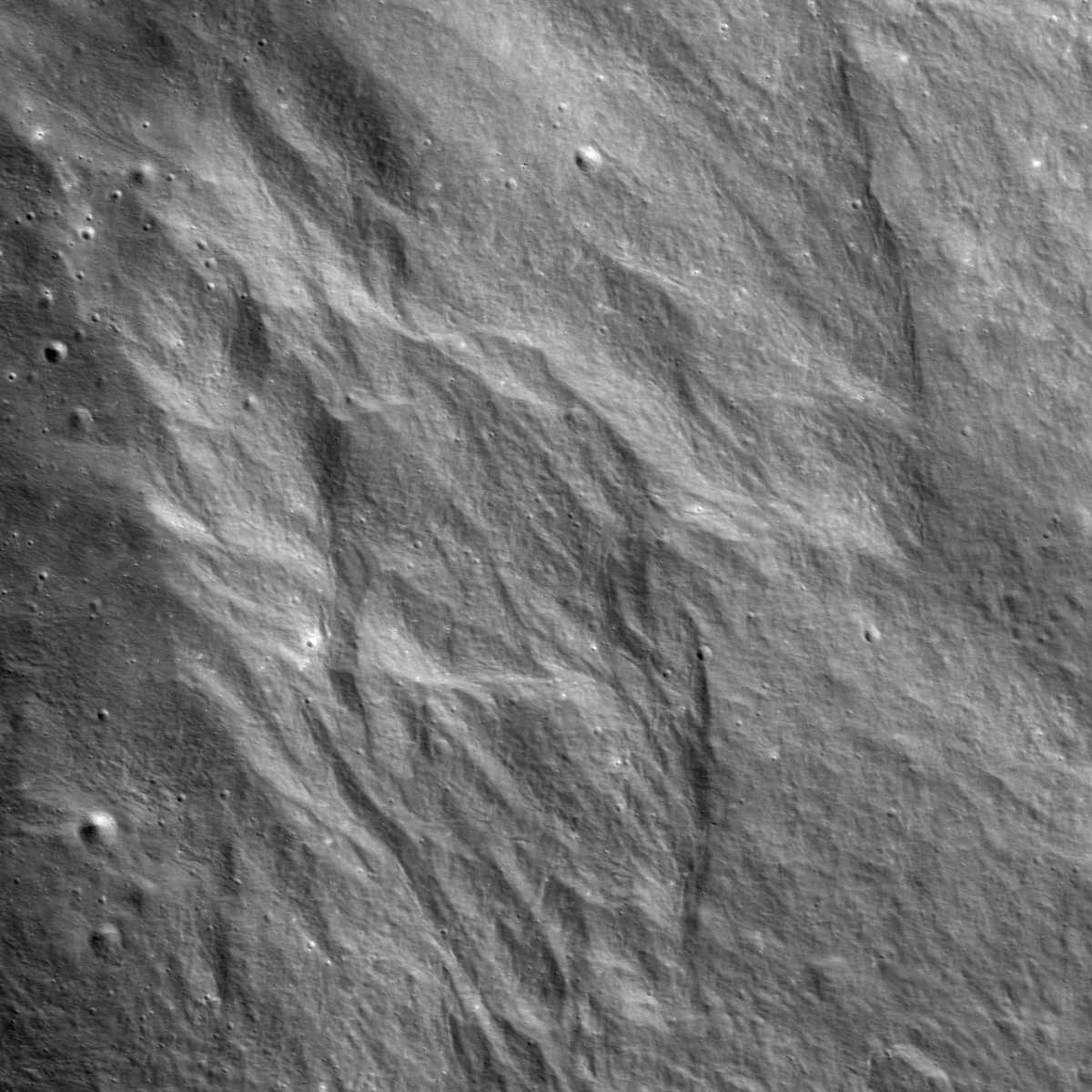
The scoured floor of Harkhebi J (43.1 km; 37.418°N, 103.356°E), near the young crater Giordano Bruno. Ejecta from Giordano Bruno flowed across the surface, leaving a record for us today. A 1570 meter-wide field of view from LROC NAC observation M1128791817L, LRO orbit 18492, July 18, 2013; incidence 60.58° resolution 1.35 meters, from 103.62 km over 37.52°N, 103.7°E [NASA/GSFC/Arizona State University].
Aaron Boyd
LROC News System

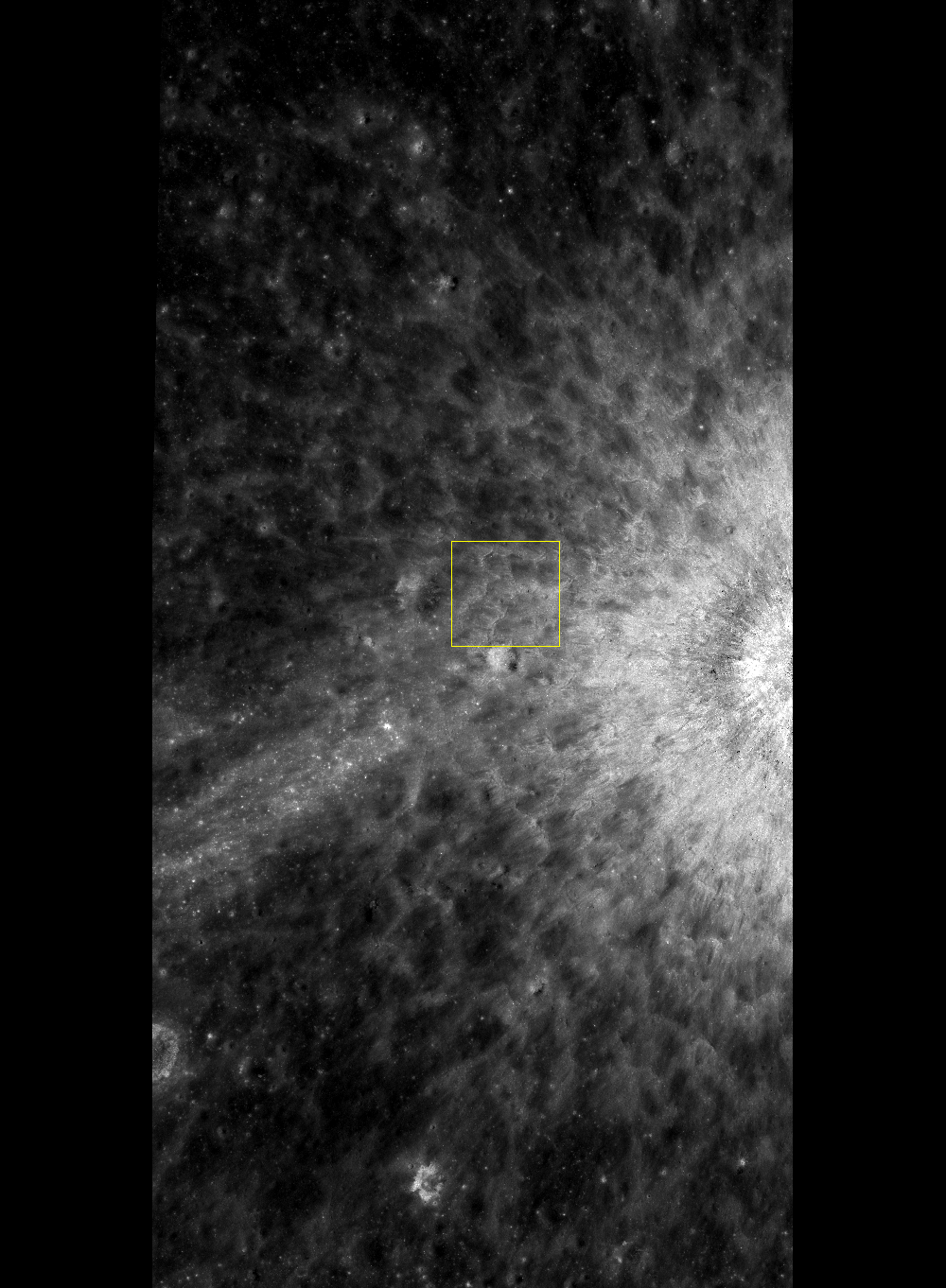
Giordano Bruno, the 22 km crater whose ejecta drapes Harkhebi J, is at most 10 million years old. Because these features are so young, they are preserved almost as though the ejecta ray landed here yesterday.

The Featured Image location is approximately 5 crater radii (55 km) away from the impact center, but the effects of the original impact are clearly visible; the momentum from the ejecta is visible as striations in the western half of the image.

The ejecta  was traveling upwards of 600 km/hr when it began to etch the surface, and when the materials finally came to rest, the evidence of the original motion was frozen in time.
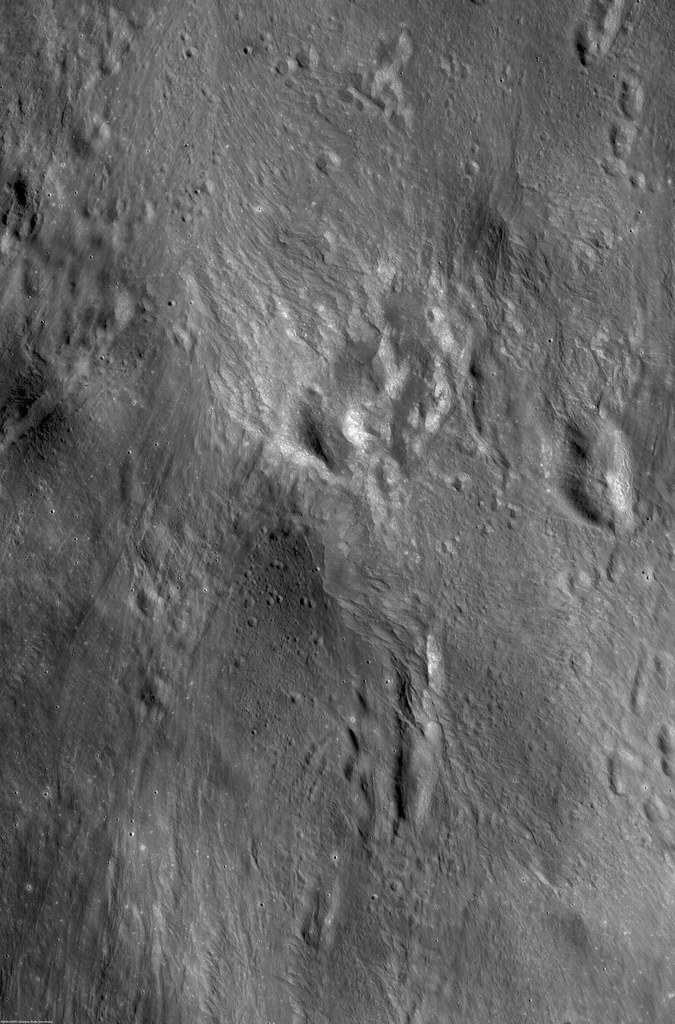
Scaled and corrected 4.912 km-wide field of view from LROC NAC observation M1128791817L, July 18, 2013. View the full-resolution mosaic HERE [NASA/GSFC/Arizona State University].
Many patterns in ejecta from Giordano Bruno crater can be seen throughout the full NAC frame. These varied beautiful patterns relate to ejecta velocity and angle, as well as the material properties of the target.

Context for the LROC Featured Image released August 20, 2014. Footprint of LROC NAC observation M1128791817L. LROC WAC observation M121532675C, LRO orbit 3044, February 23, 2010; incidence 49.3° at 76 meters resolution, from 54 km [NASA/GSFC/Arizona State University].
What would blocky ejecta look like? What would fine granular ejecta look like? The blocky ejecta would pepper the ground with secondary craters, while the granular ejecta would blast the existing surface smooth and flow like an avalanche

View full-resolution LROC NAC mosaic, HERE.

Related Posts:

Thursday, August 7, 2014

Dark Halo "Patch" west of Neper D

A roughly 470 meter wide, 560 meter long, unusually large and cohesive fan of dark halo ejecta from an unnamed but freshly prominent crater in the Neper group, southwest of Mare Marginis. 1020 meter-wide field of view from LROC NAC observation M1136029635L, LRO orbit 19510, October 10, 2013; 32.5° incidence, resolution 1.17 meters from 116.96 km over 8.73°N, 79.36°E [NASA/GSFC/Arizona State University].
Hiroyuki Sato
LROC News System

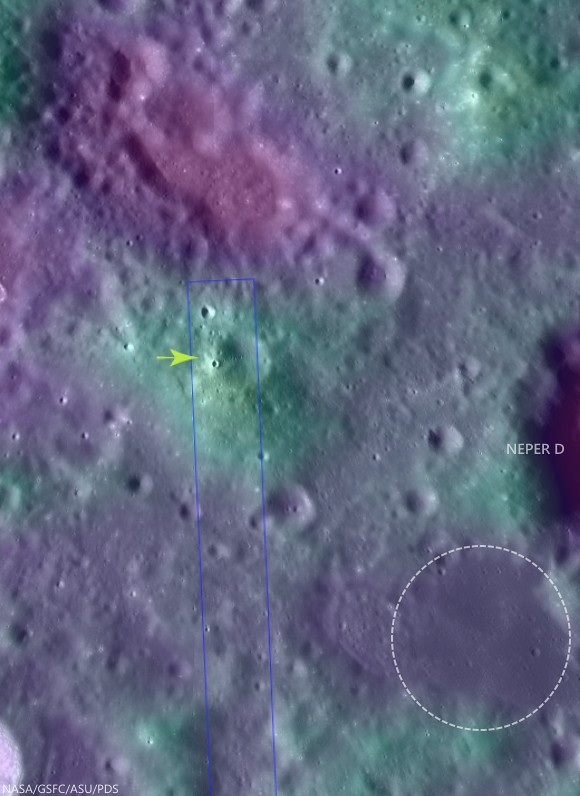
Today's Featured Image highlights an odd shape, or texture in impact ejecta. An unnamed, approximately 600 meter-wide fresh crater on a relatively high, far older crater rim, between Mare Marginis and Mare Undarum (9.5122°N, 79.40242°E) hosts teardrop-shaped low reflectance patches in its ejecta, northwest of the crater,

The larger teardrop patch in the opening picture has a sharp boundary along its western edge, perhaps implying a partially elevated surface relative to the surrounding high-reflectance ejecta.

4 km-wide field of view from LROC NAC observation M1136029635L, October 10, 2013 [NASA/GSFC/Arizona State University].
Note the faint high-reflectance ray overlying this patch, indicating that the low reflectance patch was emplaced before the completion of the impact event. Similar dark patches that are smaller and less pronounced are found at the top of the opening image.

How were these peculiar dark patches formed? If these patches are elevated, they could represent preexisting flat dark mounds that were swept by the saltating ejecta materials. Or the excavation of low-reflectance materials by the impact could have been thrown out in one direction and resulting in this unusual patch of ground. If, on the other hand, the patches are topographic lows rather than elevated, these depressions could have simply been shielded as the ejecta passed overhead. It is also possible that the topography of the rim controlled the direction of the outthrown ejecta such that there were "no ejecta" zones that resulted in the dark patches.

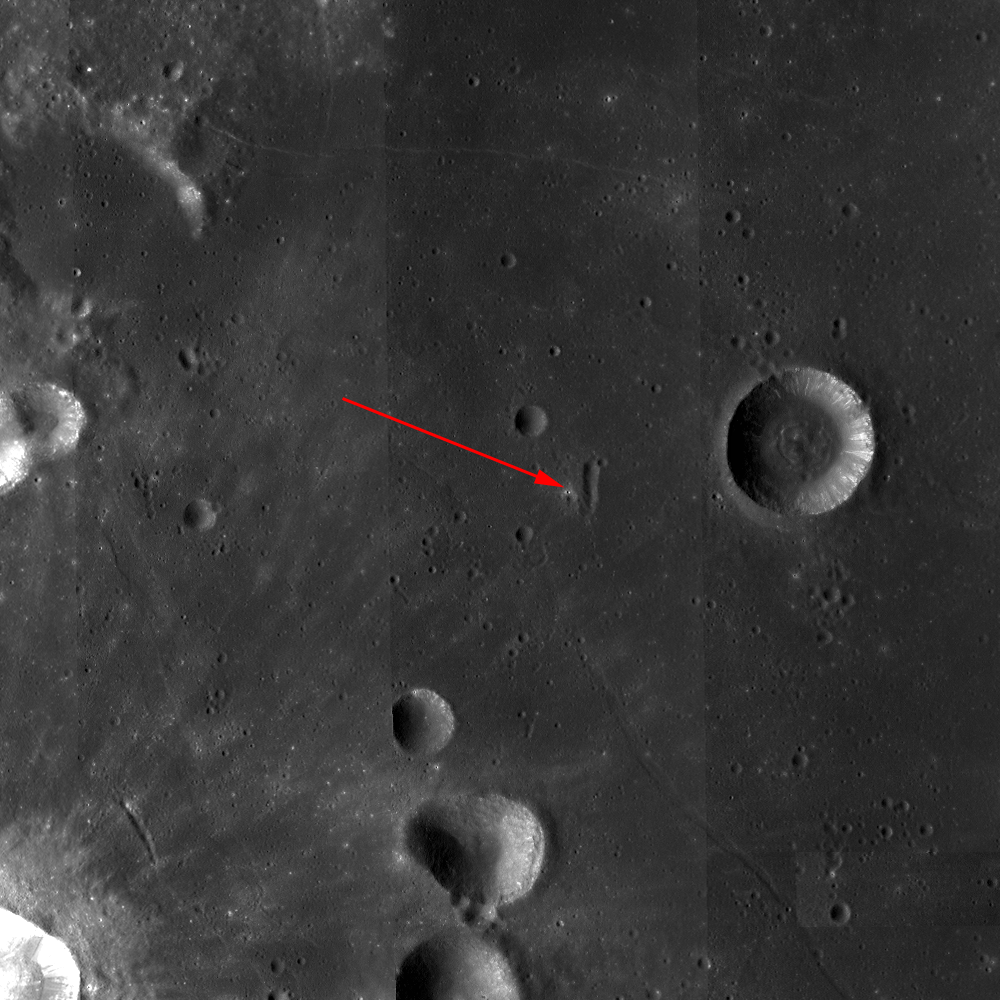
Fifty kilometer-wide field of view of the complex terrain southwest of Mare Marginis, west of Neper and Neper D. The unusually cohesive "fan" of apparent dark halo material from the unnamed relatively fresh 600 meter crater is marked at 9.5122°N, 79.40242°E (arrow) and may indicate the presence of now-buried optically mature material widely distributed in the area. The circle southwest of Neper D is a patch of isolated mare material bright in Clementine iron oxide surveys, often indicative of cryptomare.  Crater counts might eventually determine whether its age and whether or not this area is consistent with Mare Marginis or ejecta from the Crisium impact, or something much older. LROC WAC global 100 meter mosaic over LOLA laser altimetry [NASA/GSFC/ASU/USGS].
High resolution topography would really help unravel this mystery! NAC to the rescue! The LROC targeted this area for upcoming NAC stereo pairs from which meter-scale topography will be extracted. In a few months, we will post the topography and will see if we solved the mystery!

Explore this peculiar dark patch and surrounding terrain in the following full NAC frame, HERE.

Related Posts:

Thursday, April 24, 2014

Angular ejecta edge in the farside highlands

Ejecta flowed down an unnamed crater wall leaving behind this spectacular pattern. LROC NAC M1145938700LR, LRO orbit 20904, February 2, 2014; 44.1° incidence angle, resolution 1.29 meters - 1800 meter field of view centered on 34.653°N, 187.234°E; width is 1800 m, downslope is to the lower-right, north is up [NASA/GSFC/Arizona State University].
Hiroyuki Sato
LROC News System

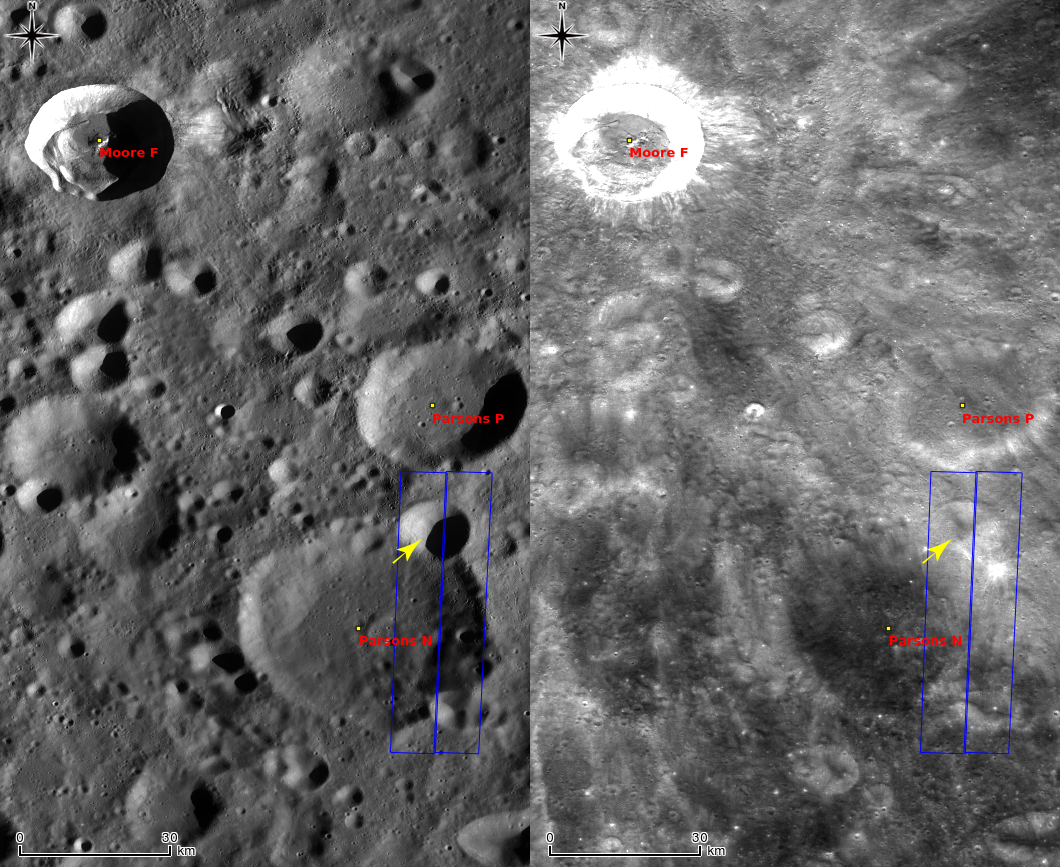
Today's Featured Image highlights the spectacular pattern left behind by ejecta rushing downslope across rough topography. As seen in next WAC context no-shadow mosaic, this area is extensively covered by fresh (high reflectance) ejecta from Moore F (~23.8 km in diameter), about 90 km northwest from the opening image. In fact the area around the image is peppered with Moore F secondaries, the beautiful terrain here may be ejecta from these secondaries.

The steep walls of this unnamed crater allow the ejecta material to travel further as a ground hugging flow, than if it had landed on a flat surface. At the distal edges of these ejecta deposits we see angular flow features (the opening image), likely formed by locally accelerated flow conditions (due to steep slopes). Unlike the flat and smooth mare surfaces, the slope-rich bumpy highlands create various flow conditions, which result in distinctive morphologies that help lunar scientists understand resurfacing processes on the Moon. Especially the importance of ground hugging flows.

Context view of ejecta inside an unnamed crater on the northeast rim and wall of Parsons N, in comparison LROC WAC monochrome mosaics (left, in sunrise shadow, right: native reflectance albedo). Field of view centered near 35.43°N, 186.26°E; width is about 86 km. The footprint (blue box) for LROC NAC observation M1145938700LR and the location of the LROC Featured Image released April 24, 2914 (yellow arrow) annotated [NASA/GSFC/Arizona State University].
Explore the strange angular shaped ejecta deposits in full NAC frame, HERE, and in LROC QuickMap, HERE.

Related Posts:
Delicate patterns in Giordano Bruno ejecta
Ground Hugging Ejecta
In the Wake of Giordano Bruno
Smooth Ejecta

Tuesday, April 22, 2014

Impact on an old and steep slope

Unnamed crater ejecta, within Dante C, field of view 1728 meters, centered on 28.463°N, 182.491°E, downslope is to the lower-right.  From LROC NAC observation M1137707212L, LRO orbit 19746, October 29, 2013; angle of incidence 57.33° resolution 1.44 meters from 143.84 km [NASA/GSFC/Arizona State University].
Hiroyuki Sato
LROC News System

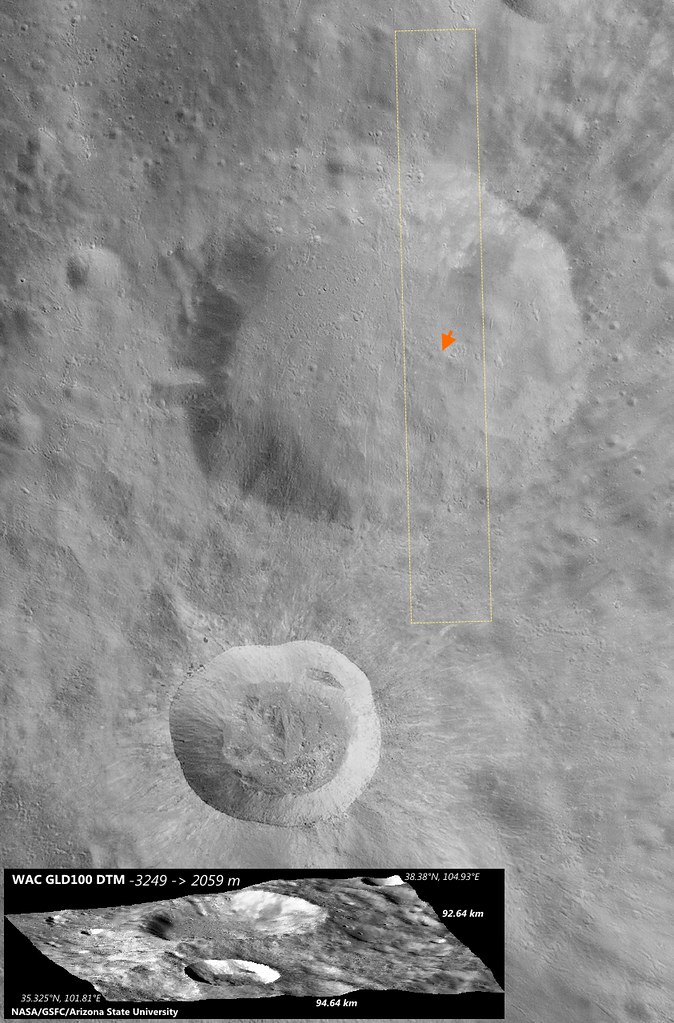
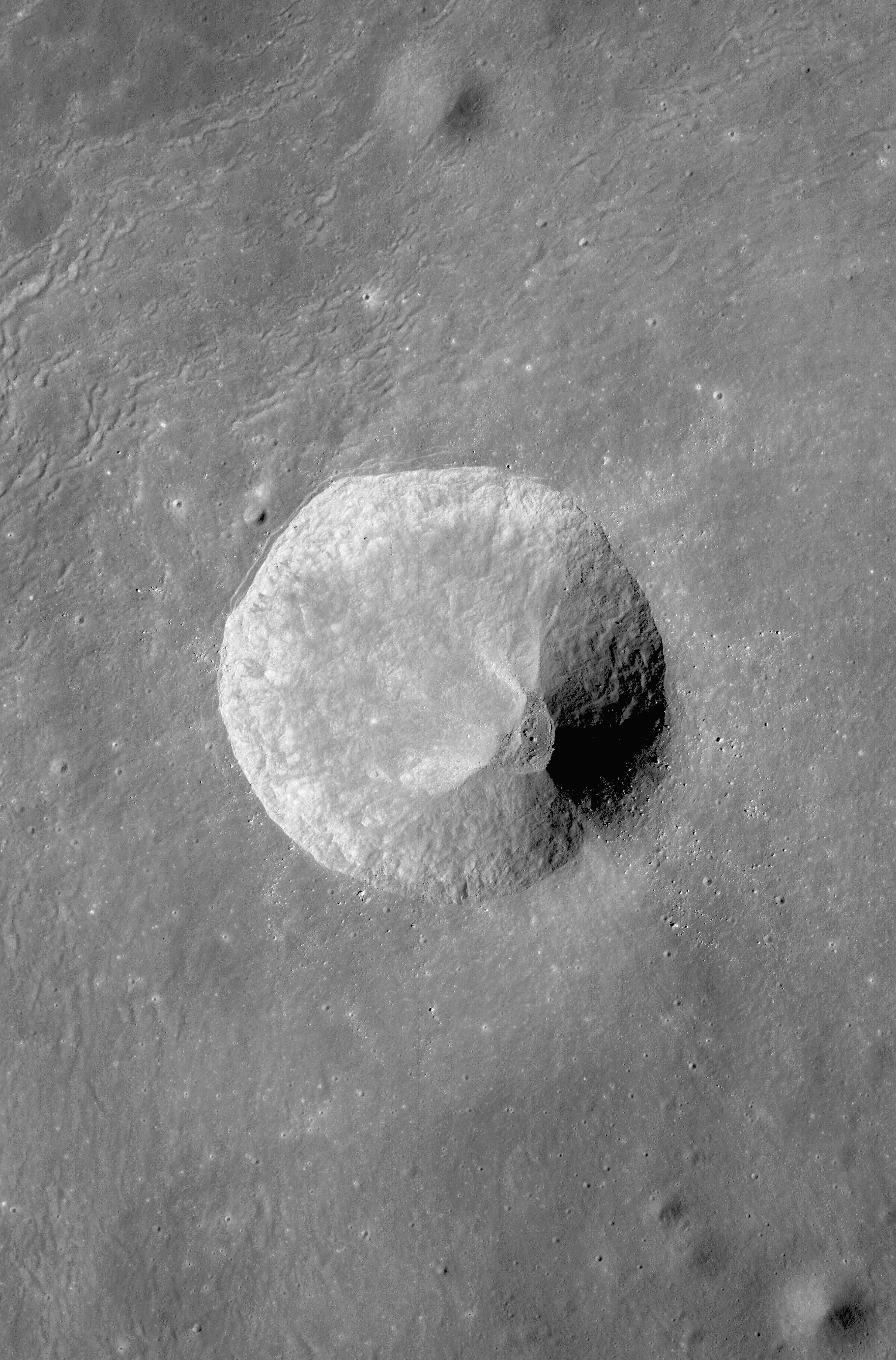
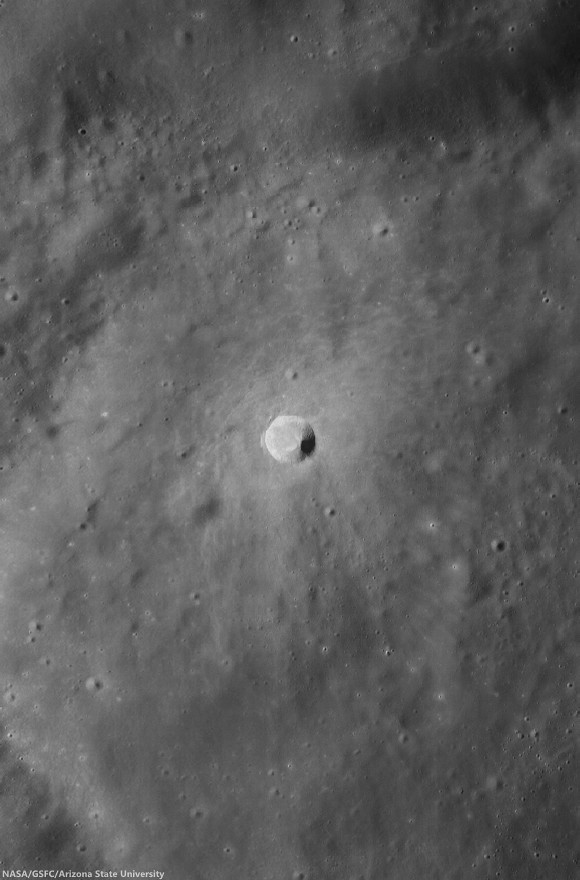
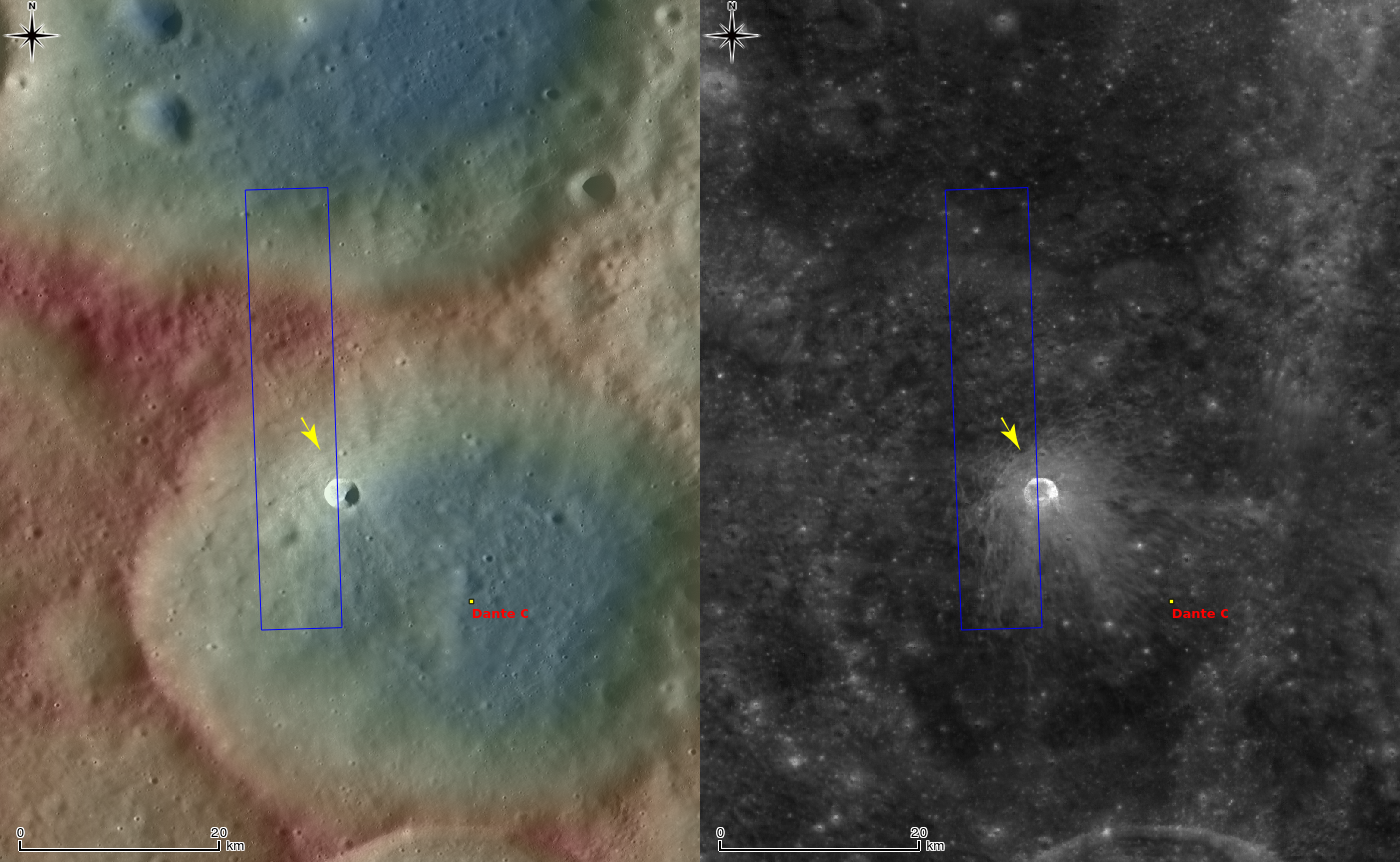
Dante C is a ~54 km diameter crater, located in the central farside highlands. In the northwestern portion of the crater floor, there is an unnamed crater (about 3 km in diameter) with a spectacular diffuse asymmetric ejecta pattern (see next WAC no-shadow context view, right side).

The uphill side (upper-left) shows a distinctive wavy pattern of ridges and grooves (seen in the opening picture) within about 3 km of the rim.

Probably due to the background slope (Dante C crater wall, downslope is to the lower-right), the ejecta hit the ground and stopped in a shorter distance than on the downhill side, leaving partially wrinkled edges in the ejecta deposits.

Wider, 6.14 km-wide field of view, context for area of interest at far upper center, left, from LROC NAC mosaic M1153033874RL, LRO orbit 21901, April 25, 2014; incidence angle 58.14° resolution 1.45 meters from 146.22 km over 29.17°N, 182.54°E [NASA/GSFC/Arizona State University].
33.1 km-wide field of view from LROC Wide Angle Camera monochrome [604 nm] mosaic, swept up over three sequential orbital passes, LRO orbits 11135-11137, November 20, 2011; average incidence angle 60° at 57 meters resolution, from 43.84 km [NASA/GSFC/Arizona State University].
Context view of Dante C crater and surroundings, LROC WAC monochrome mosaic overlayed with DTM with GLD100 at left, and WAC normalized reflectance at right (100 m/pix). Image centered on 28.57014°N, 182.63728°E, field of view 62 km. The location of area shown at high-resolution in LROC Featured Image released April 22, 2014 designated with arrow [NASA/GSFC/Arizona State University].
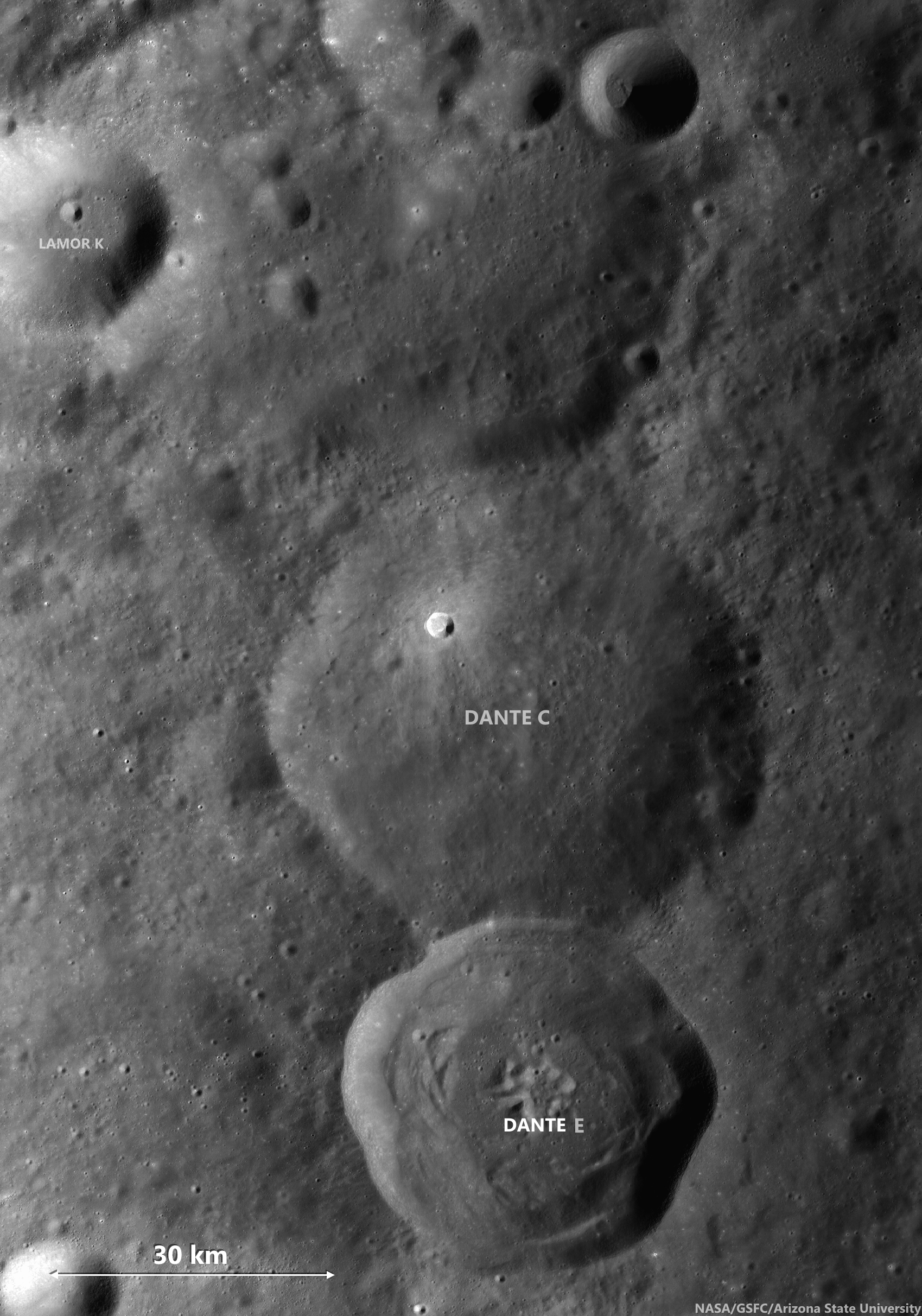
97 km-wide field of view from the same LROC Wide Angle Camera monochrome [604 nm] mosaic, swept up over three sequential orbital passes, LRO orbits 11135-11137, November 20, 2011 [NASA/GSFC/Arizona State University].
The downhill side shows a smooth surface without the wavy pattern, implying that the thin layer of ejecta spread out homogeneously on the downslope. Also, the thickness of the ejecta itself might have been asymmetric due to the local slope. The uphill slope can interrupt ejecta's lateral motion, leaving unique ridges and grooves, another example of the range of crater forms found on the Moon.

Craters like Dante C disappear under low-angle sunlight. Fresh rays from much younger craters, like Jackson, and even a young crater on its northwest interior, outshine such a very ancient crater. View the full size 1000 px original gif file, HERE [NASA/GSFC/Arizona State University].
Explore the asymmetric ejecta with clear wave patterns in full NAC frame, HERE and in LROC QuickMap, HERE.

Related Posts:
Impact Art
Bright and Dark Ejecta
Dynamic Textures
Ejecta Patterns
Lassell D Ejecta
In the Wake of Giordano Bruno
Ground Hugging Ejecta

Friday, February 7, 2014

Layering Waves at Darwin C

Fresh Impact at Darwin C (LROC NAC)
A fresh impact crater that poured ejecta down the wall of Darwin C in a 7 km field of view from LROC NAC mosaic M1145254989RL,  spacecraft orbit 20807, January 25, 2014, resolution 0.8 meters, north toward left [NASA/GSFC/Arizona State University].
Raquel Nuno
LROC Featured Image

We previously published a portion of the spectacular ejecta pattern of an unnamed fresh impact crater: "Impact Art," November 21, 2013.

 Today's Featured Image is a broader LROC NAC mosaic of the source where that ejecta originated. This unnamed crater does not have a circular shape, because it formed on the sloped wall of Darwin C crater (15.3 km, 20.51°S, 71.12°W).

Soon after impact, gravity took over, pulling large boulders and fine debris down the crater wall. Zooming in on the ejecta, you can see roughly boulders roughly 6 meters in size that "etched" their way down the crater wall, leaving trails in the granular ejecta as they tumbled downhill.

M1145254989RL_context
Boulders rolled down slope leaving evidence of their trek in their wake. They ended their journey after the impact that formed the fresh crater on the wall of crater Darwin C, as can be seen by the overprinting of their trails on the ejecta. The boulders are roughly 6 meters in diameter [NASA/GSFC/Arizona State University].
Since we don't have samples from this crater, we don't know exactly when this fresh impact crater occurred.  But, we can assume that it must be relatively young.

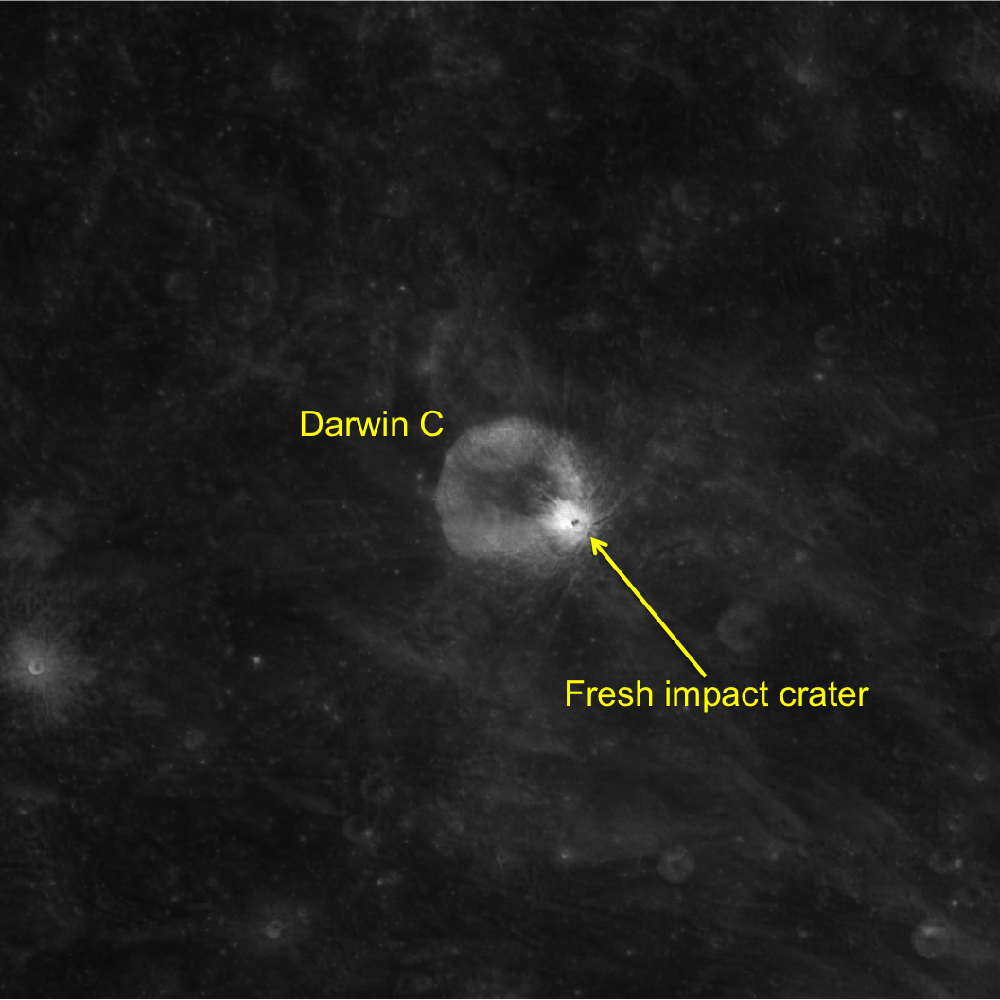
The reason why we know it must be young is that exposure to the space environment (usually referred to as space weathering) reduces the albedo of surface materials.  This means that scientists can use LROC images to get a relative sense for how long a surface has been exposed to the space environment. Getting some perspective with the wider view, combined with examination of the 643 nm normalized WAC reflectance map which enhances relative reflectance (see image below), you can see the relative brightness difference between the high-reflectance ejecta from our fresh crater compared to crater Darwin C and the rest of the surrounding terrain - this crater is not only superposes Darwin C, but its ejecta is significantly higher reflectance than anything else in the scene.

Albedo Optical Maturity of a fresh impact on the wall of Darwin C
LROC Wide Angle Camera (WAC) 643 nm normalized reflectance map of Darwin C crater. The bright area is ejecta from the fresh impact crater on the east wall of Darwin C [NASA/GSFC/Arizona State University].
Taken together with the sharp, well-defined rims and lack of other superposed impacts, we can infer that this crater is a relatively recent addition to the lunar surface.  The impact event that formed this crater almost certainly occurred within the last several hundred million years, which is practically yesterday over the billions of years of geologic time!

Follow the boulders' trails with the full resolution NAC mosaic, HERE.

Related Posts:
Impact Art
A Tangle of Talus
Bouncing, Bounding Boulders!
It's All Downhill From Here

Thursday, October 31, 2013

Dark ejecta, clue to cryptomare

M1115555142L_1k
A 78 meter diameter crater with distinct dark ejecta surrounding its rim, in the farside southern  highlands (31.131°S, 147.536°E) north of Jules Verne. LROC Narrow Angle Camera (NAC) frame M1115555142L, LRO orbit 16629, February 16, 2013; 40.36° angle of incidence, 74 cm per pixel resolution from 71.92 km [NASA/GSFC/Arizona State University].
Jeffrey Plescia
LROC News System

Impact crater ejecta is typically brighter than the surrounding material because it is fine-grained and immature (unweathered); even on the dark mare, fresh craters usually have bright ejecta. Craters with distinctly dark ejecta do occur, but they are rare (e.g., Shorty Crater at the Apollo 17 landing site). When craters have dark ejecta, the interpretation is that a layer of low reflectance rock or soil at depth was excavated and distributed around the margin of the crater. In the case of Shorty Crater, the conclusion is that a layer of dark pyroclastics was hidden just beneath the surface; in other cases, dark halo craters are interpreted to indicate mare material at depth (cryptomare). Several of the craters formed by the impact of spacecraft hardware, such as the Apollo 13 S-IVB, into the surface also have dark ejecta rays, and this observation is not yet well understood.

Details of the crater morphology can be seen in this expanded view from LROC NAC M1115555142L [NASA/GSFC/Arizona State University].
Our dark halo crater (31.131°S, 147.536°E) has a diameter of about 78 m, although it is slightly elongate in the north-south direction. Rays of dark ejecta extend for almost 200 m from the crater rim. Morphologically, the crater is not the normal simple bowl shape for a crater of this size. Rather, a depression on the crater floor in the center is surrounded by a low ridge about 33 m in diameter; beyond that annular ridge to the crater wall the floor appears to be flat. Boulders are scattered on the crater floor and on the ejecta to the east; the largest boulders on the east side are as large as 6 m across.
dark_ejecta_reg_sm
Regional view of the dark ejecta crater. Note the crater formed on the western flank of an older, larger crater. Relatively low albedo, smooth plains spread out immediately to the south. These plains (see next image) may be mare material and may underlie the area of the small impact. LRO NAC frame M167241339R (spacecraft orbit 9780, August 6, 2011; 55.96° angle of incidence, 65 cm per pixel resolution from 62.95 km)  [NASA/GSFC/Arizona State University].
LROC Wide Angle Camera (GLD100) context, at 64 meters per pixel resolution, shows the location of the crater of interest in relation to the arc of exposed mare material to the south and west [NASA/GSFC/Arizona State University].
This crater formed on the outer flank of a larger older, degraded 635 m crater. Highlands ejecta (higher reflectance than mare) from this larger crater buried the mare. Later the impact that formed the younger dark halo crater punched through the bright highland ejecta and brought up mare from 10 meters or more depth.

Explore this region of the Moon in the full NAC image, HERE.

Related Posts:
Bright and Dark Ejecta (September 11, 2013)
Excavating Dark Deposits (September 3, 2013)
Dark haloed crater in Mare Humorum (June 7, 2011)
Dark Halo Crater in Orientale (March 4, 2011)
Dark craters on a bright ejecta blanket (November 17, 2009)

Wednesday, September 11, 2013

Bright and Dark Ejecta

LROC Featured Image, September 10, 2013 (M139782204LE)
A relatively recent impact event distributed bright, reflective ejecta across the lunar surface in southeast Mare Tranquillitatis. Smaller craters punch through the ejecta to reveal darker substrate, a contrast easier to see under a high Sun, and thus a lower illumination angle of incidence. A 500 meter-wide field of view from LROC Narrow Angle Camera (NAC) observation M139782204LE, spacecraft orbit 5733, September 22, 2010; a 10.11° angle of incidence, resolution 49 cm per pixel from 44.54 km over 4.37°N, 19.29°E [NASA/GSFC/Arizona State University].
Drew Enns
LROC New System

Fresh (young) impacts on the Moon often display magnificent ejecta blankets (so called because they "blanket" the surrounding terrain). Ejecta is unevenly distributed, which gives rise to its interfingered appearance.

Since space weathering tends to lower the albedo of material on an airless planet, the relative brightness of this ejecta blanket speaks to the young age of the parent crater.

In this case, the parent crater is just to the south of the opening image, and can be seen in the context image.

M162181924L-NSJ-1110-58b92-2252x3572
The same small, relatively fresh crater at local sunrise, when shadows under a higher illumination angle of incidence exaggerate variations in topography over albedo. Even so, the brighter surface rays are as distinct as striations channeled into the terrain by the blast. An 1875 meter-wide field of view from LROC NAC frame M162181924L, LRO orbit 9035, June 8, 2011; 73.88° angle of incidence, resolution 0.83 meters per pixel from 39.7 km [NASA/GSFC/Arizona State University].
But what is providing the small circular patches of dark material? Were the patches formed as part of the impact that formed the ejecta blanket, or later? Was the material excavated from below the bright ejecta? Most likely secondary craters (late stage ejecta) from the initial impact, hit and dug up dark mare material (original surface) from below the thin ejecta blanket. Can we test this idea? How dark is dark? In a more precise sense - do the albedos of the small low reflectance spots match that of the surrounding mare?

LROCqm250-sabine-rittter-manners
LROC Wide Angle Camera (WAC) context for the LROC Featured Image released September 10, 2013, showing the field of view located at located at 4.408 N, 19.230 E (marked by the cross). Nearby linear depressions (one smaller, closer depression is visible in the preceding image) may have provided the darker substrate discussed [NASA/GSFC/Arizona State University].
Your eye could be fooled by all the changes in reflectance. The small dark patches have a higher albedo than the mare (0.07 vs 0.06), which would be consistent with mare material mixing with the brighter (0.09 to 0.11) ejecta blanket. This observation is consistent with the secondary crater interpretation (the underlying mare is mixed with a small amount of the bright immature ejecta). If the reflectance of the dark patches was lower than that of the mare, then something else would have to be at work.

Can you think of other explanations while browsing the full LROC NAC frame, HERE?

Related Posts:
Beautiful Ejecta Patterns
DMD Excavations
Symmetric Ejecta

Tuesday, September 3, 2013

Excavating Dark Deposits

M185955372RE_thumb-580
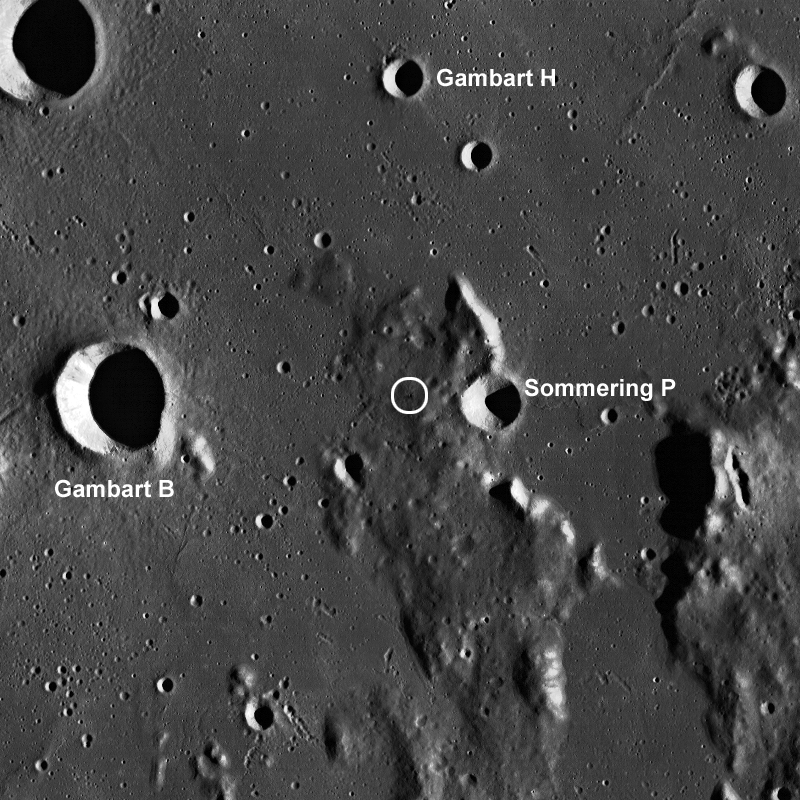
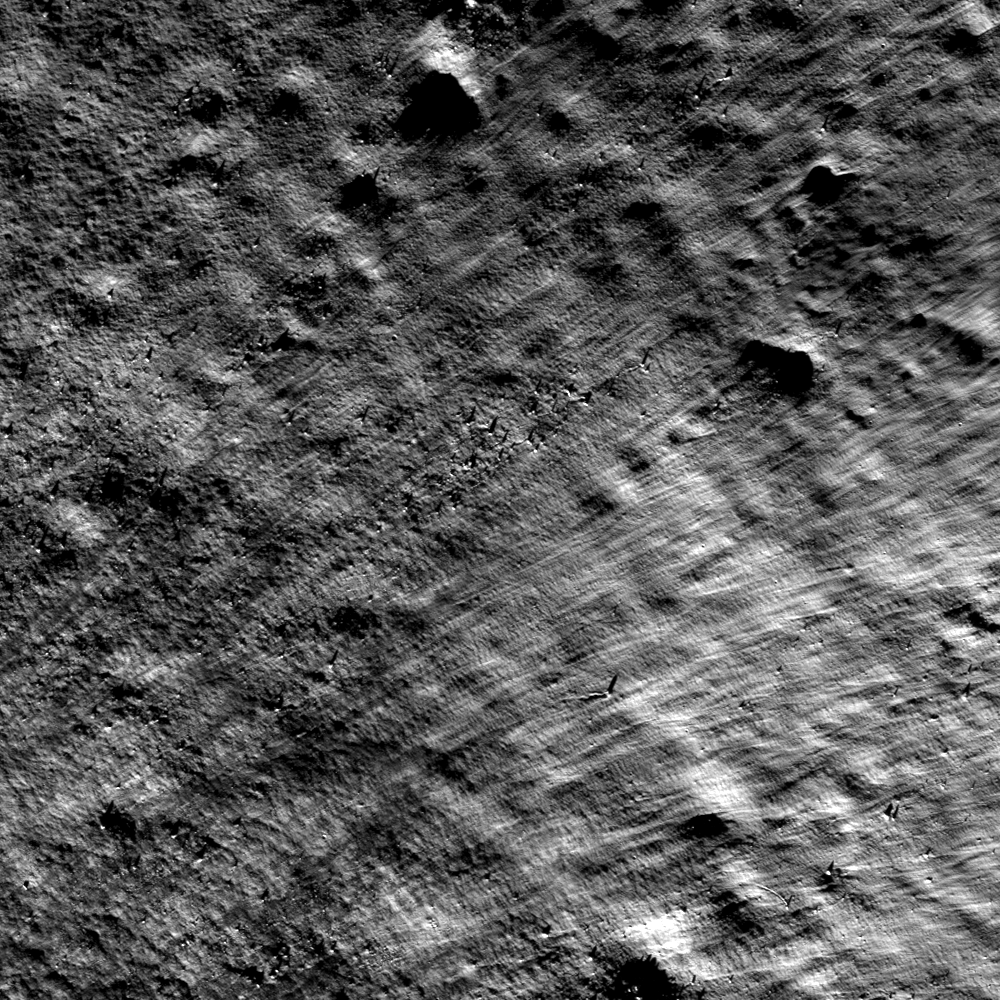
An approximately 250 meter crater has excavated low reflectance material from beneath the lunar surface, west of Sommering P crater, southeast of Copernicus. LROC Narrow Angle Camera (NAC) frame M185955372R; LRO orbit 12483, March 9, 2012; 9.56° angle of incidence, native resolution 1.11 meters per pixel, from 110.79 km over 1.53°N, 249.3°E, field of view 1.8 kilometers [NASA/GSFC/Arizona State University].
Sarah Braden
LROC News System

Amazing ejecta patterns from small, young craters are always something to look at on the lunar surface. Today's Featured Image displays compositional diversity in fresh ejecta. The broad, low-reflectance streaks of material are likely excavated pyroclastic materials. This approximately 250 m diameter crater is located at 2.162°N, 349.401°E, west of the crater Sommering P.

This low-reflectance material is part of a larger area called a Dark Mantle Deposit (DMD). Dark mantle deposits have lower reflectance compared to surrounding mare basalt areas and are also spectrally distinct from mare basalt. In this case, the dark mantle deposit was likely covered by a thin layer of crater ejecta.

Context with Sommering P
The small crater's location marked with a white circle in an LROC Wide Angle Camera (WAC) context image of a field of view 80 km across [NASA/GSFC/Arizona State University].
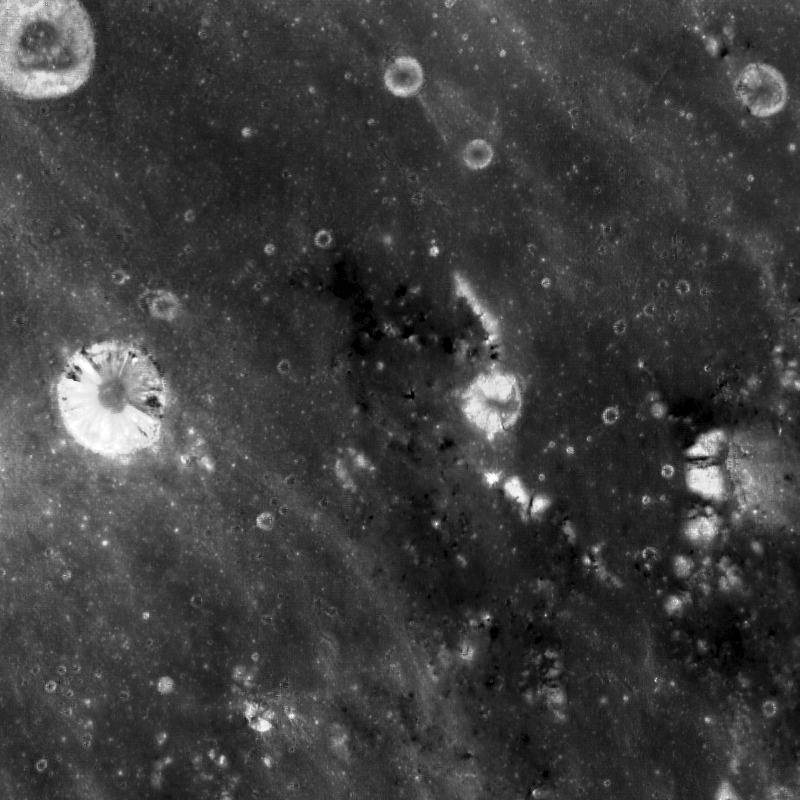
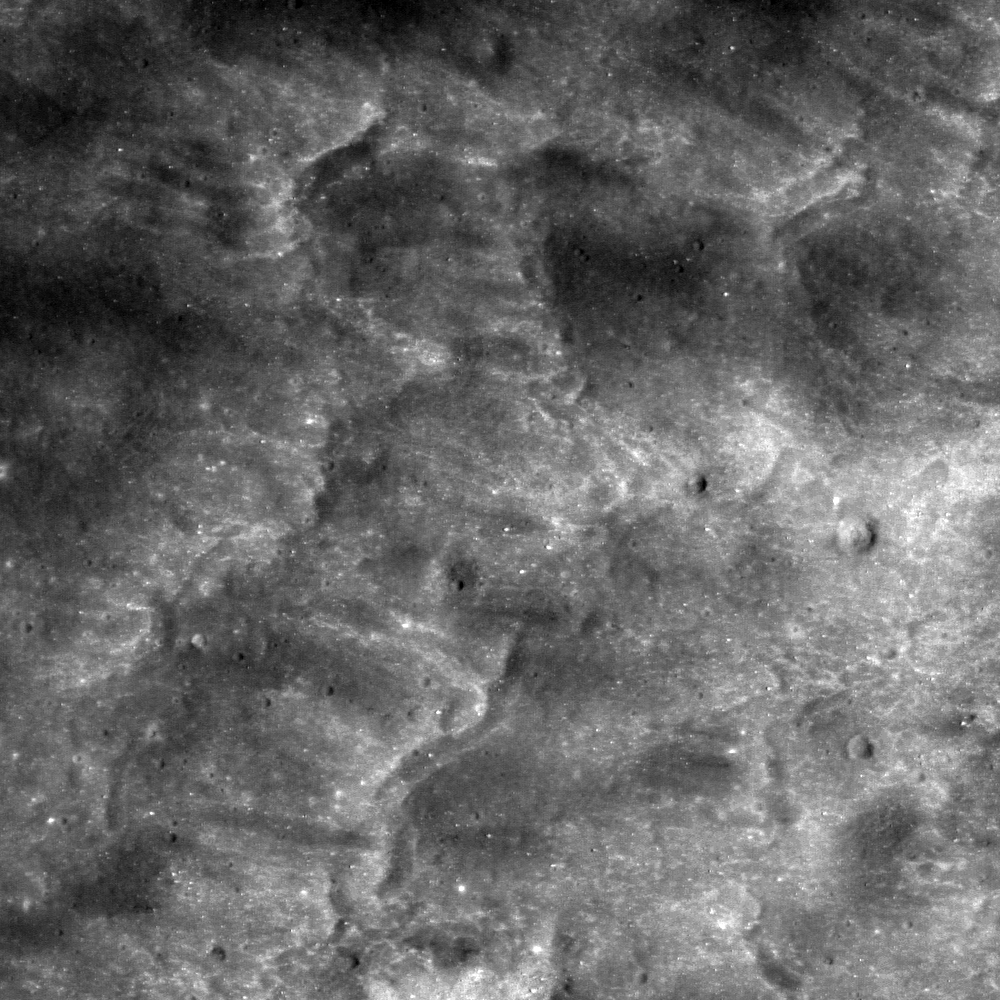
The opening image has a low incidence angle of 10° which means the Sun is high in the sky (near local noon). High-sun images are good for revealing differences in the reflectance properties of the surface. Low-sun (large incidence angle) images are better at emphasizing morphology due to topographic shading and shadowing. Incidence angle is the angle between the vector of sunlight and the vector normal to the surface. The WAC context image above has a large incidence angle (taken in early morning) which makes visible the topographic high where the crater was formed. This topographic high is a remnant of highland terrain (kipuka) surrounded by younger mare basalt deposits (smooth, flat areas). There are many other craters on the topographic high that excavate low-reflectance material, which suggests that the whole area is different from the surrounding mare basalt deposits. The high-sun WAC mosaic (below) of the same area shows the locations where the dark mantle deposit is visible. You can learn more about dark mantle deposits here!

643nm high sun, high-reflectance WAC context
LROC WAC monochrome (643 nm) high sun, high reflectance view of the same area as seen in the WAC mosaic immediately above, resolution roughly 100 meters per pixel. Note darker material around the area of the topographic high place [NASA/GSFC/Arizona State University].
Explore the full NAC image HERE to see the other craters excavating low-reflectance material.

Related Images:
Hyginus Crater and Pyroclastics
Dark Wisps in Copernicus
Polka-Dot Ejecta
Pyroclastic Excavation

Thursday, May 16, 2013

Dynamic Textures in the Farside Highland Terrain

Northeastern portion of unnamed crater ejecta, above 77°N latitude, in the farside north. LROC Narrow Angle Camera (NAC) M138600267R, LRO orbit 5559, September 8, 2010; sunlight angle of incidence 80.3° over a field of view 1080 meters across, resolution 1.08 meters per pixel, from 51.96 km. Image center 77.086°N, 200.336°E, incidence angle is 80.3° [NASA/GSFC/Arizona State University].
Hiroyuki Sato
LROC News System

This far side high latitude (just above 77°N) fresh crater (roughly 1.1 kilometers in diameter) presents striking linear patterns in its ejecta.

Due to the high latitudes, the incidence angle is always very high in this area (including in this image), which enhances subtle topographic features.

The ejecta source crater is toward bottom left (outside the image field of view), thus the ejecta landed with the velocity component in upper right (northeast) direction, consistent with linear stripes dominating this whole area of this Featured Image.

LROC Wide Angle Camera (WAC) observation shows the whole crater of interest, at the center of this 46.2 km-wide field of view captured at 79.7 meters per pixel. North a smaller fresh crater almost immediately to the south-southeast. Both these crater's fresh, bright and optically immature ejecta fields are visible in the HDTV stills from Japan's SELENE-1 orbiter Kaguya, below. LROC WAC M173944659C (643 nm), spacecraft orbit 10768, October 22, 2011 [NASA/GSFC/Arizona State University].
Context for the LROC NAC frame outlined in this crop from LROC WAC monochrome mosaic (100 meters per pixel) of the unnamed crater and surrounding vicinity, centered near 77.46°N, 200.83°E, image width is about 142 km. NAC footprint (blue box) and the location of today's Featured Image (white arrow) are indicated here [NASA/GSFC/Arizona State University].
Interestingly, the lower left (closest to the rim) and upper left corners of this image show a craggy, rough surface, while the right portion shows only the striped pattern. What causes such texture differences within the same ejecta blanket?

Demonstration of just how far north the crater of interest resides in this three-HDTV frame animation, showing an Earthrise over Plaskett crater in the Moon's far north as captured from Japan's lunar orbiter SELENE-1 ('Kaguya') in 2007. The crater later photographed from overhead from LRO is designated with an arrow in the final frame. A large reproduction of the final still can be viewed HERE [JAXA/NHK/SELENE].
One possibility is the impact melt content was enriched near the rim, increasing the cohesion among the rock fragments and decelerating the flow inducing multiple pressure ridges perpendicular to the flow direction. Perhaps variations in roughness of the pre-existing surface controlled the final look of the ejecta. What else?

Explore this fascinating ejecta morphology in full NAC frame (HERE), and find your own hypothesis and answers!

Related Posts:
Ejecta sweeps the surface
Action Shot
Polka-dot Ejecta
Smooth Ejecta
In the Wake of Giordano Bruno
Scours and Ejecta Near Jules Verne Y
Lassell D Ejecta
Swept Surface
Ejecta Patterns

Thursday, February 21, 2013

Ejecta Interference Patterns

A 960 meter-wide portion of an unnamed young crater's distinctive ejecta deposit pattern, 330 km west-southwest of Kepler in Oceanus Procellarum. LROC Narrow Angle Camera (NAC) observation M188557336R, LRO orbit 12847, April 8, 2012; field of view centered on 3.972°N, 311.942°E, resolution 95 cm per pixel, angle of incidence 21.1° from 114.25 km [NASA/GSFC/Arizona State University].
Hiroyuki Sato
LROC News System

Today's Featured Image highlights a portion of a very fresh ejecta deposit. The source crater is an unnamed crater about 1.2 km in diameter, located within Oceanus Procellarum.

As seen in the NAC context view below, the higher reflectance ejecta spreads radially from the crater, and in some regions may have formed interference patterns that look a bit like fish scales.

The opening image focuses on a typical portion showing this geometric pattern.

Near the full 5.4 km width of the field of view within the footprint of LROC NAC M188557336R, a context view for the scope of the LROC Featured Image (yellow box) at reduced resolution. [NASA/GSFC/Arizona State University].
In the vacuum of space, the ejected materials experience no atmospheric drag, and thus no fluid dynamic instabilities driven by such an interaction occur. How then was this sparse/dense ejecta pattern formed? The advancing ejecta curtain probably already had internal density contrasts that produced greater or lesser collision frequencies among the admixed rock fragments. Portions having regular density at intervals with portions have irregular density might have formed this odd, scaly pattern.

Context view of the unnamed young crater and vicinity, a LROC WAC monochrome mosaic (100 meters resolution) centered near 3.96°N, 311.94°E. LROC NAC M188557336R footprint represented by a blue rectangle with the location of LROC Featured Image field of view designated with an arrow [NASA/GSFC/Arizona State University].
At full resolution, the area of interest (arrow) is visible in a mosaic of 21 telescopic images stacked on Earth, January 13, 2009. (Note the bright ray from Kepler crossing hundreds of kilometers over and past the vicinity of the unnamed crater, visible from Earth in the midst of the wide middle expanse of Oceanus Procellarum. Field of view is shown context with a reduced view of the complete mosaic below [ASTRONOMINSK].

Explore the exotic patterns of this young crater ejecta in full NAC frame yourself, HERE.

Related Posts:

Lassell D Ejecta
In the Wake of Giordano Bruno
Smooth Ejecta
Polka-dot Ejecta
Brush Strokes of Ejecta
Action Shot
Delicate patterns in Giordano Bruno ejecta
Ejecta sweeps the surface

Tuesday, January 8, 2013

Symmetric Ejecta in the Farside Highlands

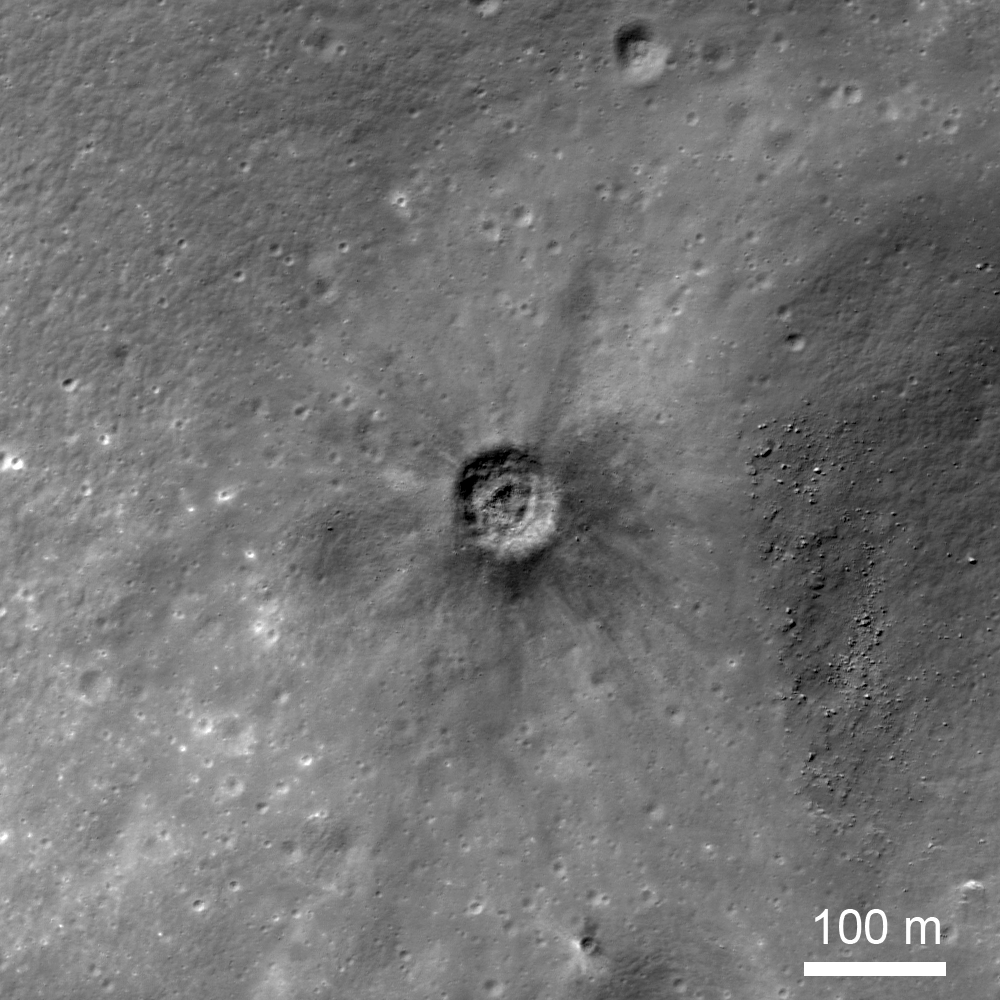
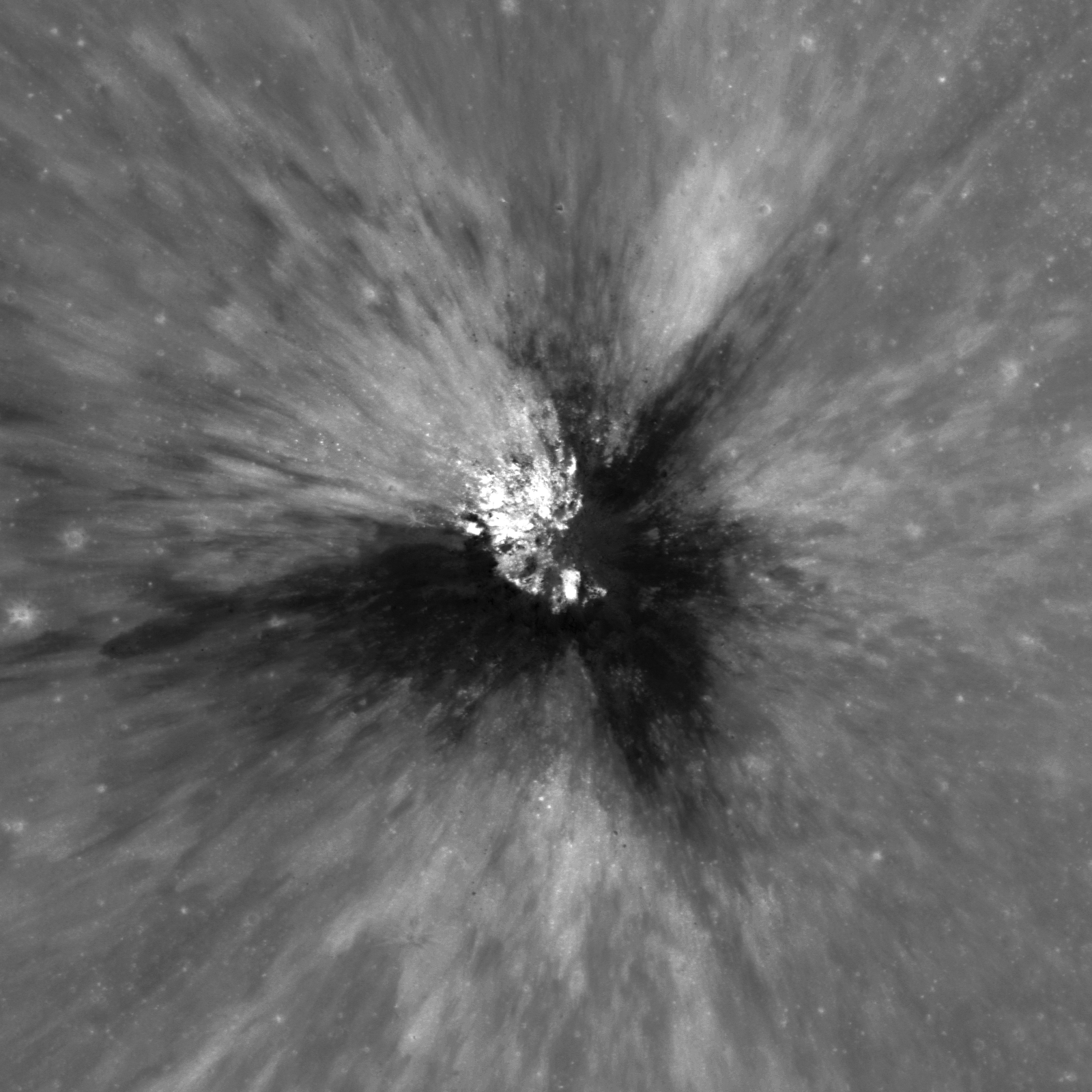
A symmetric "starburst" ejecta blanket exposed with high Sun angle. Image is 660 m wide, LROC NAC frame M108108187L. LRO orbit 1066, September 20, 2009; angle of incidence 15.44° at 0.59 meters resolution from 56.52 km [NASA/GSFC/Arizona State University].
Renee French
LROC News System

The 180 meter diameter impact crater observed in the opening image (8.874°N, 171.899°E) formed in the farside highlands. Its location away from compositional boundaries (like the mare-highland boundary) suggests that the high albedo ejecta blanket is due to freshly exposed material, indicating a young impact. How do we know that? Because material of the same composition that has been exposed to less space weathering (i.e., material that is younger) is brighter. Additionally, images acquired with the Sun nearly overhead emphasize albedo contrasts, bringing out details of ejecta distribution and rays. The directions in which ejecta spread out from a crater tells us about the angle the bolide (comet or asteroid) hit the surface. A symmetric ejecta blanket like this one typically indicates that the bolide impacted at an angle of 45° or greater (90° is vertical); an impact angle less than 45° produces asymmetric ejecta blankets. It is important to have high Sun angle images because without them, it is harder to determine the extent of the ejecta blanket and other young features.


Same Featured Image crater but observed at a lower Sun angle, LROC NAC frame M103388681R, spacecraft orbit 404, July 28, 2009; angle of incidence 65.11° at 1.25 meters resolution from 123.36 km, image field of view is approximately 700 meters wide [NASA/GSFC/Arizona State University].
The above image is of the same crater but with a different Sun angle - just look at the difference! Can you tell how big the ejecta blanket is or the distribution of ejecta with distance? In the low Sun angle image, could you tell that there were two craters next to each other, or which craters might be considered secondary craters?

LROC Wide Angle Camera (WAC) monochrome 100 meter resolution shows the location of the LROC Featured Image field of view, in the farside highlands (red arrow). Ejecta from the unnamed crater of interest barely stands out, with only a slightly a higher albedo than the surrounding terrain [NASA/GSFC/Arizona State University].
Even at the resolution of the WAC mosaic, the crater is still visible due to its bright ejecta blanket!

To spot your own young craters, view the full LROC NAC, HERE.

Related Posts:
Dark Secondary Crater Cluster
The Rays of Messier A
Farside impact!
Ejecta Starburst
Minty Fresh