Showing posts with label Volatiles. Show all posts

Wednesday, February 4, 2015

Hydrogen retention on pole-facing slopes

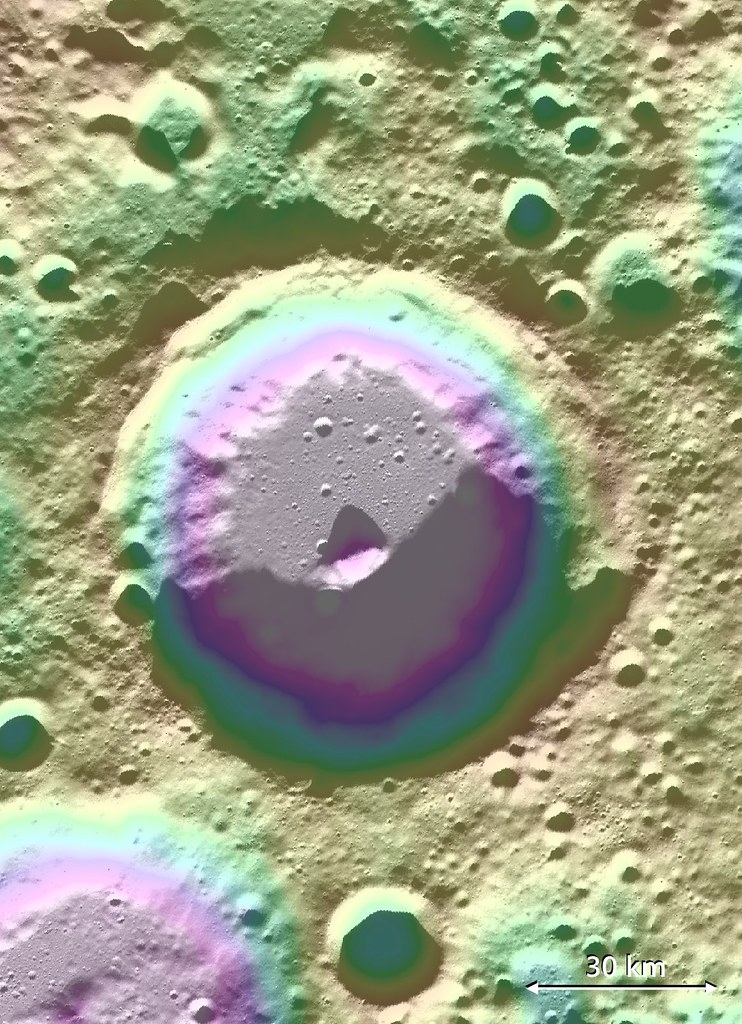
Lovelace (57.06 km; 82.08°N, 250.49°E) crater, of the Moon's far north, hosts a signature of volatiles within permanently shadowed regions (PSR) on the inside slope of its south wall. Long-term studies of the Moon's reserves of hydrogen and other volatiles, made possible by the extended science missions of the Lunar Reconnaissance Orbiter (LRO), show a diurnal cycle of hydrogen retention on pole-facing slopes, perhaps a result of neutral hydrogen from the Sun. [NASA/GSFC/ASU/LOLA/PDS].
Bill Steigerwald
Goddard Space Flight Center

Space travel is difficult and expensive – it would cost thousands of dollars to launch a bottle of water to the moon. The recent discovery of hydrogen-bearing molecules, possibly including water, on the Moon has explorers excited because these deposits could be mined if they are sufficiently abundant, sparing the considerable expense of bringing water from Earth.

Karnik
Lunar water could be used for drinking or its components – hydrogen and oxygen – could be used to manufacture important products on the surface that future visitors to the moon will need, like rocket fuel and breathable air.

Recent observations by NASA's Lunar Reconnaissance Orbiter (LRO) spacecraft indicate these deposits may be slightly more abundant on crater slopes in the southern hemisphere that face the lunar South Pole.

"There’s an average of about 23 parts-per-million-by-weight (ppmw) more hydrogen on Pole-Facing Slopes (PFS) than on Equator-Facing Slopes (EFS)," said Timothy McClanahan of NASA's Goddard Space Flight Center.

This is the first time a widespread geochemical difference in hydrogen abundance between PFS and EFS on the moon has been detected. It is equal to a one-percent difference in the neutron signal detected by LRO's Lunar Exploration Neutron Detector (LEND) instrument. McClanahan is lead author of a paper about this research published online October 19 in the journal Icarus.

The hydrogen-bearing material is volatile (easily vaporized), and may be in the form of water molecules (two hydrogen atoms bound to an oxygen atom) or hydroxyl molecules (an oxygen bound to a hydrogen) that are loosely bound to the lunar surface. The cause of the discrepancy between PFS and EFS may be similar to how the Sun mobilizes or redistributes frozen water from warmer to colder places on the surface of the Earth, according to McClanahan.

"Here in the northern hemisphere, if you go outside on a sunny day after a snowfall, you'll notice that there's more snow on north-facing slopes because they lose water at slower rates than the more sunlit south-facing slopes" said McClanahan. "We think a similar phenomenon is happening with the volatiles on the moon – PFS don't get as much sunlight as EFS, so this easily vaporized material stays longer and possibly accumulates to a greater extent on PFS."

The team observed the greater hydrogen abundance on PFS in the topography of the moon's southern hemisphere, beginning at between 50 and 60 degrees south latitude.

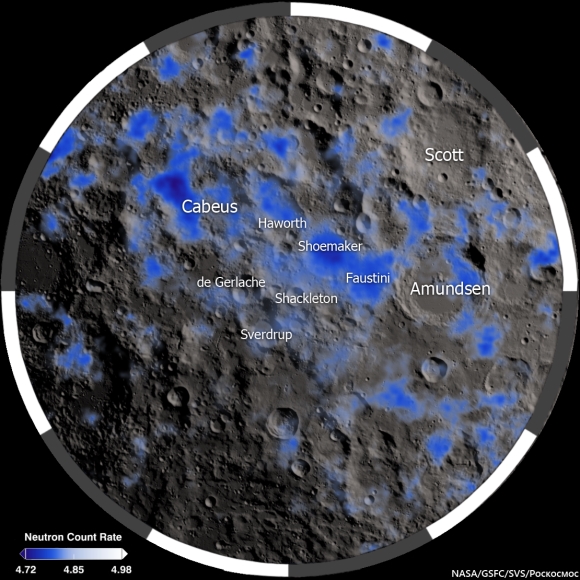
The Moon's polar south and its neutron suppression zpmes, indicative of the presence of hydrogen (inside and outside permanent shadow) mapped from data collected from the LRO LEND instrument over two and a half years [NASA/GSFC/SVS/Pockocmoc].
Slopes closer to the South Pole show a larger hydrogen concentration difference. Also, hydrogen was detected in greater concentrations on the larger PFS, about 45 ppmw near the poles. Spatially broader slopes provide more detectable signals than smaller slopes. The result indicates that PFS have greater hydrogen concentrations than their surrounding regions. Also, the LEND measurements over the larger EFS don't contrast with their surrounding regions, which indicates EFS have hydrogen concentrations that are equal to their surroundings, according to McClanahan. The team thinks more hydrogen may be found on PFS in northern hemisphere craters as well, but they are still gathering and analyzing LEND data for this region.
There are different possible sources for the hydrogen on the moon. Comets and some asteroids contain large amounts of water, and impacts by these objects may bring hydrogen to the moon. Hydrogen-bearing molecules could also be created on the lunar surface by interaction with the solar wind. The solar wind is a thin stream of gas that's constantly blown off the Sun. Most of it is hydrogen, and this hydrogen may interact with oxygen in silicate rock and dust on the moon to form hydroxyl and possibly water molecules. After these molecules arrive at the moon, it is thought they get energized by sunlight and then bounce across the lunar surface; and they get stuck, at least temporarily, in colder and more shadowy areas.

Since the 1960's scientists thought that only in permanently shadowed areas in craters near the lunar poles was it cold enough to accumulate this volatile material, but recent observations by a number of spacecraft, including LRO, suggest that hydrogen on the moon is more widespread.

It's uncertain if the hydrogen is abundant enough to economically mine. "The amounts we are detecting are still drier than the driest desert on Earth," said McClanahan. However, the resolution of the LEND instrument is greater than the size of most PFS, so smaller PFS slopes, perhaps approaching yards in size, may have significantly higher abundances, and indications are that the greatest hydrogen concentrations are within the permanently shaded regions, according to McClanahan.

The team made the observations using LRO's LEND instrument, which detects hydrogen by counting the number of subatomic particles called neutrons flying off the lunar surface. The neutrons are produced when the lunar surface gets bombarded by cosmic rays. Space is permeated by cosmic rays, which are high-speed particles produced by powerful events like flares on the Sun or exploding stars in deep space. Cosmic rays shatter atoms in material near the lunar surface, generating neutrons that bounce from atom to atom like a billiard ball. Some neutrons happen to bounce back into space where they can be counted by neutron detectors.

Neutrons from cosmic ray collisions have a wide range of speeds, and hydrogen atoms are most efficient at stopping neutrons in their medium speed range, called epithermal neutrons. Collisions with hydrogen atoms in the lunar regolith reduce the numbers of epithermal neutrons that fly into space. The more hydrogen present, the fewer epithermal neutrons the LEND detector will count.

Neutron suppression information in the Moon's polar north is, as yet, less granular than data mapped in greater detail over the far South. Here neutron suppression is overlaid on a LROC WAC mosaic with permanently shadowed regions (PSRs) outlined in black. Again, the occurrence of hydrogen is related to sunlight but not necessarily tied to its total absence.
The team interpreted a widespread decrease in the number of epithermal neutrons detected by LEND as a signal that hydrogen is present on PFS. They combined data from LEND with lunar topography and illumination maps derived from LRO's LOLA instrument (Lunar Orbiter Laser Altimeter), and temperature maps from LRO's Diviner instrument (Diviner Lunar Radiometer Experiment) to discover the greater hydrogen abundance and associated surface conditions on PFS.

In addition to seeing if the same pattern exists in the moon's northern hemisphere, the team wants to see if the hydrogen abundance changes with the transition from day to night. If so, it would substantiate existing evidence of a very active production and cycling of hydrogen on the lunar surface, according to McClanahan.

The research was funded by NASA's LRO mission. LEND was supplied by the Russian Federal Space Agency Roscosmos. Launched on June 18, 2009, LRO has collected a treasure trove of data with its seven powerful instruments, making an invaluable contribution to our knowledge about the moon. LRO is managed by NASA's Goddard Space Flight Center in Greenbelt, Maryland, for the Science Mission Directorate at NASA Headquarters in Washington.

Wednesday, February 12, 2014

The lunar forensic files

View of the Moon at gamma-ray wavelengths, as imaged by the Compton Gamma Ray Observatory satellite.  These gamma rays are induced by the collision of cosmic rays with the lunar surface, the same process recently found able to synthesize organic molecules in lunar polar ice deposits [Dave Thompson (NASA/GSFC) et al., EGRET, Compton Observatory].
Paul Spudis
The Once and Future Moon
Smithsonian Air & Space

A recent study indicates that water ice and simple molecules of carbon and nitrogen might form the seed material for more complex substances, some of which might ultimately be involved in the origin of life.  The work from the University of Hawaii took measurements of the levels of cosmic radiation from the Lunar Reconnaissance Orbiter (LRO) and applied it to a composition similar to that observed by the impacting LCROSS probe at the south pole of the Moon.  

As you may recall, this probe found both water vapor and ice particles ejected by the impact in one of the permanently dark regions near the pole; it also observed additional compounds, including methane, ammonia and some other simple organic molecules.  These substances are present in cometary ices and thus, it was thought that their presence could indicate a cometary origin for the Moon’s polar ice.

The new work does not negate that interpretation, but adds complexity to the puzzle by showing that it may be possible to manufacture some of the more complex organic molecules from the simple substances found in cosmic ice, whether deposited from the nuclei of impacting comets or made in place within the cold traps of the lunar poles.  Once again, we find that the polar regions of the Moon are even more interesting scientifically than we had thought.

The generation of new and more complex organic compounds must be a surficial process since material buried at levels deeper than a couple of meters is shielded from even the most energetic cosmic rays.  For this reason, the material observed during the LCROSS impact is likely of cometary origin because most of the ejecta created by that impact comes from depths of a few meters.  While material in the lunar surface is overturned by impact gardening, such overturn is extremely slow (rates of overturn below about 1 meter depth occur on timescales of greater than 1 billion years, the same timescale on which this radiation-induced production occurs).

The generation of complex organic molecules is an important topic of research for the origin of life.  Most scientific strategies focus on the search for extraterrestrial life in more Earth-like environments, such as a previously warmer and wetter Mars or in the hypothesized deep oceans of Europa.  A few studies have focused on the physical processes of organic chemistry, specifically the generation of complex molecules in space, within small bodies such as cometary nuclei and on primitive planetary surfaces, such as the polar deposits of the Moon and Mercury.  Findings to date show that complex organic substances are generated in a variety of environments and under a variety of energetic conditions.

Because they date from early in Solar System history and contain the materials needed for living systems (water and organic matter), comets have long been thought to be the seedbeds of life.  Comets are remnants of the original solar nebula, the cloud of debris out of which our Solar System formed.  At a certain position and beyond in the nebula, water is stable in solid form (the so-called “frost line”); in our Solar System, the frost line is between the orbits of Jupiter and Mars.  Water in nebular material inside this line vaporized and was dissipated by the solar wind, some blown outward and some disassociated by ultraviolet radiation.  But water outside of the frost line can condense into ice particles, which then may be accreted into planetary objects.  The smallest and most water-rich of these objects are the comets, most of which originate far beyond the frost line in the most distant regions of our Solar System (the so-called “Oort cloud”).  Larger icy objects in the outer Solar System include the satellites of the Jovian planets, which are predominantly made of water ice with minor amounts of admixed rocky material.  The inner (terrestrial) planets such as Earth and Mars are made mostly of rocky material but contain minor amounts of water, a consequence of their incorporation of cometary material during assembly and subsequent impact bombardment.

This last process operates on the Moon as well.  Because the Moon represents a stable, unchanging environment over billions of years, it accumulates the evidence and detritus of the impact history of that era.  Most of the volatile component of this impacting debris is lost from the Moon, but any of it that becomes trapped in the cold, dark areas near the poles remains there forever.  The poles of the Moon are thus a natural laboratory for the study of one of the early processes in Solar System history – the creation of complex organic substances from the more primitive and simple elements and compounds.  In this sense, the pre-biotic organic chemistry of the lifeless and barren Moon serves the cause of the study of life’s processes and origin.

As we continue to study the Moon, we find that it offers much more than one might suspect at first glance.  The Moon’s early history reveals the secrets of planetary assembly, impact bombardment, global melting and differentiation into core, mantle and crust.  Its middle history tells us about the thermal evolution of planets, as internal heat spawned the volcanism that resurfaced part of the Moon and operates on all of the terrestrial planets.  The continued impact history recorded in the Moon’s surface layer documents a phase of Earth history missing from our terrestrial geological record, including the possibility of episodic waves of impacts that are at least partly responsible for extinctions of life recorded in the fossil record.  This same surficial layer also records the history and output of our Sun, the provider of energy to the planets and the principal driver of climate change on Earth.  The interconnections between the various branches of lunar science with the other sciences grow more evident and more significant over time.

This new research makes the recently renewed interest in the value of the Moon and new lunar missions more comprehensible.  Far from being a mere echo of some previous space glory, a return to the Moon to undertake new scientific studies, new exploration and to develop a wholly new set of technologies impacts all of space science and exploration in many different and unexpected ways.  Insights into the origins of life can come from detailed examination of lunar polar volatiles.  These same materials can also enable travel to more distant destinations and open up Earth-Moon space to economic development.  In both cases, lunar return will enable and facilitate our understanding and movement into space.

As my colleague David Lawrence of APL put it, “One of the take-homes is, go back to the moon and look.  Dig up samples, see what’s there.”  Sound advice.

Related:
Crites, Lucey & Lawrence
Icarus, Vol. 226, No. 2, Nov.–Dec. 2013, pg. 1192–1200

The Moon's metallic water (February 27, 2011)

Committee on the Evaluation of Radiation Shielding for Space Exploration
National Research Council

Friday, May 10, 2013

Earth and Moon share primal water source, raising problems for Giant Impact origin hypothesis

Backscatter electron image of a lunar melt inclusion from Apollo 17 sample 74220, enclosed within an olivine crystal. The inclusion is 30 µm in diameter. Skeletal crystals within the melt inclusion are a fine mixture of olivine and ilmenite. Dark area in the lower-left is an ion microprobe sputter crater [John Armstrong, Geophysical Laboratory, Carnegie Institution of Washington].
PhysOrg

The water found on the moon, like that on Earth, came from small meteorites called carbonaceous chondrites in the first 100 million years or so after the solar system formed, researchers from Brown and Case Western Reserve universities and Carnegie Institution of Washington have found.

Evidence discovered within samples of moon dust returned by lunar crews of Apollo 15 and 17 dispels the theory that comets delivered the molecules.

The research is published online in Science Express today.*

The discovery's telltale sign is found in the ratio of an isotopic form of hydrogen, called deuterium, to standard hydrogen. The ratio in the Earth's water and in water from specks of volcanic glass trapped in crystals within moon dust match the ratio found in the chondrites. The proportions are far different from those in comet water.

The moon is thought to have formed from a disc of debris left when a giant object hit the Earth 4.5 billion years ago, very early in Earth's history.

Scientists have long assumed that the heat from an impact of that size would cause hydrogen and other volatile elements to boil off into space, meaning the moon must have started off completely dry.

But recently, NASA spacecraft and new research on samples from the Apollo missions have shown that the moon actually has water, both on and beneath its surface.

By showing that water on the moon and Earth came from the same source, this new study offers yet more evidence that the moon's water has been there all along, or nearly so.

"The simplest explanation for what we found is that there was water on the proto-Earth at the time of the giant impact," said Alberto Saal, a geochemist at Brown University and the study's lead author. "Some of that water survived the impact, and that's what we see in the moon."

Recent research, Saal said, has found that as much as 98 percent of the water on Earth also comes from primitive meteorites, suggesting a common source for water on Earth and the moon. The easiest way to explain that, Saal said, is that the water was already present on the early Earth and was transferred to the moon.

The finding is not necessarily inconsistent with the idea that the moon was formed by a giant impact with the early Earth, but presents a problem. If the moon is made from material that came from the Earth, it makes sense that the water in both would share a common source, Saal said. However, there's still the question of how that water was able to survive such a violent collision.

"Our work suggests that even highly volatile elements may not be lost completely during a giant impact," said Van Orman. "We need to go back to the drawing board and discover more about what giant impacts do, and we also need a better handle on volatile inventories in the moon."
Read the full article, HERE.


*Hydrogen Isotopes in Lunar Volcanic Glasses and Melt Inclusions Reveal a Carbonaceous Chondrite Heritage, A.E. Saal, et al. Science Express, 2013.

Monday, December 3, 2012

Reflecting on the ice of Mercury and the Moon

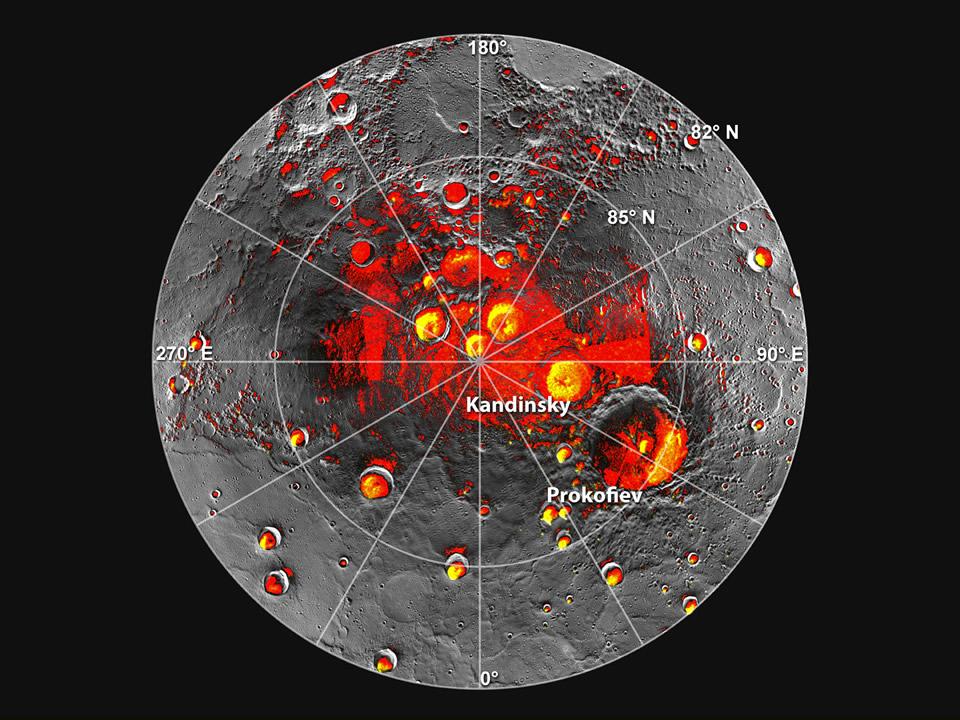
Composite image of the north pole of Mercury. Red are the areas of permanent shadow; yellow delineates radar bright deposits mapped from Earth. Data are plotted on a photomosaic of MESSENGER images [NASA].
Paul D. Spudis
Smithsonian Air & Space

Mercury – the planet, not the element – was in the news this past week.  For some time, we had suspected that the poles of Mercury might harbor deposits of water ice.  This – on a planet so close to the Sun that the surface temperature at the equator is hot enough to melt lead!

Yet like the Moon, Mercury’s spin axis is perpendicular to the plane in which it orbits the Sun.  This means that large craters near Mercury’s poles lie in permanent shadow (“shivering” around -170° C), unaffected by the Sun’s searing heat (equivalent to more than eleven times the solar flux we get on Earth).  As on the Moon, these permanently shadowed areas get heat from only two sources – the 3 K background heat of space, created during the Big Bang some 15 billion years ago, and whatever heat is being generated now from the deep interior (a quantity that geophysicists call the heat flow of a planet).

Large planets (like Earth) generate heat mostly from the decay of radioactive elements deep inside them.  This heat is lost largely through the phenomenon of volcanism, in which melted rock from the interior is erupted onto a planet’s surface as lava and ash.  Smaller planets and moons likewise experience this heating and volcanism, but because they are have lower overall contents of heat-producing elements, their volcanic episodes occurred in the distant past.  Much of the heat of these smaller planets has been largely dissipated.  Thus, on Mercury, we suspect that the overall heat flow is very low, resulting in extremely cold temperatures on the floors of its permanently shaded polar craters.

For many years, astronomers have studied Mercury with radio telescopes from Earth (using radar to make images of its surface).  Because the orbital inclination of Mercury is relatively high (about 7°), we can get a fairly good look into the interiors of the polar craters.  Interestingly, even though Mercury is much farther away than the Moon, we can see more of the mercurian polar areas because of this relatively high orbital inclination (the Moon’s orbital plane is inclined only 5°).  These radar pictures showed an amazing and unexpected feature – the dark areas are filled with material that is highly reflective at radio frequencies, properties similar to the surfaces of the icy moons of Jupiter (Europa, Ganymede and Callisto).

These results were so unexpected and startling that debate raged for many years whether these deposits really were what they appeared to be: water ice.  Facts are stubborn things and few materials have radio properties similar to ice.  Some suggested that sulfur might be an alternative explanation, but provided little evidence for such behavior.  Moreover, another moon of Jupiter, Io, which has a surface largely composed of sulfur, does not show the radar brightness or “glint” seen on the other, ice-rich Jovian moons.

The debate on the nature of the Mercury polar deposits has now been settled with the release of new data from the MESSENGER mission.  Launched on August 3, 2004, with insertion into obit around the planet on March 18, 2011, the spacecraft has been taking pictures and making measurements of Mercury for the last two years.  We have mapped the extent of darkness near the poles, measured the temperatures of the surface inside these regions, and detected the presence of significant amounts of hydrogen there.  All of these results are strongly supportive of the water ice interpretation.

The existence of ice near the poles of Mercury supports the case for water ice on our own Moon, although there are some significant differences between the two occurrences.  Like Mercury, the Moon’s spin axis is nearly perpendicular to the plane of its orbit around the Sun.  The similarity of the terrain of both bodies results in deep holes that hide large expanses of terrain from the glare and heat of the Sun.  Both objects have been volcanically active in the past, but not today, meaning that the average rates of heat flow on both are low.  These properties result in the creation of polar “cold traps” in which any entering volatile substance (such as water molecules) cannot escape.

The solid bodies of the inner Solar System are constantly hit by debris from comets and asteroids.  This material contains water, both in free form and bound within hydrous minerals.  On smaller objects (like the Moon and Mercury), most of this water is lost to space, but we suspected that some of it might be retained within these dark cold traps near the poles.  Now we know that such a process does occur.

Differences between the Moon and Mercury result in differing amounts and settings for their polar deposits.  Being much closer to the Sun, one might expect Mercury to contain less water ice, but a variety of evidence suggests that the opposite is the case.  The polar ice of Mercury appears to be greater in extent and thickness than comparable deposits on the Moon.  This probably results from two factors.  First, Mercury is a bigger object, with a surface gravity about twice that of the Moon.  Thus, it is more difficult for water to “escape” from Mercury.  Second, the closeness of Mercury to the Sun (the edge of biggest gravity well of the Solar System) results in a higher flux of cometary impacts there than experienced in the Earth-Moon system.  So more water is being added to Mercury, where it is more easily retained.

Nonetheless, both Moon and Mercury have similar polar environments and processes.  The long debate – a scientific controversy for over 50 years – about water at the poles of these objects has been resolved.  The next steps will be to characterize these deposits in situ using a soft lander and selected instruments to measure the amounts, states and distributions of water in the polar areas.  Because of the great difficulty in even getting into orbit around Mercury (let alone landing there), doing this first on the Moon will mostly likely happen first.  So, here again is another rationale for sending a robotic surveying lander and rover mission to the poles of the Moon – in addition to characterizing these areas for our future presence there, by inference, we will also learn about the polar processes on and environment of Mercury.

A planetary “two-fer.”  Let’s get on with it.

Originally published at his Smithsonian Air & Space blog The Once and Future Moon, Dr. Spudis is a senior staff scientist at the Lunar and Planetary Institute. The opinions expressed are those of the author and are better informed than average.

Sunday, July 15, 2012

'A Resolve to mine the Moon'

The Canadian Space Agency's unmanned Artemis Jr. rover with the NASA RESOLVE payload will undergo another season of testing on the Big Island of Hawai'i this year, and not Mare Crisium, as pictured above. Click HERE for a much larger and realistic rendering.
Brian Shiro
Astronaut for Hire
 

I will be on the beautiful Big Island of Hawaii next week working with the Pacific International Space Center for Exploration Systems (PISCES). As I've described in previous posts, PISCES is an international research and education consortium headquartered at the University of Hawaii at Hilo that aims to develop, test, and validate technologies for use on the Moon, Mars and beyond. When humans return to the Moon and journey to Mars, they will have to live off the land. It's just too costly to bring everything we need with us. That includes rocket fuel for the return trip, water, oxygen, and other consumables. Thus, it is critical that we learn how to utilize in situ resources if we are to establish permanent presences on other worlds.

As a geophysicist by profession, my interest lies with applying my terrestrial geophysical exploration knowledge to other planetary bodies. To this end, I carried out experiments at FMARS in 2009 and MDRS in 2010 to study the human factors elements associated with astronaut-conducted geophysical surveys to prospect for subsurface resources like water. I presented my findings at the Lunar and Planetary Science Conference and Lunar Science Forum, the results of which became my UND master's thesis. Now, I am embarking on a Ph.D. at the University of Hawaii to take this work to another level in analog environments such as Hawaii.

The main system being tested at PISCES this year is the Regolith and Environment Science and Oxygen and Lunar Volatile Extraction (RESOLVE) experiment. This consists of a lunar rover and drill provided by the Canadian Space Agency (CSA) to support a NASA payload that turns regolith (dirt) into rocket fuel, water, and air. A system developed from the RESOLVE prototype may travel to the Moon in the next few years to prove that water seen from orbit is accessible and that useful products can be made from it.  It could be the key that finally makes the solar system accessible to humans in a safe, cost-efficient manner.

Read Brian's entire post at Astronaut for Hire, HERE.

Monday, March 19, 2012

Cosmic ray flux effects lunar ice

Space scientists from the University of New Hampshire and colleagues report they have quantified levels of radiation on the Moon's surface from galactic cosmic ray (GCR) bombardment that over time causes chemical changes in water ice and can create complex carbon chains similar to those that help form the foundations of life.

The radiation process causes the lunar regolith to optically mature (OMAT), or darken, over time; important in understanding the geologic history of the Moon.

Scientists present their findings online in the American Geophysical Union's Journal of Geophysical Research. "Lunar Radiation Environment and Space Weathering from the Cosmic Ray Telescope for the Effects of Radiation (CRaTER)," is based on measurements made by the CRaTER instrument on-board NASA's Lunar Reconnaissance Orbiter (LRO). 

The paper's lead author is Nathan Schwadron, an associate professor of physics at the UNH Space Science Center within the Institute for the Study of Earth, Oceans, and Space (EOS). Co-author Harlan Spence is the director of EOS and lead scientist for the CRaTER instrument.

The telescope provides the fundamental measurements needed to test our understanding of the lunar radiation environment and shows that "space weathering" of the lunar surface by energetic radiation is an important agent for chemical alteration. CRaTER measures material interactions of GCRs and solar energetic particles (SEPs), both of which present formidable hazards for human exploration and spacecraft operations. CRaTER characterizes the global lunar radiation environment and its biological impacts by measuring radiation behind a "human tissue-equivalent" plastic.

Serendipitously, the LRO mission made measurements during a period when GCR fluxes remained at the highest levels ever observed in the space age due to the Sun's abnormally extended quiet cycle. During this quiescent period, the diminished power, pressure, flux and magnetic flux of the solar wind allowed GCRs and SEPs to more readily interact with objects they encountered -- particularly bodies such as our Moon, which has no atmosphere to shield the blow.
The arrival of cosmic rays at Earth, far more of a threat to survival than solar radiation, more than doubles on average when the Sun is relatively quiet. The peak in neutron flux since 1958 (at right) occurred during the unusually long solar minima 2009-2010, "serendipitously" coincident to the beginning of LRO's mission and the CRaTER instrument on-board [Moscow Neutron Monitor].
"This has provided us with a unique opportunity because we've never made these types of measurements before over an extended period of time, which means we've never been able to validate our models," notes Schwadron. "Now we can put this whole modeling field on more solid footing and project GCR dose rates from the present period back through time when different interplanetary conditions prevailed." This projection will provide a clearer picture of the effects of GCRs on airless bodies through the history of the solar system.

Moreover, CRaTER's recent findings also provide further insight into radiation as a double-edge sword. That is, while cosmic radiation does pose risks to astronauts and even spacecraft, it may have been a fundamental agent of change on celestial bodies by irradiating water ice and causing chemical alterations. Specifically, the process releases oxygen atoms from water ice, which are then free to bind with carbon to form large molecules that are "prebiotic" organic molecules.

In addition to being able to accurately gauge the radiation environment of the past, the now more robust models can also be used more effectively to predict potential radiation hazards spawned by GCRs and SEPs.

Says Schwadron, "Our validated models will be able to answer the question of how hazardous the space environment is and could be during these high-energy radiation events, and the ability to do this is absolutely necessary for any manned space exploration beyond low-Earth orbit."

Indeed, current models were in agreement with radiation dose rates measured by CRaTER, which together demonstrates the accuracy of the Earth-Moon-Mars Radiation Environment Module (EMMREM) being developed at UNH. EMMREM integrates a variety of models describing radiation effects in the Earth-Moon-Mars and interplanetary space environments and has now been validated to show its suitability for real-time space weather prediction.

Tuesday, October 26, 2010

Lunar Beagle and Lunar Astrobiology


Beagle 2 lander deployed in an idealized position. The Position Adjustable Work Station (PAW) is positioned for analysis of a rock and the Mole is ready to move across the surface.

Gibson, Pillinger & Waugh

The study of the elements and molecules of astrobiological interest on the Moon can be made with the Gas Analysis Package (GAP) and associated instruments developed for the Beagle 2 Mars Express Payload.

The Beagle 2’s analytical instrument package including the sample processing facility and the GAP mass spectrometer can provide vital isotopic information that can distinguish whether the lunar volatiles are indigenous to the moon, solar wind derived, cometary in origin or from meteoroids impacting on the Moon. As future Lunar Landers are being considered, the suite of instruments developed for the Mars Beagle 2 lander can be consider as the baseline for any lunar volatile or resource instrument package.

We suggest a possible package based on the Beagle 2 Mars lander, for delivery to a lunar polar region to conduct definitive studies in situ analysis of molecules of astrobiology importance.

Review the (pdf) proposal and rationale, HERE.

Friday, July 23, 2010

A Dark Cascade at Sulpicius Gallus


LROC Narrow Angle Camera (NAC) close-up of the wall of a suspected volcanic vent within the regional pyroclastic deposit near Sulpicius Gallus (19.69°N, 10.27°E). From LROC NAC Observation M124505982R (LRO orbit 3482, March 29, 2010), view is approximately 2 km in width. [NASA/GSFC/Arizona State University].

Lisa Gaddis
LROC News System

Although there are hundreds of sites on the Moon where explosive volcanism has occurred, there are several regional deposits of pyroclastic material that are especially extensive. These regional pyroclastic deposits include sites at Rima Bode, Sinus Aestuum, Mare Vaporum, and Sulpicius Gallus, and are collectively called "dark spots" because of their very dark appearance in telescopic images.

All of the regional pyroclastic deposits have largely rock-free surfaces that are thought to have large concentrations of micron-sized glass and partially crystalline spheres, similar to the glassy materials sampled by Apollo 17 astronauts at Taurus-Littrow Valley. These deposits likely formed in explosive eruptions (or "fire fountains") involving magma and some kind of volatile component. Both carbon monoxide and water have been considered as the source of the gas that drives such explosive eruptions on the Moon.


LROC Wide Angle Camera (WAC) monochrome mosaic of the Sulpicius Gallus region along the southwestern interior of Mare Serenitatis. The suspected volcanic vent is at the center of the Constellation Region of Interest delineated by the white box. Rima Sulpicius Gallus cuts through the area immediately to the north and a number of domes are also visible. (NOTE: Charles Wood, curator of the invaluable Lunar Picture of the Day (LPOD) website, provides detailed and experienced insight into this latest LROC WAC image HERE.)[NASA/GSFC/Arizona State University].

Where are the volcanic vents that were the sources of these widespread pyroclastic deposits?

Source vents for many of the larger pyroclastic deposits are difficult to identify, partly because they may have been mantled during explosive eruptions and/or buried by later volcanic material. In some cases, fractures, oddly shaped craters, or irregular depressions have been suggested as possible source vents. Such is the case for at least some of the pyroclastic material in the Sulpicius Gallus region, a Constellation Region of Interest, where a 5.5-km long "kidney-shaped depression" is considered a prime candidate for a volcanic vent.

This irregular depression was first noted by the crew of Apollo 17 as they looked down at the Moon from orbit. The fact that it lacked the prototypical features of an impact crater (raised rim, bowl shape) and that its walls and surroundings had an orange/red color similar to the orange pyroclastic glasses that were sampled at the Apollo 17 landing site made it quite distinct from the typical impact crater.

The LROC Narrow Angle Camera view of the wall of this suspected volcanic vent is similar to what the Apollo 17 crew would have seen from in orbit, albeit at higher resolution and in black and white (we rely on the LROC Wide Angle Camera for color).

In this image, the dark pyroclastic mantle at the surface has mixed with rubble and soil from the mare surface to create a small landslide or debris flow (~60 m wide) that has flowed down the wall onto the floor below. Several smaller flows can been seen and more coherent rocky layers are also observed at intervals within the wall, probably representing buried mare basalt layers.

The pyroclastic beads at sites such as Sulpicius Gallus are of high interest to lunar scientists for several reasons. They contain trapped hydrogen and Helium-3 from the solar wind, and these materials could be of high value for future in-situ energy production on the Moon. Enrichment of volatile elements such as sulfur and fluorine also have been measured on the surfaces of many of the pyroclastic beads in the Apollo sample collection, suggesting that these beads could provide lunar inhabitants with sources for these relatively rare elements. Finally, the glassy deposits are also rich in iron and titanium, which are of immense economic and engineering value to future lunar explorers.

Scroll through the full-resolution NAC frame here!

Thursday, November 26, 2009

Thanksgiving on the Moon: A Lunar Feast

Paul D. Spudis
The Once and Future Moon
Smithsonian Air & Space

We often hear the Moon described as a lifeless desert, a barren rock in space where nothing can survive. Although the Moon is certainly different from the Earth, it is hardly barren. From the 1970’s through the 1990’s (largely before we knew about the presence of water and other volatiles in the lunar polar regions) the late, lunar scientist Dr. Larry Haskin set forth some basic facts about the chemical composition of the Moon. Larry was a chemist by training and his view was that the Moon has all that we need – just not in the form in which we need it.

Larry wrote a very interesting paper for the 1988 Second Symposium on Lunar Bases. Over the years, I heard him give several different versions of this talk. Initially, he called it “Wine and Cheese from the Lunar Desert” but after deciding that he didn’t want to drive away or offend any teetotalers in his audience, he changed it, first to “Cola and Cheese” and then “Water and Cheese from the Lunar Desert.” Although the liquid varied, the cheese stayed.

Read the Post HERE.

Monday, September 7, 2009

Carbothermal Processing of Lunar Regolith using Methane

R. Balasubramaniam and U. Hegde
National Center for Space Exploration Research

S. Gokoglu
NASA Glenn Research Center
Cleveland, Ohio

The processing of lunar regolith for the production of oxygen is a key component of the ISRU, plans currently being developed by NASA. Among various candidate processes, the modeling of oxygen production by hydrogen reduction, molten salt electrolysis, and carbothermal processing are presently being pursued. In the carbothermal process, a portion of the surface of the regolith in a container is heated by exposure to a heat source such as a laser beam or a concentrated solar heat flux, so that a small zone of molten regolith is established. The molten zone is surrounded by solid regolith particles that are poor conductors of heat. A continuous flow of methane is maintained over the molten regolith zone. Our model is based on a mechanism where methane pyrolyzes when it comes in contact with the surface of the hot molten regolith to form solid carbon and hydrogen gas.

Carbon is deposited on the surface of the melt, and hydrogen is released into the gas stream above the melt surface. We assume that the deposited carbon mixes in the molten regolith and reacts with metal oxides in a reduction reaction by which gaseous carbon monoxide is liberated.

Carbon monoxide bubbles through the melt and is released into the gas stream. Oxygen is produced subsequently by (catalytically) processing the carbon monoxide downstream. In this paper, we discuss the development of a chemical conversion model of the carbothermal process to predict the rate of production of carbon monoxide.

Download the presentation, HERE.

Tuesday, August 11, 2009

Mysterious Mars methane

Where does it come from.
(How does it last?)

Source: Space Pragmatism

Teachers and Franck Lefevre Francois Forget, University Pierret Marie Curie in Paris, used a computer model of the Martian atmosphere to apply the observations made previously by a team from the Goddard center of the NASA Astrobiology U.S.. Last January, U.S. scientists confirmed in the journal “Science” the existence of methane in the atmosphere of Mars, which, they said, is proof that this planet remains active, biologically or geologically.

Spectrometers for NASA telescopes in Hawaii detected in 2003 on the surface at least three stelae of this gas, which is a key to life as known on Earth. They noted that “the atmosphere of Mars quickly destroys methane in various ways,” which suggests that there must be a process issue, as explained by Michael Mumma, of the Space Flight Center of NASA in Maryland.

In the study published today, the French experts noted the difficulty of identifying patterns of behavior of gas in the red planet using the current atmospheric chemistry or physics that applies to terrestrial processes.

Methane has photochemical cycle of several centuries, it is expected to have a uniform distribution on the planet.

However, the observations on Mars indicate that the gas presents spatial and temporal variations (depending on the season). “It happens something else, something that lowers the life cycle of methane by a factor of 600. If the measurements are correct, we are missing something important,” Lefevre said in a statement by the British public channel BBC.

If these changes are confirmed, would imply that the gas is destroyed very quickly, which would suggest that the planet is in a very difficult environment for the survival of organic components.

Methane, whose molecule consists of one carbon atom attached to four hydrogen (CH4) is the main component of natural gas on Earth, and is also involved in other geological processes such as the oxidation of iron.

Moreover, many living organisms on Earth emit gas during the process of digestion of nutrients. Scientists currently unknown whether the methane on Mars is the product of biological or geological processes such as volcanic activity.

Sunday, May 31, 2009

Spudis: The not so barren Moon

Dr. Paul Spudis checks in to remind us of something soft-spoken Dr. Harrison H. "Jack" Schmitt has quietly been insisting upon since at least as long ago as the Lunar Prospector mission. Regardless of whether we prove water is abundant on the Moon, we already know with far more certainly that hydrogen is is there, and it is also available in the same Near Side basins where titanium oxide and iron oxides are located (and where Helium-3 probably makes up twenty percent by weight of the surface layer.)

From the his new blog posting at The Once and Future Moon
Smithsonian Air & Space

Can we be "resourceful on the Moon? (Part 1)

"It’s often said that the Moon is resource-poor. That is inaccurate; the Moon is resource different. It is depleted in volatile substances (those that have very low melting points). The most important rare resource on the Moon is hydrogen. The Moon itself has very little of this element, but the soils have a great deal of it; because the Moon has no atmosphere or global magnetic field, the stream of protons from the Sun (the solar wind) implants hydrogen onto the surface of the dust grains on the Moon. This solar wind hydrogen can be released through heating of the dust. When you have both hydrogen and oxygen, you have air, water, and rocket propellant."

"The typical hydrogen concentration in most soils is 20 to 100 parts per million. This is enough quantity to extract and use, especially if much of the mining and processing work is done through robotic machines operated from Earth. Hydrogen appears to be present in higher quantities in soils that have high titanium content, which are abundant on the lunar near side (the Apollo 11 landing site has one of the highest titanium contents found on the Moon to date)."

(That's true, by the way. No question.)

"Now there are even more exciting resource prospects. The Moon has abundant hydrogen at the poles, enriched by more than a factor of three over the global average. Some of this hydrogen, present in the permanently dark and cold floors of polar craters, may be in the form of water ice. Additionally, with the spin axis of the Moon perpendicular to the plane of its orbit around the Sun, some peaks near the poles appear to be in near-permanent sunlight, permitting continuous collection and use of solar electrical power, as well as the important benefit of a near constant surface temperature."