Showing posts sorted by relevance for query Wrinkle Ridge. Sort by date Show all posts

Tuesday, January 15, 2013

Really wrinkled wrinkle ridge

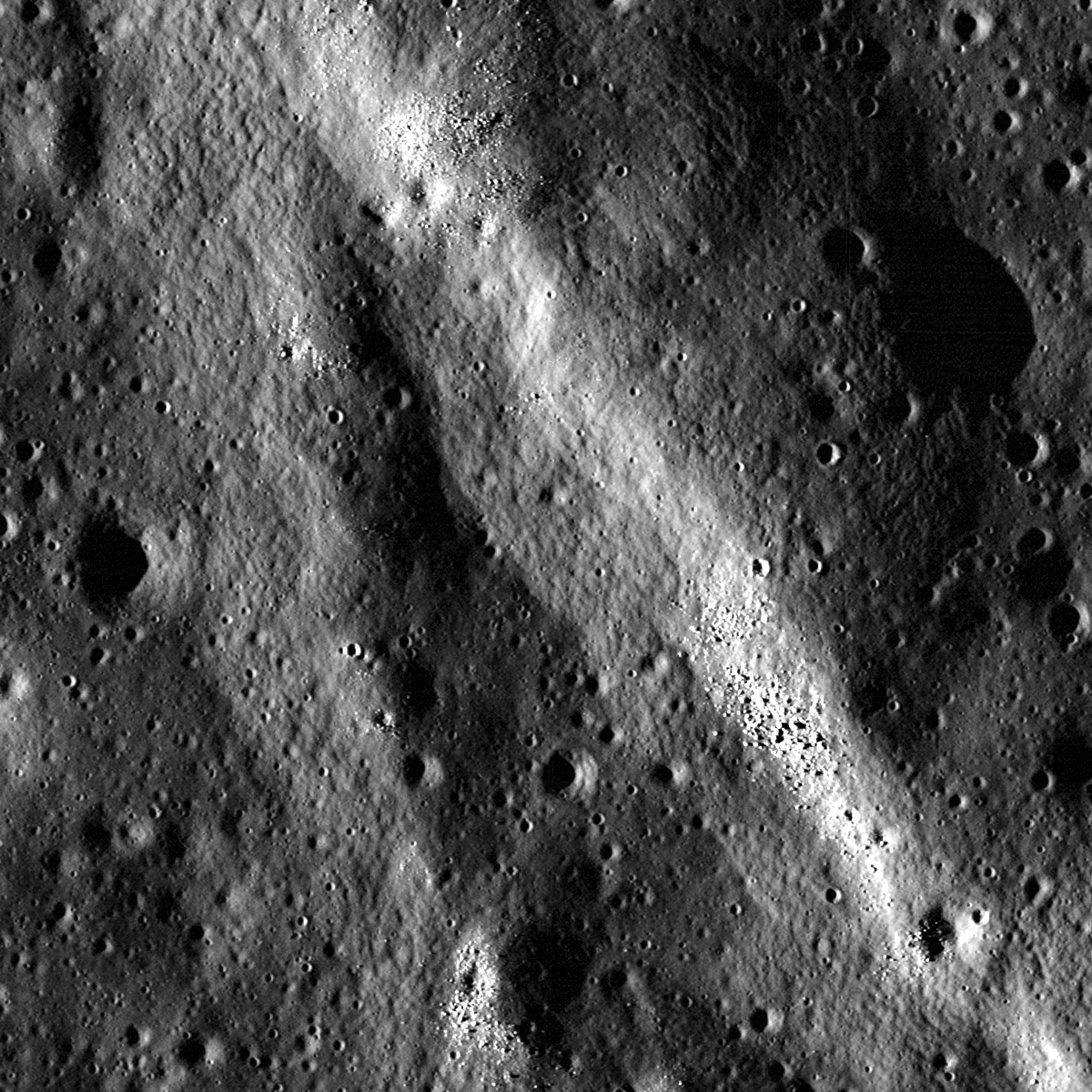
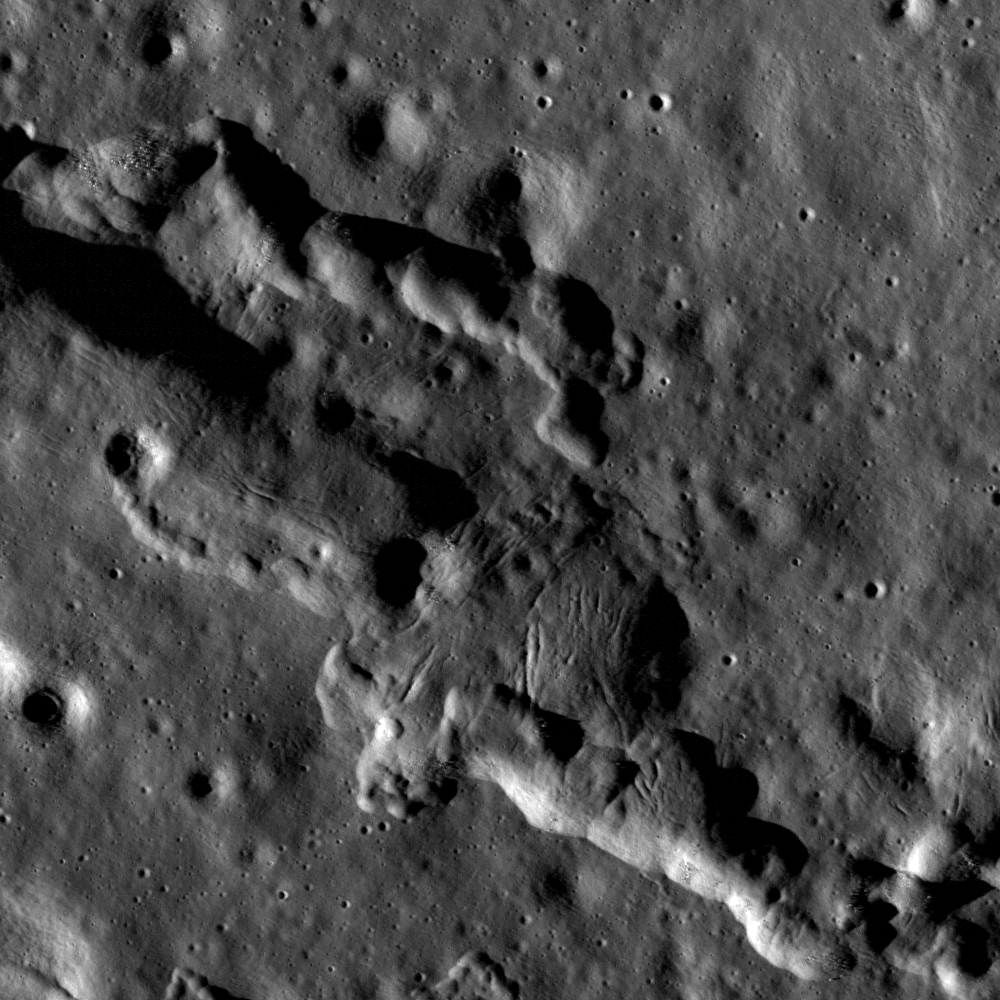
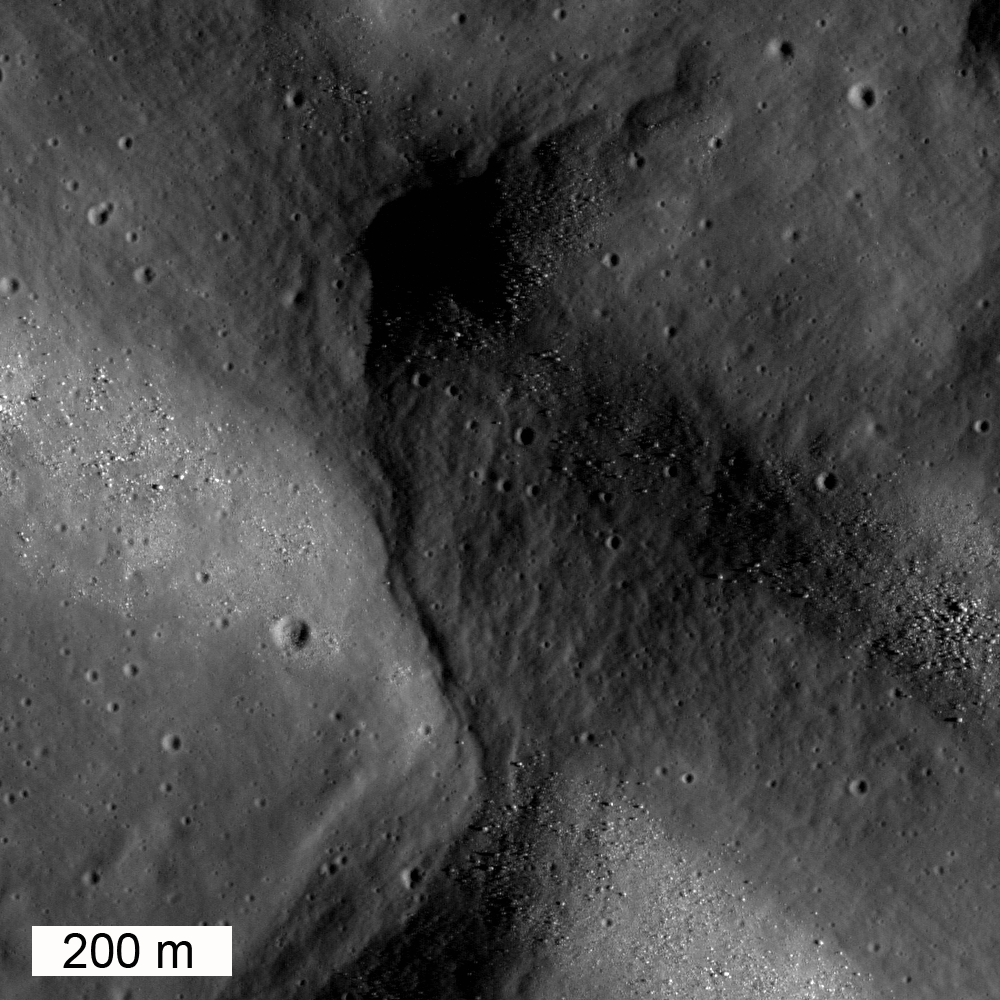
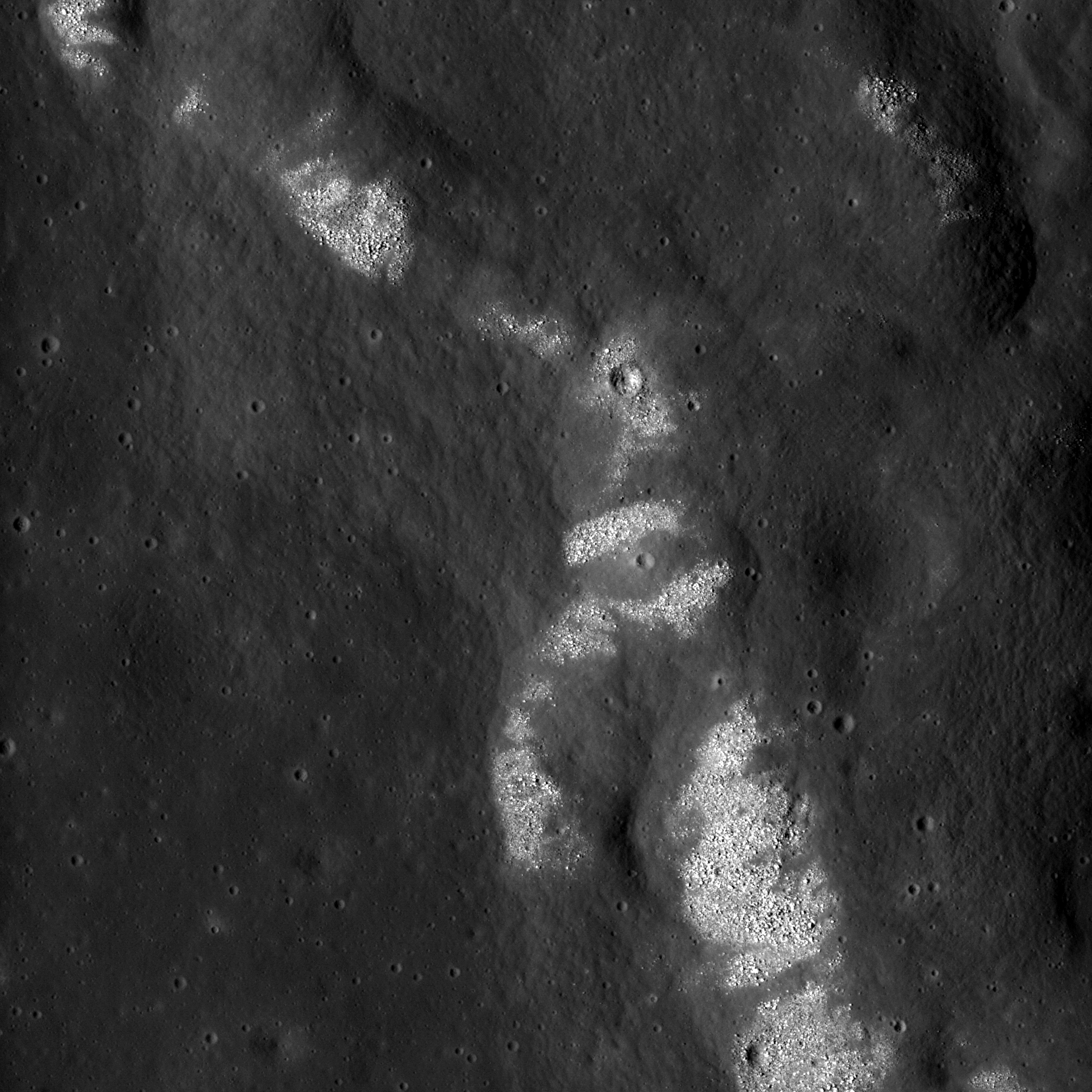
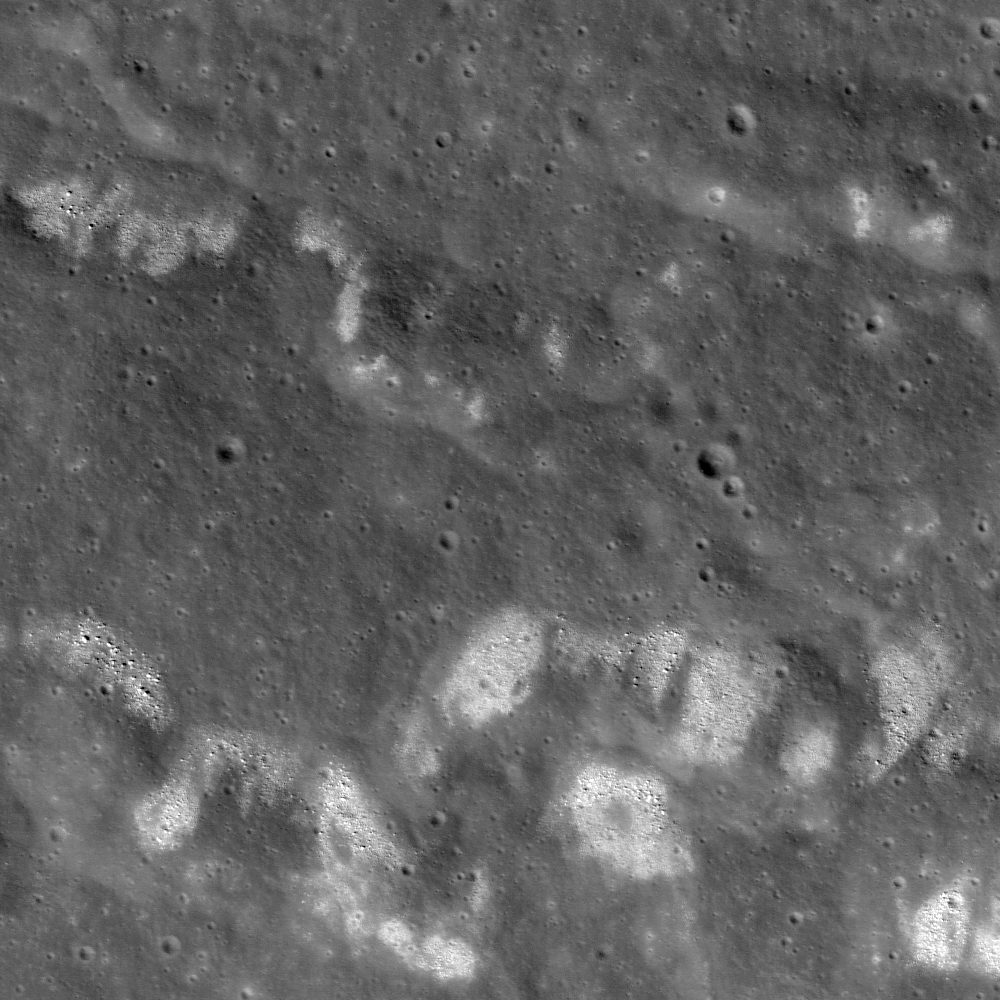
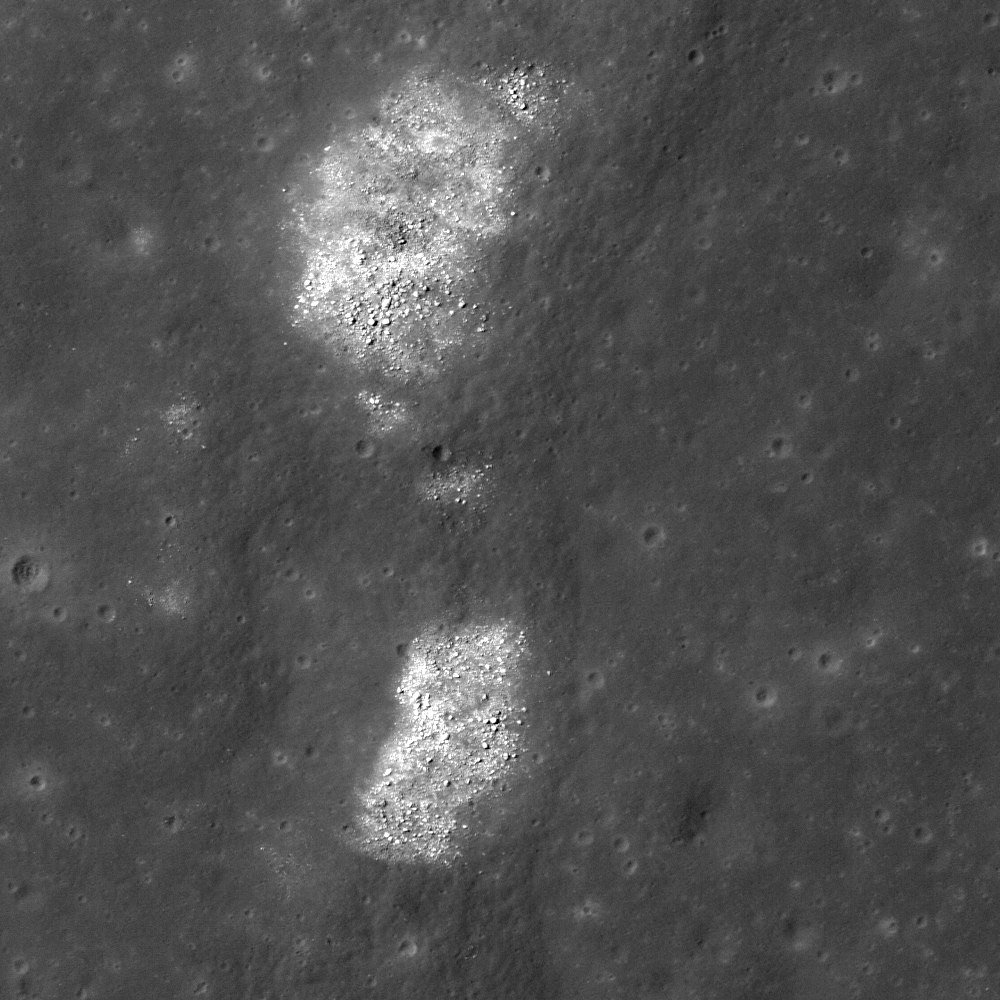
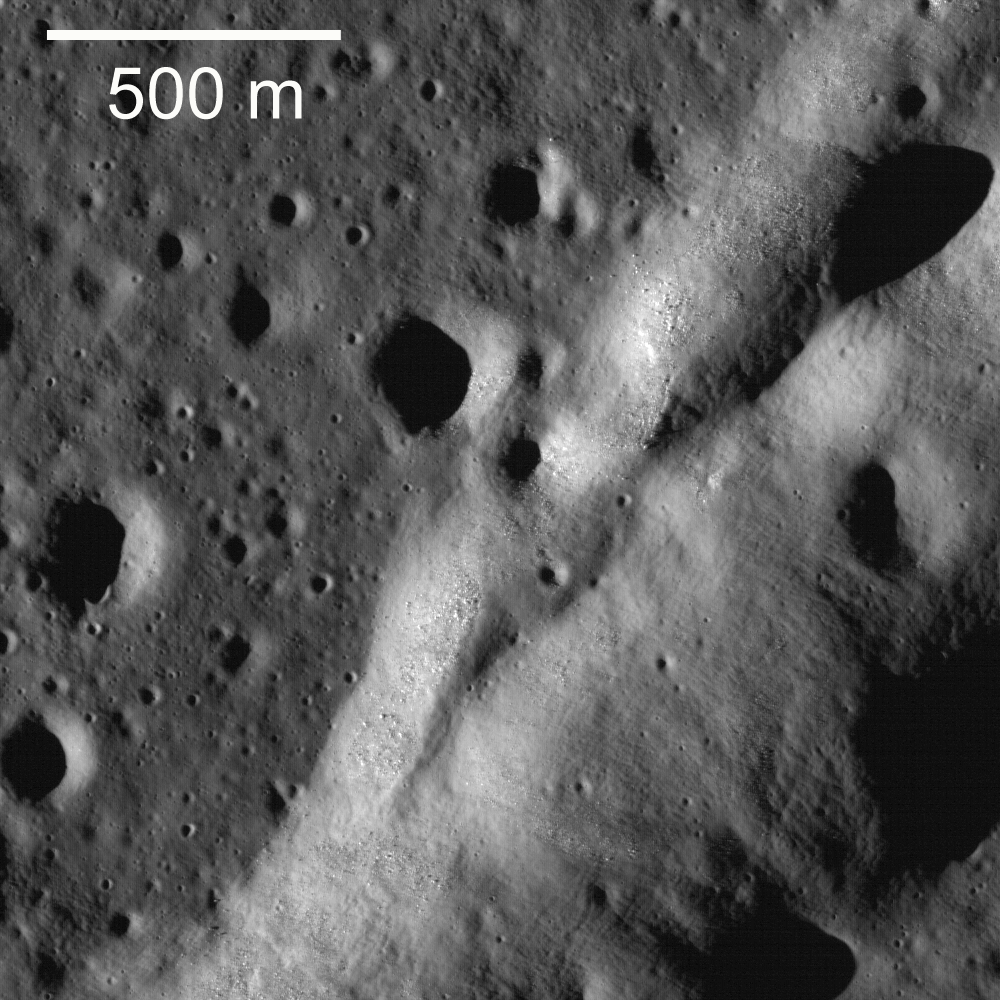
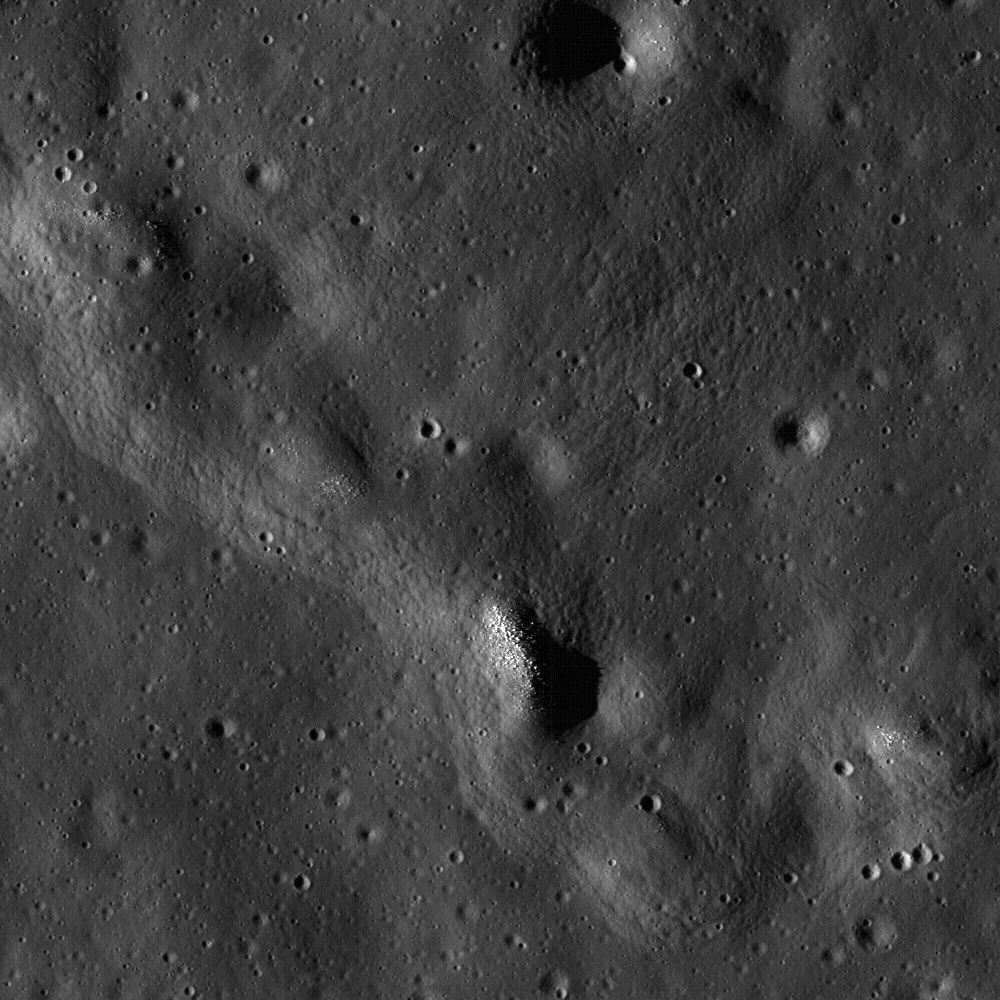
A wrinkle ridge in Mare Frigoris deformed the mare. LROC NAC M185963754R, spacecraft orbit 12484, March 9, 2012; image field of view is approximately 1.75 km, resolution 1.69 meters from 173.5 km  [NASA/GSFC/Arizona State University].
Lillian Ostrach
LROC News System

There are many wrinkle ridges throughout the lunar mare. These fascinating ridges are formed when contractional strain causes layers of mare basalt to fracture, a process that deforms the surface. Sometimes the wrinkle ridges are very sinuous and curvy, and other times wrinkle ridges are more linear and less undulatory.

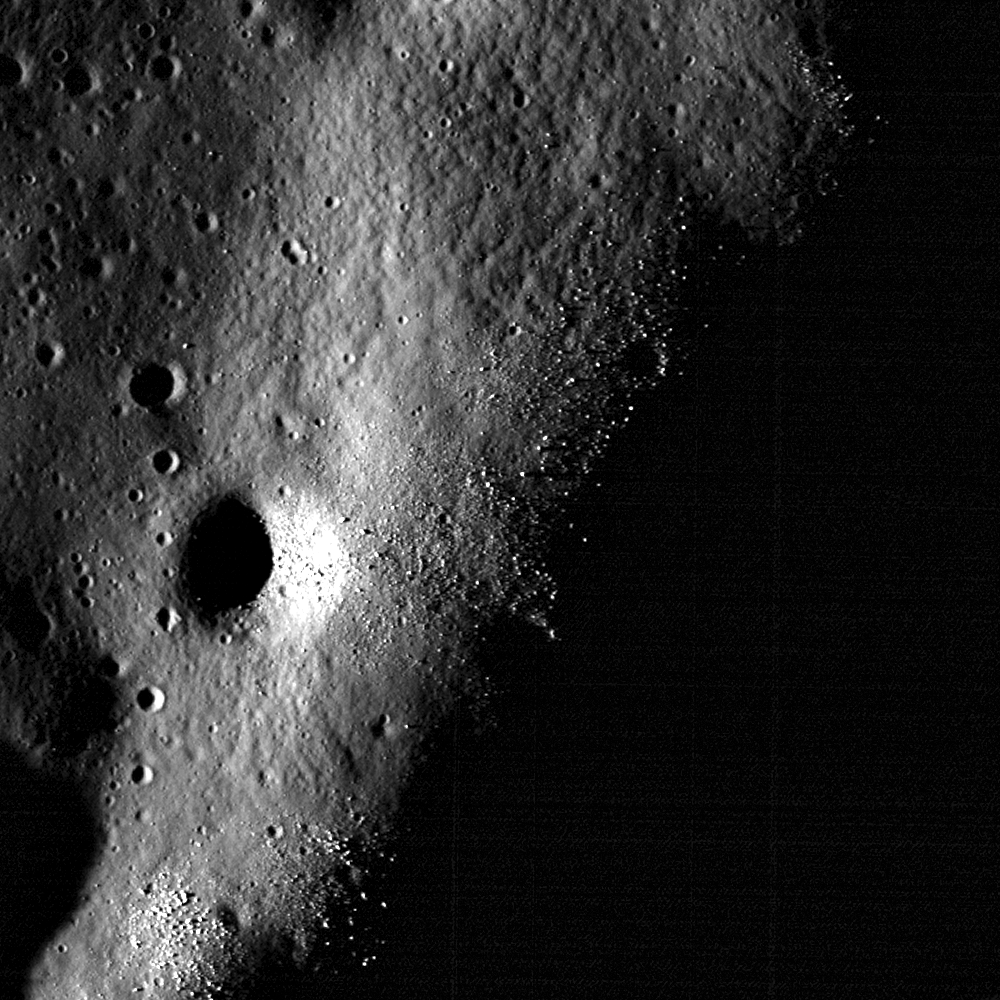
Today's Featured Image highlights a curvy wrinkle ridge in Mare Frigoris (61.492°N, 350.108°E) that is morphologically similar to other wrinkle ridges in this mare, yet today's wrinkle ridge is much smaller than many of the other wrinkle ridges in this region (see WAC context below). Like other wrinkle ridges in the mare, there are some portions of the wrinkle ridge that are covered with boulders and are slightly higher-reflectance than the remaining portion of the wrinkle ridge. Current understanding is that because the wrinkle ridge has a broad rise and a central steeper-sloped ridge, the steepest-sloped portions of the ridge crest fracture and begin to disaggregate and erode before the remainder of the wrinkle ridge.
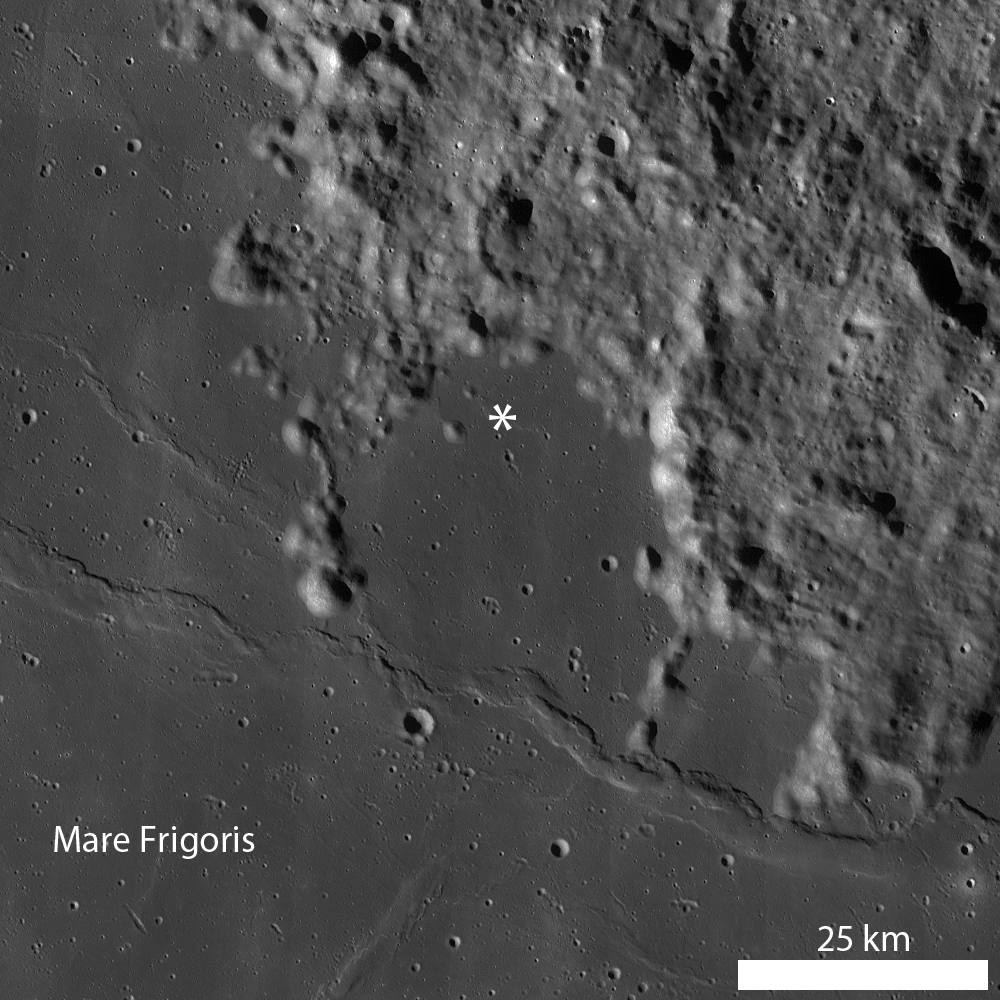
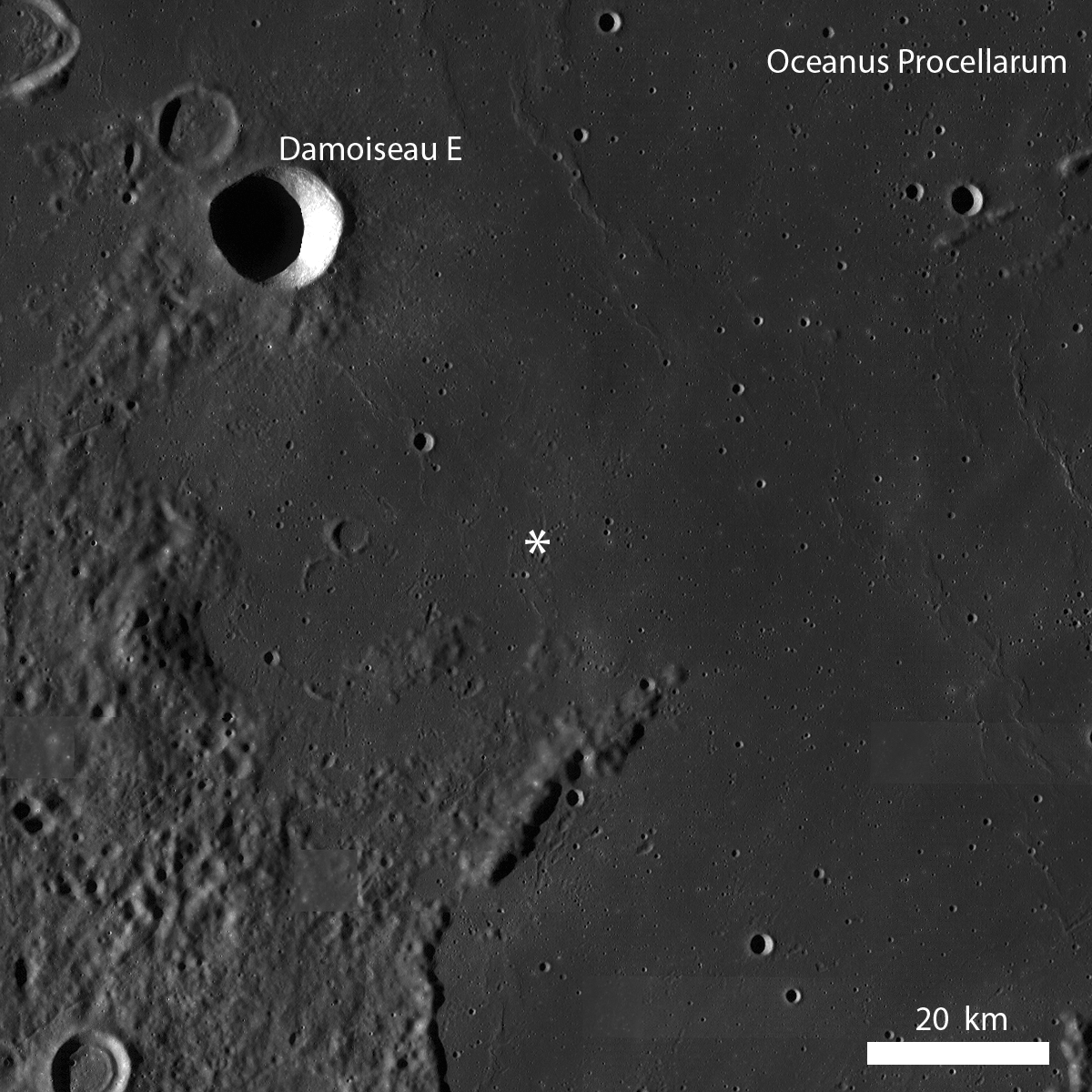
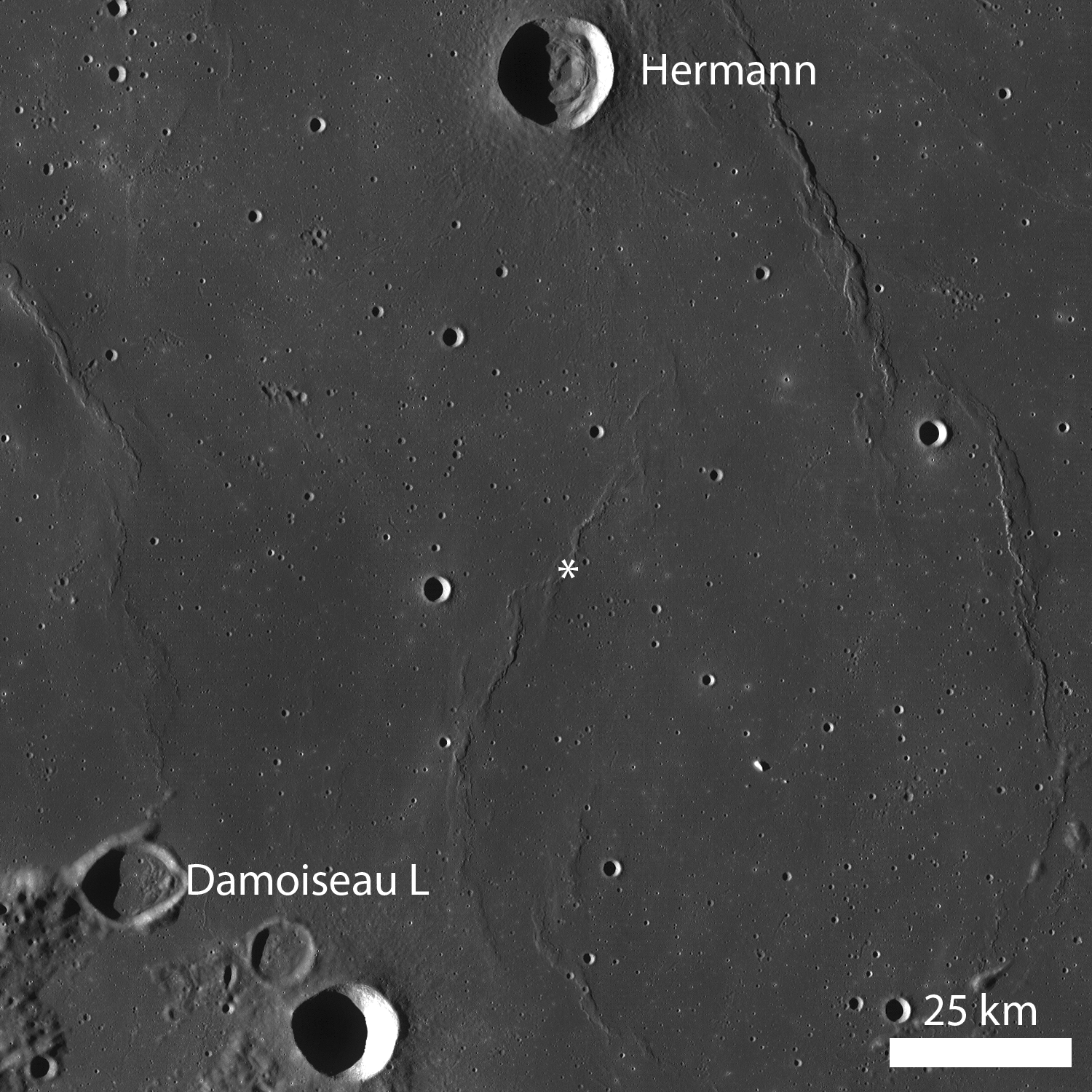
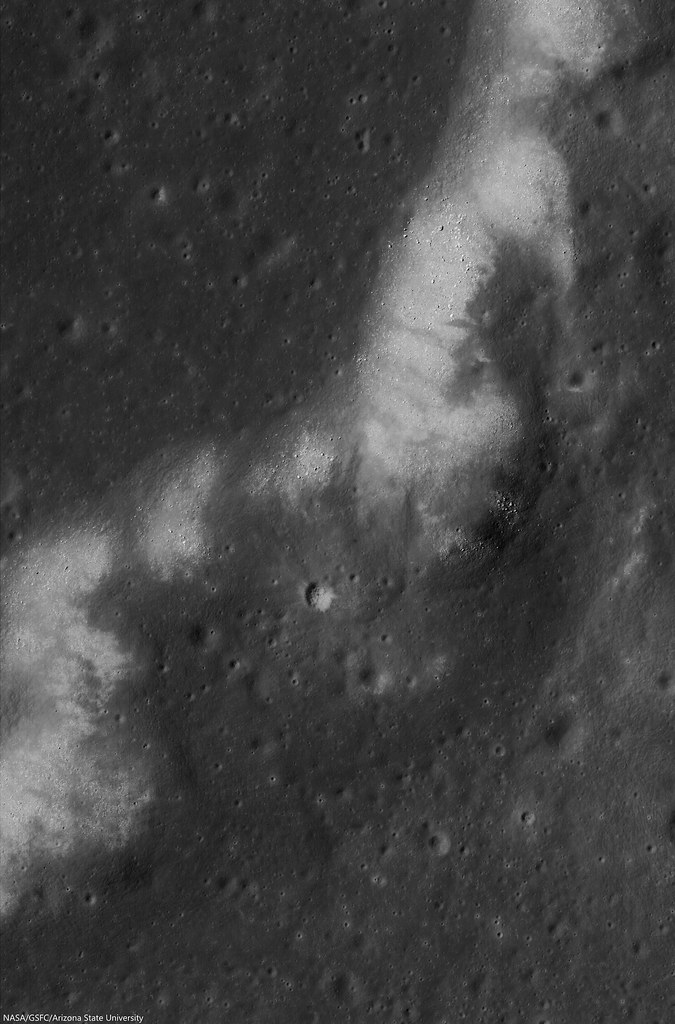
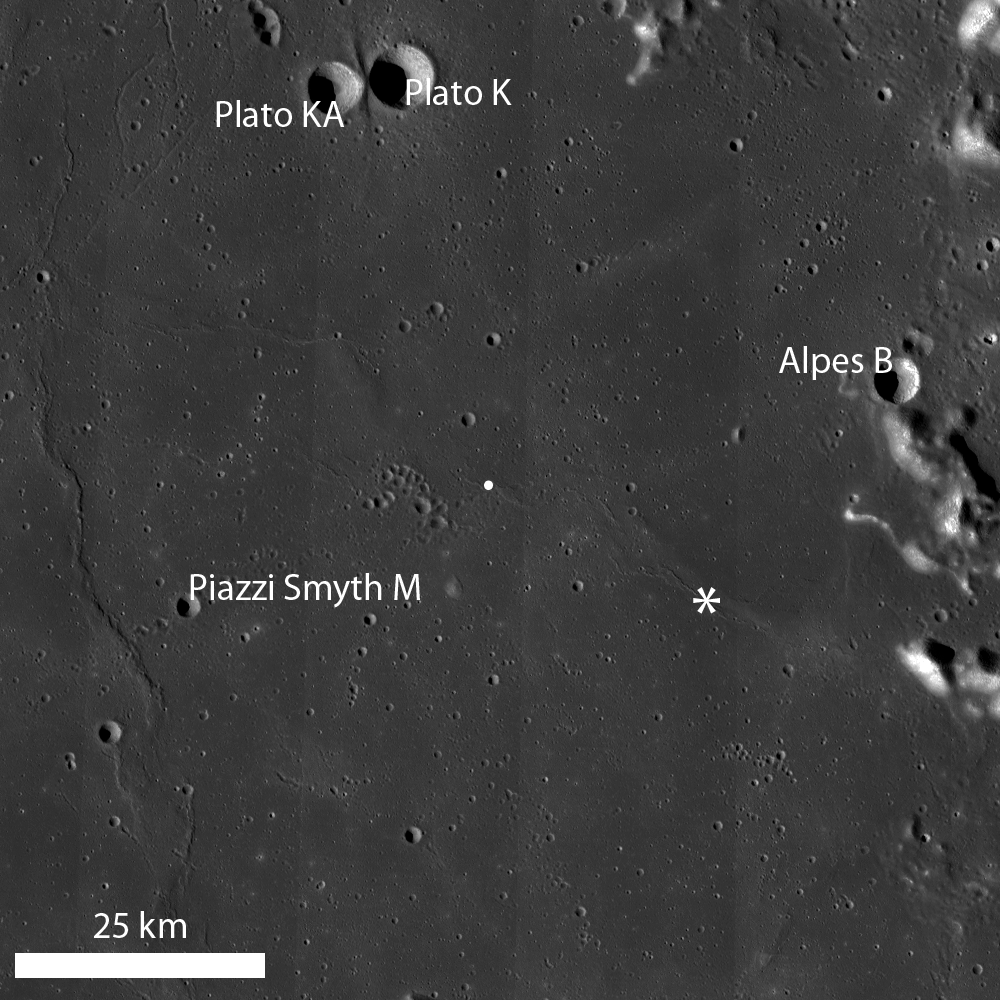
LROC WAC monochrome mosaic of the northern boundary of Mare Frigoris. The Frigoris basalts are heavily deformed by wrinkle ridges of various sizes; asterisk notes location of today's Featured Image [NASA/GSFC/Arizona State University].
Why, compared to other wrinkle ridges in this region, is today's wrinkle ridge so small? Consider the location of the wrinkle ridge in the WAC context image (above). The wrinkle ridge formed within the basalts infilling an old crater and is less than 10 km from the mare-highland boundary. It is possible that the mare-fill is thinner in this area, which would affect the degree to which the basalt could fault. This hypothesis is supported by the presence of several nearby kipukas, which were not covered by the embaying lava and probably affected the contractional strain in this area.

Further support for this hypothesis comes from observations of small wrinkle ridges in some mare-flooded craters that have much less basalt volumes than the flooded nearside basins. However, scientists have not yet identified all the wrinkle ridges in the mare, so it may be that many small wrinkle ridges are widespread that simply were unresolvable in older lunar images! Such an occurrence would make sense, especially when considering the range in sizes of lunar lobate scarps discovered by LROC1!

Do you see any evidence of kipukas affecting wrinkle ridge formation in the full LROC NAC image, HERE?

(1) For two recent publications, please refer to: Watters, T. R. et al., "Evidence of Recent Thrust Faulting on the Moon Revealed by the Lunar Reconnaissance Orbiter Camera," Science, 329, 936-940, 2010. Banks, M. E. et al., "Morphometric analysis of small-scale lobate scarps on the Moon using data from the Lunar Reconnaissance Orbiter," Jrnl. Geophys. Res., 117, E00H11, 2012.

Related Posts:
Boulders in the Sea of Serenity
Tectonics in Mare Frigoris
Forked wrinkle ridge
Wrinkle ridge in Oceanus Procellarum
Relative age relationships

Monday, July 5, 2010

Wrinkle ridge in Oceanus Procellarum


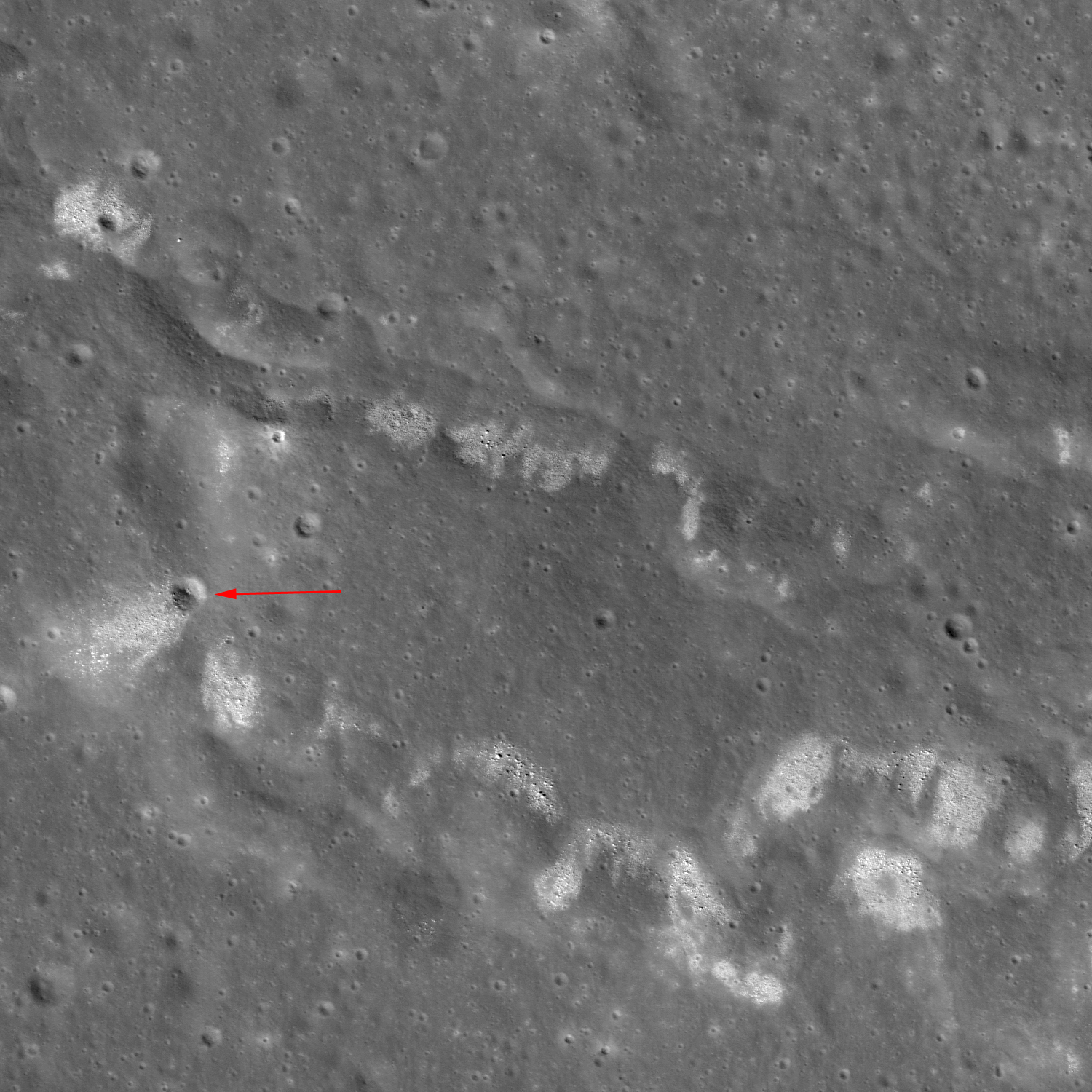
Exposed boulders are clustered on the crest of a sharply defined wrinkle ridge, much like sprinkles on an ice cream cone. Image width is 272 meters, and illumination is from the lower left in LROC NAC M117881169R (See the full-sized Featured Image, HERE.) [NASA/GSFC/Arizona State University]

Lillian Ostrach
LROC News System

The sinuous wrinkle ridge above is a small part of a larger wrinkle ridge, which in turn is part of a larger wrinkle ridge network located in southwestern Oceanus Procellarum. Wrinkle ridges are tectonic features resulting from compressive stresses and are of particular interest to scientists. The wrinkle ridge featured today has a well-defined broad rise (or ridge) and with numerous superposed wrinkles. In addition, boulders litter the crest of the ridge in some places, and most likely they eroded out of the fractured and faulted basalt forming the wrinkle ridge. However, when looking at the full LROC NAC image, there are only a few places along the wrinkle ridge where boulders are observed. No one really seems to know why boulders are present on some ridges but not others - a question lunar scientists are attempting to answer using LROC NAC data!


Backing up from the floor of Procellarum's Deep South, the complexities of the wrinkle ridge system here comes into view, part of an ancient preserve of transitory viscosities, long past. Evidence appears to show more than one event, more than a single interaction of materials, inside and out of the inundated, oblong Damoiseau L crater, immediately to the south [NASA/GSFC/Arizona State University].


Still higher, up to an "LRO's-eye-view" at 43.67 kilometers and the juxtapositions the right and left frames of LROC NAC M117881169 observation, January 11, 2010 (LRO orbit 2505) can be seen. This view also demonstrates a marked improvement in LRO photography over a relatively recent low-resolution background image [NASA/GSFC/Arizona State University/Google Earth v.5].

Just to the north of the WAC context image, there is a small wrinkle ridge ring (not nearly as large as the one in Mare Crisium). This wrinkle ridge ring formed when the compressive stresses creating the wrinkle ridge were changed by the presence of a buried crater. Tectonic features are influenced by regional, large-scale stresses (many 100s of km) and localized, smaller-scale stresses (10s of km). The presence of long wrinkle ridges in the mare are primarily the result of the regional stresses, probably caused by the weight of many layers of extruded basalts. The formation of tectonic features can also be influenced by local stresses, which may result from the presence of a particular geologic feature such as a buried crater or a hill. When features such as these exist, their localized stresses are greater than the large-scale regional stresses. This change in dominating stress field explains how a wrinkle ridge ring forms.


LROC WAC M117881131M context image of wrinkle ridges in southwestern Oceanus Procellarum. Arrow points at the portion of wrinkle ridge visible in today's Featured Image. Scene is ~82 km across [NASA/GSFC/Arizona State University].

How many boulder fields can you find on the wrinkle ridge in the full LROC NAC frame?

Wednesday, April 27, 2011

Forked wrinkle ridge


A wrinkle ridge in Oceanus Procellarum forks into two segments. Similar to many other wrinkle ridges, boulders are clustered on the ridge crest. LROC Narrow Angle Camera (NAC) observation M148536523L, LRO orbit 7023, January 1, 2011; field of view 720 meters. View the full-size LROC Featured Image, HERE [NASA/GSFC/Arizona State University].

Lillian Ostrach
LROC News System

Wrinkle ridges are fascinating tectonic features that are the surface manifestations of contraction and faulting. They are prevalent in the mare and have a distinct broad, low-relief arch with a more steeply-sloped ridge superposed on the arch. Many wrinkle ridges observed in LROC NAC images have boulders located somewhere along the ridge crest. In many cases (but not all!), the boulders are eroding out of the wrinkle ridge. How do we know this? Look at the opening image and the boulder clusters perched on the ridge crest. Do you see any fresh impact craters nearby from which the boulders might originate? In this section of the ridge, the answer is no - so the boulders most likely originate from wrinkle ridge erosion.


LROC Wide Angle Camera (WAC) monochrome mosaic of a portion of Oceanus Procellarum (6.4°S, 302.5°E) where many wrinkle ridges are found. The location of the LROC Featured Image posted April 26, 2011 is noted with an asterisk. View the full-size LROC WAC context image HERE [NASA/GSFC/Arizona State University].

Today's Featured Image highlights a bifurcation between two segments of a wrinkle ridge. The compressive stresses that produce faulting in the expansive lunar mare basalts are affected by both local, small-scale stresses (for example, a buried crater) and regional, large-scale stresses (for example, the effects of the weight of many meters of mare basalts extruded into one of the lunar basins). Such large-scale stresses probably influenced the wrinkle ridges observed in the LROC WAC context image (above), but the observation of a forked wrinkle ridge at the NAC scale probably means that smaller-scale stresses primarily influenced this wrinkle ridge. Perhaps there were pre-existing weaknesses in the local area where this ridge formed. Much less energy is needed to form a tectonic feature based around a pre-existing landform, like the rim of a buried crater mentioned above, and that could explain why wrinkle ridge splits into two (or joins, depending on how you look at it!). However, that is only one hypothesis explaining the forked wrinkle ridge - can you think of any other plausible hypotheses?

What do you think: is the wrinkle ridge splaying apart or are two separate wrinkle ridges joining together? Explore this feature in the full LROC NAC image!

Related Posts:
Wrinkle Ridges in Aitken crater!
Bright ridge near Mons Hansteen
Boulder clusters on a ridge crest
Right Angle


Full 1500 meter-wide sample of the LROC NAC frame [NASA/GSFC/Arizona State University].

Thursday, July 14, 2011

LROC: Stress and Pull


Cracks - not boulders! - abound on the ridge crest of this wrinkle ridge in northeastern Mare Imbrium, not far from Mons Pico. LROC Narrow Angle Camera (NAC) observation M102171046LR, LRO orbit 234, July 14, 2009. Image field of view is 1.7 kilometers. View the full-size LROC Featured Image HERE [NASA/GSFC/Arizona State University].

Lillian Ostrach
LROC News System

Wrinkle ridges are the result of compressional stresses, formed by faults when the rocks fracture due to squeezing (contractional strain). Unlike many of the wrinkle ridges previously featured, today's wrinkle ridge does not have boulders nor high-reflectance material, rather it exhibits unusual groups of linear features along the ridge crest. A quick look at the illumination direction (from the lower left in the opening image) shows that these features are negative relief features - troughs formed by fractures or cracks along the ridge crest.


A closer view [NASA/GSFC/Arizona State University].

These cracks do not have a single orientation: they are parallel to the ridge crest, perpendicular to the ridge crest, and angles in between. The cracks range from ~2 m to ~10 m in width and ~30 m to ~150 m in length.

The big question is - how did these cracks form?


LROC Wide Angle Camera monochrome mosaic of northeastern Mare Imbrium. LROC Featured Image July 14, 2011 (asterisk) is located southeast from the are spotlighted two days previously (dot). View the full-size LROC WAC context image HERE [NASA/GSFC/Arizona State University].

Open fractures in rocks are usually extensional features, resulting from tensional stress that pulls or stretches rocks and regolith in different directions. The stresses associated with crack formation are opposite to the compressional stresses that form wrinkle ridges, so what is going on? Wrinkle ridges are formed by thrust faults, and looking at the opening image, you can see that the rocks from the upper right side were pushed up over the rocks on the lower left, but not in a straight line. Most wrinkle ridges on the Moon are sinuous or arcuate in morphology, reflecting the local differences in mechanical properties of the rocks in which they form. Where do the cracks fit into this overall compressional story?

When the mare basalts break and thrust upward, the layer of rock that forms the wrinkle ridge folds (see Figure 26 here). Sometimes cracks form on the wrinkle ridge crest because the folded rock is now bending and in extension (pulling apart) at the crest of the fold. But wait! This explanation only addresses the tensional cracks that are parallel to the ridge crest, not the cracks that are oriented in other directions. The cracks with different orientations probably reflect extension too, especially because this wrinkle ridge is very complex and sinuous. It is possible that folding not parallel to the main ridge or multiple secondary thrust faults may be responsible for the complexity of the wrinkle ridge, and that complexity promotes tensional stresses with orientations that we might not normally expect. Additional scientific exploration of this wrinkle ridge may help disentangle the story of stress, as will comparative studies to other wrinkle ridges in the vicinity. Comparisons may be difficult to make because there is only one other well-known wrinkle ridge with similar open fractures: Littrow Ridge near the Apollo 17 landing site (Figure 75 from Apollo Over the Moon). However, a survey at the LROC NAC scale of lunar wrinkle ridges is not yet complete, so there may be many other similar cases. Have a look!

Feeling adventurous? Explore the full LROC NAC to see if there are tension cracks along the length of the wrinkle ridge!

Related Posts:
Zebra Stripes
Bright ridge near Mons Hansteen
Wrinkled Planet
Right Angle
Boulder clusters on a ridge crest

Thursday, March 24, 2011

Boulder clusters on a ridge crest


Boulders, between 1 and 6 meters in diameter, cluster on a wrinkle ridge crest in Oceanus Procellarum. Image field of view is 600 meters across. LROC Narrow Angle Camera (NAC) observation M148536582R, LRO orbit 7023, January 1, 2011. See the full-sized LROC NAC image release HERE [NASA/GSFC/Arizona State University].

Lillian Ostrach
LROC News System

The LROC NAC observes boulders and blocks located in and around many geologic features on the lunar landscape. How did the boulders get there? Some blocks are observed in ejecta blankets (and the crater itself!) and others are eroding out of sinuous rille walls and the central peaks of craters. Yet others, like the LROC NAC close-up above, highlights boulders that are eroding out of a wrinkle ridge crest.

Today's Featured Image is located to the east of a previous post that examined the presence of several boulder clusters at the crest of a wrinkle ridge in Oceanus Procellarum (see LROC WAC mosaic below for context).


LROC Wide Angle Camera (WAC) monochrome mosaic featuring the wrinkle ridge in the opening NAC image, noted with an asterisk. See the very full-sized (1500 x 1500) context image release HERE [NASA/GSFC/Arizona State University].

Unlike the wrinkle ridge to the west, today's wrinkle ridge crest is nearly covered in clusters of boulders ranging from about 1 - 6 m in diameter. However, while most of these blocks originate from the ridge itself and are erosive products, there is an ~115 m diameter crater superposed on the wrinkle ridge with boulders scattered along the illuminated wall. Could some of the boulders on the wrinkle ridge be a result of this impact event? Certainly! To test this hypothesis, look for small indentations where the ejected boulder hit the surface. However, if you look carefully at the opening image, there are no boulders on the western rim of the crater, and, of course, the shadow along the western crater wall makes it very difficult to tell if there are boulders there.

It is possible that the boulders on the illuminated portion of the crater wall are a result of post-impact modification and erosion within the crater itself and that these boulders are not from the top of the ridge - there are no visible boulder trails. Based on these observations, the boulders probably are eroded (and eroding!) fragments of ridge material fractured during deformation, and while LROC scientists do not have a definite answer at this time, they are analyzing hundreds of LROC NAC images with bouldery wrinkle ridges to try to solve this question!

Take a look at the length of the wrinkle ridge in the full LROC NAC frame - is there any evidence that some boulders do not originate from the ridge crest?

Related posts:
Wrinkle ridges of northwest Mare Imbrium
Constellation Region of Interest at Mare Tranquillitatis
Crisium's Constellation Region of Interest
Wrinkle ridge in Oceanus Procellarum
Wrinkle Ridge Near Montes Teneriffe


Thursday, January 3, 2013

Up and Down, Back and Forth

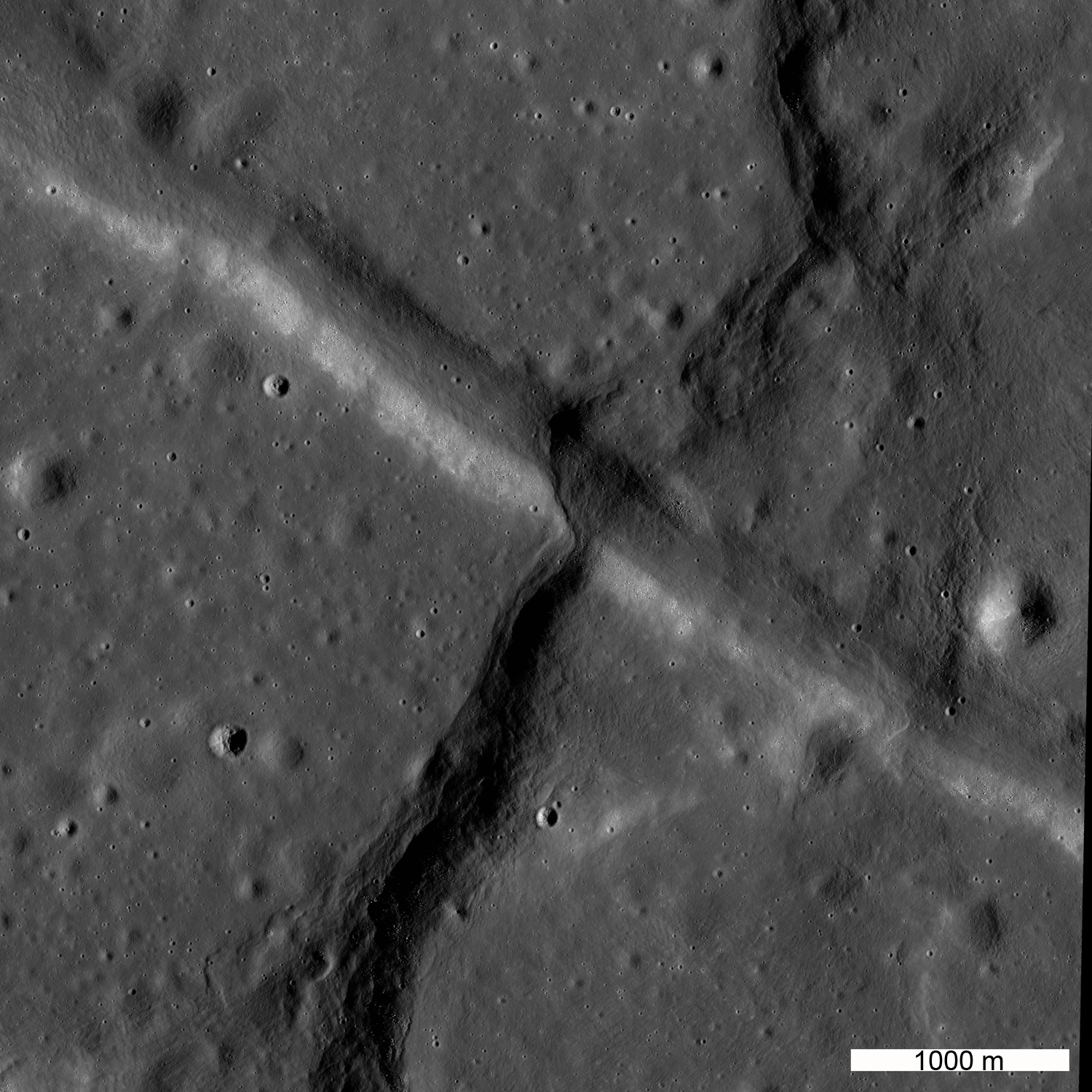
Compression and extension in Mare Tranquillitatis. A northeast-trending wrinkle ridge has overridden a northwest-trending graben. LROC Narrow Angle Camera (NAC) image M192774961L, LRO spacecraft orbit 13437, May 27, 2012; angle of incidence 69.44° at 0.96 meters resolution from 115.91 km [NASA/GSFC/Arizona State University].
Jeffrey Plescia
LROC News System

Today's Featured Image shows the amazing intersection of a northeast-trending wrinkle ridge and a northwest-trending graben, both found in Mare Tranquillitatis (intersection is located at 9.2°N, 27.66°E).

This juxtaposition of structures indicates that the area was extended in a NE-SW direction pulling the surface apart and forming the graben. Later, it was compressed along a NW-SE direction pushing the surface together and forming the wrinkle ridge.

Structural stresses in the crust are not always simple! Another large scale example of this type of intersecting compression and extension environments exists in eastern Mare Tranquillitatis at Cauchy rupes and rimae.

Larger view of the area in the Featured Image. The wrinkle ridge extends to the northeast and southwest changing morphology from narrow to wide. Sun is coming from the east (right). LROC NAC image M192774961L [NASA/GSFC/Arizona State University].
The width of the ridge varies from about 700 m to more than 2500 m, it is about 120-150 m high adjacent to the graben. Large variation in the width of wrinkle ridges is common.  In this case, the thrust fault that formed the ridge is interpreted to dip to the southeast, based on the asymmetry of the topography (the northwest side of the ridge has a steep slope and the southeast side has a gentle slope).

The lunar surface exhibits a variety of tectonic features that are produced when the stresses in the crust exceed the strength of the rock and the rocks break.  Depending upon the magnitude of the stress, the strength of the rock, and the orientation of the stress different types of tectonic features are produced. The two most common on the Moon are graben and wrinkle ridges. Graben are narrow blocks of the crust that have been down-dropped between two normal faults. Wrinkle ridges are thrust faults in which a part of the shallow crust has been thrust over the adjacent area; the upper part of the crust has been folded like an anticline into the wrinkle.

LROC Wide Angle Camera context, the graben -wrinkle ridge intersection below left center in a composite of three sequential orbital WAC observations collected December 12, 2010 (orbits 6767-6769), averaging 73° angle of incidence, 62 meters per pixel resolution from 45 km [NASA/GSFC/Arizona State University].
In this particular location the type of stress reversed over time. First there was an northeast-southwest directed extension that produced the graben, which is about 500-700 m wide and extends for more than 50 km to the northwest. Later, the crust was compressed along a northwest-southeast direction that resulted in the wrinkle ridge.  This ridge is part of a system of wrinkle ridges that extend southwest from a ridge of exposed older highlands material ~30 km to the northeast.

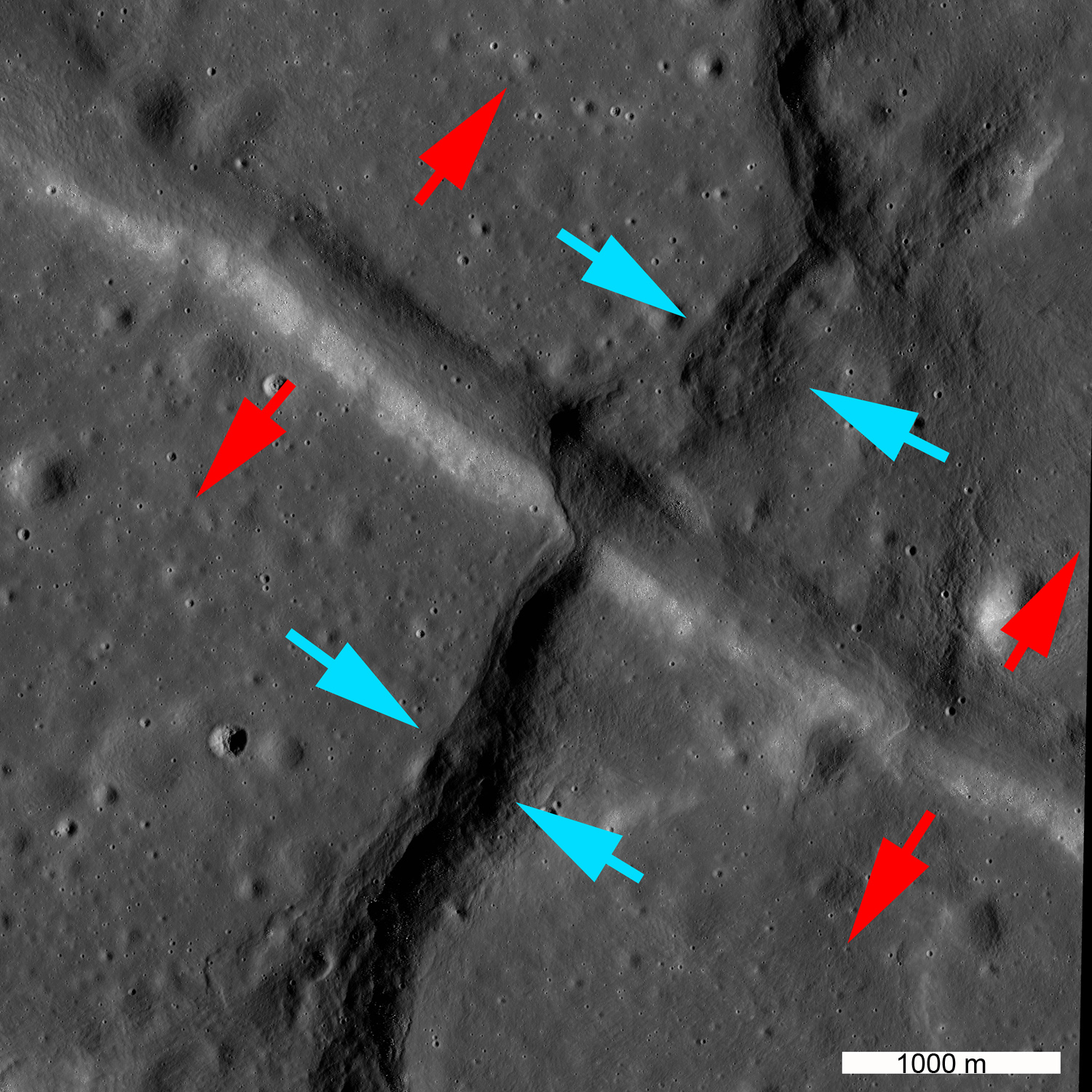
The annotated image below shows the stress directions associated with the graben and the wrinkle ridge.  Red arrows denote the tensional stresses that produced the graben; blue arrows denote the compressional stresses that resulted in the formation of the wrinkle ridge. What happened to cause this reversal, and when did it happen?

Blue arrows denote direction of compression producing the wrinkle ridge; red arrows denote direction of extension producing the graben [NASA/GSFC/Arizona State University].
Explore the entire tectonic feature in the full LROC NAC image, HERE.

Related LROC Featured Images:
Watch That First Step!
Tectonics in Mare Frigoris
Pull Apart - Grabens
It's the Moon's Fault
Linear Graben

Sunday, July 3, 2011

Zebra Stripes


Boulders decorate the slopes of this relatively small but richly complex wrinkle ridge in equatorial Oceanus Procellarum. LROC Narrow Angle Camera (NAC) observation M135507772R, LRO orbit 5103, August 3, 2010; solar illumination incidence angle 56°, resolution is half a meter per pixel in a field of view roughly 800 meters across. See the detailed, full-sized LROC Featured Image HERE [NASA/GSFC/Arizona State University].

Sarah Braden
LROC News System

This portion of a wrinkle ridge in southern Oceanus Procellarum, located at about 2.18°N, 48.55°W, has many boulders gathered on its slopes. These boulders are eroding out of the wrinkle ridge.

How can we tell? In this image there are no fresh impact craters that could have thrown the boulders all over the wrinkle ridge. Even if the boulders did come from a far away impact crater, we would expect the boulders to be distributed more randomly. Instead the boulders neatly line the ridge. What is the erosive mechanism? There is no wind or rain on the Moon. Most likely micrometeorites are slowly blasting loose regolith particles, leaving behind bedrock that was fractured by the faulting that resulted in the ridge formation. Many other wrinkle ridges observed by the LROC NAC also have boulders most likely caused by wrinkle ridge erosion.


The "zebra-striped" wrinkle ridge highlighted as the LROC Featured Image, June 29, 2011, is truly located in Procellarum's Rub' Al Khali, an apparently smooth "empty quarter" even when the vast basin's interior is view from Earth at low solar illumination angles. The subject feature (arrow) lies about 200 km northwest of the Flamsteed P "ghost crater" landing site for Surveyor 1, or perhaps better, at the southwestern range of Kepler's tenuous rays. Eight months before the NAC Featured Image further up was captured, dense and distinct families of secondary craters and the sparse anatomy of the area were readily swept up in LROC Wide Angle Camera (WAC) monochrome (643 nm) observation M117813262ME. The image cropped above shows roughly a 40 by 80 kilometer area straddling the equator, and the immediate basin floor ranges between 1750 and 1950 meters below global mean elevation [NASA/GSFC/Arizona State University].

Wrinkle ridges are fascinating tectonic features found in nearly all the lunar mare. They commonly have a distinct broad, low-relief arch with a more steeply-sloped ridge superposed on the arch. One theory of wrinkle ridge formation is described as a simple chain of events and physical forces. Scientists think that wrinkle ridges form due to the forces created when large amounts of mare basalt erupt on top of existing rock. Basalt is much denser than the anorthositic crust on which the mare basalts are deposited.

As the basalt fills in low areas in the crust, the increased weight causes sagging in the crust. As the crust sags and changes shape, the forces due to the shape change act on the basalt above the crust. The basalt deposit ends up compressed. The stress in the basalt due to the compression produces faulting within the basalt. When a fault forms in the mare, the effect we see on the surface is a wrinkle ridge. When you think about it, the wrinkle ridges in the basalt are caused by the basalt itself!

Explore the entire NAC frame!

Related Posts:
Wrinkle ridge in Oceanus Procellarum
Wrinkled Planet
Forked wrinkle ridge

Thursday, August 14, 2014

Littered wrinkle ridge in west Mare Nubium

Portion of a wrinkle ridge found in Mare Nubium.  The crest and side of the ridge is lined with high reflectance boulders, likely eroded from the fractured basalts that make up the ridge. 2.4 km wide field of view from LROC NAC mosaic M1144863959LR, LRO orbit 20752, January 20, 2014; 46.33° incidence, resolution 83 cm, from 80.7 km over 19.5°S, 349.04°E [NASA/GSFC/Arizona State University].
Raquel Nuno
LROC News System

Wrinkle ridges on the Moon are positive-relief tectonic features found predominately in mare, although some even occur inside craters.

Tectonic forces that created the wrinkle ridges were caused by the sinking of high density basalts that poured over the crust (lower density) during the formation of the maria.

In general this sinking stretched the crust on the margins of the maria, forming graben, and compressed the rock in the center of the maria, forming wrinkle ridges. 

The opening image shows a portion of a wrinkle ridge located in Mare Nubium. The slope of this ridge is littered with boulders, which have higher reflectance than the surrounding material. Where do these boulders come from?

Corrected mosaic of 20000 lines by 10000 samples (of 52224 by 5000 x 2), both the left and right camera frames from LROC NAC observation M1144863959LR, January 20, 2014; from 80.7 km over 19.5°S, 349.04°E [NASA/GSFC/Arizona State University].
They were likely eroded from the fragmented basalt by seismic events from nearby impacts. The bedrock (mare) was pre-fractured during the formation of the wrinkle ridge, thus the boulders' size and shape likely represents these small scale internal fracture patterns. The ridge is still eroding today! New boulders will erode out of the edge of the ridge until there is no more ridge to erode, while the boulders will be turned to dust by micrometeorite bombardment.

Accepted nomenclature of features of the western portion of Mare Nubium. The arrow designates the location on a prominent wrinkle ridge shown at high-resolution in LROC NAC mosaic M1144863959LR. The field of view is, in turn, a mosaic of LROC Wide Angle Camera (WAC)  monochrome (604 nm) observations (see the full-size WAC mosaic, with inset, HERE) swept up over three sequential orbital passes June 11, 2011, incidence 78.4° at 61.8 meters resolution, from 45.3 km [NASA/GSFC/Arizona State University].
Explore the fill-resolution LROC Narrow Angle Camera mosaic HERE.

Related Posts:

Friday, June 8, 2012

LROC: 'A Wrinkly Crater'

An unnamed crater deformed by tectonic forces. LROC Narrow Angle Camera (NAC) M183760209L, LRO orbit 12175, February 13, 2012; image field of view 960 meters, resolution 0.8 meters. View the more detailed LROC Featured Image HERE [NASA/GSFC/Arizona State University].
Drew Enns
LROC News System

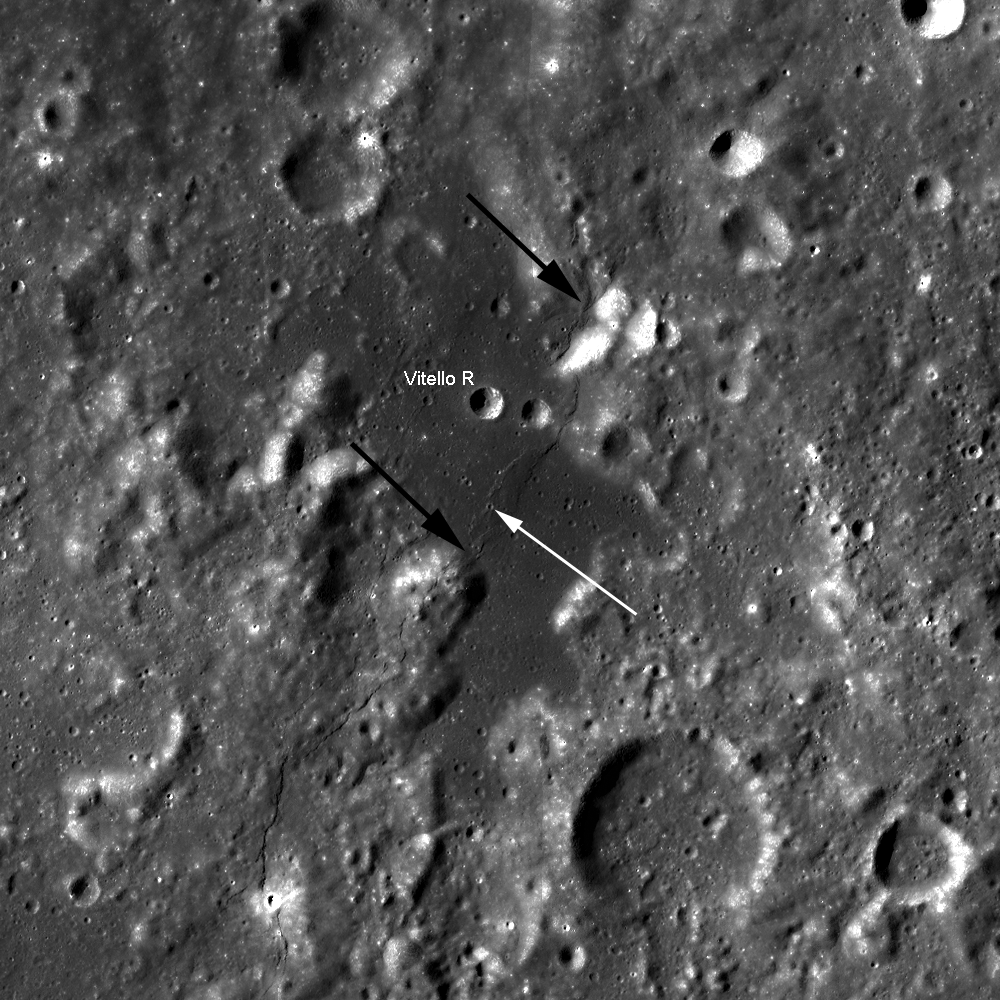
Wrinkle ridges are one of the most common tectonic features on the Moon, and they are found in the lunar maria. Today's Featured Image focuses on one wrinkle ridge, designated Vitello R from the nearby crater, deforming a small mare crater located just south of Mare Humorum. We can tell the wrinkle ridge, and associated tectonic deformation, is much younger than the mare pond as it cross-cuts and modifies the crater (the crater formed after the mare was deposited). Crater counting indicates Mare Humorum is ~3.5 billion years old, but can we say anything more definite about the timing of this wrinkle ridge's formation? Looking at the entirety of the wrinkle ridge may give us more clues.

LROC Wide Angle Camera mosaic as context for the LROC Featured Image released June 8, 2012 (FOV marked with white arrow). The wrinkle ridge can be seen transitioning into a lobate scarp when it exits the mare pond (black arrows). Field of view 58 km across. View the 100 km FOV in image accompanying the Featured Image HERE [NASA/GSFC/Arizona State University].

The wrinkle ridge shows a peculiar change in morphology as it crosses from the mare to the nearby highlands. The wrinkle ridge transitions to a lobate scarp both in the north and south! While wrinkle ridges are characterized by a broad arch with smaller associated ridges, lobate scarps are generally asymmetric landforms with a steep scarp face and shallow tailing end. Both landforms are interpreted as the surface manifestation of thrust faulting in different tectonic settings, so the wrinkle ridge and lobate scarps are probably related. A fresh crater in the bottom-left of the context image erases a portion of the western lobate scarp, but everywhere else the scarp deforms the surface. We can then infer from these observations that the wrinkle ridge-lobate scarp is both caused by a single thrust fault and is fairly young!

Explore more of the wrinkle ridge in the full LROC NAC HERE!

Related Posts:
Not Your Average Scarp
Bulging Wrinkle
Tectonics in Mare Frigoris

Wednesday, January 9, 2013

Boulders In the Sea of Serenity

A wrinkle ridge in southwest Mare Serenitatis is littered with boulders and areas of high-albedo, characterized by rough texture. Field of view is approximately 1500 meters across> LROC Narrow Angle Camera frame M106826896L, LRO orbit 884, September 5, 2009; angle of incidence 35.34° at 1.25 meters resolution from 150.42 kilometers [NASA/GSFC/Arizona State University].
Renee French
LROC News System

A wrinkle ridge in western Mare Serenitatis (23.448°N, 8.058°E) is one of many in the region that exhibits a high boulder density and high albedo (bright) summit areas. But it isn't the only place this relationship is seen! These bouldered ridges are also observed in Oceanus Procellarum, Mare Humorum, Mare Cognitum, and Mare Nubium, to name a few. Scientists are still uncertain as to why some ridges have these features and others don't, and why this isn't observed along the entire ridge. This ridge seems to be eroding along its slope, rather than the crest, suggesting that the material is coming from the ridge itself. In addition, a small impact crater (red arrow in below image) has excavated boulders and high albedo material, making it more likely that the source is from the ridge and not a product of distant cratering events.

Wider view shows a crater (red arrow) that has excavated the same material eroding out of the ridge.  Field of view approximately 2.3 kilometers across LROC NAC M106826896L [NASA/GSFC/Arizona State University].
There are two ways to describe high albedo on the Moon: either freshly exposed rock and soil, or material with different composition or properties. It is uncertain which description is best for the high albedo observed along these ridges or whether it is a combination of the two. If the boulders and high albedo material have happened because of tectonic activity, then that implies that activity along mare wrinkle ridges has occurred more recently than previously thought. These features need to be studied in more detail in order to fully understand what role they play in lunar history. This is just one of the many surprises that LROC has revealed!

LROC Wide Angle Camera (WAC) 100 meter-per pixel monochrome mosaic in the new and improved LROC WMS image search tool shows the the location of the wrinkle ridge in Mare Serenitatis (yellow arrow) in relation to Apollo 15 landing site near Hadley Rille [NASA/GSFC/Arizona State University].
To view the ridge in more detail, look at the top of the full LROC NAC frame, HERE.

Related Posts:
Zebra Stripes (July 3, 2011)
Bright ridge near Mons Hansteen (April 8, 2011)
Boulder clusters on a ridge crest (March 24, 2011)
Buckland Boulders (March 9, 2011)
Constellation Region of Interest in Mare Tranquillitatis (April 27, 2010)
Wrinkle Ridge Near Montes Teneriffe (December 29, 2009)

UPDATE: A Closer Look. This area of the Serenitatis basin is particularly interesting, under the influence of the extrusive volcanism of Sulpicius Gallus and the unusual elevation slope lower in elevation approaching the southwest basin rim, has been the subject of several earlier posts. As it turns out, for example, we had already, long ago, downloaded the entire 5000 sample by 52224 line NAC image from the Commissioning phase of the LRO mission about three years ago.

In a quick study, again using the continuously improving LROC image search tools, we wanted to see if any higher-resolution LROC NAC observations had been captured since September 5, 2009. Among the overlapping or nearly overlapping LROC NAC Observations we found of this same wrinkle ridge system were at least two perhaps helpful in further illustrating the area of interest.

Barely more than a year after the opening picture was taken, LROC swept over the same region, a bit more to the west of orbit 884, during orbit 5744, and the LROC NAC caught the image above showing the ridge "lobe" visible at lower left in the opening LROC Featured Image. Though Sun was slightly higher in the sky, the spacecraft was 106 kilometers closer, and the image immediately below shows that same ridge "lobe" at 49 cm resolution. LROC NAC M139856476R, angle of incidence 26.26° from 44.33 km [NASA/GSFC/Arizona State University].
The wrinkle ridge "lobe" at full resolution and corrected scale in a 286 meter-wide field of view from LROC NAC M139856476R, orbit 5744, September 23, 2010 [NASA/GSFC/Arizona State University].
While the area in this image does not overlap the left frame of LROC NAC M10682689L, it does overlap the right frame and a part of the same wrinkle ridge system slightly to the east. The field of view is a bit more than 2 kilometers wide, with the area in the white rectangle shown at full resolution immediately below. LROC NAC M126873954R, orbit 3831, April 25, 2010; angle of incidence 34.91° at 48 cm resolution from only 40.48 kilometers [NASA/GSFC/Arizona State University].
Perhaps one of the better close-ups of the boulders gradually being calved from the ridge through mass wasting, another full resolution, this time at a 276 meter-wide field from LROC NAC M126873954R {NASA/GSFC/Arizona State University].

Saturday, April 9, 2011

Bright ridge near Mons Hansteen


Portion of a wrinkle ridge extending from Mons Hansteen to the northeast, cropped LROC News System Featured Image, April 8, 2011; LROC Narrow Angle Camera (NAC) observation M122536322L, LRO orbit 3191, March 3, 2010. Resolution 55 cm per per pixel, Illumination is from the west at an incidence angle of 26° (field of view height is 550 meters) [NASA/GSFC/Arizona State University].

Hiroyuki Sato
LROC News System

On the Moon, small topographic highs often covered by boulders are commonly seen in LROC NAC images. Today's Featured Image shows an example of boulders atop a wrinkle ridge.

In two areas of the image high reflectance boulders are on the top of the ridge. The sinuous line to the right of these boulder clusters is the eastern edge of the wrinkle ridge.


The full-width of the left-hand NAC frame M122536322 shows an archipelago of boulder blossoms, shedding along the ridge, northeast of Mons Hansteen. The centerpiece of of the Featured Image can be seen, with far less detail, in the 2.3 kilometer-wide field of view, and the high solar angle surrenders more reflective (rougher and presumably fresher) material in exchange for a loss in relief [NASA/GSFC/Arizona State University].

Why are there two distinct patches of boulders? The ridge as a whole has numerous boulder patches just like these. How did they form? Were they thrown there by some distant impact event? Are they eroding out of the wrinkle ridge? Has everything nearby been covered by a resurfacing event leaving just a few high patches of bright boulders? We may not know until astronauts visit one of these occurrences and carefully investigate the geology and collect samples!


Context view for the LROC Featured Image, April 8, 2010, northeast of Mons Hansteen in southwestern Oceanus Procellarum. White arrow indicates the location of the shedding wrinkle ridge seen in the Featured image. LROC Wide Angle Camera (WAC) observation M117819862ME, LRO orbit 2496, January 11, 2010 from 43.51 km; centered near 12.34°S, 310.15°E (64.6 meters per pixel) [NASA/GSFC/Arizona State University].

You should check the whole view of this boulder covered wrinkle ridge by opening the full LROC NAC frame!

Related Posts:
Boulder clusters on a ridge crest
Buckland Boulders
Wrinkle ridge in Oceanus Procellarum
Constellation ROI at Mare Tranquillitatis
Hansteen Alpha
Wrinkle Ridges

Monday, December 14, 2009

Wrinkle Ridge Close-Up


Wrinkle ridges of northwest Mare Imbrium. A northeast-trending wrinkle ridge cuts across the plains of Mare Imbrium. The overall ridge is about 4.5 km wide. The contact between the ridge (right) and the surrounding mare basalt plains (left) runs diagonally up the image (NASA/GSFC/Arizona State University).

For generations amateur astronomers and Moon watchers have watched the sunrise and sunset across the lunar Near Side, patiently waiting for those brief hours when the long shadows of late and early sunshine bring into sharp relief the subtle details otherwise washed out by the glare of mid-day or by dark of long lunar night.

Changing from minute to minute are the wrinkle ridges, revealing deeper clues about the morphology of the Moon's most familiar features in glorious 3D. Most interesting of these features are the rilles, rimae and the ridge systems, especially those within the largest features that are most easily seen with the naked eye on Earth - even Mare Imbrium, that great dividing line in the lunar timeline.

Patience pays off in spades with this latest LRO narrow angle camera release from Arizona State University's LROC News System. A lot will no doubt be written about this latest image by more worthy commentators (with better patience) so I can only add my own additional twist.

Just last night, socked-in with clouds and mist while elsewhere under clear skies those more fortunate may have been rewarded with a spectacular Geminid meteror shower, I turned to Google Earth's Moon map, and happened to "walk" through the digital elevation model within Mare Imbrim.

After months of exploring that data, I have often toured the Apollo corridor where the photometric data matches the solar incidence seen in this latest image from LRO. I've added a picture of what I saw there tagged to this posting below, for some perspective and validation.

Meanwhile, Jeff Plescia at Arizona State's LROC News System had this to say about the picture up above:

"Wrinkle ridges are relatively common on the Moon and are mostly found in the maria; smaller versions are occasionally found in the highlands. They are called "wrinkle" ridges because wrinkling is exactly what happened. Rock (in this case mare basalt) was squeezed from opposite directions, as if it were in a vise, and the rock failed and buckled, or wrinkled, in a direction perpendicular to the squeezing (compression). In detail scientists have found that they are formed by a combination of faulting and folding. Generally there is a broad swell - the ridge - and a narrower feature - the wrinkle. It is the wrinkle that is shown in this frame. In full frame entire structure can be observed. In this area, the overall ridge is about 4.5 km wide and the wrinkle varies from a few hundred meters to just over a km wide. This ridge trends northeast and eventually connects with Montes Recti (a piece of highlands crust protruding through the mare basalts).

"The sun is close to the horizon in this image (about 9 degrees above the horizon), accentuating the subtle topography of the ridge. The image is about 1.7 km across. Compare this Mare Imbrium wrinkle ridge to another example found in Mare Serenitatis.

"Browse the whole NAC image!"


From the northeast rim of familiar Imbrium crater Lambert a tourist of the central basin can get a perspective on a ridge, if not precisely a wrinkle ridge in this case. This trailing feature is almost certainly related to the impact of the crater and not those true wrinkle ridges that outline the slower moving parameter of Imbrium gracing the most easily seen Near Side impact. Even so, Mare Imbrium can appear featureless on first glace, even through heavy lenses. But the patient observer watches the long shadows as they trace out and reveal these undulations, usually narrow though exceedingly long.

Thursday, October 13, 2011

LROC: Tectonics at the edge of Procellarum

A mare wrinkle ridge transitions to a highland lobate scarp at the edge of Oceanus Procellarum. Illumination is from the lower-left in this 2.9 km wide mosaic of LROC Narrow Angle Camera (NAC) frames M107069913LE and M107069913RE, LRO orbit 918, September 8, 2009. View the full size LROC Featured Image HERE [NASA/GSFC/Arizona State University].

Nathan Williams
LROC News System

A mare wrinkle ridge transitions to a highland lobate scarp at the edge of Oceanus Procellarum. Illumination is from the lower-left in this 2.9 km wide mosaic of LROC NAC images M107069913LE and M107069913RE [NASA/GSFC/Arizona State University].

Two types of compressional tectonic landforms are commonly observed on the Moon: wrinkle ridges and lobate scarps. Wrinkle ridges are long, often sinuous hills in mare basalts and are thought to be folded rock layers overlying deeper faults. Lobate scarps usually occur in the highlands and are interpreted as rocks lifted up by faults very near to or even breaking the surface. There are a few locations where a wrinkle ridge transitions into a lobate scarp or vice-versa, such as here at the northern edge of Oceanus Procellarum (60.5°N, 331.4°E). In this LROC NAC mosaic, the lobate scarp in the highlands massif to the northeast meets a wrinkle ridge to the southwest when it reaches the otherwise flat-lying Procellarum basalts. You can also see lots of boulders eroding out of the wrinkle ridge.

Reduced resolution NAC mosaic of images M107069913L and M107069913R showing the wrinkle ridge - lobate scarp transition. Illumination is from the bottom-left in this 16 km wide mosaic. [NASA/GSFC/Arizona State University].
Wrinkle ridges are thought to have formed after the basaltic lavas erupted, filling in the basins on the nearside, and weighing down the crust. All that extra weight probably made the ground sag and bend, causing the basalt to buckle and fold in some areas. On the other hand, lobate scarps are thought to form from radial contraction or shrinking of the entire Moon. The global radial contraction built up compressional stresses in the crust until the stress was great enough to fracture all the way to the surface. The transition from wrinkle ridge to lobate scarp may be due to the contrast in materials, especially if the basaltic lavas are layered and the highland massif lacks layering. However, the relationships between wrinkle ridges and lobate scarps at transitions like this are still being studied.

LROC Wide Angle Camera mosaic (604 nm band) showing the Featured Image (yellow box) in context around 7 kilometers west of craterlet Fontenelle X, and the system of wrinkle ridges and scarps, admittedly easier to see at higher resolutions. From a larger LROC WAC mosaic swept up through 14 orbital observations from an average 36 kilometers altitude, January 26 and 27, 2011; Field of view roughly 62 kilometers (phase angle averaged 70° - see image following) NASA/GSFC/Arizona State University].
Highly reduced original LROC WAC mosaic (January 26, and 27, 2011) showing the location of the Featured Image and its environs within Mare Frigoris, north of Sinus Iridum and Mare Imbrium, possibly superimposed on the older (even with younger volcanic fill) and irregularly-shaped basin known as Oceanus Procellarum. Some investigators propose most of the nearside may be an ancient basin, responsible, perhaps at least in part, for the near and far side elevation discontinuity, and a basin that is perhaps larger than the nearside hemisphere itself, originally centered northwest of Mare Tranquillitatis. This so-called "Gargantuan" impact basin is far from without it's detractors, however. Without definitive proof, the South Pole-Aitken basin remains the largest and oldest recognized impact basin.
Then there is the laser altimetry building up from the LOLA instrument on-board LRO, from hemisphere-views released earlier this year, here showing the location of the Featured Image (blue arrow) from over far north, and the farside highlands beyond 90° west. Without the nearside's familiar albedo features, the near and farside dichotomy is easier to sense [NASA/GSFC/LOLA/SVS].
Take a look at the full NAC mosaic - can you find any other scarps or ridges?

Related Posts:
Scarps in Schrödinger
Lunar Lobate Scarp
Slipher Crater Fractured Moon in 3-D
Forked Wrinkle Ridge
Stress and Pull