Showing posts with label lobate scarps. Show all posts

Thursday, January 10, 2013

Offset crater, active Moon

A small offset crater in the near side southern highlands. Field of view 342 meters across, from LROC NAC frame M177562995R, LRO orbit 11202, December 3, 2011; angle of incidence 72.25° from 39.76 km [NASA/GSFC/Arizona State University].
Renee French
LROC News System

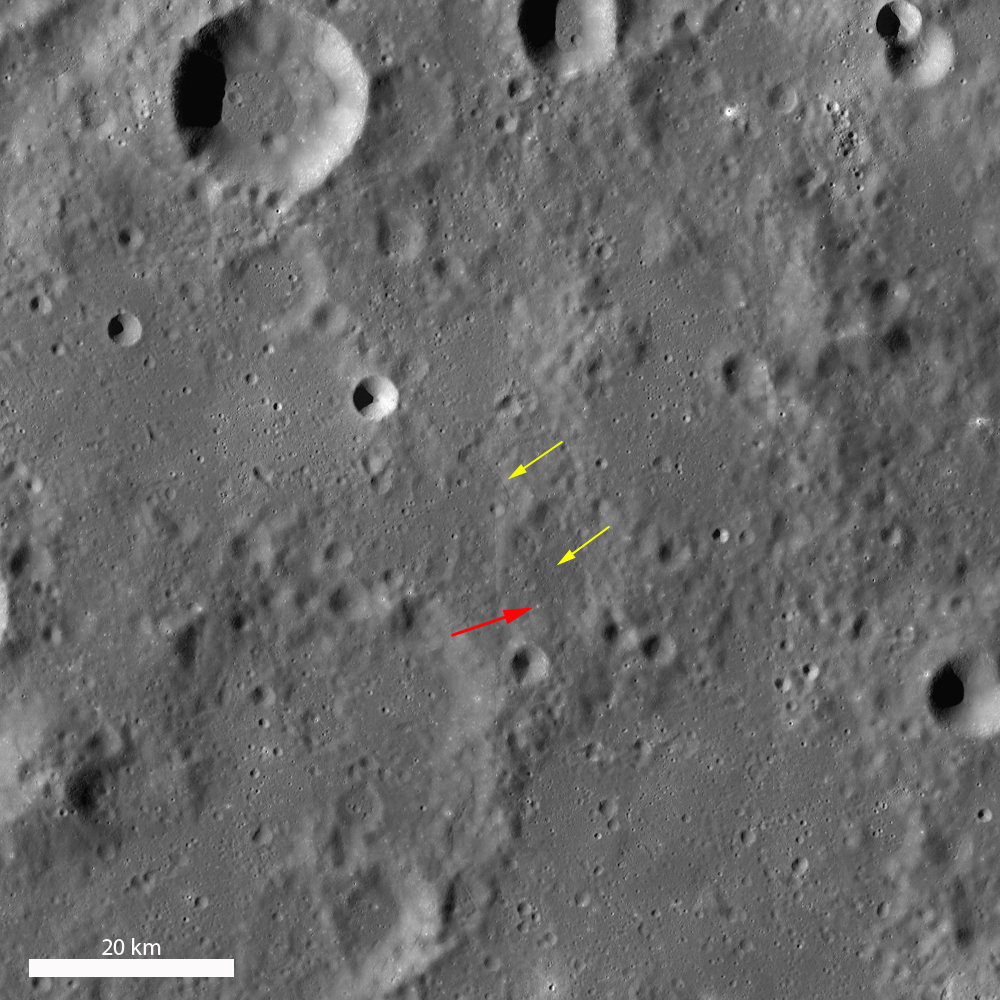
Today's image is of a 100 meter diameter crater (29.814°S, 11.465°E) located in highland terrain between Tycho crater and Nectaris basin. However, it doesn't look like a normal bowl-shaped crater by any stretch of the imagination! The top half looks like it has been shifted to the right relative to the bottom half, which is consistent with motion along a right-lateral strike-slip fault. Likely this odd crater was cut by a fault associated with the nearby Poisson lobate scarp. The faulting helps us determine the relative age of local features. The crater on the right does not appear offset, so that tells us that the fault was active after the crater on the left formed (thus offsetting it) but was not active since the formation of the crater on the right! This relationship also indicates that the crater on the left is older than the crater on the right. Observations like these allow scientists to assign relative ages to features on the surface; the only way to accurately determine absolute ages for features this small is to bring back samples for radiometric age dating. If you were to look at this crater using WAC data (see below), you couldn't tell that it was offset by a fault but you could spot it due to its high reflectivity. High resolution NAC images like these have shown that there is relatively recent, small-scale tectonic activity and that the Moon is far from being geologically dead!

LROC Wide Angle Camera (WAC) 100 meter monochrome mosaic. Red arrow points to the featured offset crater, a bright spot at this resolution and the yellow arrows point to the Poisson lobate scarp [NASA/GSFC/Arizona State University].
Check out the full LROC NAC image to spot other faulting, HERE.

Related Posts:
Relative age relationships
Scarps in Schrödinger
The Ghosts of Mare Fecunditatis

Friday, June 8, 2012

LROC: 'A Wrinkly Crater'

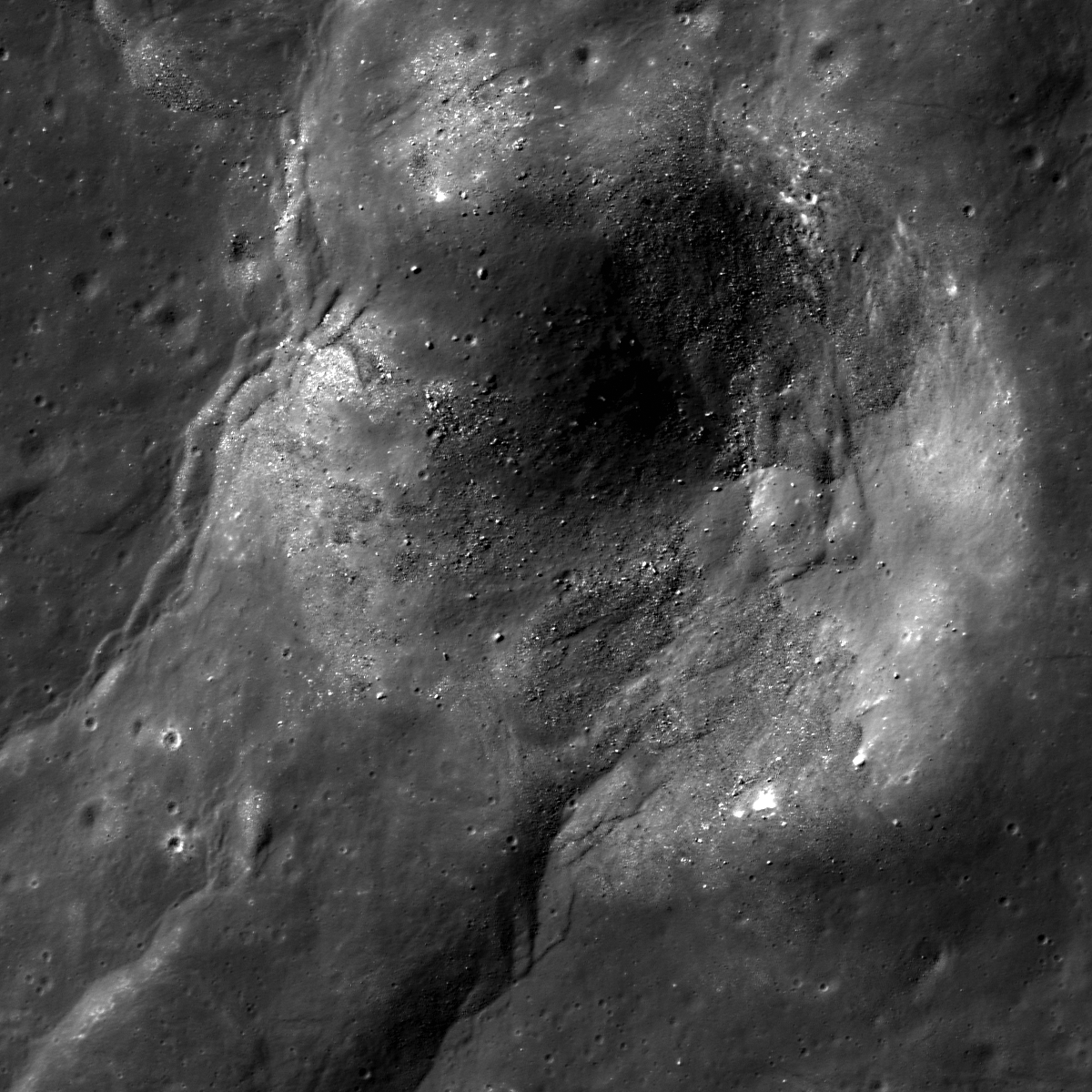
An unnamed crater deformed by tectonic forces. LROC Narrow Angle Camera (NAC) M183760209L, LRO orbit 12175, February 13, 2012; image field of view 960 meters, resolution 0.8 meters. View the more detailed LROC Featured Image HERE [NASA/GSFC/Arizona State University].
Drew Enns
LROC News System

Wrinkle ridges are one of the most common tectonic features on the Moon, and they are found in the lunar maria. Today's Featured Image focuses on one wrinkle ridge, designated Vitello R from the nearby crater, deforming a small mare crater located just south of Mare Humorum. We can tell the wrinkle ridge, and associated tectonic deformation, is much younger than the mare pond as it cross-cuts and modifies the crater (the crater formed after the mare was deposited). Crater counting indicates Mare Humorum is ~3.5 billion years old, but can we say anything more definite about the timing of this wrinkle ridge's formation? Looking at the entirety of the wrinkle ridge may give us more clues.

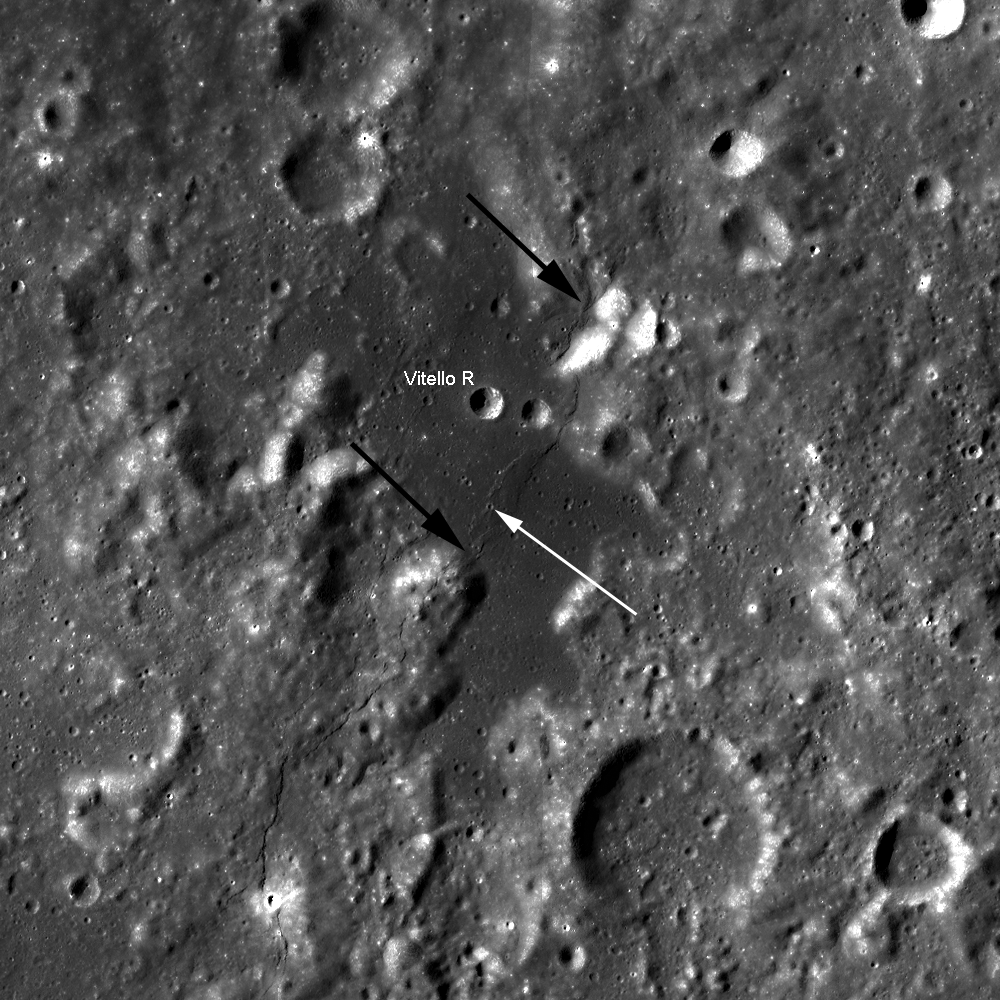
LROC Wide Angle Camera mosaic as context for the LROC Featured Image released June 8, 2012 (FOV marked with white arrow). The wrinkle ridge can be seen transitioning into a lobate scarp when it exits the mare pond (black arrows). Field of view 58 km across. View the 100 km FOV in image accompanying the Featured Image HERE [NASA/GSFC/Arizona State University].

The wrinkle ridge shows a peculiar change in morphology as it crosses from the mare to the nearby highlands. The wrinkle ridge transitions to a lobate scarp both in the north and south! While wrinkle ridges are characterized by a broad arch with smaller associated ridges, lobate scarps are generally asymmetric landforms with a steep scarp face and shallow tailing end. Both landforms are interpreted as the surface manifestation of thrust faulting in different tectonic settings, so the wrinkle ridge and lobate scarps are probably related. A fresh crater in the bottom-left of the context image erases a portion of the western lobate scarp, but everywhere else the scarp deforms the surface. We can then infer from these observations that the wrinkle ridge-lobate scarp is both caused by a single thrust fault and is fairly young!

Explore more of the wrinkle ridge in the full LROC NAC HERE!

Related Posts:
Not Your Average Scarp
Bulging Wrinkle
Tectonics in Mare Frigoris

Tuesday, February 21, 2012

Further evidence of recent lunar geologic activity

Close-up of the "Virtanen graben" field, near the 18.29°N, 180.79°E, on the central meridian of the lunar far side. From LROC Narrow Angle Camera observation M136355592RE (LRO orbit 5228, August 13, 2010; resolution 0.66 meters from 59.85 km). This LROC NAC frame, along with M136362376, were used by Mark Robinson and colleagues at Arizona State University to create a Digital Terrain Model of the Virtanen graben in November 2010. That DTM can be explored HERE.
Images and elevation models from NASA's Lunar Reconnaissance Orbiter (LRO) appear to show the Moon's crust is being stretched, forming miniature valleys in a few small places on the lunar surface. A team of investigators will present their findings at the upcoming Lunar and Planetary Science Conference as evidence that this geologic activity occurred less than 50 million years ago, a very recent time in relation to the Moon's estimated age of roughly 4.575 billion years.

Researchers analyzing high-resolution images obtained by the Lunar Reconnaissance Orbiter Camera (LROC) have shown many small, narrow trenches typically much longer than they are wide, indicating the lunar crust is being pulled apart at these locations. These linear valleys, known as graben, form when the moon's crust stretches, breaks and drops down along two bounding faults. A handful of these graben systems have already been identified across the lunar surface and are cited as evidence the Moon may be shrinking.

"We think the moon is in a general state of global contraction because of cooling of a still hot interior," said Thomas Watters of the Center for Earth and Planetary Studies at the Smithsonian's National Air and Space Museum, lead author of a paper on this research appearing in the March issue of the journal Nature Geoscience.

"The graben tell us forces acting to shrink the moon were overcome in places by forces acting to pull it apart. This means the contractional forces shrinking the moon cannot be large, or the small graben might never form."

Full width (about 5 km wide) of LROC NAC DTM"Virtanen
graben 1
;" the small rectangle is the field of view seen in the
image above
[NASA/GSFC/Arizona State University].
The weak contraction suggests that the moon, unlike terrestrial planets, did not completely melt in the very early stages of its evolution. Rather, observations support an alternative view that only the moon's exterior initially melted forming an ocean of molten rock.

In August 2010, the team used LROC images to identify physical signs of contraction on the lunar surface, in the form of lobe-shaped cliffs known as lobate scarps.

The scarps are evidence the moon shrank globally in the geologically recent past and might still be shrinking today. The team saw these scarps widely distributed across the moon and concluded it was shrinking as the interior slowly cooled.

Based on the size of the scarps, it is estimated that the distance between the moon's center and its surface shrank by approximately 300 feet. The graben were an unexpected discovery and the images provide contradictory evidence that the regions of the lunar crust are also being pulled apart.

"This pulling apart tells us the moon is still active," said Richard Vondrak, LRO Project Scientist at NASA's Goddard Space Flight Center in Greenbelt, Maryland. "LRO gives us a detailed look at that process."

As the LRO mission progresses and coverage increases, scientists will have a better picture of how common these young graben are and what other types of tectonic features are nearby. The graben systems the team finds may help scientists refine the state of stress in the lunar crust.

"It was a big surprise when I spotted graben in the far side highlands," said co-author Mark Robinson of the School of Earth and Space Exploration at Arizona State University, principal investigator of LROC. "I immediately targeted the area for high-resolution stereo images so we could create a three-dimensional view of the graben.  It's exciting when you discover something totally unexpected and only about half the lunar surface has been imaged in high resolution.  There is much more of the moon to be explored."

DERIVATION OF ABSOLUTE MODEL AGES FOR LUNAR LOBATE SCARPS
van der Bogert, Hiesinger, Banks, Watters and Robinson, LPSC #1847

Lobate Scarp or Fluidized Ejecta (November 10, 2011)

LROC: Lunar Landslides! (October 15, 2011)

LROC: Tectonics at the edge of Procellarum (October 13, 2011)

Scarps in Schrödinger (September 28, 2011)

LROC: lobate scarp in Xenophanes (September 14, 2011)

Wrinkled Planet (May 3, 2011)

Too brief an expedition to a lobate scarp (August 24, 2010)

Moon geologically active, cooling and shrinking (August 19, 2010)

Updated map of lunar graben, lobate scarps and further more recent topographic features broadly hinting Earth's Moon is not "dead," as once assumed, but geologically active [NASA/GSFC/DLR/Smithsonian CEPS/Arizona State University].

Wednesday, October 26, 2011

LROC: Extensional Fractures

Narrow fractures extend across a complex intersection of lunar surface types northeast of Mare Serenitatis, in Lacus Somniorum. LROC Narrow Angle Camera (NAC) observation M168007062L, from the period last August when the LRO spacecraft's orbit was altered to include very low passes over selected areas (resolution 25 centimeters per pixel); orbit 9893, August 15, 2011. Field of view a bit more than 550 meters wide [NASA/GSFC/Arizona State University]
Sarah Braden
LROC News System

In this 0.25 m/pixel NAC frame we found narrow fractures that extend across the lunar surface, in the mare basalt of Lacus Somniorum. Narrow fractures like these are probably extensional features caused by tension stress that pulls the rocks apart in opposite directions. Similar fractures have been found before on top of wrinkle ridges. 

The fractures in today's Featured Image are also associated with a small wrinkle ridge. In the LROC Wide Angel Camera (WAC) 60 meter per pixel context image below, you can see the ridge (yellow arrow) between two hills of non-mare material. The fractures are located west of the ridge (yellow box). There are a number of other wrinkle ridges in the area as well.

LROC Wide Angel Camera (WAC) Observation M150321508C (604 nm), LRO Orbit 7288, January 22, 2011, local late afternoon illumination at incidence angle 67.201° The yellow box at center bounds the fractures seen in the LROC Featured Image, released October 26, 2011. The yellow area designates a ridge possibly related to those fractures. [NASA/GSFC/Arizona State University].

Examine the rest of the narrow fractures in the NAC frame!

Related Posts:
Stress and pull
Fractures in the mare of Tsiolkovskiy crater


Wednesday, September 28, 2011

Scarps in Schrödinger


A lobate scarp formed in the wall material of Schrödinger basin. LROC Narrow Angle Camera (NAC) observation M159099396R, LRO orbit 8580, May 3, 2011, field of view 1.1 km, illumination from the extreme northeast, within 75° of the lunar south pole. View the full-sized LROC Featured Image HERE [NASA/GSFC/Arizona State University].

Lillian Ostrach
LROC News System

Surface manifestations of contractional stresses are observed frequently on the Moon. Oftentimes, wrinkle ridges (from several tens of meters to many hundreds of kilometers long) formed in maria are the most easily identified contractional tectonic features. Another geologic feature resulting from contraction, lobate scarps, are observed in the highlands. From LROC NAC images we now know that lobate scarps are prevalent in the highlands and thus are globally distributed. The Lee-Lincoln scarp and a lobate scarp in Slipher crater are excellent examples of highland scarps. Today's Featured Image reveals a lobate scarp in the Schrödinger basin (79.30°S, 126.50°E), an example smaller than the Lee-Lincoln and Slipher crater scarps.

Lobate scarps are the surface expression (visible part) of a fault that cuts through the lunar crust. In the opening image, the crust was probably under compression from approximately north to south (squeezed from top to bottom). The ground on the northern part of the image buckled, broke, and rode up over the ground on the southern part of the image, creating the obvious bulge. Also, just like faults on Earth, the scarp shallows out and disappears (near the right of the image). This shallowing of the scarp may be due to non-uniform contractional stresses in this area such that the stresses were not the same everywhere. Alternatively, the underlying rocks may have had different strengths, which caused the stresses to deform the rocks differently. The story is further complicated here because the scarp formed in the impact basin wall material, which was likely heavily fractured and fragmented during the violent, basin-forming impact. This scarp is ~1.3 km long and may extend for several hundred meters or more beyond the western edge of the NAC frame. While this scarp shallows and disappears, the full NAC image includes portions of at least two additional nearby lobate scarps. The scarp formation story is not a simple one, and additional observations are necessary to piece together the compressional history of this area.


From the LROC Wide Angle Camera (WAC) monochrome 100 meter per pixel resolution global mosaic, showing the southern frontier of the Schrödinger impact basin. A twenty kilometer stretch, running from southwest to northeast, is the location of a plethora of lobate scarps. The location of the lobate scarp highlighted in the LROC Featured Image released September 27, 2011 is noted with a yellow arrow [NASA/GSFC/Arizona State University].


Wider angle segment from the WAC 100 meter global mosaic, showing the full width of Schrödinger basin. The location of the lobate scarp highlighted in the LROC Featured Image released September 27, 2011 is noted with a yellow arrow [NASA/GSFC/Arizona State University].

How many lobate scarps can you find in the full LROC NAC image? Do these scarps intersect or are they separate from one another?

Related Posts:
LOLA: Schrödinger Basin
A Review of All Things Schrödinger
Wrinkled Planet
Aitken Crater Constellation Program ROI
Sampling Schrödinger


From LOLA data, Schrödinger basin in relation to the far lunar south and within the degraded mountainous rim of the vast South Pole Aitken basin. Once again, the location of the area highlighted in the LROC Featured Image released September 27, 2011 is indicated with a yellow arrow [NASA/LOLA/ILIADS].

Tuesday, August 24, 2010

Too brief an expedition to a lobate scarp

Lee Lincoln Scarp – the only lobate scarp toured on foot surveyed from the Lunar Reconnaissance Orbiter (LRO), February 1, 2010. Roughly sketched is the path of Cernan & Schmitt (Apollo 17) during rushed visit (EVA 2) to Taurus-Littrow in December 1972. White dotted lines mirror the two elevation studies discussed by Smithsonian investigator Thomas Watters, August 19. (One sampling apparently intersects the path of EVA 2 on their way to Geology Station 3, Ballet crater, east of Lara.) The blue arrows note, again roughly, the directions of mission photographs discussed below. Mosaic from LROC Narrow Angle Camera (NAC) observations M119652859L & R; north is at top, from 42.73 km alt., resolution 0.51 meters per pixel, and illumination from the west by southwest (phase angle 37.76°) [NASA/GSFC/Arizona State University/Smithsonian].

Joel Raupe

In reviewing reports of “The Incredible Shrinking Moon,” the headline originated by Paul D. Spudis and afterward headlining news accounts seemingly everywhere (including here, until we changed it to the less poetic "Moon geologically active, cooling, shrinking") we were inspired to spend time this past weekend re-experiencing the second EVA of Apollo 17.

Of all the known or newly-discovered thrust faults, manifested at the surface of the Moon by lobate scarpes, surveyed by Thomas Watters, senior scientist for the Center for Earth and Planetary Studies at the Smithsonian, cited as evidence that the Moon had "radially contracted," by 100 meters or so, and more recently than generally believed possible, only one has been toured and directly sampled.

The Lee Lincoln scarp, as labeled on maps, was walked on and driven over by Apollo 17 cmdr. Capt. Gene Cernan (USN, Ret.) and geologist Dr. Harrison H. Schmitt, on the night of December 12-13, 1972. It was next to last time anyone walked on the Moon.

Like every deep space survey, even virtual journeys like ours, we found more than we planned, and little of that immediately related to the formation of these tectonic features.

Montage of four 500mm photographs by Captain Cernan, from Geology Station 3 (Ballet crater, east of Lara), and likely our only view along a length of any lunar lobate scarp. (See the full-sized montage at the Apollo Surface Journal, HERE.) This is a foreshortened view of the scarp where it overlaps an intersection of the valley floor, the steep slope of North Massif. The feature winds upward, immediately bend to the north and northwest, like a mountain road bed, highly visible from a great distance. The movement of the thrust fault seems to have encountered the Massif and, meeting resistance, crept more slowly. The field of view is includes an area ranging from four to more than seven kilometers away. At lower center-right, Hanover crater peaks over an intervening lip of the scarp, like a Cyclops gazing over the valley floor [NASA/Apollo Surface Journal].

Some recent, hopefully temporary, computer problems continue to hamper our ability to expand graphically in as robust a manner as we prefer on the latest additions to this digest of Moon news. We're essentially bound to one audio and video format, for the moment. So we were somewhat astounded to find that the audio and video clips sequentially linked to the Apollo Surface Journal pages devoted to EVA 2 of Apollo 17 included those in that same format. Oddly, this was the true of the history of that EVA only.

We took the time to download and stack all these EVA 2 audio and television clips and then played these back to back without interruption. The result was highly worthwhile, underscoring how correct, but highly understated we are when we say "we've barely scratched the surface" of the Moon.


"The boys in the backroom" in Houston had already shaved the EVA timeline to add fifteen minutes to the their earlier stay at Nansen, on the slopes of South Massif, and were hustling Cernan & Schmitt along, by the time they arrived at the rim of Shorty crater. Their traverse of the northwestern interior of Taurus Littrow was nearly at an end. Meanwhile, Dr. Schmitt's earlier excitement was dragging slightly, but picked up instantly when his geologists' eye happened upon one of the most important discoveries of the Apollo era, "orange soil," in a landscape dominated by three shades of gray-brown dust. It took ground controllers only moments to catch up with his understanding of the possible significance of the discovery, and time was added for a longer stay. Across the horizon, with the Western Family Mountains and Mare Serenitatis beyond, is a band of lighter material. This is the edge of the lobate scarp, which is more than two kilometers away, and much better experienced in high resolution, HERE) [NASA/Apollo Surface Journal].

Others will come away from such an experience with different impressions, of course. That’s a subject for another post, but we were strongly reminded that as much time has passed since the Apollo 17 expedition and today than previously passed between the invention of talking motion pictures and the Apollo era.

Remotely operated, micro color television of rudimentary fidelity can be understood and excused. Allowing so much time to pass before advancing that experiment and others on the lunar surface cannot be.

Watching EVA 2. in “real-time,” also underscored the ironic brevity of the whole thing. The Apollo surface mission, particularly the last three Science, or "J" missions, were high water marks of civilization, culminating a decade-long devotion by 100,000 people. As we watched Gene Cernan and Jack Schmitt scramble through their perishable consumables, precious time and air, to get to the actual geology or their mission, with so many voices chattering and cautioning, and also hustling them along, we simply wondered that they were able to accomplish what they did.

Captain Cernan credits training, years of preparation, for the safe productivity of their expedition. These last missions to the Moon, especially this very last one, were also successful because of the full body of training and, by then, the experience of everyone involved.


The orange soil discovered and trenched out by Dr. Schmitt was found on the rim of Shorty, and slumped down the inner walls of the crater, most likely excavated from the depths hollowed out by the impact event. The crater itself, and the surrounding terrain now appear to have been pushed up by the thrust faulting, manifested by the scarp. In turn, Shorty sits within a wisp of the Light Mantle, higher albedo dusting the crew had come to sample. Those samples would add evidence to Schmitt's earlier determination of the age of Tycho, which appeared to have blown debris over the heights of South Massif and down into Taurus Littrow 109 million years ago. High resolution image, HERE [NASA/Apollo Surface Journal].

"Oh, hey!" Schmitt pauses very briefly, in the transcript by Eric Jones. They have just arrived at Station 4. By his own admission, Dr. Schmitt was tired, and it can be heard in his voice. right up until something caught his eye after describing the "very intensely fractured rock, right on the rim (of Shorty crater)."

Schmitt has just seen the orange soil, but He's cautious, Jones writes, having been fooled by the play of sunlight when he and Cernan were back on the scarp.

"Wait a minute...," Schmitt said. "Where are the reflections? I've been fooled once. There is orange soil!"
Reluctantly, the almost tyrannical voices from the Back Room, heard by the CapCom in Houston agree to add time to their stay at Shorty crater. Already, they had added time to their first stay at Nansen, by shaving time from their planned stay on the scarp and here at Shorty. It took only a minute or so for them to catch up with Schmitt, and by now Cernan, in understanding the possible significance of the find.

These finest particulate samples were later explained as evidence of fire fountains, perhaps similar to those seen in Iceland recently, occurring late in the Moon's cooling, perhaps now better understood as having been elevated nearer to the surface by the thrust fault which raised the whole vicinity explored during the EVA near the scarp, eventually excavated to the crater rim by the Shorty "impact event."

Those orange glass particles proved rich in titanium, iron oxide and also zinc. It was tantalizing evidence of the greater unknown part of the Moon, lying about just out of reach, or just beneath its surface. Just as the slow changing landscape of Antarctica allows for the discovery of lunar and martian samples, it's inevitable very unique terrestrial samples will be found on the Moon.

We were reminded, once again, that no comprehensive understanding of Earth can happen before a proper exploration of the Moon.

Happening upon the orange soil was a lasting result of Apollo 17, though the greater impression, we agreed, begged a simple question: If this is an example of what can be found during an abbreviated, rushed geology "field trip" on the Moon what might a true geology Season there discover?


Offering some perspective on the Shorty experience, Cernan panned through this high resolution image over and behind the crater, allowing an excellent look at it's interior, slightly stained with orange fallout. Over the far rim, thousands of meters further away, is the bend at the contact of scarp with the valley floor and North Massif slope, gazed over by of Hanover. (A strongly recommended high resolution view is HERE.) Compare with the vertical view below, and, in context, with the montage at the beginning of this post showing the vicinity from 40 km overhead (37 years later) [NASA/Apollo Surface Journal].


Shorty, in this stretched 196 meter wide scene sampled from LROC NAC observation M119652859R, swept up February 1, 2010. Those darker markings at lower left are foot prints and tire tracks. The outcrop and trench in the views further above are poised on the crater rim nearby. Illumination is from the west by southwest, or late afternoon. Cernan & Schmitt made their all-too-brief, but historic, visit at mid-morning [NASA/GSFC/Arizona State University].

Thursday, August 19, 2010

Moon geologically active, cooling and shrinking

Updated August 23, 2010 22:52 UT

Lunar Tectonism. LROC digital terrain model (DTM) of the Lee Lincoln lobate scarp, running through the Taurus Littrow valley's northern interior, northwest of the Apollo 17 landing site. (The face of the scarp can be seen in this website's logo at the top of this page. -Apollo 17 lunar module pilot Harrison H. Schmitt examines the orange glass deposit on the western rim of Shorty crater, and the bright wall running across the scene behind him is the direct face of the scarp's down-slope) [NASA/GSFC/ASU].


Corollary profiles to the above cross-sections A and B, showing the rapid change in elevation across Lee Lincoln scarp [NASA/GSFC/Arizona State University].

Joel Raupe

Investigators have discovered compelling evidence the Moon may still be geologically active.

A newly discovered global distribution of very young upthrust faults known as lobate scarps indicate the Moon has shrunk, demonstrating a radial contraction by 100 meters over a period well within the past 800 million years. The discovery definitively sets aside previously long-settled notions that the Moon is geologically dead. Instead, the Moon has been cooling very recently, and may cooling still.

The discovery announced by NASA comes after careful examination of Lunar Reconnaissance Orbiter (LROC) Narrow Angle Camera observations and the discovery of newly-identified upthrust faults and mapping their global distribution together with similar already known features.

The nature and distribution of crater counts overlapping and below these upthrust faults shows them to be relatively recent phenomena, forming as the Moon continued (or continues) to cool far later than previously believed possible.

Thomas Watters, senior scientist for the Center for Earth and Planetary Studies at the Smithsonian National Air and Space Museum, revealed these findings ahead of their publication in the Journal Science, during a NASA teleconference, Thursday, August 19.


Newly Discovered lobate scarps Rozhdestvenskiy 1 (above) and Shoemaker (below), are examples of high lattitude, thrust faults. "Seven of the fourteen newly detected lunar scarps are found at high latitudes (> ±60°). The distribution of newly detected and previously known scarps suggests that thrust faults are globally distributed; important implications for the thermal history of the Moon." - Mark Robinson, LROC principal investigator, Arizona State University [NASA/GSFC/ASU].


"Contrary to what many people, including many scientists, believe," Watters told reporters, "the Moon is not a dead, inactive planet. The Moon is truly a dynamic planet."

"This is only the beginning of our understanding of this phenomena," added John Keller, LRO deputy project scientist at NASA Goddard Space Flight Center. "As with all missions, we set off with LRO and a well-mapped plan on what to do at the Moon. Now, however, we have added another unexpected paradigm change, and something new to look for.

"It is compelling evidence of a geological process taking place over a very recent time, and one that is perhaps still under way."

The global distribution and prevalence of lobate scarps was also discussed the National Lunar Science Institute's 3rd annual conference in July, as part of the presentation of a summary of Lunar Reconnaissance Orbiter Camera (LROC) discoveries during the past year, by LROC principal investigator Mark Robinson. Robinson's presentation slides can be reviewed (PDF), HERE.


Figure 1: Thrust faults are formed when the lunar crust is pushed together, breaking the near-surface materials. The result is a steep slope on the surface called a scarp as shown in this diagram [Arizona State University]. › Larger image


Figure 2: The mare basalts that fill the Taurus-Littrow valley were thrust up by contractional forces to form the Lee-Lincoln fault scarp It is the only extraterrestrial fault scarp to be explored by humans. The digital terrain model derived from Lunar Reconnaissance Orbiter Camera (LROC) stereo images shows the fault extending upslope into North Massif were highlands material are also thrust up. The fault cuts upslope and abruptly changes orientation and cuts along slope, forming a narrow bench. LROC images show boulders shed from North Massif that have rolled downhill and collected on the bench [NASA/Goddard/Arizona State University/Smithsonian]. › Larger image


Figure 3: Over recent geologic time, as the lunar interior cooled and contracted the entire moon shrank by about 100 m. As a result its brittle crust ruptured and thrust faults (compression) formed distinctive landforms known as lobate scarps. In a particularly dramatic example, a thrust fault pushed crustal materials (arrows) up the side of the farside impact crater named Gregory (2.1°N, 128.1°E). By mapping the distribution and determining the size of all lobate scarps, the tectonic and thermal history of the moon can be reconstructed over the past billion years [NASA/Goddard/Arizona State University/Smithsonian]. › Larger image


Figure 4: This map illustrates the distribution of lobate scarp features located thus far. Black dots indicate previously known scarps while white dots depict newly detected scarps found in images from the Lunar Reconnaissance Orbiter Camera [NASA/Arizona State University/Smithsonian]. › Larger image


Figure 5: Another fault cut across and deformed several small diameter (~40-m diameter) impact craters (arrows) on the flanks of Mandel’shtam crater (6.5°N, 161°E). The fault carried near-surface crustal materials up and over the craters, burying parts of their floors and rims. About half of the rim and floor of a 20 m-in-diameter crater shown in the box has been lost. Since small craters only have a limited lifetime before they are destroyed by newer impacts, their deformation by the fault shows the fault to be relatively young [NASA/Goddard/Arizona State University/Smithsonian]. › Larger image