Showing posts with label Lobate Scarp. Show all posts

Friday, March 21, 2014

Faulted Kipula

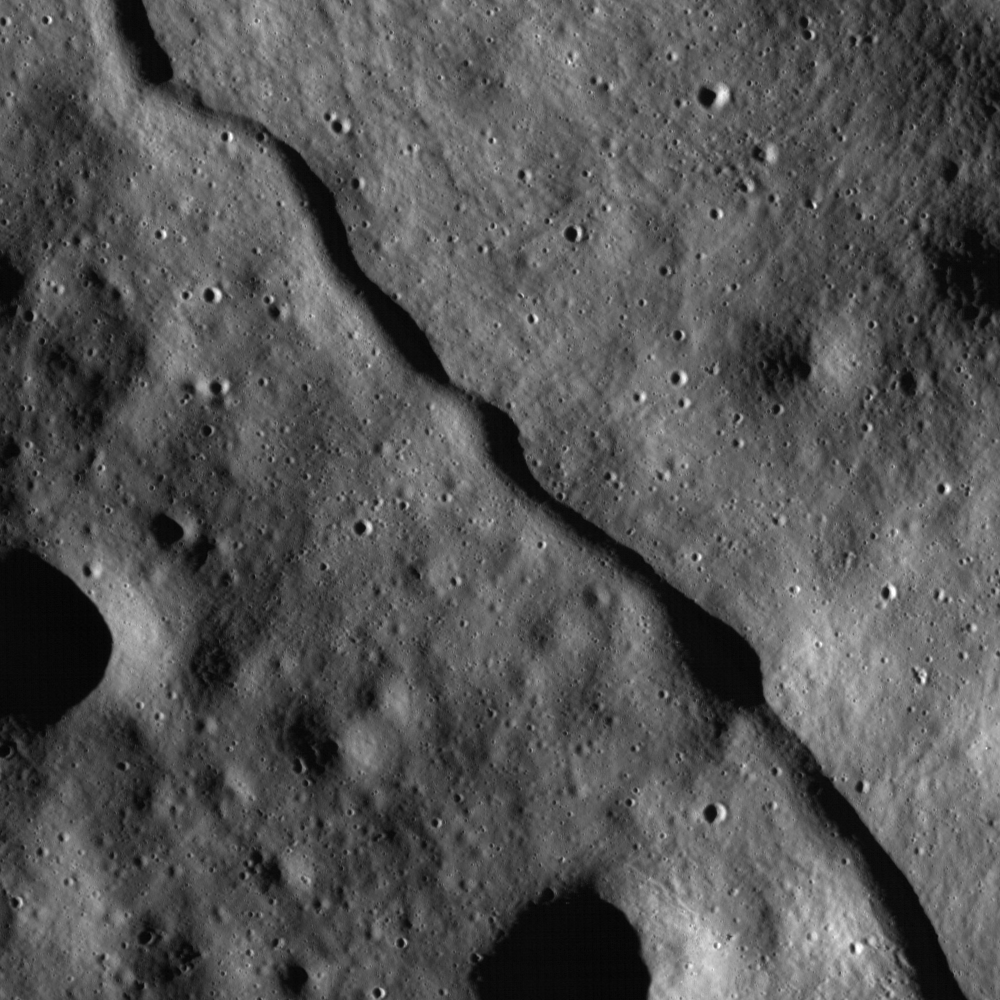
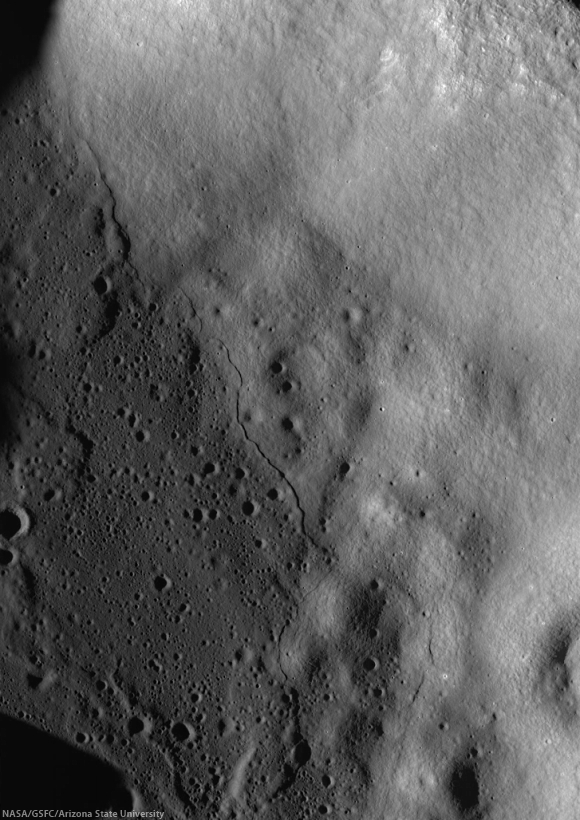
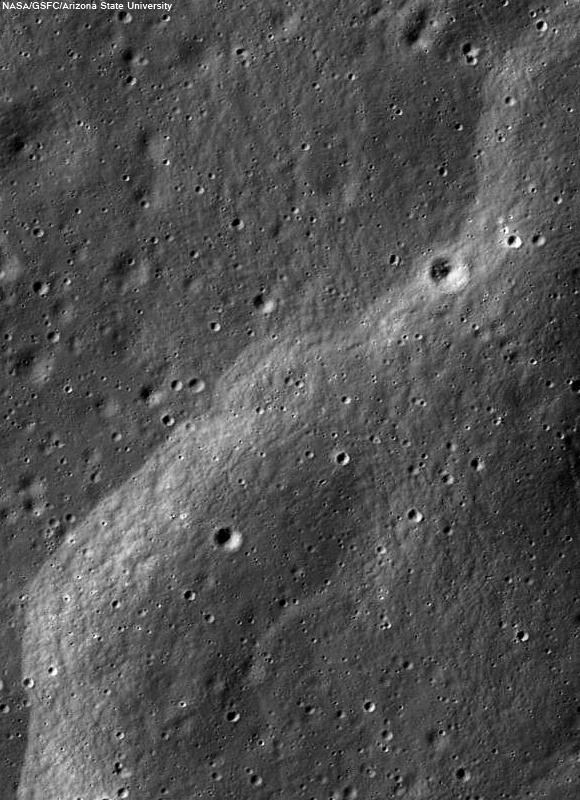
This striking mountain within Mare Imbrium was altered at its base by the formation of a lobate scarp. A wrinkle ridge runs into the base of the mountain (bottom right). Image width is approximately 4.5 km. LROC NAC image M1098943917R, spacecraft orbit 14300, August 7, 2012 [NASA/GSFC/Arizona State University].
H. Meyer
LROC News System

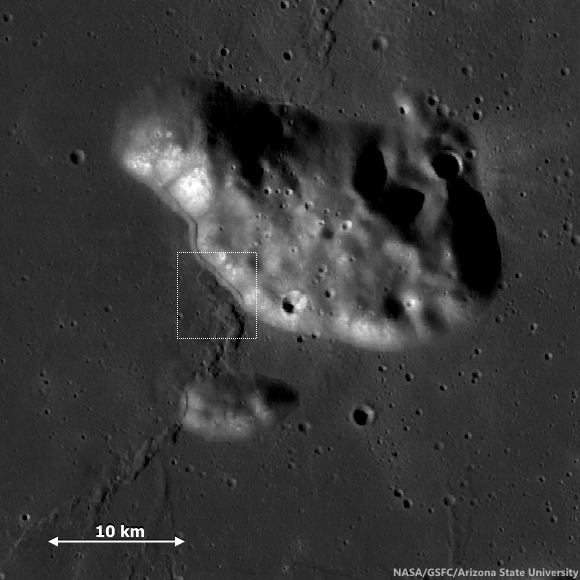
This beautiful mountain, called a kipuka, is located in northern Mare Imbrium on the nearside.

Kipukas are the high-standing remnants of a lava-flooded terrain and are quite common on the Moon. In this case, the kipukas are likely part of the inner ring of the Imbrium impact basin that was later flooded by mare basalts. The lobate scarp in the opening image formed due to contraction and the subsequent upward thrusting of the surface.

This scarp looks very familiar, a twin to the famous Lee-Lincoln scarp that the Apollo 17 astronauts explored in the Taurus Littrow Valley.

Wide Angle Camera mosaic showing the field of view of the LROC Featured Image. LROC WMS Image Browser [NASA/GSFC/Arizona State University].
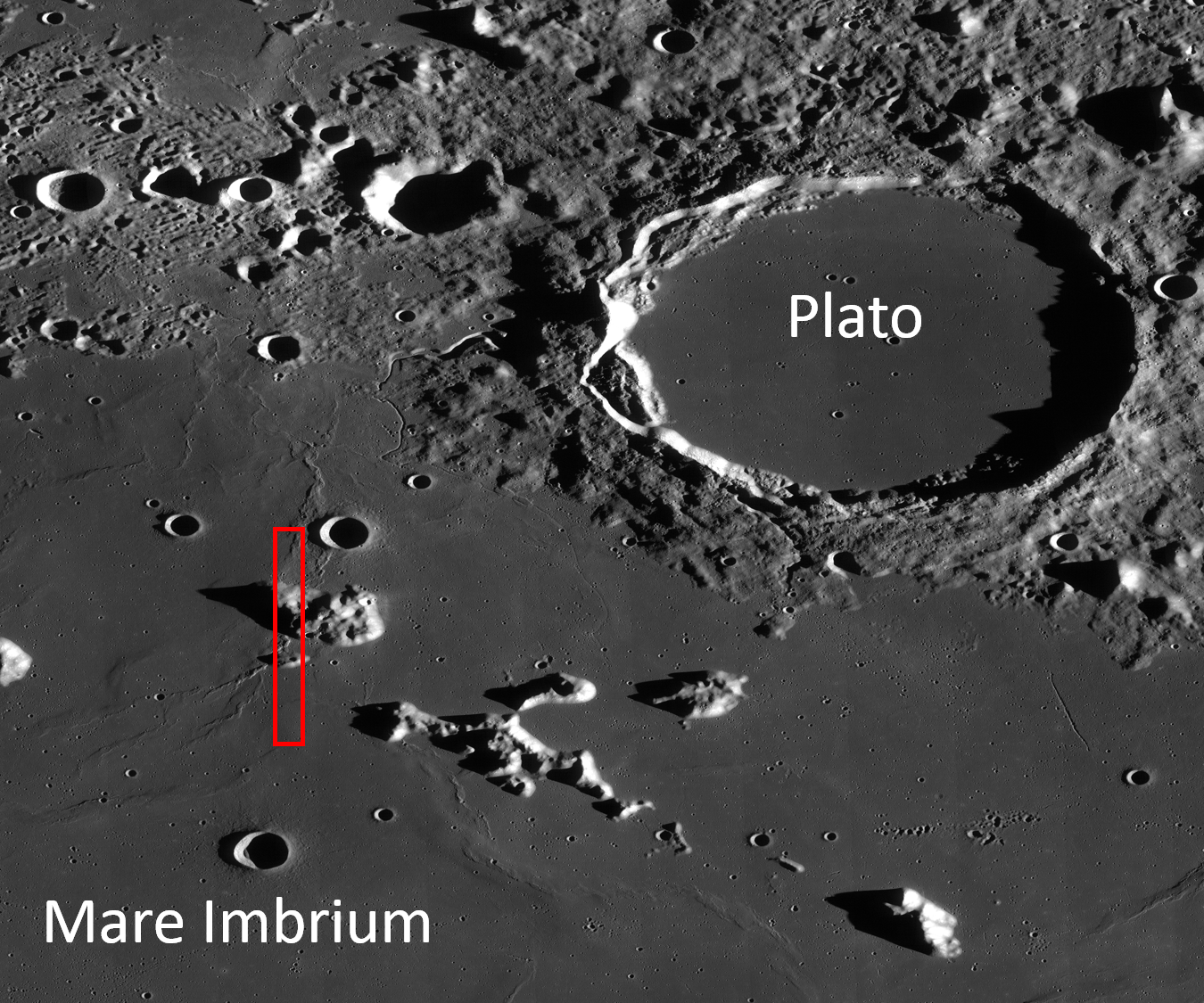
LROC WAC context image of northern Mare Imbrium centered near 49.459°N, 348.136°E. The red box denotes the location of the NAC frame from which the LROC Featured Image released March 21, 2014 was derived. Landmark crater Plato is approximately 101 km across [NASA/GSFC/Arizona State University].
Another common feature in Mare Imbrium are wrinkle ridges like the one above.

Wrinkle ridges form when the surface undergoes compression due to sagging of the lithosphere below large mare deposits. Local tectonic conditions such as the thickness of the mare, direction of stress, and the strength of the basalt affect the final shape of a wrinkle ridge, yielding a variety of ribbon-like ridge forms.

Investigate this complex area for yourself, HERE.

Related Posts:
That's a Relief
Balcony Over Plato
Wrinkled, But How Old?
Wrinkle Ridge in Mare Crisium 
Remnants of the Imbrium impact

Thursday, December 5, 2013

Offset floor of Buys-Ballot crater

M1095343282L_thumb-1000
LROC Featured Image, released December 5, 2013: Lobate scarp ridge along the east floor of Buys-Ballot crater. LROC NAC image centered on 21.321°N, 175.152°E, field of view 1.41 km. Sunset illumination (angle of incidence 82.35°), LROC NAC observation M1095343282LR, LRO orbit 13796, June 26, 2012; mean resolution 1.4 meters per pixel, spacecraft and camera slew 2.31° off nadir, captured from 139.75 km over 20.94°N, 175.0°E [NASA/GSFC/Arizona State University].
Hiroyuki Sato
LROC News System

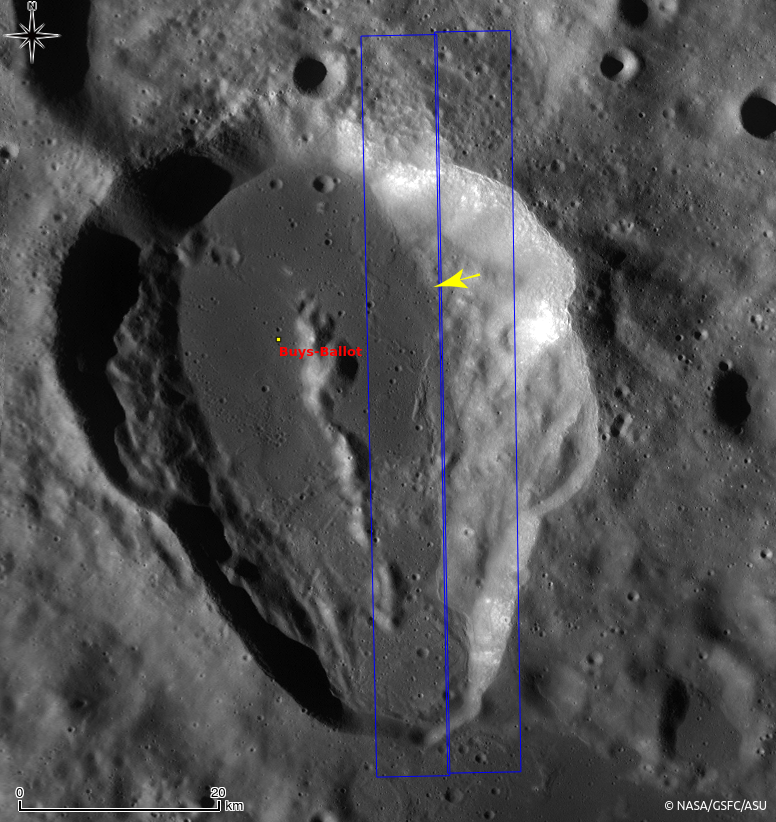
The opening image is of the eastern edge of the floor of the farside crater Buys-Ballot (66.4 km in diameter). The shape of this crater is elongated from the northwest to southeast (see next WAC context image), likely due to a low impact angle. The floor is partially resurfaced by basaltic lava, leaving a relatively flat area around the linearly aligned central peaks.

The topographic ridge from upper-left to lower-right of the opening image is offset along a lobate scarp that extends about ~60 km along the contact of the flat floor and eastern crater wall. The late afternoon illumination from the left side of this image (incidence angle is 82.4°) highlights the fault scarp and the up thrown lava (lower left half of the image). The scarps extend out of the crater in the south, but segments there are not as well developed as those inside the crater and gradually disappear.

M1095343282L_fixt-720-580x820
Full 15.3 km-wide field of view centered on area shown at 1.41 meters per pixel resolution in the LROC Featured Image, above, released December 5, 2013. LROC NAC mosaic M1095343282LR [NASA/GSFC/Arizona State University].
The lobate scarp is located in mare basalts and extends up and out of the crater into the surrounding highlands, somewhat similar to the famous Lee Lincoln scarp near the Apollo 17 landing site. Although formed in mare, the fault scarp does not have the distinctive morphology typical of wrinkle ridges that are found exclusively in mare basalts (see Wrinkles in Mare Frigoris, The Ghosts of Mare Fecunditatis & Boulder Clusters on a Ridge Crest).

Lobate scarps are formed by thrust faults caused by global contraction of the Moon as its interior cools. Sometimes these young thrust faults crosscut highland craters like Buys-Ballot crater and Seares crater, resulting in fascinating sharp morphologies on top of the featureless flat basaltic plain.

M1095343282L_context-776x822
Context view of Buys-Ballot crater (LROC Wide Angle Camera monochrome mosaic, resolution standard global 100 meter per pixel), field of view centered on 20.86°N, 175.15°E. The LROC NAC mosaic footprint (blue rectangle) and location of LROC Featured Image (yellow arrow) noted [NASA/GSFC/Arizona State University].
Explore the low-sun picture of the lobate scarps inside Buys-Ballot crater, HERE.

Related Posts:
Squished Crater
Taurus Littrow Valley, West-To-East
Not Your Average Scarp
Lobate Scarp or Fluidized Ejecta?
Tectonics in Mare Frigoris
Scarps in Schrödinger
Lunar Lobate Scarp
Right Angle
Slipher Crater: Fractured Moon in 3-D
Aitken Crater Constellation Program Region of Interest
The Moon in 3D

Southern Buys-Ballot
Bonus image: an oblique view of the south interior of the Buy-Ballot formation. LROC Narrow Angle Camera (NAC) mosaic M167091099LR, LRO orbit 9758, August 4, 2011; angle of incidence 58.6°, camera and spacecraft slew from nadir 64.7° - mean resolution 3.9 meters per pixel, from 60.35 km over 20.37°N, 169.9°E, 140 km east of field of view (mechanics of observation below) [NASA/GSFC/Arizona State University].

Southern Buys-Ballot
Mechanics of 'Bonus' image, above; highly slewed LROC NAC oblique observation M167091099LR, a slewed view of the southern interior of the Buys-Ballot formation [Google Earth].

Thursday, April 11, 2013

Squished Crater

A lobate scarp cuts across and deforms an ancient impact scar on the floor of Seares crater in the far north of the farside highlands terrain. From a mosaic of LROC Narrow Angle Camera (NAC) frame M187315000L an R, field of view 1.95 km, angle of incidence 81.38° at 2.95 meters resolution from 143.54 kilometers [NASA/GSFC/Arizona State University].
Lillian Ostrach
LROC News System

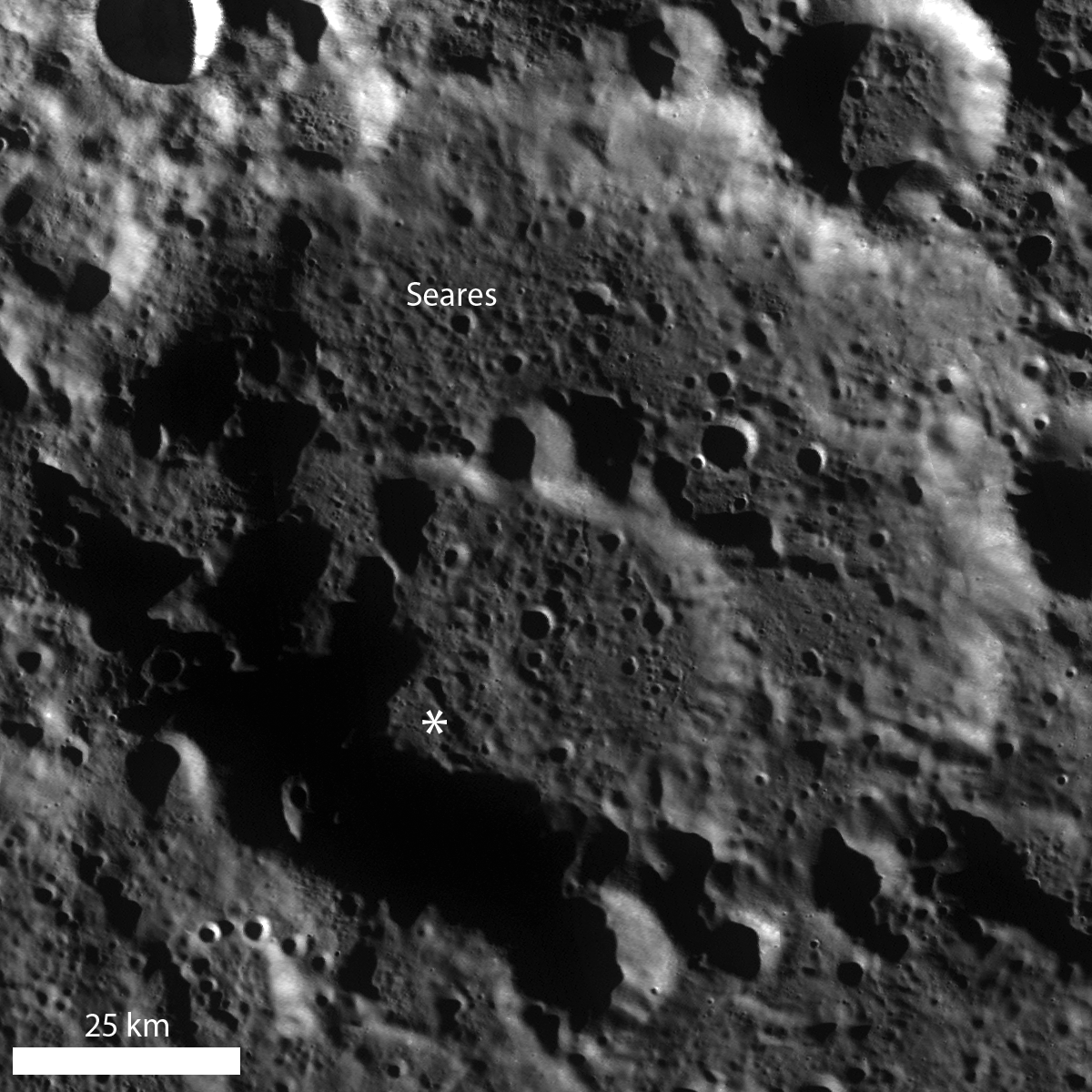
Lobate scarps, found almost only in the highlands, represent the surface expression of thrust faulting within the lunar crust. In the opening image, several segments of a lobate scarp deformed the Seares crater (75.529°N, 146.385°E, approximately 105 kilometers in diameter) floor material, including an unnamed 1.1 km crater (72.964°N, 144.897°E).

Based on the northeast/southwest trend of the lobate scarp segments, this area was probably under compression in the approximate northwest to southeast direction (squeezed from top left toward bottom right), creating bulges on the surface and squishing the crater.

LROC WAC monochrome mosaic of Seares crater. An asterisk notes the location of the opening image's field of view [NASA/GSFC/Arizona State University].
The squished crater is degraded, without a well-defined sharp rim, and it is difficult to determine with a quick glance just how much deformation occurred. Drawing a best-fit circle around the probable rim of the crater to use as a guide for many measurements of crater diameter is one way to estimate the amount of crater deformation. Using this method, the crater diameter is ~1.06 km if the measurement is based on a circle fitting the rim in the east-west direction, while a fit based on the north-south direction provides a diameter of ~1.13 km. Furthermore, the crater shape is somewhat square, which may indicate that this region was affected by ancient episodes of faulting - perhaps resulting from the Seares crater impact formation - that affected today's crater formation, similar to the structural influences that influenced the formation of Meteor Crater.

Put your eyes to the test! Can you find other cross cutting relationships involving the lobate scarp segments in the full NAC image, HERE?

Related Posts:
Scarps in Schrödinger
Relative age relationships
Simpelius Scarp
Offset Crater, Active Moon

Thursday, February 14, 2013

Numerov's Graben

Normal faults in regolith formed remarkably small graben in Nectarian age Numerov crater (70.7°S, 160.7°W). Only a handful of small craters superpose the faults, indicating a young age. LROC NAC M171619370RE, image width is 600 m [NASA/GSFC/Arizona State University].
Drew Enns
LROC News System

Graben on the Moon come in a variety of sizes. Some of the larger rilles in the maria stretch for several tens of kilometers and can be a few kilometers in width. These linear rilles are thought to be the result of extensional stresses near the edges of the maria and are thus graben.

Since the mare basalts are dense, they weigh down the crust in the center of the deposit, pulling rock near the margins inward.

However, the Featured Image today shows much smaller graben that span only hundreds of meters in length and tens of meters in width. To complicate matters, these graben are not in mare basalts, they are inside a crater!

Context image for today's Featured Image. The graben are pointed to by the arrow. A nearby lobate scarp extends from A to A', its low relief enhanced by the low Sun mosaic. Image width is 100 km [NASA/GSFC/Arizona State University].
The LROC Wide Angle Camera (WAC) context image (above) helps us decipher the origin of these graben, as a nearby lobate scarp can be seen at this scale. Lobate scarps form in compressional stress environments as layers of rock or regolith fold and thrust upwards. The thrusting might cause nearby crust or regolith to uplift and bend.

The graben and scarp are only hundreds of meters apart which argues for a compressional interpretation.Thus the interplay between compressional and extensional stresses is reflected in the distribution of tectonic features within Numerov crater. The end result is that we see small graben situated very near to lunar lobate scarps!

Numerov show its great Nectarian age at minimal shadowing in this LROC QuickMap 125 meter resolution orthographic projection assembled from LROC WAC photography and the LROC WAC-based digital terrain model (DTM). By contrast, its larger neighbor shouldered against it's western edge is Antoniadi, an uncharacteristically youthful (Upper Imbrium) impact crater for this part of the lunar surface, deep within South Pole-Aitken basin, and home of the Moon's deepest elevation. The smaller stress affects discussed in the post by Drew Enns are not as apparent at this scale, though other stress affects, scarps in particular, are easier to pick out [NASA/GSFC/ASU/DLR].
Explore more of the lobate scarp and graben in the full LROC NAC, HERE.

Related Posts:
Watch That First Step!
Its the Moon's Fault
Pull Apart - Grabens

LROC WAC mosaic presented using the Virtual Moon Atlas 6 shows Numerov in context with Antoniadi and Minnaert, a triple astrobleme that is easy to spot on maps of the farside and South Pole-Aitken basin [NASA/GSFC/ASU/VMA6].

Wednesday, December 19, 2012

Oblique view of Taurus Littrow, from the West

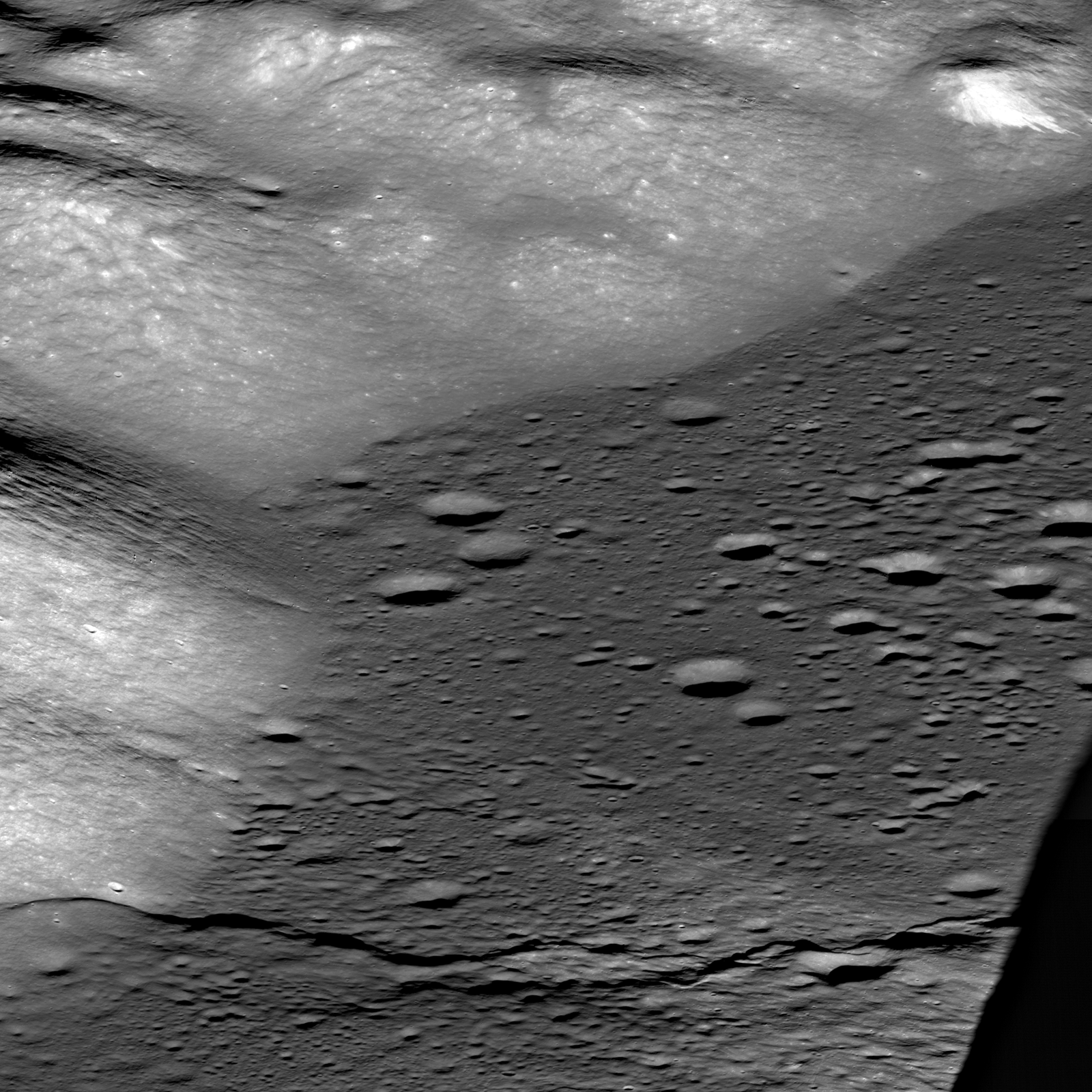
The magnificent Taurus Littrow valley photographed obliquely, from a point 330 km west by northwest, 131.12 km over central Mare Serenitatis, by the LROC Narrow Angle Camera (NAC). The Apollo 17 crew briefly explored this valley 40 years ago this month. LROC NAC observation M1096343661LR, a field of view roughly 10 km across the center; LRO orbit 13936, July 7, 2012 [NASA/GSFC/Arizona State University].
Mark Robinson
Principal Investigator
Lunar Reconnaissance Orbiter Camera
Arizona State University


In the lower right, South Massif casts a long evening shadow across the mare basalt flooded Taurus Littrow valley. Note the sharp boundary of the flat mare against the slopes of the Sculptured Hills in the background, similar to a lake shoreline, revealing the very fluid nature of the lava when it filled the valley. Your eye is drawn to the sharp line snaking across the bottom of the image. Note how this ridge traverses across the valley floor and up onto the lower slopes of North Massif (lower left). Astonishingly this feature is a large, young fault: imagine the ground in the foreground being pushed to the east and the crust buckling, a whole section was pushed up and onto the back side of the fault (low angle thrust fault). This step in the valley floor was the result of large scale contractional forces pushing the crust together. The landform created by this type of thrust fault is called a lobate scarp, this one is named the Lee Lincoln scarp. The Lee Lincoln scarp has the distinction of being the first and only extraterrestrial fault to be explored by humans. Astronauts Harrison Schmitt and Gene Cernan actually drove the Lunar Roving Vehicle (LRV) up and over this ridge during their three day exploration of the valley.

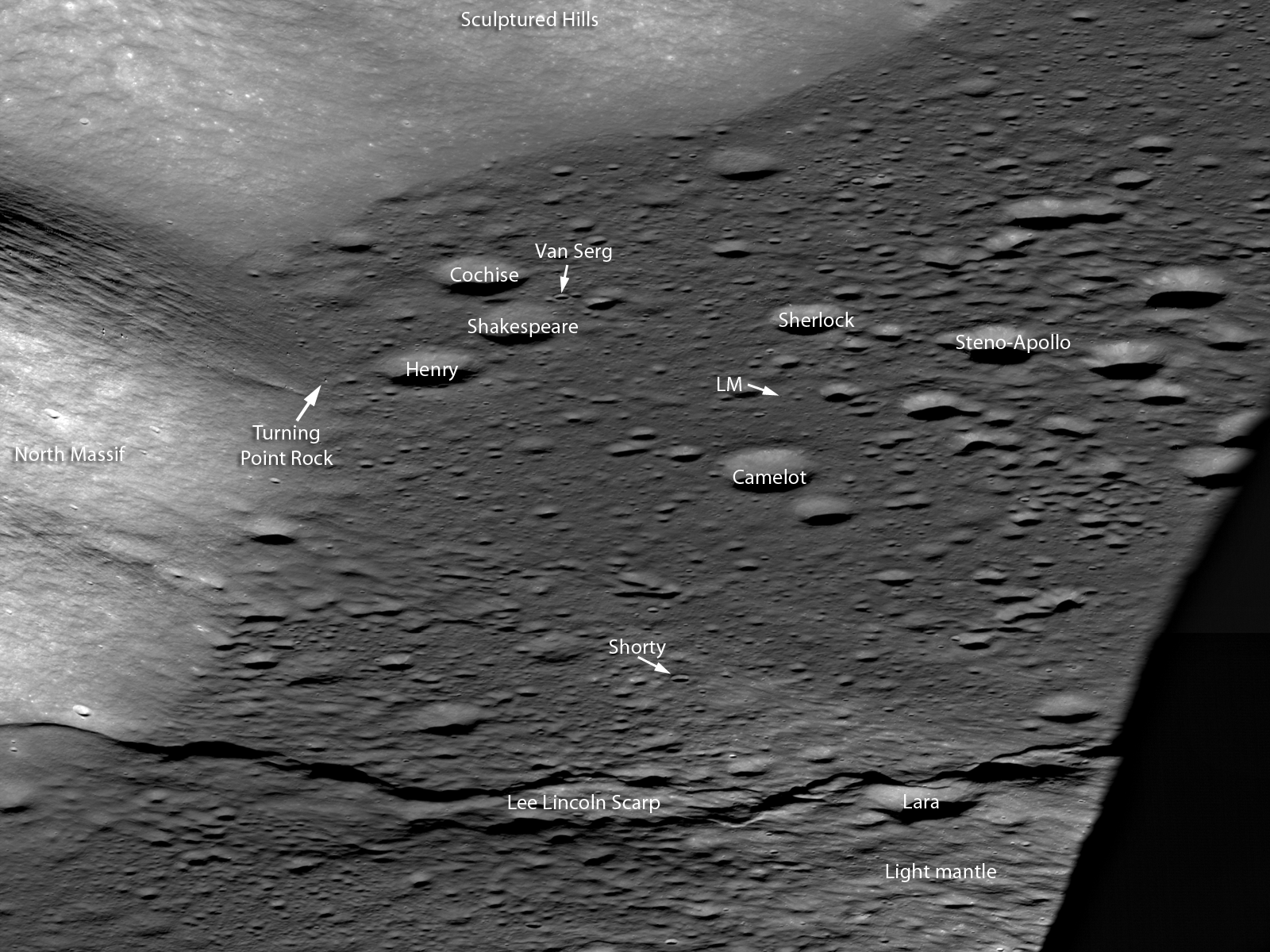
Apollo 17 commander Gene Cernan works next to the LRV at Station 3, near Lara crater, (see labeled detail below). AS17-138-21168 [NASA/Harrison Schmitt].
Where the Lee Lincoln scarp stretches into the highlands of North Massif, it abruptly changes directions and extends along slope far beyond the Apollo 17 landing site (black arrows on full NAC image).  The Lee Lincoln scarp is one of a number of such tectonic landforms that were only found in the high resolution Apollo Panoramic Camera images that covered part of the lunar equatorial zone. In LROC NAC high resolution images, lobate scarps have been discovered across the Moon at all latitudes (Watters and coworkers, 2010). The pristine appearance of the lobate scarps and the fact that the features cut across young, small-diameter craters are evidence that the scarps formed recently, more recently than the young craters they deform. The globally distributed population of lobate scarps is an indication that contractional forces are acting on the lunar crust as a result of slow cooling and shrinking of the still hot interior of the Moon.

West to east Oblique labeled - Central portion LROC NAC oblique showing significant features visited by the Apollo 17 crew, LM is the Lunar Module. North is to the left, and south is to the right. The distance along Lee Lincoln scarp from the shadow to North Massif is 8 km, M1096343661LR [NASA/GSFC/Arizona State University].
It was forty years ago today that the Apollo 17 crew splashed down in the Pacific Ocean, ending our first period of human exploration of the Moon. The extensive measurements beamed back from LRO every day are setting the stage for the next era in robotic and human exploration of the Moon. Where would you go on the Moon to continue the work of the Apollo crews?

Trace the Lee Lincoln scarp, HERE, as it snakes its way northward, well away from the Taurus Littrow valley (VSC Van Serg Crater, SC Shorty Crater, LM Lunar Module).

Previous Apollo 17 Featured Images:
Approach To Taurus Littrow Valley (December 12, 2012)
Apollo 17 lands, ending the Apollo era, 40 years ago (December 11, 2012)
The last manned launch to the Moon (December 7, 2011)
Taurus Littrow Oblique (September 29, 2012)
Question Answered! (July 17, 2012)
Significant change in bombardment timing (January 6. 2012)
Just another crater? (December 13, 2011)
Skimming the Moon (September 6, 2011)

Exploring the Apollo 17 Site (October 28, 2009)

Thursday, July 12, 2012

LROC: Simpelius Scarp

A lobate scarp formed in the far south nearside lunar highlands. Lunar scientists keep finding more of these tectonic features as LROC Narrow Angle Camera (NAC) high-resolution image coverage of the lunar surface continues to grow. An image from the Commissioning phase of the LRO mission, LROC NAC observation M106807247L, orbit 886, September 5, 2009; field of view is approximately 1000 meters wide, a 74.06° illumination incidence angle at 1 meter resolution from 42.59 km [NASA/GSFC/Arizona State University].
Drew Enns
LROC News System
 

Lobate scarps are, along with wrinkle ridges, one of the major contractional features found on the Moon. Though unlike wrinkle ridges, lunar lobate scarps form (almost) exclusively in the lunar highlands. This lobate scarp, designated Simpelius scarp, is located far to the south at 73.609°S, 8.764°E.

Unlike lobate scarps on other planets, the lunar scarps are fairly small with <100 meters maximum relief.

So how do such small features survive the onslaught of small impactors over time?

LROC QuickMap 64 meter resolution context for the Simpelius Scarp, located above the business end of the yellow arrow. At this scale and smaller the scarp is difficult to spot because it's small. [NASA/GSFC/Arizona State University].

The sharp features, lack of larger superposed craters, and cross-cutting relationship with small craters all imply that Simpelius scarp is young. The most compelling evidence that it is very young is simply that it exists at all. After about 100 million years the Moon's surface is saturated (every square inch of the surface has been reset with a crater of this size) with 100 meter diameter craters.

And the scarp is invisible altogether in this LROC QuickMap 1000 meter field of view covering the central meridian lunar surface south from 60°S to just beyond the ancient rim of South Pole-Aitken basin to Shackleton, host to the Moon's South Pole [NASA/GSFC/Arizona State University].
Since we can find only a very few craters of this size, the scarp must be significantly younger than that saturation age. If so, the Moon must have undergone compression recently, since lobate scarps are found everywhere on the Moon, and scientists are fairly certain that the Moon is still shrinking as its molten core continues to solidify and shrink. The crust is rigid and suffers brittle fracture, due to the shrinkage, that results in lobate scarp formation. Yes, the Moon is an active place just waiting for a network of seismometers to probe its interior!

Explore more of the lobate scarp in the full LROC NAC, HERE.

Related Posts:
Not Your Average Scarp
Tectonics in Mare Frigoris
Lobate Scarp or Fluidized Ejecta

Thursday, March 29, 2012

LROC: Not your average scarp

A scarp winds through an interestingly wrinkled region of mare amidst the Zucchius crater group. LROC Narrow Angle Camera (NAC) observation M166223945L, field of view width = 560 meters, LRO orbit 9630, July 25, 2011; incidence angle 75.61° at a resolution of 0.97 meters per pixel from 46.45 kilometers. View the enlarged LROC Featured Image HERE [NASA/GSFC/Arizona State University].
Lillian Ostrach
LROC News System


This lobate scarp wends through a region of mare basalts, but you will be surprised to know that the location of this image is on the lunar farside (59.921°S, 304.456°E), northwest of Zucchius crater. Even though the farside is not well known for vast deposits of mare like the nearside, there are regions of volcanically flooded terrain. Today's Featured Image highlights such an area, where contractional forces caused the mare materials to break along a fault and thrust upward, and the lobate scarp is the surface expression of slip on the fault. However, lobate scarps usually occur in the highlands and wrinkle ridges (another contractional tectonic landform) usually occur in mare regions. So why is a lobate scarp observed in this region of mare basalts?

LROC Wide Angle Camera monochrome (604nm) mosaic showing a roughly 34 km-wide field of view surrounding the area spotlighted at high-resolution in the LROC Featured Image (dead center) under early daylight illumination, in sharp relief. The scarp formation northeast of Zucchius F (lower left) is extensive and highly visible. Image derived from six sequential WAC observations, orbits 11367-11372, December 9, 2011; average incidence 81.5° at 58.38 meters resolution from 42.94 kilometers [NASA/GSFC/Arizona State University].
Lobate scarps are thought to form from global contraction of the Moon, as its still hot interior cools. In contrast, wrinkle ridges - while contractional features - probably formed by a combination of faulting and folding of mare basalts, and so wrinkle ridges have a broad swell and a characteristic ridge (or wrinkle). However, just because lobate scarps and wrinkle ridges usually form in a specific terrain does not mean that they are prevented from forming elsewhere; both landforms represent characteristic surface expressions of tectonic compression.

LROC WAC monochrome mosaic marking the location and accompanying the LROC Featured Image, March 29, 2012. The scarp is noted with an asterisk, barely visible at higher angle of sunlight, among secondaries and discontinuous ejecta from Zucchius crater to the southeast. View the full-sized LROC context image HERE [NASA/GSFC/Arizona State University].
Looking at the opening image, one can imagine that this area was squeezed together in the approximate east-west direction (right to left). When the rock could withstand no more contractional strain, it faulted and the eastern edge was pushed over the western edge, creating this broad scarp. But why not form a wrinkle ridge in this mare material? Perhaps the formation of the lobate scarp is telling us something about the mechanical properties of the mare in this location. The mare are a series of lava flows that form a layer-cake sequence. In between the layers may be soil interbeds that allow some layers to slip a little as the sequence of layers contracts. When layers can slip, a wrinkle ridge will likely form, and when layers can't slip, a lobate scarp might form. This hypothesis may be on the right track, because transitions from a wrinkle ridge to lobate scarp often occur at boundaries between mare and highlands, with the lobate scarp forming in highland material that has no discernable layering. Careful, though - when interpreting the origin of a tectonic feature, the entire region needs to be examined to answer questions such as what is the total population of contractional tectonic features, how are they oriented, and how do their sizes and shapes vary. Creating a comprehensive catalog of all tectonic features within an area allows scientists to estimate the contractional (and extensional) forces within the region. Only then can sense be made of why a single feature formed.

What do you think? Can you find any craters deformed by the lobate scarp in the full LROC NAC image, HERE? If you can, great! - you've found additional evidence for contraction of this surface!

Related Posts:
Lobate Scarp or Fluidized Ejecta?
Wrinkled Planet
Slipher Crater: Fractured Moon in 3-D
Scarps in Schrödinger

Thursday, November 10, 2011

Lobate Scarp or Fluidized Ejecta?

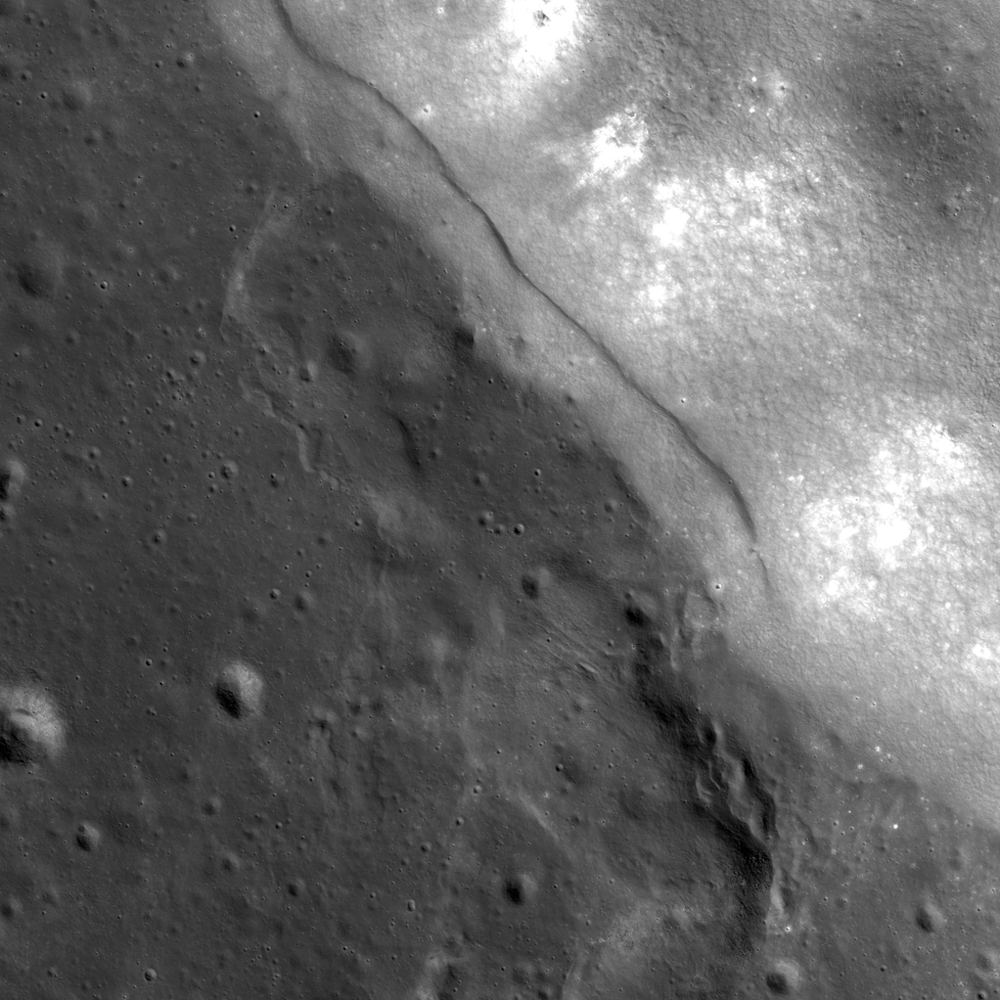
A double merges into a single escarpment, part of a dramatic scene near 32.8°N, 215.08°E on the floor of an unnamed crater superimposed on the larger farside highland crater Blazhko D. LROC Narrow Angle Camera (NAC) observation M105463860R, LRO orbit 694, August 21, 2009; field of view around 1500 meters at an incidence angle of 51.02° from an early Commissioning Mission altitude of 166.2 km. See the full size original LROC Featured Image HERE [NASA/GSFC/Arizona State University].
James Ashley
LROC News System

Is this meandering escarpment an example of 1) a lobate scarp, or 2) imbricated deceleration lobes? Lobate scarps represent portions of the lunar crust that thrust-faulted, with one portion riding up and over the other in a process that is suggestive of crustal shrinking. Imbricated deceleration lobes result from fluidized impact ejecta deposits, with some deposits riding up and over others in a similar-looking way. Fluidization in this sense should not be confused with liquid or water - these materials are totally dry!

The cause of this type of fluidized flow remains somewhat unknown, but may involve acoustic energy within the moving mass of debris. Some of this energy may be supplied by the surface beneath the debris flow as secondary impacts and tectonic readjustments keep it vibrating following the large impact that initiated the flow. Try pouring some sand on a slanted board while you drum on the board with your fingers. You will see that the drumming removes most of the friction and allows the sand to flow freely. These type of flows often travel great distances before losing energy as they encounter slopes too steep to climb. On Earth we call them sturzstroms.

A complication in the case of today's Featured Image is the presence of scarps that are clearly related, but which oppose each other in their orientation (left side of frame).

Extensions of the scarp are visible far beyond the field of view of the Featured Image (white square) in much larger 5500 meter-wide segment from LROC NAC frame M105463860R [NASA/GSFC/Arizona State University].
The presence of this feature within the deposits of a highland crater floor might argue that fluidized ejecta are responsible because these debris flows often collect (some even appear to 'pool') within the low-lying crater floors. The material could be seen as so fluid that even after portions of the material have climbed the crater wall and stalled, other portions are able to slide backward to create the secondary 'reverse' escarpment in the Featured Image. Similar features within fault escarpments are not unheard of, however, and are referred to as splay faults. Thus the discussion remains an open one...

From the LROC QuickMap a contextual image showing both the left and right frames of LROC NAC observation M105463860 juxtaposed surrounding the field of view (white square) in the 5500 meter-wide image immediately above  [NASA/GSFC/Arizona State University].
LROC Wide Angle Camera (WAC) 100 meter resolution context image superimposed upon the LOLA Digital Elevation Model from the NASA ILIADS lunar mapper program. The elevation in meters above the global mean is shown at selected points around the spotlighted area [NASA/GSFC/Arizona State University],
Additional indications of fluidized ejecta are located throughout the surrounding region in the above context image. However, although a great many highland craters are present within this region of the Moon, none stand out as being the unambiguous source of these deposits. Knowing the true mode of origin for features like these is basic to the goals of planetary science. A properly equipped team of astronauts conducting seismic measurements is probably required to make a definitive determination. Are there any additional clues visible in the full NAC image that might help solve the mystery? Examples of lobate scarps can be found in Schrödinger, and Xenophanes craters. Examples of fluidized ejecta include the Lavish Lobes of Necho R and King Crater Ejecta Deposits.

Thursday, October 13, 2011

LROC: Tectonics at the edge of Procellarum

A mare wrinkle ridge transitions to a highland lobate scarp at the edge of Oceanus Procellarum. Illumination is from the lower-left in this 2.9 km wide mosaic of LROC Narrow Angle Camera (NAC) frames M107069913LE and M107069913RE, LRO orbit 918, September 8, 2009. View the full size LROC Featured Image HERE [NASA/GSFC/Arizona State University].

Nathan Williams
LROC News System

A mare wrinkle ridge transitions to a highland lobate scarp at the edge of Oceanus Procellarum. Illumination is from the lower-left in this 2.9 km wide mosaic of LROC NAC images M107069913LE and M107069913RE [NASA/GSFC/Arizona State University].

Two types of compressional tectonic landforms are commonly observed on the Moon: wrinkle ridges and lobate scarps. Wrinkle ridges are long, often sinuous hills in mare basalts and are thought to be folded rock layers overlying deeper faults. Lobate scarps usually occur in the highlands and are interpreted as rocks lifted up by faults very near to or even breaking the surface. There are a few locations where a wrinkle ridge transitions into a lobate scarp or vice-versa, such as here at the northern edge of Oceanus Procellarum (60.5°N, 331.4°E). In this LROC NAC mosaic, the lobate scarp in the highlands massif to the northeast meets a wrinkle ridge to the southwest when it reaches the otherwise flat-lying Procellarum basalts. You can also see lots of boulders eroding out of the wrinkle ridge.

Reduced resolution NAC mosaic of images M107069913L and M107069913R showing the wrinkle ridge - lobate scarp transition. Illumination is from the bottom-left in this 16 km wide mosaic. [NASA/GSFC/Arizona State University].
Wrinkle ridges are thought to have formed after the basaltic lavas erupted, filling in the basins on the nearside, and weighing down the crust. All that extra weight probably made the ground sag and bend, causing the basalt to buckle and fold in some areas. On the other hand, lobate scarps are thought to form from radial contraction or shrinking of the entire Moon. The global radial contraction built up compressional stresses in the crust until the stress was great enough to fracture all the way to the surface. The transition from wrinkle ridge to lobate scarp may be due to the contrast in materials, especially if the basaltic lavas are layered and the highland massif lacks layering. However, the relationships between wrinkle ridges and lobate scarps at transitions like this are still being studied.

LROC Wide Angle Camera mosaic (604 nm band) showing the Featured Image (yellow box) in context around 7 kilometers west of craterlet Fontenelle X, and the system of wrinkle ridges and scarps, admittedly easier to see at higher resolutions. From a larger LROC WAC mosaic swept up through 14 orbital observations from an average 36 kilometers altitude, January 26 and 27, 2011; Field of view roughly 62 kilometers (phase angle averaged 70° - see image following) NASA/GSFC/Arizona State University].
Highly reduced original LROC WAC mosaic (January 26, and 27, 2011) showing the location of the Featured Image and its environs within Mare Frigoris, north of Sinus Iridum and Mare Imbrium, possibly superimposed on the older (even with younger volcanic fill) and irregularly-shaped basin known as Oceanus Procellarum. Some investigators propose most of the nearside may be an ancient basin, responsible, perhaps at least in part, for the near and far side elevation discontinuity, and a basin that is perhaps larger than the nearside hemisphere itself, originally centered northwest of Mare Tranquillitatis. This so-called "Gargantuan" impact basin is far from without it's detractors, however. Without definitive proof, the South Pole-Aitken basin remains the largest and oldest recognized impact basin.
Then there is the laser altimetry building up from the LOLA instrument on-board LRO, from hemisphere-views released earlier this year, here showing the location of the Featured Image (blue arrow) from over far north, and the farside highlands beyond 90° west. Without the nearside's familiar albedo features, the near and farside dichotomy is easier to sense [NASA/GSFC/LOLA/SVS].
Take a look at the full NAC mosaic - can you find any other scarps or ridges?

Related Posts:
Scarps in Schrödinger
Lunar Lobate Scarp
Slipher Crater Fractured Moon in 3-D
Forked Wrinkle Ridge
Stress and Pull

Wednesday, September 14, 2011

LROC: lobate scarp in Xenophanes


A North-South trending lobate scarp inside very ancient 127 km pre-Nectarian Xenophanes, showing the distinct "elephant skin" surface texture typical of lunar slopes. LROC Narrow Angle Camera (NAC) observation M118031613LE, LRO orbit 2528, January 13, 2010; resolution 60 cm per pixel, field of view 600 meters. View the full size LROC Featured Image HERE [NASA/GSFC/Arizona State University].


Drew Enns
LROC News System

Lobate scarps are long, curvilinear structures found on some planetary bodies. They are interpreted to be tectonic in nature, the result of a thrust fault developed in rocks that are otherwise structurally sound. Faults (planar fractures) come in several styles: Normal faults occur when one slab of rock (the hanging wall) slides below the level of a neighboring slab of rock (the foot wall).

Thrust faults (also called reverse faults when the fault angle is greater than 45 degrees to the horizontal) are the opposite of a normal fault. Instead of the hanging wall slipping below the foot wall, the hanging wall is thrust above the foot wall. In general, normal faults are the result of regional or local extension, while thrust and reverse faults give evidence of compression.


Full 2-km wide field of view of LROC NAC frame M118031613L allows a longer north-south look at the scarp, kin to the Lincoln Scarp visited by Cernan and Schmidt at Taurus Littrow (Apollo 17). At his point the scarp runs parallel with the inner slope of an unnamed crater within Xenophanes [NASA/GSFC/Arizona State University].


Context LROC Wide Angle Camera (WAC) monochrome (643 nm) observation M145154636C showing the lobate scarp running in a semi-circle along the wall of a degraded crater within Xenophanes; field of view 44 km, LRO orbit 6325, November 23, 2010 [NASA/GSFC/Arizona State University].

So what mechanism produces lobate scarps? On Mercury, lobate scarps are large and globally distributed, and have been interpreted to be the result of global contraction of the planet. What could make an entire planet contract? How about the slow cooling of its interior.

Data from LROC indicates that the lobate scarps on the Moon are also distributed globally. However, they are also small and deform the regolith locally. Because these faults are located in relatively unconsolidated material, they must be very young because the regolith is constantly churned by small asteroid and comet impacts. Scientists have thus interpreted the lunar scarps to be the result of late-stage, not early-stage, global contraction of the Moon!

LOLA altimetry of a 360 square kilometer area around the crater hosting the lobate scarp, within Xenophanes clearly shows striation channels radiant to Mare Imbrium, whose center basin beyond Oceanus Procellarum, seen at the eastern edge of the field, is 1700 km away. Procellarum's elevation, as deep as it is (here ~3100 meters below lunar mean, is more than three km higher than the flooded floor of Xenophanes. Perhaps the latter, more ancient impact floor was flooded from below. Some features nearby are radiant to the more distant Orientale impact basin [NASA/GSFC/MSFC/LMMP].

Can you trace the entire length of the lobate scarp in the full NAC frame?

Related Posts:
Wrinkled Planet
Right Angle
Aitken Crater Constellation ROI

Tuesday, May 3, 2011

Wrinkled Planet


Intricate fault patterns enhanced by polar dawn lighting in Seares crater (Sun is shining from lower right). North is up, and the image field of view is 2800 meters; LROC Narrow Angle Camera (NAC) observation M130681684LR, LRO orbit 4392, June 9, 2009. View the spectacular full-sized LROC Featured Image HERE [NASA/GSFC/Arizona State University].

Mark Robinson
Principal Investigator
Lunar Reconnaissance Orbiter Camera
Arizona State University


Wow - the Moon is a beautiful place! Who ever said wrinkles are something to dread? In the Apollo days a few faults with scarps like the one above were discovered in the highlands. However, the coverage was small so it was not known if these lobate scarps were common over the whole Moon or not. From LROC NAC images we now know that the lobate scarps are common in the highlands and are also globally distributed.

This spectacular example is located far from the Apollo zone, towards the north pole (74.5°N, 146.8°E). The fact that these ridges are found all over the Moon tell us that the lunar crust is contracting. But how? We believe the Moon is shrinking as its once molten core cools and freezes. Liquid metal takes up more space than solid metal - so as the core freezes, it shrinks. As the core shrinks, the mantle and crust follow suit. Since the crust is brittle, it faults and buckles and lobate scarps pop up! The amazing resolution of the LROC Narrow Angle Cameras brings into view the smallest details.

What are those little patches of boulders doing sitting there on the ridge?


Larger area from same NAC mosaic sampled at 6 m/p, north is up, image width 5.4 km. View the full-sized image HERE [NASA/ GSFC/ Arizona State University].

Don't confuse lobate scarps with wrinkle ridges; they do look alike to the untrained eye. Though they are both formed by compression that results in faulting and thrusting, the underlying mechanisms are very different. Visit a previous LROC post detailing wrinkle ridges. Explore the entire NAC mosaic, and keep an eye out for more compressional features as well as those formed by extension!