Showing posts with label LROC WAC Previewer. Show all posts

Saturday, March 12, 2011

Farside & LROC WAC views all the way around!

Updated 0158 UT 16 March 2011
From LROC Wide Angle Camera Collection -
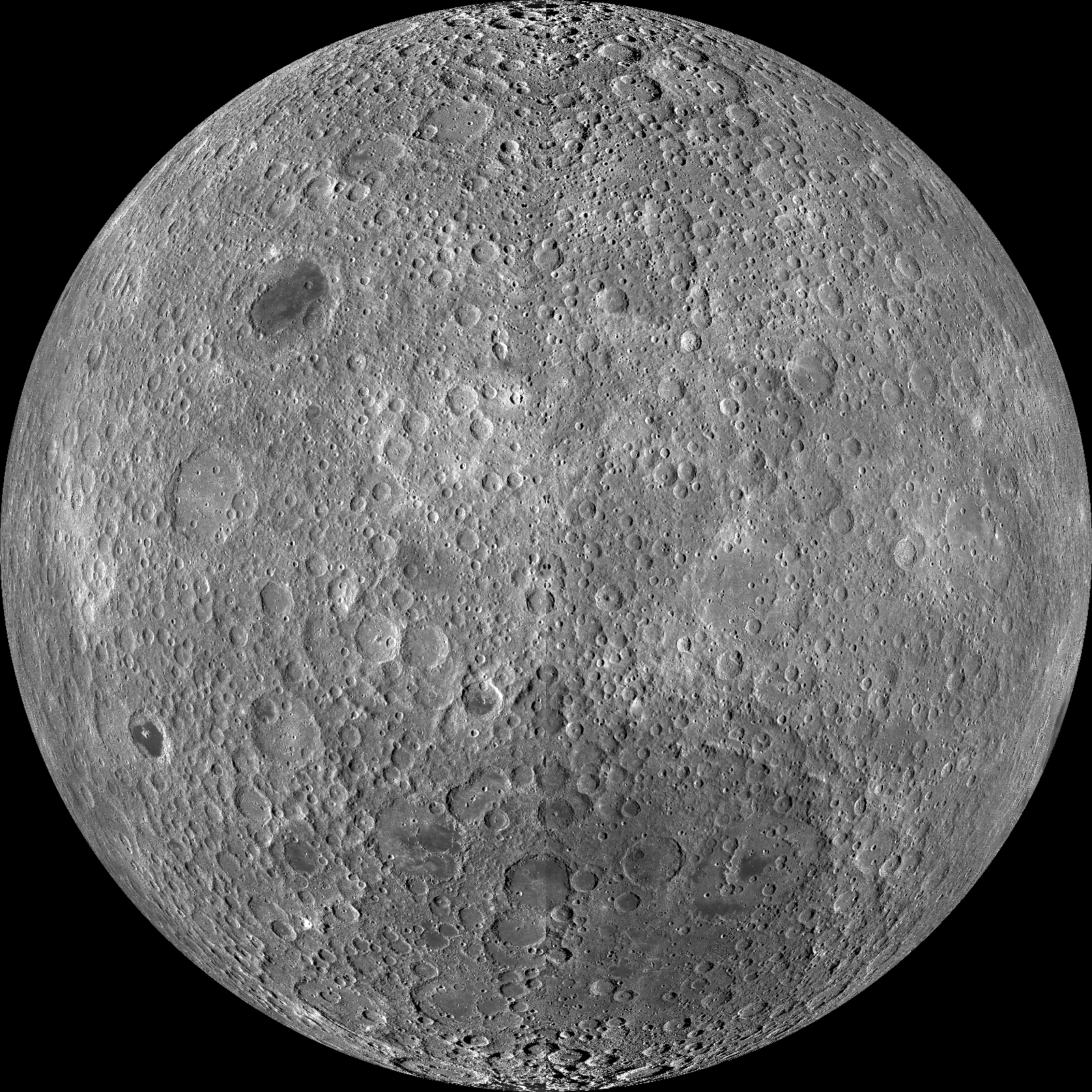
The lunar farside as never seen before. LROC Wide Angle Camera orthographic projection, centered at 0°N, 180°E. The Lunar Reconnaissance Orbiter Camera (LROC) team has now released a complete compliment of 100 meter resolution, contiguous illumination mosaics from a perspective over the Moon's equator. The full-sized (1600 x 1600) image is available HERE [NASA/GSFC/Arizona State University].

Mark Robinson
Principal Investigator
Lunar Reconnaissance Orbiter Camera
Arizona State University


Because the Moon is tidally locked, it was not until 1959 that the farside was first imaged by the Soviet Luna 3 spacecraft (hence the Russian names for prominent farside features, such as Mare Moscoviense).

And what a surprise -­ unlike the widespread maria on the nearside, basaltic volcanism was restricted to a relatively few, smaller regions on the farside, and the battered highlands crust dominated.

A different world from what we see from Earth.

Of course, the cause of the farside/nearside asymmetry is an interesting scientific question. Past studies have shown that the crust on the farside is thicker, likely making it more difficult for magmas to erupt on the surface, limiting the amount of farside mare basalts. Why is the farside crust thicker? That is still up for debate, and in fact several presentations at this week's Lunar and Planetary Science Conference attempt to answer this question.

The Clementine (1994) mission obtained beautiful mosaics with the sun high in the sky (low phase angles), but did not have the opportunity to observe the farside at sun angles favorable for seeing surface topography. This WAC mosaic provides the most complete look at the morphology of the farside to date, and will provide a valuable resource for the scientific community. And it's simply a spectacular sight!

The Lunar Reconnaissance Orbiter Camera (LROC) Wide Angle Camera (WAC) is a push-frame camera that captures seven color bands (321, 360, 415, 566, 604, 643, and 689 nm) with a 57-km swath (105-km swath in monochrome mode) from a 50 km orbit.

One of the primary objectives of LROC is to provide a global 100 m/pixel monochrome (643 nm) base map with incidence angles between 55°-70° at the equator, lighting that is favorable for morphological interpretations. Each month, the WAC provides nearly complete coverage of the Moon under unique lighting. As an added bonus, the orbit-to-orbit image overlap provides stereo coverage.

Reducing all these stereo images into a global topographic map is a big job, and is being led by LROC Team Members from the German Aerospace Center (Deutsches Zentrum für Luft- und Raumfahrt; DLR). Several preliminary WAC topographic products have appeared in LROC featured images over the past year (Orientale basin, Sinus Iridum).


For a sneak preview of the WAC global Digital Elevation Model (DEM) with the WAC global mosaic, view a rotating composite Moon (Full Resolution), HERE. The WAC topographic dataset will be completed and released later this year.

The global mosaic released today is comprised of over 15,000 WAC images acquired between November 2009 and February 2011. The non-polar images were map projected onto the GLD100 shape model (WAC derived 100 m/pixel Digital Terrain Model - DTM), while polar images were map-projected on the LOLA shape model. In addition, the LOLA derived crossover corrected ephemeris, and an improved camera pointing, provide accurate positioning (better than 100 m) of each WAC image.


As part of (their) March 2011 release to the Planetary Data System (PDS), the LROC team posted the global map in ten regional tiles. Eight of the tiles are equirectangular projections that encompass 60° latitude by 90° longitude. In addition, two polar stereographic projections are available for each pole from ±60° to the pole. These reduced data records (RDR) products will be available for download on March 15, 2011.

As the mission progresses, and our knowledge of the lunar photometric function increases, improved and new mosaics will be released! Work your way around the Moon with these six orthographic projections constructed from WAC mosaics. (The nearside view linked below is different from that released February 21.)
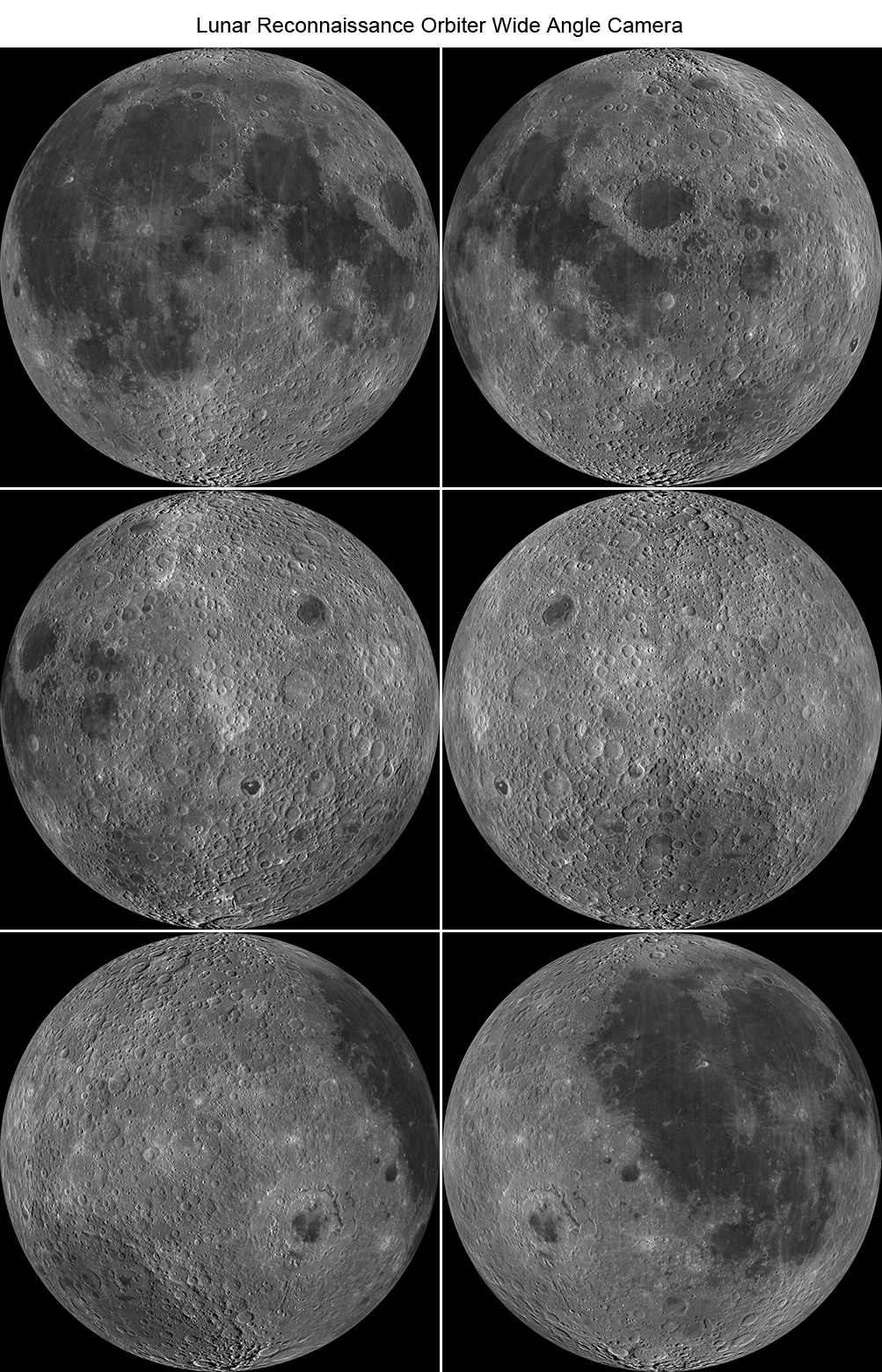

Six orthographic views of the Moon created from the new Lunar Reconnaissance Orbiter Camera WAC global mosaic; upper left to lower right the central longitude is 0°, 60°, 120°, 180°, 240°, 300° East longitude. View the full preview image above HERE [NASA/GSFC/ Arizona State University].

WAC mosaic orthographic view centered at 0° longitude
WAC mosaic orthographic view centered at 60° longitude
WAC mosaic orthographic view centered at 120° longitude
WAC mosaic orthographic view centered at 180° longitude
WAC mosaic orthographic view centered at 240° longitude
WAC mosaic orthographic view centered at 300° longitude

Friday, December 31, 2010

More on that second Rupes Recta close-up


Using the Google Earth (>v.5) lunar digital elevation model, after downloading that application's latest catalog of LROC images available through the Planetary Data System (PDS), prepared and updated this past week by Washington University, shows the extent of the only two publicly released LROC Narrow Angle Camera (NAC) observations of "the Straight Wall" of eastern Mare Nubium. Rendered immediately below is a monochrome Wide Angle Camera (WAC) mosaic of the vicinity (stretched, below) that provides a lower resolution but still unprecedented detail of nearby Birt and its ejecta blanket, its companion Birt A and Rima Birt with its "cobra head" feature discussed here July 8, 2010 [NASA/USGS/JAXA/GSFC/Arizona State University/WUSTL/Google Earth].


The 114 km-long landmark "straight wall" with companions Birt and Birt A along the southwest shore of Mare Nubium. With Rima Birt at left, these have often been discussed on the Network. LROC Wide Angle Camera mosaic assembled from images gathered on three successive orbital passes January 7, 2010; processed using LROC WAC Previewer (v.1.6) and stitched together using Microsoft Research Image Composite Editor (ICE) [NASA/GSFC/Arizona State University].

Wednesday, October 20, 2010

LROC: Rimae Sirsalis

The Moon's longest rille system are the Rimae Sirsalis, most likely a very old fault-related feature subsequently bombarded and also deeply grooved perpendicularly at its upper reaches by the energetic debris cast off by the Orientale-impact. The fault, more than 400 km-long, is a model of lunar stratigraphy. It cuts through the highlands of the Near side's southwestern limb near Byrgius and, in a relentless and nearly straight line - like a modern highway - to a terminus under Oceanus Procellarum. Click here for the full-sized mosaic [NASA/GSFC/Arizona State University].
Joel Raupe
Lunar Pioneer
 
Those whose interests include lunar magnetic anomalies, and rilles or faults, have long been intrigued by the Sirsalis crater group and the Moon's longest rille nearby, Rimae Sirsalis. From Earth our perspective of the highlands southwest of Oceanus Procellarum, where these features abide, is highly foreshortened, and a bright nearly Full Moon overwhelms the eye and our optics by the time the sun finally rises over the extensive area haunted by the Sirsalis features. Nevertheless, the thin clear line slicing its way from the limb northeast into the Procellarum depths draws the eye, especially during favorable libration.

A sub-satellite released by Apollo 16 traced out a crustal magnetic field associated with Rimae Sirsalis that was unusual even for the Moon. Over several high altitude passes the influence of the field was found to be tightly associated with the surface feature, more so in the highland west than where it disappears under Procellarum. The field was indicative of magnetized rock, either molten or ground up, having long ago pushed up from deep within the Moon along a very long and apparently very deep line.

Perhaps the Sirsalis fault is the remnant of a kind of plate tectonics that lasted only a very brief time in the Moon's early history. The kind of bright and fresh optical immaturity of surface regolith, the swirl albedo patterns seen under the influence of lunar magnetic anomalies elsewhere is more generalized here, either tightly associated with the surface features of the fault line, if these exist at all.

The magnetism associated with the Sirsalis fault has been discussed at length by Hood, Halekas and Head, to name just a few of the more prominent sources. The Sirsalis fault may be an intrusion, a dike at one time tapping into the lunar mantle and running upwards from at least 300 km below.

Perhaps more recent activity, after having been less than gently "jostled" awake by huge impacts more recently in its history, can explain some of the history seen at the surface. We can see the surface manifestation of this deep running but very thin (4 km) feature has to be older than Mare Orientale. In the perspective view below, grooving etched out radially from the center of the Orientale basin, more than 900 km away. That event, more than 3 billion years ago, superimposed its influence on the older rille.

In the image above (better seen here), 42 km-wide Sirsalis (12.5°S, 299.6°E) and it's older , less deep companion crater (a model of superposition all by themselves) stand by to the north as the fault passes under the ejecta blanket of a smaller, younger pair of super-positioned craters. Further along, the fault clearly passes over the rims and through the interior of another much older crater.

Creating as detailed a mosaic of the upper extremes of the Rimae Sirsalis, putting the whole system into the context of a single image, is a challenge even for LRO's Wide Angle Camera (LROC WAC). For the moment, we'll satisfy our curiosity with outstanding telescopic views and an artificial perspective view conjured up below.
For context, a foreshortened perspective view looking northeast from the southwestern Near side highlands, grooved by the impact event that created Orientale basin (lower left center) following the direction of Rimae Sirsalis to where it disappears under the inundation of Oceanus Procellarum. Japan and USGS laser altimetry and color-coded shaded relief mosaic in Google Earth v.5

The broad plain where the Rimae Sirsalis "crack" apparently originates, showing the perpendicular "grooves" that radiate from the basin-forming impact that excavated Mare Orientale, centered more than 900 km to the northwest. This closer look, courtesy of LROC Wide Angle Camera observations last May, shows much more was happening here when the Orientale impactor ejected its debris fan 3.1 billion years ago. More than a shockwave, the ejecta that returned to the surface here was molten, rebounding into pools and eventually channeling down the trace of the rille and northeastward toward Procellarum. Additionally, the weight of liquid that reformed the surface here appears to have pulled the surface, mirroring the very deep rille's shape, on either side of the broad Rimae Sirsalis valley. LROC WAC M129709429C-M129716196C-M129722993C (604nm), LRO orbits 4248-4250, May 28, 2010 [NASA/GSFC/Arizona State University].

Last updated July 14, 2012

Tuesday, October 19, 2010

The largest volcano on the Moon

From LRO WAC Album 1 -
The Heart of the Marius Domes (27.2 km field of view), from LROC WAC M116683214ME (December 29, 2009), much as they would appear as the morning terminator begins its sweep across the central Oceanus Procellarum, today, October 19, 2010 [NASA/GSFC/Arizona State University].

Sunrise at Marius Hills is a significant time for Moon watchers, even for those equipped with modest telescopes. The myriad domes there, only a bit higher in profile than the rolling elevation of the surrounding, vast basaltic plains of Oceanus Procellarum are briefly very starkly highlighted by long shadows. Very soon after, the terminator continues it endless westward, march and the domes (near 12.0°N, 306°E) quickly become difficult to see, overwhelmed by brighter albedo contrasts as a chief marker of topography under a high sun.

But the Sun was less than two degrees over the east when LRO swept up the dark scene above, much as it should be for the next few hours today, Tuesday, October 19, 2010.

In the long shadows above is the "Heart" of the Marius Domes, where a sinuous rille winds between the two largest domes of an enormous volcano China's Chang'E-1 investigators have labeled "Yutu." LRO Laser altimetry (LOLA) shows the many hundreds of domes west of Marius crater are clustered atop a larger bulge near the center of the Procellarum expanse.

No one has yet definitively identified Procellarum as a typical, fully formed round basin, though there are many theories, including the Gargantuan impact theory, where Procellarum originates as part of an impact, centered in northeastern Mare Tranquillitatis, whose outer circumference is larger than the entire Near side as the original source of the Moon's Near and Far side discontinuity.

Whatever the source of Procellarum, we know it's huge expanse was covered by molten flows in many places at many times. Thankfully, the occasional asteroid, comet or large meteor has pre-excavated the Procellarum floor, uncovering the history for future definitive dating.


Perspective view of the Constellation Region of Interest landing zone at the Sinuous Rille A "cobra head" formation in the Marius Hills, derived from LROC Narrow Angle Camera Digital Terrain Models [NASA/GSFC/Arizona State University].

LRO and the others building the huge new legacy of an international fleet of 21st century orbiters, are allowing investigators a closer look at the Marius Hills, and in a wider context - tied into neighbors like the Reiner Gamma swirl, the surrounding plains typified by minerals found nowhere else on the Moon, and perhaps even the Aristarchus Plateau and Mons Rümker. A casual glance at Oceanus Procellarum appears to show a huge semi-circle lunar "sea" devoid of anything as dynamic as "storms," but there is much more to be seen here for the patient observer.

The full LRO Wide Angle Camera (WAC) monochrome (689nm) observation M116696805ME was swept up from an altitude of 45.4 kilometers over the course of 2 minutes, 51 seconds during LRO orbit 2331, December 29, 2009.

Additional Reading:
Reiner Gamma in color
October 15, 2010

NASA@Science: "Down the rabbit-hole"
July 13, 2010

LROC: Marius Hills ROI
June 2, 1010

Hearts of Marius, Shadows of Yutu
May 29, 1010

Local Topography and Reiner Gamma
May 22, 2010

Lunar Swirl phenomena from LRO
May 17, 2010

LRO/LROC/LOLA: Marius Hills
March 20, 2010

LROC: Haruyama Cavern in the Marius Hills
March 2, 2010

From Lunar & Planetary Science Conference Album -
Marius Hills is the largest volcanic dome field on the Moon. The region is an area of high interest because it contains approximately half of the Moon's known volcanic domes. These domes range from 200-500 meters in height. In comparison, the Hawaiian volcano Mauna Loa, which is the largest shield volcano on Earth, is 17,170 meters high. This LOLA image covers the area of the Moon from 9.5 - 17N°, and 303.5 - 311°E [NASA/GSFC].

Amateurs decipher lunar color as seen by LROC


Quick sketch of the contact, separating an earlier inundation that had more completely filled the Serenitatis basin with a newer melt that did not reach the basin's outer edge. This was a test of aesthetics, not spectrometry. No attempt at answering the source of Serenitatis or its fills is implied. [Virtual Moon Atlas v.4].

Cleopas Blount
Lunar Pioneer


Is it possible for rank amateurs to capture the true color of the lunar surface coded into LRO's Wide Angle Camera seven-wavelength color observations?

We've been engaging in some non-destructive testing of this notion, using tools at hand (i.e., free software) to produce monochrome, single-wavelength scenes as something very close to the actual "color" the respective wavelength represents. The result has been encouraging, wetting the appetite for the work more competent investigators will accomplish in coming years.

Our first tests of the heart of Reiner Gamma and the Sulpicius Gallus vent look right, though so much subjectivity, plain old guess work, has been a part of working this way.

For our first large area, we chose a well-known contact, where an obviously darker color of darker basalt that seems (from a great distance) mostly continuous from Tranquillitatis into Serenitatis basin, where it forms an annulus around a much lighter, younger interior plain covering the entire central area of Serenitatis basin. Through filters, photographers on Earth have photographed this clear color difference, visible through good eyes and a modest telescope (at the right illumination).

Coincidentally, LROC principal investigator Mark Robinson used a larger field of view which also included this much smaller area in his discussion of The Color of the Moon, September 10, 2010. There are photographs of excellent, professional quality posted at that link, showing the contact area very clearly. Dr. Robinson also offers information about the causes of these distinct lunar colors.

LROC Wide Angle Camera observations of this contact, just inside the southeastern edge of Serenitatis basin, at proper times in four successive orbital passes of LRO. as the Moon rotated underneath. These were then stitched into a three respective mosaics, each representing one of three visible wavebands among the seven imaged during each session. Then we tinted the individual monochromes with something close to the color of the respective wavelengths as seen by the human eye.

Using the logic of the color wheel, we then lightly transparentified and tested various overlays in differing combinations in the hope of seeing something like we would had we been riding on LRO at those times.

Fortunately, we discovered an orbital HDTV color still of precisely the same area imaged by Japan's Kaguya in our year-old archives. We've posted a thumbnail link to the full image for comparison.


Our second color test began with a monochrome photograph of one of three of seven wavebands collected nearly simultaneously in four successive Lunar Reconnaissance Orbiter Camera (LROC) Wide Angle Camera (WAC) observations. Above, a monochrome image of light at a wavelength of 566nm was tented with a close approximation of what the human eye would see if also tuned to that narrow band [NASA/GSFC/Arizona State University].


And another of very nearly the same geography (differences were mostly squeezed out during their recomposition), of the 604nm waveband was similarly tented with the visible "color" equivalent (LROC WAC observations took place during LRO orbits 4164-4167, May 22, 2010 [NASA/GSFC/Arizona State University].


And yet again, from very near to the longest wavelengths visible to the human eye, the same area as "seen" in a third (643nm) waveband. The most obvious feature seen in all these example images of the "confluence" of Tranquillitatis and Serenitatis is Promontorium Archerusia (16.70°N, 22.00°E) at lower left [NASA/GSFC/Arizona State University].


The result... is... interesting, not surprisingly confirming what's well-known. This false color combination of the three visible wavelengths are, however, not very far from true.


For example, here is a "true-color" HDTV still from Japan's Kaguya in 2008, showing the well-known contact inside the southeastern edge of Serenitatis basin. Because of the proclivities of color monitors, we recommend the reader click HERE (or on the image thumbnail above) to truly compare the test result with the full-sized digital image of the very same area taken from orbit. (The thumbnail does not do the full picture justice [JAXA/NHK/SELENE].


Closer to the Moon, late in its mission, Japan's SELENE-1 (Kaguya) captured some spectacular shots of far side highlands and lowlands under relatively high-illumination. The result cast a yellow tint on the reproductions, most notably those of the interior of South Pole-Aitken basin imaged from less than 45 kilometers, during Kaguya's long, low terminal spiral into the Gill crater region [JAXA/NHK/SELENE].

The sandy greens, and especially the "reds," derived in our own amateurish compositions from LROC WAC monochromes from three visible wavebands should rightly be disputed.

They don't meet our expectations either, even when compared to true-color HDTV images from Japan's lunar orbiter SELENE-1 (Kaguya) in 2008 and 2009. Those who have been in lunar orbit described those spectacular videos and stills as being similar to their own experiences.

Nevertheless, careful consideration has to be given to illumination, surface composition, the angle of incidence, altitude. etc., because the color of the Moon appears quite different here on Earth than from orbit, or on the surface, and different still from "up-sun, down-sun" or under high-noon Sun. The bright anorthosites of the highlands looks very different than the plains, as everyone knows, so the "red" in Reiner Gamma's stain, posted earlier, may represent a higher ferrous oxide presense in all its manifestations, but it's more likely representative of poor tuning on our part.

What is the color of the Moon? There's no precise answer, only a wide range of possibilities. One things is certain, however. The Moon is not Black and White.

Friday, October 15, 2010

Reiner Gamma in color

From LRO Wide Angle Camera
Actually a combination of three wavebands (566, 604, 643nm) of seven swept up by the LROC Wide Angle Camera (WAC) observation M122597745CE during LRO orbit 3201, March 7, 2010. The natural color here is less luminous, though the red cast when compared to similar mare basalts appears to be an actual aspect outside the anomalous low optical maturity of the enormous swirl albedo here, stretching over 500 km across the floor of Oceanus Procellarum [NASA/GSFC/Arizona State University].


Reiner Gamma and it's traces into the heart of the Marius Hills volcanic feature, southeastward to the western edges of Oceanus Procellarum [NASA/GSFC/Arizona State University].

Tuesday, October 12, 2010

LROC WAC: Archimedes


From LROC Wide Angle Camera monochrome (689nm) mosaic of tell-tale Archimedes region, hugging the southeastern edge of the Imbrium impact basin. Even evidence for "emplacement" set forth in studies of 85 km-wide Archimedes (29.7°N, 356°E) was not enough for some early Space Age investigators to accept. Nevertheless, evidence mounted and the sequence generally went something like this: Imbrium impact, Archimedes impact affecting areas in the immediate vicinity, and then the Mare Imbrium mare basalt melt seen today, and embayment of lower elevations [NASA/GSFC/Arizona State University].

Saturday, October 9, 2010

Chang'E-2 arrives alive in mission orbit

Following a third orbital trim, Chang'E-2 has been successfully inserted into it's targeted mission orbit.

Dr. Yong-Chun Zheng of the Chinese Academy of Sciences reported early Saturday (UT) that the third braking of Chang'E-2 was successfully completed at 03:17, October 9 (UT).

"The braking action lasted for about 15 minutes," Zheng said "Chang'E-2 has entered its initial target orbit of 100 x 100km with a period of about 117 minutes."

There was no word yet on when perilune for China's second lunar orbiter will be brought down to as low as 15 km to enable very high resolution surveys of potential landing sites for Chang'E-3 and 4.


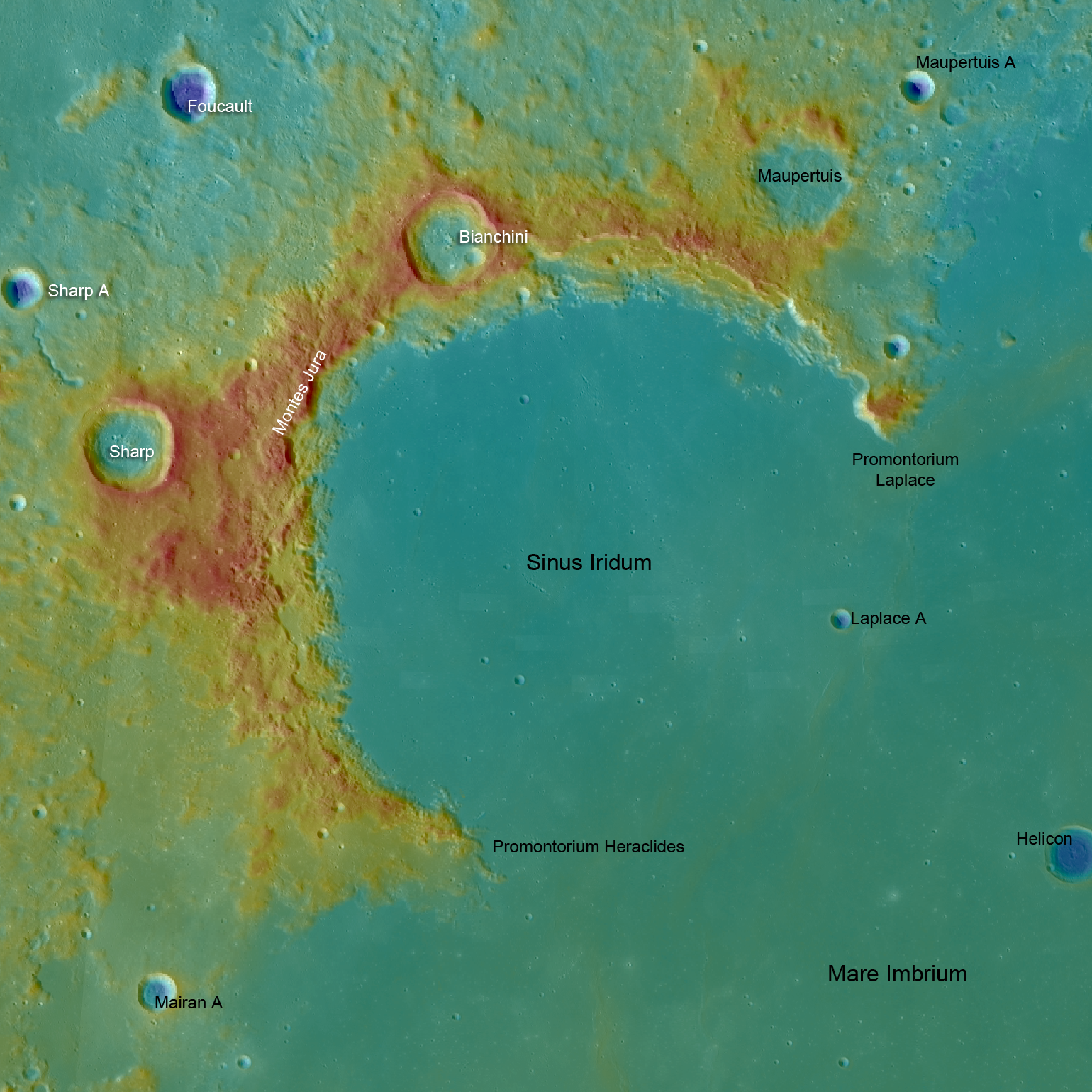
'Target Rainbow,' Sinus Iridum, the "Bay of Rainbows," high resolution survey target for Chang'E-2, the second lunar orbiter that entered orbit October 6 after a nominal direct transit after only 112 hours from launch. (As impressive as such navigation still is, contrary to press account, this was not the "fastest" such transit in history.) 411 km-wide Iridum is an announced landing target for the Chang'E-3 stationary lander and rover under development for 2013. From LROC WAC mosaic of 40 observations (see below) during LRO orbits 2469 through 2491, January 9-10, 2010 [NASA/GSFC/Arizona State University].

"In the target orbit, Chang'E-2 will work and explore the lunar surface for about half a year. The topography and material composition of the lunar surface will be measured in the future. During that time, the space environment and microwave thermal emission of the moon will be measured by Chang'E-2."

Instruments on board Chang'E-2 began checking in beginning soon after launch, October 1. Following a 17 second orbital trim Friday, October 8 Chang'E-2 was brought down to an 3.5 hour elliptical orbit.

"The two ground stations in Beijing and Yunnan have recieved the first data sets, amounting to 1.6 Gb," Zheng said. "There are seven scientific instruments on board Chang'E-2," Zheng said. An improved stereo CCD camera, laser altimeter, gamma ray spectrometer (GRS), X ray spectrometer (XRS), Microwave radiometer (MRM), solar wind ion dector (SWID) and high-energy particle dector (HPD).

"The GRS, SWID, HDP were powered up and began work duirng the 112 hour trans-lunar coast. The CCD and MRM will be powered up after Chang'E-2 enters its mission orbit and will begin mapping the topography of the lunar surface.

"Topography data and technology testing," Zheng said, "will be helpful for the soft landing of Chang'E-3.

Chang'E-3, a stationary lander and lunar rover, are under development for launch in 2013. Further along, planning is also under way for Chang'E-4, an unmanned sample return mission in 2017.


Promonitorium Laplace (46.0°N, 314°E), 24.8 x 49.6 km (east at top) full resolution detail from LROC Wide Angle Camera mosaic, January 9-10, 2010. At it's highest point, the cliffs rise 2600 meters over the basin's interior rim [NASA/GSFC/Arizona State University].


Very small thumbnail of the 9184 x 6312 pixel LROC mosaic study of Pre-Imbrium Sinus Iridum from which these smaller-scale higher resolution images were sampled. Iridum is centered near 45.0°N, 32.0°W and has an outer ring and full interior submerged by the northwestern Mare Imbrium basin melt. 39 km Bianchini crater straddles the Jura mountains on Iridum's rim, and Promonitorium Laplace stand out sharply in the long shadows three days following a Full Moon. A small part of Mare Frigoris stretches through the northwest. The landing site of Luna 17 (Lunokhod 1) is well outside the field of view. The entire scene exceeds 1000 km west to east, at an average 62 meters per pixel in full resolution (see below) [NASA/GSFC/Arizona State University].

Monday, October 4, 2010

Grand lunar swirls yielding to LRO Mini-RF

Swirls at Gerasimovich less than 10 centimeters deep
Orientale Antipodes - Goddard - the Grand Swirl field on the direct opposite side of the Moon from Mare Orientale. The broad area is coincident with crustal magnetism. LROC WAC (false color) Mosaic (689nm) from LRO orbits 4445-4450, June 13, 2010; avg. alt. 51.653 km, avg. res. 73.04 m [NASA/GSFC/Arizona State University].

Joel Raupe

Certain places on the Moon look freshly dusted with snow. Bright sweeping patterns,visible only from high overhead, look like cosmic cave paintings or the Nazca Lines in Peru. These bright ghostly patches or “swirls” appear on the Moon’s vast lava flats, atop mountains and often both simultaneously.

Similar phenomena have been cataloged on Mercury, and perhaps also on other “airless bodies” in the solar system, but none so far beat out the Moon's population of swirls.

Aside from their chaotic, ink blot patterns, these swirls are made of regolith that refuses to grow old. As authors of a new study appearing in the Bulletin of the American Astronomical Society put the case, regarding a familiar Near side landmark, "the degree of degradation of Descartes C suggests it should not be optically bright, yet it is."

But accepting the evidence of immature surfaces built up into something that "looks like the shadow” of invisible magnetic fields, crediting swirls to the crustal magnetism that inevitably accompanies them, has not been an easy thing for investigators to swallow.

The magnetic fields that accompany swirl albedo "anomalies" certainly seem old enough. Investigators believe a now-extinct global magnetic field became “shock-fossilized” into the Moon’s thicker crusts at points on the lunar globe opposite the basin-forming-impacts that created Mare Imbrium, Serenitatis and others of the more famous "seas" between 3.9 and 3.1 billion years ago. And intense crustal magnetism is definitely knotted tightly in places opposite those basins on the Moon.

At the antipodes of Mare Imbrium for example, around the fabulous albedo swirl patterns of Mare Ingenii, a very impressive magnetic field has been well-mapped. On maps of crustal magnetism the Far side's southern latitudes clearly mirror the Near side's major famous basins.


The Moon’s most intense magnetic field, strong enough in places to hollow-out a mini-magnetosphere in the solar wind, is found on the opposite side of the Moon from Mare Crisium, around the Far side Gerasimovich craters. Accompanying those fields are swirl albedo anomalies, though they are more difficult for the eye to trace out from the brighter highland terrain background.

Crisium Antipodes (Gerasimovich). Swirl albedo patterns here (like the "Mushroom" of Gerasimovich D - compare this image with the image immediately below) are sometimes not as easy to immediately recognize, unlike swirls appearing on darker basins, like Reiner Gamma in Oceanus Procellarum or upon the plains of Mare Ingenni. The above monochrome LROC WAC M102966996ME observation (LRO orbit 345, July 23, 2009) [NASA/GSFC/Arizona State University].

The magic mushroom "swirl" at Gerasimovich D. The area surrounding 22.3°S, 237.5°E is antipodal to Mare Crisium. As persistent as lunar swirls appear to be, Mini-RF scans from the Lunar Reconnaissance Orbiter indicate this swirl and others nearby are less than 10 centimeters thick.

As with many other features, things are different on the Near side. The most familiar swirl albedo-magnetic anomalies on the Near side do not seem to be "antipodal" to any basin. This hardly conclusive, but no known clue points to the existence of a buried basin (e.g., cryptomare and/or gravity anomaly) antipodal to the Near side swirls and magnetic fields at Reiner Gamma, west of Airy crater or at the Descartes formation, 60 km southeast of the Apollo 16 landing site.

The most renowned lunar swirl of them all is Reiner Gamma. (See "Another look at Reiner Gamma, June 30, 2010.) Near side swirls may be related to a different source of magnetism, just as Reiner Gamma seems optically entangled with rise and fall of lavas at Marius Hills.

Reiner Gamma seems optically related to the Marius Hills [7 image mosaic by Goryachko, Abgarian & Morozov (Astronominsk) - Minsk, Belarus - August 6, 2010].

The new study, based on data returned from the Mini-RF radar on board LRO, focuses attention on two strongly representative examples of the differences between albedo swirl-magnetic anomaly on the Near and Far sides. For the Far side investigators scanned area surfaces around the swirls of Gerasimovich and for a Near side sample the authors examined the Descartes formation, in particular the small crater Descartes C, on the northeastern rim of ancient Descartes, a 30 km-wide Near side landmark.

While the bright albedo on the grooved highland north of very ancient Descartes has been mapped and observed through modest telescopes for centuries the albedo wasn't identified as a swirl anomaly until the 21st century. A brilliant contrast becomes scattered in richer details when viewed up close, as in this false color montage image of 415 nm waveband light, just below the range of human vision, derived from three LROC WAC observations during the summer of 2009 [NASA/GSFC/Arizona State University].

Even though the vast family of lunar swirl phenomena had already been identified, though the bright patch on running northwest of Descartes C, like a dusting of snow, was not recognized as genuine swirl until 2001. Magnetometer data from end-of-mission low orbital passes (18 km) by Lunar Prospector in 1999 were later identified with now is thought to be the most intense magnetism on the Moon's Near side [NASA/GSFC/Arizona State University].

My colleague Larry F. Scott and I were happy to learn the new Mini-RF study's authors (The Surficial Nature of Lunar Swirls as Revealed by Mini-RF on LRO; Neish, Blewett, Bussey, Lawrence, Mechtley, Thomson, Robinson and the Mini-RF Team - American Astronomical Society, DPS meeting #42, #18.06; Bulletin of the American Astronomical Society, Vol. 42, p.979) selected Descartes C because their results are well in line with suggestions we put forth together in 2008.

The full text of the study published last week is not yet available to us, but the abstract was released and reads as follows:

Lunar swirls are optically bright, sinuous albedo features found on the Moon. Lunar swirls appear to overlay the lunar surface, apparently representing diffuse brightening of unmodified terrains. Lunar swirls are associated with regions of anomalously high crustal magnetic fields, but their exact formation mechanism is unknown. The Mini-RF synthetic aperture radar on LRO acquired a comprehensive set of radar images of these enigmatic features, including the first radar observations of swirls on the lunar farside. A few general remarks can be made about the nature of the lunar swirls from this data set.

First, the average radar properties of lunar swirls are identical to nearby non-swirl regions, in both total radar backscatter and circular polarization ratio (CPR). This implies that average decimeter-scale roughness and composition within the high-albedo portions of the swirls do not differ appreciably from the surroundings, and thus that the swirls are a very thin surface manifestation -less than 10 cm- not observable with S-Band radar.

Secondly, bright swirl material appears to be stratigraphically younger than an impact melt flow at Gerasimovich D newly discovered in Mini-RF images. This observation indicates that the swirls are capable of forming over timescales less than the age of the crater, perhaps less than 1 Ga. This data set also provides information about the origin of the lunar swirls. In at least one case, the presence of an enhanced crustal magnetic field appears to be responsible for the preservation of a high-albedo ejecta blanket around an otherwise degraded crater, Descartes C.

The degree of degradation of Descartes C suggests it should not be optically bright, yet it is. This suggests that the albedo is preserved due to its location within a magnetic anomaly, and hence supports an origin hypothesis that invokes interaction between the solar wind and the magnetic anomaly.


If we accept that magnetism can persist, in some places intensely, for almost 4 billion years, the optically immature regolith of their swirls cannot. Experiments show freshly "gardened" lunar regolith, such as the bright rays of 109 million year old Tycho, inevitably darken under the relentless solar wind in "only" 900 million years.

Accepting that locally intense magnetic fields can and do deflect solar wind they are too small to bend cosmic rays, which - though rarer- build up similar maturing affects over time. Neither can they deflect the micrometeorites that continuously “garden” the top 3 centimeters of lunar surface every two million years. Because lunar swirls cannot be as old as the magnetic fields where they congregate, some other, more dynamic mechanism has to be the source of their optically immaturity.

In 2008 we weakly suggested an interaction with the Moon's dusty, dynamic exosphere, a process where the believed migration of charged and levitated sub-micron-sized dust behaves differently in the presence of crustal magnetism. Thankfully, other studies by more qualified investigators, especially those working the Mini-RF team, have described just such a process earlier this year and with this most recent study.

Though other sources of regolith freshening probably exist, it may eventually be determined that dust migration is the source of swirl albedo phenomena, repelled and then blocked from reintroduction to the lunar surface in the presence of crustal magnetic fields. Such a process would continually allow certain areas on the Moon to remain eternally immature.

Additional Reading:
Another look at Reiner Gamma
June 30, 2010

LOLA: Goddard
June 26, 2010

LROC: Ingenii Swirls at Constellation ROI
May 26, 2010

Local Topography and Reiner Gamma
May 22, 2010

Lunar Swirl phenomena from LRO
May 17, 2010

The still-mysterious Descartes formation
May 10, 2010

Thursday, September 30, 2010

The Great Wall of Aristarchus


Four days after First Quarter, as the Moon waxes Full, our first glimpse of Aristarchus and its namesake plateau comes before the ground-hugging terminator officially arrives with true dawn. This LROC WAC monochrome mosaic, swept up during four LRO orbital opportunities (in LRO orbits 2496-2499) January 10, 2010, allows us an overhead look at the High Wall contact, between plateau and mare, the most abrupt, angular transition between Oceanus Procellarum and anywhere around the plateau. As dawn briefly reaches over the horizon to this height the bow-shaped Wall often seems to hover by itself. As the smoky, colorful and wispy patterns here, including the bright inner slopes of Aristarchus proper (r) catch the sun, it's easy to see why this prominent near side landmark is the location most frequently cited for reports of "transient lunar phenomena" (TLP) [NASA/GSFC/Arizona State University].

Additional Reading:
LROC: Aristarchus - Up from the Depths
July 20, 2010

Friday, September 24, 2010

Rümker


Mons Rümker (40.8°N, 302.01°E) at dawn, means the Moon was nearly Full the night of December 28-29, 2009. The 72 km-wide volcanic heap lords it over the north-northwest Oceanus Procellarum and is never seen except in profile from Earth. Mosaic (by Microsoft ICE) from four LROC Wide Angle Camera observations (processed using LROC WAC Previewer v.1.6) over LRO orbits 2329-2332; avg. alt. 46.59 km., avg. res. 65.53 m, avg. LRO/Moon/Sun phase angle = 89.07° See larger view HERE [NASA/GSFC/Arizona State University]


Nearly a full lunar day later, late in a lunar afternoon, January 11, 2010, Rümker was fully illuminated perhaps for another 20 hours or so. Although, at middle latitudes north, areas behind the higher elevations have already fallen into long shadows as the Sun creeps down to within ten degrees of the southwest horizon. On Earth, the Moon is rising as a waning crescent before dawn. Another mosaic (by Microsoft ICE) from four LROC WAC passes in LRO orbits 2504-2507 (processed using LROC WAC Previewer v.1.6); avg. alt. 40.44 km., avg. res. 57.05 m, avg. LRO/Moon/Sun phase angle = 80.26° See larger view HERE [NASA/GSFC/Arizona State University].


Part of a spectacular HDTV view from Japan's Kaguya lunar orbiter in 2008 shows Rümker at dawn from 100 km polar orbit. [JAXA/NHK/SELENE].


Simulated view of Rümker from a point of view 8000 meters over the average -2200 meter elevation of this part of the Procellarum plain. The wide mound shows extensive signs of periodic intrusions of material piling over 900 meters above its surroundings, though most of the 72 km-wide feature is only 500 m high.

Thursday, September 23, 2010

Copernicus


In late afternoon. LROC Wide Angle Camera mosaic (LROC WAC Previewer, Microsoft ICE) from six consecutive passes during LRO orbits 2466-2471, January 8 & 9, 2010. (Closer view HERE. Images assembled with LROC_WAC_Image_Previewer, mosaic stitched with Microsoft ICE) [NASA/GSFC/Arizona State University]. [NASA/GSFC/Arizona State University].

Tuesday, September 21, 2010

Ejecta from Van de Graaff

Updated September 22, 2010 0021 UT

The texture of ejecta thrown from Van de Graaff Crater along the northern rim, seen from a low Sun angle in the NAC image (incidence angle = 72°). This subset of the NAC image M115177455R shows a field of view of roughly 1 km. LRO orbit 2107, December 11, 2009; alt. 62.75, res. 0.98 m/p [NASA/GSFC/Arizona State University].

Sarah Braden
LROC News System

Van de Graaff crater is located on the farside of the Moon south of Aitken crater, at about latitude -27.9, longitude 172.8. Two merged craters make up the formation known as Van de Graaff crater, named after the American physicist.

Unlike other merged craters on the Moon, there is no rim separating the two "sections" of the crater. A relatively strong magnetic field was detected near this crater by the Apollo 15 subsatellite magnetometer. This discovery was unusual for the lunar surface because the Moon does not currently have a global magnetic field like the Earth does. Also, Van de Graaff and the surrounding area also have slightly higher concentrations of thorium, a radioactive metal. Are the two observations related? To find out more about Van de Graaff crater, read our Apollo Image of the Week post.


Early LRO laser altimetry (LOLA) map of the Moon's far side show the 20 kilometer variance from mean global elevation, and the dominant 4 billion-old South Pole-Aitken basin. Van de Graaff, integral to the more ancient crater's rim, is indicated by an arrow [NASA/GSFC].


Van de Graaff crater. Mosaic of 18 LROC Wide Angle Camera passes, January 21, 2010; LRO orbits 2626 - 2634, res. averages 76 meters. "Look at the crater walls to see the unique grooved texture." (Closer view HERE. Image assembled with LROC_WAC_Image_Previewer Mosaic stitched with Microsoft ICE) [NASA/GSFC/Arizona State University].

Browse the full-resolution NAC image in our LROC Image Gallery!

(LOLA close-up of Van de Graaff, May 8, 2010)