Showing posts with label Rümker. Show all posts

Friday, March 8, 2013

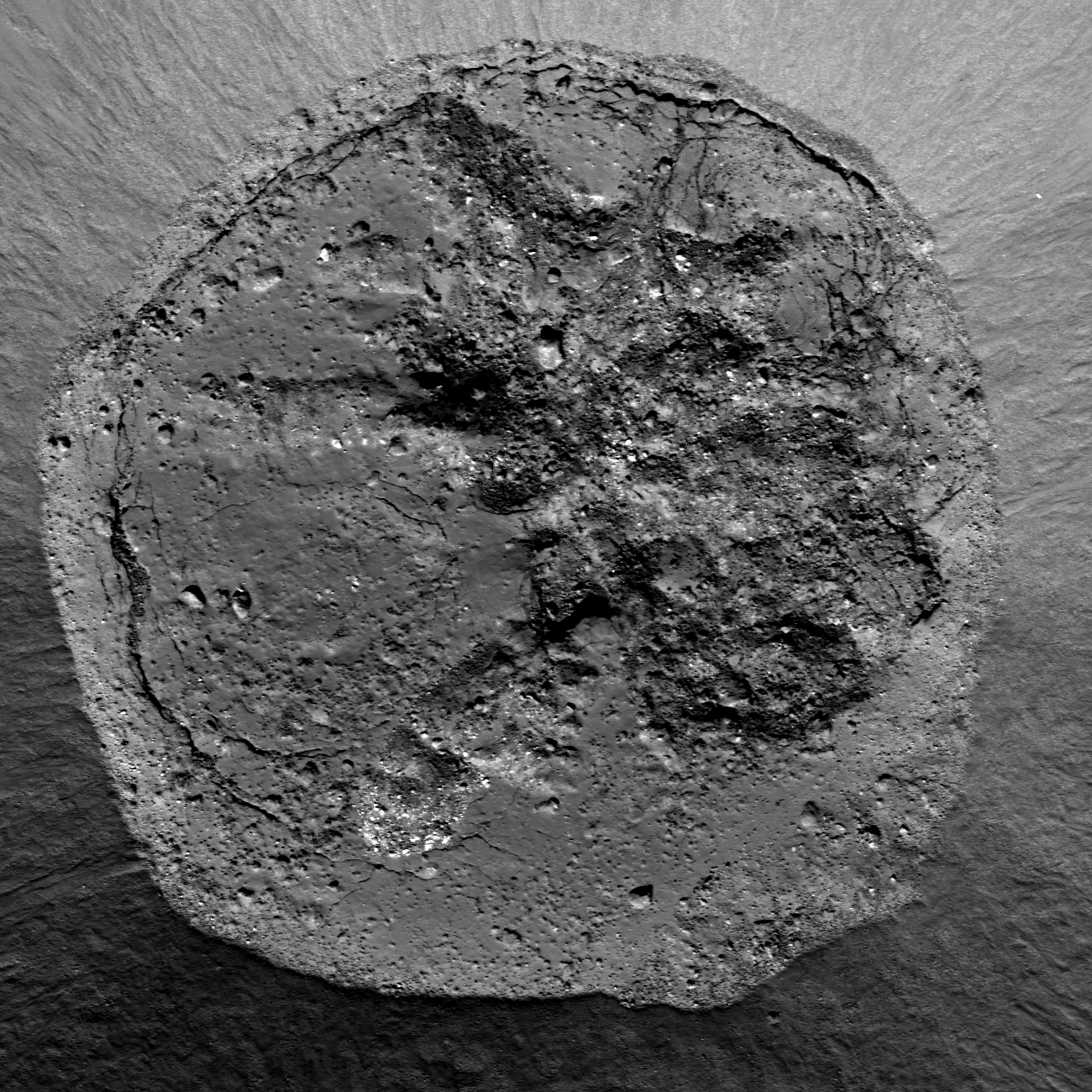
Impact melt on the floor of Rümker E

Contact between wall, with debris flows, and the impact melt lens inundating the floor of Rümker E, immediately southeast of the landmark Mons Rümker ridge extrusion mound in north Oceanus Procellarum. Area detail covered in the LROC Featured Image released March 8, 2013. LROC Narrow Angle Camera (NAC) observation M122591558L, spacecraft orbit 3200, March 7, 2010; angle of incidence 42.68° at 0.5 meters resolution from 40.63 km [NASA/GSFC/Arizona State University].
LROC Featured Image, March 8, 2013: Close up on the full width of the impact melt deposit on the floor of Rümker E, in an approximately 2 km wide field of view from LROC NAC M1101573334L, LRO orbit 14668, September 6, 2012; angle of incidence 41.16° at 1.13 meters resolution, from 152.92 km  [NASA/GSFC/Arizona State University].
Sarah Braden
LROC News System

Imagine a quiet afternoon on the lunar surface about 1 billion years ago. Suddenly, the ground shakes due to the shock wave from a nearby impact.

You see rock and dust burst away from the ground on ballistic trajectories, and some large chunks of material contain so much energy from the impact, they are glowing with heat.

Some of the molten rock splashes outside the rim, but most remains on the floor of the newly formed crater, creating an impact melt deposit.

The crater Rümker E (38.620°N, 302.881°E) is a simple Copernican-aged crater with a diameter of 6.96 km.
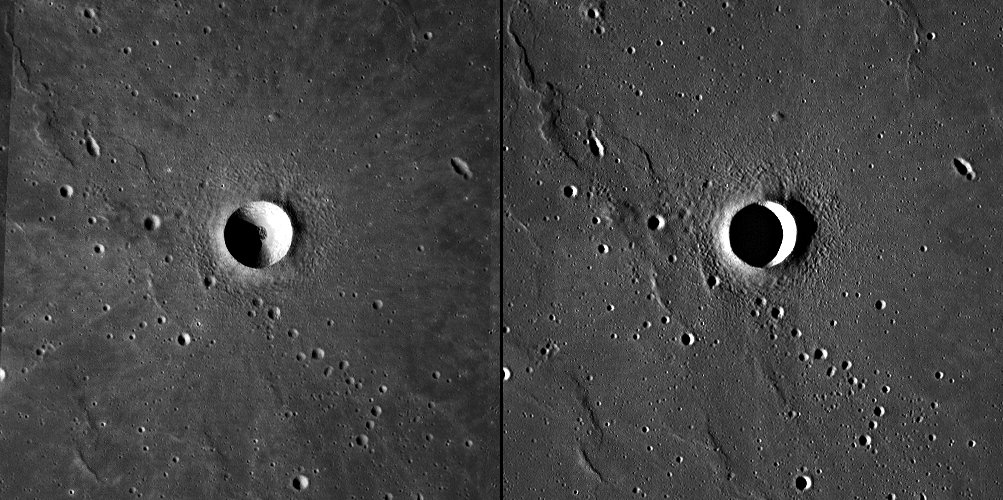
Two LROC Wide Angle Camera (WAC) mosaics show different sun angles. Above, the sun angle is higher, so the high reflectance rays of the crater are more visible, and below the sun angle is lower, emphasizing the morphology of the surface [NASA/GSFC/Arizona State University].
Impact melt in the crater floor is fresh with common features such as fractures, boulders, and mounds. The fractures are mostly located around the edges of the impact melt deposit and formed either as the impact melt cooled, or after cooling during the stage of crater modification due to stresses in the crater floor. Over time the granular material falling down the crater walls will slowly cover more and more of the impact melt deposit, decreasing its diameter. Compositionally, the impact melt is a combination of the rocks present in the target material. In this case, the target material is mostly mare basalt.

Rümker E in relation to Mons Rümker, a wide volcanic shield mound showing sighs of long-term episodic, if not particularly violent, periods of activity; a extraordinary formation easily seen at high angles along the telescopic line of sight from Earth. LROC WAC monochrome (643nm) mosaic [NASA/GSFC/Arizona State University].
Explore the entire NAC frame, HERE.

Check out these previous posts for more examples of beautiful impact melt features:
Lineations on the Melt
Dynamics of Molten Rocks
Sunny Side Up

The wrinkled morphology and ridges of north Oceanus Procellarum, including compositional differences between the mare terrain and Mons Rümker (above left from center), are more difficult to detect when the Sun is high, but when the terminator passes and the Sun is low, the anatomy is stark. from HDTV still captured by Japan's lunar orbiter SELENE-1 (Kaguya) in 2008 [NASA/GSFC/Arizona State University].

Wednesday, July 27, 2011

LROC: Rümker E - Melt and more melt


Southwestern edge of Rümker E crater floor, LROC Narrow Angle Camera (NAC) observation M122591558L, LRO orbit 3200, March 7, 2010; resolution 0.5 meter per pixel, field of view 500 meters with an illumination incidence angle of 43° from south-west. View the full-size LROC Featured Image HERE [NASA/GSFC/Arizona State University].

Hiroyuki Sato
LROC News System

The floor of Rümker E crater exhibits a variety of beautifully preserved impact melt features.

The platy surface, partially submerged boulders and flows are an invitation to explorers!

The edges of the floor are sharply overlayed by debris avalanches from the cavity slopes. How did the flows seen on the left form? Are they impact melt or later debris flows?


Full view of the Rümker E crater floor at the full field of view width of about 2.5 km seen in LROC NAC M122591558L. The square corresponds to the LROC Featured Image released July 27, 2011. See the full-sized context image HERE [NASA/GSFC/Arizona State University].

Crater shapes are changing with time little by little, by slope failures inside the cavity, isostatic rebound, and magma intrusions (depending on the crater size). Debris flows in Rümker E will continue to mask the melt-covered floor, eventually the whole area. There are lots of degraded craters on the Moon showing no interior melt deposits, but they may be there now buried waiting for future astronauts to uncover.

Impact melts are especially interesting to geologists because they are clocks. The melting resets the internal radiometric clock so even a small sample provides the means to date the moment the impact occurred.


LROC Wide Angle Camera (WAC) 100 meter/pixel monochrome (643 nm) mosaic of the region of interest, near Rümker E crater (lower right), including the northern Oceanus Procellarum landmark volcanic Rümker formation immediately to the north-by-northwest. Mosaic stitched from four sequential orbital observation opportunities swept up on January 10, 2010 [NASA/GSFC/Arizona State University].

Explore Rümker E floor in the full NAC frame by yourself!

Related posts:
Rümker
Das crater
Anomalous mounds on the King crater floor
Mounds in a melt pond
Impact melt features in Tycho crater's floor

Friday, September 24, 2010

Rümker


Mons Rümker (40.8°N, 302.01°E) at dawn, means the Moon was nearly Full the night of December 28-29, 2009. The 72 km-wide volcanic heap lords it over the north-northwest Oceanus Procellarum and is never seen except in profile from Earth. Mosaic (by Microsoft ICE) from four LROC Wide Angle Camera observations (processed using LROC WAC Previewer v.1.6) over LRO orbits 2329-2332; avg. alt. 46.59 km., avg. res. 65.53 m, avg. LRO/Moon/Sun phase angle = 89.07° See larger view HERE [NASA/GSFC/Arizona State University]


Nearly a full lunar day later, late in a lunar afternoon, January 11, 2010, Rümker was fully illuminated perhaps for another 20 hours or so. Although, at middle latitudes north, areas behind the higher elevations have already fallen into long shadows as the Sun creeps down to within ten degrees of the southwest horizon. On Earth, the Moon is rising as a waning crescent before dawn. Another mosaic (by Microsoft ICE) from four LROC WAC passes in LRO orbits 2504-2507 (processed using LROC WAC Previewer v.1.6); avg. alt. 40.44 km., avg. res. 57.05 m, avg. LRO/Moon/Sun phase angle = 80.26° See larger view HERE [NASA/GSFC/Arizona State University].


Part of a spectacular HDTV view from Japan's Kaguya lunar orbiter in 2008 shows Rümker at dawn from 100 km polar orbit. [JAXA/NHK/SELENE].


Simulated view of Rümker from a point of view 8000 meters over the average -2200 meter elevation of this part of the Procellarum plain. The wide mound shows extensive signs of periodic intrusions of material piling over 900 meters above its surroundings, though most of the 72 km-wide feature is only 500 m high.