
Showing posts with label Apollo 1. Show all posts
Showing posts with label Apollo 1. Show all posts
Tuesday, January 27, 2015


Saturday, January 7, 2012
Project Gemini comes to life
 |
| Early in the Space Age, there were some who firmly believed this was simply impossible. Tom Stafford took this picture on the evening of December 15, 1965. He was in the starboard seat of Gemini VI-A, commanded by Mercury veteran Wally Schirra, and in the fifth orbit of a one day flight they successfully rendezvoused with Frank Borman and Jim Lovell on-board Gemini VII. Borman and Lovell had three days remaining on a fourteen day flight, a world record at the time. The successful closed-loop rendezvous of piloted spacecraft was an essential skill that needed proving if the scenario in preparation for Apollo lunar landings was going to work [NASA/JSC/ASU]. |
Principal Investigator
Lunar Reconnaissance Orbiter Camera
Arizona State University
On 23 March 1965, the first of ten crewed Gemini spacecraft was launched carrying it's crew of two astronauts, Gus Grissom and John Young. The NASA Johnson Space Center and the School of Earth and Space Exploration at Arizona State University today proudly unveil the Project Gemini Online Digital Archive. The archive contains the first high-resolution digital scans of the original Gemini flight films, now available in several formats with a click of your mouse.
 |
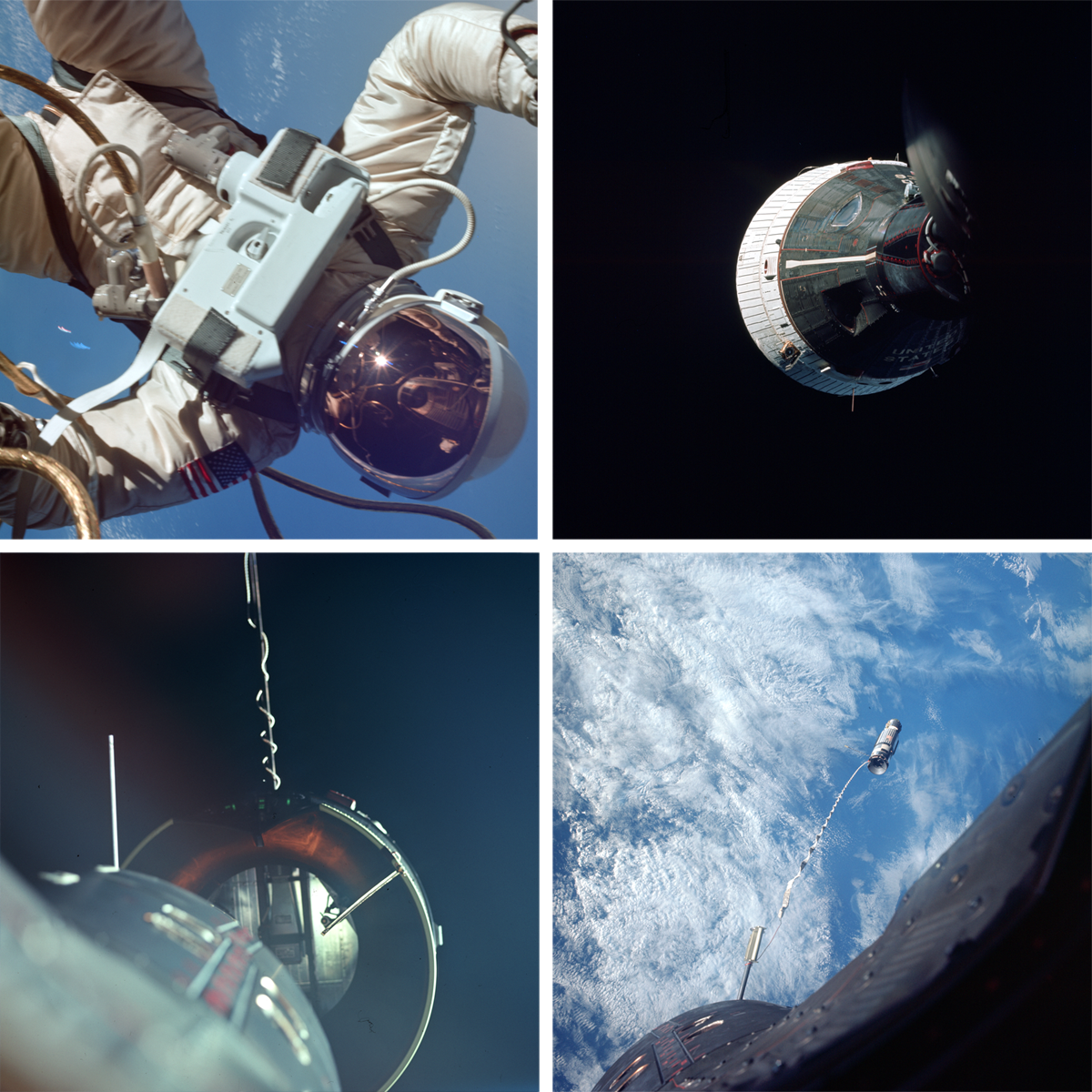
| Project Gemini Highlights - Major milestones of the Gemini flights: Ed White performs the first US spacewalk (upper left), first rendezvous of two crewed spacecraft (upper right), first docking of two spacecraft (lower left), tethering of two spacecraft. Download the full-size commemorative image HERE (lower right) [NASA/JSC/Arizona State University]. |
 |
| Ed White (1930-1967), the first American to walk in space, photographed by Jim McDivitt during the Gemini IV mission [NASA/JSC/Arizona State University]. |
Project Gemini (1964-1966) was the second United States human spaceflight program, after Project Mercury (1960-1963). The overarching goal was to test systems and operations critical to the Apollo program (1961-1975), conceived with the purpose of "landing a man on the Moon and returning him safely to the Earth". Specific goals of Gemini included: perfecting rendezvous and docking between two crewed spacecraft, successfully undertaking extravehicular activities (space walking), perfecting precise reentry procedures, understanding the effects of the space environment on humans, and testing systems for Apollo. The Gemini spacecraft were launched on modified Titan II intercontinental ballistic missiles (ICBM) to low Earth orbit.
 |
| Gemini spacecraft and Titan missile display at NASA's Kennedy Space Center Visitor Complex [M. Robinson]. |
The successful NASA Gemini missions indeed provided critical space operations experience and directly enabled all American space achievements that followed, in particular the Apollo Moon landings and the first American space station, Skylab (1973-1974). Below is a short list of "firsts" from the Gemini missions.
- First US extravehicular activity (EVA)
- First EVA recovery and return of materials exposed to the space environment for long durations (Agena micrometeorite package)
- First US extravehicular activity (EVA)
- First EVA recovery and return of materials exposed to the space environment for long durations (Agena micrometeorite package)
- First use of fuel cells on a spacecraft
- First operation of two crewed US spacecraft simultaneously
- Longest US space mission until Skylab (Gemini 7, nearly two weeks)
- Development of coherent EVA techniques (culminating in Gemini 12)
- First on-orbit rendezvous and docking
- First demonstration of an orbital tether
- First demonstration of the scientific utility of systematic targeted Earth observation--these are some of the earliest color photos of Earth from orbit.
- First operation of two crewed US spacecraft simultaneously
- Longest US space mission until Skylab (Gemini 7, nearly two weeks)
- Development of coherent EVA techniques (culminating in Gemini 12)
- First on-orbit rendezvous and docking
- First demonstration of an orbital tether
- First demonstration of the scientific utility of systematic targeted Earth observation--these are some of the earliest color photos of Earth from orbit.
 |
| Buzz Aldrin, second seat on the last mission of the program, Gemini XII during his record 5 and one-half hour EVA [NASA/JSC/Arizona State University]. |
Go to the Project Gemini digital scan archive.
Also visit the ASU Project Mercury digital scan archive, and the Apollo archive.
Also visit the ASU Project Mercury digital scan archive, and the Apollo archive.
Monday, April 27, 2009
Shuttle's past: Time is not on its side
John Kelly
Florida Today
Florida Today
The two dates seem arbitrary because they are. They may seem unrelated, but they're not.
Sept. 30, 2010, is technically the deadline for finishing the last shuttle mission and retiring the fleet.
Feb. 19, 2004, was the deadline for finishing the construction of the International Space Station. But that was before Columbia.
Under intense pressure to keep space station assembly on schedule and within budget, managers harped on that date to the point of installing screensavers on workers' computers counting down the seconds. The message: hurry up, time is running out on your program.
Then, we lost the Columbia astronauts. Investigators blamed the accident in part on schedule pressure, saying it drove people to make bad tradeoffs favoring on-time flights over safety. They wrote, "Most of the shuttle program's concern about Columbia's foam strike were not about the threat it might pose to the vehicle in orbit, but about the threat it might pose to the schedule."
Fast forward to 2009. NASA's shuttle program is again working against the clock. I think managers, engineers and front-line shuttle workers learned the agonizing lessons of Columbia and will not repeat those mistakes on purpose. But, the influence of schedule pressure can be subtle.
In a business demanding perfection, it's the little unnoticed decisions that can add up to a catastrophe. Subtle pressure is there in the form of the 2010 deadline. NASA needs to complete nine more flights to complete the shuttle's mission, which is to finish building and outfitting a space station that can stay in orbit a decade or so.
That's as many as nine missions in about 19 months, or almost six launches per year. Since the return to flight, NASA has flown about three times a year. Even that has required nearly flawless preparation by crews at Kennedy Space Center and some (recent) good luck with the weather.
Nothing is impossible, but flying shuttles every other month or so is as close as it gets. With three orbiters left, stricter safety rules and slim budgets, flying these last missions is going to be difficult enough without the tick-tock of the clock booming in the background. Making matters worse: an exodus of talented people fleeing for more secure jobs.
Sept. 30, 2010, is technically the deadline for finishing the last shuttle mission and retiring the fleet.
Feb. 19, 2004, was the deadline for finishing the construction of the International Space Station. But that was before Columbia.
Under intense pressure to keep space station assembly on schedule and within budget, managers harped on that date to the point of installing screensavers on workers' computers counting down the seconds. The message: hurry up, time is running out on your program.
Then, we lost the Columbia astronauts. Investigators blamed the accident in part on schedule pressure, saying it drove people to make bad tradeoffs favoring on-time flights over safety. They wrote, "Most of the shuttle program's concern about Columbia's foam strike were not about the threat it might pose to the vehicle in orbit, but about the threat it might pose to the schedule."
Fast forward to 2009. NASA's shuttle program is again working against the clock. I think managers, engineers and front-line shuttle workers learned the agonizing lessons of Columbia and will not repeat those mistakes on purpose. But, the influence of schedule pressure can be subtle.
In a business demanding perfection, it's the little unnoticed decisions that can add up to a catastrophe. Subtle pressure is there in the form of the 2010 deadline. NASA needs to complete nine more flights to complete the shuttle's mission, which is to finish building and outfitting a space station that can stay in orbit a decade or so.
That's as many as nine missions in about 19 months, or almost six launches per year. Since the return to flight, NASA has flown about three times a year. Even that has required nearly flawless preparation by crews at Kennedy Space Center and some (recent) good luck with the weather.
Nothing is impossible, but flying shuttles every other month or so is as close as it gets. With three orbiters left, stricter safety rules and slim budgets, flying these last missions is going to be difficult enough without the tick-tock of the clock booming in the background. Making matters worse: an exodus of talented people fleeing for more secure jobs.
Sunday, January 25, 2009
At the cost of the lives of seventeen extraordinarily brave and courageous astronauts
 Alamogordo Daily News
By Michael Shinabery
New Mexico Museum of Space History
The tragedies that killed three Apollo astronauts and two space shuttle crews have anniversaries during less than one week's time: Apollo 1 on Jan. 27, 1967; Challenger on Jan. 28, 1986; and Columbia on Feb. 1, 2003.
Apollo 1
Commander Gus Grissom, Ed White and Roger Chaffee were 5 1/2 hours into a simulated countdown at the Kennedy Space Center when White cried, "Fire!"
Chafee shouted, "We're burning up."
In the oxygen-saturated cabin 218 feet in the air atop the Saturn IB rocket at Pad 34, White's hand was seen trying to blow the hatch.
"If Ed couldn't get that hatch off, no one could," Robert Zimmerman quotes astronaut Frank Borman in "Genesis" (Four Walls Eight Windows/1998).
Astronauts and their loved ones were in shock.
"Test pilots died while in the air, which was what all the astronauts and their families braced themselves for. No one at NASA had prepared them for an accident on the ground," Zimmerman wrote.
In "Moon Shot" (Turner Publishing/1994), Alan Shepard and Deke Slayton attributed a chafed wire underneath Grissom's seat as sparking the inferno. Newsweek (Feb. 6, 1967) reported: "With a great whoosh, like the sound of an oven being lit, the pure O2 in the cabin made every combustible item in the ship burn with super intensity. At the same time, no O2 was left to breathe."
"The three astronauts were trapped in their melted suit material, fused with the charred nylon from the inside of the spacecraft," Buzz Aldrin and Malcolm McConnell wrote in "Men From Earth" (Bantam/1989). To remove the hatch, the Web site, www.nasa.gov, states five men struggled in thick smoke, "each forced to make several trips in order to reach breathable air."
Borman, a member of the investigating team, listened to the tape of his friends' screams and crawled into what he called the "fire-blackened charnel house," Zimmerman said. "Borman felt himself getting increasingly angry. Everywhere he and the rest of the investigation committee looked, they found sloppy workmanship by both the contractor and by NASA. Borman decided that he was going to do whatever it took to make sure the Apollo spacecraft flew again. And when it did, it would be the safest spacecraft ever built."
As a result, NASA abandoned the oxygen-rich atmosphere and, Zimmerman cited, "more than 2,500 different items were removed, replaced with nonflammable materials." Engineers redesigned the hatch to open in 10 seconds. The old hatch, according to Zimmerman, took 90 seconds to remove and involved "laboriously unscrewing some lug nuts."
Borman, in his book "Countdown," (Silver Arrow Books/1988), described each NASA staff member who suffered depression, guilt or a breakdown as a "victim of Pad 34."
One man during a meeting suddenly drew an organizational chart of Heaven on a blackboard.
He flew home in a straitjacket. A "NASA official drove onto a Houston expressway and raced his car at speeds of more than 100 mph until the engine caught fire," Borman wrote. "He explained later that he'd seen a metaphysical connection between the pad fire and the one that destroyed his automobile."
The final "victim," Borman said, was White's wife. She "committed suicide" in 1984.
Thursday, April 10, 2008
No Retreat from Tomorrow
 Without question, the best commentary inspiring of perspective, meditation, and sound thought on present day space exploration is The Space Review. It makes no claim of being the repository of the best archives or science, but what it does provide is didactic in the form of good writing and timely, well-informed commentary. It is always difficult to recommend which article of the week needs to be read first. But for entertainment's sake, I turned first today to They were warned, by Taylor Dinerman.
Mr. Dinerman's piece reminded me that Congress was not the only group to be warned, over and over, of the inevitable end of the Space Shuttle, and "The Gap" looming ahead for workers at KSC and JSC particularly. The rest of us were warned, also. And ultimately, Congress derives its power from you and me. We, too, were warned, and the fate of NASA's worker and plant investments are ultimately our responsibility, and not only the responsibility of the next president or, more importantly, the Congress.
One rare example of representative government being successful at long-term planning was the Apollo program, and it's sustained, persistent and ultimately successful manned lunar landings.
Political Will (without which, nothing is ever accomplished) combined with the Cold War's "battle for men's minds" and kept real funding for NASA's missions going steady through an escalating and expensive Vietnam War and a general social upheaval not seen since before Appomattox, rivaling Depression and World War, through three presidential administrations from 1961 until 1972.
It is astounding this funding was sustained from the 86th Congress through the 92nd, through six congressional elections.
Those of us experienced with this sorts of things often say your average legislator "has the attention span of a circus monkey."
It was not always this way, but in modern times, as you might expect of what is still the most productive nation on Earth, Congress has "a lot on its plate," and, for good or ill, they are required to be extraordinary people (or must surround themselves with extraordinary people) just to keep their reception schedule straight.
Congress costs us more than a billion dollars per year to operate, prioritizing new and more clever ways to define their generosity by its prior claim on our paychecks.
It is astounding this funding was sustained from the 86th Congress through the 92nd, through six congressional elections.
Those of us experienced with this sorts of things often say your average legislator "has the attention span of a circus monkey."
It was not always this way, but in modern times, as you might expect of what is still the most productive nation on Earth, Congress has "a lot on its plate," and, for good or ill, they are required to be extraordinary people (or must surround themselves with extraordinary people) just to keep their reception schedule straight.
Congress costs us more than a billion dollars per year to operate, prioritizing new and more clever ways to define their generosity by its prior claim on our paychecks.
So, as cringing as it has been to hear the cries of outrage from Florida's impacted federal representatives over the arrival, at long last, of a long-overdue end to the experimental platform called the Space Shuttle, it is understandable.
Not because it plays well at home. The folks back home, especially those impacted by the loss of real jobs, their own jobs, ahead, with the $500 million retirement of Atlantis, Discovery and Endeavour, have seen it coming for a long time.
As hard as it might be to believe, the outrage and squeals you've been hearing from the Florida delegation in Washington reflects genuine surprise, or at very least a purposeful tone of rhetoric those using it hope will arouse their colleagues and boost the signal over the unprecedented noise level to be heard in the marketplace.
NASA is a creature of Congress, after all. For the rightful credit given John Kennedy for Apollo, Lyndon Johnson was more influential in his desire not to "sleep by the light of a communist moon" when he lead the U.S. Senate in 1957 that gave birth to NASA fifty years ago. He was the reason the Vice President, serving in that role under President Kennedy, is still chairman of the National Space Council (and why Dan Quayle, in that same role sixteen years after Johnson's death, prevailed upon NASA to restore the traditional blue "meatball" as its logo, setting aside the "snake" of the 1980's).
Lyndon Johnson was the most successful president in history in getting his agenda passed in Congress, even if his Civil Rights initiative required Republican votes to win out over the opposition of southern Democrats. Mercury, Gemini and through the Apollo 1 fire in January 1967, in 1968, less than a month before he left office, the crew of Apoll0 8 became the first men to leave Earth orbit and return from the Moon.
I credit President Johnson not to raise sympathy for an admittedly enigmatic historic figure or to claim this friend of my father was misunderstood or his historic role under-appreciated, though with regard to Apollo, it clearly was and is.
I'm as ambivalent toward this man as the next guy.
My point is to cast light on an often hidden reality about the exercise of real political power, the kind that escalates an increasingly unpopular war, declares another "unconditional war on poverty," and shepherds Civil Rights legislation, bill after bill, through an increasingly hostile Congress.
Ronald Reagan understood the principle, having on his desk the engraved words, "Anyone can get anything done if they don't care who gets the credit."
Ronald Reagan was a product of Labor and Hollywood, however. Lyndon Johnson was a creature of Congress, like NASA, and he never really quit being the Senate's majority leader until he left Washington physically and politically exhausted and handed it all over to the neo-socialist anti-communist and equally complex Richard Nixon in January 1969.
In the "vesting clause" of the U.S. Constitution, we read, "All legislative Powers herein granted shall be vested in a Congress of the United States..."
For all the concern united in the election of the American President, it is just a president, after all, that will also be elected this year, along with the next Congress, where all the money and power originates. Divided as it is among 538 accidents and Alphas, both men and women, it is the embodiment of the apparent chaos of representative government.
"Find a better country," as they say. (Good luck with that.)
When decisions are made about "ramping up" or eliminating Constellation after the election in November, it will not be an expression of the charisma of the next president. The decision will be made by the lumbering sausage factory on Jenkins Hill in the Potomac swamp.
No building inside the limits of the District of Columbia can be built higher than the U.S. Capitol Dome for a reason. That's where decisions are made about what should actually be done, and how, with that prior claim on your wages.
Rather than ask Senators Obama, Clinton or McCain their positions on Constellation or COTS or the very real threat of regulation of NewSpace when you exercise the responsibility of casting your federal ballot, it might be a better idea to know what your congressional representatives plan to do when the 111th Congress convenes next January.
Better still, why not clue them in on what you want them to do.
Not because it plays well at home. The folks back home, especially those impacted by the loss of real jobs, their own jobs, ahead, with the $500 million retirement of Atlantis, Discovery and Endeavour, have seen it coming for a long time.
As hard as it might be to believe, the outrage and squeals you've been hearing from the Florida delegation in Washington reflects genuine surprise, or at very least a purposeful tone of rhetoric those using it hope will arouse their colleagues and boost the signal over the unprecedented noise level to be heard in the marketplace.
NASA is a creature of Congress, after all. For the rightful credit given John Kennedy for Apollo, Lyndon Johnson was more influential in his desire not to "sleep by the light of a communist moon" when he lead the U.S. Senate in 1957 that gave birth to NASA fifty years ago. He was the reason the Vice President, serving in that role under President Kennedy, is still chairman of the National Space Council (and why Dan Quayle, in that same role sixteen years after Johnson's death, prevailed upon NASA to restore the traditional blue "meatball" as its logo, setting aside the "snake" of the 1980's).
Lyndon Johnson was the most successful president in history in getting his agenda passed in Congress, even if his Civil Rights initiative required Republican votes to win out over the opposition of southern Democrats. Mercury, Gemini and through the Apollo 1 fire in January 1967, in 1968, less than a month before he left office, the crew of Apoll0 8 became the first men to leave Earth orbit and return from the Moon.
I credit President Johnson not to raise sympathy for an admittedly enigmatic historic figure or to claim this friend of my father was misunderstood or his historic role under-appreciated, though with regard to Apollo, it clearly was and is.
I'm as ambivalent toward this man as the next guy.
My point is to cast light on an often hidden reality about the exercise of real political power, the kind that escalates an increasingly unpopular war, declares another "unconditional war on poverty," and shepherds Civil Rights legislation, bill after bill, through an increasingly hostile Congress.
Ronald Reagan understood the principle, having on his desk the engraved words, "Anyone can get anything done if they don't care who gets the credit."
Ronald Reagan was a product of Labor and Hollywood, however. Lyndon Johnson was a creature of Congress, like NASA, and he never really quit being the Senate's majority leader until he left Washington physically and politically exhausted and handed it all over to the neo-socialist anti-communist and equally complex Richard Nixon in January 1969.
In the "vesting clause" of the U.S. Constitution, we read, "All legislative Powers herein granted shall be vested in a Congress of the United States..."
For all the concern united in the election of the American President, it is just a president, after all, that will also be elected this year, along with the next Congress, where all the money and power originates. Divided as it is among 538 accidents and Alphas, both men and women, it is the embodiment of the apparent chaos of representative government.
"Find a better country," as they say. (Good luck with that.)
When decisions are made about "ramping up" or eliminating Constellation after the election in November, it will not be an expression of the charisma of the next president. The decision will be made by the lumbering sausage factory on Jenkins Hill in the Potomac swamp.
No building inside the limits of the District of Columbia can be built higher than the U.S. Capitol Dome for a reason. That's where decisions are made about what should actually be done, and how, with that prior claim on your wages.
Rather than ask Senators Obama, Clinton or McCain their positions on Constellation or COTS or the very real threat of regulation of NewSpace when you exercise the responsibility of casting your federal ballot, it might be a better idea to know what your congressional representatives plan to do when the 111th Congress convenes next January.
Better still, why not clue them in on what you want them to do.
Friday, March 14, 2008
A Week in Space: Success Built on Failure

The Fountains of Enceladus
"Institutional memory is no luxury at NASA."
"Institutional memory is no luxury at NASA."
Joel Raupe
LUNAR PIONEER
The week in space saw demonstrations of astounding success, with stubbed toes and skinned knees here and there. Around Saturn, in low-Earth-orbit and here on the surface humans are building success on the shoulders of monumental failure.
Twentieth Century astronomer Harlow Shapley may have been wrong to disagree with Edmund Hubble’s theory that the Milky Way is yet another Galaxy, in a universe filled with similar “islands” in "the Great Debate" with Heber D. Curtis in 1920, but Shapley was prophetic in believing the quest for the stars would be a rugged one.
Planning for Failure:
At Langley Research Center NASA showed off an engineering mock up of an Orion engineering mock-up built to test launch failure escape systems. It evoked memories of similar Apollo mock-ups rolled out in 1961, even as Project Mercury was barely underway, and also memories also of Apollo 1 and the launch test Oxygen fire incinerating it's crew, Gus Grissom, Ed White and Roger Chaffee in 1967.
"Institutional Memory isn't a luxury with NASA. Failure to remember is far too expensive.
Last month Thomas D. Jones remembered his friends aboard Columbia five years ago when he wrote in Popular Science that “Orion will launch with a powerful escape motor that can rocket its crew away from a disintegrating booster. A conical crew cabin structure will protect the heat shield beneath it from a debris strike like the one that doomed Columbia.”
Institutional Memory isn't a luxury with NASA. Failure to remember is far too expensive, as is contingency planning that would give a soccer mom a brain cramp. The costly fire on the pad killing the crew of Apollo 1, and the Apollo 204 Investigation Board, led by future Apollo 8 commander Frank Borman, and the discovering of 20,000 design flaws in the Apollo/Saturn vehicles, saved future success for Apollo and nine visits by 27 people to lunar realm.
Of course, the pad fire would not have been prevented by a capsule escape system, a contingency never used in American manned spaceflight, but it does show contingency planning works. It works where failure is anticipated. Critical faults that did end up failing in the future appear always to be ones not planned for in contingency policy, but deadly failure always brought harsh light to systemic and mechanical flaws in need of being contingency planning priorities.
Capsule escape systems were never used during the Mercury, Gemini and Apollo missions, but early NASA officials were informed by the spectacular booster explosions on the pad and just after lift-off of unmanned vehicles before and after, just as they're reminded today by more recent failure. Thomas D. Jones' article in POPSCI shows a return to expendable boosters and “capsules” won't mean that Constellation will be uninformed by the space shuttle and the lessons of both Challenger and Columbia, perhaps in finally giving design and mission critics a voice equal to those of accountants and vendors, and their friends in Congress.
Working the Problem:
In low-Earth-orbit, STS-123 and Endeavour docked with the International Space Station and joined Expedition 16 a few minutes later than planned, and by the end of our work week the first of five planned spacewalks during the shuttle's stay ended with attachment of the Japanese Kibo module and new dexterity added to the space station’s robotic Canadarm2 and crane with Dextre properly installed, at least where it should be.
Initial Power Couplings for the improvement didn't power-up, however, but costly failure was diverted in time when Primary Couplings were installed on the second spacewalk of STS-123, Saturday.
It's been a working weekend for NASA-Houston, and mostly according to plan for the ten people falling around Earth five miles a second, and 200 miles overhead.
On the first spacewalk, EVA record holder and ISS Expedition 16 commander Dr. Peggy Whitson reported her first look inside Kibo from the station showed "nothing unexpected." She was also happy to confirm no "floaters" inside the new station segment, now the first manned space vehicle built by Japan.
Expedition 16 flight engineer Dr. Garrett Reisman and STS-123 mission specialist Dr. Rick Linnehan completed the first spacewalk of the shuttle mission at 0919 UT, out in the void for seven hours and one minute.
Hiccups.
Far beyond the Moon, and just past conjunction, the soft yellowish star overhead before sidereal midnight testifies to the distance Cassini first had to travel even to begin its mission at Saturn.
It has been darting up and around and over and under the gaseous giant, using orbital mechanics of astounding complexities and Saturn and its many moon's gravity wells as third and fourth dimensional side pockets to fly out and away and quickly drawn back in again in precise maneuvering over and over again in an orbit around Saturn unlike any in nature.
Wednesday evening, in a much anticipated event Cassini was busy collecting data as it sliced just under the brightest moon in the solar system, over fresh snow on the south pole of Enceladus.
Slewing cameras as it moved by at 9 miles a second (14.4 kps); and only 32.3 miles above its surface, Cassini performed another unprecedented maneuver in a mission composed of unprecedented maneuvers to discover more about still another outer solar system discovery.
Almost everyone who read a newspaper on Earth knew the purpose. Ice geysers, shooting towers of wispy strands the fan directly away at distances far greater than Enceladus' width had been discovered where a heat signature was spotted in the Infrared spectrum earlier in the mission. Cassini, steered by controllers at JPL a billion miles away in Pasadena, was forced to zip directly through what apparently were the highest water fountains known to exist in our star system.
Enceladus has joined its Saturnian sister Titan, and Jupiter’s Io and Europa, as a member of the human "Hit Parade" of most intriguing moons.” It's large enough for its mass to have crushed itself into a sphere, but has a snow-blinding diameter roughly equal to the length of Interstate 95 in North Carolina.
As monumental a success as the maneuver turned out to be in adding another achievement to Pasadena’s long list of unsurpassed magic, as JPL waited for the data to download as it arrived in packets from 90 light minutes away as it was being scooped up by the Deep Space Network, and as Cassini continued a mad dash toward Titan, it became clear after a time that a “software hiccup” had spoiled a most important part of the show.
Planetary scientists won’t be disappointed with the pictures. They may even yet begin to answer the question of what forces are at play making Enceladus so “dynamic” and new in its south while so obviously ancient and quiet in its north. Those same scientists continue to puzzle over the awesome complexities of Saturn’s rings, and Enceladus with her high fountains of water ice somehow plays a role in that mystery.
Leading into the flyby Cassini shot side glances of those rings nearly edge on and caught now alomost routine shots of more than a few of the Ring’s Shepherd Moons, dancing to a melody we still can’t quite hear. Enceladus may be chief among them, particulary concerning its part in the cycling of Saturn's E-Ring.
But the very experiment onboard Cassini needing to be inside those tremendous Fountains of Enceladus became useless at the very moment it was most needed, though shuffling of software that had been rehearsed and rehearsed, and rehearsed again in the days beforehand. It was an anomaly suitable to a short story by Arthur C. Clarke.
JPL explained the "hiccup" this way:
"During Cassini's closest approach, two instruments were collecting data--the Cosmic Dust Analyzer and the Ion and Neutral Mass Spectrometer. An unexplained software hiccup with Cassini's Cosmic Dust Analyzer instrument prevented it from collecting any data during closest approach, although the instrument did get data before and after the approach. During the flyby, the instrument was switching between two versions of software programs. The new version was designed to increase the ability to count particle hits by several hundred hits per second. The other four fields and particles instruments on the spacecraft, in addition to the ion and neutral mass spectrometer, did capture all of their data, which will complement the overall composition studies and elucidate the unique plume environment of Enceladus."And the raw imagery doesn't disappoint, with promising new information promising to be teased out in the days ahead.
Amazing Cassini, unscathed, roboticly unembarrassed, now speeds on toward Titan, continuing a long and amazing tour.
Cassini returns to Enceladus next October.
Europe’s Progress:
And then there’s the Jules Verne, ESA's new unmanned ATV space truck, which was inserted safely into a parking orbit after being lifted high and fast aloft from equatorial Kourou while perched atop a powerful Ariane 5.
During initial orbital checkout, in a “holding pattern” and with time to kill as controllers waits for Endeavour to depart for its turn at the Harmony Node at ISS, ESA ground controllers worked feverishly to restore 7 of 28 reaction control thrusters and one of three of the ATV’s main engines, failing to respond to command.
They were successful in restoring the fire (though ESA was confident the cargo vessel would safely make it to ISS regardless) and they can stop sweating, for the moment, ahead they can look forward to new ATV’s first semi-automated docking depending the hardcore-proven Russian-supplied and Ukrainian-built Kurs docking system.
Conclusion:
Noteworthy in all this are simple facts illustrating little problems are always essential parts of the stories of big successes, and big success seems highly dependant upon now-working systems that were once spectacular failures.
That Kurs docking system, an unquestioned success today and essential to the ISS and Russia's Progress, was a buggy and unholy mess, playing a role in breath-stealing human and mechanical error such as more than one complete miss, near miss and at least one catastrophic accident in the days of the Soviet MIR space station program only eleven years ago.
And Jules Verne was successfully propelled to its present station-keeping orbit by the once- equally disastrous Ariane 5, which exploded nine miles up and rained debris on the French Guyana and Brazilian coast over an area of many miles twelve years ago.
Remembered clearly that day the cry of a Kourou facility launch director, when it happened, who reported with tears, “it is all over, it is all finished.”
Clearly, it was not.
And then the beginning of this present NewSpace Race, even throughout the world, might well be marked by the hellish disintegration of Columbia over Texas on February 1, 2003., though some would mark it with Ronald Reagan's determination to open the sky to entrepreneurship the previous decade. It was Columbia that refocused public attention, and without political will, Lincoln believed, nothing is possible.
Far from ending manned and unmanned space exploration, renewed Vision starts with documented mechanical and systemic failure. Failure may not be "an option," but it is a proven element essential to success.
The week in space saw demonstrations of astounding success, with stubbed toes and skinned knees here and there. Around Saturn, in low-Earth-orbit and here on the surface humans are building success on the shoulders of monumental failure.
Twentieth Century astronomer Harlow Shapley may have been wrong to disagree with Edmund Hubble’s theory that the Milky Way is yet another Galaxy, in a universe filled with similar “islands” in "the Great Debate" with Heber D. Curtis in 1920, but Shapley was prophetic in believing the quest for the stars would be a rugged one.
Planning for Failure:
At Langley Research Center NASA showed off an engineering mock up of an Orion engineering mock-up built to test launch failure escape systems. It evoked memories of similar Apollo mock-ups rolled out in 1961, even as Project Mercury was barely underway, and also memories also of Apollo 1 and the launch test Oxygen fire incinerating it's crew, Gus Grissom, Ed White and Roger Chaffee in 1967.
"Institutional Memory isn't a luxury with NASA. Failure to remember is far too expensive.
Last month Thomas D. Jones remembered his friends aboard Columbia five years ago when he wrote in Popular Science that “Orion will launch with a powerful escape motor that can rocket its crew away from a disintegrating booster. A conical crew cabin structure will protect the heat shield beneath it from a debris strike like the one that doomed Columbia.”
Institutional Memory isn't a luxury with NASA. Failure to remember is far too expensive, as is contingency planning that would give a soccer mom a brain cramp. The costly fire on the pad killing the crew of Apollo 1, and the Apollo 204 Investigation Board, led by future Apollo 8 commander Frank Borman, and the discovering of 20,000 design flaws in the Apollo/Saturn vehicles, saved future success for Apollo and nine visits by 27 people to lunar realm.
Of course, the pad fire would not have been prevented by a capsule escape system, a contingency never used in American manned spaceflight, but it does show contingency planning works. It works where failure is anticipated. Critical faults that did end up failing in the future appear always to be ones not planned for in contingency policy, but deadly failure always brought harsh light to systemic and mechanical flaws in need of being contingency planning priorities.
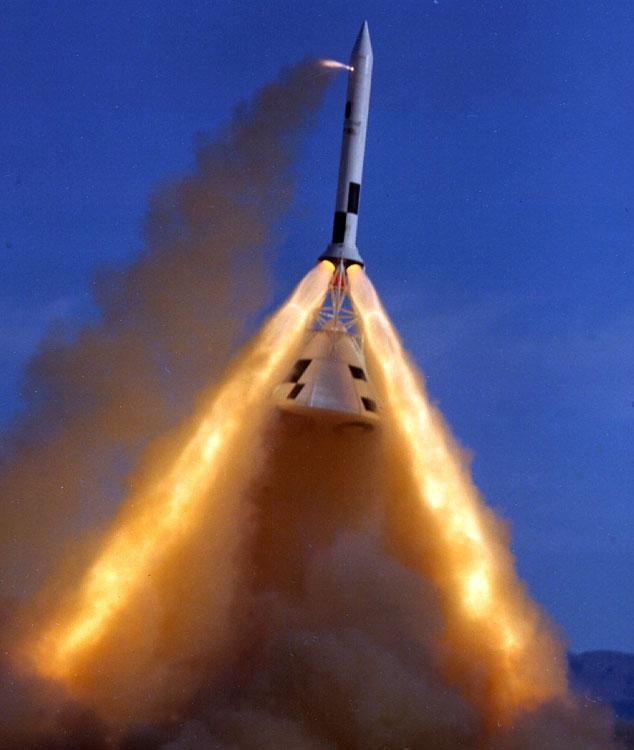
Capsule escape systems were never used during the Mercury, Gemini and Apollo missions, but early NASA officials were informed by the spectacular booster explosions on the pad and just after lift-off of unmanned vehicles before and after, just as they're reminded today by more recent failure. Thomas D. Jones' article in POPSCI shows a return to expendable boosters and “capsules” won't mean that Constellation will be uninformed by the space shuttle and the lessons of both Challenger and Columbia, perhaps in finally giving design and mission critics a voice equal to those of accountants and vendors, and their friends in Congress.
Working the Problem:
In low-Earth-orbit, STS-123 and Endeavour docked with the International Space Station and joined Expedition 16 a few minutes later than planned, and by the end of our work week the first of five planned spacewalks during the shuttle's stay ended with attachment of the Japanese Kibo module and new dexterity added to the space station’s robotic Canadarm2 and crane with Dextre properly installed, at least where it should be.
Initial Power Couplings for the improvement didn't power-up, however, but costly failure was diverted in time when Primary Couplings were installed on the second spacewalk of STS-123, Saturday.
It's been a working weekend for NASA-Houston, and mostly according to plan for the ten people falling around Earth five miles a second, and 200 miles overhead.
On the first spacewalk, EVA record holder and ISS Expedition 16 commander Dr. Peggy Whitson reported her first look inside Kibo from the station showed "nothing unexpected." She was also happy to confirm no "floaters" inside the new station segment, now the first manned space vehicle built by Japan.
Expedition 16 flight engineer Dr. Garrett Reisman and STS-123 mission specialist Dr. Rick Linnehan completed the first spacewalk of the shuttle mission at 0919 UT, out in the void for seven hours and one minute.
Hiccups.
Far beyond the Moon, and just past conjunction, the soft yellowish star overhead before sidereal midnight testifies to the distance Cassini first had to travel even to begin its mission at Saturn.
It has been darting up and around and over and under the gaseous giant, using orbital mechanics of astounding complexities and Saturn and its many moon's gravity wells as third and fourth dimensional side pockets to fly out and away and quickly drawn back in again in precise maneuvering over and over again in an orbit around Saturn unlike any in nature.
Wednesday evening, in a much anticipated event Cassini was busy collecting data as it sliced just under the brightest moon in the solar system, over fresh snow on the south pole of Enceladus.
Slewing cameras as it moved by at 9 miles a second (14.4 kps); and only 32.3 miles above its surface, Cassini performed another unprecedented maneuver in a mission composed of unprecedented maneuvers to discover more about still another outer solar system discovery.
Almost everyone who read a newspaper on Earth knew the purpose. Ice geysers, shooting towers of wispy strands the fan directly away at distances far greater than Enceladus' width had been discovered where a heat signature was spotted in the Infrared spectrum earlier in the mission. Cassini, steered by controllers at JPL a billion miles away in Pasadena, was forced to zip directly through what apparently were the highest water fountains known to exist in our star system.
Enceladus has joined its Saturnian sister Titan, and Jupiter’s Io and Europa, as a member of the human "Hit Parade" of most intriguing moons.” It's large enough for its mass to have crushed itself into a sphere, but has a snow-blinding diameter roughly equal to the length of Interstate 95 in North Carolina.
As monumental a success as the maneuver turned out to be in adding another achievement to Pasadena’s long list of unsurpassed magic, as JPL waited for the data to download as it arrived in packets from 90 light minutes away as it was being scooped up by the Deep Space Network, and as Cassini continued a mad dash toward Titan, it became clear after a time that a “software hiccup” had spoiled a most important part of the show.
Planetary scientists won’t be disappointed with the pictures. They may even yet begin to answer the question of what forces are at play making Enceladus so “dynamic” and new in its south while so obviously ancient and quiet in its north. Those same scientists continue to puzzle over the awesome complexities of Saturn’s rings, and Enceladus with her high fountains of water ice somehow plays a role in that mystery.
Leading into the flyby Cassini shot side glances of those rings nearly edge on and caught now alomost routine shots of more than a few of the Ring’s Shepherd Moons, dancing to a melody we still can’t quite hear. Enceladus may be chief among them, particulary concerning its part in the cycling of Saturn's E-Ring.
But the very experiment onboard Cassini needing to be inside those tremendous Fountains of Enceladus became useless at the very moment it was most needed, though shuffling of software that had been rehearsed and rehearsed, and rehearsed again in the days beforehand. It was an anomaly suitable to a short story by Arthur C. Clarke.
JPL explained the "hiccup" this way:
"During Cassini's closest approach, two instruments were collecting data--the Cosmic Dust Analyzer and the Ion and Neutral Mass Spectrometer. An unexplained software hiccup with Cassini's Cosmic Dust Analyzer instrument prevented it from collecting any data during closest approach, although the instrument did get data before and after the approach. During the flyby, the instrument was switching between two versions of software programs. The new version was designed to increase the ability to count particle hits by several hundred hits per second. The other four fields and particles instruments on the spacecraft, in addition to the ion and neutral mass spectrometer, did capture all of their data, which will complement the overall composition studies and elucidate the unique plume environment of Enceladus."And the raw imagery doesn't disappoint, with promising new information promising to be teased out in the days ahead.
Amazing Cassini, unscathed, roboticly unembarrassed, now speeds on toward Titan, continuing a long and amazing tour.
Cassini returns to Enceladus next October.
Europe’s Progress:
And then there’s the Jules Verne, ESA's new unmanned ATV space truck, which was inserted safely into a parking orbit after being lifted high and fast aloft from equatorial Kourou while perched atop a powerful Ariane 5.
During initial orbital checkout, in a “holding pattern” and with time to kill as controllers waits for Endeavour to depart for its turn at the Harmony Node at ISS, ESA ground controllers worked feverishly to restore 7 of 28 reaction control thrusters and one of three of the ATV’s main engines, failing to respond to command.
They were successful in restoring the fire (though ESA was confident the cargo vessel would safely make it to ISS regardless) and they can stop sweating, for the moment, ahead they can look forward to new ATV’s first semi-automated docking depending the hardcore-proven Russian-supplied and Ukrainian-built Kurs docking system.
Conclusion:
Noteworthy in all this are simple facts illustrating little problems are always essential parts of the stories of big successes, and big success seems highly dependant upon now-working systems that were once spectacular failures.
That Kurs docking system, an unquestioned success today and essential to the ISS and Russia's Progress, was a buggy and unholy mess, playing a role in breath-stealing human and mechanical error such as more than one complete miss, near miss and at least one catastrophic accident in the days of the Soviet MIR space station program only eleven years ago.
And Jules Verne was successfully propelled to its present station-keeping orbit by the once- equally disastrous Ariane 5, which exploded nine miles up and rained debris on the French Guyana and Brazilian coast over an area of many miles twelve years ago.
Remembered clearly that day the cry of a Kourou facility launch director, when it happened, who reported with tears, “it is all over, it is all finished.”
Clearly, it was not.
And then the beginning of this present NewSpace Race, even throughout the world, might well be marked by the hellish disintegration of Columbia over Texas on February 1, 2003., though some would mark it with Ronald Reagan's determination to open the sky to entrepreneurship the previous decade. It was Columbia that refocused public attention, and without political will, Lincoln believed, nothing is possible.
Far from ending manned and unmanned space exploration, renewed Vision starts with documented mechanical and systemic failure. Failure may not be "an option," but it is a proven element essential to success.
Subscribe to:
Posts (Atom)