|
| Early in the Space Age, there were some who firmly believed this was simply impossible. Tom Stafford took this picture on the evening of December 15, 1965. He was in the starboard seat of Gemini VI-A, commanded by Mercury veteran Wally Schirra, and in the fifth orbit of a one day flight they successfully rendezvoused with Frank Borman and Jim Lovell on-board Gemini VII. Borman and Lovell had three days remaining on a fourteen day flight, a world record at the time. The successful closed-loop rendezvous of piloted spacecraft was an essential skill that needed proving if the scenario in preparation for Apollo lunar landings was going to work [NASA/JSC/ASU]. |
Principal Investigator
Lunar Reconnaissance Orbiter Camera
Arizona State University
On 23 March 1965, the first of ten crewed Gemini spacecraft was launched carrying it's crew of two astronauts, Gus Grissom and John Young. The NASA Johnson Space Center and the School of Earth and Space Exploration at Arizona State University today proudly unveil the Project Gemini Online Digital Archive. The archive contains the first high-resolution digital scans of the original Gemini flight films, now available in several formats with a click of your mouse.
 |
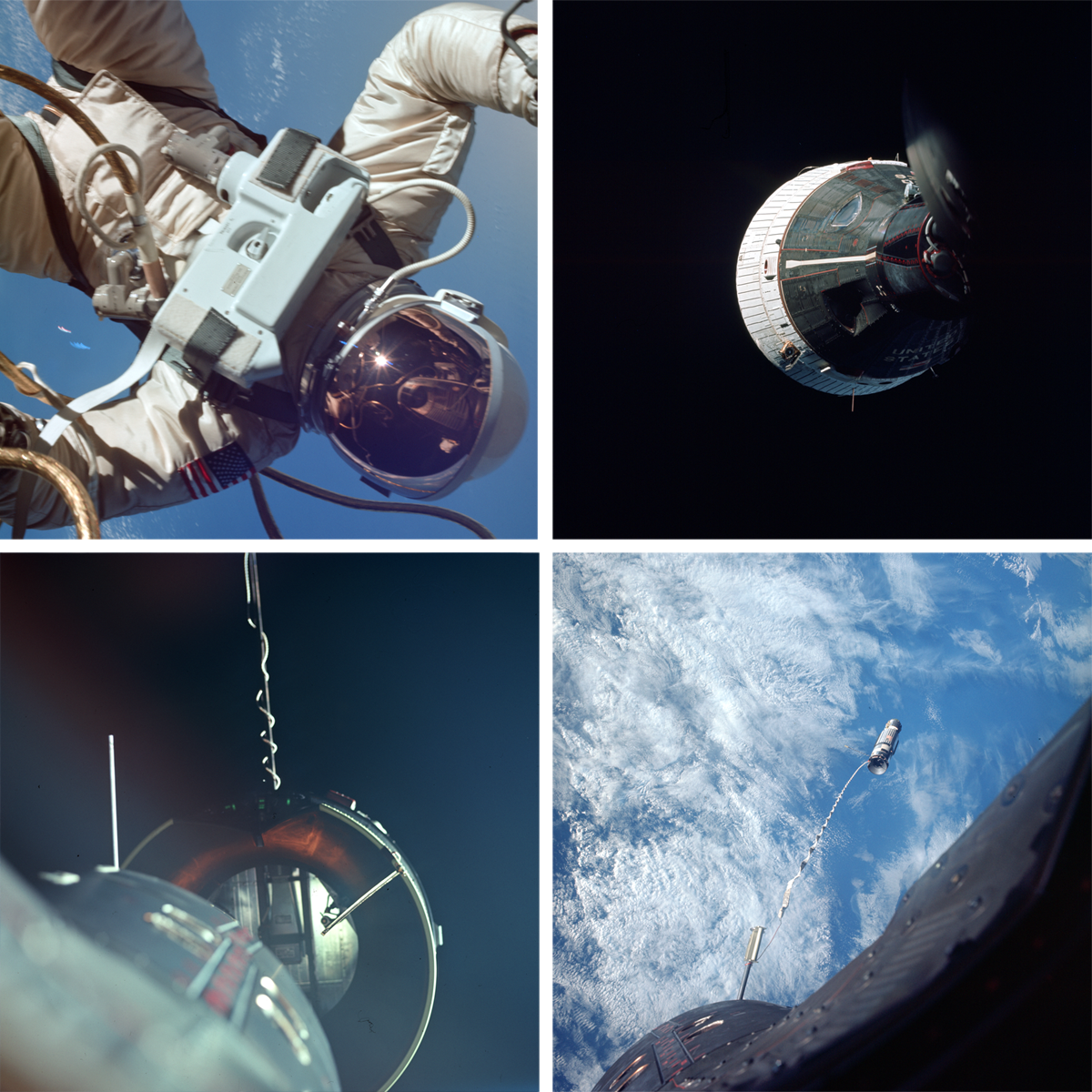
| Project Gemini Highlights - Major milestones of the Gemini flights: Ed White performs the first US spacewalk (upper left), first rendezvous of two crewed spacecraft (upper right), first docking of two spacecraft (lower left), tethering of two spacecraft. Download the full-size commemorative image HERE (lower right) [NASA/JSC/Arizona State University]. |
 |
| Ed White (1930-1967), the first American to walk in space, photographed by Jim McDivitt during the Gemini IV mission [NASA/JSC/Arizona State University]. |
Project Gemini (1964-1966) was the second United States human spaceflight program, after Project Mercury (1960-1963). The overarching goal was to test systems and operations critical to the Apollo program (1961-1975), conceived with the purpose of "landing a man on the Moon and returning him safely to the Earth". Specific goals of Gemini included: perfecting rendezvous and docking between two crewed spacecraft, successfully undertaking extravehicular activities (space walking), perfecting precise reentry procedures, understanding the effects of the space environment on humans, and testing systems for Apollo. The Gemini spacecraft were launched on modified Titan II intercontinental ballistic missiles (ICBM) to low Earth orbit.
 |
| Gemini spacecraft and Titan missile display at NASA's Kennedy Space Center Visitor Complex [M. Robinson]. |
The successful NASA Gemini missions indeed provided critical space operations experience and directly enabled all American space achievements that followed, in particular the Apollo Moon landings and the first American space station, Skylab (1973-1974). Below is a short list of "firsts" from the Gemini missions.
- First US extravehicular activity (EVA)
- First EVA recovery and return of materials exposed to the space environment for long durations (Agena micrometeorite package)
- First US extravehicular activity (EVA)
- First EVA recovery and return of materials exposed to the space environment for long durations (Agena micrometeorite package)
- First use of fuel cells on a spacecraft
- First operation of two crewed US spacecraft simultaneously
- Longest US space mission until Skylab (Gemini 7, nearly two weeks)
- Development of coherent EVA techniques (culminating in Gemini 12)
- First on-orbit rendezvous and docking
- First demonstration of an orbital tether
- First demonstration of the scientific utility of systematic targeted Earth observation--these are some of the earliest color photos of Earth from orbit.
- First operation of two crewed US spacecraft simultaneously
- Longest US space mission until Skylab (Gemini 7, nearly two weeks)
- Development of coherent EVA techniques (culminating in Gemini 12)
- First on-orbit rendezvous and docking
- First demonstration of an orbital tether
- First demonstration of the scientific utility of systematic targeted Earth observation--these are some of the earliest color photos of Earth from orbit.
 |
| Buzz Aldrin, second seat on the last mission of the program, Gemini XII during his record 5 and one-half hour EVA [NASA/JSC/Arizona State University]. |
Go to the Project Gemini digital scan archive.
Also visit the ASU Project Mercury digital scan archive, and the Apollo archive.
Also visit the ASU Project Mercury digital scan archive, and the Apollo archive.