Showing posts with label David S. F. Portree. Show all posts

Monday, February 23, 2015

SDI: Military uses of the Moon and Asteroids (1983)

NASA/DOD joint lunar reconnaissance and instrument test platform Clementine, "lost and gone forever" following its remarkable and successful mission in 1994.
David S.F. Portree
Wired

On the evening of 23 March 1983, President Ronald Reagan addressed the people of the United States from the Oval Office. Citing aggressive moves on the part of the Soviet Union, he defended proposed increases in U.S. military spending and the introduction of new missiles and bombers. He then called for a revolution in U.S. strategic doctrine:

Let me share with you a vision of the future. . .What if free people could live secure in the knowledge that their security did not rest upon the threat of instant U.S. retaliation to deter a Soviet attack, that we could intercept and destroy strategic ballistic missiles before they reached our own soil or that of our allies? I know this is a formidable technical task, one that may not be accomplished before the end of this century. . .I call upon the scientific community in our country, those who gave us nuclear weapons, to turn their great talents now to the cause of Mankind and world peace, to give us the means of rendering these nuclear weapons impotent and obsolete.

Thus was born the Strategic Defense Initiative (SDI), which is perhaps better known by its cinema-inspired nickname “Star Wars.” This post is not meant to discuss the geopolitical ramifications or technical feasibility of SDI. It will instead focus on a lesser-known aspect of SDI planning.

Read the fascinating full story at WIRED, HERE.

Friday, October 24, 2014

Bellcomm’s 1968 Lunar Exploration Program

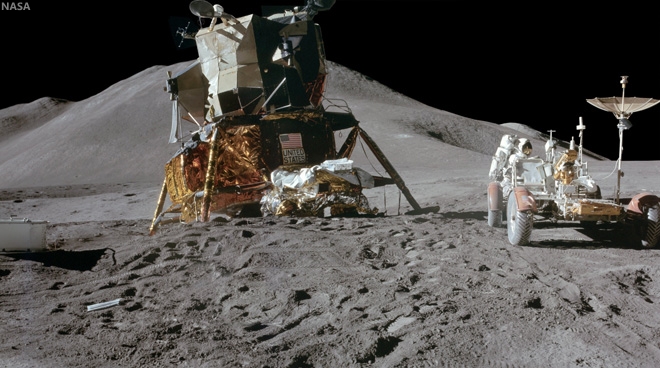
Apollo 15 astronaut James Irwin works beside the mission’s Lunar Roving Vehicle, the first to reach the moon, July 31, 1971. Beginning with Apollo 15, NASA deviated from Bellcomm’s proposed Lunar Exploration Program outlined in 1968 [NASA].
David S. F. Portree
Wired

Bellcomm, Inc., based near NASA Headquarters in Washington, DC, was carved out of Bell Labs in 1962 to provide technical advice to NASA’s Apollo Program Director. The organization rapidly expanded its bailiwick to support nearly all NASA Office of Manned Space Flight advance planning.

In a January 1968 report, Bellcomm planners N. Hinners, D. James, and F. Schmidt proposed a mission series designed to fill a gap which they felt existed in NASA’s lunar exploration schedule between the first piloted Apollo lunar landing and later, more advanced Apollo Applications Program (AAP) lunar flights. The trio declared that their plan was “based upon a reasonable set of assumptions regarding hardware capability and evolution, an increase in scientific endeavor, launch rates, budgetary constraints, operational learning, lead times, and interaction with other space programs,” as well as “the assumption that lunar exploration will be a continuing aspect of human endeavor.”

To bridge the gap between early Apollo and AAP, they envisioned a series of 12 lunar missions in four phases.

Read the full article, HERE.


Thursday, January 24, 2013

The proper course for lunar exploration (1965)

MOLAB with side-mounted drill and Apollo LEM as conceived in 1964-1965. The MOLAB would have arrived on the moon ahead of the piloted LEM on an unmanned LEM Truck [Bendix/NASA].
David S.F. Portree
Beyond Apollo
WIRED

For a time, Thomas Evans headed up the Advanced Lunar Missions Study Program in the NASA Headquarters Office of Manned Space Flight. By the time of the 11th Annual Meeting of the American Astronautical Society (AAS) in May 1965, however, he had retired from NASA and become a farmer in Iowa. This gave him the freedom to speak his mind about what he felt were the Apollo Program’s shortcomings.

Evans told assembled members of the AAS that “the idea of a manned [landing] on the moon was so spectacular. . .that [it] dominated most pronouncements and thoughts on the space program.” He argued, however, that this objective had “too much the flavor of a stunt to be the final goal of a $20 billion national effort.” Evans maintained that
[Our] situation today is comparable to one which might have occurred during the railroad building era in America a century ago. It is as if the federal government had invested vast sums in the construction of the first railroad spanning the North American continent, but had procurred only a single engine and caboose. . . The first crossing by that engine and caboose would have been a major milestone in man’s progress and would have been greeted with enthusiasm and applause. But then those responsible for the program would have faced a major decision. . .Should the project be stopped? Should the engine-caboose be run repeatedly back and forth across the Continent to constantly remind the world of our great achievement? Or should a further modest investment be made in. . .some freight and passenger cars, to convert the system into something of practical value? Only the last solution would have been tenable then, and only a similar constructive approach would seem acceptable now.
 Evans argued that the Saturn rockets and Apollo spacecraft NASA had under development would provide “an excellent base upon which to build a broad program of manned. . .lunar exploration beyond the first landing.” Evans pointed to statements by President Lyndon Baines Johnson and Vice-President Hubert Humphrey which he said made clear that “the United States fully intends to explore the moon, not merely to visit it.” He also noted that NASA expected to be able to launch six Saturn V rockets per year beginning in 1969.

Read the full article, HERE.

Thursday, June 28, 2012

Cancelled: Apollo 15 and Apollo 19

Dr. Thomas O. Paine, NASA Deputy Administrator, January 31-
October 8, 1968; Acting Administrator, October 8, 1968-Mar. 21,
1969; NASA Administrator, March 21, 1969-September 15, 1970
[NASA].
David S. F. Portree
WIRED

On 5 August and 13 August 1970, NASA Administrator Thomas Paine dispatched letters on the future of the U.S. lunar program to the Lunar and Planetary Missions Board (LPMB) and the Space Science Board (SSB) of the National Academy of Sciences National Research Council. In his letters, he outlined three options for curtailing Project Apollo. Of these, the first (Option I) would cancel one Apollo mission, while the others would nix two. The options he described were in part aimed at avoiding a delay in the Skylab Program, which constituted a step toward Paine’s favorite 1970s NASA goal: a 12-man Earth-orbiting space station that would be staffed and resupplied using a fully reusable space shuttle. Members of the LPMB and the SSB held an urgent two-day meeting (15-16 August 1970) in Woods Hole, Massachusetts, to develop a response to Paine’s letters.

By the time the LPMB and SSB met, NASA had flown three manned lunar landing missions: Apollo 11 (16-24 July 1969), which landed off-target on Mare Tranquillitatis; Apollo 12  (14-24 November 1969), which landed close by the derelict Surveyor 3 automated lander on Oceanus Procellarum, thereby demonstrating the pinpoint landing capability essential for geologic traverse planning; and perilous Apollo 13 (11-17 April 1970), which suffered an oxygen tank explosion in its Command and Service Module (CSM) that scrubbed its planned landing at Fra Mauro. Of these, Apollo 11 and Apollo 12 were mainly engineering missions intended to prove the Apollo system, while Apollo 13 had been intended as the first science-focused mission. Paine had canceled one Apollo mission, Apollo 20, in January 1970 so that its Saturn V rocket could launch the Skylab Orbital Workshop into low-Earth orbit. That left six moon landings before the program concluded with Apollo 19.

The program meant to extend piloted lunar exploration deep into the 1970s, the Apollo Applications Program (AAP), had taken repeated funding hits since 1967, and so had abandoned its lunar ambitions, becoming  the strictly Earth-orbital Skylab Program in February 1970. Some concepts proposed for AAP lunar missions – for example, three-day lunar surface stays and a manned roving vehicle – would find their way into Apollo before its end, but when Apollo ended, so would end piloted lunar exploration.

With the goal of a man on the moon by 1970 successfully attained, pressure had begun to build to cancel some or all of the remaining Apollo lunar missions. In the aftermath of the Apollo 13 accident, some policy-makers questioned the wisdom of continuing to place astronauts at risk. Apollo 11 had humbled the Soviets on the technological prestige front of the Cold War; future landings would do little to enhance prestige, they argued, but a single lost crew could erase much of what the U.S. had gained by being first on the moon.

In addition, President Richard Nixon’s Office of Management and Budget was eager to rein in Federal expenditures. By mid-1970, the United States was spending roughly the entire $25-billion cost of the Apollo Program every 10 weeks to wage war in Indochina. Though NASA’s budget had fallen to only about $4 billion in 1970, the agency still constituted a highly visible and thus highly vulnerable target for new cuts.
"In their joint response to Paine, dated 24 August 1970, LPMB chair John Findlay and SSB chair (and Nobel Laureate) Charles Townes reminded Paine that past scientific advisory boards – including one Townes had chaired, which prepared a January 1969 report for then-President-elect Nixon – had advised that NASA should continue manned lunar exploration throughout the 1970s, and that from 10 to 15 manned moon landings should be flown. They cited this when they refused to consider cutting more than one Apollo mission. The Townes Committee had, incidentally, expressly opposed Paine’s large Earth-orbiting station.

"Apollo, they told the NASA Administrator, was of the greatest scientific importance. They explained that “the Apollo missions do not simply represent the study of a specific small planet but rather form the keystone for a near term understanding of planetary evolution.”
In their joint response to Paine, dated 24 August 1970, LPMB chair John Findlay and SSB chair (and Nobel Laureate) Charles Townes reminded Paine that past scientific advisory boards – including one Townes had chaired, which prepared a January 1969 report for then-President-elect Nixon – had advised that NASA should continue manned lunar exploration throughout the 1970s, and that from 10 to 15 manned moon landings should be flown. They cited this when they refused to consider cutting more than one Apollo mission. The Townes Committee had, incidentally, expressly opposed Paine’s large Earth-orbiting station.

Apollo, they told the NASA Administrator, was of the greatest scientific importance. They explained that “the Apollo missions do not simply represent the study of a specific small planet but rather form the keystone for a near term understanding of planetary evolution.” They then wrote that

"We respect the serious fiscal and programmatic constraints…. However, it should be recognized that any reduction in the number of missions will seriously threaten the ability of the total Apollo program to answer first-order scientific questions. We are on the very beginning of a learning curve, and it is clear that the loss of one mission will have much greater than a proportional effect on the instrumented experiments and, more critically, on the design and execution of the geology experiments involving the astronauts."

Findlay and Townes explained that at Woods Hole the LPMB and SSB had considered three options for Apollo’s future, all different from Paine’s three options. Option I was to fly missions 14, 15, 16, and 17 about six months apart, fly missions to the Skylab A Orbital Workshop over a period of about 20 months, and then carry out Apollo missions 18 and 19 six months apart.

Missions 14 and 15 would be H-class walking missions, as had been 12 and 13; 16 and subsequent would be J-class missions. The latter would include a Lunar Module (LM) capable of increased lunar surface stay time, a rover, improved lunar surface experiments, remote sensors on the CSM in lunar orbit, and a CSM-released lunar subsatellite. The long gap between Apollo 17 and 18 would permit lunar scientists to digest data from the previous missions and to design new experiments for the final mission pair. Findlay and Townes noted, however, that the gap might also make Apollo 18 and 19 vulnerable to budget cuts. Paine’s Option I had cut Apollo 15 and flown all the remaining lunar missions before Skylab A.

The LPMB and SSB’s Option II was to cut Apollo 15, fly 14, 16, 17, 18, and 19 about six months apart, and then fly the Skylab A missions. Their Option III was to cut Apollo 15, fly 14, 16, 17, 18, and 19 five months apart, and then fly Skylab A. Paine’s Options II and III had both omitted 15 and 19.

As might be expected, the LPMB and SSB favored their Option I, which cut no missions. If, on the other hand, “retreat from Option I proves unavoidable,” they recommended their Option III. This would, they explained, sacrifice Apollo 15 to save Apollo 19, which, they explained, would include 20% of the Apollo program’s moonwalk time and cover 25% of the total area to be included in Apollo traverses. In addition, by reducing the time between launches, they hoped to limit the costly delay in Skylab A’s launch.

They conceded that most of the experiments planned for Apollo could be carried out even if both Apollo 15 and 19 were cut. However, an automated station in the passive seismic network would be lost, surface samples would not be obtained from two geologically significant locations, and several experiments would be flown only once, so would have no backup. They concluded by reiterating that the cuts Paine envisioned could prevent lunar scientists from answering first-order questions about the moon, and added that “the consequences of such failure for the future of [NASA] and, we believe, for large-scale science in this country are incalculable.”

Read the full article, HERE.

Monday, April 30, 2012

The discarded extension of the Ranger program

Site of the guided impact of Ranger 9, March 24, 1965 (12.82°S, 357.61°E). LROC Narrow Angle Camera (NAC) observation M170579736R, LRO orbit 10272, September 13, 2012; resolution 49.6 cm, angle of incidence 16.1° from 44.64 kilometers. There are images of the impact showing more relief but this most recently released view, under a high sun, balances detail with contrast exposing more detail of the wispy ejecta albedo [NASA/GSFC/Arizona State University].
David S. F. Portree
WIRED/Beyond Apollo

In the summer and fall of 1962, NASA Headquarters planned at least 18 missions in the Ranger series. Some would have imaged the moon’s surface to certify potential Apollo landing sites, while others would have had a more purely scientific intent. On December 13, 1963, however, the total shrank to nine, with science missions taking the brunt of the cuts. Ranger itself was partly to blame; all five Rangers flown up to that time had failed, undermining confidence in the program and building support for an early switch to Lunar Orbiter and Surveyor, Ranger’s intended successor programs.

The Jet Propulsion Laboratory (JPL) in Pasadena, California, built the Rangers on contract to NASA Headquarters. The probes left Earth atop Atlas rockets with Agena B upper stages (image at top of post). Rangers 1 and 2, Block I spacecraft designed to test spacecraft systems and return data on conditions in space up to 1.1 million kilometers from Earth, weighed a little over 300 kilograms each. Both reached low-Earth orbit, where they became stranded by Agena B failures. Ranger 1 lifted off on August 23, 1961, and burned up in the atmosphere a week later. NASA launched Ranger 2 on November 18, 1961; it burned up just two days later.

Ranger - Block III - spacecraft diagram [NASA].
Rangers 3 through 5 were Block II spacecraft designed to image the moon during approach and then rough-land a balsa wood-cushioned instrument capsule bearing a battery-powered seismometer. Rangers 3 and 4 weighed about 330 kilograms; Ranger 5 was somewhat heavier (342 kilograms). Ranger 3, launched on January 26, 1962, missed the moon by 36,800 kilometers on January 28 and entered orbit around the Sun. Ranger 4, launched April 23, 1962, lost power 10 hours after launch after its twin tapering solar arrays failed to open. It became the first Ranger to touch the moon, crashing inert on the lunar Farside (the hemisphere turned always away from Earth) on April 26. Ranger 5 also suffered a power failure shortly after launch on October 18, 1962; it passed about 725 kilometers over the moon on October 21 and entered solar orbit. After the Ranger 5 failure, NASA tasked the RCA Astro Division with reworking the spacecraft’s electronics.

Block III Rangers, the next in the series, were meant to radio to Earth images of the lunar surface as they plummeted toward destructive impact. All weighed about 365 kilograms. Ranger 6, the first of the Block III Rangers, left Earth on January 30, 1964. It transmitted signals until it struck the moon’s Mare Tranquillitatis – the Sea of Tranquility – within a few kilometers of its target on February 2, 1964, but its six cameras never switched on. The failure led to an independent review board, new program management, a Congressional investigation, and calls for the program’s cancellation.

Read the full article HERE.

Saturday, April 21, 2012

The Gap in U.S. manned spaceflight

The drop tests of the Enterprise Space Shuttle test platform, beginning in 1977 and four years before Columbia finally launched, were dreary teasers of a program long on promises and short on funding. The original manned spaceflight 'gap,' according to David S. F. Portree, colors the end of the Shuttle program with unnecessary dread. The "Gap" of the present day is hardly a gap at all in comparison. The needless dread attaches itself to an all-too-human inability to fully prepare one's self for the "wholly new" [NASA].
David S. F. Portree
WIRED

July 1979 was the busiest month for American spaceflight I could remember, and it was a mixed bag. On the one hand, Skylab fell from orbit, pelting Australia with debris. Where the heck was the Shuttle, which was supposed to have saved it? That was bad. On the other hand, Voyager 2 zipped through the Jupiter system, returning more breathtaking (and freaking weird) views of the planet’s intricate zones and bands and crazy moons. (Voyager 1 had flown by Jupiter earlier in the year, making new data from Voyager 2 eagerly anticipated.) That was terrific.

July 1979 also marked four years since Americans had flown in space, three years since Viking 1 had landed on Mars and found no recognizable life, and 10 years since the first men had walked on the moon. The Shuttle was late, I couldn’t get a date, and the first Star Trek movie wouldn’t be out until Christmas.

Much has been made of the current “gap in U.S. spaceflight.” Some even bemoan “the end of U.S. spaceflight.” Poppycock. You call this a gap? I’ll tell you about a gap. I was in 6th grade when the last crew left Skylab (February 1974). A year and a half later Apollo-Soyuz flew. Then, nothing – no Americans in space at all – until April 1981, when I was a sophomore in college. On the plus side, somewhere in there I got a date.

There was no Internet then and no cable TV. Unless a mission was happening, space news was tough to come by. Heck, even if a mission was happening, it was hard to find out what was going on. NASA published infrequent mission updates on paper, and wasn’t always good about sending them via snailmail to space-cadet teenagers. I remember specific issues of magazines that contained a lot of space news because that made them unusual. They were like freak rain squalls in the space cadet desert.

Being able to remember the Apollo landings made the 1970s gap worse. Even though I had been about to start 2nd grade when Neil and Buzz cavorted on the Sea of Tranquillity, I had sensed that we were at the beginning of something magnificent. I lacked the words to express how terribly wrong it seemed when, just three and a half years later, Apollo 17 returned to Earth and the moon missions ended.

During The Great 1970s Gap, humans continued to fly in space. Soviet cosmonauts worked on board Salyut space stations, but their program was deeply mysterious. They claimed that they had never intended to send men to the moon. We had, they said, spent a lot of money and risked astronaut lives to race ourselves. Many spaceflight opponents repeated that propaganda on the 10th anniversary of Apollo 11.

Skylab’s untimely demise happened 11 days before the 10th anniversary of the Apollo 11 landing, spoiling the party. Not that anyone threw a party to celebrate Apollo 11′s 10th anniversary; there was nothing like Yuri’s Night in 1979. It seemed that no one mentioned Apollo 11 without also mentioning Skylab, as if the latter had diminished the epic significance of the former. They didn’t mention Voyager 2 much on the Apollo 11 anniversary, as I recall, even though it was inside the Jupiter moon system when Skylab fell. After all, the Voyagers were just machines operated on behalf of goofy scientists (this was before Cosmos and planetary scientist Carl Sagan’s rise to pop culture icon).