Showing posts with label Wallops Island. Show all posts

Friday, November 22, 2013

LADEE begins collecting data

NASA Ames / Dana Berry
NASA's Lunar Atmosphere and Dust Environment Explorer (LADEE) spacecraft, in orbit above the Moon, as dust scatters light during lunar sunset [NASA/ARC/JAXA/Dana Berry].
Rachel Hoover
NASA Ames Research Center

NASA's Lunar Atmosphere and Dust Environment Explorer (LADEE) is ready to begin collecting science data about the Moon.

On November 20, the spacecraft successfully entered its planned orbit around the Moon's equator -- a unique position allowing the small probe to make frequent passes from lunar day to lunar night. This will provide a full view of the changes and processes occurring within the moon's tenuous atmosphere.

LADEE now orbits the moon about every two hours at an altitude of 12 to 60 km above the Moon's surface. For about 100 days, the spacecraft will gather detailed information about the structure and composition of the thin lunar atmosphere and determine whether dust is being lofted into the lunar sky.

Scientists will be able to study the conditions in the atmosphere during lunar sunrise and sunset, where previous crewed and robotic missions detected a glow of rays and streamers reaching high into the lunar sky.

“This is what we’ve been waiting for – we are already seeing the shape of things to come,” said Rick Elphic, LADEE project scientist at NASA's Ames Research Center in Moffett Field, California

On November 20, flight controllers in the LADEE Mission Operations Center at Ames confirmed LADEE performed a crucial burn of its orbit control system to lower the spacecraft into its optimal position to enable science collection. Mission managers will continuously monitor the spacecraft's altitude and make adjustments as necessary.

"Due to the lumpiness of the moon's gravitational field, LADEE's orbit requires significant maintenance activity with maneuvers taking place as often as every three to five days, or as infrequently as once every two weeks," said Butler Hine, LADEE project manager at Ames. "LADEE will perform regular orbital maintenance maneuvers to keep the spacecraft’s altitude within a safe range above the surface that maximizes the science return."

In addition to science instruments, the spacecraft carried the Lunar Laser Communications Demonstration, NASA's first high-data-rate laser communication system. It is designed to enable satellite communication at rates similar to those of high-speed fiber optic networks on Earth. The system was tested successfully during the commissioning phase of the mission, while LADEE was still at a higher altitude.

LADEE was launched September 6 on a US Air Force Minotaur V, an excess ballistic missile converted into a space launch vehicle and operated by Orbital Sciences Corporation of Dulles, Virginia. LADEE is the first spacecraft designed, developed, built, integrated and tested at Ames, and it is the first probe launched beyond Earth orbit from NASA's Wallops Flight Facility on the Virginia's Eastern Shore.

NASA's Science Mission Directorate in Washington funds the LADEE mission. Ames manages the overall mission and serves as a base for mission operations and real-time control of the probe. NASA's Goddard Space Flight Center in Greenbelt, Maryland, manages the science instruments and technology demonstration payload, the science operations center and overall mission support. NASA's Marshall Space Flight Center in Huntsville, Alabama, manages LADEE within the Lunar Quest Program Office.

Saturday, September 7, 2013

LADEE legacies

LADEE approaches lunar orbit insertion
In planning since 2008, LADEE's reason-for-being emerged from mapping science goals believed essential before any permanent manned presence on the Moon's surface could begin. Fortunately, like LRO, LCROSS and GRAIL, planning and development were well underway and within budget when Congress eventually scrubbed the Constellation brand and manned Altair lander [NASA].
Like "The Blind Men and the Elephant" the most important moving part of many riding along with LADEE to the Moon very much depends on your personal perspective.

What might seem a low-priority mission, accompanied by an appropriate degree of "hype," and has modest fundamental goals under the banner of experimental modular designs and revolutionary high speed communications, - only a 100 day science mission, LADEE has been in development for more than five years. The advanced vehicle also carries with it hopes of some that go back nine times that period, covering a lot of political ground and many changes, even over the relatively short time since its framing and approval.

Gene Cernan's Dusty Spacesuit
Gene Cernan (by Harrison Schmitt) at the close-out of the third and final EVA of Apollo 17, and the last manned visit to the Moon in December 1972. The commander's spacesuit is blackened by exceeding fine lunar dust, more than just a problem of appearances, a real hazard that might have caused hatch and spacesuit seals to fail on a longer surface mission. Constellation planners understood they needed to get a handle on mitigating the hazard posed by omnipresent dust while also gaining an better understanding of the dynamics of a primal airless Moon and its surface before humans return to stay [NASA/JSC].
Few watching the LADEE/Minotaur V launch, critical for Orbital Sciences Corporation, from Wallops Island, are likely to be reminded that the mission owes its existence to the catastrophic loss of Space Shuttle Challenger ten years ago. But it is possible to appreciate the things NASA logically wants emphasized without forgetting LADEE is the beginning of the end of the defunct Constellation program that so many wanted dead and buried in 2009.

LADEE is the last of the unmanned precursor missions once believed essential before "extended human activity" on the Moon could begin. The absolutely remarkable Lunar Reconnaissance Orbiter (LRO) will likely still be orbiting the Moon for a few years after LADEE's mission-terminating guided impact a few months from now, but none of these 21st century American unmanned lunar missions are likely to have have occurred before today without the initial political will put in motion after the report of the Challenger Accident Investigation Board (CAIB).

LRO, LCROSS, GRAIL and now LADEE each owe their reason for being to the loss of a second Space Shuttle and crew in 2003.

LADEE Slides (LEAG 2011 Lunar Exosphere Model (After Halekas))
Very simple schematic of the lunar exosphere. The Moon's surface turned out to be a very dynamic place, after all, with water and exotic metals and volatiles trapped in permanent shadow and also hiding in plain sight [Halekas/LEAG/NASA].
If you've seen the movie footage of Neil Armstrong immediately after setting that first boot on the Moon, backing away from the ladder tethered to the spacecraft then you may have guessed there once was real fear that he might just suddenly disappear in a bog of dust.

Such concern had mostly been dispelled by July 1969, though, after none of the successful unmanned Surveyor landers had encountered anything other than a hard-packed lunar surface. And yet the Moon was correctly presumed to be a very dusty place, constantly "gardened" by micrometeorites (and some not so micro) together with energetic cosmic and solar radiation. Without direct samples, however, no one correctly guessed just how "fine" the dusty powder on the lunar surface could be.

By the time Gene Cernan climbed back into the Apollo 17 lunar module in late 1972 at the end of the program another hazard from this dust had become apparent instead. Rather than sinking into feathery banks of fluffy snowbanks astronauts had to deal instead with a film of electrostatic-charged, clinging and microscopic glassy razor blades. It smelled like gun powder and got into everything, and seemed impossible to clean.

The dark dust of the Moon's immediate surface threatened hatch seals, it scared and tore into spacesuits and, following EVA close-outs became lodged in every conceivable place on an astronaut's body, including up their noses, in their lungs and also lingering in their softest places.

Clearly, "dust mitigation," by then long acknowledged as a real mission and health hazard, came forward as a priority science goal when before new lunar surface expeditions could be carried out. It is accepted as a similar threat to manned travel to Mars, and to the asteroids.

All models of what has become known as a "dynamic" rather than "static" lunar surface include production and trapping of volatile compounds once thought essentially non-existent on the Moon. The speed of this production, it's true dynamics, badly need to be studied before we can return to the Moon with impunity.

Every time an unmanned spacecraft (or a manned lunar module) has landed or taken off from the Moon it's certain some of the dust propelled away by exhaust reaches escape velocity. A larger part of this spiny cloud is put into orbit or on a ballistic path carrying these particles all over the lunar surface. LADEE is designed to establish some natural baseline for this dust before humans start stirring things up. The impact of spacecraft is comparable to the occasional larger natural impact, but hot gas exhaust and its effects is something new.

Painted On Procellarum
The delicate bright dust lanes of the Reiner Gamma "swirl albedo" phenomena, stretching at least 550 km southwest from the dormant volcanic Marius domes to the western frontier of Oceanus Procellarum. Seen here in an LROC WAC mosaic from 2010 under early morning shadows. Detailed laser altimetry confirms little to no topographic component, though it does closely correlate with a well-mapped anomalous crustal magnetic field that must be older than exposure to the Sun and space weathering would allow the surface here to remain so bright. Migration of dust, alternately charged and discharged, dislodged by micro-bombardment is alternately attracted and repelled, here, by the local magnetic field lines, keeping the new dust constantly renewed and gathered no more than a meter or so deep [NASA/GSFC/Arizona State University].
Whether or not this was really a guesstimate or hard science, by the time Congress seriously committed to return to the Moon to stay investigators had acknowledged that a kind of primal state existed there that was worth scientific study for its own sake, before human engaged in any "extended activity." And herein is the compelling interest for funding the LADEE mission. It's one way of discovering the state of the lunar exosphere, its dynamics in and out of Earth's extended magnetic field, under a traveling solar incidence, and through a good sampling of lunar days and nights before things inevitably get busy.

The hyperfast laser-based communications and modular spacecraft design for LADEE will be much talked about in reports about this mission, over the next few days and months. That's "all good," as they say, but it might be worth it to also remember the mission's origins going back before Surveyor or Apollo and also offer at least some thanks to the crew of Columbia. We owe the recent renewed short burst in lunar exploration and our added knowledge of the Moon directly to the loss of that spacecraft and crew.

Lunar Horizon Glow from Clementine (1994)
Another lunar mission (and one of only two American missions to the Moon between 1972 and 2009) was also justified as a test platform for new technologies. Now "lost and gone forever," Clementine (1994) spent a year in lunar orbit operated by both NASA and the U.S. Department of Defense. Here Clementine's star-tracking camera finally definitively photographed the "horizon glow" caught previously in the lunar night from the surface by Surveyor 7 and described by Apollo astronauts in lunar orbit twenty years before. This is the phenomena, believed to be back-lit lunar dust, that LADEE is designed to directly sample [NASA/DOD].
And whenever humans eventually return to the Moon for their inevitable extended stay, they will owe much of their preparation to that spacecraft and crew.

Related Posts:
LADEE Prelaunch Mission Briefing (September 6, 2013)
ESA prepares for LADEE (July 31, 2013)
LADEE arrives at Wallops Island (June 5, 2013)
LADEE ready to baseline dusty lunar exosphere (June 5, 2013)
First laser comm system ready for launch on LADEE (March 16, 2013)
LADEE project manager update (February 6, 2013)
The Mona Lisa test for LADEE communications (January 21, 2013)
Toxicity of lunar dust (July 2, 2012)
Expectations for the LADEE LDEX (March 23, 2012)
The Dust Management Project (August 9, 2010)
LADEE architecture and mission design (July 6, 2010)
DesertRatS testing electrodynamic dust shield (July 5, 2010)
Dust transport and its importance in the origin of lunar swirls (February 21, 2010)
Dust accumulation on Apollo laser reflectors may indicate a surprisingly fast and
more dynamic lunar exosphere
(February 16, 2010)
NASA applies low cost lessons to LADEE (January 18, 2010)
Nanotech advances in lunar dust mitigation (August 19, 2009)
Moon dust hazard influenced by Sun's elevation (April 17, 2009)
LADEE launch by Orbital from Wallops Island (April 14, 2009)
Understanding the activation and solution properties of lunar dust
for future lunar habitation
(March 2, 2009)
Respiratory toxicity of lunar highland dust (January 19, 2009)
Toxicological effects of moon dust (June 25, 2008)
Moon dust and duct tape (April 22, 2008)

Wednesday, June 5, 2013

LADEE arrives at Wallops Island

Special Delivery. The Moon-bound LADEE lunar orbiter arrives at NASA Goddard's Wallops Flight Facility, Wallops Island, Virginia [NASA].
NASA - The Lunar Atmosphere and Dust Environment Explorer (LADEE) arrived today at NASA’s Wallops Flight Facility to begin final processing for its trip to the moon later this year. LADEE is a robotic mission that will orbit the moon to gather detailed information about the lunar atmosphere, conditions near the surface and environmental influences on lunar dust. A thorough understanding of these characteristics will address long-standing unknowns, and help scientists understand other planetary bodies as well. LADEE has three science instruments and one technology demonstration onboard.

LADEE’s scheduled September 5 launch will mark several firsts. LADEE will be the first payload to launch on a U.S. Air Force Minotaur V rocket integrated by Orbital Sciences Corporation and the first deep space mission to launch from NASA’s Goddard Space Flight Center’s Wallops Flight Facility.

NASA’s Science Mission Directorate in Washington funds the LADEE mission, a cooperative effort led by NASA’s Ames Research Center. ARC in California is responsible for managing the mission, building the spacecraft and performing mission operations. 

NASA’s Goddard Space Flight Center in Maryland is responsible for managing the science instruments and technology demonstration payload, and the science operations center. 

Wallops Flight Facility is responsible for launch vehicle integration, launch services, and launch range operations.

NASA’s Marshall Space Flight Center in Alabama manages LADEE within the Lunar Quest Program Office.

For more information about the LADEE Mission, visit: http://www.nasa.gov/LADEE

LADEE ready to baseline the dusty lunar exosphere and test high-speed data link

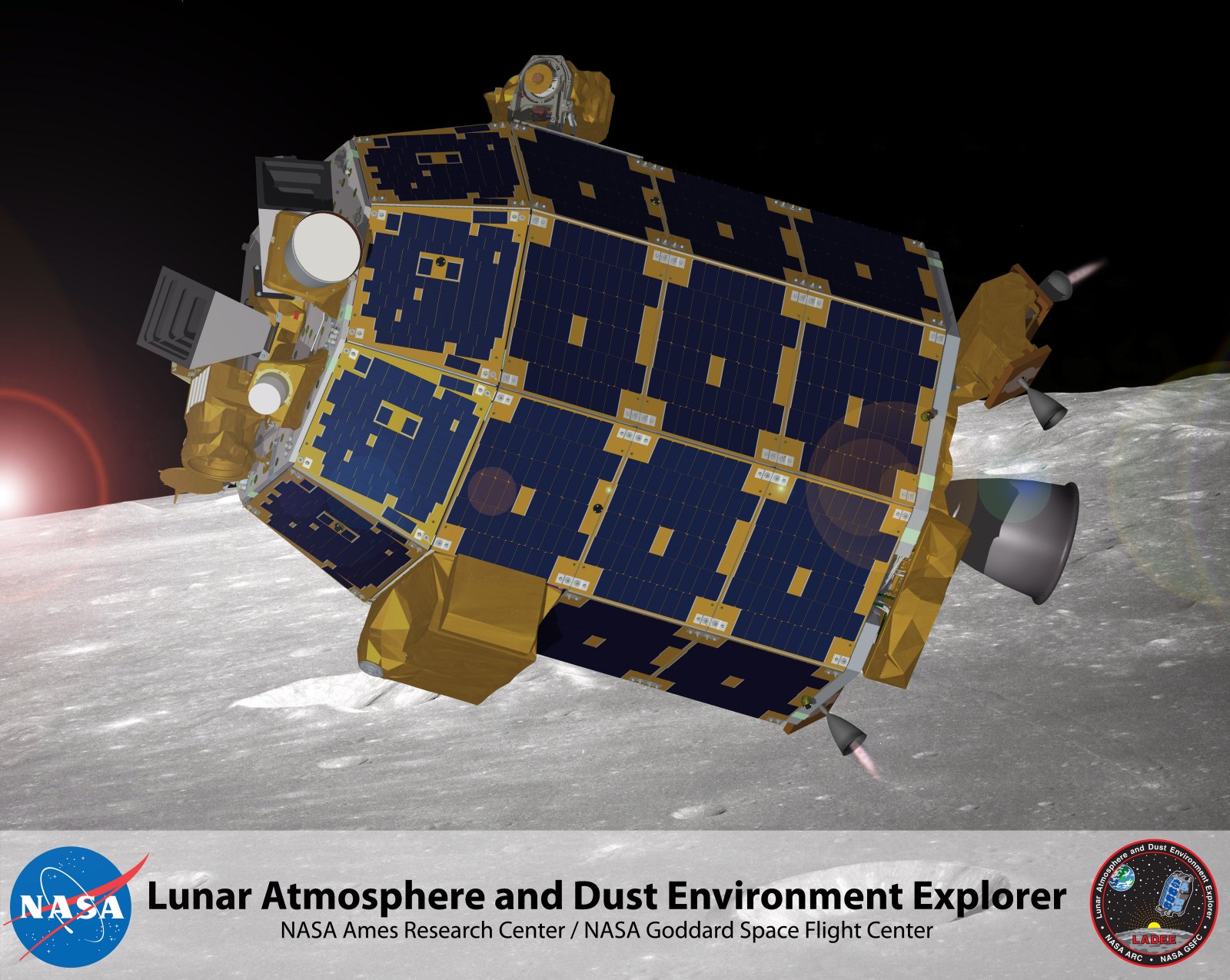
Idealized view of LADEE, last of the Constellation 'precursors,' in lunar orbit [NASA/ARC].
Steve Nerlich
AmericaSpace.com

The Lunar Atmosphere and Dust Environment Explorer (LADEE) is due for launch in September 2013 from the Mid-Atlantic Regional Spaceport. LADEE will study the composition and structure of the tenuous lunar atmosphere, including dust that may be lofted up from the surface. It will also undertake a demonstration of a laser-mediated communications system.

In a thick atmosphere like Earth’s, particles are constantly colliding with each other and hence moving in random and frequently-changing directions. The Moon is thought to have a surface boundary exosphere, which is a thin, collision-free atmosphere in which particles follow largely uninterrupted paths.

A key goal of the LADEE mission is to understand the dynamics of a surface boundary exosphere and how it changes over time, as external conditions vary. A surface boundary exosphere is probably the most common atmosphere found around celestial bodies in the Solar System, including Mercury, the majority of the large asteroids, the moons around our major planets, and the majority of large Kuiper Belt Objects. So, getting a better understanding of the Moon’s surface boundary exosphere is a good start to understanding those environments as well.

Indeed, there is a certain imperative to undertake this research now. The increasing interest in the Moon by a number of nations will lead to a steadily increasing frequency of lunar exploration missions that could change the natural composition of the lunar atmosphere, both through the stirring up of surface dust and by the addition of rocket exhaust components.

Read the article at AmericaSpace.com, HERE.

Related Posts:

Monday, January 21, 2013

The Mona Lisa test for LADEE communications


The laser communications link between Goddard Space Flight Center and the Lunar Reconnaissance Orbiter (LRO) is already a record-breaker. More information has been returned to Earth from LRO through the high-capacity of laser light than all other deep space missions combined.

Later this year, the last of the original Constellation unmanned precursor missions, NASA's Lunar Atmosphere and Dust Environment Explorer (LADEE) will be launched from Wallops Island. The success of this small but advanced lunar atmosphere explorer will depend on its laser link. It's integral to its efficient mission design.

As a demonstration and test of that link, NASA recently put its nearly four year old laser link with LRO through its paces, beaming up and returning a facsimile of Leonard da Vinci's Mona Lisa.

Monday, February 15, 2010

In Virginia, NASA 'new direction' could lift local space assets

Sample ballistic Ranges of the Mid-Atlantic Regional Spaceport (MARS) adjacent to NASA facilities at Wallops Island, on the Atlantic and within Virginia's portion of the Delmarva Peninsula. Headquarters for Orbital Sciences Corporation, Wallops Island is set to become one of two points of origin for ATV cargo resupply missions to the International Space Station [NASA].

Michael Schwartz
Excerpted from the Virginia Pilot

The decision to forgo, at least temporarily, manned trips to the moon and beyond will have a direct impact on NASA Langley in Hampton. The research facility was involved in several areas of the Constellation program.

According to Keith Henry, NASA Langley spokesman, about 300 service employees and 80 contractors have been working at NASA Langley on the Constellation program. Of NASA Langley's $750 million annual budget, about $65 million was funding for Constellation, Henry said.

Closing the door on Constellation will provide opportunities in many other space-related areas. In fact, as many other departments will see cuts, the president has proposed that NASA receive $19 billion in 2011 and a total of about $5 billion through 2015, all to be used to transform NASA into a more efficient organization.

Perhaps most promising from a local economic development perspective is the administration's call for increased reliance on commercial industry to help NASA get to space.

The Virginia Commercial Space Flight Authority and its Mid-Atlantic Regional Spaceport on Wallops Island on the Eastern Shore all of a sudden are in the right place at the right time.

Excerpted from the full article, HERE.

Sunday, February 14, 2010

Pro & Con: The Final Frontier of Profit?

Artist's representation of a scheduled 2011 launch of the Taurus II, a booster built and operated by Orbital Sciences, from Wallops Island. A year ago, together with SpaceX, the Virginia-based Orbital divided a NASA contract to fly twenty unmanned resupply missions to the International Space Station through mid-2015. In June 2009 Orbital contracted with Thales Alenia in a $250 million deal to design and build the pressurized modules for Orbital's ATV "Cygnus."

From The Wall Street Journal, a debate on the pros and cons of commercializing the cosmos:

The Case Against Private Space

Taylor Dinerman

"President Barack Obama's proposed plan for NASA bets that the private sector—small, entrepreneurial firms as well as traditional aerospace companies—can safely carry the burden of flying U.S. astronauts into space at a fraction of the former price. The main idea: to spend $6 billion over the next five years to help develop new commercial spacecraft capable of carrying humans.

"The private sector simply is not up for the job."

Continued, HERE.

The Case for Private Space

Peter Diamandis


"Government agencies have dominated space exploration for three decades. But in a new plan unveiled in President Barack Obama's 2011 budget earlier this month, a new player has taken center stage: American capitalism and entrepreneurship. The plan lays the foundation for the future Google, Cisco and Apple of space to be born, drive job creation and open the cosmos for the rest of us."

Continued, HERE.

Sunday, August 9, 2009

Orbital discusses 2011 Taurus II launch plans with Wallops Island community

Notional launch of Orbital Taurus II Medium-Class Launch Vehicle, now rescheduled for Spring 2011, from Wallops Island, Virginia's Mid-Atlantic Spaceport. (Orbital Sciences Corporation Taurus II Fact Sheet)

Carol Vaughn
Staff Writer
Delmarvanow.com

Accomac - Orbital Sciences Corp. launch site manager Norm Bobczynski appeared before the Accomack County Board of Supervisors for the first time Wednesday to update the county about progress on Orbital's Taurus II rocket project at Wallops Island.

Bobczynski, a Norfolk native, has worked for decades in the space industry, including in the Atlas rocket program and most recently for Orbital's competitor SpaceX. He began work at Orbital in June 2008, the same week the company committed to using Wallops Island as the launch site for its Taurus II rocket, which will carry cargo to the International Space Station in eight contracted missions between 2011 and 2015.

An initial demonstration flight previously scheduled for December 2010 is now expected to happen in spring 2011.

Bobczynski said the company has the capability to launch more than those missions NASA has contracted for and expects to get more business from the Department of Defense and other commercial missions after it completes an initial launch of Taurus II successfully.

"It is important to Orbital Sciences Corp. to have a good working relationship with the community," Bobczynski said, adding that the company hopes to provide good jobs in the future.

Read the full article HERE.

Thursday, July 9, 2009

MLAS test a success


After delays reported June 13, a first test of Northrop's Manned Launch Abort System (MLAS) was reported to have been a success. NASA conducted the unpiloted MLAS test July 8 at Wallops Island.

Unlike the Orion escape system - which has a single launch abort motor in a tower positioned above the Orion Crew Module, the MLAS concept would have four or more rocket motors attached inside a bullet-shaped composite fairing.

Both systems are designed to propel the crew module and fairing from an Ares I rocket in the event of a launch emergency.
Read a report HERE.

Sunday, July 5, 2009

Wallops "KSC North"

Wallops Island, along with White Sands and Edwards, home of America's official rocketry beginning in 1946 when U.S. Navy moved it home-grown sea-launched guided missile program away from Topsail Island in North Carolina. Advances in rocket efficiencies and the rise of commercial space have witnessed the return of orbital missions originating here, hundreds of miles farther from the equator than Cape Canaveral. The facility has been the site of NASA's sub-orbital sounding rocket program for fifty years. Orbital Sciences has facilities here, with other companies on the way, urged on by a strong state-incentives investment by Virginia and the Commonwealth's Mid-Atlantic Spaceport.

History gets warped, a little, in the headline from the story in Sunday's Baltimore Sun, referring to the older facility on Virginia's small part of the Delmarva peninsula Eastern Shore as "The Cape Kennedy of the North" when KSC would more properly be called "Wallops Island South."

Paul West of the Sun looks close by and joins in rediscovering the sudden growth in interest in Wallops Island.

Wallops Island, Va. — - There isn't much to see yet at the grandly named Mid-Atlantic Regional Spaceport, just the skeleton of an old launch gantry on a piece of oceanfront leased from the federal government.

But promoters expect something remarkable to blossom on this sun-baked spit of sand and scrub on the Eastern Shore.

David Smith, a state official from Virginia, which joined with Maryland six years ago to operate a commercial spaceflight center with the lofty acronym MARS, says the area is on track to become "the Cape Canaveral of the North."

For now, though, it's the Wal-Mart of spaceports.

"They can do more with a dollar than anyone else within NASA," said Robert Strain, director of the National Aeronautics and Space Administration's Goddard Space Flight Center, which operates the Wallops Flight Facility where MARS is based.

The facility operates out of a one-room former gas station on NASA property, not far from a busy highway that takes beach-bound visitors to the southern end of Assateague Island. It employs six people.

Spaceport officials like to tout their cut-rate location, a barrier island just off the Delmarva Peninsula. From here, they say, it's a shorter shot to the orbiting International Space Station, which means lower bills for rocket fuel. Insurance is cheaper, too, since flights go almost entirely over water (trajectories from Florida cross Europe and the Middle East).

MARS' new $10 million rocket assembly building, soon to go up near a new launch pad, is so modestly sized that 50 of them could fit into the Kennedy Space Center's Vehicle Assembly Building in Florida with room to spare. The Mid-Atlantic spaceport's sole rocket provider fashions launch vehicles, in part, from fuel tanks and engines developed for intercontinental ballistic missiles by the United States and its Soviet bloc adversaries and decommissioned after the Cold War.

"These guys have to live by their wits," Strain said, getting work wherever they can. "It keeps them more clever."

A flourishing space complex on the Maryland-Virginia coast remains a shaky prospect in a time of economic recession, tight budgets and uncertainty about the next stage of America's human space flight program. But events over the past year, which have drawn little attention outside the space industry and the local community, have nudged the future closer.

Already, the Wallops facility, about 10 miles south of the Maryland-Virginia line and less than a three-hour drive from Baltimore, is stealing business and jobs from Cape Canaveral.

Supply missions to the space station are in the works. A first-ever moon shot, yet to be publicly announced, is planned for less than three years from now.

Local boosters expect repeat invasions of space enthusiasts, lured by the thunderous spectacle of the largest rockets ever launched on the Atlantic coast outside Florida.

A trigger for all this was NASA's selection of Orbital Sciences Corp., a Washington-area space technology company, for a private-public partnership to ferry cargo to the space station. The supply flights are needed to fill a gap after the U.S. space shuttle program ends next year.

As early as next month, MARS will start constructing a launch pad for Orbital's new Taurus II rocket, designed to carry an unmanned craft into orbit 200 miles above the Earth for a rendezvous with the space station and its human crew. The target date for the first flight is less than two years away, with a total of eight resupply missions planned through 2015.

Sen. Barbara A. Mikulski, a Maryland Democrat whose patronage has been crucial to the spaceport's development, said the project will generate hundreds of jobs in an area that has suffered from the collapse of housing markets in Ocean City and other nearby towns.

NASA awarded a $1.9 billion federal contract to Orbital in December, and the company is investing an initial $150 million in private funds. The project employs hundreds of people at Orbital's facility in Greenbelt, where its Cygnus cargo craft is being developed, in addition to the new work at Wallops.

"This is aimed at developing Wallops into the first rank of major, international space launch sites to serve both government and commercial customers," said David W. Thompson, chairman of Orbital, currently the spaceport's only customer for rocket launches, including some under contract with the Air Force.

Similar claims, over the past 15 years, turned out to be pie in the sky. But if the spaceport has truly turned a corner, it could transform the country's oldest operating launch site, which NASA shares with the Virginia Commercial Space Flight Authority, the independent agency that owns MARS.

Sixty-four years ago this weekend, on July 4, 1945, scientists launched the first small rocket from this low-lying coastal island, whose tantalizing curve of sandy beach has eroded badly over the years. But Wallops never built the capacity to launch large rockets, and there were proposals to shut the NASA facility down in the early 1990s, when budgets got squeezed.

Read the balance of the Article HERE.

Saturday, June 13, 2009

MLAS test at Wallops delayed

"A Test launch of the Max Launch Abort System (MLAS) from NASA Wallops is delayed until "no earlier than June 20."

"The alternate escape system, called Max Launch Abort System (MLAS), is a risk mitigation effort on behalf of Orion. MLAS was named after Maxime (Max) Faget, a Mercury-era pioneer. Faget was the designer of the Project Mercury Capsule and holder of the patent for the "Aerial Capsule Emergency Separation Device," which is commonly known as the escape tower."

A Closer Look at MLAS at SpaceRef.com

Tuesday, April 14, 2009

LADEE launch by Orbital from Wallops Island

UPDATED: 0240 14 April (ZULU)
Buzz is running high saying Virginia and Wallops Island will host the launching in 2011 of an important part of NASA's Lunar Precursor Robotics program, the Lunar Atmosphere and Dust Environment Explorer (LADEE).

The mission remains listed on the NASA Science Directorate's website as still "under study" but its mission, along with the International Lunar Network, are considered vital follow-up missions to the Lunar Reconnaissance Orbiter and LCROSS now impactor scheduled for launch on the same booster in early June.

The LADEE Science Definition Team made a report on the goals of the mission in May 2008 to NASA's Science Directorate, recommending the NASA launch LADEE as a single payload with less weight restrictions.

Out-year budget planning has been moving up fast, but preliminary designs called for LADEE to share a its ride with GRAIL, the mission to map the Moon's lumpy gravity field. The LADEE Science Definition Team made a strong case, however, for LADEE being most likely to succeed in its sensitive science mission if constructed slightly outside the weight restrictions needed to share its Atlas-Centaur with GRAIL.

Today's news has also fueled a rumor that data returned over the past year by Japan's Kaguya sub-satellite gravity survey may have made JPL's GRAIL mission unnecessary.

Understanding the dynamics of the Moon's dusty exosphere, believed to consist of a solar-charge-driven and levitated wave of exceedingly fine sub-micron-sized dust particles thought to continuously following the Moon's terminator, and acted upon further by the Moon's monthly encounter with the Earth's magnetic field, is considered to be a very important "early" mission.

Lunar Dust mitigation and study by NASA has been rated most highly in follow-up assessment s of agency's progress in returning to the Moon, but also lacking needed progress. Just one difficulty in discovering the true dynamics of the dusty lunar exosphere is sensitive instrumentation. Theory has exceeded intrumentation. Though it is believed some charged dust is levitated on ballistic paths higher than 100 kilometers, such particles are microscopic.

The Science Definition Team has set a course for LADEE that coincides with the complex positioning needed to sense dust in motion, but the planning is almost based entirely on theory. The best data the mission is built upon are observations made prior to orbital sunrise during the Apollo Era, a solar wind experiment showing instead fast moving "winds" of dust performed on the surface and famous nighttime photographs of horizon glow returned by Surveyor 7 forty years ago.

Mitigating the hazards to personnel and equipment presented by the presence, apparently everywhere on the surface of the Moon, of lunar dust has made the 140 kilo LADEE mission important "before extended human activity" on the Moon can begin, according to the Science Definition Team chair Laurie Leshin of NASA Goddard.

The National Academy of Sciences influential "Scientific Context for the Exploration of the Moon (2007)" cited the unknown hazards to explorers, well-remembered by the Apollo pioneers, and also a need to study the lunar exosphere "while still in a relatively pristine state."

Assessing conditions on the surface has always presented an unexpected set of frustrations in the history of lunar exploration. In November 1969 Pete Conrad and Alan Bean landed roughtly 170 meters from the landing site of Surveyor 3, southwest of Copernicus. Retrieval and careful study on Earth of artifacts from the robotic lander revealed most, if not all weathering that could be discovered after more than 20 months on the lunar surface had been the result of the arrival of Apollo 12.

It is now generally accepted that the original decompression of the Apollo 11 Lunar Module Eagle added around 5 percent to the total gaseous element of the lunar exosphere. The arrival (and departure) of all powered soft landings on the Moon are now known to have propelled at least some microscopic dust to escape velocities.

The choice of Wallops Island adds to a rich history as an original home for America's Atlantic Missile Range, prior to the move to Cape Canaveral fifty years ago. NASA's facility on Virginia's Eastern Shore has been home since then to almost continuous sub-orbital sounding rocket experiments, to study, among other things, dynamics of Earth's atmosphere.

Like California, Florida, New Mexico and elsewhere Virginia's state government has been enacting tax breaks and doing what it can to attract future sub-orbital space tourism and commercial launch work to the Eastern Shore.

The Mid-Atlantic Regional Spaceport, immediately adjacent to Wallops Island, is part of a tax break and incentives-driven commitment that has drawn, and its most famous tenant Orbital Sciences Corporation.

NASA recently announced its robotic ATV ISS orbiting resupply program will be a publicly-funded private affair, awarding eight ISS resupply missions to Orbital Sciences' Cygnus ATV and twelve to the SpaceX Dragon, totaling twenty ATV ISS resupply flights after the retirement of the Space Shuttle in late 2010.

While SpaceX, on its fourth attempt, managed to orbit a small payload from Kwajalein, near the equator, and is readying its heavier Falcon 9 booster for a test flight from Kennedy Space Center, Orbital Science has yet to launch its five stage Minotaur V booster. Nevertheless, using boosters like the L-1011 wing-launched Pegasus, Orbital has launched 55 payloads into orbit since 1990.

Saturday, August 23, 2008

NASA and ATK Investigate Failed Launch Of Hypersonic Experiments

WALLOPS ISLAND -- An Alliant Techsystems suborbital rocket carrying two NASA hypersonic experiments was destroyed by range safety officials shortly after liftoff from NASA's Wallops Flight Facility in Virginia Friday. No injuries or property damage were reported.

Most debris from the rocket is thought to have fallen in the Atlantic Ocean. However, there are conflicting reports of debris being sighted on land. This debris could be hazardous. People who think they may have encountered rocket debris are advised not to touch it and to report it to the Wallops Emergency Operations Center at 757-824-1300.

NASA is very disappointed in this failure but has directed its focus on protecting public safety and conducting a routine confirmation of the effectiveness of its range safety operations. NASA has a response team in the field. Alliant Techsystems, also known as ATK, of Salt Lake City, is conducting the investigation of the rocket malfunction. NASA will consult with ATK and support the investigation.

The exact launch time was 5:10 a.m. EDT. The anomaly that caused the failure occurred approximately 27 seconds into flight and is not known.