
 |
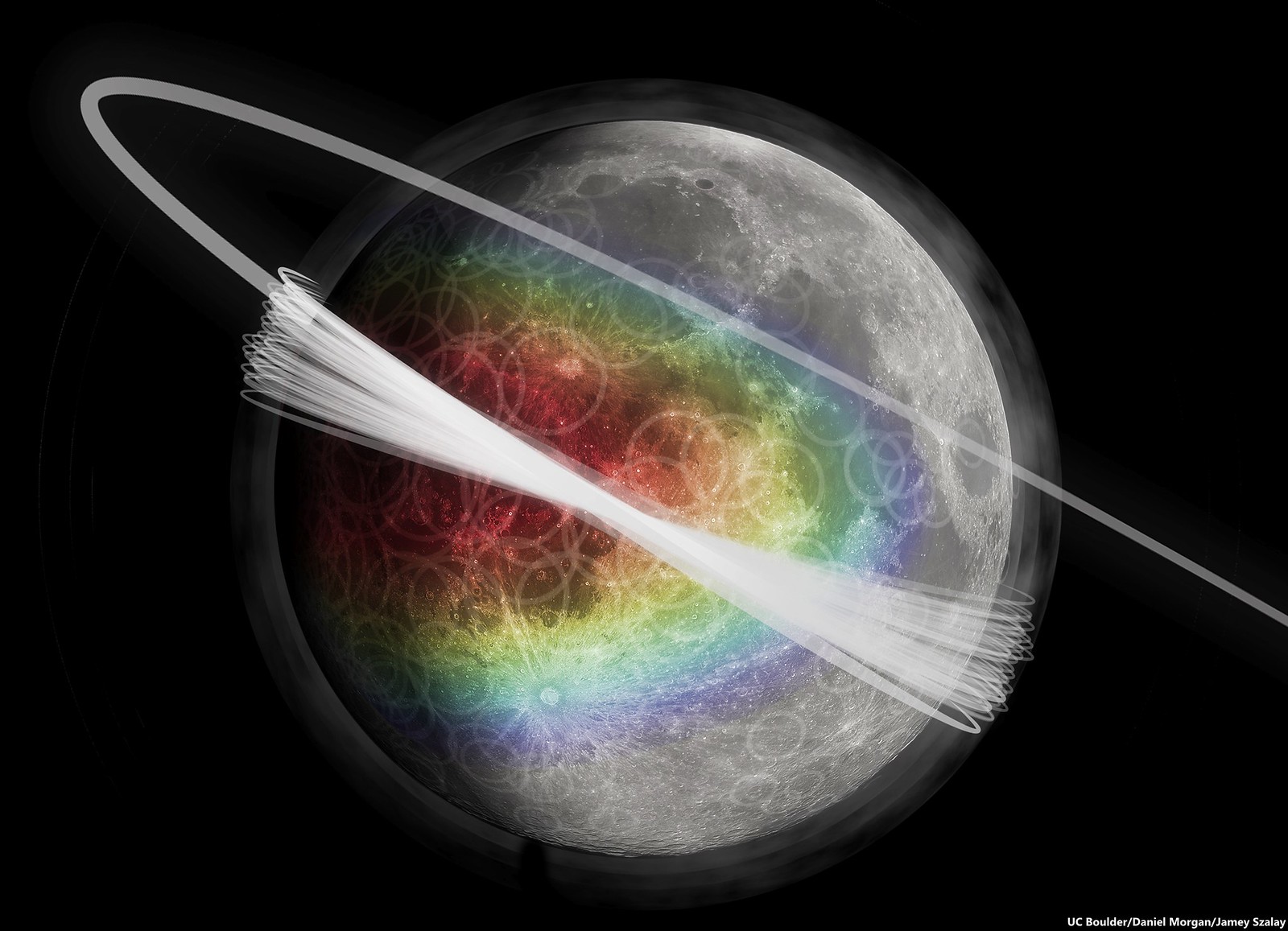
| Artist's conception of the lunar dust exosphere surrounding the moon. The color represents the amount of material ejected from the surface, showing a peak in the apex direction. A haze of dust is shown around the moon. Gray faded circles are overlaid on the lunar surface to represent the random nature of the primary impactors. An artist's conception of the LADEE orbital inclination is also shown [UC Boulder/Daniel Morgan/Jamey Szalay]. |
Darryl Waller
Sharon Lozano
NASA Ames
New science results from NASA’s LADEE mission (Lunar Atmosphere and Dust Environment Explorer) indicate the Moon is regularly engulfed in a permanent, but lopsided and transitory, dust cloud increasing in density during encounters with cometary debris, like those producing the Geminids, according to a new study led by University of Colorado Boulder.
"Knowledge about the dusty environments in space has practical applications," said CU-Boulder physics Professor Mihály Horányi. "Knowing where the dust is and where it is headed in the solar system could help mitigate hazards for future human exploration, including dust particles damaging spacecraft or harming astronauts."
The cloud was discovered using data from a detector on board LADEE called the Lunar Dust Experiment (LDEX) designed and built by CU-Boulder. LDEX charted more than 140,000 impacts during the six-month survey launched in September 2013. NASA’s Ames Research Center in Moffett Field, California was responsible for spacecraft design, development, testing and mission operations.
“The LDEX team has been painstakingly analyzing their data since the LADEE mission ended on April 18, 2014,” said LADEE project scientist at Ames, Rick Elphic. “Their results answer one of the big LADEE science questions: is there a dust component to the tenuous lunar atmosphere? And if so, why is it there?”
According to Horányi, the cloud is primarily made up of tiny dust grains kicked up from the moon’s surface by the impact of high-speed, interplanetary dust particles. A single dust particle from a comet striking the moon’s surface lofts thousands of smaller dust specks into the airless environment, and the lunar cloud is maintained by this sometimes predictable process of regolith "gardening."
“Identifying this permanent dust cloud engulfing the moon was a nice gift from this mission,” said Horányi, the principal investigator for the LDEX instrument and lead author of the study. “We can carry these findings over to studies of other airless bodies, like the moons of other planets and the asteroids.”
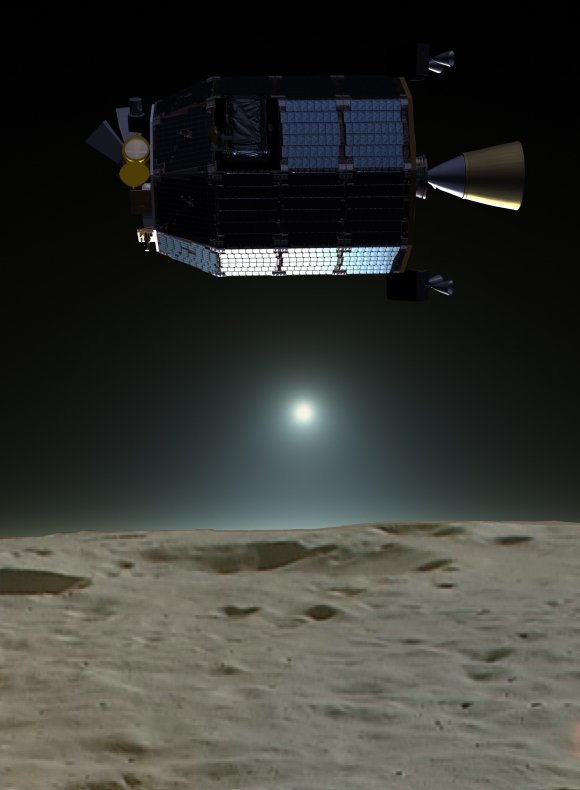 |
| Artist's composite showing LADEE spacecraft in close orbit [NASA/JAXA/LP]. |
The first hints of a cloud of dust around the moon came in the late 1960s when cameras functioning overnight aboard the unmanned moon lander Surveyor 7 captured bright glow hours ahead of lunar sunrise. Not long after astronauts in lunar orbit described a significant glow above the lunar surface when approaching sunrise, phenomenon brighter than the sun by itself should have been able to produce over a body with only a trace, essentially non-existent, atmosphere.
Because these new findings do not square with the Apollo reports of a thicker, higher dust cloud, conditions back then may have been somewhat different. The dust on the moon -- which is dark and sticky and regularly dirtied the suits of moonwalking astronauts -- was created over several billion years as interplanetary dust particles incessantly pounded the rocky lunar surface.
 |
| Apollo 17 commander Gene Cernan's sketches and description of horizon glow and streamers observed in lunar orbit in December 1972 [NASA]. |
Related LADEE Posts:
LADEE impact crater found (October 29, 2014)
First Science from LADEE (45th LPSC, March 18 2014)
LADEE's (star tracker) images of the Moon (February 14, 2014)
LADEE economy adds 28 days to mission (February 5, 2014)
LROC captures LADEE from 9,000 meters (January 30, 2014)
Red Moon, Blue Moon Dwayne Day, The Space Review (December 3, 2013)
LADEE begins collecting data (November 22, 2013)
LADEE transitioning out of commissioning phase (November 6, 2013)
Apollo 12 ALSEP first to measure dust accumulation (November 21, 2013)
Chang'e-3 & LADEE: The Role of Serendipity (October 31, 2013)
LADEE LLCD sets new data record (October 25, 2013)
Measuring almost nothing, looking for the almost invisible (October 16, 2013)
LADEE legacies (September 7, 2013)
LADEE Prelaunch Mission Briefing (September 6, 2013)
ESA prepares for LADEE (July 31, 2013)
LADEE arrives at Wallops Island (June 5, 2013)
LADEE ready to baseline dusty lunar exosphere (June 5, 2013)
First laser comm system ready for launch on LADEE (March 16, 2013)
LADEE project manager update (February 6, 2013)
The Mona Lisa test for LADEE communications (January 21, 2013)
Toxicity of lunar dust (July 2, 2012)
Expectations for the LADEE LDEX (March 23, 2012)
The Dust Management Project (August 9, 2010)
LADEE architecture and mission design (July 6, 2010)
DesertRatS testing electrodynamic dust shield (July 5, 2010)
Dust transport and its importance in the origin of lunar swirls (February 21, 2010)
Dust accumulation on Apollo laser reflectors may indicate a surprisingly fast and
more dynamic lunar exosphere (February 16, 2010)
NASA applies low cost lessons to LADEE (January 18, 2010)
Nanotech advances in lunar dust mitigation (August 19, 2009)
Moon dust hazard influenced by Sun's elevation (April 17, 2009)
LADEE launch by Orbital from Wallops Island (April 14, 2009)
Understanding the activation and solution properties of lunar dust
for future lunar habitation (March 2, 2009)
Respiratory toxicity of lunar highland dust (January 19, 2009)
Toxicological effects of moon dust (June 25, 2008)
Moon dust and duct tape (April 22, 2008)
LADEE impact crater found (October 29, 2014)
First Science from LADEE (45th LPSC, March 18 2014)
LADEE's (star tracker) images of the Moon (February 14, 2014)
LADEE economy adds 28 days to mission (February 5, 2014)
LROC captures LADEE from 9,000 meters (January 30, 2014)
Red Moon, Blue Moon Dwayne Day, The Space Review (December 3, 2013)
LADEE begins collecting data (November 22, 2013)
LADEE transitioning out of commissioning phase (November 6, 2013)
Apollo 12 ALSEP first to measure dust accumulation (November 21, 2013)
Chang'e-3 & LADEE: The Role of Serendipity (October 31, 2013)
LADEE LLCD sets new data record (October 25, 2013)
Measuring almost nothing, looking for the almost invisible (October 16, 2013)
LADEE legacies (September 7, 2013)
LADEE Prelaunch Mission Briefing (September 6, 2013)
ESA prepares for LADEE (July 31, 2013)
LADEE arrives at Wallops Island (June 5, 2013)
LADEE ready to baseline dusty lunar exosphere (June 5, 2013)
First laser comm system ready for launch on LADEE (March 16, 2013)
LADEE project manager update (February 6, 2013)
The Mona Lisa test for LADEE communications (January 21, 2013)
Toxicity of lunar dust (July 2, 2012)
Expectations for the LADEE LDEX (March 23, 2012)
The Dust Management Project (August 9, 2010)
LADEE architecture and mission design (July 6, 2010)
DesertRatS testing electrodynamic dust shield (July 5, 2010)
Dust transport and its importance in the origin of lunar swirls (February 21, 2010)
Dust accumulation on Apollo laser reflectors may indicate a surprisingly fast and
more dynamic lunar exosphere (February 16, 2010)
NASA applies low cost lessons to LADEE (January 18, 2010)
Nanotech advances in lunar dust mitigation (August 19, 2009)
Moon dust hazard influenced by Sun's elevation (April 17, 2009)
LADEE launch by Orbital from Wallops Island (April 14, 2009)
Understanding the activation and solution properties of lunar dust
for future lunar habitation (March 2, 2009)
Respiratory toxicity of lunar highland dust (January 19, 2009)
Toxicological effects of moon dust (June 25, 2008)
Moon dust and duct tape (April 22, 2008)


