Showing posts with label Russia. Show all posts

Thursday, December 11, 2014

ESA to explore lunar probe partnership with Russia

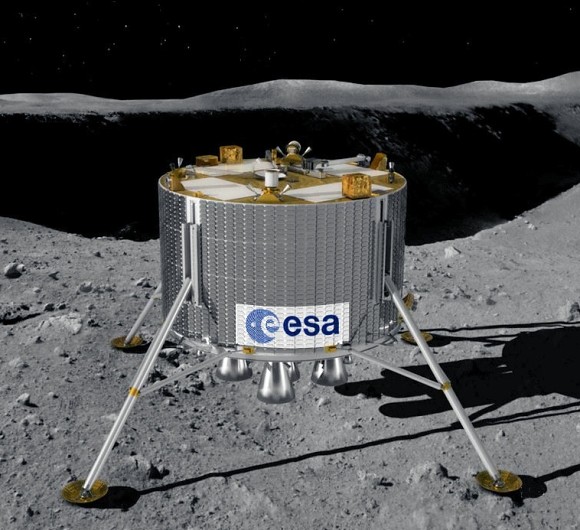
Ten years after planning got underway to place an ESA lander on the rim of Shackleton crater, the design of the MoonNEXT probe was improved by development of the ESA's ATV resupply ship. Still the program was scrapped. But, even as tensions continue between European Union  partners and Russia, ESA's managers have agreed to investigate joining forces with Roscosmos in Russia's lunar program, forestalled by loss of partnership with India, the problem-plagued Fregat vehicle and tight budgets [ESA/Astrium].
Elizabeth Gibney
NATURE

Science ministers in Europe have resurrected plans to explore the Moon’s surface — and the only strategy currently on the table is to join two uncrewed Russian missions. The developments, which follow the shelving of a proposed European Space Agency (ESA) Moon lander two years ago, come amid growing political tensions between Russia and Western nations.

On 2 December, at a meeting in Luxembourg to determine ESA’s policy, the space agency got the go-ahead and funding to investigate “participation in robotic missions for the exploration of the Moon”. Science ministers from the ESA member states did not approve collaboration with Russia specifically, but at the meeting, ESA scientists presented a proposal to join Russia on its missions to put a lander and a rover on the Moon’s south pole.

Money for lunar exploration will come from a pot of €800 million (US$980 million) contributed by ESA’s member states and dedicated to international space exploration; the pot will primarily pay for activities on the International Space Station and the development of a propulsion module for NASA’s Orion spacecraft, which is eventually designed to carry astronauts to deep space, and was tested on 5 December in an uncrewed space flight.

"There be dragons here," no longer applies to the Moon's nearly always, or permanently, shadowed areas at polar latitudes. The Vision for Space Exploration, before it also was scrapped, developed inertia for a brief second golden age of lunar exploration, and it prioritized scientific goals there.

Above, the state of our knowledge about the Moon's south pole in 1994 is compared with where this knowledge base stands today, illustrating one vast improvement in our understanding of the Moon gained at low cost and with great efficiency
 
[NASA/GSFC/JPL/DOD/USGS/Caltech/Arizona State University].
In the 45 years since astronauts first walked on the Moon, no European country or space agency has launched a mission to the Moon’s surface. And no lander or astronaut has been to the lunar south pole, a region thought to contain ice and thus deemed a probable spot for any future permanent lunar base. A 12-kilometre-deep crater there might provide access to material from the Moon’s interior, also making it attractive for scientific study, says Ian Crawford, a lunar scientist at Birkbeck, University of London. The ancient material could reveal details of the collision between a Mars-sized planet and early Earth that is thought to have produced the Moon. “The idea that we've ‘been there and done that’ did last for a long time, but that’s gone away now,” says Crawford. “The Moon still has a lot to tell us.”

Read the full article at NATURE, HERE.

Saturday, November 1, 2014

Lunar exploration will reduce shortage of rare earths

The store of our knowledge of the Moon grew exponentially in the wake of America's brief but still lingering commitment to the Vision for Space Exploration (2004-2009), without which the LCROSS, LRO, LADEE and GRAIL missions would not have been funded.
A planned Russian return to the lunar
surface may benefit from a post-
Fobos-Grunt shakeout.
Aram Ter-Ghazaryan
Special to Russia Beyond the Headlines

As part of the Federal Space Program, Moon exploration operations will be launched in 2016. In 2018 the first spacecraft will be sent to the Moon to deliver comet material back to Earth. 

A manned flight is scheduled for 2030-2031. Future plans include the mining of rare earth metals required for the development of high-tech industries.

Scientists from the Russian Academy of Sciences, the Moscow State University Sternberg Astronomical Institute and the Russian Federal Space Agency are participating in this Moon exploration project.

The first spacecraft to be sent to the Moon will be relatively simple. According to Vladislav Shevchenko, the Sternberg Institute’s Head of the Department of Lunar and Planetary Research, this is because the Russian space program has not carried out a Moon landing for over 40 years.

“The last Luna-24 launch was carried out in 1976. The current spacecraft, Luna-25, is a lot lighter than its predecessor, as its main mission is to bring back ice from the lunar south pole,” Shevchenko said. According to him, the south pole was chosen because according to satellite data, it houses the largest reserves of frozen volatile gases found in comets.

Read the full article at Russia Beyond the Headlines, HERE.

The last direct sample of the Moon returned to Earth was retrieved by the Soviet Union's Luna 24 robotic lander on August 18, 1976 (in total darkness). The vehicle landed on the rim of this 64 meter-wide crater on the southeastern plains of Mare Crisium (12.717°N, 62.222°E) and the Lunar Reconnaissance Orbiter (LRO) LROC Narrow Angle Cameras (NAC) imaged the lander's descent stage (lower left) on November 2, 2011, from only 25.57 km overhead. LROC NAC M174868307L, LRO orbit 10904, resolution 43 cm per pixel [NASA/GSFC/Arizona State University].

Tuesday, December 17, 2013

Rogozin renews call for Russian lunar exploration, base

Luna-Grunt - Rover Configuration
Russia's space program suffered a huge set back to a renewed lunar exploration effort with the loss of the Phobos-Grunt sample return mission in 2011. A joint mission with India designed to ferry the ISRO Chandrayaan-2 lunar rover to the Moon's surface was cancelled and the Grunt standard prototype lander was returned to the drawing board. Above, a 2010 notional view of a Grunt descent stage delivering rover to the Moon [Anatoly Zak/RussianSpaceWeb].
MOSCOW, December 17 (RIA Novosti) – Russia should consider farsighted space projects such as building a manned outpost on the moon, a senior Russian defense official said Tuesday.

“We must formulate practical plans from conceptual projects and fantasies,” said Deputy Prime Minister Dmitry Rogozin, who oversees the defense and space industry.

Rogozin suggested the Russian space agency Roscosmos and the recently launched Future Research Fund (FPI) should work in tandem on developing such projects.

The FPI – patterned on the United States’ Defense Advanced Research Projects Agency – began distributing grants in April to fund farsighted defense projects. The fund will disburse $70 million this year.

“Many organizations are unfortunately stuck in their busy routines and they have no time to stop and think about new projects,” said Rogozin, who made a similar appeal in September last year for a Russian lunar base to reinvigorate the country’s space aspirations.

On Saturday the 140-kilogram Chinese lunar rover Jade Rabbit made the first soft landing of any probe on the moon in nearly four decades. China is the third nation to achieve a soft lunar landing after the US and the Soviet Union.

Related Posts:
A Russian Moon? Dwayne Day, The Space Review (January 28, 2013)
ESA lunar lander axed (November 21, 2012)
Rogozin presses lunar base, Chandrayaan-2 delayed (September 12, 2012)
Soyuz replacement delayed until 2018 - Popovkin (July 19, 2012)
Craters near Lunokhod-1 officially named (July 3, 2012)
Is there money on the Moon?  Joshua E. Keating Foreign Policy (June 21, 2012)
Russian outlines spaceflight plans to 2030 Marcia S. Smith SpacePolicyOnline (April 29, 2012)
Russian Academy plans Lunokhod-3 and 4 (April 9, 2012)
Popovkin: 'To the Moon in Seven Years?' (February 8, 2012)
"Boy, that sure looks like Luna 9!" (December 3, 2011)

Thursday, September 13, 2012

Rogozin presses Russian lunar base, Chandrayaan-2 delayed by Proton and Phobos-Grunt investigations

As Russia’s Deputy Prime Minister Dmitry Rogozin continues to deployment of a manned base lunar base 'by 2020,' ISRO declines comment on Chandrayaan-2 delay 'until 2016' India's follow-up to its successful first lunar orbiter, together with a small remotely operated rover landed on the Moon by a Russian spacecraft had previously been delayed to 2013 and 2013 [ISRO/IKI].
According to Russian and Indian sources, Russian Prime Minister Dmitry Rogozin continues to lobby for  a permanent station on the lunar surface "before 2020," calling it an "over-arching task," a "super goal," or очень задача for the Russian state, "stimulating the development of science and industry."

Reports followed an interview recorded on Vesti FM Radio earlier this month.

“Russian cosmonauts learned to work in orbit and gained needed experience there," Rogozin said. "Why shouldn't they try to build a full-scale lunar base to set the groundwork for further leaps in science?”

Indian press reports have covered the interview in context with little more information than previously known about Russia's planned role in Chandrayaan-2. Indian Space Research Organisation (ISRO) chief K. Radhakrishan recently declined comment on reports that the Chandrayaan-2 lunar orbiter, lander and rover mission will now be unavoidably delayed until 2016.

"For Chandrayaan-2, Russia has to provide the lander, and India will build the lunar orbiter and rover," Radhakrishan said. "Russia has said they would come to us with a decision (regarding their grunt-class Luna-Resurs lander) after their reviews.”

Russia is reviewing their inter-planetary missions in light of recent set-backs, particularly following the November failure of Phobos-Grunt  and, more recently, after the failure of Sino-Russian vehicle that was tied to a faulty Proton booster.

The results of at least one such investigation, into the Proton failure, were reported out September 12, according to Anatoly Zak of RussianSpaceWeb.com.

Chandrayaan-2 had already been delayed until 2014, planned for launch on India's troubled Geosynchronous Satellite Launch Vehicle (GSLV).  Radhakrishnan confirmed ISRO will prepare the booster, the lunar orbiter and rover, but he declined comment on a report from Russia that India’s second lunar mission must be delayed until at least 2016.

Lev Zelyony, head of the Russian Space Research Institute (IKI), said in February the Luna-Resurs lander might not be ready before 2016.

“There were plans to launch the Luna-Glob and Luna-Resurs missions in 2015,” Zelyony told RIA Novosti in February. “But dates may have to be moved, because the NPO Lavochkin-design for the ill-fated Phobos-Grunt vehicle are integral also to Russia's planned unmanned lunar projects and "clearly need to be reviewed.”

Tuesday, July 3, 2012

Craters near Lunokhod-1 officially named

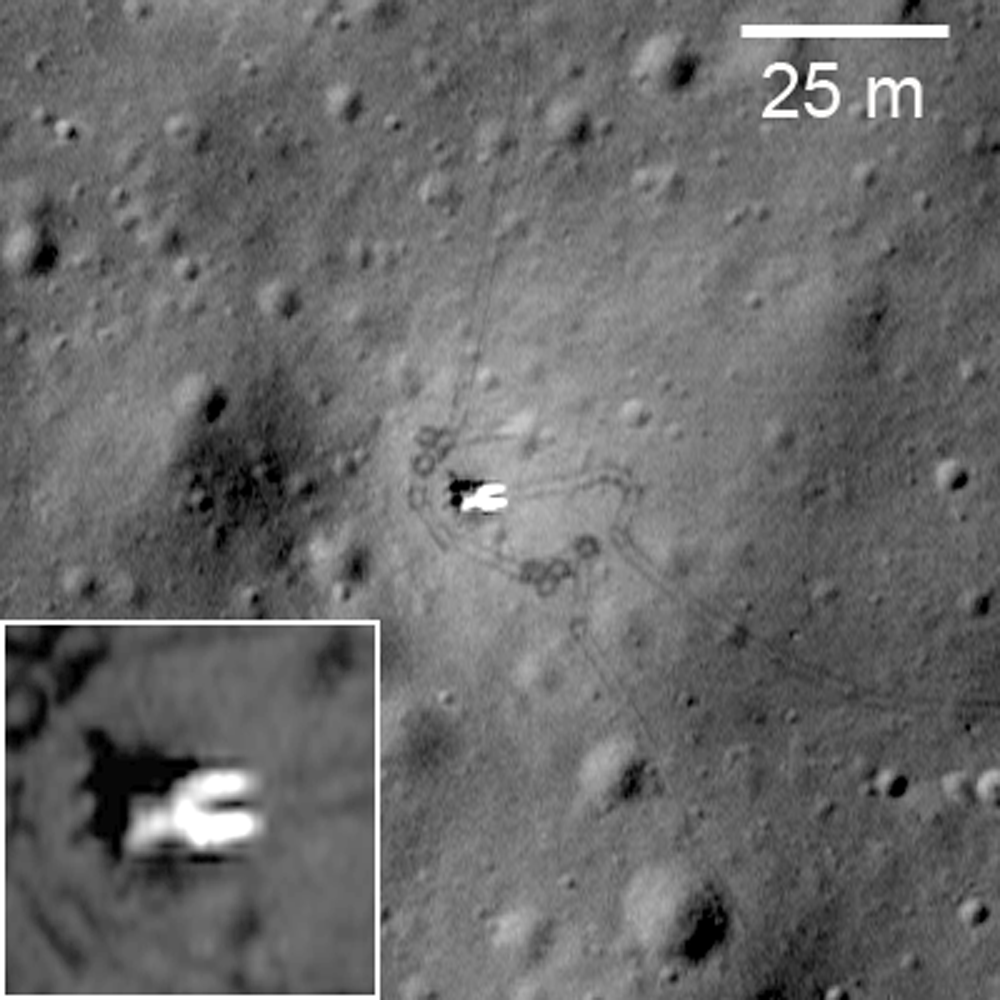
Luna 17, the lander that carried Lunokhod 1 to the surface; debarking ramps for the rover visible extending down to the surface to the right. Many rover tracks are visible around the lander and throughout LROC Narrow Angle Camera (NAC) frame M175502049RE, LRO orbit 10998, November 9, 2011. View the original contextual image with enlarged inset, HERE [NASA/GSFC/Arizona State University].
Olga Zakutnyaya
The Voice of Russia
 

A number of moon craters in the vicinity of Lunokhod–1 lunar rover have been given their own names. They were named in honor of the crew members of the first self-propelled vehicle on the surface of the celestial body.

The experiment carried out more than 40 years ago is to be repeated in the course of “Luna-Resource” expedition which should be launched no earlier than 2015.

The International Astronomical Union has approved 12 new names for small craters on the Moon, and now they have names of the members of the first lunar expedition and scientists who were involved in the project. Despite the fact that these people were not able to walk on the Moon’s surface themselves, they were the ones who led Lunokhod–1 – the first planet rover on the surface of an alien celestial body. All craters are located in the area of the “Sea of Rain” (Mare Imbrium) where the landing vehicle of Luna-17 interplanetary automatic station soft-landed in November 1970. It delivered Lunokhod lunar rover onto the Moon’s surface. All craters are comparatively small, their diameter ranging from 100 to 400 meters.

Thus, the names of Albert, Borya, Gena (in honor of the navigator Gabdulkhai Latypov), Igor, Kolya, Kostya, Leonid, Nikolya, Slava, Valera, Vasya, and Vitya appeared on the Moon.

The Luna-17 spacecraft was built by the design and construction bureau of the machine-engineering plant named after S.A. Lavochkin (now NPO Lavochkin). Lunokhod-1 was equipped with a set of scientific devices to explore the lunar soil. In the course of 10 months that it was working on the Moon, the rover traveled over 10.5 kilometers and sent back to Earth information about the mineral composition and characteristics of the lunar surface.

Lunokhod 1 rover in its final parking place (38.315°N, 324.992°E) on the surface of Mare Imbrium. LROC Narrow Angle Camera (NAC) observation M175502049RE, orbit 10998, November 9, 2011, resolution 33 cm per pixel. View original Featured Image released March 14, 2012 (with enlarged inset) HERE. [NASA/GSFC/Arizona State University].
Lunokhod-1 was controlled remotely via the center for space communications by two crews – five people each who worked in shifts. Each crew consisted of a commander, a driver, a navigator, a flight engineer, and a high gain antenna operator. Thus there were 10 people all together, plus a reserve driver and reserve high gain antenna operator.

Even though by the time Lunokhod-1 was launched American astronauts had already landed on the Moon, the soviet rover was no less a remarkable scientific and technical achievement. Unfortunately, at that time, the meaning of this achievement was overshadowed by the defeat in the race to put a man on the moon. Lunokhod-1, with all its novelty and complexity, was more of a consolation prize. At least that was the general attitude – and analysts might object, of course. Sadly, it was what determined the further development of the lunar program. After the improved version Lunokhod-2 in 1973, there was Lunokhod-3 which never made it to the Moon. As a result, the Lunar Program of the USSR was suspended. Forty years on there has been little progress.

Today it can be said that it was a mistake. Weak consolation might be the fact that space programs in other countries primarily in the United States have also been suspended. However, the comparison might not be accurate – paradoxically as it may sound as though the soviet moon explorations at the end of the “manned moon race” were in a better state (if not financially from the strategic point of view). A continuation of manned expeditions demanded huge resources and clear goals, which probably did not exist at that time. Autonomous expeditions were easier from the point of view of their preparation but brought back much more scientific results. Besides, by that time, complicated initial stages with lots of failures were overcome and so reliability was higher.

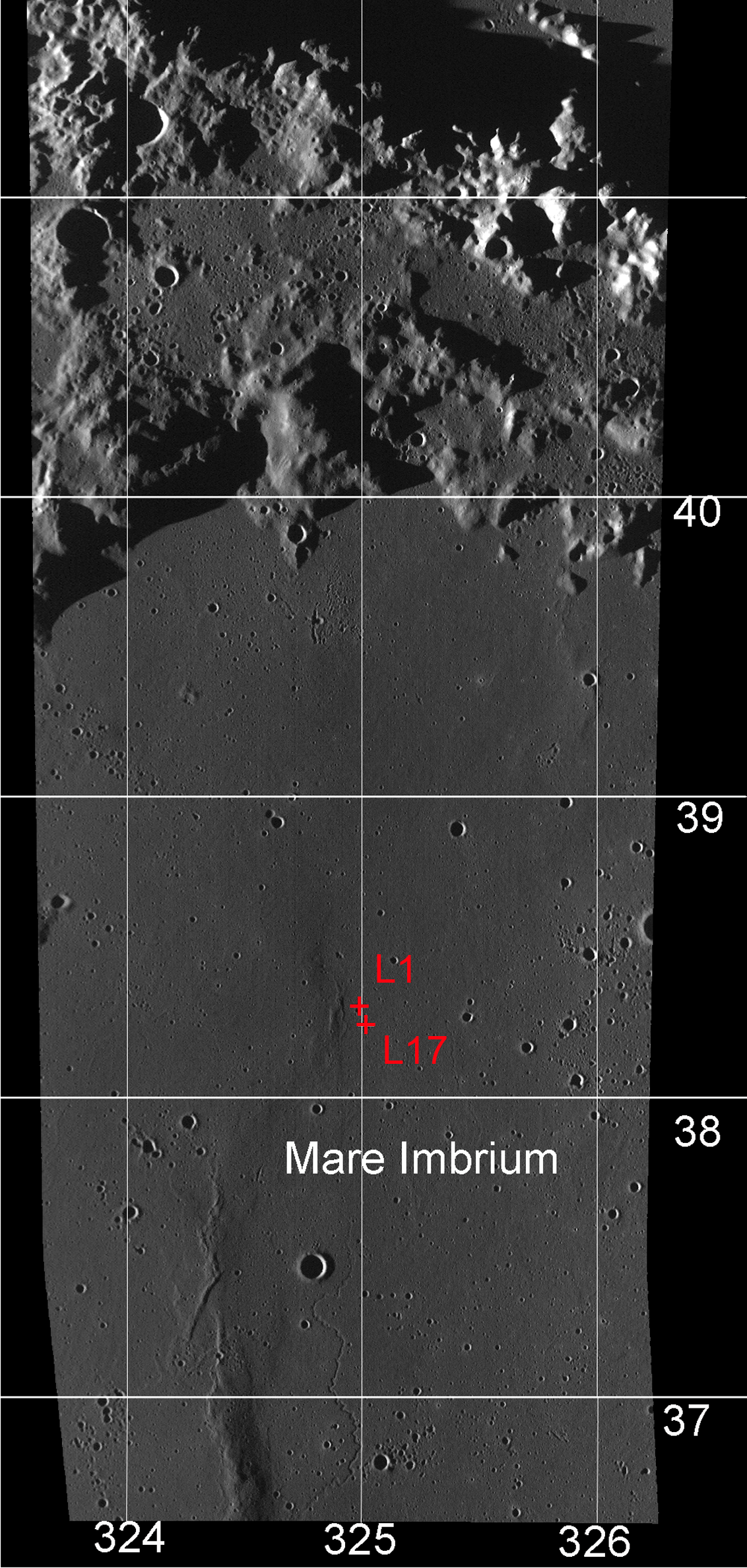
Far western 1970 Landing Zone of the Soviet Union's Luna 17, and the final parking spot of the first remote-operated lunar rover, Lunokhod-1. The French-built laser reflector array deployed from the Lunokhod eluded detection for four decades until its precise location was reacquired by the LROC Narrow Angle Camera in 2009. It's relocation added vital precision to measurements of the Earth-Moon distance that may answer important questions in astrophysics. LROC Wide Angle Camera 100 meter Global Mosaic overlaid upon LOLA topography and assembled using the NASA LMMP ILIADS application [NASA/GSFC/LMMP/Arizona State University].
Something similar is happening to NASA’s Mars exploration program. A long and ongoing exploration of the planet with more and more sophisticated and complex tasks resulted in the fact that the US became a true leader in the Mars programs. That was, in fact, the main argument by scholars who objected to cuts in NASA’s planetary space budget in 2013. In their opinion to lose such an important scientific and technical foundation would be a poor strategic move.

The current plans of Russia in the area of space exploration include returning to the Moon with landing vehicles and a mini-rover – a self-propelled machine which is being developed by an Indian organization for the purposes of the Luna-Resource program. It is planned to repeat lunar soil collection considering previous experiences. If in the course of the first expeditions the soil was collected only in the places of landing – now the goal is to combine the operation of the mini-rover and returning spacecraft. The mini-rover is to determine the most interesting spots and collect soil from them and then the spacecraft should return the samples to the Earth.

New Names Approved for Twelve Small Lunar Craters - The Working Group for Planetary System Nomenclature has approved 12 new names for small craters on the Moon: Albert, Borya, Gena, Igor, Kolya, Kostya, Leonid, Nikolya, Slava, Valera, Vasya, and Vitya. For details, see the map of LAC 24 and the Lunokhod-1 traverse map in the Gazetteer of Planetary Nomenclature [USGS].
Yet as of now these are only plans. Information from the Moon is coming daily. NASA LRO and GRAIL spacecraft continue to work in the Moon’s orbit (two spacecraft which measure lunar gravity fields). Several days ago, the NASA LRO mission published recent images of the lava fields formed as a result of asteroid impacts. The images were taken by LROC – Lunar Reconnaissance Orbiter Camera. This camera is also connected to the Lunokhods – in 2010, the first high resolution images were printed and it was possible to see Lunokhod-1 and the landing spacecraft and the wheel tracks. Interesting that in the same year a group of American scientists announced that they had managed to intercept a pulse from a laser retroreflector on Lunokhod-1.

It is probable that these circumstances have raised the interest in the Lunokhod program again. Naturally, recognition of the achievements of the soviet scientists is satisfying on the one hand, but on the other the interest is mostly coming from western institutions and space lovers. Without the LROC images, the “favourite lunar tractor” would be remembered only by those who are truly loyal to space science. That is why one of the tasks of the future lunar program is not only to learn again how to land and control spacecraft on the Moon, but also how to inform people about it in plain language, and on a regular basis.

Related: Lunokhod-1 revisited (March 15, 2012)

Thursday, April 12, 2012

Selenokhod GLXP rover ready by summer

Team activity - The implementation of such a large-scale project is impossible without cooperation of various specialists. In team discussions we find powerful incentive to progress it’s extremely exciting and useful for professional development [Selenokhod].
The Team Selenokhod GLXP lunar rover prototype will be finished by summer, developers said on Thursday. Selenokhod is the only Russian entrant among the 26 teams competing for the Google Lunar X Prize.

Selenokhod will move on flats instead of wheels, a design developed for the 4.5-kg Prop-M rovers that traveled on-board the identical Mars 2 and Mars 3 missions. After Mars 2 crashed on the martian surface, Mars 3 achieved the first soft landing there, December 2, 1971. But, for reasons still unknown, all contact was lost with Mars 3 after only 14.5 seconds.

RIA Novosti has posted a video showing
the Selenokhod lunar rover in action
.
Though neither Prop-M rover was successfully deployed on Mars, the Russians are apparently working hard to live up to an inherited legacy of having landed and operated the only robotic rovers on the Moon, in 1970 and 1973.

The team is planning to deliver its 5-kg Selenokhod to the moon on-board Luna-Glob, though that mission was recently delayed until sometime after 2015, past the present X-Prize deadline, and the team reports that contest organizers have not yet indicated whether using a government-funded platform is acceptable.

Thursday, March 15, 2012

LROC: Lunokhod 1 revisited, too

Lunokhod 1 rover in its final parking place (38.315°N, 324.992°E) on the surface of Mare Imbrium. LROC Narrow Angle Camera (NAC) observation M175502049RE, orbit 10998, November 9, 2011, resolution 33 cm per pixel. View original Featured Image with enlarged inset HERE. [NASA/GSFC/Arizona State University].
Jeff Plescia
LROC News System

Luna 17, carrying Lunokhod 1, landed on the flood basalt surface of Mare Imbrium on November 17, 1970, after entering orbit on November 15. 

Today's Featured Image of Luna 17 and Lunokhod 1 was obtained during a low altitude (33 km) pass providing the highest resolution view yet of the landing site.

The same LROC Narrow Angle Camera frame captured both the lander and the Lunokhod 1 lunar rover, and nearly all the wheel tracks the rover left behind, just shy of 42 years afterward.

Luna 17, the lander that carried Lunokhod 1 to the surface; debarking ramps for the rover visible extending down to the surface to the right. Many rover tracks are visible around the lander and throughout LROC NAC frame M175502049RE. View the original contextual image with enlarged inset, HERE [NASA/GSFC/Arizona State University].

Artist’s conception of Luna 17 on the lunar surface, with Lunokhod descending to the surface [Anatoly Zak/Russian Space Web].
Once Luna 17 landed, ramps were deployed on two sides of the lander allowing for two possible directions for the rover to drive to the surface. In this case, the rover drove down the ramps on the east side of the lander. Rover tracks can be seen extending away from and around the rover. Also note the bright area around the Luna 17 lander; the surface was modified by the exhaust gases from the descent engines such that it appears brighter. This increased contract makes the rover tracks more obvious near the lander.

View of the Luna 17 from the Lunokhod 1. The rover descended from the lander on the opposite side. The wide variety of images, including many other firsts, from the Cold War era Soviet lunar program can be viewed HERE.

Lunokhod 1 traveled a total distance of 10.5 km. It was first commanded to drive south from the Luna 17 lander, making a loop across the mare surface, and then returning north to Luna 17. The rover was then directed to proceed farther north, making a small loop to the west, then returning to its track and continuing northward. The payload consisted of a suite of television cameras, a cone penetrometer to determine physical properties of the regolith, and an X-ray spectrometer to determine the chemistry of the regolith. An X-ray telescope and cosmic ray detector were also part of the payload.

Like Lunokhod 2, Lunokhod 1 carried a French-built laser retroreflector. The vehicle was tracked for a short period during the mission then lost. Once the vehicle was located using LRO/LROC images by the LROC team, it was targeted and recovered using the lunar lasers at the Apache Point Observatory. Because of its location away from the Apollo retroreflectors and Lunokhod 2, recovering Lunokhod 1 is important for lunar geophysical studies.

The rover’s journey across the surface formally ended on October 4, 1971, after 11 lunar day-night cycles (322 Earth-days). Attempts to contact the rover after the lunar night that began on September 14, 1971 were unsuccessful, apparently due to a failure of some component of the rover during the lunar night.

Northern Mare Imbrium showing the location of the Luna 17 landing site and the final position of the Lunokhod 1 rover. View the larger LROC WAC context image HERE. [NASA/GSFC/ Arizona State University].

Explore the Lunokhod 1 site on your own HERE.

Revisit about the earlier LROC "rediscovery" of Lunokhod 1 HERE.

Tuesday, February 21, 2012

Will LRO LEND prove ineffective?

Noted "NSR's," or "Neutron Suppression Regions" from LEND measurements over the first two years of the LRO mission clearly show depths associated with areas in and around the permanently shadowed regions of craters Cabeus and, nearer to the lunar South Pole, Shoemaker and, to a lesser extent, Faustini. Haworth, where the LAMP far UV detector seems to have detected frost, shows little if any neutron suppression. Is the presentation of LEND data highly contrasted, in false color, to appear to be of higher resolution? [NASA].
A quiet controversy has surfaced regarding the usefulness of the Russian-built and managed LEND instrument on-board the Lunar Reconnaissance Orbiter, now approaching its 12,300th orbit of the Moon.

Intended as a sharper-resolution follow-up to neutron flux detection performed by Lunar Prospector (1998-1999) a team of investigators representing four prestigious institutions are expressing doubts about the actual resolution of the LEND Collimated Sensors for EpiThermal Neutrons (CSETN).

LRO instrument payload schematic. The LEND package
is at bottom center [NASA].
“Serious questions have been raised concerning the effectiveness of the LEND CSETN for actually returning a sharper map of the lunar neutron flux,” the team writes in “What is LEND collimated detector really measuring?” a presentation prepared for the 43rd Lunar and Planetary Science Conference (2012), in March.

Cosmic rays of a wide range of energies rain in on the inner Solar System from beyond the Sun’s interplanetary magnetic field, at a more or less constant rate that varies by roughly 100 percent to a peak infall from all directions at solar cycle minima and dropping by half inversely to solar cycle max. As these energetic nuclei bombard the lunar surface the result is a predictable flux of freed neutrons scattered into space. As a detector in low lunar orbit passes overhead these newly space borne neutrons can be related to their origin on the lunar surface.

The presence of hydrogen, in the form of hydroxyl molecules, hydrogen gas or was water ice, in the upper half meter of the lunar surface will absorb or refract some of these neutrons. It was the confirmation of such an apparent detection by Lunar Prospector that gradually convinced many scientists of the otherwise thought unlikely presence of cold- trapped volatiles, perhaps in the form of water ice, near the Moon’s highest latitudes.

But the neutron detection array on-board the highly budget-restricted Lunar Prospector was of very low resolution, and though the detection of hydrogen by that instrument was mostly confined to the lunar poles its detection was not confined directly to permanently shadowed regions, the only place where water ice was believed possible. 

The two complementary detectors of the Lunar Exploration Neutron Detector (LEND), flying on LRO, carried high hopes of a great improvement on the Lunar Prospector measurements.  The work by Eke, Teodoro and Lawrence, et al., first appearing in Science last fall, “uses the Lunar Prospector results in combination with data from the LEND CSETN to demonstrate that less than 5 percent of the LEND CSETN counts come from the (detector’s actual) field of view.”

The abstract “What is the LEND collimated detector really measuring,” (LPSC 2012, #2211) can be reviewed HERE.

A preliminary letter responding to similar critical comments from Lawrence, et al., written by LEND team members I.G. Mitrofanov, et al., was published in Science, February 14, 2011. It can be read HERE.

Wednesday, February 8, 2012

Popovkin: 'To the Moon in Seven Years?'

Former Russian Defense Minister Vladimir
Popovkin has headed up the Russian Fed-
eral Space Agency (Roscosmos) less than a
year
[news.ru].

Vladimir Popovkin, head of the Russian Federal Space Agency Roscosmos, is currently heading up a national contest designed to select five new Russian cosmonauts. The competition, which began February 1, is open to all citizens of the Russian Federation and closes March 15. In a recent interview promoting the new round of cosmonaut recruitment Popovkin said training for those ultimately selected in the process would likely include preparation for expeditions to the lunar surface, as soon as 2020.

According to Zakutnyaya Olga, writing for The Voice of Russia, February 6, "On February 2, in his interview to ‘Echo of Moscow’ Vladimir Popovkin reminded listeners about the contest and made a short remark that ‘this team will be most likely trained for the Moon’. The head of Roscosmos also suggested that manned expedition to the Moon with long-term goals, a manned lunar base in particular, might be possible by 2020."

A month ago, in an interview broadcast by Vesti-FM, Popovkin said "Roscosmos was discussing plans for lunar exploration with European and American partners."

"The idea of flying people to the Moon after the Phobos-Grunt disaster may seem at least rather bizarre, even though manned space flights have never had such long period of dormancy, as the Russian planetary science experienced in last decades. However, it is not the mission itself but rather the fragmentary character of the Russian space plans and total absence of completed lunar missions after 1976’s Luna-24 sample return mission that makes one wonder at far too obvious discrepancy between the ever-changing plans and the too small achievements in the running of the current Federal Space Program."

To the Moon in seven years?
The Voice of Russia

Wednesday, April 14, 2010

Energia taking a pioneering lead

Heads Up from Rob Coppinger at Hyperbola for posting an English-language Russia Today interview with Engergia head Vitaly Lopota, discussing the long-term and immediate future of space tourism, the Advanced Crew Vehicle, soft-landings on the Moon and the company's interest in nuclear rockets for manned expeditions to Mars.

Review the post here.

Tuesday, February 9, 2010

Spudis: The New Space Race

Paul D. Spudis
OnOrbit.com

Recent media reports suggest that China is stepping up their program to send people to the Moon just as America appears to be standing down from it. This circumstance has re-awakened a long-standing debate about the geopolitical aspects of space travel and with it some questions. Are we in a race back to the Moon? Should we be? And if there is a "space race" today, what do we mean by the term? Is it a race of military dimensions or is such thinking just an artifact of the Cold War? What are the implications of a new space race?

Many in the space business purport to be unimpressed by the idea that China is going to the Moon and publicly invite them to waste money on such a stunt. "No big deal" seems to be the attitude - after all America did that over 30 years ago. NASA Administrator Charles Bolden recently professed to be unmoved by the possible future presence of a Chinese flag on the Moon, noting that there are already six American flags on the Moon.

Although it is not currently popular in this country to think about national interests and the competition of nations in space, others do not labor under this restriction. Our current human spaceflight effort, the International Space Station (ISS), has shown us both the benefits and drawbacks of cooperative projects. Soon, we will not have the ability to send crew to and from the ISS. But that's not a problem; the Russians have graciously agreed to transport us - at $50 million a pop. Look for that price to rise once the Shuttle is fully retired.

Read to Post, Submitted by Keith Cowing, HERE.

Friday, November 20, 2009

Cosmonaut says Russia falling behind in space

Vladimir Isachenkov
AP

Russia lacks a viable program for developing a new spacecraft and will likely fall behind in the space race, a veteran Russian cosmonaut said in an interview published Friday.

Efforts to build a successor to the 40-year old Soyuz spacecraft have dragged on with no end in sight, Mikhail Tyurin told the Novaya Gazeta newspaper.

Tyurin, a veteran of two missions to the International Space Station in 2001 and 2007, blamed the slow progress on a lack of clear goals and poor coordination.

"They have issued an order for a new spacecraft without having any concept," Tyurin said.

He said officials' talk of using the ship to fly to the International Space Station, and then the moon and Mars, are unfeasible. "One vehicle can't be both a steamroller and a Formula One racer," he said.

Russia's Federal Space Agency had no immediate comment.

Full story HERE.

Friday, November 6, 2009

The Space Arms Race begins: Should the U.S. and China cooperate?

Gordon G. Chang
Forbes.com

Did the arms race in space begin this week?

"Competition between military forces is developing towards the sky and space, it is extending beyond the atmosphere and even into outer space," said the chief of the Chinese air force in the Nov. 2 edition of People's Liberation Army Daily, the official newspaper of China's military. "This development is a historical inevitability and cannot be undone."

What cannot be undone is the effect of General Xu Qiliang's words. Chinese state media, however, tried to do just that, contending that the foreign media misinterpreted him. Then Chinese diplomats got in on the act. "China has never and will not participate in an outer space arms race in any form," said Foreign Ministry spokesman Ma Zhaoxu on Nov. 5. "The position of China on this point remains unchanged."

China's position--at least up until this week--was that no nation should use space for the purposes of war. In February of last year, Beijing and Moscow introduced a draft space treaty at a disarmament conference in Geneva. The Bush administration opposed it on the sensible ground that a deal would be unverifiable--any object in space can be used as a weapon if it can be maneuvered to arrange a collision, for instance. Moreover, a ground-launched missile can also be used to knock out satellites, space stations or shuttles.

The Russians and Chinese, in all probability, were just engaging in a public relations exercise last year because they obviously had no intention of ever allowing the intrusive inspections that would have to be built into any meaningful treaty. Yet, minutes after his inauguration, President Obama called Beijing's and Moscow's bluff by coming out in favor of a global agreement to keep weapons out of the heavens.

In response to Obama's countermove, Beijing--or at least the People's Liberation Army--has now changed tack and announced its intention to begin the space arms race in earnest. General Xu's bold words, interestingly enough, come at the same time that some in Washington are calling for civilian cooperation with the Chinese in space.

Read the analysis, HERE.

Wednesday, October 28, 2009

Russian space chief proposes nuclear spaceship

Russia's space agency chief is proposing to build a new spaceship with a nuclear engine.

Anatoly Perminov told a government meeting Wednesday that the preliminary design could be ready by 2012. He said it will then take nine more years and 17 billion rubles (about $600 million or 400 million euros) to build the ship.

Read the story HERE.

Thursday, October 1, 2009

Pavel Popovich

Pavel Popovich during Vostok 4 [CollectSpace.com-Asif Siddiqi/NASA]

The sixth man to orbit the Earth, Pavel Romanovich Popovich died Wednesday, five days before his 79th birthday. According to officials in Russia, his death came following a stroke at a hospital in Gurzuf on Ukraine's Crimean Peninsula.

"Pavel was a wonderful person," recalled first woman in space Valentina Tereshkova, in an interview with RIA Novosti. "A professional cosmonaut, devoted to his work, and he was also a good friend."

The first to be chosen among the Soviet Union's original 20 cosmonaut candidates, Popovich was considered for the country's -- and world's -- first spaceflight, which was ultimately flown by Yuri Gagarin. Instead, he served as capcom for Vostok 1, conveying commands between the ground and Gagarin in space.

Full Story, HERE.

Tuesday, September 22, 2009

Russia's Selenokhod chases GXP

Team Selenokhod, a Russian group of engineers and managers, announced its official entry into the Google Lunar X Prize competition Monday. The $30 million competition challenges space professionals and engineers from across the globe to build and launch a privately funded spacecraft to the moon which is capable of completing a series of exploration and transmission tasks as outlined in the competition's official rules. Team Selenokhod, headquartered in Moscow, Russia with ten group members, is among 20 teams from 44 countries that are competing for their share of the $30 million prize.

"The contribution progress of (the) private sector in cosmonautics is (a) worldwide trend nowadays. The previous international contest, (the) Ansari X Prize, showed that non-government companies have (opportunities) to create space technologies needed to achieve ambitious goals. Team Selenokhod wants Russian companies to evaluate the experience of their foreign colleagues, to understand (the) big opportunities of private space exploration and join us in our challenging project", said Nikolay Dzis-Voynarovskiy, Selenokhod Team Leader.

Story from Aero-News, HERE.

Wednesday, August 12, 2009

China warns of space arms race; Russia threatens response to U.S. hypersonic advances

China warns of 'Arms Race in Outer Space'
AP - GENEVA — China's Foreign Minister Yang Jiechi called Wednesday for international diplomacy to avert an "arms race in outer space."

Space should be reserved for peaceful purposes, Yang told the 65-nation Conference on Disarmament in Geneva.

"Outer space is now facing the looming danger of weaponization," he said. "Credible and effective multilateral measures must be taken to forestall the weaponization and arms race in outer space."

China and Russia have been vocal advocates of a global treaty against space-based weapons and argue for this to be included in future Conference of Disarmament negotiations.

The United States has dismissed the criticism as designed to block its plans for a missile interceptor system — while leaving untouched Chinese and Russian ground-based missiles that can fire into space.

"Countries should neither develop missile defense systems that undermine global strategic stability nor deploy weapons in outer space," Yang said.

Read the full article HERE.

Russia to upgrade air-space defense:
air force commander

Zelin says response to U.S. hypersonic advances

Xinhua -Russia will improve its air and space defense systems to counter possible threats from other nations, the country's air force commander said Tuesday.

Other countries, particularly the United States, will acquire new weapons such as hypersonic vehicles by 2030, and therefore will be able to deliver coordinated high-precision strikes from air and space against any target on Russian territory, Col. Gen. Alexander Zelin told a news conference.

Russia needs to upgrade its weapons and systems in order to counter such a potential, Zelin said.

In line with the new concept, air-space defense brigades will be created within the Russian Air Force and will be equipped with advanced S-400 and S-500 air defense systems, he said.

"The S-500 system is being developed under an original design ... and will be capable of destroying hypersonic and ballistic targets," Zelin said.

Read the full article HERE.

Sunday, July 26, 2009

Russian Moonrace Surplus Sale?

Hat Tip to Doug Messier at Parabolic Arc


Russia Today is not the most credible source for well-researched news. For more than a year, for example, someone has been promoting the Russian news site with news that the late Cold War Space Shuttle knock-off Buran was going to "save NASA." Because the actual Buran, which unsuccessfully flew a single unmanned orbit around the world before the fall of the Communist government, is now a scrapped piece of playground equipment.

Nevertheless, now RT is reporting The Russians are in discussion with Americans on a joint venture to revive the NK-33 engine, which was developed for the Soviet manned lunar program.

Thursday, May 28, 2009

NASA modifies contract with Roscosmos

From MSNBC
NASA has signed a $306 million modification to the current International Space Station contract with the Russian Federal Space Agency for crew transportation and related services in 2012 and 2013.

The firm-fixed price modification covers comprehensive Soyuz support, including all necessary training and preparation for launch, crew rescue, and landing of a long-duration mission for six individual station crew members.

Space station crew members will launch on four Soyuz vehicles: two in spring 2012 and two in fall 2012. Their landings are scheduled for fall 2012 and spring 2013, respectively. The contract modification also provides for crew post-flight rehabilitation, medical exams and services.

Under the contract modification, the Soyuz flights will carry limited cargo to and from the station, and dispose of trash. The cargo allowed per person is approximately 110 pounds launched to the station, approximately 37 pounds returned to Earth, and trash disposal of approximately 66 pounds.

Wednesday, April 29, 2009

New Soyuz landing may be rocket cushioned

From RussianSpaceWeb.com via BBC, notional glimpse
of renovated Russian Soyuz terminal descent
cushioned by rockets and footpads

From Anatoly Zak (via BBC) Engineers are considering a rocket-powered landing system for the successor to Russia's Soyuz spacecraft.

If accepted, it would be the first time in history that a manned vehicle relied solely on rocket engines for touchdown.

Previous manned missions have landed on Earth using a parachute or, in the case of space shuttles, a pair of wings.

RKK Energia, Russia's prime developer of manned spacecraft, had to examine the feasibility of the rocket-powered landing as a result of conflicting requirements for the project set by the Russian government.

Currently, Russian cosmonauts are carried into orbit on the three-seat Soyuz capsule. Russia is developing the new craft as a replacement to this venerable spacecraft, which has been in service for more than four decades.

The Soyuz does use small solid propellant motors to soften its touchdown, but the ship's parachute plays the main role in providing the vehicle and crew with a safe landing.

New launch site: In 2007, Moscow took the momentous decision to build a new launch site in the nation's far east, hoping to end Russia's dependency on the spaceport in Baikonur, which, after the collapse of the Soviet Union, ended up in the newly independent republic of Kazakhstan.

The new site, which has been dubbed Vostochny, or simply "Eastern", will be located almost as far south as Baikonur - an important orbital mechanics factor which determines the cargo-carrying capacity of rockets.

(Increasing the cargo capacity even more would result from the Russian - ESA partnership calling for a devoted Russian launch facility on the equator at Kourou.)