Showing posts with label Mars. Show all posts

Tuesday, September 24, 2013

Is a 'Quest for Life Elsewhere' a solid rationale for Space?

Mars Exploration Family Portrait
Robotic missions to Mars, thus far. To this list we can now add the successful launch, November 5, of India's Mars Orbiter Mission (MOM).
Paul D. Spudis
The Once and Future Moon
Smithsonian Air & Space

An interesting report in the Washington Post relates that the current Mars rover Curiosity (MSL) has found no evidence for methane on that planet, a finding that contradicts some earlier reports of the presence of that gas in the martian atmosphere.  The report goes on to say that this finding “disappointed” some members of the Curiosity science team.  Supposedly after earlier studies detected methane in telescopic spectra, they had “high hopes” for a positive result from the Curiosity rover.

Various reactions to this revelation are interesting, as they suggest something about the current mania for the search for extraterrestrial life, as well as something about the ultimate rationale for our national space program.

Mars Orbiter Mission (MOM), subsequently launched successfully November 5, under preparation for a prelaunch test at the ISRO Satish Dhawan Space Centre, SHAR, at Srihairkota [ISRO].
Whence comes this obsession and why does it drive our space efforts and dominate space news coverage?  Science fiction dreams have long been a part of the space effort, with many working in the field receiving their first exposure to space topics via that medium played out in print, film and video.  From bug-eyed Martians invading the Earth to slimy, acid-dripping killers stowed away aboard spacecraft, the obsession with extraterrestrial life took firm hold of the human imagination.

This sense of fascination is so strong that space advocates have tried to harness it as a way to justify (if not coerce) increased amounts of spending on the civil space program.  After the end of the Apollo program, with its clearly geopolitical goals accomplished, the space program needed a new long-term rationale, one that would ensure its continuation over many years.  Carl Sagan, an astronomer fascinated by the possibility of life on other worlds, emerged as the principal spokesman for the idea that searching for ET was the “true and good” rationale for exploring space.  The dominant theme of his television series Cosmos was the vastness of the universe with endless possibilities for finding life “out there.”  For a public television program, it was a huge hit (but to keep some perspective, in 1980 when the series first aired, it did not crack even the top thirty, which included such fare as Dallas, The Dukes of Hazard, and The Love Boat).

Seeking to justify federal spending on space, the Quest for Life Elsewhere (QFLE, as I shall call it) was enthusiastically adopted by the scientific community.  As a slogan it was catchy, but effectively got nowhere in terms of policy influence until 1996, with the discovery of what was claimed to be bacterial microfossils in ALHA 84001 (a meteorite that on the basis of several lines of evidence, we believe comes from Mars).  This rock has tiny features that resemble fossil bacteria as seen in Earth rocks.  This discovery was considered sensational at the time and even resulted in a nationally televised Rose Garden statement by the President of the United States.  More significantly for policy, the Mars scientific community parleyed that discovery into a program series of robotic missions, each one increasingly more ambitious (read: expensive) to be sent to Mars over the coming decade(s).  This mission series was established outside the agency’s traditional lines of mission proposal and accountability systems and became (in effect), an “entitlement” for the Mars science community and JPL, who possesses the agency monopoly on missions to Mars.

A series of increasingly sophisticated spacecraft were then sent to Mars over the next few years, each one finding that the planet at one time had liquid water at or near its surface and that the climate of the planet has changed, perhaps many times, over the course of its history.  But no evidence of extant or former life has been found.  As portrayed in the article, this latest finding is another dashing of the “hopes” of the Mars scientists.  Funny – I always thought that the job of the scientist was to describe the universe as it is and how it works, not to “hope” for a confirmation of one’s preferred hypothesis (gained through the eyes of a machine afforded almost human-like adoration).

Which brings us to my point above about the use of QFLE as a rationale for the American civil space program.

Mars atmosphere from orbit
Seasonal, or at least periodic, remote detection of Methane in the tenuous martian atmosphere may be evidence of biotic activity [ESA].
The goal of adopting such a rationale is to ensure an enduring, long-term space exploration program.  From a practical perspective, the danger of using QFLE as the primary goal for space is that if you do not find life, you’ve essentially failed and have probably written your programmatic obituary.  To date, the Mars science community has pled for a verdict of incomplete – we simply have not yet gone to the correct place with the correct tools and techniques to verify what they “hope” to find.  If this rationalization works, Mars exploration becomes an endless program – we can always say this, no matter wherever we go on Mars and whatever we find.  In fact, the problem with that rationale is that such pleading may backfire.  When most people think of alien life, they have images of ET in mind, not pond scum.  If the public understood that’s what we are really looking for, I suspect that a lot of the support for this crusade would quickly dissipate (I believe much of it has already).

My objection to using the QFLE as a rationale for space is on a more philosophical level.  Even if you finally do find martian microbes, what have you proven?  There are virtually no modern scientists who do not (to some degree) subscribe to the materialist paradigm of life’s origins, in which given the right compositions, energy and environment, life will naturally arise and evolve.  This is what scientists believe about the Earth and they most certainly believe it about other planets.  So if we finally do find Mars microbes, either ancient or existing, all we would have done is to prove something that most scientists believe now anyway.  The stridency of many scientists in their obsession to obtain “proof” of extraterrestrial life seems like other agendas are at work here, which I pass over without comment.

In science, new findings come all the time and it is highly likely that this “negative” result will soon be countered by some new and compelling “evidence” to the contrary.  I think that a long-range strategic rationale to explore and use the Solar System requires re-thinking.  A space program needs to return societal value for its cost.  I believe that there is abundant value in making our near-term goal the creation of a flexible and permanent system that opens up space for many different and varied uses.  Making the space program a Quest for Life Elsewhere is a prescription for failure and ultimately, termination..

Originally published September 24, 2013 at his Smithsonian Air & Space blog The Once and Future Moon, Dr. Spudis is a senior staff scientist at the Lunar and Planetary Institute. The opinions expressed are those of the author but are better informed than average

Friday, May 31, 2013

Cosmic ray threat to manned spaceflight tested on MSL

The MSL cruise phase as unmanned proxy for Orion, testing the deep space radiation environment [NASA].
Employing present, proven technology manned space travel to Mars exceeds NASA’s own limits on astronaut radiation exposure. That limit is calculated in terms of risk of “Radiation Exposure Induced Death,” or “REID,” over an individual astronaut’s life expectancy.

Ironically, as astronauts age their risk of eventually dying from causes unrelated to radiation exposure steadily increase. It’s the kind of risk coldly calculated by insurance providers. Though dying of undiagnosed heart disease is fed into the calculus, such other threats to the older astronaut's long-term survival overshadow their cumulative risk of REID.

None of this is news. This fly in the ointment in need of being overcome before humans can safely experience long-duration spaceflight beyond Earth’s magnetic field was starkly spelled out in the influential “ (2007),” a report put together by the National Academy of Science before the Constellation program was cancelled. The hard numbers have been gathered from the opening of the Space Age, from Explorer 1 through Apollo, from the Voyagers through the International Space Station.

Now these projections have been verified again by an instrument that traveled to Mars with Curiosity.

The lead investigators for these sensors announced their results during a NASA audio press conference Thursday. Dr. Cary Zeitlin, a principal scientist in the Southwest Research Institute’s (SwRI) Space Science and Engineering Division discussed detailed measurements of energetic and highly-ionizing particle radiation gathered during the 253 day, 560 million km journey to deliver the Mars Science Laboratory (MSL) “Curiosity” rover to the floor of Gail crater on Mars.

The Radiation Assessment Detector (RAD) made detailed measurements of the energetic particle radiation environment inside the spacecraft, providing important insights for future human missions to Mars.

NASA/JPL/SwRI
"In terms of accumulated dose, it's like getting a whole-body CT scan once every five or six days," said Dr. Cary Zeitlin, a principal scientist in SwRI's Space Science and Engineering Division and lead author of Measurements of Energetic Particle Radiation in Transit to Mars on the Mars Science Laboratory, scheduled for publication in the journal Science on May 31.

"Understanding the radiation environment inside a spacecraft carrying humans to Mars or other deep space destinations is critical for planning future crewed missions," Zeitlin said. "Based on RAD measurements, unless propulsion systems advance rapidly, a large share of mission radiation exposure will be during outbound and return travel, when the spacecraft and its inhabitants will be exposed to the radiation environment in interplanetary space, shielded only by the spacecraft itself."

Titanium alloy in the hull of a manned spacecraft is a good shield
against most solar particle events, but counter-productive against
the heaviest cosmic rays. These heavy nucleons split and shower
damage into human tissue.
Two forms of radiation pose potential health risks to astronauts in deep space: a chronic low dose of galactic cosmic rays (GCRs) and the possibility of short-term exposures to the solar energetic particles (SEPs) associated with solar flares and coronal mass ejections. Radiation dose is measured in units of Sievert (Sv) or milliSievert (1/1000 Sv). Long-term population studies have shown that exposure to radiation increases a person's lifetime cancer risk; exposure to a dose of 1 Sv is associated with a 5 percent increase in fatal cancer risk.

GCRs tend to be highly energetic, highly penetrating particles that are not stopped by the modest shielding provided by a typical spacecraft. These high-energy particles include a small percentage of so-called heavy ions, which are atomic nuclei without their usual complement of electrons. Heavy ions are known to cause more biological damage than other types of particles.

The solar particles of concern for astronaut safety are typically protons with kinetic energies up to a few hundred MeV (one MeV is a million electron volts). Solar events typically produce very large fluxes of these particles, as well as helium and heavier ions, but rarely produce higher-energy fluxes similar to GCRs. The comparatively low energy of typical SEPs means that spacecraft shielding is much more effective against SEPs than GCRs.

"A vehicle carrying humans into deep space would likely have a 'storm shelter' to protect against solar particles. But the GCRs are harder to stop and, even an aluminum hull a foot thick wouldn't change the dose very much," said Zeitlin.

"The RAD data show an average GCR dose equivalent rate of 1.8 milliSieverts per day in cruise. The total during just the transit phases of a Mars mission would be approximately .66 Sv for a round trip with current propulsion systems," said Zeitlin. Time spent on the surface of Mars might add considerably to the total dose equivalent, depending on shielding conditions and the duration of the stay. Exposure values that ensure crews will not exceed the various space agencies standards are less than 1 Sv.

"Scientists need to validate theories and models with actual measurements, which RAD is now providing. These measurements will be used to better understand how radiation travels through deep space and how it is affected and changed by the spacecraft structure itself," says Donald M. Hassler, a program director at Southwest Research Institute and principal investigator of the RAD investigation. "The spacecraft protects somewhat against lower energy particles, but others can propagate through the structure unchanged or break down into secondary particles."

Only about 5 percent of the radiation dose was associated with solar particles, both because it was a relatively quiet period in the solar cycle and due to shielding provided by the spacecraft. Crew exposures during a human mission back and forth to Mars would depend on the habitat shielding and the unpredictable nature of large SEP events. Even so, the results are representative of a trip to Mars under conditions of low to moderate solar activity.

"This issue will have to be addressed, one way or another, before humans can go into deep space for months or years at a time," said Zeitlin.

SwRI, together with Christian Albrechts University in Kiel, Germany, built RAD with funding from the NASA Human Exploration and Operations Mission Directorate and Germany's national aerospace research center, DLR.


Scientific Context for the Exploration of the Moon (2007)
Space Studies Board
National Research Council

Saturday, March 10, 2012

How the Mars community shot itself in the foot

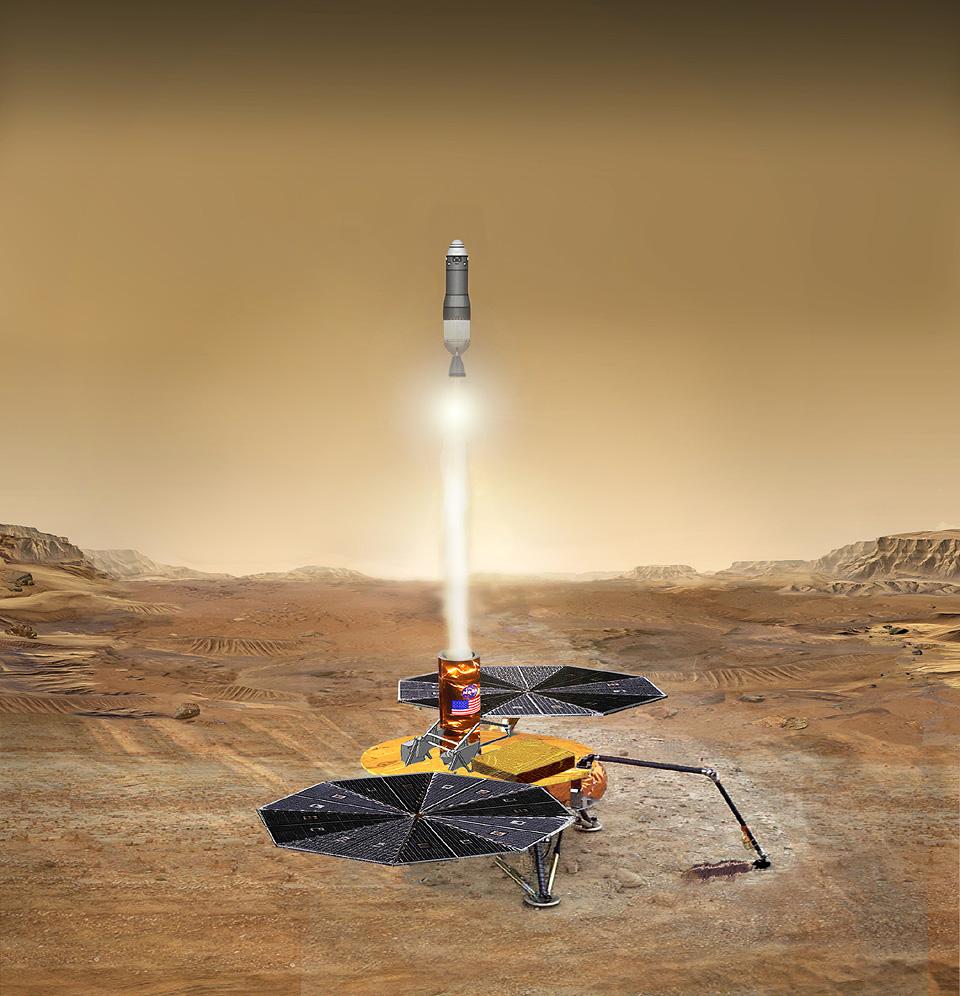
Mars Sample Return (MSR) as envisioned in 2006 [NASA].
Paul D. Spudis
The Once and Future Moon
Smithsonian Air & Space
 
The recent release of the administration’s FY 2013 budget gave some scientists a bit of a shock.  Planetary science (considered a “jewel in the crown” of the space agency) has been identified for cutting, over 20% during the next five years.  A particularly painful cut comes to the agency’s robotic Mars exploration program.  Planned missions in cooperation with the Europeans and future missions designed to lead up to the return of a surface sample from Mars were eliminated from the budget.  In effect, the successful program of Mars missions created after the embarrassing failure of the Mars Polar Lander over a decade ago is being scrapped.

The administration digested the National Research Council (NRC) Decadal Survey in planetary science (released last spring) before writing their new budget.  The study process for this report involves getting the relevant scientific communities to determine and lay out their priorities.  The assumption is that the scientific community can best determine the most relevant goals and questions in planetary science and therefore design mission concepts to address them.  Through a variety of working groups and forums, the desires of the community are made known and a report is written around them.  Typically, planetary scientists organize their working groups around objects of study, such as the inner (rocky) planets, small bodies (asteroids and comets), and giant planets.  For the latest Decadal Survey, the Mars community had its own separate group. Mars is, of course, a rocky, inner planet, and for decades has held sway in the planning process, both for robotic and human missions.

NASA’s highest scientific priority for Mars exploration is to determine if it has now, or has ever had life.  The chosen mission concept to address this question is to return samples of the surface of Mars to the Earth.  This is a very difficult task.  Mars is a big planet with a deep gravity well.  At its closest, it is several tens of millions of miles from the Earth, leaving robotic machines controlled from the Earth with long time delays (up to tens of minutes).  Safely landing on Mars is hard enough – taking off again and navigating back to Earth with samples safely in hand, is at least an order of magnitude more difficult.

Yet the new Decadal Survey made Mars sample return its only priority in the area of Mars science – the report offered no alternative missions for consideration.  Moreover, the sample return mission concept presented by the Decadal Survey required not one, but three separate “Flagship” missions (i.e., those having total costs exceeding $1 billion).  In a complex scenario, the mission concept called for a Mars lander to deliver a rover, explore and collect samples and then store them on the surface.  A second mission years later would rendezvous with the stored samples on the surface of Mars, transfer them to an ascent vehicle, and place the samples in orbit around the red planet.  The third and final mission would rendezvous with this orbital vehicle, dock with it and return the samples to the Earth.  From initial landing to sample return would take over a decade and cost many billions of dollars.  Moreover, in this series of three sequential and very complex missions, one single-point failure could spell the end of the entire effort.

When the Office of Management and Budget (OMB) saw this plan and its price tag, they thought it was too much money for too complicated a mission.  Unfortunately, the Mars subgroup left no “back-up” options in the Decadal Survey – it was do the sample return trio or do nothing.  Hence, the new budget proposes nothing.  Of course, a big part of the reason that this mission trio was a non-starter was to preserve funding for the James Webb Space Telescope (JWST), which at its current estimated $8 billion cost (and counting), effectively makes most other space science endeavors non-starters.

Cry “Havoc!” and let slip the dogs of war!  The planetary science community was stunned.  The Planetary Society organized a letter writing campaign, demanding that Congress intervene and save the “Mars program.”  Scientists complained that their highest priority as expressed in the Decadal Survey had been discarded without any real thought and debate (much as the Vision for Space Exploration had been thrown away two years ago).  In partial response, the agency is setting up an ad hoc group to study some less expensive, interim Mars missions (something that the Decadal Survey should have done).  Presently, all of planetary science is in danger of severe cutbacks.  And the final bill for JWST has yet to be delivered.

The MoonRise mission concept, in its most recent iteration planned in cooperation with the Canadian Space Agency, fulfills the need to obtain a baseline sample of the 4 billion year-old South Pole-Aitken basin, only a small part of which spills over onto the Moon's nearside, in line of sight with flight directors on Earth [NASA/NLSI].
What can be learned from this these events and applied to the exploration of the Moon?  Like the Mars community, the lunar science community has made sample return the centerpiece of their mission wish list.  A South Pole-Aitken (SPA) basin sample return has been proposed as a New Frontiers mission and studied in detail twice over the last nine years – and passed over for selection twice.  Yet the new Decadal Survey once again makes this mission its top priority in lunar science.  Moreover, for this mission to be scientifically successful in its goal of dating the impact that created the SPA basin (the biggest and oldest impact crater on the Moon) it must not only complete the sample return, it must collect samples whose context can be reconstructed and fully understood.  As discussed here previously, given the difficulty of such reconstruction for the Apollo samples (which were carefully documented and collected by trained field observers), an unambiguous outcome for this robotic mission is exceedingly unlikely.

Certainly, returning a sample from the Moon is less difficult than doing it from Mars, so the two tasks are not directly comparable.  Yet, there are a number of missions to both the Moon and Mars that could be done for less money and would significantly advance our understanding of their histories and processes.  For example, an entirely new field of scientific study is the generation, movement and fate of water on the Moon, a problem rich in both scientific and exploration potential.  This new field could be investigated profitably by a series of properly instrumented, small robotic missions.

These issues and questions were known at the time that the Decadal Survey was conducted, so there is little excuse for ignoring them, except for the community’s fixation on sample return missions.  In part, this obsession exists because it provides a large part of the research community with something to do.  NASA money has built many expensive laboratories to analyze extraterrestrial materials and new lunar and planetary samples are needed to keep them operating.  But the full potential of remote, in situ analysis – coupled with careful and clever geological planning – has not been given enough thought by the scientific community.

Will the lunar science community also shoot itself in the foot?  If so, it will simply be finishing a job started by this administration two years ago with the cancellation of the VSE.  Fans of human spaceflight please take note:  the process of undertaking these “Decadal Surveys” has been widely praised and advocated as a model for determining the goals and objectives of the human space program.  Considering the consequences of this latest effort in planetary science, one might want to re-think that scenario.

Originally published March 8, 2012 at his Smithsonian Air & Space blogThe Once and Future Moon, Dr. Spudis is a senior staff scientist at the Lunar and Planetary Institute. The opinions expressed are those of the author and are better informed than average.

Tuesday, December 8, 2009

Imperial College study boosts methane signal as evidence of life on Mars

Coming on the heels of announced results following thirteen years of study of "biomorph" sign in Martian meteorite ALH 84001, apparently ruling out any terrestrial origin for "fossilized" microorganisms discovered inside the rock in 1996, another announcement ftoday rom Imperial College London is likely to dovetail two stories into new headlines:

Scientists have ruled out the possibility that methane is delivered to Mars by meteorites, raising fresh hopes that the gas might be generated by life on the red planet, in research published Wednesday in Earth and Planetary Science Letters.

Methane has a short lifetime of just a few hundred years on Mars because it is constantly being depleted by a chemical reaction in the planet’s atmosphere, caused by sunlight. Scientists analyzing data from telescopic observations and unmanned space missions have discovered that methane on Mars is being constantly replenished by an unknown source and they are keen to uncover how the levels of methane are being topped up.

Researchers had thought that meteorites might be responsible for Martian methane levels because when the rocks enter the planet’s atmosphere they are subjected to intense heat, causing a chemical reaction that releases methane and other gases into the atmosphere.

However, the new study, by researchers from Imperial College London, shows that the volumes of methane that could be released by the meteorites entering Mars’s atmosphere are too low to maintain the current atmospheric levels of methane. Previous studies have also ruled out the possibility that the methane is delivered through volcanic activity.

Read the Imperial College release HERE.

Tuesday, December 1, 2009

Life on Mars: Evidence from Martian Meteorites

A filament from ALH84001. Filaments and filament fragments of this size are common in modern microbial biofilms and are a product of microbes much larger than the filament. This filament is clearly intergrown with the matrix and is unlikely to be random microbial contamination.

You may remember ALH84001. Thirteen years ago, in what quickly became a media circus, NASA brought an intense budget-time spotlight on this fragment of Mars that had been recovered from the blue ice of Antarctica. Preliminary study and microphotography appeared to show "biomorphs," a fossil trace of microbial life. (NASA's Astrobiology Institute owes its founding to this discovery.) Over time, however, the possibility these traces of primative lifeforms had contaminated after its arrival on Earth could not be eliminated., and direct interest in the meteorite waned. After more than a decade of study investigators are now prepared to say ALH84001 is very likely to be the first evidence of life elsewhere in the Solar System.

David S. McKay, Kathie L. Thomas-Keprta, Simon J. Clemett, Everett K. Gibson, Jr., Lauren Spencer, and Susan J. Wentworth - NASA Johnson Space Center & Jacobs Technology

ABSTRACT

New data on martian meteorite 84001 as well as new experimental studies show that thermal or shock decomposition of carbonate, the leading alternative non-biologic explanation for the unusual nanophase magnetite found in this meteorite, cannot explain the chemistry of the actual martian magnetites. This leaves the biogenic explanation as the only remaining viable hypothesis for the origin of these unique magnetites. Additional data from two other martian meteorites show a suite of biomorphs which are nearly identical between meteorites recovered from two widely different terrestrial environments (Egyptian Nile bottomlands and Antarctic ice sheets). This similarity argues Martian meteorites from widely different terrestrial environments contain features similar to each other and to known biogenic features from other terrestrial environments.

We term many of these features biomorphs and use them as pointers for more exhaustive analysis by SEM EDX, TEM, and nanoscale elemental and isotopic analysis by ionmicroprobe (NanoSims Such analysis will include biogenic elements N, C, P, etc., three dimensional mapping, of oxygen isotopes, and determination of deuterium/hydrogen ratios Focussed ion beam sample preparation of selected features is also underway.

Biomorphs found in martian meteorites must also pass our tests for terrestrial contamination in order to be considered genuine evidence for possible microbial life on Mars.

Overall Conclusions:

None of the original features supporting our hypothesis for ALH84001 has either been discredited or has been positively ascribed to non-biologic explanations.

The most controversial feature, the presence of distinctive nanophase magnetite (always accepted as a certain biosignature when found in Earth environments), despite repeated attempts, has never been accurately produced in the laboratory in verified reproducible experiments.

Multiple studies by European and US investigators have shown that pure Fe-magnetite cannot be produced by thermal decomposition of mixed composition carbonate: Mixed composition spinels are always the product.

There is no evidence that ALH84001 ever contained any pure Fe-carbonate (siderite); it is impossible to produce the pure Fe-magnetite in this meteorite by the thermal decomposition of any carbonates in the meteorite, Other Martian meteorites from quite different terrestrial environments contain nearly identical biomorphs suggestive of fossilized bacteria from Mars.

The martian biomorphs are intimately associated and interlaced with iddingsite vein fillings which are now universally accepted as martian in origin.

These martian biomorphs are very similar to terrestrial biomorphs from modern microbial complexes as well as biomorphs from Archean rocks interpreted as microbial fossils.

In summary, the original hypothesis that features in ALH84001 may be the result of early microbial life on Mars remains robust and is further strengthened by the presence of abundant biomorphs in other martian meteorites. These biomorphs, while not completely definitive for microbial life, are clearly associated with martian aqueous alteration (iddingsite) and are nearly identical to terrestrial biomorphs known to be formed by microbial activity. New martian data since our original paper have significantly supported the habitability of Mars and the possibility of life there. These data include the presence of an early magnetic dynamo detected by by the discovery of strongly magnetized crustal rocks, the presence of abundant early surface water and recent near-surface water, the presence of early clay minerals and carbonates, and the presence of methane plumes in the atmosphere which may have a biological origin.

Document ID: 20090038980
(10 mg - .pdf)

Tuesday, August 11, 2009

Mysterious Mars methane

Where does it come from.
(How does it last?)

Source: Space Pragmatism

Teachers and Franck Lefevre Francois Forget, University Pierret Marie Curie in Paris, used a computer model of the Martian atmosphere to apply the observations made previously by a team from the Goddard center of the NASA Astrobiology U.S.. Last January, U.S. scientists confirmed in the journal “Science” the existence of methane in the atmosphere of Mars, which, they said, is proof that this planet remains active, biologically or geologically.

Spectrometers for NASA telescopes in Hawaii detected in 2003 on the surface at least three stelae of this gas, which is a key to life as known on Earth. They noted that “the atmosphere of Mars quickly destroys methane in various ways,” which suggests that there must be a process issue, as explained by Michael Mumma, of the Space Flight Center of NASA in Maryland.

In the study published today, the French experts noted the difficulty of identifying patterns of behavior of gas in the red planet using the current atmospheric chemistry or physics that applies to terrestrial processes.

Methane has photochemical cycle of several centuries, it is expected to have a uniform distribution on the planet.

However, the observations on Mars indicate that the gas presents spatial and temporal variations (depending on the season). “It happens something else, something that lowers the life cycle of methane by a factor of 600. If the measurements are correct, we are missing something important,” Lefevre said in a statement by the British public channel BBC.

If these changes are confirmed, would imply that the gas is destroyed very quickly, which would suggest that the planet is in a very difficult environment for the survival of organic components.

Methane, whose molecule consists of one carbon atom attached to four hydrogen (CH4) is the main component of natural gas on Earth, and is also involved in other geological processes such as the oxidation of iron.

Moreover, many living organisms on Earth emit gas during the process of digestion of nutrients. Scientists currently unknown whether the methane on Mars is the product of biological or geological processes such as volcanic activity.

Saturday, June 20, 2009

Space Geology: From the Moon to Mars


Dr. Harrison Schmitt, in one of the many now iconic photographs taken during his field expedition to Taurus-Littrow valley, samples the diverse lunar regolith. Eugene Cernan, Apollo 17, December 1972)

Harrison H. Schmitt, for Scientific American, July 2009 "Mountains higher than the walls of the Grand Canyon of the Colorado towered above the long, narrow valley of Taurus-Littrow. A brilliant sun, brighter than any sun experienced on Earth, illuminated the cratered valley floor and steep mountain slopes, starkly contrasted against a blacker-than-black sky. My crewmate Gene Cernan and I explored this nearly four-billion-year-old valley, as well as the slightly younger volcanic lava rocks and ash partially filling it, for three days in 1972—concluding the Apollo program. It was the first and, so far, only time a geologist has ever done hands-on study of another world. Now the U.S., the European Union, Russia and other international partners are contemplating sending astronauts to Mars to do fieldwork there, probably beginning within the first third of this century. What will be new and what will be familiar to the first geologist to step before a red Martian sunrise?"

Read the Feature HERE.

Monday, June 1, 2009

Do we need to go to the Moon to get to Mars?

William Sweet IEEE-Spectrum
June 2009

This is part of IEEE Spectrum's Special Report: Why Mars? Why Now?

It’s an irrational thing, the pull of the moon. From time immemorial, the White Goddess has been held responsible for menstrual cycles, moods, and madness; she’s the mythic governess of our dreams and emotions.

In 1969, Neil Armstrong’s small step for man electrified people around the world, and in the United States it provided a momentary respite from social upheaval. Work done by Armstrong and his successors transformed our understanding of the moon, setting in motion research that continues to this day.

Of course, nobody pretends that the United States went to the moon mainly for science, and if people return to the moon now, it won’t be all for science, either. In the 1960s, the point was to win a race with the Soviet Union. Today the supposed point is to use the moon as a stepping-stone to Mars.

Of the nearly 7 billion people on Earth today, four out of five were not alive when the first lunar landing took place. Without a doubt, a great many of them would love to see people back on the moon again. But does it make sense to spend the US $50 billion it might cost to get them there? Do we need a base on the moon to get to Mars? And if not, should we bother going to the moon at all?

Playing perhaps more to our passions than our reason, in January 2004 President George W. Bush promulgated a program to return to the moon by 2020 and make it a staging area for a mission to Mars, perhaps two decades later. His father, President George H.W. Bush, had suggested essentially the same plan in 1989, but because of the enormous expense and conflicting U.S. commitments in space, it was dead on arrival. The second time around the vision fared better, eventually winning the endorsement—at least on paper—of all the world’s space powers.

But you didn’t have to scratch very hard to discover that such support was often only skin deep, even in the United States itself. Bush never actually mentioned his vision again, and the U.S. Congress promptly excised funding for the Mars part, instructing NASA to focus strictly on the moon. The effect was to radically disconnect the moon from Mars planning, even though going to Mars was supposedly the main rationale for returning to the moon.

Read the whole Artical HERE.

Thursday, January 15, 2009

Methane strong hint of Martian Biosphere.

Earth-based spectography has confirmed earlier hints, from probes orbiting Mars, of plumes of Methane gas, the strongest sign of a native biosphere since modern remote sensing of the fourth planet began more than forty years ago.

From the San Francisco Chronicle: The scientists, from NASA and other U.S. institutions, found high concentrations of methane that are consistent with methane plumes produced by underground bacteria on Earth.

The observations have reignited a life-on-Mars debate that began in 1996 when NASA astrobiologist David McKay and several other colleagues announced that a meteorite from Mars contained evidence of bacteria.

Since then, in absence of more substantive proof, most scientists have discounted McKay’s findings. But that may now change.

“I think this is extremely strong evidence for current life on Mars,” said McKay, who works at Johnson Space Center.

“It doesn’t prove it. But, to me, that is very strong support for the microbial life theory that we have been promoting with evidence for a number of years.”

The new methane data, collected by NASA senior scientist Michael Mumma and other planetary scientists, found that concentrations of the gas varied greatly by location and season on Mars.

The primary plume they found contained about 19,000 metric tons of methane, which is comparable to the methane produced at the large hydrocarbon seep Coal Oil Point in California, where underwater bacteria produce methane by processing hydrocarbons
.
Read more HERE.