Showing posts with label Orion. Show all posts

Sunday, January 25, 2015

Palazzo to push lunar surface expeditions

U.S. Rep. Steven Palazzo's district includes NASA's John C. Stennis Space Center [Rollcall].
Deborah Barfield Berry and Ledyard King
Hattiesburg American

Rep. Steven Palazzo (R-MS) plans to use his chairmanship of a House panel on space this year to again promote a return-to-the-moon mission and lobby against President Obama's plan to use an asteroid as a stepping-stone to remote sensing Mars from martian orbit.

Palazzo also chaired the House Science, Space and Technology Subcommittee on Space in the last Congress, but this year he sees a possible boost for his priorities in the GOP's takeover of the Senate.

"With the expanded majorities, we're going to continue to put an emphasis on America remaining the leader in space," Palazzo said in a recent interview. "America's leadership in space is no longer just a matter of national pride, it's become a matter of national security."

US Senator Ted Cruz (R-TX), new chairman of the Commerce Subcommittee on Science, Space and Competitiveness, outlined plans to "focus NASA on its core mission, exploring Space and more of it," on January 14 [AP].
One pressing issue this year, he said, will be helping NASA craft a "road map."

"Right now, they say, 'We're going to Mars,'" Palazzo said of NASA officials. "Well, that's great, but they haven't said how we're going to get there. So no one knows what to build, how to build it, when to build it or how to pay for it."

He said the moon, which the U.S. last visited in 1972, is a more logical route to the Red Planet than an asteroid.
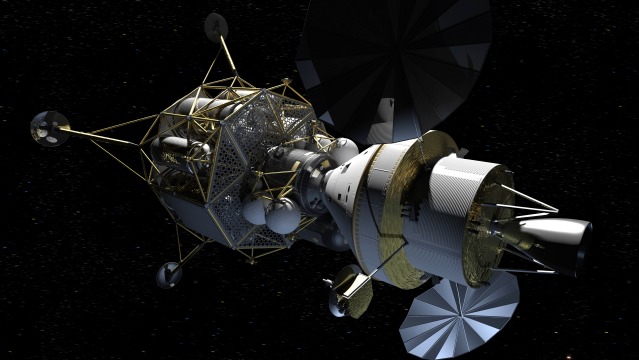
Orion and Altair: architecture envisioned within NASA in 2007, before Congress, acting on the recommendation the Obama administration, eliminated research and development for surface expeditions on the Moon and on Mars. Along with operations in Cislunar space or retrieving an asteroid NASA's leadership today proposes robotic exploration of the martian surface and of Phobos controlled from Mars orbit [NASA/Frassinito & Associates].
"I think most people agree, just because we've done it doesn't mean we can't do it again," Palazzo said.

Palazzo's district is home to Stennis Space Center, a rocket testing site that Palazzo said employs more than 4,000 workers.

But with limited funding for NASA, it will be harder for Palazzo and other supporters of a lunar mission to win support, said Stephen Rozman, a political scientist at Tougaloo College in Mississippi.

"They're going to have to show a real reason for rebuilding or taking the program to the next level right now," he said.

Read the entire article HERE.

Thursday, January 22, 2015

Marshall plans eleven cubesats on 2018 SLS debut

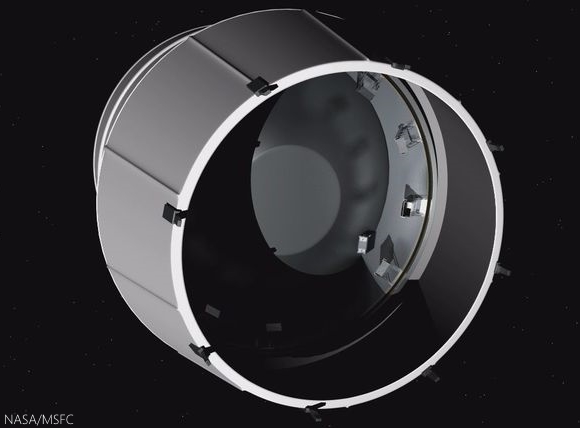
The MSA with cubesats tucked away [NASA/MSFC].
Josh Barrett
SpaceAlabama.com

Exploration Flight Test-1, which launched on December 5, 2014 tested the Orion spacecraft.  The capsule that would take people to Mars went to space for the first time, and it was one of NASA's biggest accomplishments in 2014.  In 2018, the next flight of Orion will be on the Space Launch System (SLS), and it will again be an unmanned test flight.  But this time around, there's going to be some extra things sent to space.

The Marshall Space Flight Center is working on getting the most out of the SLS's tremendous lift capability.  NASA had the novel idea of tucking away eleven different scientific missions on Exploration Mission-1, which would provide otherwise costly access to deep space.

"What we're really excited about is the fact that we're able to take this test flight and actually get science out of it, and we're expanding the capability," said Joseph Pelfry, a deputy project manager at Marshall, who was instrumental in this idea.  "SLS is designed for a lot more payload capability, but we're trying to take advantage of every bit of capability the vehicle has."

Three of the eleven missions have already been selected.  The science payloads must fit in to six-unit cubesats, which are efficient and versatile.  They will be hidden in the multi-vehicle stage adapter (MSA), which is the ring that connects Orion's service module to the top stage of SLS.  Once Orion and the service module disconnect and continue on to orbit the moon, compartments in the MSA will launch the science missions at certain times depending on particular mission.

"Flying these secondary payloads is something we're going to do for missions to come and really provide the science community an opportunity that they haven't had before," Pelfrey said.  "That's what the SLS enables beyond the journey to Mars."

Two missions are being designed at Marshall.  The Near-Earth Asteroid (NEA) Scout and Lunar Flashlight are already approved.  Both will make use of solar sail technology - which uses energy from photons emitted by the sun to create a highly efficient, propulsionless way to explore the solar system. 

Read the full post at SpaceAlabama.com, HERE.

Thursday, January 17, 2013

NASA, ESA agree on new Orion-MPV SM


This animation shows NASA's Orion spacecraft as it will appear on its Exploration Mission-1 in 2017, complete with a service module to be provided by the European Space Agency. After Orion blasts off atop a Space Launch System rocket, the ESA-provided service module will fuel and propel the capsule on its journey through space. Exploration Mission-1 in 2017 will be the first mission to incorporate both the Orion vehicle and NASA's new Space Launch System. It will follow the upcoming Exploration Flight Test-1 in 2014, in which an uncrewed Orion will launch atop a Delta IV Heavy rocket and fly 3,600 miles above Earth's surface, farther than a human spacecraft has gone in 40 years.

NASA-ESA agreement on Orion Service Module
for one unit, plus spares

Marcia Smith
SpacePolicyOnline.com

NASA and the European Space Agency (ESA) provided more details today of their agreement for ESA to provide the service module for NASA's Orion spacecraft.

ESA Director General Jean-Jacques Dordain announced the plan following ESA's ministerial meeting in November.  Dordain extolled its significance both in terms of demonstrating ESA's commitment to partner with NASA in human exploration of space beyond low Earth orbit and in NASA allowing other countries to be in the "critical path" of the U.S. human spaceflight program.

At a press conference today, NASA and ESA officials continued to tout the importance of the agreement, although as details emerge it seems less dramatic than at first glance.

Read the full article, HERE.

Monday, January 7, 2013

NASA, ESA televised briefing on Orion-MPV Service Module, Wednesday, January 16

Following unmanned testing beginning in September 2014, the Orion-MPV stack may begin crewed flights two years later. The Service Module design above represents designs from 2006 [NASA].
NASA and the European Space Agency (ESA) will hold a joint news conference Wednesday, January 16, at 1630 UT to discuss details of an agreement for ESA to provide the Service Module portion of the Orion-MPV manned vehicle, still scheduled to begin unmanned flight testing in September 2014.

NASA-TV will carry the briefing live from Johnson Space Center in Houston.

The agreement, according to NASA, "expands on the successful partnership between the agencies on the International Space Station and other activities," and "ensures continued international collaboration as humans explore new frontiers in the solar system."

The Orion Service Module (SM) is not presently a planned part of crew capsule tests, beginning in 2014. Exploration Test Mission-1 (EMT-1) will be lofted into high-Earth orbit on a Delta-IV heavy booster. NASA's next "man-rated" booster, the Space Launch System (SLS), may not be ready before 2017.

The news conference participants will include Bill Gerstenmaier, NASA associate administrator for Human Exploration and Operations; Thomas Reiter, ESA director of Human Spaceflight and Operations; Mark Geyer, Orion Program manager and Bernardo Patti, ESA manager of International Space Station operations.

Presently scratched into "out years" of NASA funding are proposed manned flights of the Orion-MPV system ferrying crews to the International Space Station as early as 2017, with a possible return to lunar orbit, a Hubble Space Telescope servicing mission and long duration flights in the decade following.

The Orion system is all that remains of the crewed segment of the cancelled Constellation program, whose trailing legacy includes the Lunar Reconnaissance Orbiter (LRO), the now-completed GRAIL lunar gravity mapping mission and the Lunar Atmosphere and Dust Environment Explorer (LADEE) scheduled for launch later this year.

Wednesday, December 26, 2012

September 2014 EFT-1 after 2-chute Orion test

Artist’s illustration of the EFT-1 Orion in orbit, following a planned launch atop a Delta-IV Heavy booster in September 2014 [NASA].
Ben Evans
AmericaSpace

In less than two years’ time, NASA intends to loft its first unmanned Orion spacecraft on the long-awaited Exploration Flight Test (EFT)-1 mission atop United Launch Alliance’s gigantic Delta IV Heavy booster. The mission, which will rise to a maximum altitude of 3,600 miles—the highest a human-capable vehicle has flown since the end of the Apollo era—will serve to wring out many of Orion’s systems in readiness for its first Exploration Mission in late 2017. NASA took one step toward the EFT-1 goal yesterday (Thursday), by completing the latest in a series of parachute drop tests of a mock-up vehicle at the US Army’s Yuma Proving Ground in Arizona. The test confirmed that Orion could land safely even if one of its two parachutes failed to open during the critical final stages of descent.

Read the full article, HERE.

Monday, September 24, 2012

NASA floats parking at Lagrange Point 2

One of many proposed configurations for the Gateway architecture, shown above the lunar farside "parked" at Lagrange Point 2 [NASA].
Mark K. Matthews
Orlando Sentinel

Top NASA officials have picked a leading candidate for the agency's next major mission: construction of a new outpost that would send astronauts farther from Earth than at any time in history.

The so-called "gateway spacecraft" would hover in orbit on the far side of the moon, support a small astronaut crew and function as a staging area for future missions to the moon and Mars.

At 277,000 miles from Earth, the outpost would be far more remote than the current space station, which orbits a little more than 200 miles above Earth. The distance raises complex questions of how to protect astronauts from the radiation of deep space — and rescue them if something goes wrong.

NASA Chief Charlie Bolden briefed the White House earlier this month on details of the proposal, but it's unclear whether it has the administration's support. Of critical importance is the price tag, which would certainly run into the billions of dollars.

Documents obtained by the Orlando Sentinel show that NASA wants to build a small outpost — likely with parts left over from the $100 billion International Space Station — at what's known as the Earth-Moon Lagrange Point 2, a spot about 38,000 miles from the moon and 277,000 miles from Earth.

At that location, the combined gravities of the Earth and moon reach equilibrium, making it possible to "stick" an outpost there with minimal power required to keep it in place.

To get there, NASA would use the massive rocket and space capsule that it is developing as a successor to the retired space shuttle. A first flight of that rocket is planned for 2017, and construction of the outpost would begin two years later, according to NASA planning documents.

Read the full article HERE.

Related Post:

Wednesday, September 19, 2012

Orion and SLS: Where Are They Now?

Amy Teitel
AmericaSpace.com

It’s been a little over a year since NASA announced its intention to build the Space Launch System or SLS, the rocket that will be bigger and more powerful than the Saturn V. Its payload is set to be the Orion Multi-Purpose Crew Vehicle, the Apollo-inspired capsule that is slated to take men to the Moon, Mars, and asteroids at some still-undefined point in the future. Last Wednesday, the Republican Subcommittee on Space and Aeronautics held a hearing to examine ongoing developments of Orion and SLS. The word from NASA is that both projects are moving forward. But schedules are starting to slip, and things will only get worse if the agency faces further budget cuts.

Testifying at the September 12 hearing were Cleon Lacefield, Vice President and Orion Program Manager from Lockheed Martin; Boeing Space Exploration Vice President and SLS Stages Program Manager Jim Chilton; NASA Deputy Associate Administrator for Exploration Systems Development Daniel L. Dumbacher; and Matt Mountain, Director of the Space Telescope Science Institute.

Read the full article, HERE.

Thursday, July 19, 2012

Another successful Orion drop test

The Orion team loads a test version of the spacecraft into a C-17 in preparation for a parachute drop test at the U.S. Army Yuma Proving Ground in Arizona. The main objective of the latest drop test is to determine how the entire system would respond if one of the three main parachutes inflated too quickly [NASA].
NASA completed another successful test Wednesday of the Orion crew vehicle's parachutes high above the Arizona desert in preparation for the spacecraft’s orbital flight test in 2014. Orion will carry astronauts deeper into space than ever before, provide emergency abort capability, sustain the crew during space travel and ensure a safe re-entry and landing.

› Watch a video of the parachute drop test

A C-17 plane dropped a test version of Orion from an altitude of 25,000 feet above the U.S. Army Yuma Proving Ground in southwestern Arizona. This test was the second to use an Orion craft that mimics the full size and shape of the spacecraft.

Orion's drogue chutes were deployed between 15,000 feet and 20,000 feet, followed by the pilot parachutes, which deployed the main landing parachutes. Orion descended about 25 feet per second, well below its maximum designed touchdown speed, when it landed on the desert floor.

Read the full NASA Feature article, HERE.

Wednesday, July 11, 2012

Checking up on the Space Launch System

The most recent publicly released artist's rendering of the Orion/SLS Block-1 architecture, now intended for a hoped-for 2017 debut. Success by streamlined commercial manned space companies filling America's low-Earth orbit manned spaceflight gap with the retirement of the Space Shuttle in 2011, the Space Launce System heavy-lift architecture will revive American manned spaceflight access to Cis-Lunar Space and beyond. Until then, NASA will utilize the work-horse Delta-IV heavy lift booster to begin unmanned flight testing of the Orion spacecraft beginning in 2014  [NASA].
Jason Davis
The Planetary Society Blog
 
When SpaceX's Dragon capsule returned from its historic trip to the International Space Station this May, it proved that -- in theory -- the idea of having private spaceflight companies relieve NASA of its low-Earth orbit taxi duties can succeed. Meanwhile, work continues on the Space Launch System, the next-generation deep space vehicle slated to take humans beyond Earth for the first time since 1972.

Orion arrives at KSC -- Amid much pomp and circumstance, the first space-bound Orion capsule arrived at Kennedy Space Center at the end of June. Orion sat naked during its official unveiling, baring its sea foam-green hull that was constructed using friction stir welding, a process in which metal is 'mixed' at the joint rather than melted (other space vehicles have used this technique, including SpaceX's Falcon 9 rocket). NASA officials, astronauts and politicians attended the official unveiling, including U.S. Senator Bill Nelson, who is fond of referring to the SLS by a different moniker: the "Monster Rocket."

Read the complete post HERE.

Related:
Orion Drop Test (April 18. 2012)

Friday, May 18, 2012

Delta IV second stage chosen for Orion tests

Delta IV upper stage utilized on a variety of
configurations
[NASA/USAF].
Todd Halverson
Florida Today

NASA intends to use a modified Delta IV second stage to launch Orion spacecraft on an unmanned test flight in 2017 and then a human expedition to lunar orbit four years later.

The Boeing upper stage is “the only means available to support the immediate in-space propulsion needs” for the excursions, NASA said in a procurement notice issued early this month.

The missions both are to be launched from complex 39B at Kennedy Space Center on early versions of NASA’s new heavy-lift Space Launch System.

The second stage for the first flight must be delivered to KSC no later than the fourth quarter of 2016, the notice said. The fourth quarter of 2020 is the deadline for delivery of the upper stage for the second mission.

NASA performed an internal market study of in-space propulsion systems available in the U.S., Europe and Japan, the notice said. From that research, NASA determined that the Delta IV upper stage “is the only known in-space stage requiring relatively minor modifications” to meet mission requirements as well as the launch schedule, the notice said.

Moreover, NASA said no other in-space propulsion system – “either existing with flight proven performance, or planned” – could be upgraded to fly astronauts with “relatively minor modifications.”

A single Pratt & Whitney RL-10B2 engine powers the Delta IV second stage. The engine runs on supercold liquid hydrogen and liquid oxygen.

The RL-10 was the first liquid hydrogen rocket engine built in the United States and has been flying for 50 years. Versions of it still power Atlas V and Delta IV upper stages.

Read the full article HERE.

Thursday, March 1, 2012

EM1: 2017 SLS/Orion lunar mission outlined

It's baseline development all but complete, the Orion MPV is on track to be the capstone of a return to American civilian heavy-lift spaceflight in 2017, if the US commitment to commercial low-Earth orbit crew transfers lives up to it hopes [NASA].
Chris Bergin
NASASpaceflight.com

The debut of the Space Launch System (SLS) will send the Orion (MPCV) on a 7-10 day mission to the Moon, with an aim to qualify the Heavy Lift Launch Vehicle (HLV) and Beyond Earth Orbit (BEO) Orion to carry humans into deep space. Exploration Mission 1 (EM-1) involves sending Orion around the far side of the Moon, prior to a splashdown in the Pacific Ocean.

Pitch over, at T L I-plus 20 minutes
SLS-1 – EM-1: With a launch date of December 17, 2017, the historic mission will aim to hand NASA a Christmas present of becoming a successful pathfinder for crewed flights on the new spacecraft, in turn providing a baseline for a return to exploration in deep space for the first time since the 1970s.

Launch date slips are a natural part of the space launch business, although the development roadmap for the SLS shows a large amount of schedule mitigation through the key review milestones leading up to the opening mission.

Ironically, the main threat to the schedule target may be due to problems unrelated to Orion or the SLS. This is due to the law of the 2010 Authorization Act, which requires SLS and Orion to provide a back-up role for the International Space Station (ISS), in the event of major disruption in the Commercial Crew arena.

This would be an undesirable situation for all concerned, not least because the 70mt SLS and BEO Orion would be vastly overpowered – and economically overpriced – for the role of lofting astronauts to the orbital outpost in Low Earth Orbit. At the same time, it would mean the Commercial Crew partners would have failed to achieve their designated role several years after the initial target of 2015.

Read the full article HERE.

Tuesday, December 27, 2011

Annus Horribilis: Space in 2011

Cue music, "Also Sprach Zarathustra".....
Paul D. Spudis
The Once and Future Moon
Smithsonian Air & Space


A long established year-end tradition – for good or ill – is a review and analysis of the preceding twelve months.  Who am I to fight this trend?  Being that I am a “the glass is not only half-empty, but chipped and cracked down the middle” space policy town crier, be fairly warned as I conclude this year’s blogging with a look back at 2011.

The retirement of the Space Shuttle this past year vindicated T.S. Elliot’s pronouncement about the nature of the end of the world.  The U.S. workhorses that ferried Station pieces and crew to low Earth orbit await their museum berths.  The most heated emotions and debate surrounding this event dealt with the agency’s selection of the final resting places for the working U.S. space access machines.  To the outrage of many, space-oriented places like Houston and Huntsville were cold-shouldered in favor of show business-oriented Los Angeles and New York City.  In the heat of this controversy (so dire that members of Congress from space-economy communities rose from their slumber to pen op-eds mirroring constituent alarm),  few noticed or understood that without a replacement, the country’s capability for humans to access space had been discarded.  As  2011 closes out, construction and assembly of the International Space Station is complete – it is a unique Earth-orbiting platform for ongoing scientific research, accessible for the price of a ride on a Russian Soyuz spacecraft.

This past year was heralded as the opening chapter for a new approach to human spaceflight – the American civil space program was to advance more economically through the use of commercial launch services to LEO.  We’re waiting and watching, with more than a little trepidation, as millions of taxpayer dollars are doled out to “New Space” companies branded “commercial.”  Recent history shows taxpayer-funded, new-technology enterprises have failed spectacularly.  It’s troubling that simultaneously, these space access ventures are making similar claims of soon-to-be superior, cheap alternatives toward solving a pressing national problem.

In other exciting developments, the agency announced their new “mission statement” –  “To reach for new heights and reveal the unknown so that what we do and learn will benefit all humankind.”  Some noted the new statement says nothing about conducting missions and doesn’t mention space.  But it is stirring – a mission statement for an agency without a mission.

After being kicked long and hard by the Congress, NASA finally decided that they should probably go ahead and build a new launch vehicle.  Despite some initial foot-dragging (and the conspicuously ignored presence of an obvious and inexpensive alternative), the agency buckled down and produced a design for a new heavy lift launch vehicle, one that looks remarkably similar to the now-discarded Ares system.  With continued work on the new Multi-Purpose Crew Vehicle, looking remarkably similar to the now-discarded Orion spacecraft, we soon will be ready for new and exciting missions to untrod landscapes in space – perhaps a large rock –in a decade.  Maybe.  Perhaps even for less than its estimated $100 billion cost.

Robotic science missions, the so-called “crown jewels” of the space program, had their own share of difficulties this year.  The Goddard-run James Webb Space Telescope, the second-generation successor to the highly successful Hubble Space Telescope, is coming in late with a price tag of more than $8.7 billion and counting.  Its continued cost growth threatens all NASA space science programs.  JPL’s own giga-project, the $2.5 billion Mars Science Laboratory, was successfully launched and will encounter the planet in about six months, hopefully at very low velocity.  Less costly robotic missions to a variety of destinations continue to return copious amounts of data; whether there will be money to reduce and analyze it all remains uncertain.

The past year was the 50th anniversary of both Yuri Gagarin’s first flight into space and John F. Kennedy’s announcement of the Moon landing goal – two events separated by type and location but connected in motivation.  It also was the centennial year of the race to, and attainment of, the South Pole – an event with reverberations throughout the ensuing years as a template for national efforts in exploration.  The space program, steeped in the history of global geopolitics and national competition, has sputtered slowly to a stop under that motivational and operational model.  A new paradigm for the space program is needed, one that ensures its long-term viability and stability.

To their own and the nation’s detriment, NASA is trapped by one model when thinking about space.  Missing is the notion of permanence and expansion into space.  A variety of “anyplace-but-the-Moon” destinations for human spaceflight have been mooted and studied in the past year, including near-Earth asteroids, L-points, the tiny, asteroid-like moons of Mars, lunar orbit, and even a human Venus flyby.  All of these imagined missions require knowledge, hardware and technologies that we do not now possess.  All expose human crews to substantial risk through long-term exposure to radiation and microgravity.  None create permanence of human presence or extension of capability in space.  And all travel to destinations offering little scientific and exploratory benefit or variety; their main attraction seems to be the yet-to-be-explained agency imperative to cross them off some “been there” check-list.

Several plans to develop cislunar space through an incremental, step-wise approach have been advanced.  The goal in each is not a flags-and-footprints type of space extravaganza, but the steady expansion of capabilities and reach beyond low Earth orbit.  Such a modus operandi is possible through the development and use of lunar resources —specifically the water ice found in quantity at both poles of the Moon.  In stark contrast to the Apollo template (and regardless of budgetary ups and downs), constant, steady and measurable progress can be realized through the creation of this “transcontinental railroad” in cislunar space.

I note with sadness, the passing of some great space visionaries this year.  John Marburger, former Presidential Science Advisor, was one of the few who truly understood the meaning and purpose of the Vision for Space Exploration.  Lunar and planetary scientists Baruch Blumberg, Bill Muehlberger, Mike Drake, Paul Lowman, Nick Short, Chuck Sonett, and my academic advisor and friend Ron Greeley passed away this year.  Theirs were voices of knowledge and experience and they will be missed.

The year 2011 was an annus horribilis for the national space program.  Here’s to the forthcoming year and hopes for a return of sanity to space policy.

Originally published December 27, 2011 at his Smithsonian Air & Space blog The Once and Future Moon, Dr. Spudis is a senior staff scientist at the Lunar and Planetary Institute. The opinions expressed are those of the author and are better informed than average.

Monday, June 14, 2010

Orion budget embargoed, 600 jobs cut

The first Lunar Test capsule for people since Project Apollo has just been welded into shape. This work finishes the structural framework of the pioneer Orion crew cabin – known as the Ground Test Article – or GTA, by a Lockheed Martin contractor team toiling away at the historic NASA-owned Michoud Assembly Facility (MAF) in New Orleans [NLSI/Ken Kremer].

Ken Kremer

Lockheed Martin and other contractors working on NASA's endangered Constellation program now have no choice but to delay or halt forward progress on major aspects of the 'Return to the Moon' program and that will quickly cause numerous jobs cuts rippling across the US.

These actions are a direct result of new budget and contract guidance from NASA Administrator Charles Bolden with regard to contract termination liabilities for Project Constellation if the project is cancelled. This could effectively kill the moon program as desired by the Obama Administration, despite a Congressional legislative ban on changing or cancelling Constellation without the agreement of Congress.

"The impact of termination liability on the contract has necessitated a 20 percent reduction across the program within Lockheed Martin as well as our subcontractors and suppliers", says Cleon Lacefield, Lockheed Martin vice president and Orion program manager. Lacefield told me that "Orion procurements are being reduced to allow work to continue within the budget limitations and about 600 positions among the Lockheed Martin and subcontractor workforce are being moved off of the program to adjust staffing needs."

These cutbacks come directly on the heels of Lockheed Martin just completing the structural framework of the first Lunar Orion test capsule at NASA's Michoud Assembly Facility in New Orleans as reported in my illustrated Orion feature story on June 7 here.

Bolden outlined the job and budget issues in stark terms in a June 9 memo to the chairs of the key Congressional committees that have NASA oversight.

The issue is who is liable to pay for the costs of terminating NASA contracts; NASA or the contractors. Bolden states that according to the "Anti-Deficiency Act" the contractors must now set aside funds to cover the termination liability costs in case the contract is cancelled.

NASA estimates the termination liability costs this year to be almost $1 Billion and must be accounted for before the end of the fiscal year in September 2010.

Read the full article, HERE.

Thursday, May 6, 2010

Orion Pad Abort 1 Launch at White Sands


Pad Abort 1 (PA-1), launched May 6, 2010 from White Sands Missile Range, N.M. PA-1 is the first fully integrated flight test of the launch abort system being developed for the Orion crew exploration vehicle [NASA].

Details via NASA.

Friday, November 27, 2009

Aldrin calls Orion a step backwards

Doug Messier
Parabolic Arc

Buzz Aldrin writes that NASA is making a mistake by replacing the winged shuttle with smaller ocean-landing Orion:

"Two Shuttle accidents — each caused by NASA hubris — combined with a tight budget have caused NASA to retire the fleet. Understandable, I think. But in a move that truly makes no sense, they will be replaced by…the space capsules we long ago outgrew. And to save even more money, these cannon-ball-like capsules would land once again in the ocean, not on dry land. To recover Orion will require deployment of ships in several landing zones. How much will that cost? Much of the Orion will be expendable, such as the heat shield. It seems we have decided to throw away our Shuttle experience and go “back to the future”.

Tuesday, October 6, 2009

Jacobs gets 3 year, $973 million NASA contract extention

Dow Jones Newswire

Jacobs Engineering Group Inc. received a three-year extension of its engineering and science contract with the National Aeronautics and Space Administration at the Johnson Space Center.

The $978 million extension at the Houston facility, one of seven current contracts with NASA centers, calls for the engineering consulting company to provide various services related to the International Space Station, the final space shuttle flights and the next-generation Orion spacecraft.

The contract's value is now $2.16 billion as it gets extended to eight years. Jacobs has various subcontractors for the Johnson Space Center work.

Thursday, September 3, 2009

Orion passes Preliminary Design Review


By now, a familiar artist's conception of Orion, notional successor to both Apollo and the U.S. Space Shuttle under development since 2004, in orbit around the Moon... someday... [NASA 2008]


The heart of what, until Congress says different, is the next manned spacecraft for NASA after the retirement of the Space Shuttle next year, has passed its Preliminary Design Review, a necessary goal on its present planned pathway toward a launch still slated for late 2015.

Orion, which shares mostly only the appearance of an Apollo command and service module (1969-1972) combination, passed it's PDR as tests continue in preparation for the launch of Ares 1-X, a prototype of the Ares I manned booster, and firing of a longer and more powerful Solid Rocket Booster than is presently used on the Space Shuttle, before the end of the present U.S. federal fiscal year, September 30.

Further development awaits a review of the U.S. Review of Human Spaceflight Committee report by the President and Congress, not expected to be made fully public before Sept. 15.

The PDR is an essential engineering assessment certifying the Orion concept is fit for manned spaceflight, and its completion clears the way for NASA to start to build the capsule for flight, if Congress agrees to continue funding.

"This is the successful culmination of all of the design trade studies and activities to date," said Mark Geyer, manager of the Orion Project Office at Nasa's Johnson Space Center in Houston. "As a project, a program and an agency, we are reviewing the design maturity, strategy and plans for NASA's next human spacecraft and agree this is the architecture we are going to build."

Friday, August 14, 2009

Bigelow makes pitch for 'Orion-lite' CEV

Bigelow Aerospace Orion-Lite - According to reports, officials representing Bigelow Aerospace, with a test inflatible prototype for a proposed low-Earth orbiting hotel in orbit for many months, met privately with members of the Augustine Human Spaceflight Review committee this week, to pitch a cheaper version of the Orion Crew Exploration Vehicle, presumably designed for shorter, low Earth orbiting missions, and without radiation proofing deemed necessary for the redesigned vehicle to travel for long-duration missions, to the Moon and deeper destinations in Space. Bigelow reportedly said their version of Orion could be ready for flight in 2013.

Stacked and packed, Ares 1-x

From Lunar Pioneer 3
Long anticipated, with millions of miles of uncertainty still ahead, the report came by way of Twitter, this afternoon, from @NASA_Ares_I_X, proudly presenting this picture, fully available HERE and from which the above was cropped.

"For the first time in more than a quarter-century, a new space vehicle stands ready in the (Vehicle Assembly Building,)" at Kennedy Space Center in Florida, the proud building built to stack the legendary Saturn Vs eventually carrying nine crews to the Moon between December 1968 and December 1972.

The final segments of the Ares I-X were stacked on Aug. 13, completing the 327-foot launch vehicle and providing the first look at the finished rocket’s distinctive shape. The Ares I-X flight test is targeted for Oct. 31.

“More than three years of hard work with the NASA and contractor team has brought us to this historic moment,” said Bob Ess, Ares I-X mission manager. “This flight test is a critical step in continuing our design process for the Ares vehicle and the first flight for the Constellation Program.”

The Ares I-X is wired with more than 700 sensors to gather data during the two-and-a-half minute flight test. The launch will provide NASA an early opportunity to test and prove hardware, facilities and ground operations associated with the Ares I crew launch vehicle. The data collected during the launch will allow NASA to gather critical data during ascent of the integrated Orion spacecraft and the Ares I rocket.

Now that the Ares I-X is assembled, numerous evaluations will be run on all the rocket systems, including complex instruments that will constantly measure the vehicle’s movements as it launches and the first stage separates. The evaluations include a process called “modal testing,” which will shake the stack slightly to test stiffness of the rocket, including the pinned and bolted joints.

Thursday, August 13, 2009

Review of Human Space Flight Committee: NASA Constellation program unaffordable

Robert Block
The Write Stuff
Orlando Sentinel

The Augustine Panel re-examining NASA's human spaceflight plans has concluded that the agency's current Constellation Program to return astronauts to the moon by 2020 will not fit into the current presidential budget.

In fact, the panel has found that President Barack Obama's current budget does not allow for any significant human exploration program.

"We are on a path right now for a system on a close order of just double the budget to operate," said panel member Jeff Greason of Constellation, which stemmed from President George W. Bush's 2005 "vision" to return Americans to the moon by 2020 and then move on to Mars.

Greason added that if Santa Claus gave the program to the country fully developed, NASA would still have to cancel it because the agency could not afford to launch it.

Read the Post HERE.