Showing posts with label Jeff Foust. Show all posts

Sunday, February 8, 2015

Bigelow, FAA not talking lunar property rights

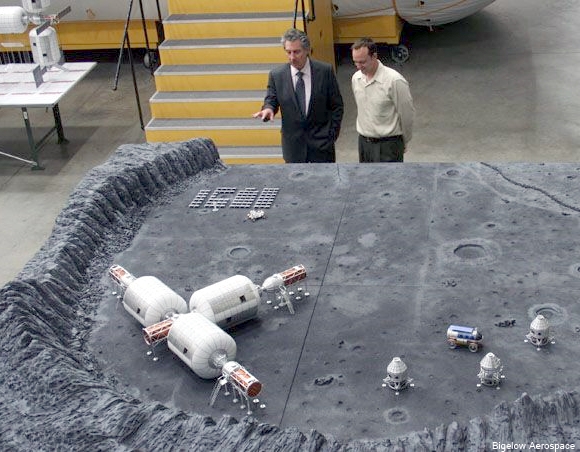
Notional Bigelow inflatable lunar habitat - Detail of scale model of a possible lunar habitat, based on Bigelow Aerospace inflatable modules. Recent exchanges of reports with the FAA, U.S. authority for American compliance with the 1967 Outer Space Treaty, have been misinterpreted as clearing the path for land claims on the Moon [Bigelow].
Jeff Foust
SpaceNews

A positive review by the Federal Aviation Administration of a proposed Bigelow Aerospace lunar habitat is seen as a first step towards supporting commercial activities on the moon, but contrary to some reports, that review does not represent a government endorsement of property rights claims there.

In a December 22 letter to Bigelow Aerospace, the FAA’s Office of Commercial Space Transportation (AST) said it had completed a payload review of a proposed lunar habitat requested by the company in late 2013. The office, working with several other government agencies, said it was willing to use its authority to ensure Bigelow could carry out its activities there without interference from other companies licensed by the FAA.

“AST was able to assure Bigelow Aerospace that it in fact would use its launch licensing authority, as best it can, to protect private sector assets on the Moon and to provide a safe environment for companies to conduct peaceful commercial activities without fear of harmful interference from other AST licensees,” Mike Gold, director of Washington operations and business growth for Bigelow Aerospace, said in a Feb. 3 statement to SpaceNews.
First reported by Reuters February 3, news was interpreted by many as an endorsement by the U.S. government of lunar property rights for private companies. Nield said that was not the intent of the FAA’s review.
Although Bigelow has no immediate plans for a lunar base, the company requested the payload review — one part of the FAA’s overall launch licensing process — to identify any issues that could hinder private development of the moon. Bigelow decided to pursue the review after completing a report for NASA in 2013 that identified an uncertain regulatory environment as a major obstacle to commercial activities there.

“We think that, first of all, this is not an overnight process, and that is probably the main reason why we are starting on this,” Bigelow Aerospace founder and president Robert Bigelow said at a November 2013 press conference, discussing the company’s intent to request the payload review.

“They wanted to know, before they go through a lot of engineering design, analysis, and investment, whether there were going to be any showstoppers,” said George Nield, FAA associate administrator for commercial space transportation, at the FAA Commercial Space Transportation Conference here February 4.

“In this particular case, it looked like a really good idea that the government as a whole is supportive of,” Nield added.

“We’re not talking about property rights at this point,” he said. “What we’re talking about is having the U.S. government have a regulatory framework that provides some certainty so they will be free to proceed with their plans and raising of funds.”

Read the full article at SpaceNews, HERE.

Some Related Posts:
"The Flight of the Dragon" Paul Spudis (May 16, 2012)
Boeing, Bigelow commercial crew concept Rob Coppinger (February 2, 2010)
Boeing throws hat in with Bigelow (September 23, 2009)

Friday, November 15, 2013

"The Best of Times, the Worst of Times..."

Robert Bigelow explains his commercial lunar habitat, being readied to undergo a test deployment in the Nevada desert, last May. More recently he's proposed using of the NASA COTS model to explore cislunar space and establish 'extended human activity' on the Moon [Bigelow Aerospace].
Doug Messier
Parabolic Arc

All the promise, perils and contradictions of America’s human spaceflight effort were on display earlier this week in Washington, D.C.

Things were looking good for a day or so, but then the proverbial other shoe dropped to remind everyone of the deep trouble that lies ahead as NASA attempts to restore its human spaceflight capability and send astronauts beyond low Earth orbit.

As NASA struggles to execute a series of ambitious programs on increasingly tight budgets, the main beneficiary appears to be the bumbling, crisis prone Russian space agency Roscosmos, which has reaped a financial windfall as a result of America’s equally bumbling human spaceflight policy. And matters could get worse before they get better (for NASA, at least).

The events of the week played out as follows:

Read the full post, HERE.

Also:
Bigelow urges use of COTS model for cislunar transportation
Jeff Foust, New Space Journal, November 15, 2013 

Tuesday, December 11, 2012

Turning science fiction to science fact: Golden Spike makes plans for human lunar missions

Golden Spike proposes to land humans on the surface of the Moon commercially as soon as 2020, for a price tag that has raised eyebrows—and some skepticism [Golden Spike Company].
Jeff Foust
The Space Review

The last 12 months has seen the unveiling of a number of commercial space ventures whose audacious plans can’t be immediately dismissed given the technical and financial pedigree of their founders and backers. Almost exactly a year ago, Microsoft co-founder Paul Allen announced the formation of Stratolaunch Systems, an air-launch system that requires the development of the world’s largest airplane. Allen assembled a team that included Scaled Composites and, originally, SpaceX (since replaced by Orbital Sciences), with a board that included Burt Rutan and former NASA administrator Mike Griffin (see “Stratolaunch: SpaceShipThree or Space Goose?”, The Space Review, December 19, 2011). In April, Planetary Resources announced plans for a series of robotic missions to prospect and, eventually, mine asteroids. That company has an impressive list of investors, including Google’s Larry Page and Eric Schmidt as well as Ross Perot Jr. and former Microsoft executive and two-time space tourist Charles Simonyi (see “Planetary Resources believes asteroid mining has come of age”, The Space Review, April 30, 2012).

Yet, the goals of these startups—a giant air-launch system and missions to prospect and mine asteroids—pale in comparison to the goal of another new space startup: sending people to the surface of the Moon. That feat has been accomplished only six times, and by one nation, the United States, with the last such mission, Apollo 17, flying 40 years ago this month. At the time, it was a potent symbol of America’s capabilities, and one of the signature achievements of the 20th century. The scale of that accomplishment, in many respects, grows as the decades stretch on without anyone else repeating it.

Given those factors, the idea that a human landing on the Moon could be done commercially, and for a fraction of the cost of Apollo or any more recent proposal, hardly seems credible. However, like those other firms, the plans of Golden Spike, the company that formally announced last week its desire to carry out such missions starting as soon as 2020, can’t be easily dismissed. The company has assembled an impressive team, including an Apollo veteran and others with experience in technology, science, policy, and finance. But can this lunar A-team overcome what are likely to be giant technical and financial obstacles?

Read the full article at The Space Review, this week, HERE.

Monday, July 23, 2012

Posey: “Going to the moon should be a goal”

U.S. Rep. Bill Posey (R-FL) attending committee meeting in Washington earlier this year.
Jeff Foust
Space Politics
 

Sunday’s edition of Florida Today features excerpts of an interview with Rep. Bill Posey (R-FL), including some discussion of space policy issues. Posey doesn’t break much new ground here, defending his vote on an appropriations bill that included language calling on NASA to immediately downselect to one or two commercial crew providers. He compares it to building a house on a $100,000 budget: “Do you hire one contractor to build your $100,000 house? Or do you hire four contractors and say, see how far you can go for $25,000 each?”

Read the full post HERE.

Wednesday, June 6, 2012

Human space exploration: asteroids vs. the Moon?

Sunflower solar panel-powered architecture, featuring the LER, Athlete and Chariot vehicles, that were well along in development before Congress and the Obama administration shelved the Constellation program [NASA/John Frassanito & Associates].
Jeff Foust

Two years ago, the Obama Administration changed the direction of the nation’s human spaceflight programs in a number of ways, including the destinations of those efforts. Gone was the goal of the previous administration of a human return to the Moon by 2020, a date that was looking increasingly unrealistic in the eyes of many, including the Augustine Committee that reviewed NASA’s plans in 2009. In its place was something resembling the “flexible path” approach in that committee’s final report, with the Moon replaced as an initial beyond-Earth destination by a near Earth asteroid. President Obama established a 2025 goal for a human mission to an asteroid in a speech at the Kennedy Space Center in April 2010, also setting a goal of a human mission to Mars in the mid-2030s.

From a technical standpoint, a human mission to a near Earth asteroid could be done solely by the United States given both existing capabilities and those under development, like the Orion spacecraft and Space Launch System heavy-lift rocket. Yet, from a financial standpoint, particular in an era of constrained and even declining budgets, it’s likely the US will seek international partners for an asteroid mission, and almost certainly for later missions to Mars. But do the potential partners of the US also want to participate in human asteroid missions?

The recent Global Space Exploration Conference, or GLEX, held in Washington, DC last month by the American Institute of Aeronautics and Astronautics (AIAA) and the International Astronautical Federation (IAF), offered some mixed messages about international interest in human asteroid missions. Some space agency executives instead spoke openly about going back to the Moon, comments that have some support among former NASA officials who believe that human lunar exploration will have greater support internationally.

Perhaps the boldest endorsement of the Moon, and not near Earth asteroids, as the next destination for human exploration came from Vladimir Popovkin, general director of the Russian space agency Roscosmos. Speaking at a plenary session at GLEX on May 22 that featured the leaders or other top officials of six space agencies, Popovkin suggested the Moon, and not the asteroids, was the preferred destination of the Russian space program.

“We arrived at the conclusion that the Moon is supposed to be the next target” for human exploration, Popovkin said through an interpreter. “We’re not trying to convince you that we shouldn’t be doing anything in the area of Mars exploration, asteroid exploration, just that, in our professional opinion, today we have much better chances to come up with very productive and tangible results when concentrating on the Moon.”

Read the in-depth article, HERE.

Thursday, April 12, 2012

Staking a claim on the Moon


Jeff Foust
The Space Review

A long-running cause célèbre of some elements of the space advocacy movement has been the issue of private property rights, or the lack thereof, beyond Earth. Despite the existence of many private ventures that are happy to sell you plots of land on the Moon or other worlds, there are no recognized claims of property on those celestial bodies. The Moon Treaty of 1979, for example, explicitly prohibits any entity, government or commercial, from claiming any territory on the Moon.

While that treaty has been ratified or acceded to by only a handful of countries, the older Outer Space Treaty (OST), widely accepted by all major spacefaring countries, prohibits countries from making any claims of national sovereignty over the Moon or other celestial bodies. Without any nation claiming territory on the Moon, the conventional wisdom goes, there is no national government that can register or recognize claims made by individuals or companies to property there. Changing that situation would require amending the OST, a process that would likely be drawn-out, messy, and unpredictable.

Or does it? A white paper released last week argues that private property claims to territory in outer space could be consistent with the OST, provided the US passed legislation to recognize those claims. Such legislation could enable private entities inside and outside the US to claim property of the Moon, thus enabling greater private development in space. Others, though, while acknowledging the need for private property rights on the Moon, say the loophole that this proposal exploits doesn’t actually exist.


A loophole in the OST? Read the article HERE.

Tuesday, November 8, 2011

TSR: Fear of a Chinese Moon

Robert Bigelow, speaking at the ISPCS conference in New Mexico this month, claimed that China is on a path towards taking control of the Moon within 15 years [ISPCS].

Jeff Foust

Robert Bigelow is best known in space circles as the founder of Bigelow Aerospace, the company he created over a decade ago to develop commercial space habitats using expandable (or inflatable) technology licensed from NASA. The Las Vegas-based company has successfully launched two prototype modules, Genesis 1 and 2, to demonstrate the technology and has plans for larger modules and commercial space stations for companies and so-called “sovereign clients”, nations without their own indigenous space programs.

Bigelow’s plans originally generated considerable skepticism in the broader space community. However, as the company won success with its Genesis missions and found interest in its plans from potential customers and even NASA—which sees the demand generated by Bigelow’s commercial habitats as a key part of the broader business case for the agency’s commercial crew plans—Bigelow has gained considerable credibility. Now, he’s using the platform he has as one of the nation’s leading space entrepreneurs to broadcast a warning about an unusual, even quixotic, threat to America’s space ambitions: that China will, in effect, seize the Moon.

Speaking at the International Symposium for Personal and Commercial Spaceflight (ISPCS) in Las Cruces, New Mexico, earlier this month, Bigelow spent very little time talking about his own company and its ambitions.


Why would China do such a thing? Bigelow is convinced that China’s quest for prestige—to demonstrate that it is the most powerful country in the world—will inevitably drive the country to lay claim to the Moon. “China already has a grand national vision,” he said. “Their vision is that China wants to be indisputably number one in the world, measured any way you want to measure.”

That means, he said, not just simply repeating the past achievements of the US in space but moving beyond them. “Why not take the all-important syllogistic next step: ownership, ownership, ownership?” he suggested. Doing so, he said, would generate “global psychological impact” and considerable prestige for the Chinese people. “I think nothing else the Chinese could possibly do in the next 15 years would cause as great a benefit for China,” he said.

He argued that China, with its growing wealth and its historical “ability to maintain focus”, would be in a position to land humans on the Moon and start making claims between 2022 and 2026. “China has an ability to focus and galvanize its programs because of the centralization of the government” that can allow them to stay on that schedule, he told reporters after his ISPCS talk.

One obvious obstacle is the Outer Space Treaty, of which China is a party, which prohibits countries from making territorial claims to the Moon or other celestial bodies. Bigelow suggested, though, that China could work to amend the treaty through the support of countries in Africa and Latin America where China is making major investments. Alternatively, he said, China could simply decide to withdraw from the treaty. Public opinion, he said, won’t be factor. “There isn’t going to be World War Three over this,” he said. “There isn’t going to be a single shot fired.”

Read the full article at The Space Review, HERE.

Wednesday, March 9, 2011

Fierce urgency of NOW for US space industry


L2 Depot with Orion CEV and DTAL-C docked, notional concept featured in "A commercially-based lunar architecture," October 12, 2010 [United Launch Alliance/AIAA].

Jeff Foust
Space Politics

The president of Pratt and Whitney Rocketdyne had a blunt warning this week for policymakers: get a plan in place for NASA’s future now or industry will suffer the consequences.

“NASA has a very short period of time to work with Congress and come up with a unified position and get their act together, and let industry know what’s going on,” Jim Maser told reporters in a roundtable Monday in Washington. “We’ve got to pick something, we’ve got to move on.”

Maser said he was concerned about the effect of extended uncertainty about NASA’s future plans on an industry already challenged by low flight rates and an unstable supplier base. He described one specific supplier of a component for the RL-10 rocket engine that still does business with him because the owner “wants to be part of the space business”. That owner, he added, is in his 80s, and his heirs don’t share that passion.

“With this uncertainty I would think there’s a fair number of second- and third-tier suppliers” who are rethinking their commitment to the industry, he warned. “In the absence of a decision in the next four to eight months, I think companies will be making decisions about space.”

Read the full article, HERE.

Monday, August 9, 2010

Griffin’s critique of NASA’s new direction

Former NASA administrator Mike Griffin was less critical than in months past, speaking to a conference of the International Mars Society in Dayton, Ohio, Friday. The House committee plan for NASA FY2011 , he said, was better than the Senate's, and plans preliminarily approved in both chambers were superior to plans promoted by the White House [File photo: CSM, April 2009].

Jeff Foust
The Space Review

Former NASA administrators are not generally known for being outspoken about space policy after their tenures running the agency...Mike Griffin, however, is not content to remain quiet during this period of upheaval in space policy. The administrator who oversaw the formation and initial development of the Constellation architecture—most notably the Ares 1 rocket and Orion capsule—is clearly not happy to see the White House and even Congress willing to dismantle part or all it in favor of a new approach to human space exploration.

Griffin started his speech by first reviewing the administration’s proposed plan for NASA, and his take on it—which, not unexpectedly, wasn’t particularly positive. One area of concern he expressed was the plan by the White House to defer a decision on a heavy-lift vehicle (HLV) to no later than 2015. “I would ask you to note the timing,” Griffin said: a 2015 decision would come near the end of President Obama’s second and final term (assuming he wins reelection in 2012), and thus the funding decisions would be put in the lap of his successor. “By the time there was any budget year that would actually have to support the development of a real heavy-lift rocket, the president who is promising to do it will be gone,” he said.

Read the full report, HERE.

Monday, February 15, 2010

Augustine: new plan’s means meet the ends

Norm Augustine, chairman of the Review of US Human Spaceflight Plans Committee largely endorsed the Obama administration’s newly proposed direction for NASA, Monday, speaking to a meeting of the American Physical Society in Washington. According to Jeff Foust, Space Politics, Augustine did offer "some caveats and concerns, primarily about funding."

Read Jeff Foust's Post HERE.

Tuesday, December 8, 2009

Richardson speaks out on Commercial Space

New Mexico Governor Bill Richardson

Jeff Foust
Space Politics

Yesterday’s rollout of Virgin Galactic’s SpaceShipTwo vehicle featured appearances by two sitting governors: Arnold Schwarzenegger of California and Bill Richardson of New Mexico. However, there wasn’t much in the way of politics at the event other than a brief statement by Richardson, echoing something he said over a year ago:

Read Jeff's Post HERE.

Thursday, December 3, 2009

Columbia on their minds?

Over north central Texas, February 1, 2003, traveling on the edge of space at Mach 18, the first Space Shuttle Columbia breaks apart during re-entry, killing all seven of her crew and scattering wreckage over thousands of square miles of east Texas, northeast of Houston. Ironically the flawless regularity of the program's final missions following a very restricted return to space, a clear-headed attention to detail and professionalism and (finally) a realistic assessment of what was always an incredible, useful, but inherently dangerous test vehicle has led many outside NASA to again take vehicle safety for granted, the temptation to push the vehicle into its fourth decade of service seems easy. More ironic, the long gap in U.S. manned spaceflight ahead, after the Shuttle's retirement in 2010 (a billion dollar line item, already well underway), is leading to a brain-drain and erosion of institutional memory and experience at every level. More tempting still is to forget how the United States came to be in this position, to allow an institution's mere self-continuity and tradition to become its sole reason-for-being.

In 1971, mostly in denial concerning a sparsely populated gap in U.S. manned space flight after Apollo 17, Congress settled on the promise of a Space Shuttle. The fire that destroyed Apollo 1 and her crew on the pad in 1967 and the breathtaking close call of Apollo 13 three years later made the future safety of manned spaceflight every bit as much of a paramount concern at the time as today, with only five Space Shuttle missions scheduled before its retirement a year from today, even as we approach the fortieth anniversary of Apollo 13 next April.

It would belabor the point to review the Space Shuttle's record, its surprising capabilities, needed more today in no small part because of its 130 missions. And it only seems obvious that the Shuttle never lived up to its primary selling points decades ago, those of convenience, lowered cost and primarily safety, because of those missions since 1981. The Hubble Space Telescope was also a product of that same difficult and clumsy long-term planning so typical of Washington, built to accommodate the two-year election cycle of the U.S. House of Representatives, with its power of the purse.

It's a good idea to look back and to ask how we got here, and to consider America's present dilemma concerning manned spaceflight to be a clear repetition of a similar process that unfolded almost four decades ago, once again in a age-old political dynamic built around short-term planning. In 1971 no one believed a decade would pass before the Space Shuttle flew, or that aside from the surprisingly useful Skylab missions and the Apollo-Soyuz rendezvous in 1975, that first gap in manned spaceflight would last until 1981. The missions underway had NASA's attention, as an institution where lunar travel never lost its novelty.

A similar situation is underway once again, with tight budgets and a host of nested institutions and stockholders prepared to argue over what, in an age where entitlement obligations exceed double the value of all the assets of America and Americans, mere table scraps. A unified vision articulated finally, after the loss of Columbia, is hanging by a thread. And partisan adversaries are squaring off for a bruising fight, each accusing the other of being unrealistic.

Jeff Foust has been following an almost invisible set of congressional hearings, that seemed to suddenly crop up, ostensibly dedicated (once again) to "safety" of one vision of NASA's future over another.

From his writings on his Blog "Space Politics," Jeff offers "A few notes on the human spaceflight hearing," Thursday.

Meanwhile Mark Whittington, writing for the Houston Space News Examiner in "Ares 1 vs.commercial launchers - how to replace the space shuttle?" and points to "Two recent editorials in the journal Space News, one by Congressman Ralph Hall opposing a commercial solution to Earth to low Earth orbit space flight," and "the other by Patti Grace Smith, a former FAA associate administrator" writing for commercial space transportation, and supporting commercial space flight, illustrates development of a new and quite unnecessary controversy in space policy. "

And Keith Cowing for NASA Watch details where prepared statements can be read and the scheduled rebroadcast of the House committee hearings this coming weekend, HERE.

Monday, November 23, 2009

An impatient space community

Jeff Foust
Space Politics

A few other notes from Alan Ladwig’s talk Friday at the University of Nebraska space law conference in Washington:

Ladwig acknowledged the uncertainty that many have felt over the last year about the future policy direction of the new administration. “The space community has been a little on edge during the past 11 months, waiting to see what the Obama Administration has in store for us,” he said, calling the agency currently a “work in progress.” “The space community is not a patient lot, and we’re not putting up well with the pace, the priority, and the inconvenience of having to wait for the new administration to determine our direction and level of resources committed to the civil space program.”

Some changes might be visible soon, though. Ladwig noted that new administrator Charles Bolden is now free to make organizational changes and realign personnel in the agency now that he’s passed the 120-day mark in his tenure there. “We expect an announcement on that to be coming before Thanksgiving.”

Read the post HERE.

Wednesday, October 14, 2009

"Heavy-Lift yes, EELV no?"

Jeff Foust
SpacePolitics.com

"While the Augustine committee wraps up its final report, NASA hasn’t been standing still waiting for it. In an article in Monday’s issue of The Space Review, I wrote about Bolden’s statements in his Space Transportation Association speech on Thursday about what NASA’s internal planning:"

"While Bolden didn’t mention any specifics in Washington, he did let slip a few details about what might be included on Monday at the IAC in Daejon, South Korea, Flightglobal.com reports. Bolden was clearly interested in developing a heavy-lift vehicle, saying that NASA was “costing” such a launcher, which the report believes is the Ares 5 “Lite” vehicle mentioned in the Augustine committee report instead of a shuttle-derived alternative or even simply re-estimating the development cost of the Ares 5 itself."

Read the Post, HERE.

Thursday, August 6, 2009

$50 million for commercial crew development

Jeff Foust
Space Politics

"A month ago it appeared that pressure from Sen. Richard Shelby would force NASA to redirect most of the $150 million in stimulus funds planned for commercial crew work to Constellation instead, after the Alabama Republican strongly opposed the plan, saying the money should be spent on trying to reduce (if by only a tiny amount) the gap between the shuttle’s retirement and Constellation’s introduction."

Read the posting HERE.

Monday, June 22, 2009

Definitive story of Augustine Committee meeting, last week


We have been asked why we have yet to post anything about the public panel presentations, during the first meeting, last week, of President Obama's Human Space Flight Review Committee, aka, Augustine Commission II, in honor of its chairman Norm Augustine, who chaired a more long term look at human spaceflight in late 1990.

The reason is simple. We knew Jeff Foust of Space Politics and the Space Review was in attendance.

The Review of US Human Space Flight Plans Committee
held their first public meeting in Washington last week.
- The Space Review


Although he kept Twitter Followers informed of events at the meeting as they happened, we knew Jeff Foust was there for a reason. He was bound to write it up, in this case, for the essential Space Review, the online publication s a "periscope into reality," with its latest series of excellent articles coming out every Monday.

The Space Review - June 22 : "The existence of the Augustine committee (officially the Review of US Human Space Flight Plans Committee) has been widely interpreted to be a vote of no confidence in NASA’s current human spaceflight plans, in particular Constellation, by the White House. After all, if everything was going well—or at least perceived to be going well by the new administration—there would be little need for an independent review. The existence of the committee has provided a new opening for those who want to replace the current architecture with any number of alternatives."

"The committee’s first meeting, held last Wednesday at the Carnegie Institute for Science in Washington, DC, appeared to confirm those beliefs. Much of the eight-hour hearing was devoted to examining Constellation and well as several alternative systems that could be ready sooner and/or with less money than the incumbent. And while the committee dropped no hints about what direction it might be leaning, the hearing certainly triggered discussion within and outside the meeting that will last all summer, if not beyond."

Read and comment on the story HERE.

The Presentations

Meeting Agendas
- June 17 Public Agenda (pdf, 11k)

Meeting Presentations
- 9:20am - Summary of past studies - NASA/Mike Hawes (pdf, 60k)
- 9:30am - Constellation Program - Nasa/Doug Cooke (pdf, 4.55MB)
- 10:00am - ISS Partner Discussion - ESA - Jean-Jacques Dordain (pdf, 241k)
- 10:00am - ISS Partner Discussion - RSA - Perminov (pdf, 460k)
- 12:00pm - Comments via Website (pdf, 81k)
- 1:00pm - EELV Considerations - NASA Expendable Launch Services Current Use of EELV - Lynn Cline (pdf, 590k)
- 1:00pm - EELV Considerations - Briefing to the Review of U.S. Human Space Flight Plans Committee - Michael Gass (pdf, 3.03MB)
- 1:00pm - EELV Considerations - Initial Summary of Human Rated Delta IV Heavy Study - Gary Pulliam (pdf, 123k)
- 2:00pm - Other Commercial Launch Capabilities - NASA COTS - NASA/Doug Cooke (pdf, 773k)
- 2:00pm - Other Commercial Launch Capabilities - SpaceX COTS - SpaceX (pdf, 3.67MB)
- 2:00pm - Other Commercial Launch Capabilities - Orbital COTS - Orbital (pdf, 3.34MB)
- 2:00pm - Other Commercial Launch Capabilities - ISS CRS - NASA/Mike Suffredini (pdf, 790k)
- 3:30pm - Alternative Architectures - Direct - Steve Metschan (pdf, 26.9MB)
- 3:30pm - Alternative Architectures - Shuttle Side-mount Options - NASA/John Shannon (pdf, 2.35MB)

The Committee Website

Friday, June 5, 2009

Griffin’s “exit interview”

Jeff Foust
Space Politics

While working on a recent article about Charles Bolden’s nomination to be NASA administrator, I checked out the latest report by the Aerospace Safety Advisory Panel (ASAP), the independent review panel that Bolden has been a member of the last few years. There wasn’t much in the panel’s findings that could be directly tied to Bolden, but there was something else interesting in the 2008 report, published a little over a month ago: a memo from then-administrator Mike Griffin. The memo, dated November 10, 2008, responded to a set of questions posed by ASAP on “agency transition issues prior to the presidential transition” and could be, in a sense, be considered something of an exit interview by Griffin (although at the time he was still hoping to be retained by the incoming administration.)

Perhaps the most interesting question posed by ASAP is their request for the top five goals for the next administrator, since, as it turns out, ASAP’s membership included the person picked to be the next administrator. Griffin’s response, summarized:

Read the Article HERE.

Saturday, May 9, 2009

Augustine & Griffin from Jeff Foust's Archive

Jeff Foust - Space Politics - As expected, the White House has ordered an independent review of Constellation to be chaired by Norm Augustine and be completed by August. That exploration architecture is at the heart of Mike Griffin’s legacy at NASA administrator. So it was interesting that someone reminded me that both Augustine and Griffin were witnesses at the same hearing of the House Science Committee back in March 2004, when the committee was taking an initial look at the Vision for Space Exploration announced two months earlier. Augustine appeared in his role as former chairman of the “Committee on the Future of the U.S. Space Program” (aka the Augustine Commission) in 1990, while Griffin spoke as president of In-Q-Tel and incoming head of the Space Department at APL (the hearing took place almost exactly one year before Griffin was nominated to become NASA administrator).

Read the Posting HERE.

Sunday, March 30, 2008

Obama's Empty Space Program

Trying to pen Senator Obama's space policy has been described as "trying to keep a jellyfish on your fork." Two more posting by Jeff Foust, also from Space Politics, discuss the "Wyoming Statement," and the Senator's statement about NASA no longer being inspiring, and in need of "a reorienting of priorities."

Whether the Senator is likely to be friendly to commercial and private space remains unanswered:
Jeff Foust
More on Obama's Wyoming Statement

"I exchanged emails today with Greg Zsidisin, who was not only at the Obama rally yesterday in Casper, Wyoming, but asked Obama the question about space policy that was mentioned in the previous post. Greg told me exactly what he asked Obama..."

Obama: NASA 'no longer associated with inspiration

“I grew up on Star Trek,” Obama said.
“I believe in the final frontier.”

Two other Heads-Ups from Foust

Also from Space Politics and authored by Jeff Foust:

...have been posted more than worth reading and pondering:

Upcoming Hearings:

As Congress returns from recess next week, the House Science and Technology Committee has a couple of relevant hearings scheduled. On Wednesday morning, April 2, the research and education subcommittee is holding a hearing on “International Science and Technology Cooperation” with the following witnesses scheduled:

  • Dr. John Marburger, Director, Office of Science and Technology Policy
  • Dr. Arden Bement, Director, National Science Foundation (NSF)
  • Dr. Nina Fedoroff, Science and Technology Advisor to the Secretary, U.S. Department of State
  • Mr. Jeff Miotke, Deputy Assistant Secretary of State for Science, Space and Health, Bureau of Oceans and International and Environmental and Scientific Affairs, U.S. Department of State
  • Mr. Michael O’Brien, Assistant Administrator for External Relations, National Aeronautics and Space Administration (NASA)

On Thursday morning, April 3, the space subcommittee is holding a hearing titled “NASA’s Exploration Initiative: Status and Issues”, with the following witnesses:

  • Dr. Richard Gilbrech, Associate Administrator, Exploration Systems Mission Directorate, NASA
  • Ms. Cristina T. Chaplain, Director, Acquisition and Sourcing Management,
    Government Accountability Office
  • Dr. Noel Hinners, Independent Consultant
  • Dr. Kathryn Thornton, Professor of Department of Science, Technology and Society & Associate Dean of the School of Engineering & Applied Science, University of Virginia
Both hearings are certainly vital for those wanting to assess the how both Majority Democrats and Minority Republicans intend to present their respective space agendas to the American people in the pivotal election ahead.

And more from Jeff Foust on the departure of Alan Stern,NASA's former head of the Science Mission Directorate
HERE.