Showing posts with label Bigelow. Show all posts

Sunday, February 8, 2015

Bigelow, FAA not talking lunar property rights

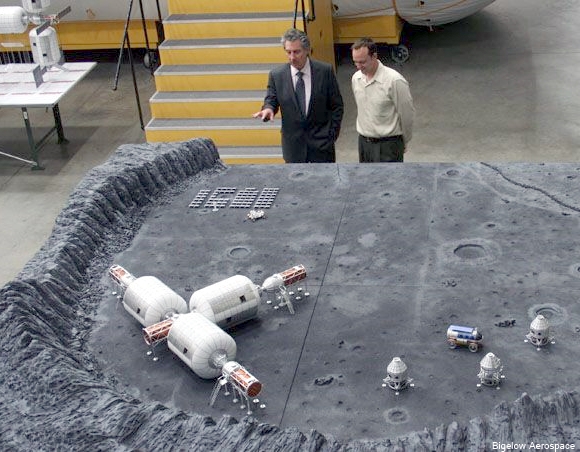
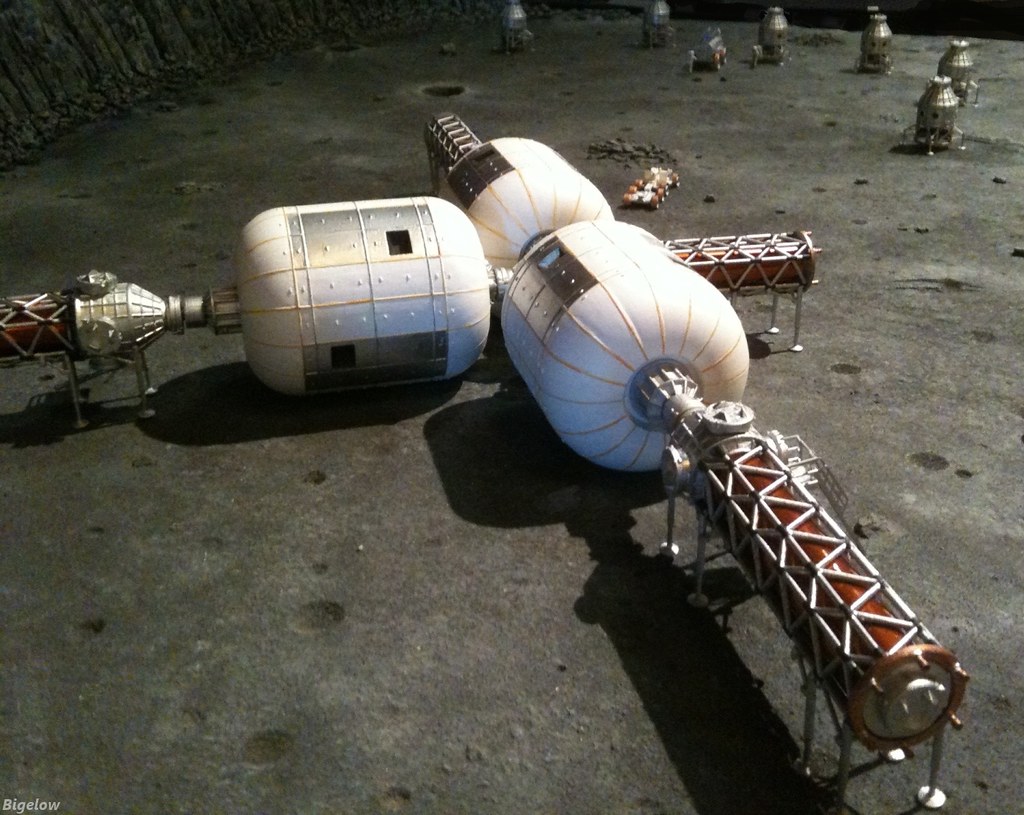
Notional Bigelow inflatable lunar habitat - Detail of scale model of a possible lunar habitat, based on Bigelow Aerospace inflatable modules. Recent exchanges of reports with the FAA, U.S. authority for American compliance with the 1967 Outer Space Treaty, have been misinterpreted as clearing the path for land claims on the Moon [Bigelow].
Jeff Foust
SpaceNews

A positive review by the Federal Aviation Administration of a proposed Bigelow Aerospace lunar habitat is seen as a first step towards supporting commercial activities on the moon, but contrary to some reports, that review does not represent a government endorsement of property rights claims there.

In a December 22 letter to Bigelow Aerospace, the FAA’s Office of Commercial Space Transportation (AST) said it had completed a payload review of a proposed lunar habitat requested by the company in late 2013. The office, working with several other government agencies, said it was willing to use its authority to ensure Bigelow could carry out its activities there without interference from other companies licensed by the FAA.

“AST was able to assure Bigelow Aerospace that it in fact would use its launch licensing authority, as best it can, to protect private sector assets on the Moon and to provide a safe environment for companies to conduct peaceful commercial activities without fear of harmful interference from other AST licensees,” Mike Gold, director of Washington operations and business growth for Bigelow Aerospace, said in a Feb. 3 statement to SpaceNews.
First reported by Reuters February 3, news was interpreted by many as an endorsement by the U.S. government of lunar property rights for private companies. Nield said that was not the intent of the FAA’s review.
Although Bigelow has no immediate plans for a lunar base, the company requested the payload review — one part of the FAA’s overall launch licensing process — to identify any issues that could hinder private development of the moon. Bigelow decided to pursue the review after completing a report for NASA in 2013 that identified an uncertain regulatory environment as a major obstacle to commercial activities there.

“We think that, first of all, this is not an overnight process, and that is probably the main reason why we are starting on this,” Bigelow Aerospace founder and president Robert Bigelow said at a November 2013 press conference, discussing the company’s intent to request the payload review.

“They wanted to know, before they go through a lot of engineering design, analysis, and investment, whether there were going to be any showstoppers,” said George Nield, FAA associate administrator for commercial space transportation, at the FAA Commercial Space Transportation Conference here February 4.

“In this particular case, it looked like a really good idea that the government as a whole is supportive of,” Nield added.

“We’re not talking about property rights at this point,” he said. “What we’re talking about is having the U.S. government have a regulatory framework that provides some certainty so they will be free to proceed with their plans and raising of funds.”

Read the full article at SpaceNews, HERE.

Some Related Posts:
"The Flight of the Dragon" Paul Spudis (May 16, 2012)
Boeing, Bigelow commercial crew concept Rob Coppinger (February 2, 2010)
Boeing throws hat in with Bigelow (September 23, 2009)

Friday, November 15, 2013

"The Best of Times, the Worst of Times..."

Robert Bigelow explains his commercial lunar habitat, being readied to undergo a test deployment in the Nevada desert, last May. More recently he's proposed using of the NASA COTS model to explore cislunar space and establish 'extended human activity' on the Moon [Bigelow Aerospace].
Doug Messier
Parabolic Arc

All the promise, perils and contradictions of America’s human spaceflight effort were on display earlier this week in Washington, D.C.

Things were looking good for a day or so, but then the proverbial other shoe dropped to remind everyone of the deep trouble that lies ahead as NASA attempts to restore its human spaceflight capability and send astronauts beyond low Earth orbit.

As NASA struggles to execute a series of ambitious programs on increasingly tight budgets, the main beneficiary appears to be the bumbling, crisis prone Russian space agency Roscosmos, which has reaped a financial windfall as a result of America’s equally bumbling human spaceflight policy. And matters could get worse before they get better (for NASA, at least).

The events of the week played out as follows:

Read the full post, HERE.

Also:
Bigelow urges use of COTS model for cislunar transportation
Jeff Foust, New Space Journal, November 15, 2013 

Friday, April 12, 2013

Bigelow, NASA rumored contracted for the Moon

Robert Bigelow explains his moon base concept. Photograph by Bigelow Aerospace. HT: Astronwright ("Chronicles of someone trying to get off this rock.")
George Knapp
Las Vegas City Life

Business deals don’t get much bigger than this one. Have you ever read a contract that gives a governmental green light to a program to “place a base on the surface of the moon?” Ever see an agreement signed by the U.S. government that declares a specific goal “to extend and sustain human activities across the solar system?” Me, either.

Yet that is essence of an adventurous deal already reached between NASA and Las Vegas space entrepreneur Robert Bigelow. An official announcement is still a few days away and will likely happen during a news conference at NASA headquarters. In the meantime, I have a draft copy of what could be an historic contract, one that reads like a Kubrick screenplay or an Arthur C. Clarke story. It is flat-out otherworldly.

Bigelow made his fortune building apartment buildings and weekly-rental hotel rooms in Las Vegas. In 1999, he launched what must have seemed a pipe dream at the time — his own private space program. But within a few short years he stunned the aerospace world by launching two of his own locally built spacecraft, both of which still circle the Earth (and one of which contains my weightless, floating business card). The focus of Bigelow Aerospace is an expandable module, small and light enough to make for less expensive launches but so strong and durable when expanded to full size that it accomplishes what NASA has been unable to do on its own: It puts more space in space, that is, more room for companies and governments to work, live and conduct research.

Back in January, NASA bigwigs came to Bigelow’s main plant to announce a landmark deal that calls for one of Bigelow’s modules to be attached to the International Space Station (ISS) within two years. Bigelow used that occasion to let slip some even bigger news — the fact that he is spending $250 million of his own money to build a private space station, larger than the ISS, and that he plans to have it in low-Earth orbit by 2016. What few knew at the time was that he was secretly negotiating an even bigger deal with NASA, one that represents a fundamental, across-the-board change in our approach to space.

Read the full article HERE.

Friday, May 11, 2012

SpaceX joins Bigelow in marketing LEO stations

Exterior camera view of the unmanned inflatable Bigelow Genesis orbital station, in low Earth orbit April 27, 2009 [Bigelow Aerospace].
Hawthorne, California and Las Vegas, Nevada – SpaceX and Bigelow Aerospace have agreed to conduct a joint marketing effort focused on international customers. The two companies will offer rides on SpaceX’s Dragon orbiter, using the Falcon launch vehicle, carrying passengers to Bigelow habitats in low Earth orbit.

Bigelow president and founder Robert T. Bigelow said, “We’re very excited to be working with our colleagues at SpaceX to present the unique services that our two companies can offer to international clientele. We’re eager to join them overseas to discuss the substantial benefits that BA 330 leasing can offer in combination with SpaceX transportation capabilities”.

The BA 330 is a habitat that will provide roughly 330 cubic meters of usable volume and can support a crew of up to six. Bigelow Aerospace plans to connect two or more BA 330s in orbit to provide national space agencies, companies, and universities with unparalleled access to the microgravity environment.

NASA signed off on the 7 passenger Dragon seating layout, May 8
[NASA].
“SpaceX and BA have a lot in common. Both companies were founded to help create a new era in space enterprise,” said SpaceX President Gwynne Shotwell. “Together we will provide unique opportunities to entities -- whether nations or corporations -- wishing to have crewed access to the space environment for extended periods. I’m looking forward to working with Bigelow Aerospace and engaging with international customers,” Shotwell explained.

SpaceX’s Dragon spacecraft will be capable of carrying seven passengers to orbit. With the company’s Falcon family of rockets, SpaceX is working to create the world’s safest human spaceflight system.

The companies will kick off their marketing effort in Asia. Representatives from Bigelow and SpaceX will meet with officials in Japan shortly after the next launch of the Falcon 9 and Dragon spacecraft.

Wednesday, January 25, 2012

'Everybody has won, and all must have prizes'


Paul D. Spudis
The Once and Future Moon
Smithsonian Air & Space

The Dodo rewards Alice's own thimble back as a prize, from
Alice's Adventures in Wonderland.
In space circles, the idea of offering incentive prizes to develop complex technology has some currency.  Most notably, Republican presidential candidate Newt Gingrich recently advocated a prize-based incentive model coupled with a leaner NASA as an alternative to our currently stalled, government bureaucratic model of space operations.  The incentive idea is behind the current Centennial Challenges program of NASA, which offers money for the demonstration of certain specified technologies or procedures.  Presumably, Gingrich is speaking not of this existing program but about a vastly expanded prize structure, funded by the federal government, for significant milestones in humanity’s expansion into space.

This model structure harkens to early days of aviation when prizes for specific aeronautical achievement proliferated.  Notable was the $25,000 Orteig Prize offered by New York hotelier Raymond Orteig for the first non-stop air flight between New York and Paris.  Charles Lindbergh won the Orteig Prize in 1927 in his specially built Spirit of St. Louis.  After this flight, probably due more to celebrity culture and the frenzy of fame rather than actual flight accomplishment, commercial aviation enjoyed a boom of popularity with the public and industry.  In short, the prize offering succeeded in producing a PR stunt; the design features of Spirit of St. Louis were specifically optimized to permit Lindbergh to win the prize, not to advance aeronautical technology or establish commercial transatlantic flight operations.

Currently, the most visible prize structure for spaceflight is Peter Diamandis’ X-Prize Foundation, a private funding group that awards prizes for specific space-related goals.  The first and most famous, the Ansari X-Prize founded in 1996, was offered to the first non-government group that could (within two weeks) twice launch and safely return to Earth a reusable, manned spacecraft.  In 2004, the $10,000,000 X-Prize was won by Burt Rutan’s SpaceShipOne, funded by Microsoft’s Paul Allen.  This vehicle used an innovative airborne launch system, a hybrid solid-liquid rocket engine and a “wing feathering” method for re-entry and return flight.  Plans were immediately made to construct a commercial version of SpaceShipOne, to be sponsored and operated by Richard Branson’s Virgin Galactic organization.

However, since that prize-winning flight almost eight years ago, things have not proceeded smoothly.  An explosion in 2007 destroyed the rocket fabrication facility and killed three workers.  Virgin Galactic established an operations base in New Mexico on October 17, 2011.  There is a passenger manifest backlog of 455 subscribers but as of this writing, not a single commercial passenger spaceflight has occurred.

Another current space prize is the Google Lunar X-Prize, offering a $20 million award for successfully landing a spacecraft carrying a high-definition imaging system and roving on the Moon at least 500 meters.  Since its announcement in 2007, over 30 companies have registered to participate in the competition.  Additional prize increments are awarded for other accomplishment, such as long range (> 5 km) roving, survival over a lunar night, and documentation of the presence of water in lunar soil.  No lunar mission has yet been launched nor has any launch date been announced.  The original expiration date for the lunar X-Prize was 2012 but was extended to the end of 2015.

An alternative incentive approach is milestone-based contracting.  NASA’s Commercial Orbital Transportation Services (COTS) program awards government money to companies that meet specific milestones on previously announced timescales.  That money is to be spent developing specific capabilities required for government needs.  The reward at the end of this cycle is a performance-based government contract for launch services.  However, under this government-sponsored incentive program, a commercial human spaceflight industry has yet to develop.

Bigelow Aerospace, a builder of private, “For Lease” space stations, recently laid off over one third of their workforce.  Part of the problem is the lack of assured, commercially available access to their orbital stations.  In 2004, Bigelow himself established and funded a $50 million prize to develop a commercial crew vehicle for orbital transport; the prize expired in 2010 without a single attempt at flight.  Although rumor has it that Boeing is developing a spacecraft to serve private space stations, nothing has yet appeared, even in prototype form.  Due to some unidentified technical issues, SpaceX has delayed the launch of the first flight of their Dragon cargo vehicle to ISS from early next month to an unspecified future date.

The simple glaring fact is the United States has no commercial human spaceflight industry.  NASA’s attempt to encourage the development of such through COTS is floundering against some unpleasant realities:  it is both very difficult and very costly to get into and back from space.  The former drives up the cost, severely limiting potential markets.  The latter stops not only imagined demand (such as space tourism) dead in its tracks but also real demand, such as government contracts for ISS crew access.

The hope of space prize enthusiasts for explosive growth in space similar to that seen in aviation innovation and industry following the winning of the Orteig Prize is unlikely to be realized.  The problem is that spaceflight is a vastly more difficult field in which to participate than aviation.  Many amateurs could and did fabricate aircraft in their garages and barns in the early decades of the last century.  The First World War made surplus aircraft widely available at low cost, furthering the development of a robust early aviation industry.  In contrast, no one has flown a surplus government space vehicle and “barnstorming” rockets do not exist, despite some imaginative depictions in Hollywood films.

Unfortunately, this is the space program we now have.  No American human spaceflight flight systems exist and their development is dependent on the advent of a demand that has not yet materialized.  Meanwhile, we comfort ourselves with fantasies about human missions to Mars.  I appreciate and applaud Gingrich’s enthusiasm for space, a visionary attitude sorely lacking in most politicians.  He needs to think carefully about how to incentivize the development of space and about the critical national needs served by our civil space program.  Prizes seem attractive because of their historical role in stimulating a nascent aviation industry.  But significant differences between aviation and spaceflight and our primitive level of development of the latter suggest that what worked before may not work now.

Originally published January 25, 2012 at his Smithsonian Air & Space blog The Once and Future Moon, Dr. Spudis is a senior staff scientist at the Lunar and Planetary Institute. The opinions expressed are those of the author and are better informed than average.

Tuesday, November 8, 2011

TSR: Fear of a Chinese Moon

Robert Bigelow, speaking at the ISPCS conference in New Mexico this month, claimed that China is on a path towards taking control of the Moon within 15 years [ISPCS].

Jeff Foust

Robert Bigelow is best known in space circles as the founder of Bigelow Aerospace, the company he created over a decade ago to develop commercial space habitats using expandable (or inflatable) technology licensed from NASA. The Las Vegas-based company has successfully launched two prototype modules, Genesis 1 and 2, to demonstrate the technology and has plans for larger modules and commercial space stations for companies and so-called “sovereign clients”, nations without their own indigenous space programs.

Bigelow’s plans originally generated considerable skepticism in the broader space community. However, as the company won success with its Genesis missions and found interest in its plans from potential customers and even NASA—which sees the demand generated by Bigelow’s commercial habitats as a key part of the broader business case for the agency’s commercial crew plans—Bigelow has gained considerable credibility. Now, he’s using the platform he has as one of the nation’s leading space entrepreneurs to broadcast a warning about an unusual, even quixotic, threat to America’s space ambitions: that China will, in effect, seize the Moon.

Speaking at the International Symposium for Personal and Commercial Spaceflight (ISPCS) in Las Cruces, New Mexico, earlier this month, Bigelow spent very little time talking about his own company and its ambitions.


Why would China do such a thing? Bigelow is convinced that China’s quest for prestige—to demonstrate that it is the most powerful country in the world—will inevitably drive the country to lay claim to the Moon. “China already has a grand national vision,” he said. “Their vision is that China wants to be indisputably number one in the world, measured any way you want to measure.”

That means, he said, not just simply repeating the past achievements of the US in space but moving beyond them. “Why not take the all-important syllogistic next step: ownership, ownership, ownership?” he suggested. Doing so, he said, would generate “global psychological impact” and considerable prestige for the Chinese people. “I think nothing else the Chinese could possibly do in the next 15 years would cause as great a benefit for China,” he said.

He argued that China, with its growing wealth and its historical “ability to maintain focus”, would be in a position to land humans on the Moon and start making claims between 2022 and 2026. “China has an ability to focus and galvanize its programs because of the centralization of the government” that can allow them to stay on that schedule, he told reporters after his ISPCS talk.

One obvious obstacle is the Outer Space Treaty, of which China is a party, which prohibits countries from making territorial claims to the Moon or other celestial bodies. Bigelow suggested, though, that China could work to amend the treaty through the support of countries in Africa and Latin America where China is making major investments. Alternatively, he said, China could simply decide to withdraw from the treaty. Public opinion, he said, won’t be factor. “There isn’t going to be World War Three over this,” he said. “There isn’t going to be a single shot fired.”

Read the full article at The Space Review, HERE.

Tuesday, February 2, 2010

Boeing-Bigelow CCCV Images

The Boeing/Bigelow Aerospace commercial crew capsule concept that is part of the Boeing company's $18 million funded space act agreement for the Commercial Crew Development initiative.

Rob Coppinger
Hyperbola

Friday, October 16, 2009

Open Letter to NASA Administrator Charles Bolden from Robert Bigelow

"When the commercial crew transportation debate is artificially limited to only the two current participants of NASA's Commercial Orbital Transportation Services program, and the Atlas 5 is ignored, as it was during the congressional hearing in the House several weeks ago, this leads to a flawed discussion and problematic conclusions. We don't know if the House authorizers avoided talking about the Atlas due to bias, ignorance or a combination of both..."

"As you are well aware, future U.S. access to space will soon be entirely dependent on Russia. The Russians are excellent capitalists, and you should expect prices to rise above the already stunning $51 million per seat that NASA is currently paying during every subsequent Soyuz contract negotiation. A robust commercial crew program represents this nation's only hope of reversing this deplorable situation and reviving America's human spaceflight capabilities. If you choose this path, it will free NASA both in terms of substance and financing to look beyond LEO, leaving the agency to again become a trailblazer to the stars."

Full Text at SpaceRef.com

Wednesday, September 23, 2009

Boeing throws hat in with Bigelow

Robert Block
The Write Stuff
Orlando Sentinel

Undaunted by Congressional skeptics of commercial space ventures, aerospace heavyweight Boeing Co. submitted a proposal Tuesday to NASA requesting the agency to speed up development of commercial human spaceflight capabilities.

The company said in a press release that the company has joined a total of four teams of commercial space ventures vying for a share of $50 million of Recovery Act funds given to NASA to develop technologies and processes so that commercial rocket companies can begin transporting astronauts to orbit.

The money is essentially for a study contract that will be awarded to a number of companies to develop subsystems and technologies for commercial crew transport, said Boeing spokesman Ed Memi.

Boeing already has a capsule design that it has proposed to NASA before.

According to the press release, one of the projects has Boeing joining forces with Las Vegas-based Bigelow Aerospace, which has created self-expanding space modules that can be used as labs or hotels in orbit. The plan would be to design a system that could take crew and cargo to Bigelow’s facilities or even the international space station, Memi said in an email.

Read the Write Stuff post, HERE.

Friday, August 14, 2009

Bigelow makes pitch for 'Orion-lite' CEV

Bigelow Aerospace Orion-Lite - According to reports, officials representing Bigelow Aerospace, with a test inflatible prototype for a proposed low-Earth orbiting hotel in orbit for many months, met privately with members of the Augustine Human Spaceflight Review committee this week, to pitch a cheaper version of the Orion Crew Exploration Vehicle, presumably designed for shorter, low Earth orbiting missions, and without radiation proofing deemed necessary for the redesigned vehicle to travel for long-duration missions, to the Moon and deeper destinations in Space. Bigelow reportedly said their version of Orion could be ready for flight in 2013.

Friday, April 24, 2009

Genesis II Completes 10,000 Orbits

Bigelow Aerospace GENESIS II after 22 months in orbit

Genesis II, the second prototype expandable space habitat launched by Bigelow Aerospace on June 28, 2007, has completed its 10,000th orbit around the Earth. Following the first spacecraft Genesis I, this unmanned vehicle demonstrates the continued development of future space stations technologies.

Orbiting 665 days and having traveled close to 270 million miles, Genesis II has been busy transmitting pressure, temperature and radiation data to the mission operations staff in Las Vegas. We are also conducting long term testing of systems such as lighting, air circulation, and pressure monitoring systems. In addition, the expanded camera configuration has provided over 51,000 images consisting of the inside of the spacecraft, the external micro-meteoroid shielding, and the Earth. New images are downloaded weekly and can be seen HERE.

Genesis II was inserted into the same orbit as Genesis I. However, due to natural orbital decay, Genesis II is currently at a slightly higher altitude. Based on lifetime estimates, Genesis II and Genesis I will be in orbit for many more years. Check out the tracking page to find out when the satellite will be passing over your part of the world.