Showing posts with label OMAT. Show all posts

Wednesday, September 3, 2014

Lovely Lichtenberg B

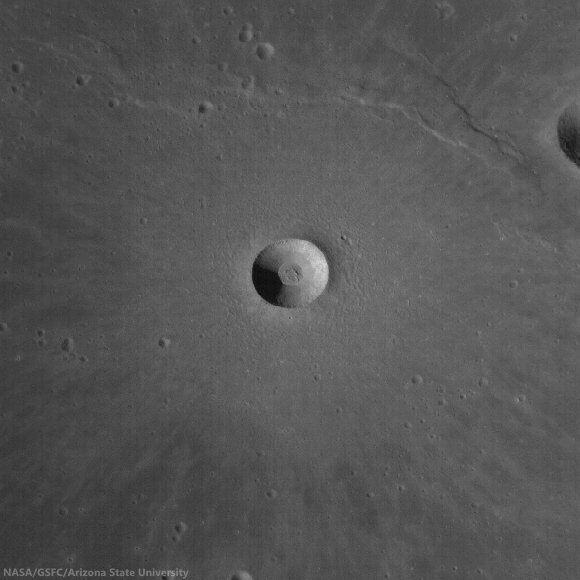
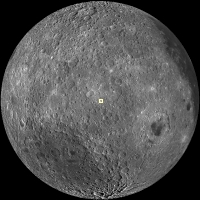

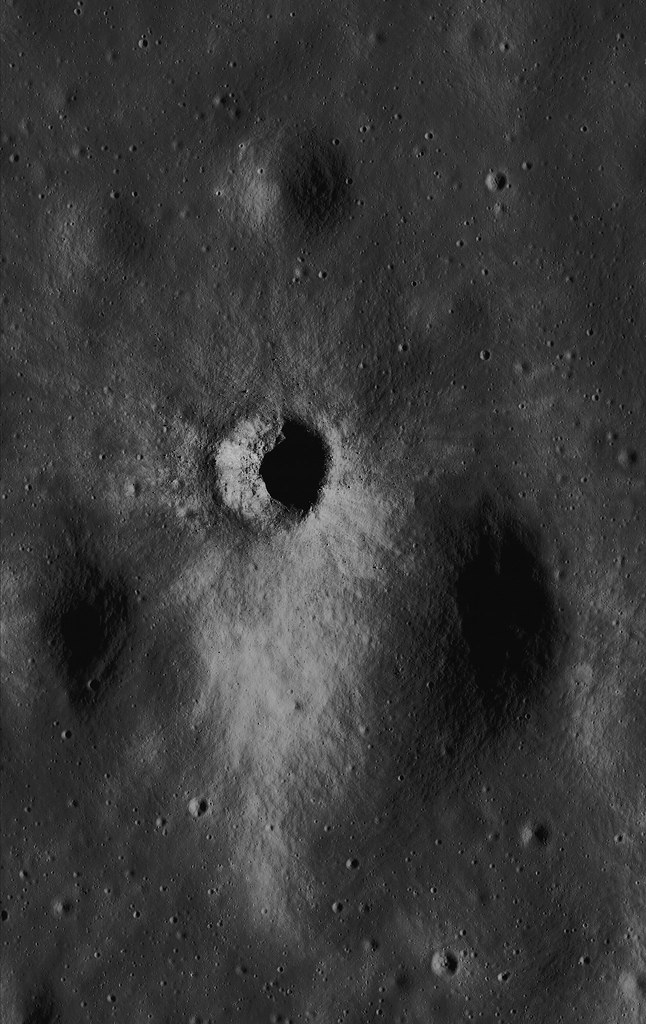
Lichtenberg B (4.86 km; 33.253°N, 298.48°) is a beautifully preserved young impact crater. Rock outcrops in the upper portion of the crater wall are due to the successive thin lava flows that filled Oceanus Procellarum more than 3 billion years ago. LROC NAC mosaic M1162852913LR, LRO orbit 23280, August 16, 2014; incidence angle 35.4° at 1.31 meters resolution, from 129.2 km over 32.46°N, 298.45°E [NASA/GSFC/Arizona State University].
H. Meyer
LROC News System

The lack of atmosphere on the Moon can have its benefits. For example, without an atmosphere, there are few processes to degrade landforms.

On Earth, rain and wind are major causes of erosion, but on the Moon, those causes are absent. Erosion on the Moon is due to impacts that cause shaking and can demolish other craters during formation and to gravity pulling material downslope.

In the case of Lichtenberg B, gravity has not yet rendered the crater smooth and subdued, and there are few impacts nearby, much less any that could have affected the morphology of the crater, as Lichtenberg B appears younger than its neighbors.

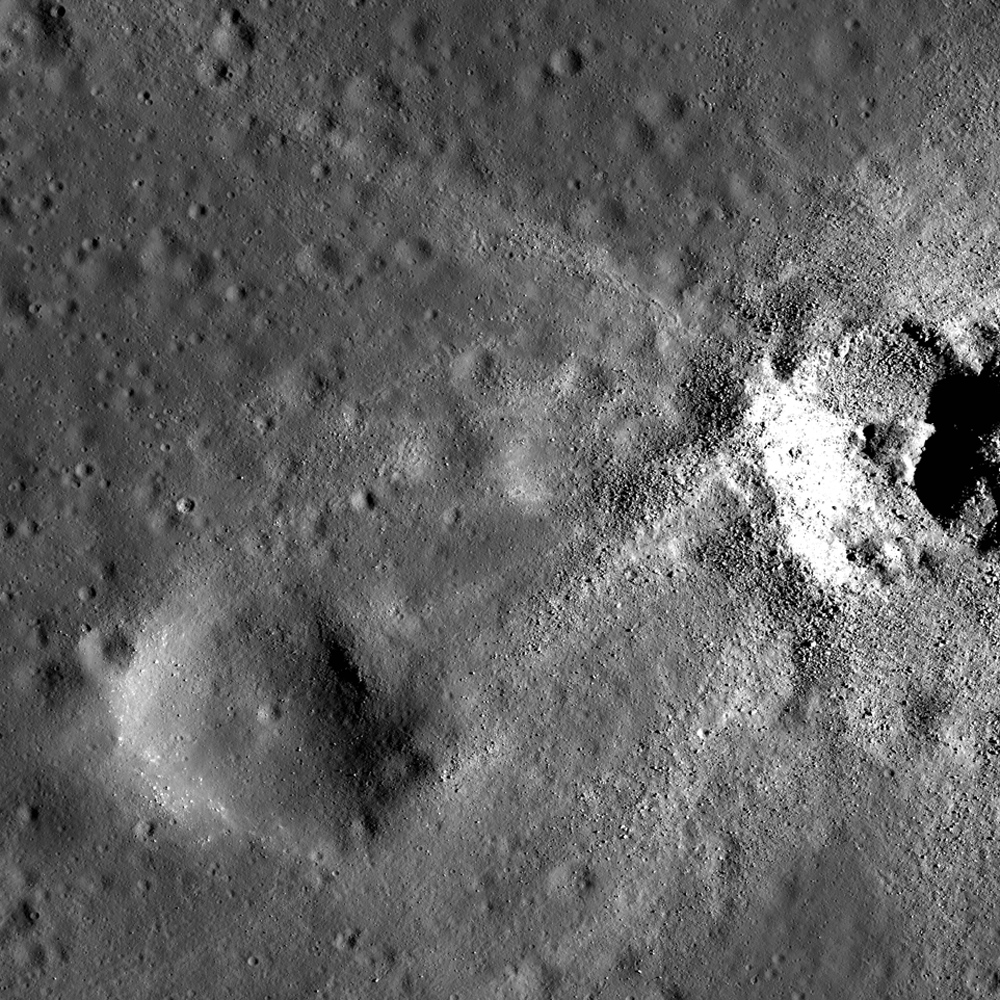
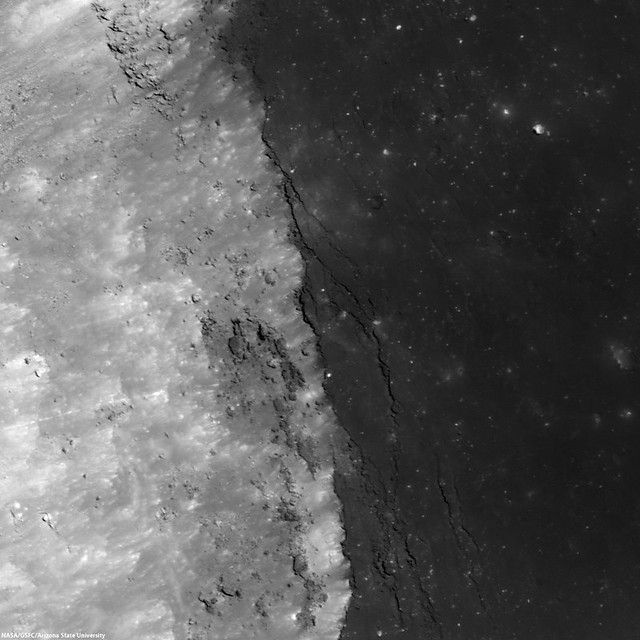
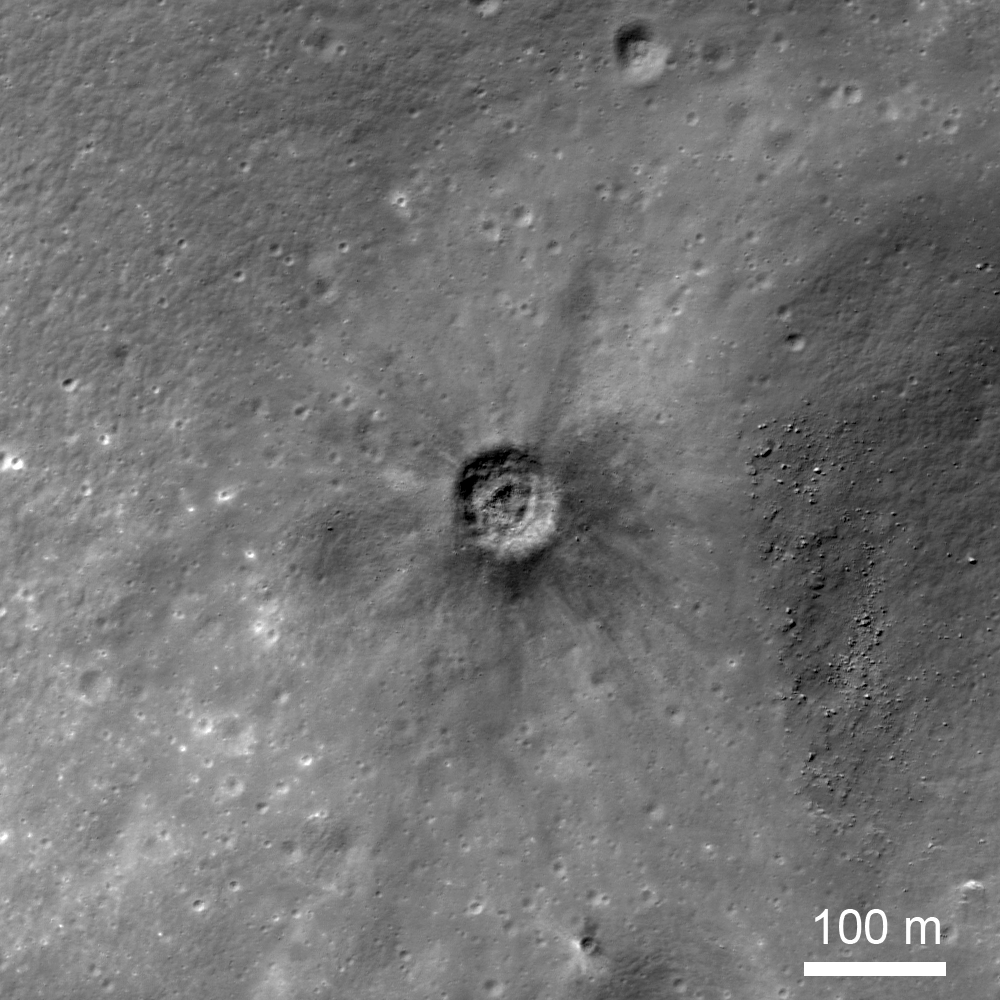
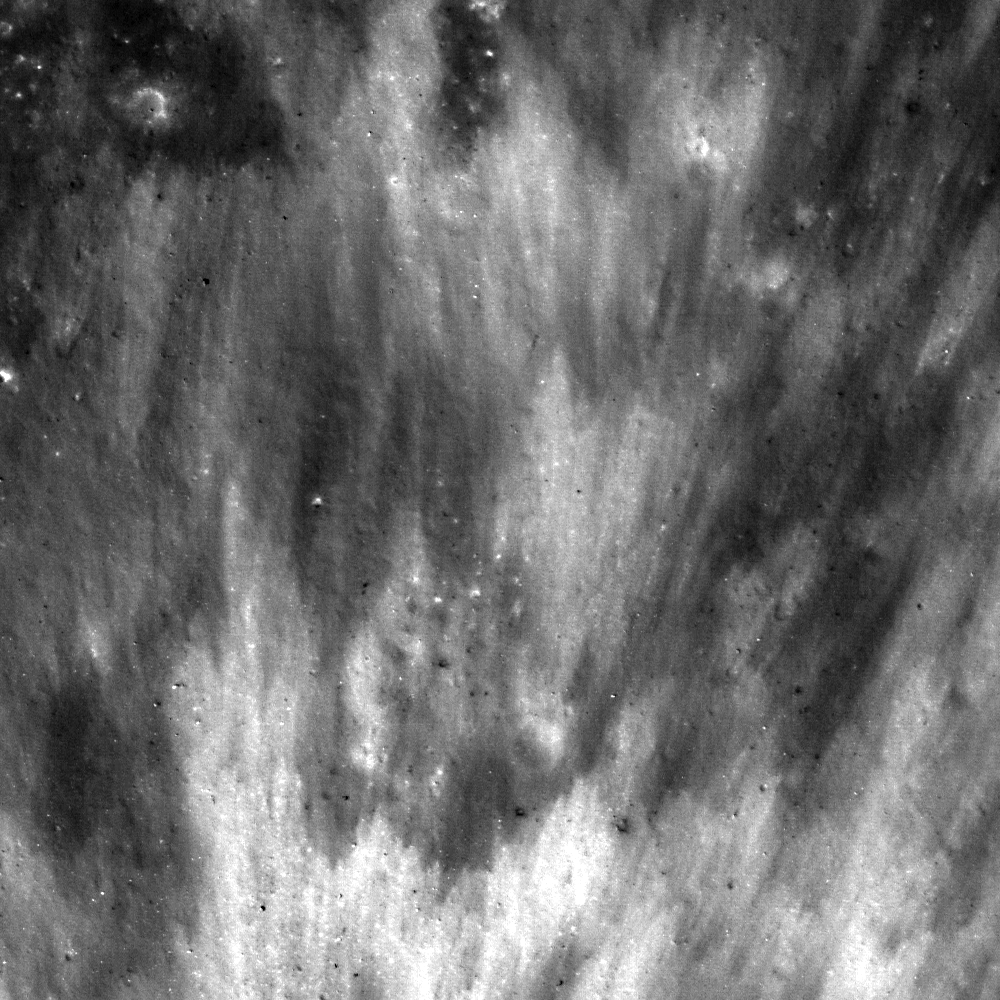
Extreme close-up of the wall and rim of Lichtenberg B wall and rim, just east of south center, where impact melt flowed and formed a channel, pushing boulders aside in the process. This 430 meter field of view illustrated "Lichtenberg B Flow," released December 2, 2011. LROC NAC observation M120257109R, February 8, 2010 [NASA/GSFC/Arizona State University].
On the downside, the lack of atmosphere means that space weathering is more efficient on the Moon, and fresh, highly reflective crater ejecta darkens over time. Because Lichtenberg B's ejecta deposit is still bright, it is quite young.

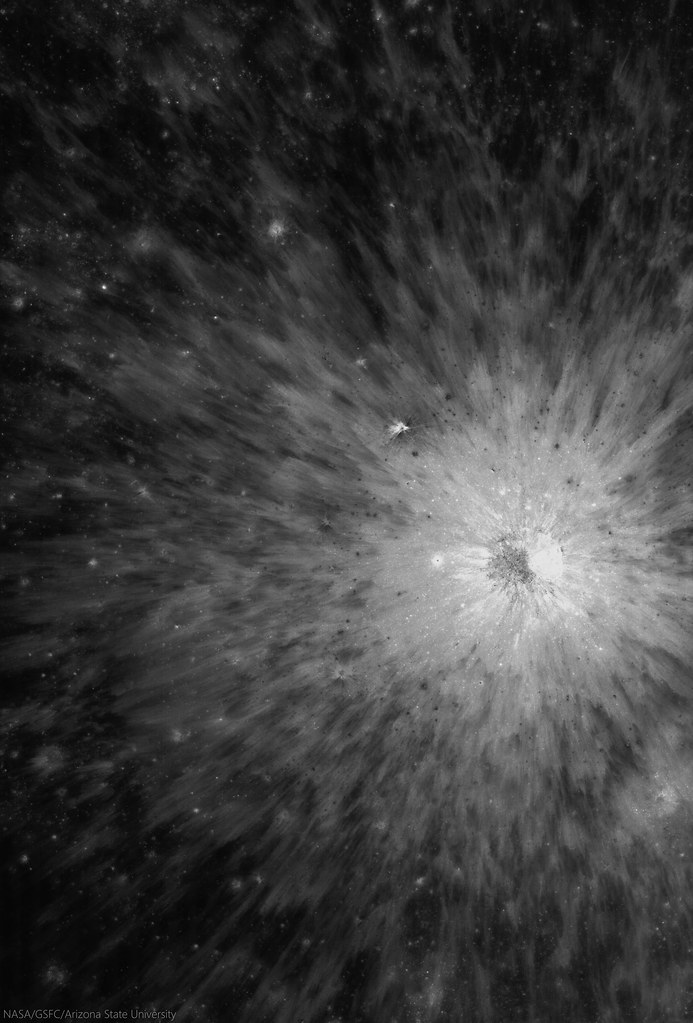
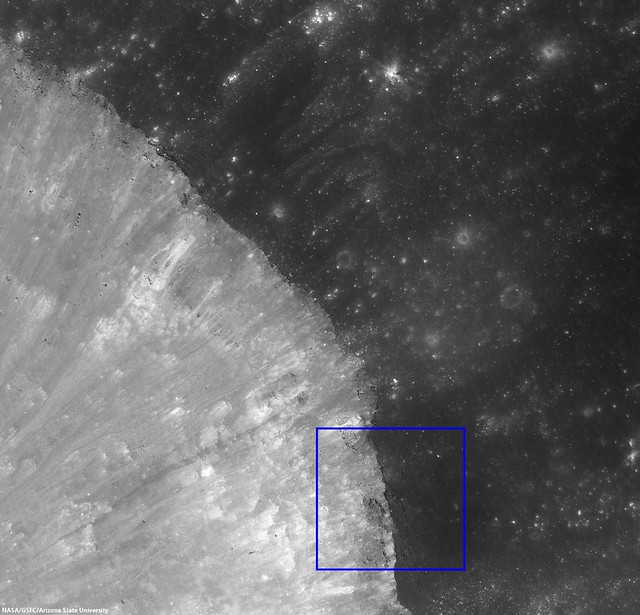
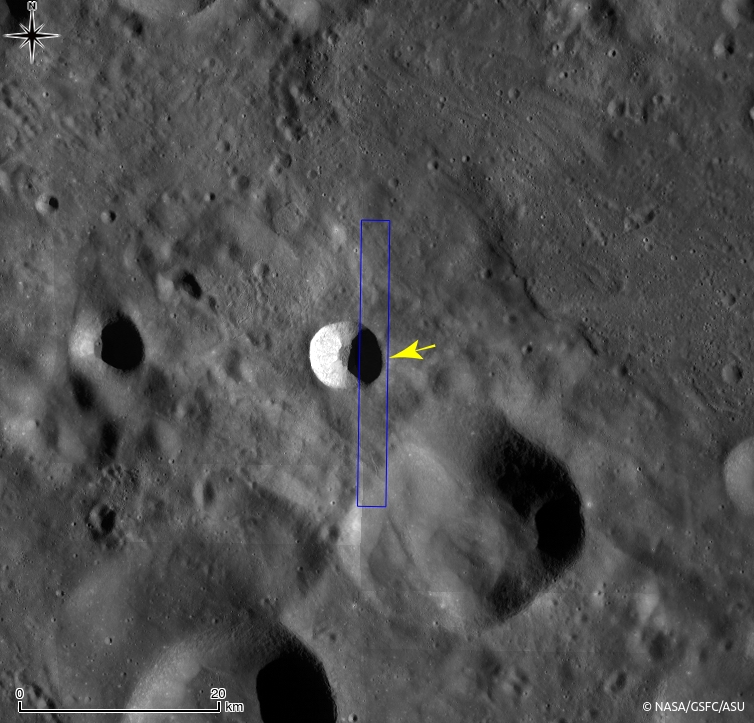
Lichtenberg B and about 56 km-field of view of its surroundings shows an ejecta blanket still highly visible, most than half-way through its long process of optical maturity. LROC monochrome (643 nm) observation M120256944CE, LRO orbit 2856, February 8, 2010; 54.76° incidence angle, 57.42 meters resolution, from 40.39 km [NASA/GSFC/Arizona State University].
Crisp morphology and a highly reflective ejecta deposit make Lichtenberg B stand out from many of the nearby impact craters. This exquisitely preserved crater is located to the northwest of Aristarchus Plateau in Oceanus Procellarum, a vast mare unit littered with impact craters and wrinkle ridges. The ejecta deposit is particularly interesting because it displays a wrinkled texture with structures that resemble dunes.

High-angle (late afternoon) incidence view draws some depth of field to the plains impacted by Lichtenberg B. LROC WAC monochrome (604 nm) mosaic of four observations from sequential passes December 8, 2011; 77° incidence, 56.5 meters resolution from 40 km [NASA/GSFC/Arizona State University].
How do these structures form? What makes Lichtenberg B's ejecta deposit different from other craters that lack these dune-like structures? It turns out that Lichtenberg B is not alone. Scientists have observed these same features at Linné Crater and are in the process of determining how they formed.

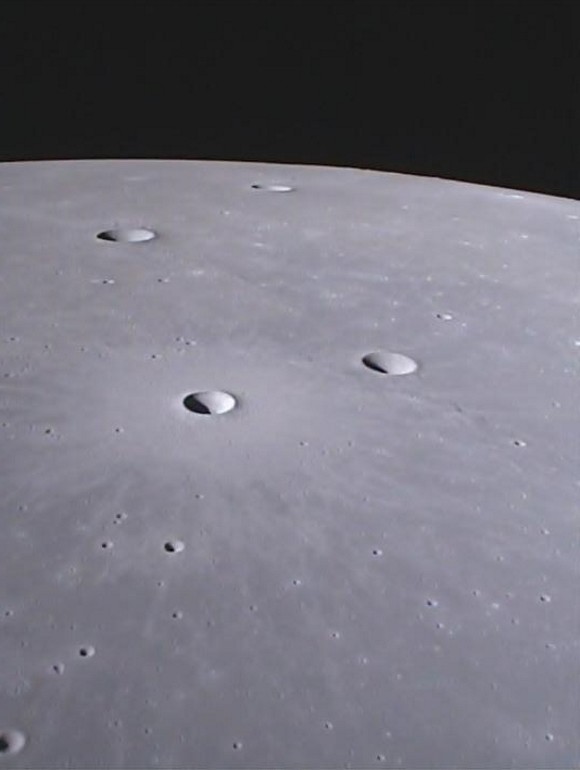
Forward view (north) from GRAIL-A gravity probe Ebb MoonKAM in May 2012, over northwest central Oceanus Procellarum. The maturing ejecta blanket from Lichtenberg B, Dorsum Scilla and Naumann G are in mid-foreground, with Naumann further beyond, and Naumann B (10.72 km; 37.46°N, 299.3°E) is nearer the horizon. ( MoonKAM image 133655 ) [NASA/JPL/SRSC/UCSD].
Check out the full NAC mosaic HERE.

Related Posts:

Tuesday, August 12, 2014

Complimentary craters, south of Maclear

South of Maclear in northwest Mare Tranquillitatis, two complimentary craters of very similar location, size and origin, but additionally of widely different ages. The relentless bombardment of small debris "gardens" the lunar surface at an average rate of 3 mm every 2 million years. In addition to the nearly billion year long cycle of cosmic ray dark-reddening, "space weathering" ages, or "optically matures" the lunar surface at a predictable rate, adding to crater counts and super-positioning another useful tool to the craft of dating lunar features from a distance. LROC NAC observation M131515002R, LRO orbit 4515, June 18, 2010; 79.75° sunrise incidence angle, resolution 85 cm from 40.68 km over 9.09°N, 20.14°E [NASA/GSFC/Arizona State University].
Raquel Nuno
LROC News System

There are several distinguishing properties of craters that help lunar scientists determine their ages. As craters get older their appearance changes through exposure to solar wind bombardment and other impacts (collectively called space weathering), and even gravity has an effect.

Effects of the solar wind lower the reflectance of the surface; so regolith (soil) that was excavated by recent impacts has higher reflectance than the background surface, this is why small young craters have visible crater rays. New impacts pulverize rocks that were ejected during the formation of an older crater and disturb the shape by causing moonquakes. Also, gravity works to alter the shape of a crater by pulling material down its walls in a process called slumping, this causes craters to have a smoother appearance.

1.69 km field of view from LROC NAC Commissioning observation M106748283R, LRO orbit 873, September 5, 2009; 29.84 low-angle incidence, resolution 1.17 meters from 133.64 km over 9.82°N, 20.15°E [NASA/GSFC/Arizona State University].
Today's Featured Image showcases two similarly sized adjacent craters (each ~500 m in diameter) located in Mare Tranquillitatis (see WAC context image below) with very different appearances. The area surrounding the top crater is littered with boulders in all directions. Wheras the more southerly crater has only a few rocks near its rim. Where did the boulders come from in the first place? And did the lower crater originally have boulders?

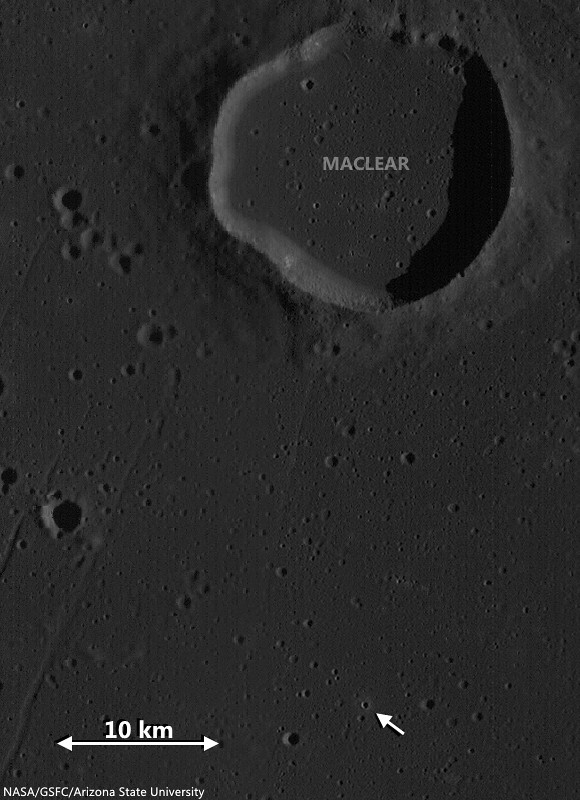
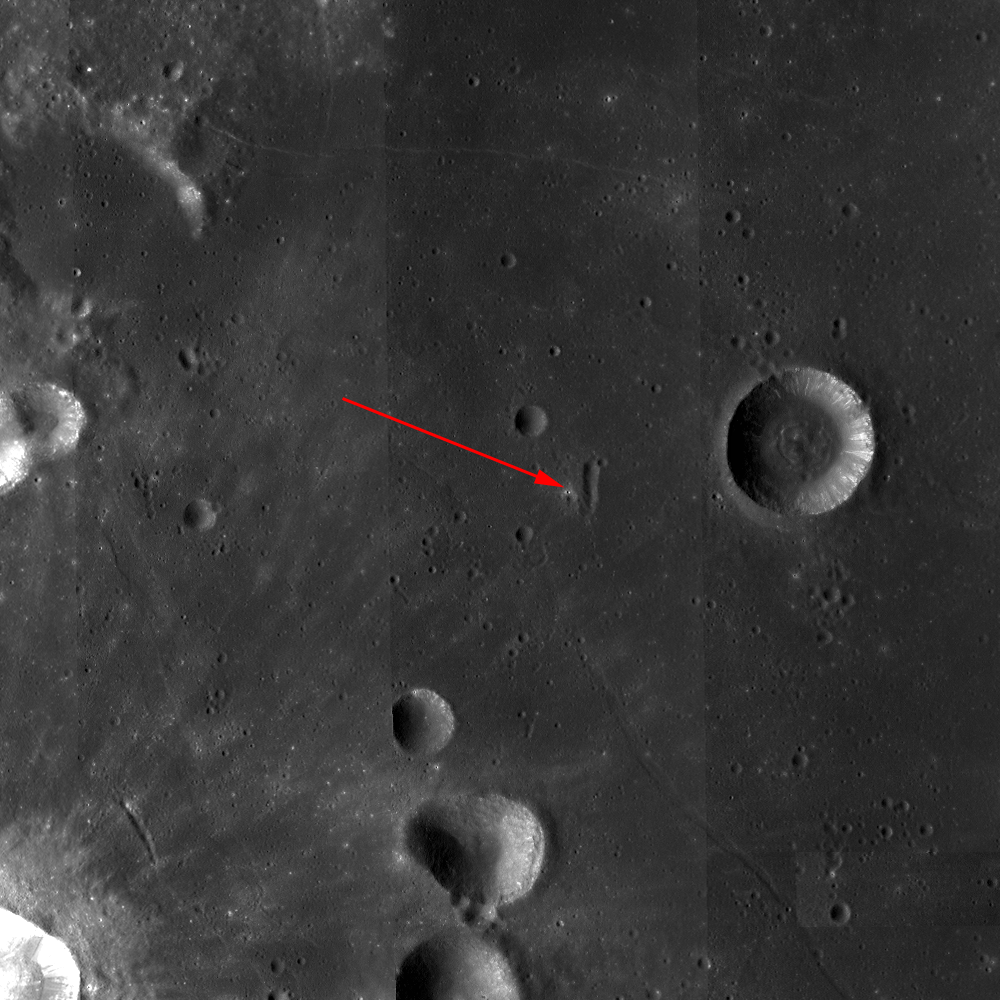
Locating two co-located 500 meter "complimentary craters" (arrow) good for comparing rates of general space weathering, in west-northwest Mare Tranquillitatis. LROC Wide Angle Camera (WAC) monochrome (566 nm) observation M131514941C, captured simultaneous with the NAC observation opportunity shown in the Featured Image at the top of this post. LRO orbit 4515, June 18, 2010; 79.75° incidence, resolution 57.7 meters from 40.72 km over 10.17°N, 20.14°E [NASA/GSFC/Arizona State University].
Since the mare basalt formed from layers of lava that hardened into solid rock, it is likely the boulders are coherent fragments of those thick layers (a few to tens of meters thick) that were broken up and ejected during the impact event. Since these two craters are so close and both formed in the mare it is very likely that the lower crater also had a large grouping of boulders in its ejecta field. The dissimilarity between these two craters is most likely due to age difference. Over time (perhaps a couple of billion years) the original boulders around the lower crater were slowly ground down by micro-meteorite bombardment - think of this process as cosmic sand-blasting! The boulders around the younger crater (top) have not had time to be pulverized by other impacts, but stick around for a billion years and you can watch these boulders slowly disappear!

Explore the full resolution NAC HERE.

Related Posts:

Thursday, August 7, 2014

Dark Halo "Patch" west of Neper D

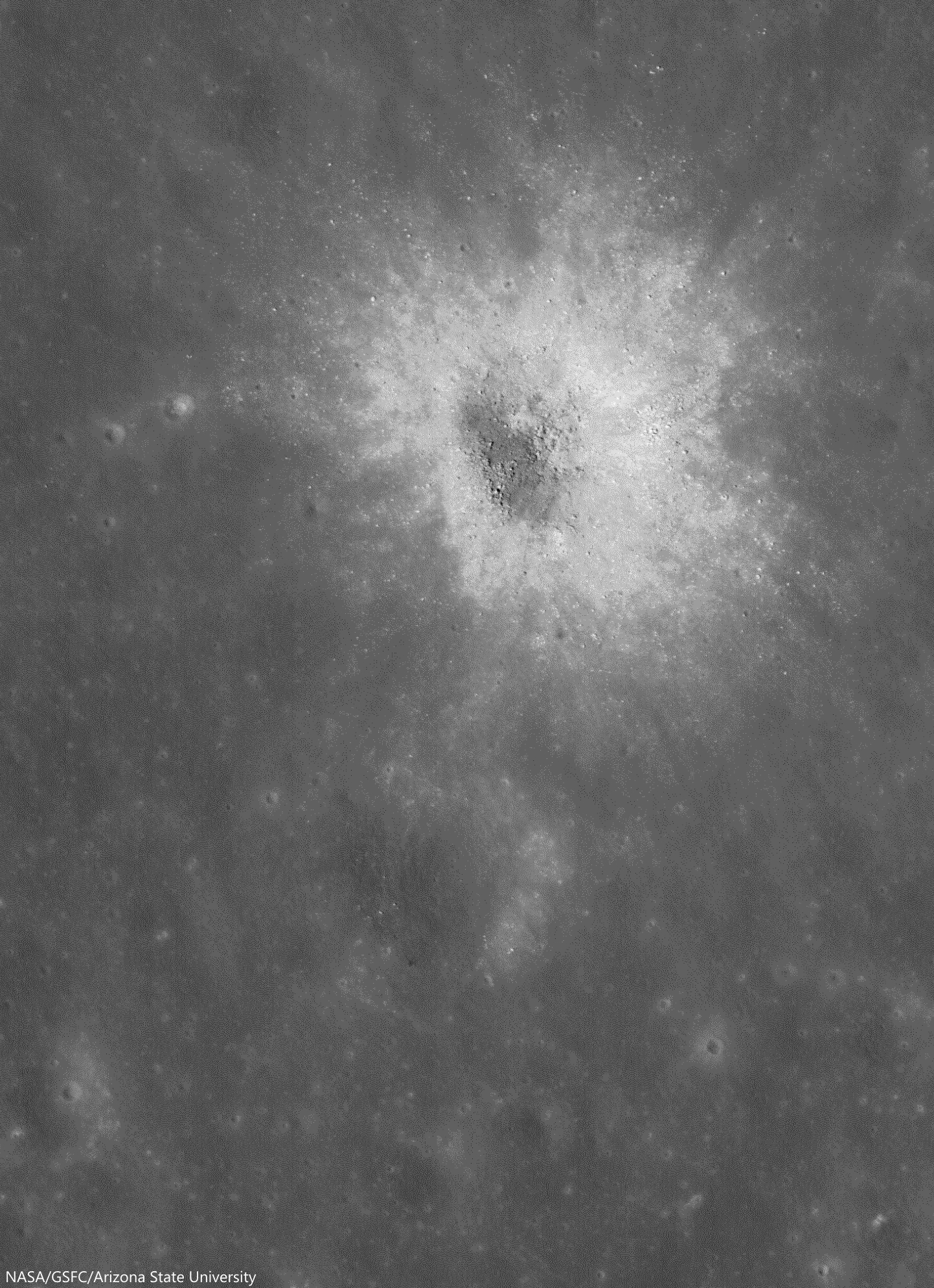
A roughly 470 meter wide, 560 meter long, unusually large and cohesive fan of dark halo ejecta from an unnamed but freshly prominent crater in the Neper group, southwest of Mare Marginis. 1020 meter-wide field of view from LROC NAC observation M1136029635L, LRO orbit 19510, October 10, 2013; 32.5° incidence, resolution 1.17 meters from 116.96 km over 8.73°N, 79.36°E [NASA/GSFC/Arizona State University].
Hiroyuki Sato
LROC News System

Today's Featured Image highlights an odd shape, or texture in impact ejecta. An unnamed, approximately 600 meter-wide fresh crater on a relatively high, far older crater rim, between Mare Marginis and Mare Undarum (9.5122°N, 79.40242°E) hosts teardrop-shaped low reflectance patches in its ejecta, northwest of the crater,

The larger teardrop patch in the opening picture has a sharp boundary along its western edge, perhaps implying a partially elevated surface relative to the surrounding high-reflectance ejecta.

4 km-wide field of view from LROC NAC observation M1136029635L, October 10, 2013 [NASA/GSFC/Arizona State University].
Note the faint high-reflectance ray overlying this patch, indicating that the low reflectance patch was emplaced before the completion of the impact event. Similar dark patches that are smaller and less pronounced are found at the top of the opening image.

How were these peculiar dark patches formed? If these patches are elevated, they could represent preexisting flat dark mounds that were swept by the saltating ejecta materials. Or the excavation of low-reflectance materials by the impact could have been thrown out in one direction and resulting in this unusual patch of ground. If, on the other hand, the patches are topographic lows rather than elevated, these depressions could have simply been shielded as the ejecta passed overhead. It is also possible that the topography of the rim controlled the direction of the outthrown ejecta such that there were "no ejecta" zones that resulted in the dark patches.

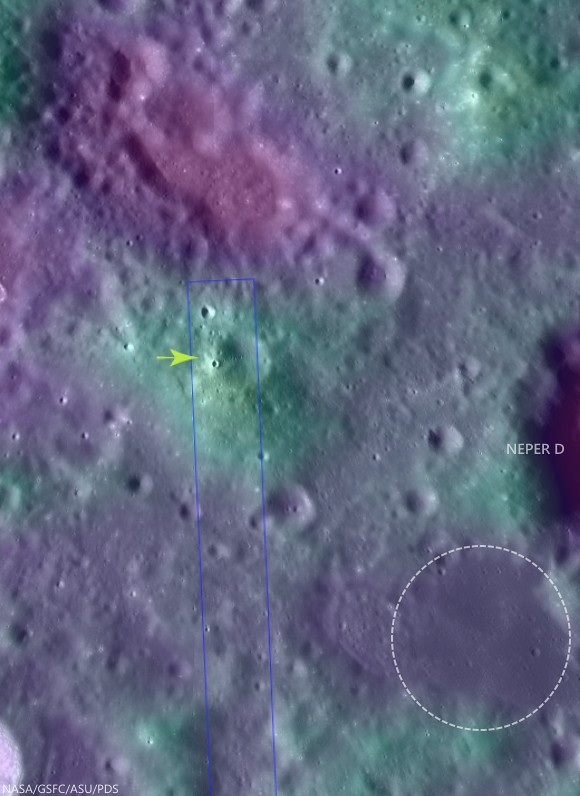
Fifty kilometer-wide field of view of the complex terrain southwest of Mare Marginis, west of Neper and Neper D. The unusually cohesive "fan" of apparent dark halo material from the unnamed relatively fresh 600 meter crater is marked at 9.5122°N, 79.40242°E (arrow) and may indicate the presence of now-buried optically mature material widely distributed in the area. The circle southwest of Neper D is a patch of isolated mare material bright in Clementine iron oxide surveys, often indicative of cryptomare.  Crater counts might eventually determine whether its age and whether or not this area is consistent with Mare Marginis or ejecta from the Crisium impact, or something much older. LROC WAC global 100 meter mosaic over LOLA laser altimetry [NASA/GSFC/ASU/USGS].
High resolution topography would really help unravel this mystery! NAC to the rescue! The LROC targeted this area for upcoming NAC stereo pairs from which meter-scale topography will be extracted. In a few months, we will post the topography and will see if we solved the mystery!

Explore this peculiar dark patch and surrounding terrain in the following full NAC frame, HERE.

Related Posts:

Wednesday, June 25, 2014

Fresh crater in Campbell, north of Mare Moscoviense

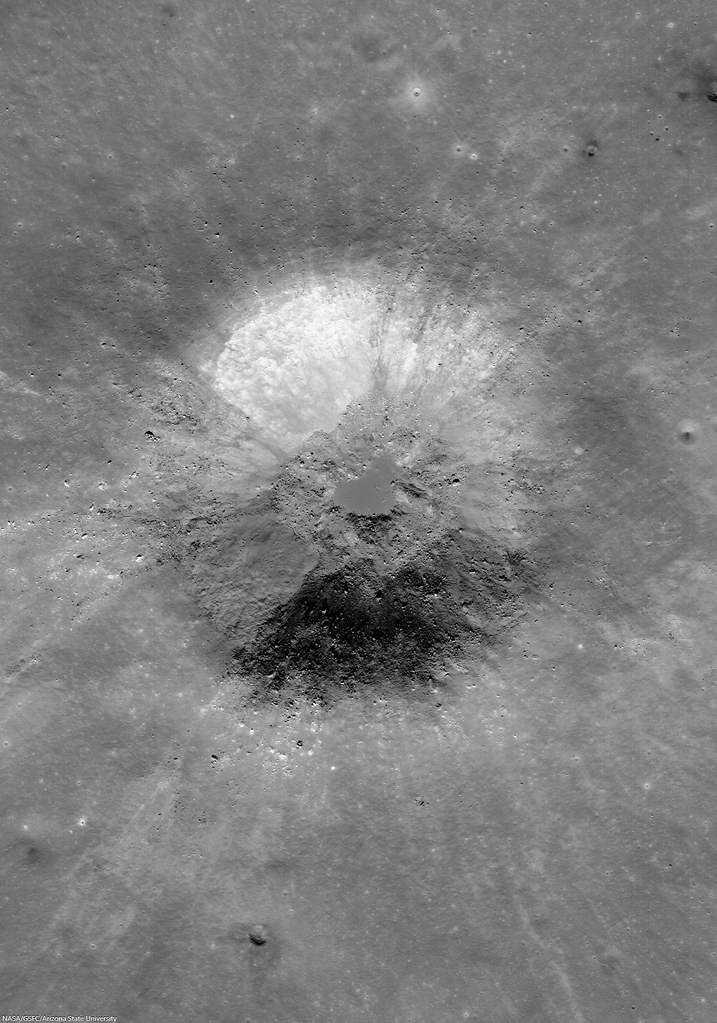
Very fresh roughly 4 km crater deep inside ancient, 222 km Campbell crater, north of Wiener F and Mare Moscoviense. Note the paucity of small craters on the melt disk on this young crater's floor, one of many clues to a recent origin.  LROC NAC mosaic M1133199962LR, LRO orbit 19112, September 7, 2013; 4.28° incidence, resolution 1.11 meters from 148.28 km over 46°N, 150.87°E [NASA/GSFC/Arizona State University].
H. Meyer
LROC News System

The longer a crater's ejecta is exposed to space weathering, the lower the albedo of the ejecta becomes.

Over time, gravity also takes effect, pulling material downslope and softening the appearance of the crater rim and the hummocky ejecta deposit.

Therefore, craters with highly textured, high albedo ejecta and crisp, well-defined rims are considered relatively fresh, like the crater above (46.188°N, 150.717°E), deep within the ancient farside crater Campbell.

In this case, the slightly asymmetric ejecta blanket is likely due to the fact that this crater formed on top of existing topographic highs, which appear to be the intersecting rims of partially flooded craters.
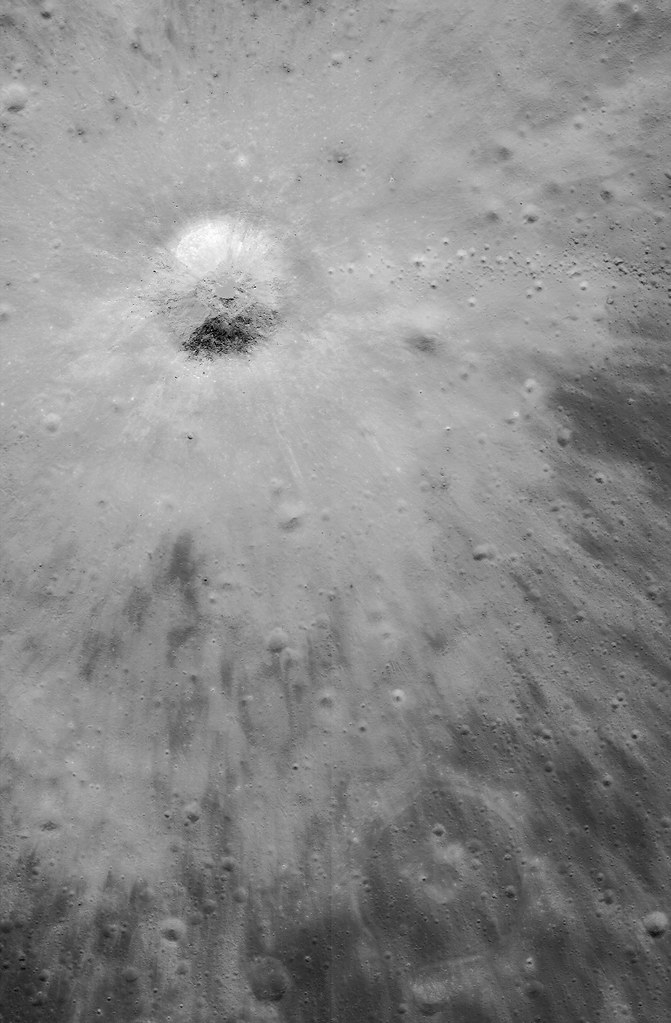
Bright, optically immature ejecta blanket, from the fresh crater is like a bright fan of farside anorthositic highlands terrain spread over an iron rich optically mature patch of mare deep inside ancient Campbell crater. Note the string of secondary crater east of the impact (and the nearly mare-inundated "ghost crater," on the edge of the ejecta blanket at bottom right). A larger 10.74 km-wide field of view, from the same, low incidence angle LROC NAC mosaic. [NASA/GSFC/Arizona State University].
The crater in the opening image is located in the floor of the much larger, much older crater Campbell (See WAC animation below). Campbell, named after two American astronomers, is an interesting study in its own right.

A portion of the floor of Campbell has been resurfaced by basaltic volcanism, an uncommon occurrence on the lunar farside. In this case, the volcanic activity did not produce sufficient lava to completely cover all of the craters in the floor, leaving traces of flooded craters like the one at lower right, on the edge of the ejecta blanket, in the NAC field of view above.

Campbell (222 km; 45.57° 152.9°E), in the farside highlands, almost disappears under certain conditions, because much of the wider region here has been relentlessly bombarded with predominantly iron nuclei, and "gardened" at a rate of 3 cm every two million years since the terrain first assumed its general shape. This animation shows the footprints of both LROC NAC observations used in this posting, above and below, of the fresh crater and immediate surroundings, near a boundary of basalt melt inside Campbell. From LROC WAC-derived 100-meter global mosaic, GLD100 elevation model and natural colors at normalized albedo, plus color-ratio analysis from Clementine (1994) [NASA/GSFC/Arizona State University].
Flooded craters are useful to scientists trying to determine the timing and sequence of events in areas that display multiple geologic processes in close proximity, such as impacts and volcanic activity.
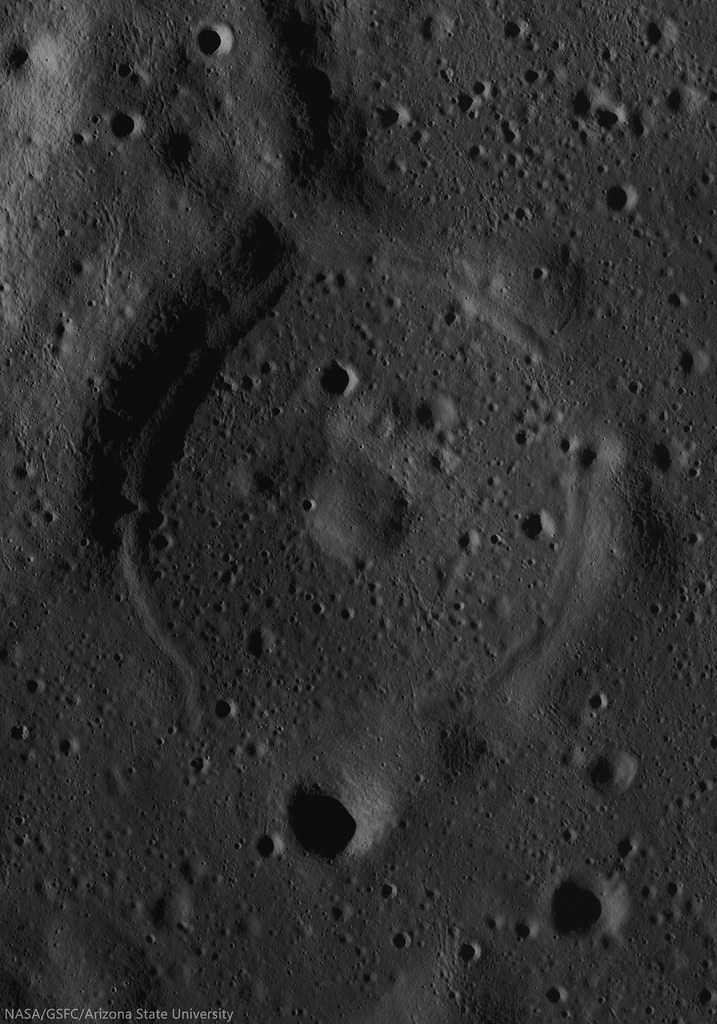
An ephemeral ghost crater stands out in the depth of field resumed in long evening shadow, though the reflectivity of the ejecta from the fresh crater toward the north-northwest is still slightly traced out. A 5.77 km-wide field of view from M180187723LR, LRO orbit 11676, January 2, 2012; 81.93° evening incidence angle, 1.71 meters resolution from 176.17 km over 45.93°N, 151.34°E [NASA/GSFC/Arizona State University].
Because we can see partially flooded craters, we know that the crater Campbell must have existed long enough for new craters to form on its floor before volcanic activity began.

Understanding the Moon requires orbital photography at every angle of illumination. A full-width 16.47 km-wide field of view from M180187723LR  [NASA/GSFC/Arizona State University].
The fresh crater from Today's Featured Image adds another point of reference because its ejecta drapes the nearby mare deposit, making it the most recent addition to this region's geologic history.
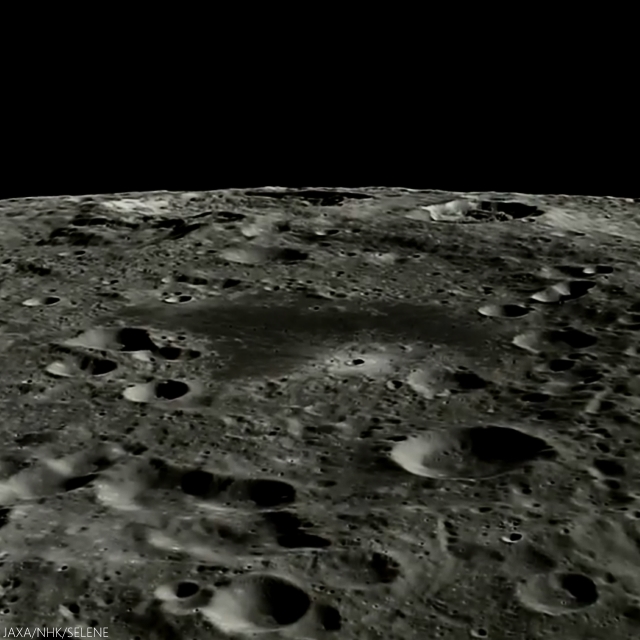
The western two-thirds of Campbell are more difficult to discern from polar orbit, but our bright fresh crater perched on the north of its small plain of mare basalt are easy to pick out, looking south from Japan's lunar orbiter Kaguya in 2008. This image is taken from just past the halfway point in the HDTV sequential still video below, from approximately 120 km overhead [JAXA/HKT/SELENE].

As noted in the YouTube video, presented by the Japan's space agency JAXA, Campbell is immediately north of Von Neumann and Wiener craters (on Campbell's southeast and southwest, respectively). Between these two craters, unnoted however, is Wiener F, with it's distinctive semi-circular bench of impact melt, discussed in more detail HERE.

Explore the full NAC mosaic, HERE.

Related Posts:

Tuesday, June 10, 2014

Ready-made excavations near Lucretius C

Self-secondary of a bright, relatively fresh crater northwest of Mare Orientale, in the wider highlands greatly affected by that basin-forming impact. The unnamed primary crater (between Lucretius C and Grachev craters, see below) is visible from a great altitude because of its relative low optical maturity. Full-resolution, 530 meter-wide field of view from LROC NAC observation M1132582647R, LRO orbit 19028, August 31, 2013; 9.47° incidence angle, resolution 92 cm, from 106.13 km over 3.09°S, 246.92°E [NASA/GSFC/Arizona State University].
Hiroyuki Sato
LROC News System

Today's Featured Image highlights the spectacular fresh ejecta from an unnamed crater (1.05 km; 3.06°S, 297°E), approximately 750 km northwest of Mare Orientale.

Subsequent impacts (possibly including self-secondaries) excavate through the ejecta sheet, leaving small craters, mostly less than 50 meters in diameter, and tiny ejecta splashes.

Some are lower and others are higher in reflectance than their surroundings, resulting in a variety of contrasts against the bright, optically immature ejecta field of the primary crater. 

Bright, relatively fresh primary to highlighted secondary crater at upper left northwest of Orientale basin, between Lucretius C and Grachev. 4.54 km-wide field of view from full-width of LROC NAC observation M1132582647R, visible HERE. [NASA/GSFC/Arizona State University].
In the opening image, many small high reflectance craters (~10 m) are clustered at the lower right side of the image, while nearby mid-sized craters (~50 m) are darker than their surroundings. The largest crater's ejecta (center-left in this image) is composed of two layers, the brighter layer on top of the darker layer.

Full-width mosaic, 13.357 km-wide field of view from a mosaic of both the left and right frames of LROC observation M1132582647.   Larger reproductions are available HERE [NASA/GSFC/Arizona State University].
These reflectance variations are likely due to the different excavation depths into the low and high reflectance surface and subsurface deposits. The mid-sized craters probably reached the original low reflectance materials below the upper higher reflectance ejecta sheet (from the unnamed ~1km diameter crater). The largest crater likely excavated high reflectance substrate that is also exposed on the unnamed crater's wall. 

250 meter resolution view shows the high visibility of the small crater of interest (1.05 km; 3.03°S, 297°E), against the ancient highlands, deeply scared by the energy of the Orientale basin-forming-impact. LROC Quickman WAC natural color beta over 100 meter global mosaic [NASA/GSFC/Arizona State University].
Context for high resolution LROC NAC view of bright fresh 1.05 km crater (3.06°S, 297°E) northwest of Mare Orientale [NASA/GSFC/SVS/Arizona State University].
Impacts serve as a natural excavation process which helps us to glimpse into the otherwise unreachable geological layers on the Moon. 

View full-width mosaic, HERE.

Related Posts

Friday, March 21, 2014

Lacus Autumni

Fresh and not-so-fresh craters on the basalt plain of Lacus Autumni, a pool of volcanic material solidified between the concentric rings of Orientale basin. Field of view from a mosaic of the left and right frames of LROC NAC observation M114498609, LRO orbit 2007, December 3, 2009; resolution 51 cm per pixel, incidence 62.57° from 48.44 km [NASA/GSFC/Arizona State University].
H. Meyer
LROC News System

This exquisite crater formed when an impactor crashed into the mare pond called Lacus Autumni. Angular blocks, which erode over time and gradually disappear, littering the terrain both within the crater and outside of it.

Though the margins of the crater are crisp and distinct, it has a lumpy appearance that is probably due to the coherence of the target material.

The ejecta of the crater has a slightly higher reflectance relative to the mare in which it is found. High-reflectance ejecta can represent recently exposed material that has not been affected by space weathering processes, called maturity rays, or material that is compositionally distinct from its surroundings, called compositional rays. Due to its crisp appearance and the predominance of blocks, we interpret this as a young, fresh crater, so the rays are likely maturity rays.

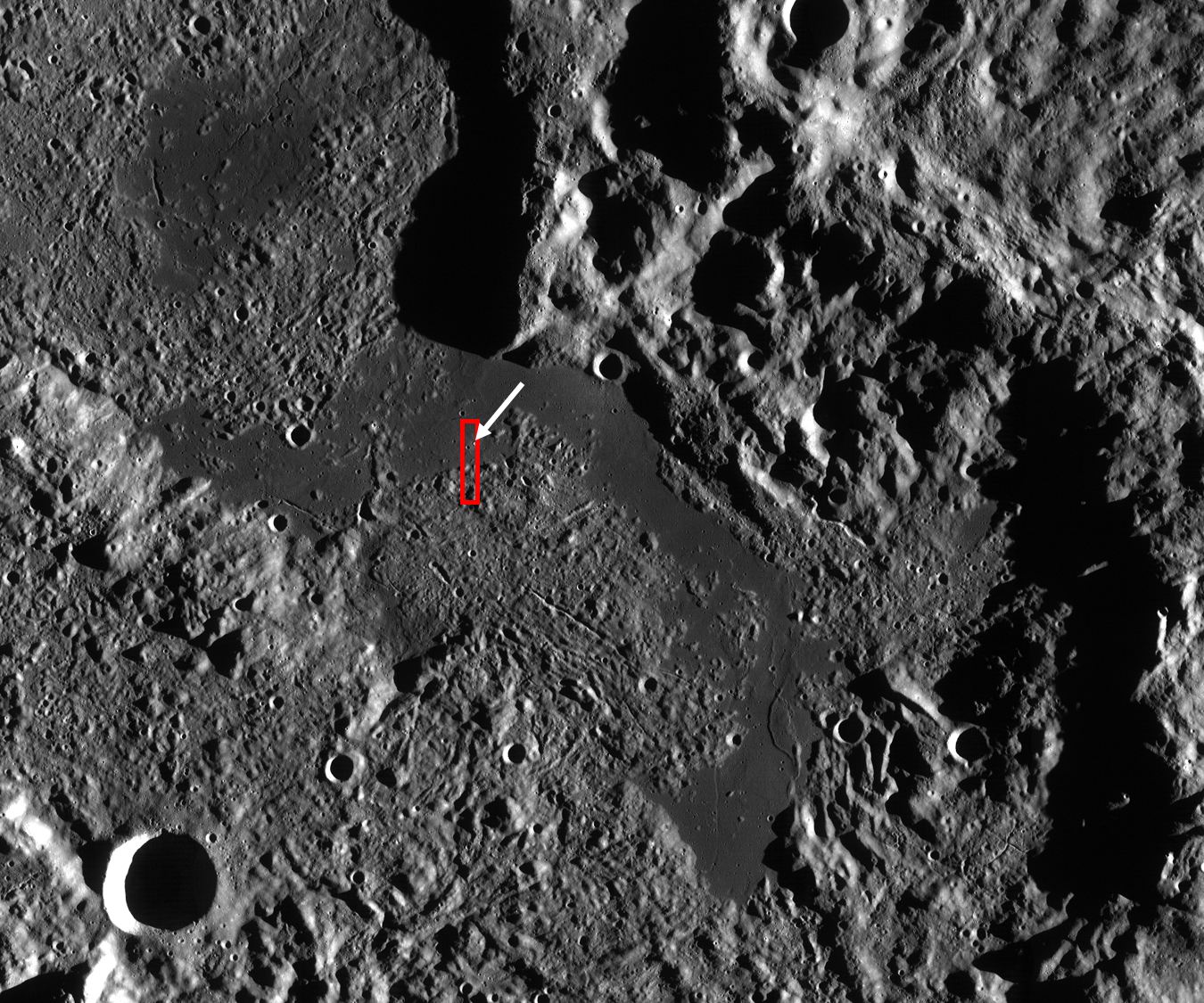
LROC WAC mosaic of Lacus Autumni, context for the LROC Featured Image. Red box outlines the the full LROC NAC field of view from LROC observation M114498609, orbit 2007, December 3, 2009. The white arrows points to the location of the fresh crater. Field of view above approximately 160 km across [NASA/GSFC/Arizona State University].
Lacus Autumni (or "Autumn Lake"), along with Lacus Veris and Mare Orientale, is a mare pond located in the northeast portion of the Orientale Basin. It lies between the Orientale inner ring (Montes Rook) and outer ring (Montes Cordillera). When craters form in thin mare sometimes high-reflectance highlands material is excavated from depth, which makes it difficult to differentiate between maturity rays and compositional rays. To resolve this issue, we can look at the composition of the material that was excavated, looking specifically at both iron and titanium maps.

Nestled in a valley between the inner and outer Orientale impact basin rings, Lacus Autumni is seen here at high relief of sunset shadows. Mosaic of LROC WAC observations from orbits 4786 through 4791, July 9, 2010; Uncropped field of view (very roughly) 205 km across, at an average resolution 68 meters, incidence 80° from 49 km. View the full-size original HERE [NASA/GSFC/Arizona State University].
If the rays are indistinguishable from the mare in which the crater formed, then we can conclude that they are highly reflective because they are young and unweathered. If the rays are composed of highlands material, the rays are likely compositional rays.

If the crater excavated highlands material from beneath the mare, then we can estimate the thickness of the mare deposit and determine just how much lava was extruded onto the surface when the mare formed. In the case of compositional rays, the morphology of the crater, such as a crisp rim or peak, is an indicator of the age of the crater.

The crater rays in this LROC Featured Image are indistinguishable from the mare in which they are found, so these are indeed maturity rays.

Explore more of Lacus Autumni, HERE.

Related Posts:
Fresh Bench Crater in Oceanus Procellarum
A Gathering in Lacus Mortis
Shield Volcanoes in Lacus Veris
Unnamed Fresh Crater Northeast of Arago (DTM)
New Crater!

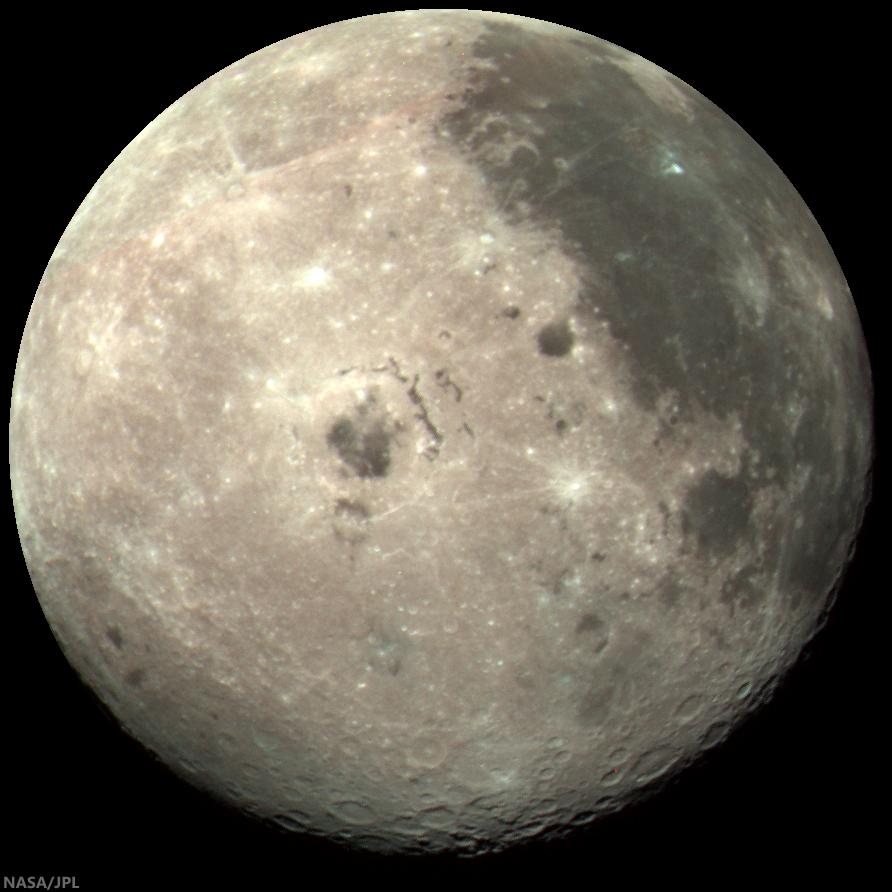
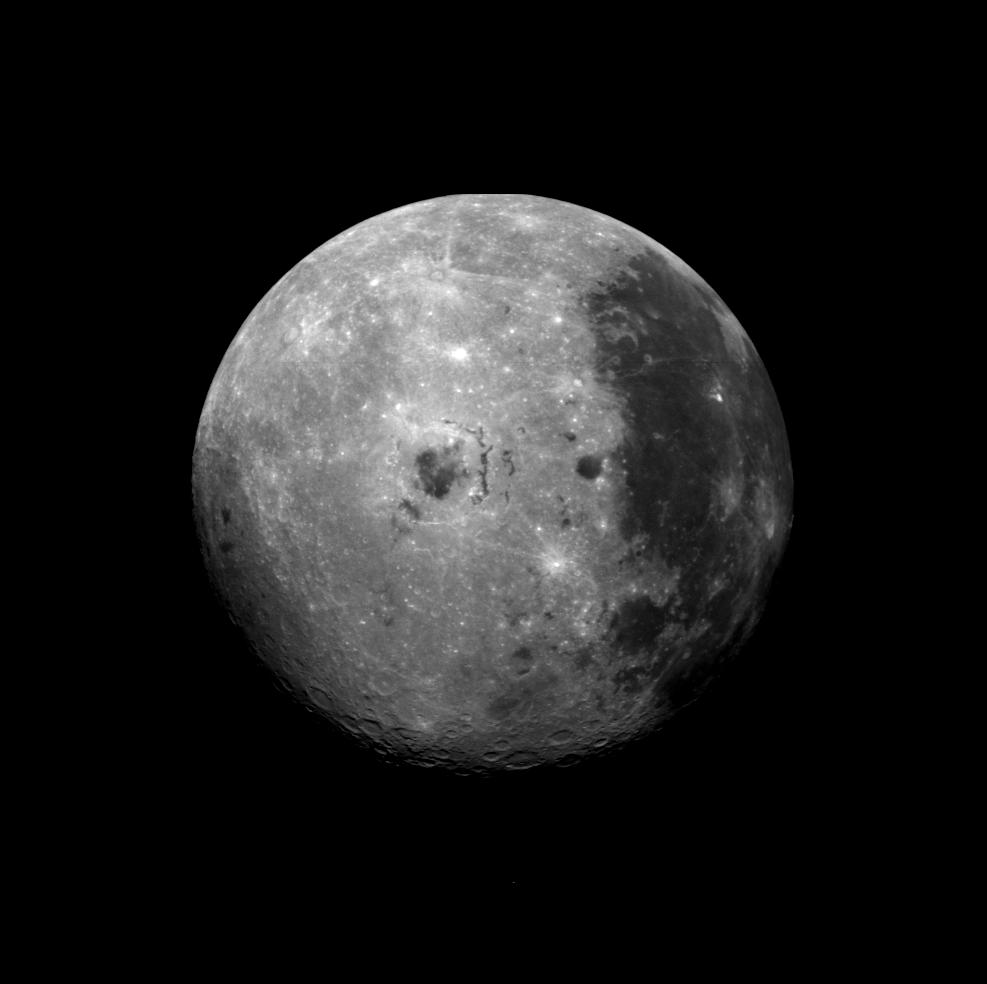
A well-known composite color image of the Moon's western hemisphere centered just below Lacus Autumni, northeast of Mare Orientale, captured by the Galileo spacecraft while maneuvering out of the inner solar system on its way to Jupiter, at 1735 UT  December 9, 1990, from roughly 560,000 km away. The color composite was stacked from monochrome images taken through violet, red, and near-infrared filters. The Moon's nearside is to the right, the far side to the left [NASA/JPL].

Tuesday, December 3, 2013

Smattering of Self-Secondaries

Self-secondary craters in ejecta
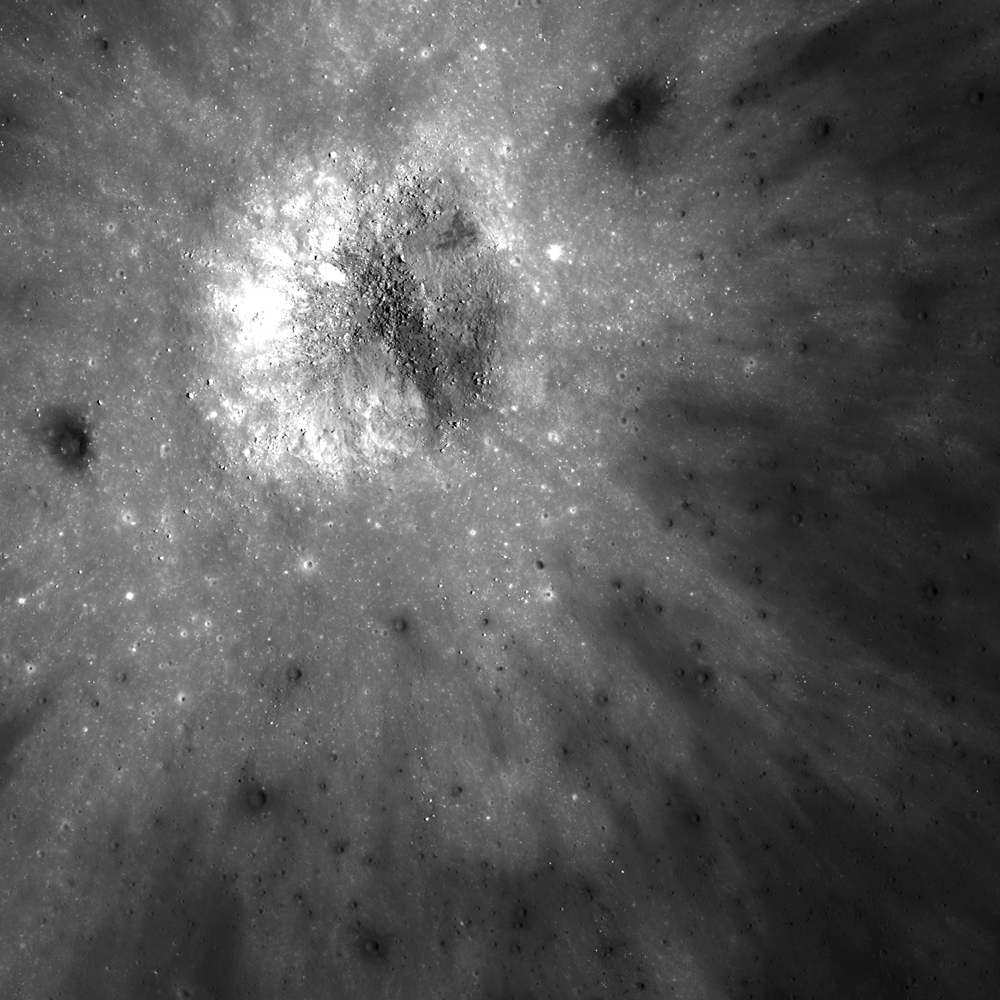
Self-secondaries within the ejecta blanket of a fresh crater. A roughly 2500 meter-wide field of view from LROC Narrow Angle Camera (NAC) observation M1120683999L, LRO orbit 17351, angle of incidence 34.85° at 0.88 meters per pixel resolution from 97 km over 2.21°S, 84.85°E, central Mare Smythii [NASA/GSFC/Arizona State University].
Sarah Braden
LROC News System

Today's Featured Image highlights a small (830 meter) fresh impact crater (located at 2.017°S, 84.948°E) with an ejecta blanket peppered with smaller impact craters. Two of the largest superposed impact craters excavated lower reflectance material (darker) from beneath the main ejecta blanket. This low reflectance material is more mature than the primary crater ejecta. The ejecta from the primary impact is higher reflectance since it is immature material that has not been darkened by space weathering processes. Some of the small impacts have higher reflectance ejecta, which means they did not puncture through the fresh primary crater ejecta blanket.

The craters seen in the Featured Image are a mix of self-secondary and small primary impacts. The term secondary crater describes impact craters formed by ejecta materials from larger impacts. Self-secondary craters form as late stage ejecta is superposed on early ejecta material from the same impact event and are for the most part found near the primary impact crater. The velocity of ejected material increases with distance from the primary crater; therefore, most self-secondary craters are created by low-velocity impacts. Secondary craters formed furthest from the primary crater result from higher velocity ejecta, which makes those secondary craters harder to discern from small primary craters. Secondary craters on the Moon are estimated to have a maximum size of ~4% of the primary crater diameter.

Planetary scientists use the density of craters on impact ejecta as an indicator of age of the impact, based on our understanding of the flux of primary impacts over time. Self-secondaries on crater ejecta are not primary impact craters and inclusion of self-secondary impacts in a measurement will give a higher crater density, and thus result in an older age estimate for that particular surface. The age estimate for the impact crater Giordano Bruno is an example where self-secondaries complicate our understanding of the relationship between surface age and crater density.  

LROC WAC Haldane and Talbot (Context)
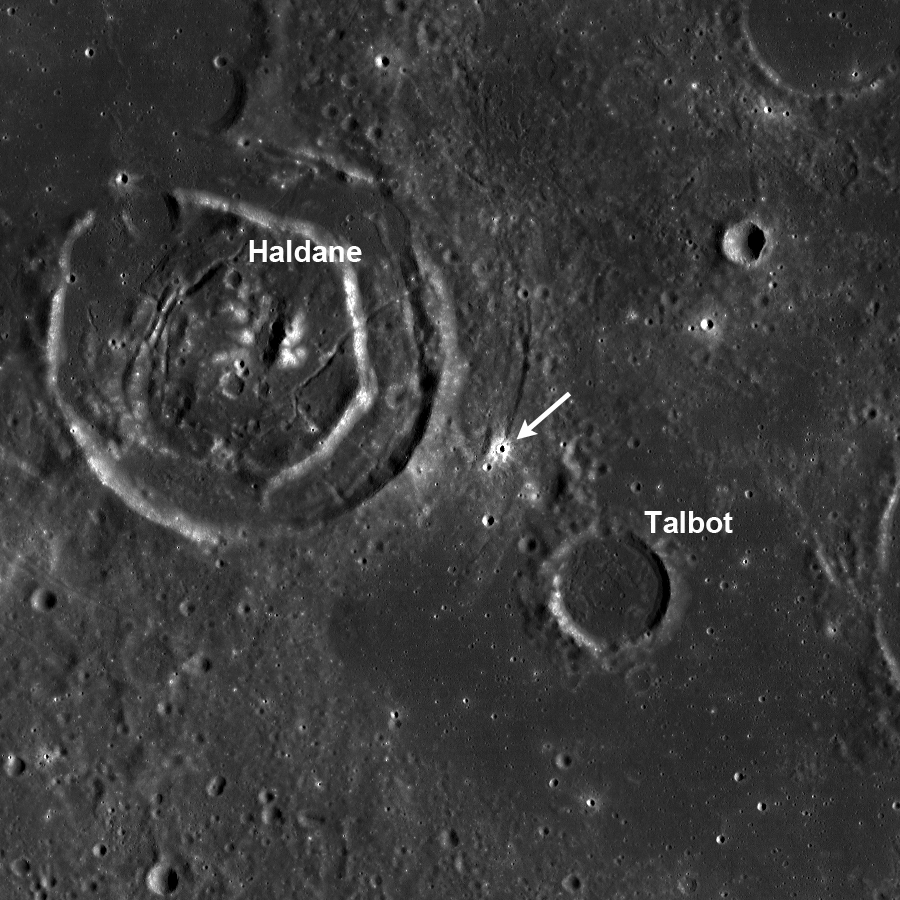
LROC WAC 643 nm reflectance mosaic of the area surrounding the fresh crater in the Featured Image (white arrow) [NASA/GSFC/Arizona State University].
The fresh impact crater in today's Featured Image is between two relatively older craters: Haldane (40 km diameter) and Talbot (12.4 km diameter). The crater Talbot has a visible rim, but the ejecta blanket was embayed by mare basalt. Talbot's floor is flooded with mare basalt as well. Haldane is also as old or older than Talbot since sections of Haldane's rim are completely destroyed.

Explore the full NAC image, HERE.

Related LROC Featured Images:
Polka-dot Ejecta
Action Shot
Impact Art
Ejecta sweeps the surface

HDTV-Mare-Smythii
HDTV still from Japan's lunar orbiter SELENE-1 (Kaguya, 2007) captured the western interior of Mare Smythii, straddling the libration zone between the Moon's near and far sides. The small, fresh crater of interest (east-southeast of Haldane, on the lower far right) is not as readily visible at high (sunrise) solar illumination angles. From Earth, the Moon was a thin, early evening crescent [JAXA/NHK/SELENE].

Thursday, November 28, 2013

Excavation of a Thin Dark Layer in Hertzsprung

M156102528L
Eastern rim of an unnamed young crater. LROC NAC M156102528L; image center 4.072°S, 227.294°E; image width is 590 m; incidence angle is 7.2°, illuminated from right side [NASA/GSFC/Arizona State University].
Hiroyuki Sato
LROC News System

Today's Featured Image highlights the eastern rim of an unnamed young crater (about 6.8 km in diameter), observed in the farside highlands, 218 km southwest from the center of Hertzsprung crater (587 km in diameter). The higher reflectance area (left side of image) is the crater wall inside the crater cavity, and the low reflectance area (right side of image) is the outer surface of the crater, covered by a layer of dark impact melt deposits (see next NAC context view). The low incidence angle (Sun overhead, 7.2° from vertical) enhances the strong reflectance contrast between the fresh anorthosite-rich outcrops on the crater wall and fresh impact melt rocks on the crater exterior. During the cratering process, impact melt was ejected from the crater and placed on the crater exterior, forming a thin layer, or veneer, which solidified into solid rock as it cooled.

M156102528L_context2-977x939
A NAC context view, highlighting the impact melts along northeastern rim of the unnamed crater. Blue box indicates the location of the LROC Featured Image, released November 27, 2013 [NASA/GSFC/Arizona State University].
M156102528RL-NSJ-0704-9112-5891-5800x9130
Full 5.4 km-wide field of view from full-width mosaic of the left and right frames from LROC Narrow Angle Camera (NAC) observation M156102528RL, LRO orbit 8138, March 30, 2011; angle of incidence 7.23° at 59 cm per pixel resolution from 56.8 km [NASA/GSFC/Arizona State University].

As the crater wall collapses with time, the exterior melt veneer is fractured and collapses into the crater, as seen in the center of the opening image. From the very narrow shadows (2~3 pixels) along the boundaries between the melt layer and the crater wall, the thickness of the melt sheet can be roughly estimated to be 9 to 14 m. The thickness of the impact melt deposits near the crater rim crest is controlled by the viscosity of the melt and local slopes. In addition, melt splashing out of the crater with a high ejection velocity may form thinner melt veneer deposits. High resolution NAC images allow us to examine the changes in melt thickness as impact melt flowed away from the crater, telling part of the story of the spectacular moment of this impact cratering event.

M156102528L_context-754x723
Synoptic view of the unnamed young crater and surrounding areas in LROC WAC monochrome mosaic (100 meters/pixel), centered on 2.07°S, 113.88°W. The NAC footprint (blue box) and the location of opening image (yellow arrow) are illustrated [NASA/GSFC/Arizona State University].
Explore the fresh impact melt sheet around this unnamed young crater in full NAC frame yourself, HERE.

Related Posts:
Fractured Melt Rock
Hole on A Melt Sheet
Dark Impact Melt Sheet
Splash and flow

WMSDTMcolshd-Hertzsprung-Basin-767
Orthographic projection (Color-shaded LROC WAC-derived digital terrain model) explicitly shows the location of the aforementioned 'unnamed crater,' between the peak rings of Hertzsprung crater [NASA/GSFC/Arizona State University].

Thursday, October 31, 2013

Dark ejecta, clue to cryptomare

M1115555142L_1k
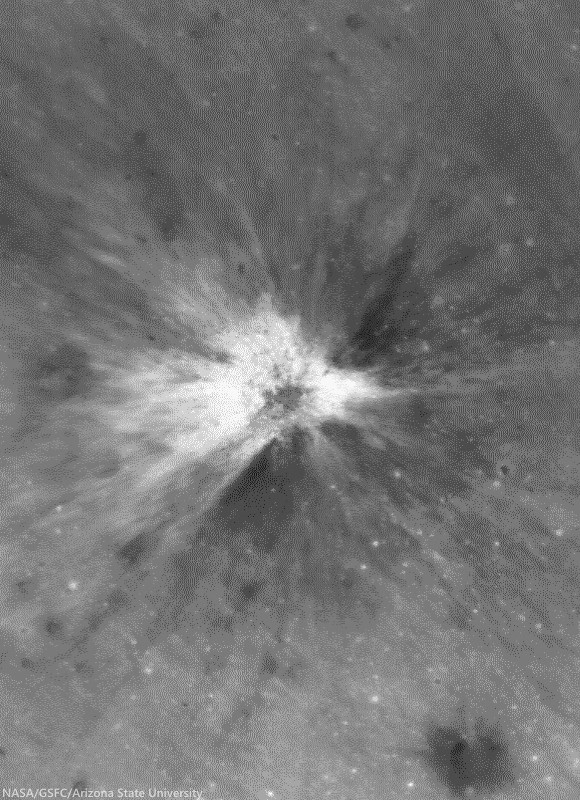
A 78 meter diameter crater with distinct dark ejecta surrounding its rim, in the farside southern  highlands (31.131°S, 147.536°E) north of Jules Verne. LROC Narrow Angle Camera (NAC) frame M1115555142L, LRO orbit 16629, February 16, 2013; 40.36° angle of incidence, 74 cm per pixel resolution from 71.92 km [NASA/GSFC/Arizona State University].
Jeffrey Plescia
LROC News System

Impact crater ejecta is typically brighter than the surrounding material because it is fine-grained and immature (unweathered); even on the dark mare, fresh craters usually have bright ejecta. Craters with distinctly dark ejecta do occur, but they are rare (e.g., Shorty Crater at the Apollo 17 landing site). When craters have dark ejecta, the interpretation is that a layer of low reflectance rock or soil at depth was excavated and distributed around the margin of the crater. In the case of Shorty Crater, the conclusion is that a layer of dark pyroclastics was hidden just beneath the surface; in other cases, dark halo craters are interpreted to indicate mare material at depth (cryptomare). Several of the craters formed by the impact of spacecraft hardware, such as the Apollo 13 S-IVB, into the surface also have dark ejecta rays, and this observation is not yet well understood.

Details of the crater morphology can be seen in this expanded view from LROC NAC M1115555142L [NASA/GSFC/Arizona State University].
Our dark halo crater (31.131°S, 147.536°E) has a diameter of about 78 m, although it is slightly elongate in the north-south direction. Rays of dark ejecta extend for almost 200 m from the crater rim. Morphologically, the crater is not the normal simple bowl shape for a crater of this size. Rather, a depression on the crater floor in the center is surrounded by a low ridge about 33 m in diameter; beyond that annular ridge to the crater wall the floor appears to be flat. Boulders are scattered on the crater floor and on the ejecta to the east; the largest boulders on the east side are as large as 6 m across.
dark_ejecta_reg_sm
Regional view of the dark ejecta crater. Note the crater formed on the western flank of an older, larger crater. Relatively low albedo, smooth plains spread out immediately to the south. These plains (see next image) may be mare material and may underlie the area of the small impact. LRO NAC frame M167241339R (spacecraft orbit 9780, August 6, 2011; 55.96° angle of incidence, 65 cm per pixel resolution from 62.95 km)  [NASA/GSFC/Arizona State University].
LROC Wide Angle Camera (GLD100) context, at 64 meters per pixel resolution, shows the location of the crater of interest in relation to the arc of exposed mare material to the south and west [NASA/GSFC/Arizona State University].
This crater formed on the outer flank of a larger older, degraded 635 m crater. Highlands ejecta (higher reflectance than mare) from this larger crater buried the mare. Later the impact that formed the younger dark halo crater punched through the bright highland ejecta and brought up mare from 10 meters or more depth.

Explore this region of the Moon in the full NAC image, HERE.

Related Posts:
Bright and Dark Ejecta (September 11, 2013)
Excavating Dark Deposits (September 3, 2013)
Dark haloed crater in Mare Humorum (June 7, 2011)
Dark Halo Crater in Orientale (March 4, 2011)
Dark craters on a bright ejecta blanket (November 17, 2009)

Wednesday, September 11, 2013

Bright and Dark Ejecta

LROC Featured Image, September 10, 2013 (M139782204LE)
A relatively recent impact event distributed bright, reflective ejecta across the lunar surface in southeast Mare Tranquillitatis. Smaller craters punch through the ejecta to reveal darker substrate, a contrast easier to see under a high Sun, and thus a lower illumination angle of incidence. A 500 meter-wide field of view from LROC Narrow Angle Camera (NAC) observation M139782204LE, spacecraft orbit 5733, September 22, 2010; a 10.11° angle of incidence, resolution 49 cm per pixel from 44.54 km over 4.37°N, 19.29°E [NASA/GSFC/Arizona State University].
Drew Enns
LROC New System

Fresh (young) impacts on the Moon often display magnificent ejecta blankets (so called because they "blanket" the surrounding terrain). Ejecta is unevenly distributed, which gives rise to its interfingered appearance.

Since space weathering tends to lower the albedo of material on an airless planet, the relative brightness of this ejecta blanket speaks to the young age of the parent crater.

In this case, the parent crater is just to the south of the opening image, and can be seen in the context image.

M162181924L-NSJ-1110-58b92-2252x3572
The same small, relatively fresh crater at local sunrise, when shadows under a higher illumination angle of incidence exaggerate variations in topography over albedo. Even so, the brighter surface rays are as distinct as striations channeled into the terrain by the blast. An 1875 meter-wide field of view from LROC NAC frame M162181924L, LRO orbit 9035, June 8, 2011; 73.88° angle of incidence, resolution 0.83 meters per pixel from 39.7 km [NASA/GSFC/Arizona State University].
But what is providing the small circular patches of dark material? Were the patches formed as part of the impact that formed the ejecta blanket, or later? Was the material excavated from below the bright ejecta? Most likely secondary craters (late stage ejecta) from the initial impact, hit and dug up dark mare material (original surface) from below the thin ejecta blanket. Can we test this idea? How dark is dark? In a more precise sense - do the albedos of the small low reflectance spots match that of the surrounding mare?

LROCqm250-sabine-rittter-manners
LROC Wide Angle Camera (WAC) context for the LROC Featured Image released September 10, 2013, showing the field of view located at located at 4.408 N, 19.230 E (marked by the cross). Nearby linear depressions (one smaller, closer depression is visible in the preceding image) may have provided the darker substrate discussed [NASA/GSFC/Arizona State University].
Your eye could be fooled by all the changes in reflectance. The small dark patches have a higher albedo than the mare (0.07 vs 0.06), which would be consistent with mare material mixing with the brighter (0.09 to 0.11) ejecta blanket. This observation is consistent with the secondary crater interpretation (the underlying mare is mixed with a small amount of the bright immature ejecta). If the reflectance of the dark patches was lower than that of the mare, then something else would have to be at work.

Can you think of other explanations while browsing the full LROC NAC frame, HERE?

Related Posts:
Beautiful Ejecta Patterns
DMD Excavations
Symmetric Ejecta