Showing posts with label Galileo. Show all posts

Friday, March 21, 2014

Lacus Autumni

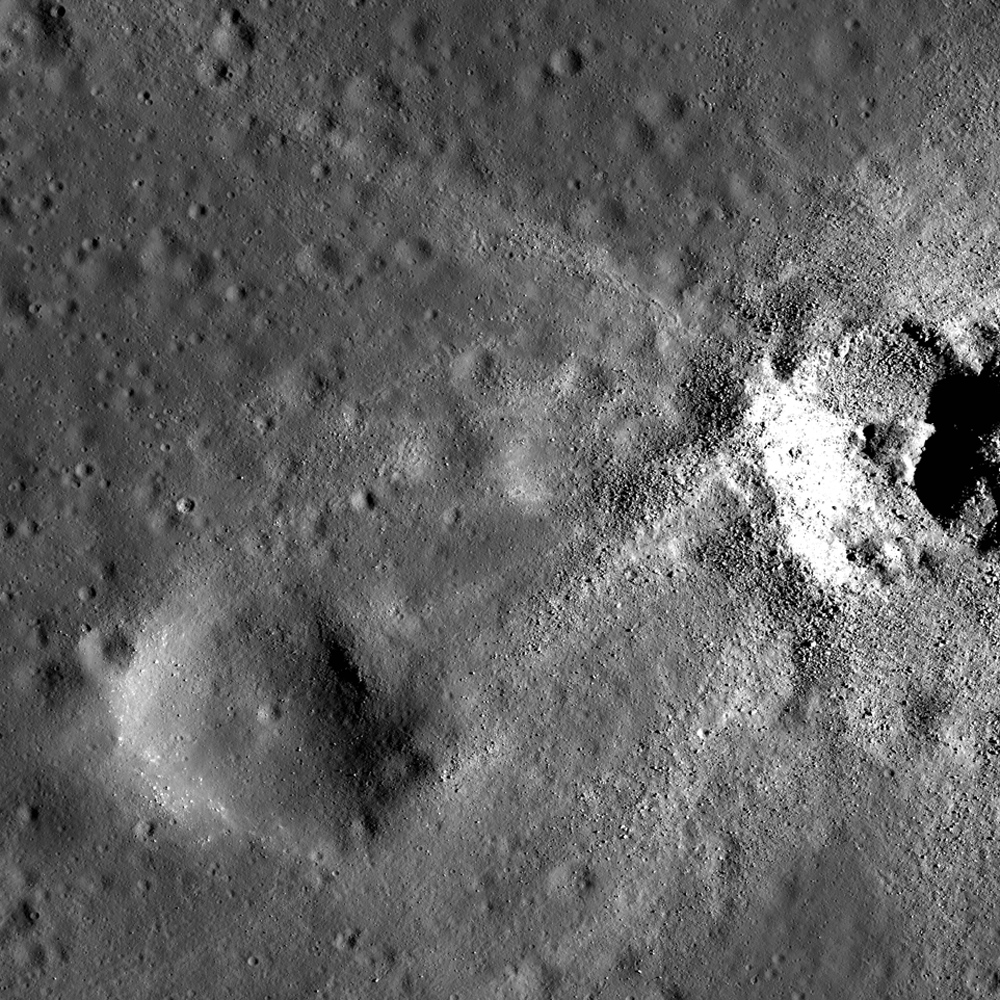
Fresh and not-so-fresh craters on the basalt plain of Lacus Autumni, a pool of volcanic material solidified between the concentric rings of Orientale basin. Field of view from a mosaic of the left and right frames of LROC NAC observation M114498609, LRO orbit 2007, December 3, 2009; resolution 51 cm per pixel, incidence 62.57° from 48.44 km [NASA/GSFC/Arizona State University].
H. Meyer
LROC News System

This exquisite crater formed when an impactor crashed into the mare pond called Lacus Autumni. Angular blocks, which erode over time and gradually disappear, littering the terrain both within the crater and outside of it.

Though the margins of the crater are crisp and distinct, it has a lumpy appearance that is probably due to the coherence of the target material.

The ejecta of the crater has a slightly higher reflectance relative to the mare in which it is found. High-reflectance ejecta can represent recently exposed material that has not been affected by space weathering processes, called maturity rays, or material that is compositionally distinct from its surroundings, called compositional rays. Due to its crisp appearance and the predominance of blocks, we interpret this as a young, fresh crater, so the rays are likely maturity rays.
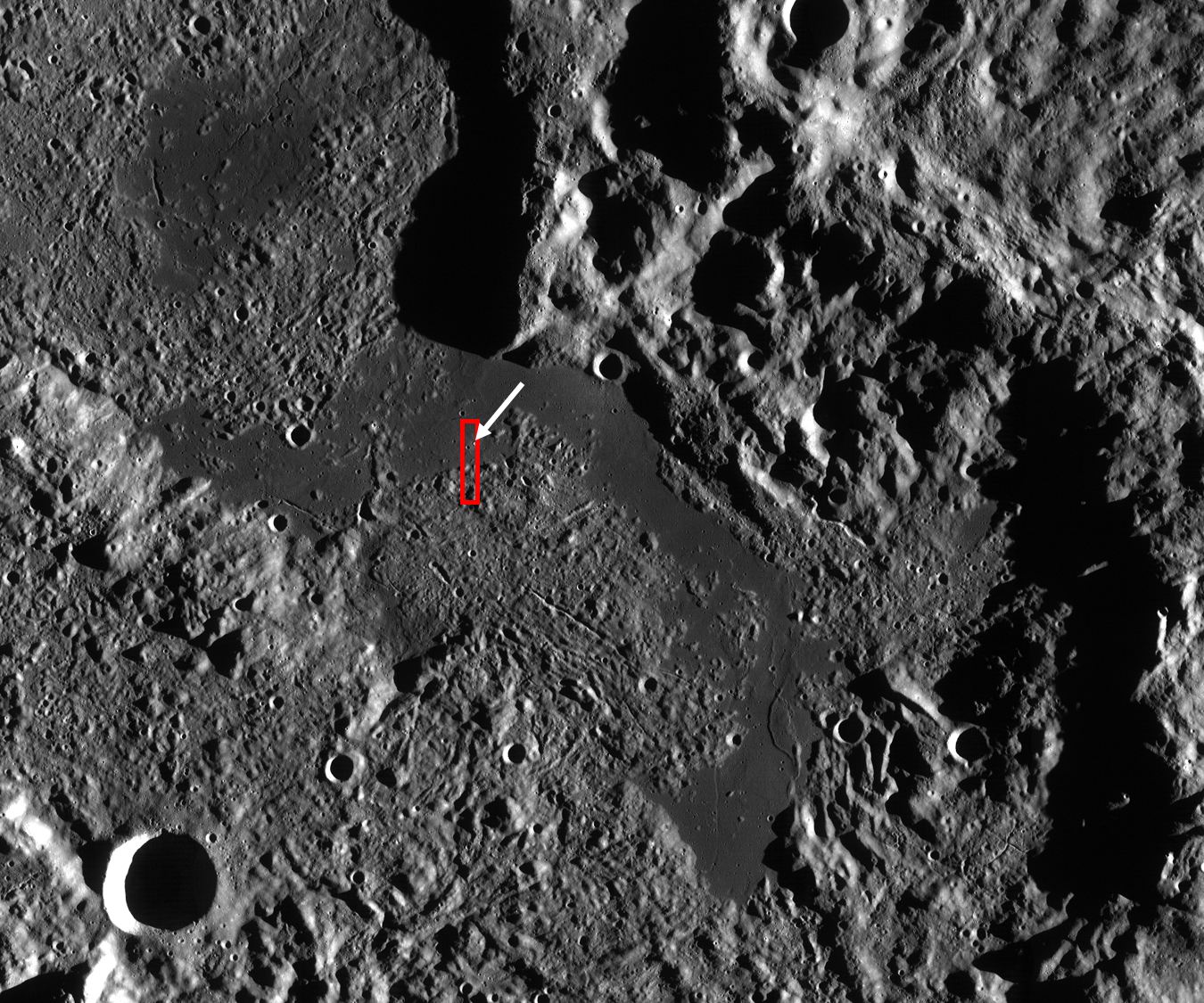
LROC WAC mosaic of Lacus Autumni, context for the LROC Featured Image. Red box outlines the the full LROC NAC field of view from LROC observation M114498609, orbit 2007, December 3, 2009. The white arrows points to the location of the fresh crater. Field of view above approximately 160 km across [NASA/GSFC/Arizona State University].
Lacus Autumni (or "Autumn Lake"), along with Lacus Veris and Mare Orientale, is a mare pond located in the northeast portion of the Orientale Basin. It lies between the Orientale inner ring (Montes Rook) and outer ring (Montes Cordillera). When craters form in thin mare sometimes high-reflectance highlands material is excavated from depth, which makes it difficult to differentiate between maturity rays and compositional rays. To resolve this issue, we can look at the composition of the material that was excavated, looking specifically at both iron and titanium maps.

Nestled in a valley between the inner and outer Orientale impact basin rings, Lacus Autumni is seen here at high relief of sunset shadows. Mosaic of LROC WAC observations from orbits 4786 through 4791, July 9, 2010; Uncropped field of view (very roughly) 205 km across, at an average resolution 68 meters, incidence 80° from 49 km. View the full-size original HERE [NASA/GSFC/Arizona State University].
If the rays are indistinguishable from the mare in which the crater formed, then we can conclude that they are highly reflective because they are young and unweathered. If the rays are composed of highlands material, the rays are likely compositional rays.

If the crater excavated highlands material from beneath the mare, then we can estimate the thickness of the mare deposit and determine just how much lava was extruded onto the surface when the mare formed. In the case of compositional rays, the morphology of the crater, such as a crisp rim or peak, is an indicator of the age of the crater.

The crater rays in this LROC Featured Image are indistinguishable from the mare in which they are found, so these are indeed maturity rays.

Explore more of Lacus Autumni, HERE.

Related Posts:
Fresh Bench Crater in Oceanus Procellarum
A Gathering in Lacus Mortis
Shield Volcanoes in Lacus Veris
Unnamed Fresh Crater Northeast of Arago (DTM)
New Crater!

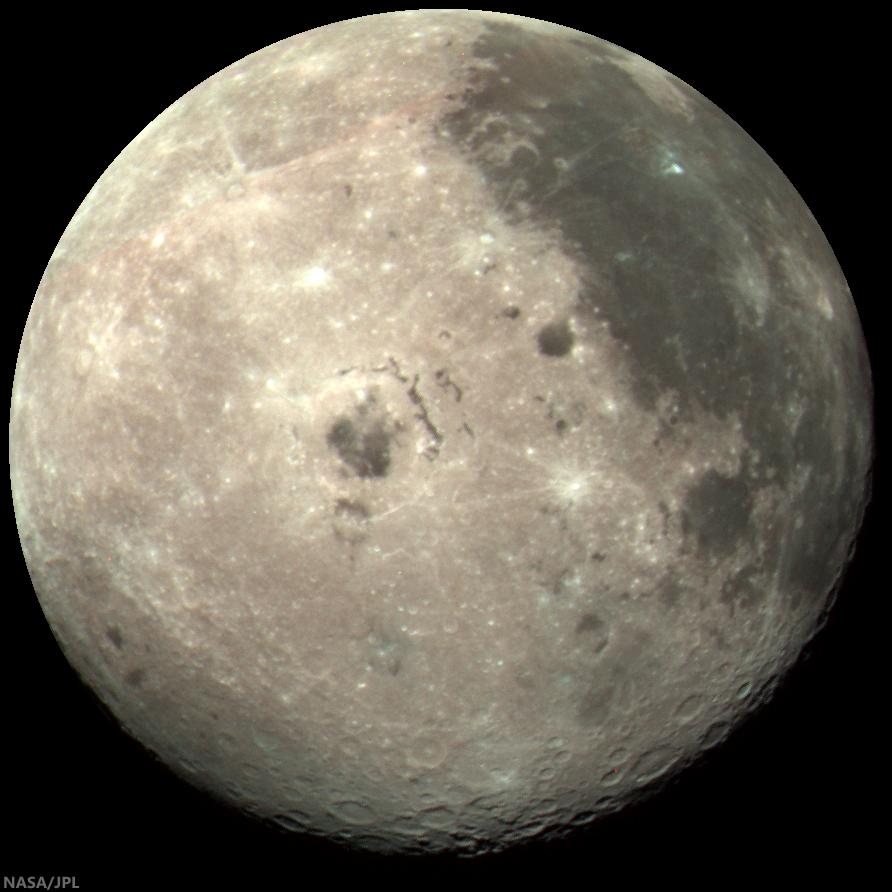
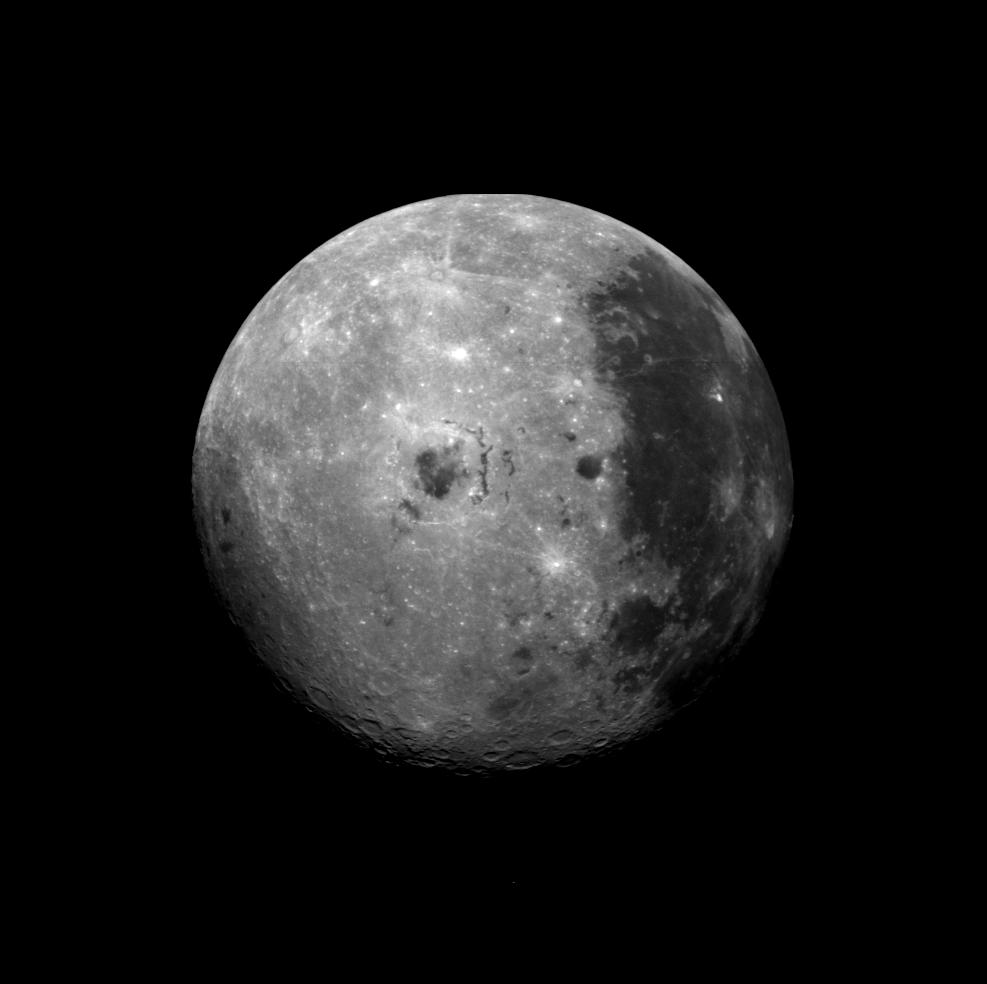
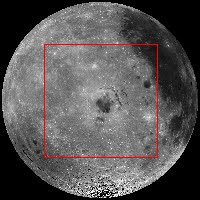
A well-known composite color image of the Moon's western hemisphere centered just below Lacus Autumni, northeast of Mare Orientale, captured by the Galileo spacecraft while maneuvering out of the inner solar system on its way to Jupiter, at 1735 UT  December 9, 1990, from roughly 560,000 km away. The color composite was stacked from monochrome images taken through violet, red, and near-infrared filters. The Moon's nearside is to the right, the far side to the left [NASA/JPL].

Tuesday, December 4, 2012

"Physics is fun, especially on the Moon!"

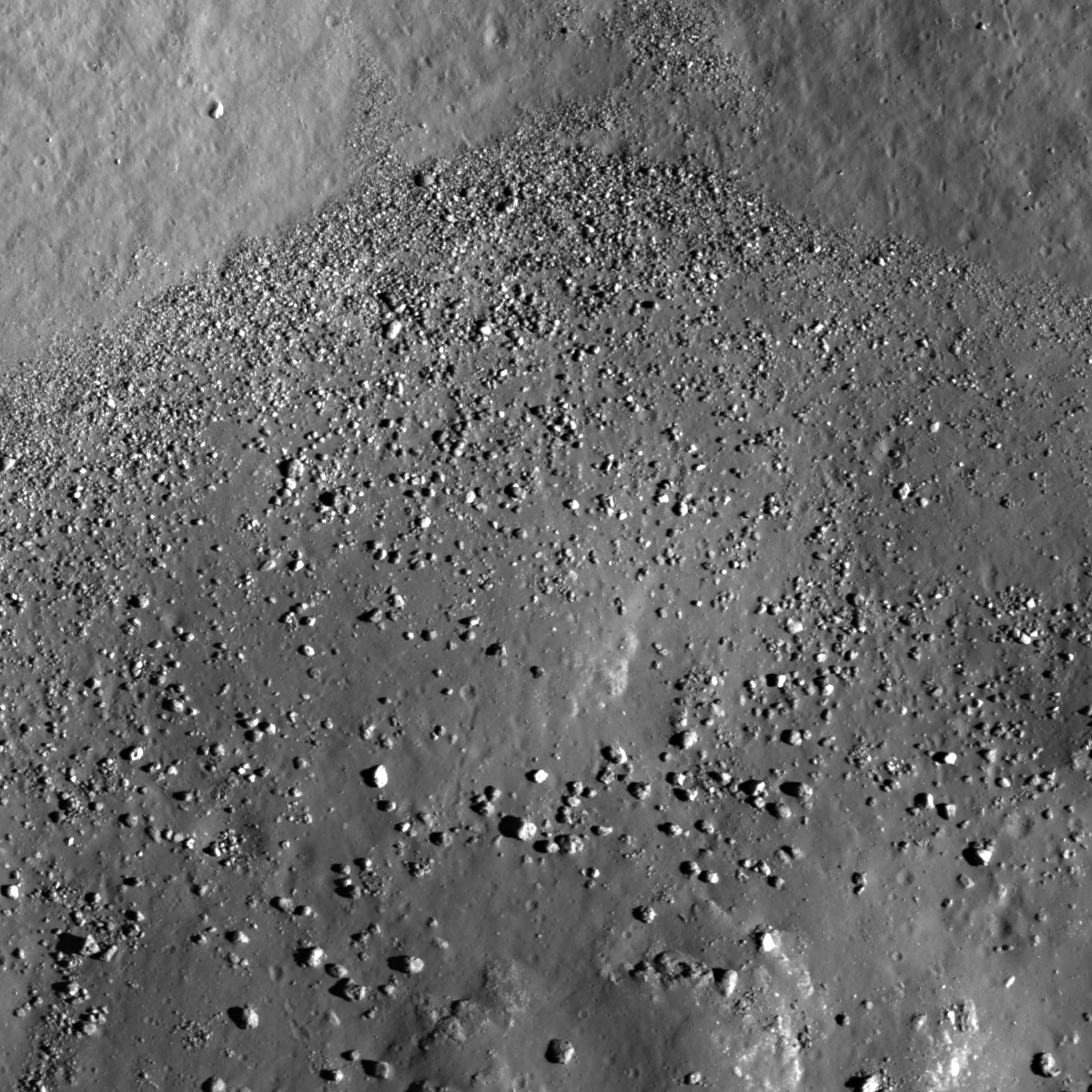
A gradational distribution of boulders inside a crater. LROC Narrow Angle Camera (NAC) observation M176224625L, LRO orbit 11105, November 18, 2011; field of view 500 meters across at 0.51 meters resolution from 47.61 kilometers, incidence angle 55.29° [NASA/GSFC/Arizona State University].
Sarah Braden
LROC News System

A distribution of boulders within the floor of an unnamed crater demonstrates physics at work. In the Featured Image (located in the lunar highlands at 6.275°N, 214.770°E) you can see that smaller boulders are (on average) closer to the boundary where the wall of the crater meets the floor. As distance increases from this boundary, the size of the individual boulders increases.

Why is this happening?

The larger boulders have more kinetic energy at the bottom of the slope due to their greater mass. Kinetic energy is 1/2 the mass times the velocity squared. So at the bottom of the crater wall, the more massive boulders will have more kinetic energy than the small boulders, even though they are all subject to the same acceleration due to the Moon's gravity. The crater floor is relatively flat, so the larger boulders will travel further than the small boulders before coming to a halt. An alternative explanation is that larger boulders originate preferentially from the rim of the crater and thus fall from a greater height on average compared to small boulders. Either way, the larger boulders have more kinetic energy when the reach the bottom of the crater.

Full width, 4000 lines in a mosaic of both left and right frames of LROC NAC M176224625 shows the tumbled mix of impact melt typical of craters with larger floors. The field of view at shown at full resolution in the Featured Image is the upper most contact between the crater floor and north wall [NASA/GSFC/Arizona State University].
August 2, 1971, Hadley Rille Delta Apollo 15 commander Dave Scott demonstrates the basic physics of falling objects on the surface of an airless body. In tribute to Galileo, Scott simultaneously drops a 1.32-kg aluminum geological hammer and a 0.03 kg falcon feather and both objects, falling at identical acceleration, reach the surface at the same time [NASA].
During the Apollo 15 mission, Commander David Scott performed a related physics experiment live for the TV cameras! You can watch the video here: Apollo 15 Hammer and Feather Drop. He dropped a rock hammer and a feather from the same height at the same time. The point of the experiment was to show that in an environment with no atmospheric drag (a vacuum) the feather and the hammer will fall at the same speed (and hit the ground at the same time) regardless of the difference in mass. This basic idea is attributed to Galileo. Read more about the Apollo 15 experiment HERE.

Physics is fun, especially on the Moon!

LROC Wide Angle Camera (WAC) context image, photographed as the LROC NAC (and LROC Featured Image) captured a much higher resolution field of view (asterisk) of the boulder distribution deep within this unnamed, young 12 km crater in the farside lunar highlands. LROC WAC observation M176217257C (643nm) LRO orbit 11105, November 18, 2011; resolution 62 meters per pixel [NASA/GSFC/Arizona State University]

The crater is shown in greater, smaller-scale context, within a roughly 82 km-wide field of view; from a mosaic of LROC WAC observations captured in orbits 11104 and 11105, November 18, 2011. The wider region, northwest of Vavilov crater and northeast of the ancient South Pole-Aitken impact basin, is characterized by some of the highest elevations (and thickest crust) on the Moon. The nearest named crater, Artem'ev L, at upper right, received its official designation in 2006 [NASA/GSFC/Arizona State University].

Explore the entire NAC frame, HERE.

Related LROC Featured Images:
Crater Covered With Boulders
Ray of Boulders
Sampling a Central Peak

Tuesday, March 15, 2011

LROC PDS Release Number 5


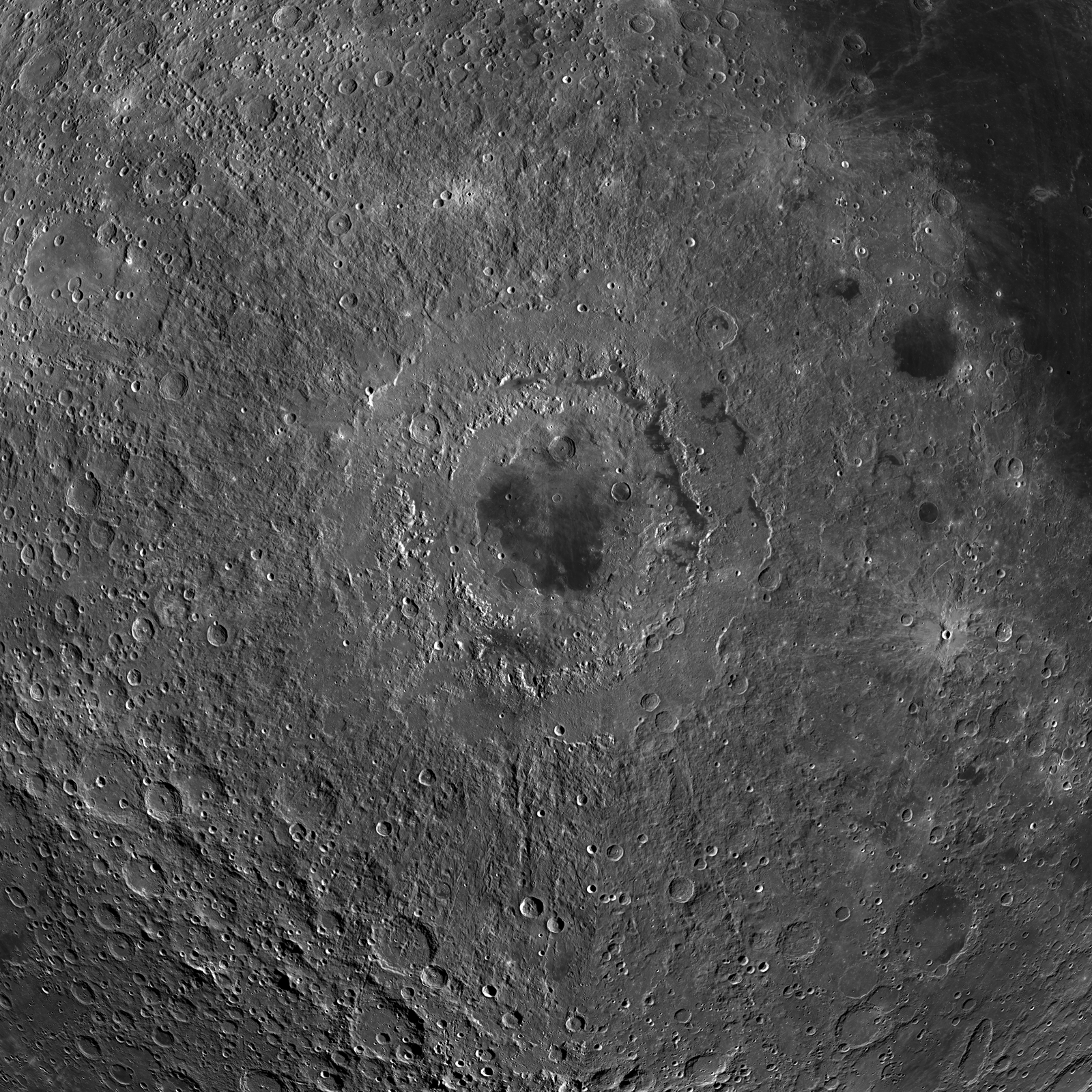
LROC Wide Angle Camera (WAC) mosaic centered on Orientale basin. From the center of the mosaic to a corner is about 2000 km. View the full LROC 1600 x 1600 Featured Image HERE [NASA/GSFC/Arizona State University].

Mark Robinson
Principal Investigator
Lunar Reconnaissance Orbiter Camera (LROC)
Arizona State University


The 5th LROC Planetary Data System (PDS) release includes images acquired between September 16, 2010 and December 15, 2010, during the Science mission phase. This release includes 69,505 Experiment Data Record (EDR) images totaling 8,498 Gbytes and 69,528 Calibrated Data Record (CDR) images totaling 17,651 Gbytes worth of data.

The LROC Team is also making it's first Reduced Data Record (RDR) release this week, which represents a culmination of many months of work calibrating, map projecting, and creating mosaics and topographic maps from NAC and WAC images. The RDR release includes a global WAC monochrome mosaic, NAC mosaics for 40 regions of interest (ROI), numerous NAC DTM products, NAC North and South Polar mosaics, several example WAC UV and VIS regional mosaics, and over 8,000 WAC North and South Pole observations used to create movies of each poles lighting conditions over time. The RDR release totals over 8,400 images totaling over 2 Tbytes of data.


At full-resolution, zooming in on the Orientale pyroclastic vent perched at the center of a dark "smoke ring," of darker material draped upon the mountainous southwestern edge of the Orientale basin. The vent interior has already been imaged in great detail by the LROC Narrow Angle Camera, but the WAC mosaics deliver unprecedented context and depth of field [NASA/GSFC/Arizona State University].

Today's Featured Image is an orthographic re-projection of the WAC global mosaic centered on the youngest large basin on the Moon, Orientale. This basin is barely visible on the western limb of the Moon as seen from the Earth. Its existence was not confirmed until spacecraft sent back images of the farside 50 years ago. Unlike other large basins, Orientale has very little volcanic materials filling its interior, so the basin structure is easily seen. The inner and outer basin rings are particularly obvious - imagine if the Moon were rotated 90° and the Orientale basin faced the Earth. What sort of mythology would have grown up around the great eyeball in the sky?


Backing away, the vent is harder to discern, though the ring of darker material surrounding it makes the feature easier to pick out. Compare this with the high-sun incidence view further below taken from Galileo on its way toward Jupiter in 1990 [NASA/GSFC/Arizona State University].

The new WAC Orientale mosaic also reveals striking detail in the far-flung ejecta blanket. Note the radial chains of secondary craters formed as large chunks of the Moon were thrown hundreds of kilometers! These same type of large impacts occurred on the Earth also - fortunately the era of heavy bombardment ended about 3.9 billion years ago!

Explore the Orientale basin at 100 m/pixel.

Revisit the early version of the WAC Orientale mosaic.


Early in the Galileo mission to Jupiter, the probe used Earth's Moon to test and baseline it's remote sensing capabilities. During a second gravity-assist fly-by of the Earth-Moon system in 1990, JPL turned the probe's cameras on the Moon's western hemisphere and swept up this late morning overhead view of Mare Orientale [NASA/JPL].

Wednesday, January 14, 2009

The First Eye on the Moon

Composite lunar drawing by English
astronomer Thomas Harriot, 1612 or 1613.


Technology hurried from theory to practice, allowing a color television camera to finally, faithfully show a live broadcast of Alan Shepard and Edgar Mitchell complete the moonwalks of Apollo 14 in 1971 is today in the hands of most cellphone users. It is taken for granted, enough to have become a neglected extra feature. The Charged-Coupled Device (CCD) just isn't as celebrated as the light bulb, for example, or the telescope. But there was a time when amateur astronomers couldn't apply photographic techniques and computer-guided clock-drives to take photographs of the Moon superior to that of the largest institutionally-owned telescopes of the World.

Just 400 years ago the telescope, as a concept employed to view the sky, was recorded for the first time. Like so many other things lost in the mists of time, what we call the telescope today was part of the vast accumulated technology of China, and was brought to Europe during the late Era of Exploration and Imperialism by the Dutch. The positioning of lens to refract and magnify a distant and small segment of the distant line of sight was likely to have been stumbled upon countless times in countless ways over the centuries.
Who was it, then, who first trained two lens fixed perpendicular along the line of sight between the human eye and the Moon, foe example?

This International Year of Astronomy 2009 has been set to remember Galileo Galilei, the long-celebrated favorite of Pope Urban VIII and credited with "inventing the telescope in 1609. History is often lost, or distorted, in translation, as misconceptions go on to be repeated long enough to eventually become "fact." Galileo is clearly worthy of celebration, but hardly for being the first astronomer or as the inventor of the telescope.

Astronomy may, in fact, have been first distinguished from astrology by Abraham, who 1st Century historian Josephus described as having coming out from "Ur of the Chaldees" after strong disagreement with fellow members of the astrological priesthood of Sumer (modern day Iraq), early in the 2nd Millennium B.C. (4000 years ago).

And according to today's Guardian Science Blog posting "Did an Englishman beat Galileo to the first moon observation," more than the politics of Galileo is being celebrated during this IYA2009.

"Thomas Harriot, a wealthy but publicity-shy astronomer and mapmaker, produced a series of exquisite lunar drawings, one of which is dated 26 July 1609, pre-dating Galileo's much-celebrated observations of the moon by six months."

"A composite drawing of the moon dating to 1612 or 1613 is considered by some experts to mark the birth of modern cartography. The lunar drawings by Harriot will form part of an exhibition at West Sussex Record Office in Chichester in July to mark the International Year of Astronomy."

Read more HERE.