Showing posts with label gardening. Show all posts

Monday, August 25, 2014

Add 'sparking' in PSRs to the space weathering zoo

University of New Hampshire (UNH) scientists propose the addition of "sparking"  to cosmic rays and micrometeor bombardment as part of the relentless space weather gardening always underway within the Moon's permanently shadowed regions. This illustration shows a PSR undergoing subsurface sparking, to a depth of about 1mm, which ejects vaporized material [UNH/SVS].
Durham (NH) –- The Moon appears to be a tranquil place, but modeling done by University of New Hampshire and NASA scientists suggests that, over the eons, periodic storms of solar energetic particles may have significantly altered the properties of regolith in the Moon’s coldest craters through the process of "sparking" —a finding that could change our understanding of the evolution of planetary surfaces in the solar system.

The study, published recently in the Journal of Geophysical Research-Planets, proposes that high-energy particles from uncommon, large solar storms penetrate the Moon’s frigid, polar regions and electrically charges the regolith. The charging may create sparking, or an electrostatic breakdown, and this “breakdown weathering” process has possibly changed the nature of the Moon’s regolith within its permanently shadowed regions, or "PSR's," which may be more active than previously thought.

“Decoding the history recorded within these cold, dark craters requires understanding what processes affect their regolith,” says Andrew Jordan of the UNH Institute for the Study of Earth, Oceans, and Space, lead author of the paper. 

“To that end, we built a computer model to estimate how high-energy particles detected by the CRaTER (Cosmic Ray Telescope for the Effects of Radiation) instrument, on board LRO can create significant electric fields in the top layer of lunar regolith,” Jordan wrote.

The scientists also used data from the Electron, Proton, and Alpha Monitor (EPAM) on the Advanced Composition Explorer (ACE).

CRaTER, which is led by scientists from UNH, and EPAM both detect high-energy particles, including solar energetic particles (SEPs). SEPs, after being created by solar storms, stream through space and bombard the Moon. These particles can build up electric charges faster than the regolith can dissipate them and may cause sparking, particularly in the polar cold of permanently shadowed regions—unique lunar sites as cold as minus 240 degrees Celsius and known to contain water ice. 

The record cold at Hermite (108 km; 86.16°N, 266.68°E), straddling the 85 parallel and 270th meridian, host significant zones in permanent shadow, including permanently shadowed regions (PSRs) along it's southern wall and floor (left) the host the lowest temperatures yet recorded in the solar system, 24°K. LROC Quickmap, 250 meter resolution, orthographic projection of the Moon's north pole and vicinity [NASA/GSFC/Arizona State University].
Says Jordan, “Sparking is a process in which electrons, released from the regolith grains by strong electric fields, race through the material so quickly that they vaporize little channels.” Repeated sparking with each large solar storm could gradually grow these channels large enough to fragment the grains, disintegrating the regolith into smaller particles of distinct minerals, Jordan and colleagues hypothesize.

The next phase of this research will involve investigating whether other instruments aboard LRO could detect evidence for sparking in lunar regolith, as well as improving the model to better understand the process and its consequences.

“If breakdown weathering occurs on the moon, then it has important implications for our understanding of the evolution of planetary surfaces in the solar system, especially in extremely cold regions that are exposed to harsh radiation from space,” says coauthor Timothy Stubbs of the NASA Goddard Space Flight Center.

Tuesday, August 12, 2014

Complimentary craters, south of Maclear

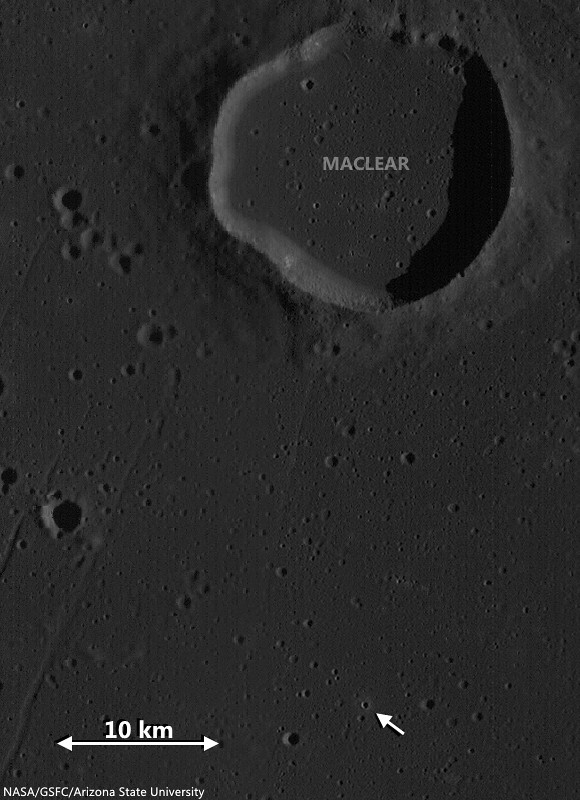
South of Maclear in northwest Mare Tranquillitatis, two complimentary craters of very similar location, size and origin, but additionally of widely different ages. The relentless bombardment of small debris "gardens" the lunar surface at an average rate of 3 mm every 2 million years. In addition to the nearly billion year long cycle of cosmic ray dark-reddening, "space weathering" ages, or "optically matures" the lunar surface at a predictable rate, adding to crater counts and super-positioning another useful tool to the craft of dating lunar features from a distance. LROC NAC observation M131515002R, LRO orbit 4515, June 18, 2010; 79.75° sunrise incidence angle, resolution 85 cm from 40.68 km over 9.09°N, 20.14°E [NASA/GSFC/Arizona State University].
Raquel Nuno
LROC News System

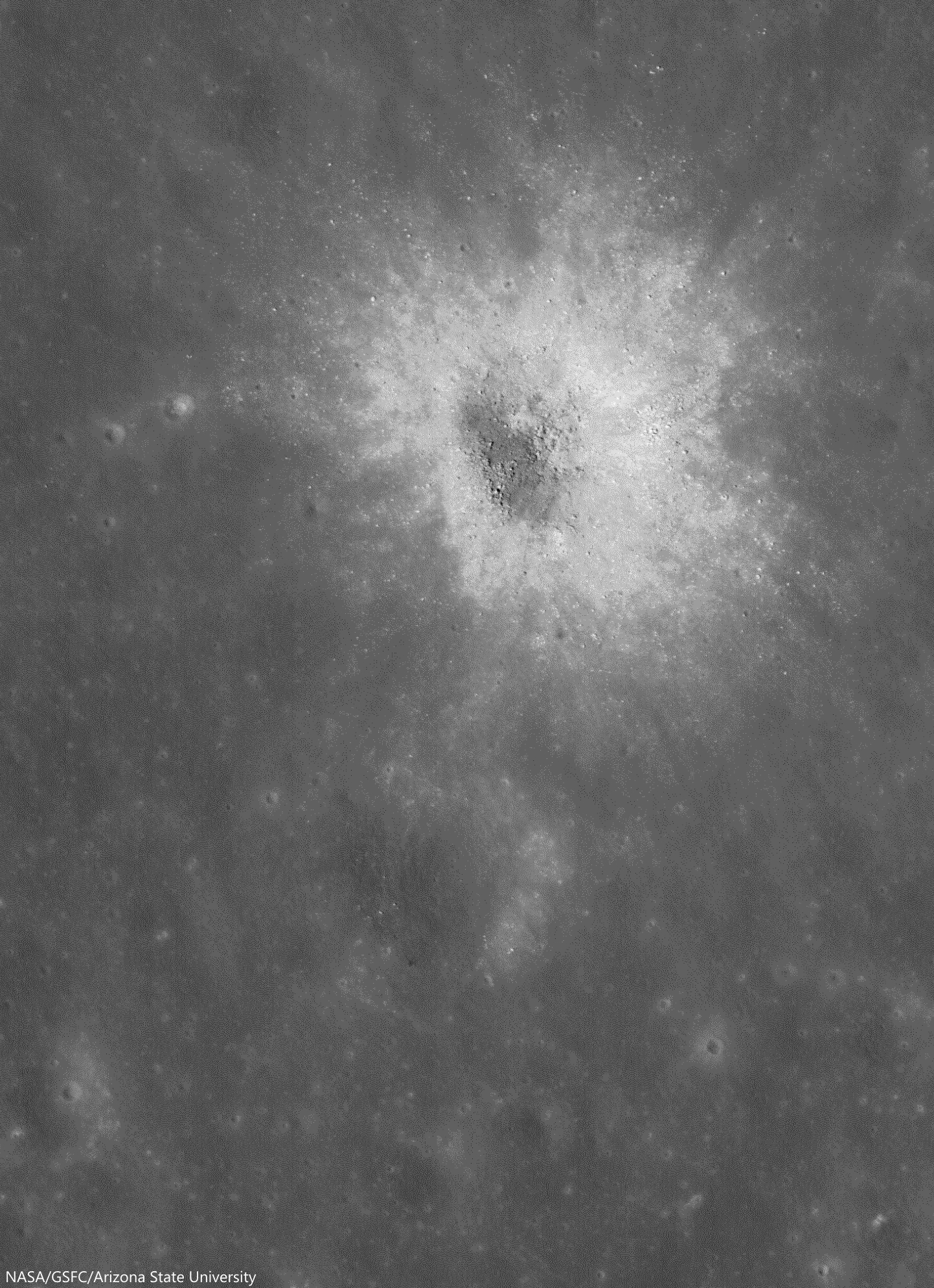
There are several distinguishing properties of craters that help lunar scientists determine their ages. As craters get older their appearance changes through exposure to solar wind bombardment and other impacts (collectively called space weathering), and even gravity has an effect.

Effects of the solar wind lower the reflectance of the surface; so regolith (soil) that was excavated by recent impacts has higher reflectance than the background surface, this is why small young craters have visible crater rays. New impacts pulverize rocks that were ejected during the formation of an older crater and disturb the shape by causing moonquakes. Also, gravity works to alter the shape of a crater by pulling material down its walls in a process called slumping, this causes craters to have a smoother appearance.

1.69 km field of view from LROC NAC Commissioning observation M106748283R, LRO orbit 873, September 5, 2009; 29.84 low-angle incidence, resolution 1.17 meters from 133.64 km over 9.82°N, 20.15°E [NASA/GSFC/Arizona State University].
Today's Featured Image showcases two similarly sized adjacent craters (each ~500 m in diameter) located in Mare Tranquillitatis (see WAC context image below) with very different appearances. The area surrounding the top crater is littered with boulders in all directions. Wheras the more southerly crater has only a few rocks near its rim. Where did the boulders come from in the first place? And did the lower crater originally have boulders?

Locating two co-located 500 meter "complimentary craters" (arrow) good for comparing rates of general space weathering, in west-northwest Mare Tranquillitatis. LROC Wide Angle Camera (WAC) monochrome (566 nm) observation M131514941C, captured simultaneous with the NAC observation opportunity shown in the Featured Image at the top of this post. LRO orbit 4515, June 18, 2010; 79.75° incidence, resolution 57.7 meters from 40.72 km over 10.17°N, 20.14°E [NASA/GSFC/Arizona State University].
Since the mare basalt formed from layers of lava that hardened into solid rock, it is likely the boulders are coherent fragments of those thick layers (a few to tens of meters thick) that were broken up and ejected during the impact event. Since these two craters are so close and both formed in the mare it is very likely that the lower crater also had a large grouping of boulders in its ejecta field. The dissimilarity between these two craters is most likely due to age difference. Over time (perhaps a couple of billion years) the original boulders around the lower crater were slowly ground down by micro-meteorite bombardment - think of this process as cosmic sand-blasting! The boulders around the younger crater (top) have not had time to be pulverized by other impacts, but stick around for a billion years and you can watch these boulders slowly disappear!

Explore the full resolution NAC HERE.

Related Posts: