Showing posts with label Mare Smythii. Show all posts

Tuesday, February 25, 2014

Dark patch enigma in Mare Smythii

Splash of dark material
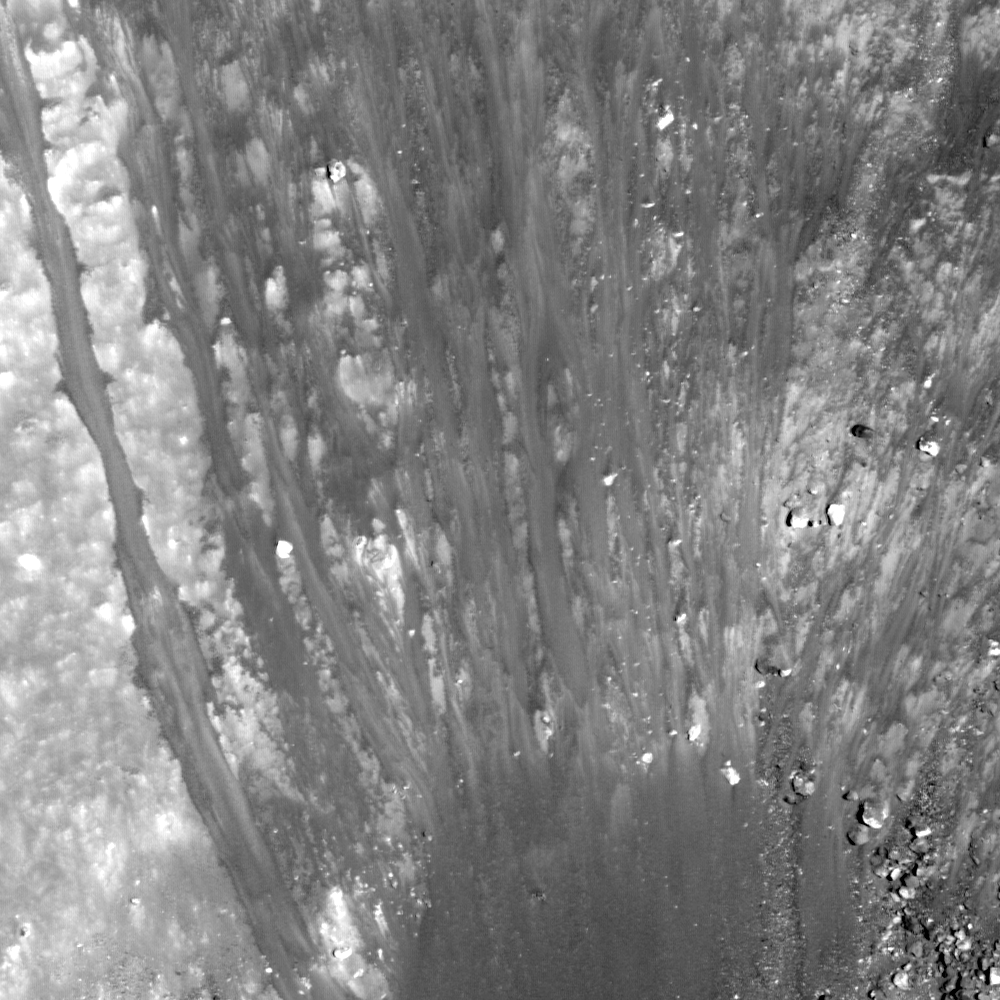
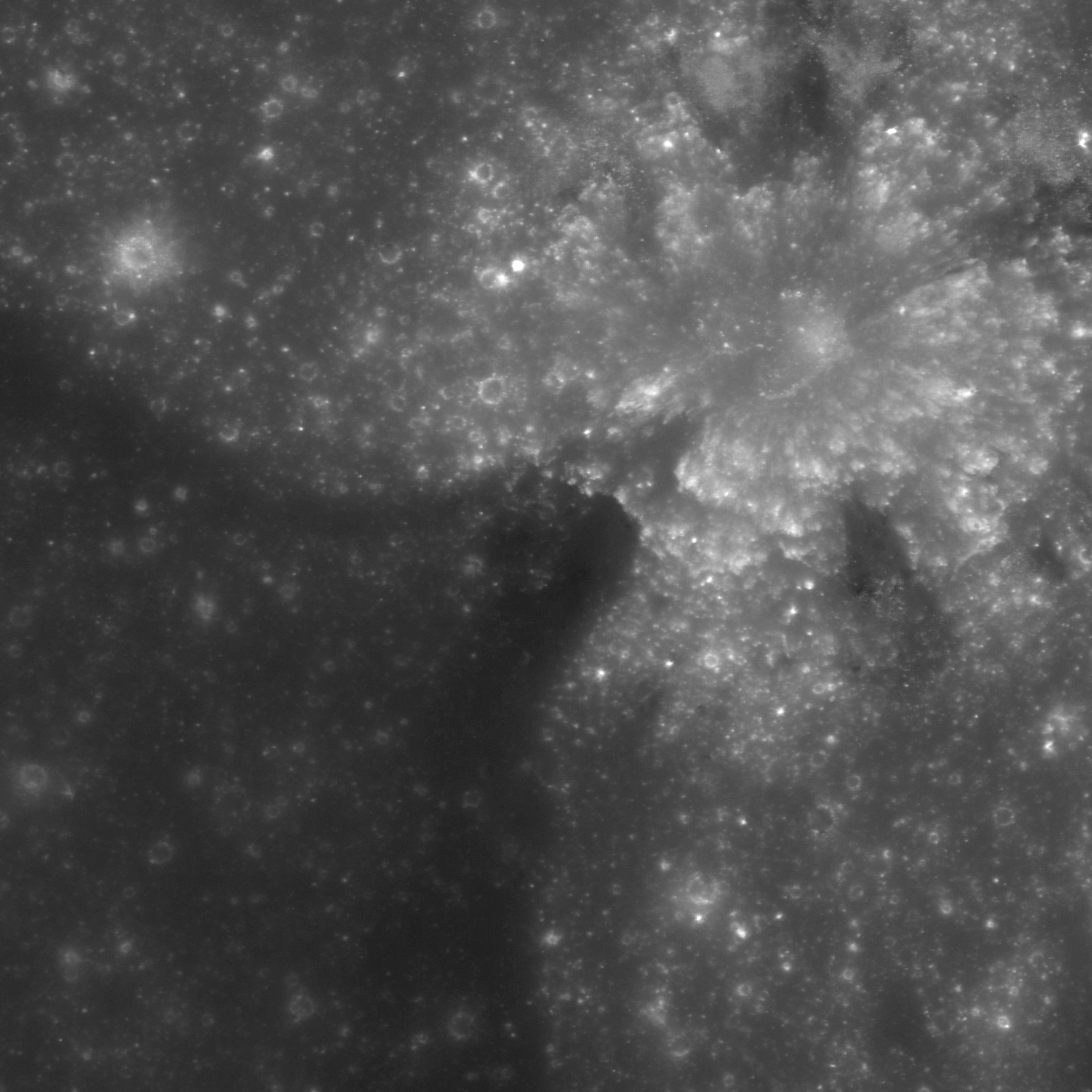
Low reflectance materials splashed out from an unnamed crater, 1260 meter-wide field of view centered on 2.322°S, 81.725°E, incidence angle 3.3°   From an Narrow Angle Camera observation swept up over the far western interior of Mare Smythii, LRO orbit 19177, September 12, 2013. LROC NAC M1133662942L [NASA/GSFC/Arizona State University].
Hiroyuki Sato
LROC News System

Today's Featured Image highlights an unnamed fresh crater, about 700 meters in diameter, found on the western edge of Mare Smythii.

The low reflectance materials extend out in an distinctive bell shaped pattern from the southwestern edge of the crater rim. The interior crater wall near this deposit also shows splashes of relatively darker materials, as well as three other dark patches (at 12, 2, and 5 o'clock, relative to the crater center).

These deposits are likely similar in nature to the excavated dark deposits emplaced near the rim, and they appear to have partially flowed back into the cavity.
Full LROC NAC enigmatic splash in Mare Smythii
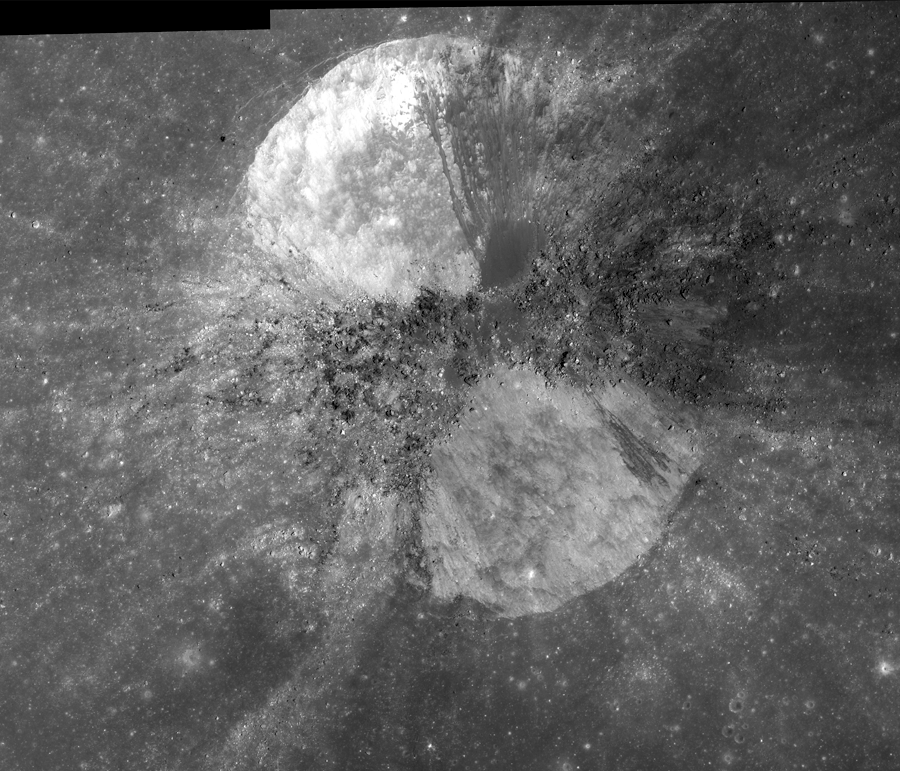
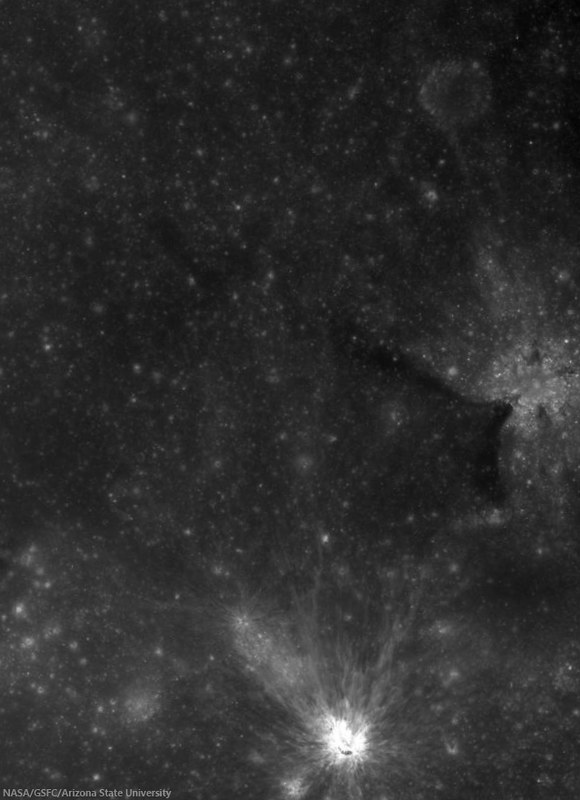
Enigmatic low reflectance material and surroundings in the context of the full 7.2 km width of LROC NAC observation M1133662942L [NASA/GSFC/Arizona State University].
Normally, ejecta travels radially from the impact center, resulting in lineations in the ejecta or rays pointing away from the source crater. In this bell shaped deposit, however, the two main dark lines outlining the bell are curved and extend about 150-200 m outside of the rim. Note that the surrounding terrain of this unnamed crater is nearly flat (see next WAC context); there are no readily apparent obstacles that might have affected the ejecta trajectory. Perhaps the original low reflectance deposits were unevenly buried, resulting in the curved dark patterns after excavation and final emplacement. What is the darker material? Since the crater is near the highland / mare boundary we might be seeing dark basalts or pyroclastics mixed with bright anorthositic crust.

Context LROC Featured Image, released February 25, 2014
Area of interest in LROC WAC monochrome mosaic (100 m/pix) overlayed by WAC stereo Digital Terrain Model (GLD100-DTM) false-color topography (red relatively high, blue low). Image centered at 2.22°S, 81.71°E. The LROC NAC M1333662942L footprint outlined in blue with the location of the LROC Featured Image above marked by the arrow [NASA/GSFC/Arizona State University]. 
Explore this enigmatic dark ejecta deposits in the full 7.2 km field of view of the NAC frame HERE, and find your own scenario.

Related Posts:
Dark Craters on a Bright Ejecta Blanket
Rima Bode: Constellation ROI
Dark-haloed crater in Mare Humorum
Dark halo crater
A Beautiful Impact
Pyroclastic Excavation
Dark Secondary Crater Cluster
Excavating Deposits

Tuesday, January 14, 2014

Tangle of talus at Schubert A

M141743432_thumb-1000
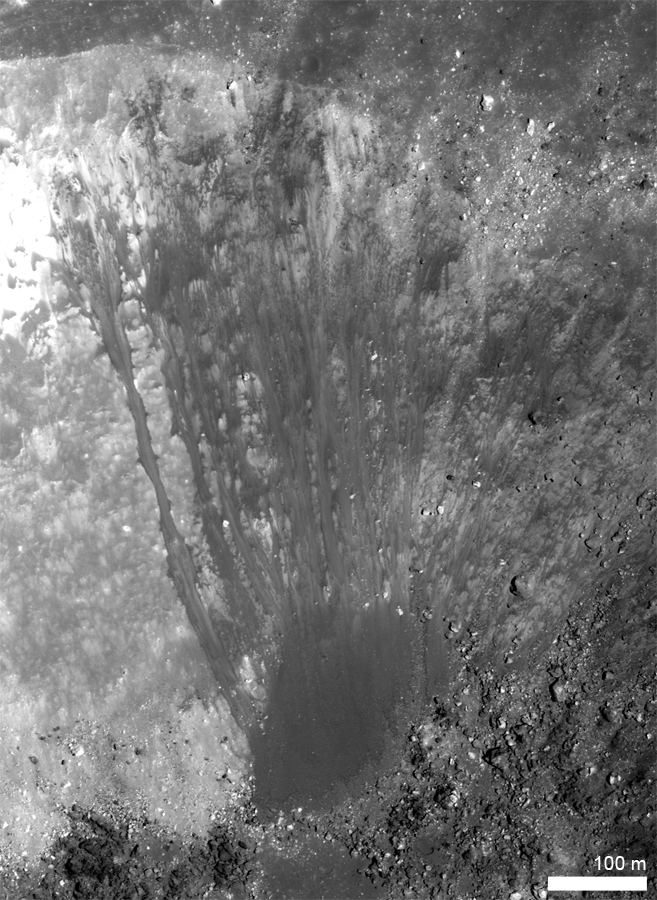
Multiple dry debris flows along the wall of Schubert A crater. LROC Narrow Angle Camera (NAC) observation M141743432L, spacecraft orbit 6022, October 15, 2010, slew 2° under 15.2° solar incidence, resolution 48 cm per pixel from 41.92 km over 1.49°S, 94.2°E, image field of view 420 meters [NASA/GSFC/Arizona State University].
J. Stopar
LROC News System

A 2.2-km diameter crater, Schubert A (2.135°N, 79.341°E), has steep walls, up to ~30° in slope. These steep walls are susceptible to gravity-driven mass wasting events.

Mass wasting is a geologic process that acts on all planetary surfaces to erode or degrade landforms over time, and results from the downslope movement of rocks and soil under the influence of gravity.

On the Moon, the slope of a surface is a key influencing factor: the steeper the slope, the faster mass wasting occurs. Mass wasting is typically triggered by nearby moonquakes, some caused by impact events.

Schubert_A-context-20140114-900x771
Subsampled NAC mosaic showing Schubert A in entirety, LROC NAC mosaic M141743432LR crater is 1.88 km in diameter [NASA/GSFC/Arizona State University].
Mass wasting on the Moon can take many forms from rockfalls, the plummeting of a few boulders, to rock avalanches and landslides. Material moving downslope in a fluid-like manner is often called a debris flow. And even though water is not required to cause debris flows, the resulting landforms resemble rivers of rock particles. At the base of the slope where mass wasting occurs, a mound of material piles up, called a talus deposit. The portion of Schubert A crater shown in the opening image exhibits the scars of many dry debris flows terminating in a mounded talus deposit, near the base of the crater floor.

schubert_a-taluscontext_20140114-657x900
Northeast wall of Schubert A crater displays the traces of numerous dry debris flows terminating in a talus deposit near the base of the wall. LROC NAC mosaic M141743432LR [NASA/GSFC/Arizona State University].
This talus deposit appears to be size or density sorted, with coarse material in the lower unit and a patina of finer materials on top. Perhaps a coarser mix of material was dislodged from the crater wall initially, as the result of a triggering event, while finer material continued to slide downslope after the main failure.

schubert_a-talus-20140114-1228x1016
Talus deposit is size or density sorted, with coarser materials on the bottom (black arrow) and finer materials on top (white arrow). LROC NAC mosaic M141743432LR [NASA/GSFC/Arizona State University].
Explore these debris flows in the full resolution NAC, HERE, and see if you can figure out why they are so dark (hint: look for materials eroding from near the crater rim).

Related LROC Posts:
It's All Downhill From Here (November 12, 2013)
Lobate Debris Aprons on the Moon (February 28, 2013)
Bounce, Roll and Stop (October 24, 2012)
Recent Debris Flow (October 3, 2012)
A Recent Journey (February 7, 2012)
Tendrils in Reiner Crater (August 8, 2011)
Bouncing, Bounding Boulders! (October 15, 2009)

Tuesday, December 3, 2013

Smattering of Self-Secondaries

Self-secondary craters in ejecta
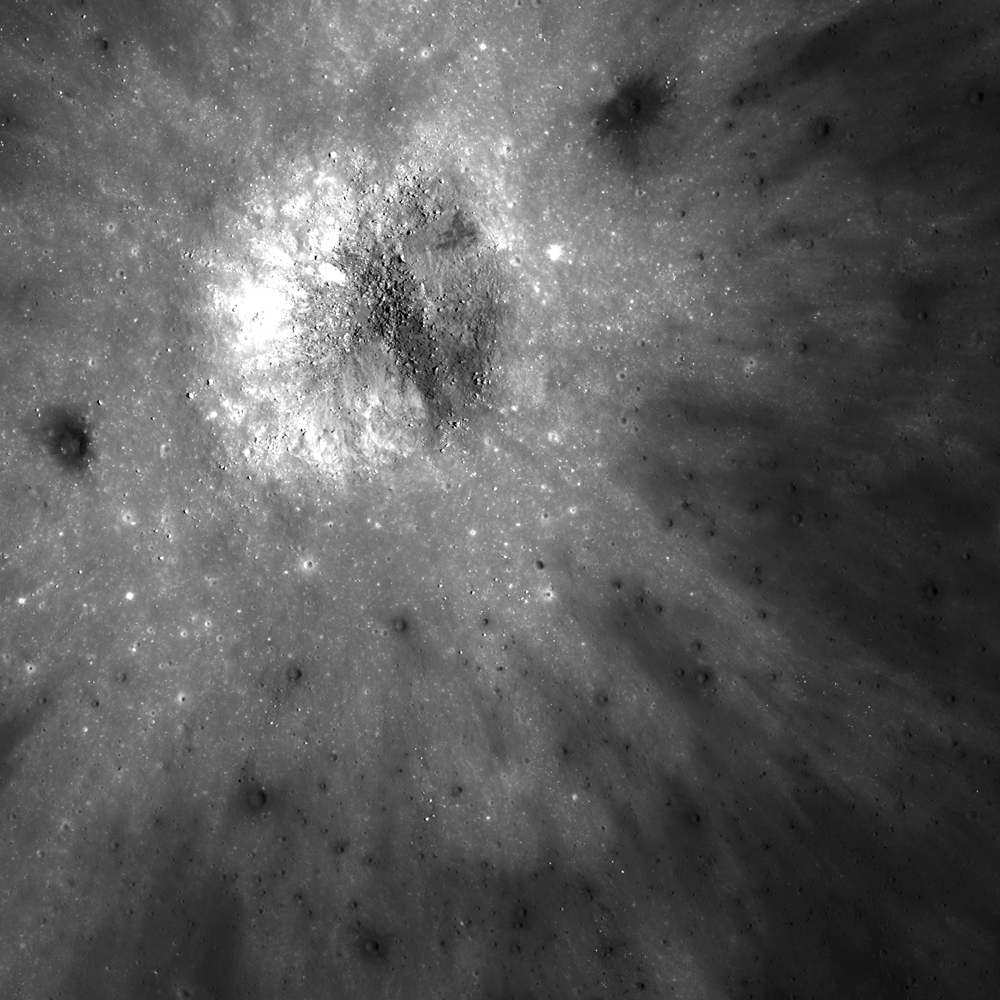
Self-secondaries within the ejecta blanket of a fresh crater. A roughly 2500 meter-wide field of view from LROC Narrow Angle Camera (NAC) observation M1120683999L, LRO orbit 17351, angle of incidence 34.85° at 0.88 meters per pixel resolution from 97 km over 2.21°S, 84.85°E, central Mare Smythii [NASA/GSFC/Arizona State University].
Sarah Braden
LROC News System

Today's Featured Image highlights a small (830 meter) fresh impact crater (located at 2.017°S, 84.948°E) with an ejecta blanket peppered with smaller impact craters. Two of the largest superposed impact craters excavated lower reflectance material (darker) from beneath the main ejecta blanket. This low reflectance material is more mature than the primary crater ejecta. The ejecta from the primary impact is higher reflectance since it is immature material that has not been darkened by space weathering processes. Some of the small impacts have higher reflectance ejecta, which means they did not puncture through the fresh primary crater ejecta blanket.

The craters seen in the Featured Image are a mix of self-secondary and small primary impacts. The term secondary crater describes impact craters formed by ejecta materials from larger impacts. Self-secondary craters form as late stage ejecta is superposed on early ejecta material from the same impact event and are for the most part found near the primary impact crater. The velocity of ejected material increases with distance from the primary crater; therefore, most self-secondary craters are created by low-velocity impacts. Secondary craters formed furthest from the primary crater result from higher velocity ejecta, which makes those secondary craters harder to discern from small primary craters. Secondary craters on the Moon are estimated to have a maximum size of ~4% of the primary crater diameter.

Planetary scientists use the density of craters on impact ejecta as an indicator of age of the impact, based on our understanding of the flux of primary impacts over time. Self-secondaries on crater ejecta are not primary impact craters and inclusion of self-secondary impacts in a measurement will give a higher crater density, and thus result in an older age estimate for that particular surface. The age estimate for the impact crater Giordano Bruno is an example where self-secondaries complicate our understanding of the relationship between surface age and crater density.  

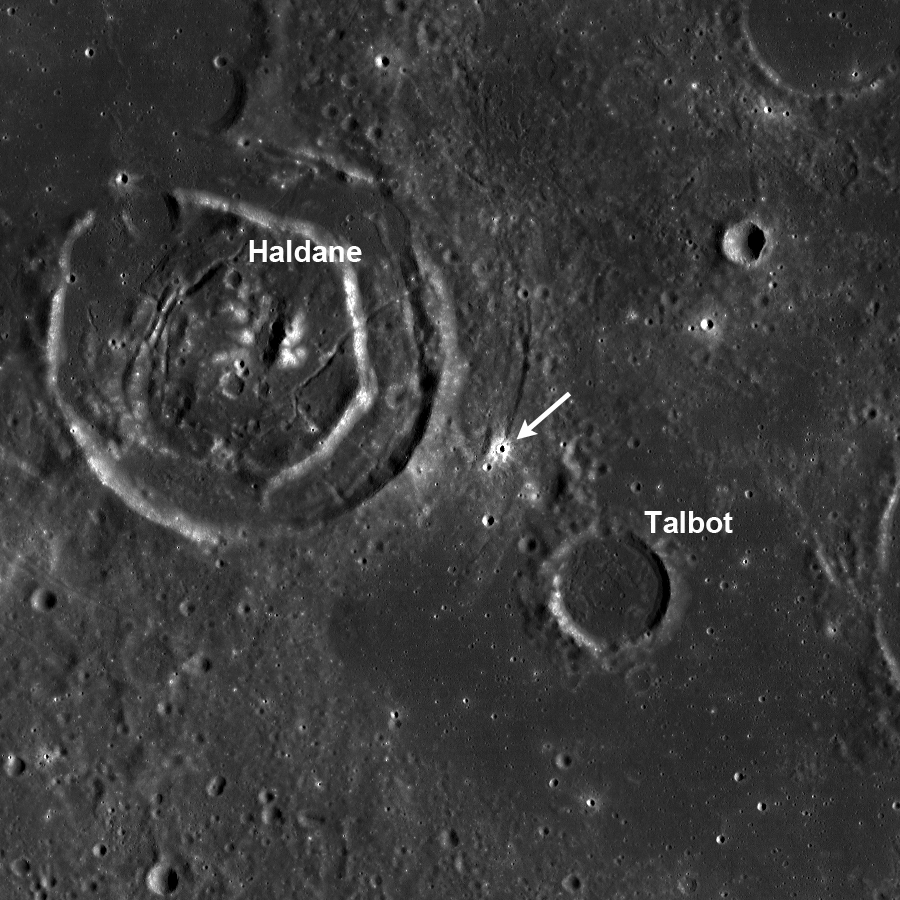
LROC WAC Haldane and Talbot (Context)
LROC WAC 643 nm reflectance mosaic of the area surrounding the fresh crater in the Featured Image (white arrow) [NASA/GSFC/Arizona State University].
The fresh impact crater in today's Featured Image is between two relatively older craters: Haldane (40 km diameter) and Talbot (12.4 km diameter). The crater Talbot has a visible rim, but the ejecta blanket was embayed by mare basalt. Talbot's floor is flooded with mare basalt as well. Haldane is also as old or older than Talbot since sections of Haldane's rim are completely destroyed.

Explore the full NAC image, HERE.

Related LROC Featured Images:
Polka-dot Ejecta
Action Shot
Impact Art
Ejecta sweeps the surface

HDTV-Mare-Smythii
HDTV still from Japan's lunar orbiter SELENE-1 (Kaguya, 2007) captured the western interior of Mare Smythii, straddling the libration zone between the Moon's near and far sides. The small, fresh crater of interest (east-southeast of Haldane, on the lower far right) is not as readily visible at high (sunrise) solar illumination angles. From Earth, the Moon was a thin, early evening crescent [JAXA/NHK/SELENE].

Friday, March 27, 2009

Wieczorek: Moonface two-face

The man in the moon always presents us with the same mugshot, because the Earth's tides have locked the moon's spin to ours. But in a talk yesterday, Mark Wieczorek pointed out that not only did it not always have to be this way, but also that there is some evidence that the moon actually did swap its Earth-facing side at least once in the ancient past.

The work builds on a theoretical result in the 1970s from the University of Arizona's Jay Melosh, who showed that there were two equally stable ways in which the face of the moon could freeze toward Earth: the near side, and the far side. A glancing blow from a moderately big asteroid would be enough to do the job. Wieczorek, of the Institut de Physique du Globe de Paris, now shows that if that was the case, there would be a slight preponderance of big impacts on the moon's leading edge (marked 'apex' in the image here), since its orbiting velocity would be added to, rather than subtracted from, the impacting object. Lo and behold, he finds, the oldest impacts cluster around the moon's trailing face -- implying a flip-flop. "It's probably happened several times," he says. Most basin impacts would be big enough for the great switcheroo, but based on chronology, Wieczorek suggests that Smythii would be a likely candidate.

He says the process of a face switch could even start and stop temporary lunar dynamos -- which would be an interesting new mechanism for imprinting magnetic orientations onto lunar rocks.

Melosh was pleased that someone followed up on his theoretical idea, and says it needs to be tested on many of the Jovian and Saturnian satellites. "This suggests that this could be a common process with the other tidally locked satellites," he says.
LPS XL (2009)
Nature News