Showing posts with label Mascons. Show all posts

Thursday, May 30, 2013

Origin of lunar MASCONS found in GRAIL data - JPL

The Moon's elusive, uneven gravity is clearly seen in this Free-Air Gravity map produced from data returned in 2012 by the twin GRAIL orbiters. Mare Imbrium, for example, at upper right presents a significant anomalous profile, concentrated near what may have been the original "transitory" crater boundary but equally reduced from the lunar average (blue) between that boundary and the outer reaches of Imbrium's present boundary [NASA/JPL/MIT].
Pasadena -- Investigators combing through the huge treasure trove of data returned to Earth by NASA's GRAIL (Gravity Recovery and Interior Laboratory) twin spacecraft Ebb and Flow in 2012 claim to have "uncovered the origin of massive invisible regions that make the moon's gravity uneven, a phenomenon affecting the stability and longevity of lunar-orbiting spacecraft," JPL announced Thursday.

"GRAIL data confirm that lunar mascons were generated when large asteroids or comets impacted the ancient moon, when its interior was much hotter than it is now," said Jay Melosh, a GRAIL co-investigator at Purdue University in West Lafayette, Ind., and lead author of the new research. "We believe the data from GRAIL show how the moon's light crust and dense mantle combined with the shock of a large impact to create the distinctive pattern of density anomalies that we recognize as mascons."

The origin of lunar mascons has been a mystery in planetary science since their discovery in 1968 by a team at NASA's Jet Propulsion Laboratory in Pasadena, Calif. Researchers generally agree mascons resulted from ancient impacts billions of years ago. It was not clear until now how much of the unseen excess mass resulted from lava filling the crater or iron-rich mantle upwelling to the crust.

On a map of the moon's gravity field, a mascon appears in a target pattern. The bulls-eye has a gravity surplus. It is surrounded by a ring with a gravity deficit. A ring with a gravity surplus surrounds the bulls-eye and the inner ring. This pattern arises as a natural consequence of crater excavation, collapse and cooling following an impact. The increase in density and gravitational pull at a mascon's bulls-eye is caused by lunar material melted from the heat of a long-ago asteroid impact.

"Knowing about mascons means we finally are beginning to understand the geologic consequences of large impacts," Melosh said. "Our planet suffered similar impacts in its distant past, and understanding mascons may teach us more about the ancient Earth, perhaps about how plate tectonics got started and what created the first ore deposits."

"Mascons also have been identified in association with impact basins on Mars and Mercury," said GRAIL principal investigator Maria Zuber of the Massachusetts Institute of Technology in Cambridge. "Understanding them on the moon tells us how the largest impacts modified early planetary crusts."

Launched as GRAIL A and GRAIL B in September 2011, the probes, renamed Ebb and Flow, operated in a nearly circular orbit near the poles of the moon at an altitude of about 34 miles (55 kilometers) until their mission ended in December 2012. The distance between the twin probes changed slightly as they flew over areas of greater and lesser gravity caused by visible features, such as mountains and craters, and by masses hidden beneath the lunar surface.

Tuesday, December 11, 2012

The surface of the Moon: What lies beneath?

The Moon's anisotropic composition is well represented in this Mercator projection of lunar gravity, mapped at unprecedented resolution by the twin GRAIL lunar orbiters and centered on the Moon's farside [NASA/JPL/MIT].
Paul D. Spudis
Smithsonian Air & Space

The NASA mission GRAIL (Gravity Recovery And Interior Laboratory) has been orbiting the Moon since last spring.  The mission consists of two identical small spacecraft (dubbed Ebb and Flow) that very carefully keep track of their relative position from each other.  By tracking both of these spacecraft with high precision from Earth, we can monitor any small variations (caused by variations in the Moon’s gravity field) away from their predicted orbital paths.  If the satellite is flying over an area on the Moon with less material than normal (for example, over a deep crater, a hole in the Moon’s crust), it will be less attracted to the Moon because of this mass deficiency and will therefore fly away from the Moon.  If, on the other hand, it flies over an area of excess mass, such as a thick stack of dense lava flows, the excess mass pulls the satellite slightly toward it, increasing its speed and pulling it downwards.  As Ebb and Flow orbit the Moon, they conduct a delicate “dance.”  These movements are caused by variations in the Moon’s gravity (largely a reflection of variations in the density of its crustal rocks).  When combined with the high-resolution, precision topography of the Moon (currently being gathered by the Lunar Reconnaissance Orbiter), we are able to reconstruct the structure and thickness of the lunar crust from orbit.

GRAIL has unveiled a new global gravity data set, very high in resolution and precision and greater than ten times better than our previous version of the global gravity from the Japanese mission SELENE (Kaguya).  One interesting result shows unusual structure – long, quasi-linear gravity features appear in a variety of locations associated with lunar impact basins.  Basins are very large craters that formed during asteroid collisions prior to 3.8 billion years ago.  Some of these linear features extend on great circles across the lunar globe for distances of more than 500 km. These results suggest that solidified intrusions of once-molten rock may form a dense, criss-crossing network within the upper crust.

In order to understand the significance of these gravity features, it is necessary to understand some elementary facts about planetary geology.  Planets generate heat and this heat must be dissipated.  Typically, the heat generated from both the original energy release during formation (accretion) and from the decay of radioactive elements (e.g., uranium) melts the interiors of planets, forming bodies of liquid rock called magma.  This magma is usually less dense than the rocks from which it forms and thus, rises upwards towards the surface.  Sometimes, the molten rock cannot ascend any higher from the deep locations where it comes from and freezes in place – geologists call this type of frozen rock body an intrusion, because it intrudes into pre-existing rock as a liquid and then solidifies by crystallizing.  When magma actually reaches the surface of a planet, it can erupt onto its surface as lava; this activity is called extrusive because the molten rock extrudes onto the surface and then solidifies as lava flows.

Clearly, all erupting lava must have at one time been an intrusive magma body, at least during the time it was ascending upwards toward the surface.  Although many magma bodies reach the surface and create lava flows (such as the dark, smooth maria of the lunar lowlands), sometimes this magma cannot reach the surface and freezes in place within the crust as a linear or tabular body.  Such features (called dikes) are an essential part of the underground, igneous plumbing of volcanoes on all of the terrestrial planets.  We knew that they must have formed on the Moon because we saw the evidence of vents and structures in the maria that are the surface expression of such features.

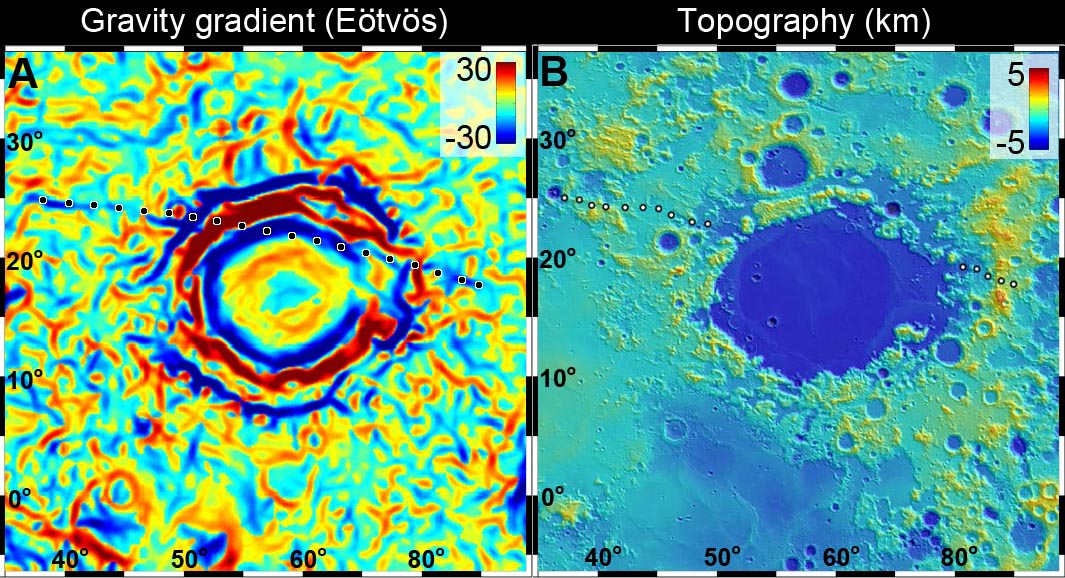
For the first time, the new GRAIL data show us direct evidence for these buried igneous dikes within the lunar crust.  One particularly prominent dike occurs near the Crisium basin, on the eastern near side of the Moon.  This dike extends over 1000 km in a quasi-radial direction northwest of the Crisium rim, disappearing beneath the mare lavas of that basin.  The fact that it is not clearly aligned with the basin structure suggests that it may predate it; we estimate that Crisium basin is older than 3.9 billion years.

Newly released GRAIL lunar gravity gradient map centered on Mare Crisium. An otherwise essentially invisible 300 km-long density of mass was detected buried under 3.9 billion year old Crisium (dotted line) [NASA/JPL/MIT].
Small scale topography of the Crisium basin, assembled from laser data points collected by the LOLA instrument aboard the Lunar Reconnaissance Orbiter [NASA/GSFC].
Mare Crisium and vicinity in a monochrome 1240 km-wide field of view from the LROC Wide Angle Camera 100 meter resolution global mosaic [NASA/GSFC/Arizona State University].
This long linear feature may have been formed when molten magma from the deep interior of the Moon oozed its way toward the surface, before “freezing” at some intermediate level.  Its presence, evident now only by a faint gravity signature (those denser areas “tugging” on the GRAIL satellites “Ebb” and “Flow”), is a tell-tale remnant of its existence deep inside the Moon’s crust.

The highly-detailed GRAIL lunar gravity gradient orthographic map, centered near 60° E meridian (and Mare Crisium, above center). The third of the hemisphere at right is on the Moon's farside. To view the spectacular new animations at their highest-available resolution by visiting the Science Visualization Studio (SVS) at NASA Goddard Space Flight Center, HERE [NASA/JPL/MIT/GSFC/SVS].
Many other linear and circular features are evident in the gravity gradient map produced by GRAIL.  Most of these seem to be associated with the large basins of the lunar highlands, the largest impact craters on the Moon. These features both excavate large amounts of crustal material during formation, and serve as topographic lows and structural traps for the accumulation of subsequent erupted lavas.  The gradient structures show a complex network of density patterns in the shallow subsurface of the Moon; this area is a morass of crushed rock, fractures, large faults and collapse features.  The entire outer portion of the lunar crust has been shattered and broken by an impact barrage of almost unimaginable violence.  The crust has since been partly annealed together by heat, re-fractured by additional impacts, intruded by large bodies of molten rock, resurfaced by the eruption of lavas from the deep interior, and finally has had its outermost surface pulverized into a fine powder by the micrometeorite bombardment.

The Moon may look like a silent, dead world but its past (which is Earth’s past) is testament to an early history of extreme violence and chaos.  The results from the GRAIL mission are helping us understand this complex story.

Originally published at his Smithsonian Air & Space blog The Once and Future Moon, Dr. Spudis is a senior staff scientist at the Lunar and Planetary Institute. The opinions expressed are those of the author and are better informed than average.

Sunday, September 11, 2011

The thinking behind the GRAIL twins


A useful view of our heterogeneous Moon. A practical illustration of the thinking behind the GRAIL project. From several thousand kilometers above the southern hemisphere and just below the equator of the lunar Farside it’s easier to see our Moon is “lumpy;” perhaps like the asteroids, it's own mass isn't high enough to crush it into a unified solid. From the standpoint of gravity the Moon retains the the memory of the smaller solid and semi-solid bodies from both before and after it's original formation. So nothing stays in close orbit around the Moon for very long without getting a frequent boost, and such boosts need fuel and fuel eventually runs out. This false color map of the lunar surface shows, in low resolution, differences from average elevation, or datum. Mare Orientale is on the right, and just beyond, so a crescent of the Nearside’s is visible. The expanse of the Farside here is defined, by the ancient South Pole Aitken basin, with the Moon's thinnest crusts, below center left, and by the Moon’s highest elevations and thickest crusts in the Farside highlands spread above the SPA rim (yellow box shows field of view in the next illustration [NASA/GSFC/MSFC/LOLA/LMMP/LP].

The Lunar Reconnaissance Orbiter (LRO) has orbited the Moon over 10,000 times since June 2009, mostly in a low and circular polar orbit. It requires a monthly boost to keep its record-breaking mission going. A common demonstration of the Moon's mass concentration (MASCON) problem is a thought experiment. A future astronaut stands on the rim of the Nearside impact basin Mare Imbrium holding a weight suspended a meter below a gloved hand sees that it doesn't hang straight down. Instead it hangs angling slightly toward the center of the basin hundreds of kilometers away. Anything in orbit is alternately tugged or gains slack changing its speed, causing it to eventually crash. This inconvenience, when carefully recorded and studied, is also a good way of mapping the Moon's interior in 3D.

The elevation map above shows how radically different the Moon’s Farside is from the familiar Nearside. In a photographs the extent of the 4 billion year-old SPA basin and the higher ground and its rim don’t stand out nearly as well. The map is plotted from millions of laser points measured from LRO's orbit to and from the lunar surface by the LOLA instrument, shown here using the ILIADS program available from NASA Marshall Space Flight Center. The yellow rectangle shows the field of view shown in an August 2011 release of LOLA science from the Goddard Space Flight Center.


NASA/GSFC, August 15, 2011 - Twenty-five years have passed since seven brave astronauts lost their lives in the Challenger accident. As the Shuttle program comes to an end, we are reminded of those who lost their lives in the pursuit of human exploration. Shortly after the accident, the Challenger astronauts were memorialized by having lunar craters named after them. These seven craters, located on the far side of the Moon in the Apollo Basin, expose deep portions of the lunar crust.

This LOLA image reveals that the depths of McNair and Jarvis craters, in particular, reach nearly 7 km below the lunar datum (the Moon's equivalent of 'sea level'). The depth of McNair and Jarvis is due to their placement within the large Apollo Basin (an existing topographic low) as well as the Apollo Basins location in the even larger South Pole-Aitken Basin. When combined with data from other LRO instruments such as LROC and Diviner, and instruments aboard other spacecraft such as the Moon Mineralogy Mapper (M3) aboard Chandrayaan-1, the complex nature of the Challenger craters is revealed. Data from the M3 instrument reveal that Jarvis crater's composition may represents a deep portion of the lunar crust.

References

Steigerwald, B. (2010) "Biggest, Deepest Crater Exposes Hidden, Ancient Moon," June 2, 2011.
Robinson, M. (2011) "Challenger Astronauts Memorialized on the Moon," January 28, 2011, LROC
Petro, N., et al. (2010) "Lower Crustal Materials Exposed in the Apollo Basin Revealed Using Moon Mineralogy Mapper (M3) Data," 41st Lunar and Planetary Science Conference, #1802, March 2010.

LOLA original map: small | large 


Japan’s lunar orbiter Kaguya (SELENE-1, 2007-2009) vastly added to our knowledge about the “hidden Moon” originally gathered through the Apollo era and afterward, stitched together by 2005. Along with the first HDTV from lunar orbit, Kaguya was a platform for a variety of instruments, including laser altimetry, like LRO. The Kaguya LALT system itself built up an elevation map that is only very recently being surpassed by LOLA during the past two years.

Using their links with Kaguya, with its sub-satellite R-SAT, and in a manner very much like the mission plan for GRAIL-A and B, JAXA investigators delicately measured Doppler shift and subtle light-speed changes between each orbiting spacecraft and with the ground to built-up a detailed map of the Moon’s "gravimetric anomalies."

Together with the unprecedented detail of the Moon’s crustal thicknesses, seen in maps like the one below, Kaguya presented scientists with new and very much more detailed faces of the Moon. Kaguya investigators also helped refine the elusive center of the Moon, from within 20 to 2 kilometers, much more.


The relative thickness of the lunar crust as teased out by Japan's Kaguya orbiter and its sub-satellite R-SAT. The Moon's MASCONS and 'negative gravity anomalies' don't necessarily manifest themselves in surface features, like the one associated with Mare Imbrium.[JAXA].

GRAIL-A and B will join LRO and the recommissioned ARTEMIS twins for a grand total five American unmanned lunar missions, all orbiting the Moon at the same time by the end of the year. The skies above the Moon will become nearly as crowded as those of Mars.

The GRAIL twins will pick up the task of mapping our lumpy Moon’s mass, ARTEMIS the intricacies of the Moon’s plasma wake and its interaction with Solar wind as the Moon orbits through Earth’s magneto-tail with LRO continuing to map the lunar surface from more lasting, slightly higher polar orbit.

All this latter-day renewed interest in the Moon began as preparation for an eventual return, inspired by the loss of Columbia in 2003. That original timeline for renewed, extended human activity on the Moon may seem much further away once again, for the moment, but these unmanned “precursor missions” set into motion through the vagaries of reaction to tragedy or short-term public policy shifts are well along in the pipeline, on time and under budget.


LROC Wide Angle Camera (WAC) monochrome (604nm) mosaic of northeastern Apollo basin, from observations in LRO orbits 2068 and 2069, December 8, 2009; field of view roughly 120 km, resolution 78 meters per pixel, incidence 70° The depth of the interior floor of Jarvis and McNair, the larger and smaller of the two co-joined craters, respectively, and the largest feature seen above, are roughly 7,000 meters below lunar mean elevation. [NASA/GSFC/Arizona State University].

Wednesday, December 2, 2009

Chang'E-1 has blazed a new trail in China's deep space exploration

Lunar global topographic map based on Chang'E-1 Digital Elevation model (DEM) CLTM-s01.

Science in China
(Series G, Physics, Mechanics & Astronomy)

A huge amount of scientific data have been accumulated by the Chang'E-1 lunar orbiter. Using laser altimeter data, Jinsong Ping and Qian Huang et al obtained improved 3D lunar topography, and based on this, they had made new discoveries (such as impact basins and volcanic deposit highlands) of some ancient topographic characteristics on the lunar surface. Chao Chen and Qing Liang et al., found the South Pole-Aitken (SPA) Basin as the biggest mascon on the moon and put forward a fault structure hypothesis for the Apenninus Mountains, which is significant for the study of the origin and evolution of the moon.

The above special-issue papers reporting on the Chang'E selenodesy results were jointly accomplished by experts from the Shanghai Astronomical Observatory (SHAO), the China University of Geosciences (Wuhan) and other institutions. They will appear on Vol. 39 Issue 10 of the "Science in China Series G: Physics, Mechanics & Astronomy" and Vol. 54 Issue 20 of the Chinese Science Bulletin.

Since the 1990s, there has been a new worldwide upsurge of lunar exploration missions. As did the other lunar spacecrafts launched about the same time frame, the Chang'E-1 lunar orbiter focused on selenodesy so that it could remedy the low resolution and poor coverage problems of past data and open the door to recovering lunar evolution by detecting new lunar topography, gravity fields or interior structures. Furthermore, it would prepare for future Chinese spacecraft landing on the surface of the moon.

Lunar topography, chemical composition and thickness all show obvious dichotomy. In-depth investigation into the lunar dichotomy and characteristics of basins, mascons, impact craters and volcanic highlands is the only way to throw light on the history of lunar evolution. Based on the Chang'E-1 lunar DEM model CLTM-s01 published in 2008, researchers from SHAO took a comparative planetary science approach and successfully found some impact basins (i.e. the quasi-impact basin Sternfeld-Lewis and impact basin Fitzgerald-Jackson) and one crater (i.e. the crater Wugang) on the Far Side, and one middle scale volcanic deposit highland (i.e. the 2.8 km highland Yutu) on the Near Side. Moreover, they analyzed and identified some middle scale impact basins and classified them according to their circular characteristics.

Based on the Bouguer gravity anomaly, researchers from the China University of Geosciences confirmed the SPA basin is the biggest mascon on the terrestrial planets in the solar system. Comparing the Apenninus Mountain of the moon with the Himalayas on Earth, they put forward a hypothesis about the possible existence of a big fault structure band, which would possibly change our previous knowledge that there is no motion in the interior of the moon.

Due to certain operational limitations, it is difficult to calibrate the data collected by the Chang'E-1 orbiter. The researchers tried to get around various problems with novel techniques (especially related to the interferometer spectrometer imager), and made the previously inapplicable data useful for estimating the distribution of lunar materials. Besides, Chinese astronomers creatively monitored the critical arcs of the Chang'E-1 trajectory with a VLBI measurement platform.

As forward-looking technologists, they also performed open-loop radiometric tracking of the spacecraft and other unprecedented test experiments, while further participating in same-beam observation of the Japanese SELENE spacecrafts. We believe these pioneering works would make a significant contribution to our country's future deep space exploration.

Saturday, June 13, 2009

The different gravity anomalies of the lunar Near and Far Sides


The nearside on the left, and the farside on the right. Red
indicates strong gravity (positive gravity anomalies), and
blue indicates weak gravity (negative gravity anomalies).
Anomalies differ on the near and far sides.


Prof. Manabu Kato
Science Manager of Kaguya

"On the nearside they are made up of heavy materials, and contain mascons (mass concentrations) that are positive gravity anomalies - i.e., the local gravity is stronger than average. Hypothetically, when a celestial body hit the Moon's surface, the temperature and pressure of the lunar interior increased, and the softened and easily distorted interior material pushed up the mantle, causing the eruption of high-density lava and producing a mascon. On the farside, on the other hand, there are few lunar maria. The farside has no mascons - positive gravity anomalies - but rather a number of negative gravity anomalies in craters and basins, which are all topographically round-shaped. Scientists believe that on the farside, the interior of the Moon was at lower temperatures and thus more firm. As a result, when large celestial objects impacted the Moon and impact basins were formed, there was less crustal uplift and lava eruption, and thus no density anomalies."

"KAGUYA's gravity measurements suggest that approximately 4 billion years ago, when most of the Moon's impact topography (craters, basins and maria) was formed, its interior was hot on the nearside but cold on the farside, resulting in the variation in the firmness of the crust on the near and far sides."

Read the JAXA feature story HERE.

Wednesday, October 15, 2008

Global Topography and Gravity of the Moon Revealed by KAGUYA

Antarctica and the southern hemisphere disappears behind Mount Malapert
and the Lunar South Pole, Nov. 2007, from the HDTV camera on-board
"Kaguya," Japan's Lunar orbiter. Abyssal Shackleton Crater slips
behind the probe's path northward over the Moon's farside.


The elusive shape of the "lunoid," the shape, density and complexity of the mass of Earth's Moon, scientists claim, has finally been mapped. In an oral presentation to the 40th annual meeting of the Division of Planetary Sciences, American Astronomical Association, Dr. Sho Sasaki made announcement on behalf of JAXA and the National Astronomical Observatory of Japan.

"The Japanese lunar explorer KAGUYA (SELENE) was launched successfully on September 14th, 2007. KAGUYA has two small spin-stabilized subsatellites, Rstar (OKINA) and Vstar (OUNA) for gravity measurement. We can track the three satellites by new methods: 4-way Doppler tracking between the main satellite and Rstar for the far-side gravity and multi-frequency differential Very Long Baseline Interferometry (VLBI) tracking between Rstar and Vstar. The global lunar gravity field with unprecedented accuracy can be obtained.

"Through more than 6 months, precise gravity field including most of farside was obtained. The farside gravity field shows significant improvement from the previous model. Many circular features corresponding to impact structures are clearly identified. Some of the circular gravity anomalies in the free-air gravity apparently disappear in Bouguer anomaly map; the surface topography is a dominant source of free-air gravity anomalies and large impact structures are supported by lithosphere, which would lead to the difference of thermal history between nearside and farside.

"A possible cryptomare candidate (a circular gravity anomaly without topographic signature) was also found.

"KAGUYA has a laser altimeter (LALT). The first precise global topography data with range accuracy 5 meters have been produced by LALT. In the polar regions where CLEMENTINE did not cover, topographic features in the shadowed area are newly discovered.

"Solar illumination condition was calculated, and the region whose solar illumination rate is higher than 90% is very limited.

"Lunar mean radius is 1737.15 (±0.01) kilometers and the COM-COF offset is 1.94 kilometers. The amplitude of the power spectrum of topography spherical harmonics is larger than that of the previous model, at Love Number greater than 30.

"From the gravity and topography data, we obtain the distribution of the crustal thickness on the Moon. We also estimate the correlation between gravity and topography and localized admittance values. Gravity and topography observation of KAGUYA will continue until early 2009."

Friday, May 23, 2008

Lunar GRAIL will detail Moon's "Interiors"

From one of the many studies still being produced from Lunar Prospector (1998-99), this one by Alex S. Konopliv, et.al., of NASA JPL, showing the complex discontinuities of the Moon's many centers of gravity. After the Lunar Reconnaisance Orbiter, NASA's GRAIL mission will provide finest detail yet of the lunar "interiors."

MIT professor of physics Maria Zuber is the principal investigator of the Gravity Recovery and Interior Laboratory — "GRAIL" for short. It's a new NASA mission slated for launch in 2011 that will probe the moon's quirky gravity field. Data from GRAIL will help scientists understand forces at play beneath the lunar surface and learn how the moon, Earth and other terrestrial planets evolved.

"We're going to study the moon's interior from crust to core," says Zuber. "It's very exciting."

For 270 days, beginning in September 2011, the GRAIL will be "twins," using interferometry turned inward for unprecedented detail of the complexities of the Moon's many interiors.

GRAIL will fly twin spacecraft, one behind the other, around the moon for several months. All the while, a microwave ranging system will precisely measure the distance between the two satellites. By watching that distance expand and contract as the two satellites fly over the lunar surface, researchers can map the moon's underlying gravity.

Scientists have long known that the moon's gravity field is strangely uneven and tugs on satellites in complex ways. Without course corrections, orbiters end their missions nose down in the moondust! In fact, all five of NASA's Lunar Orbiters (1966-1972), four Soviet Luna probes (1959-1965), two Apollo sub-satellites (1970-1971) and Japan's Hiten spacecraft (1993) suffered this fate.

Read MORE from Science@NASA HERE.

Excellent abstract and Study presentation (.pdf)
from the Lunar Science and Planetary Institutes 39th Conference (2008)