Showing posts with label cryptomare. Show all posts

Sunday, November 23, 2014

Dark splotches over high albedo, under a high sun

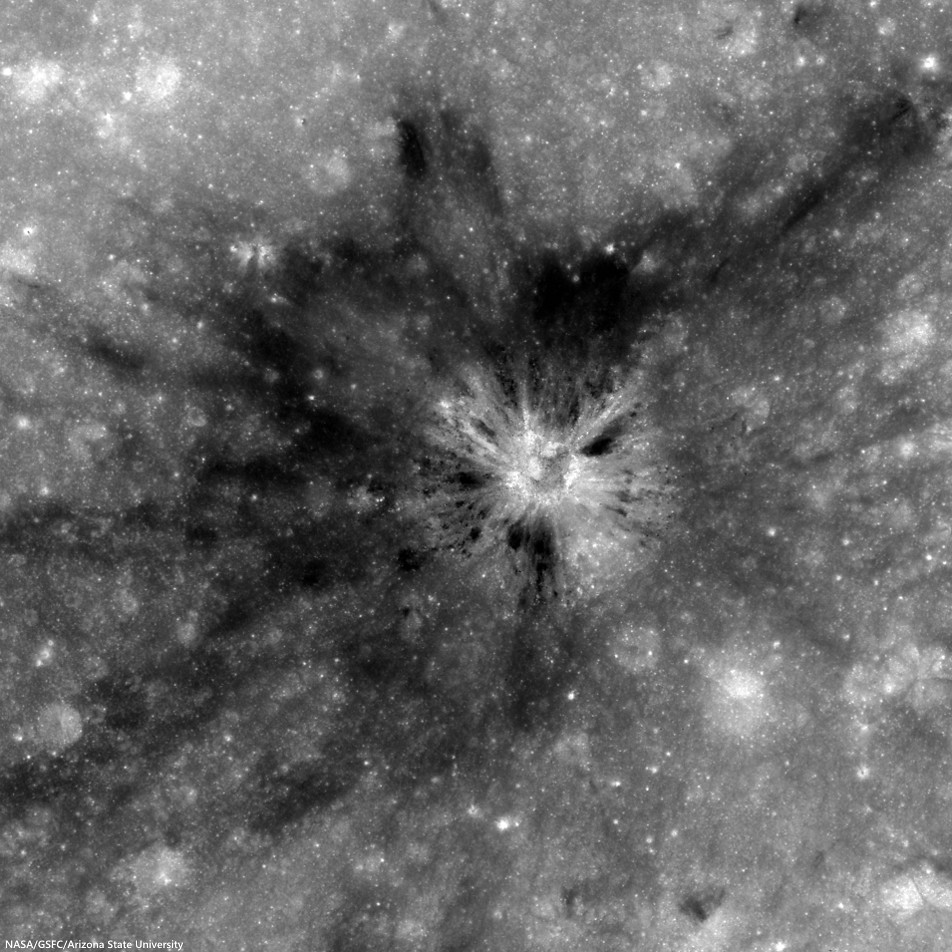
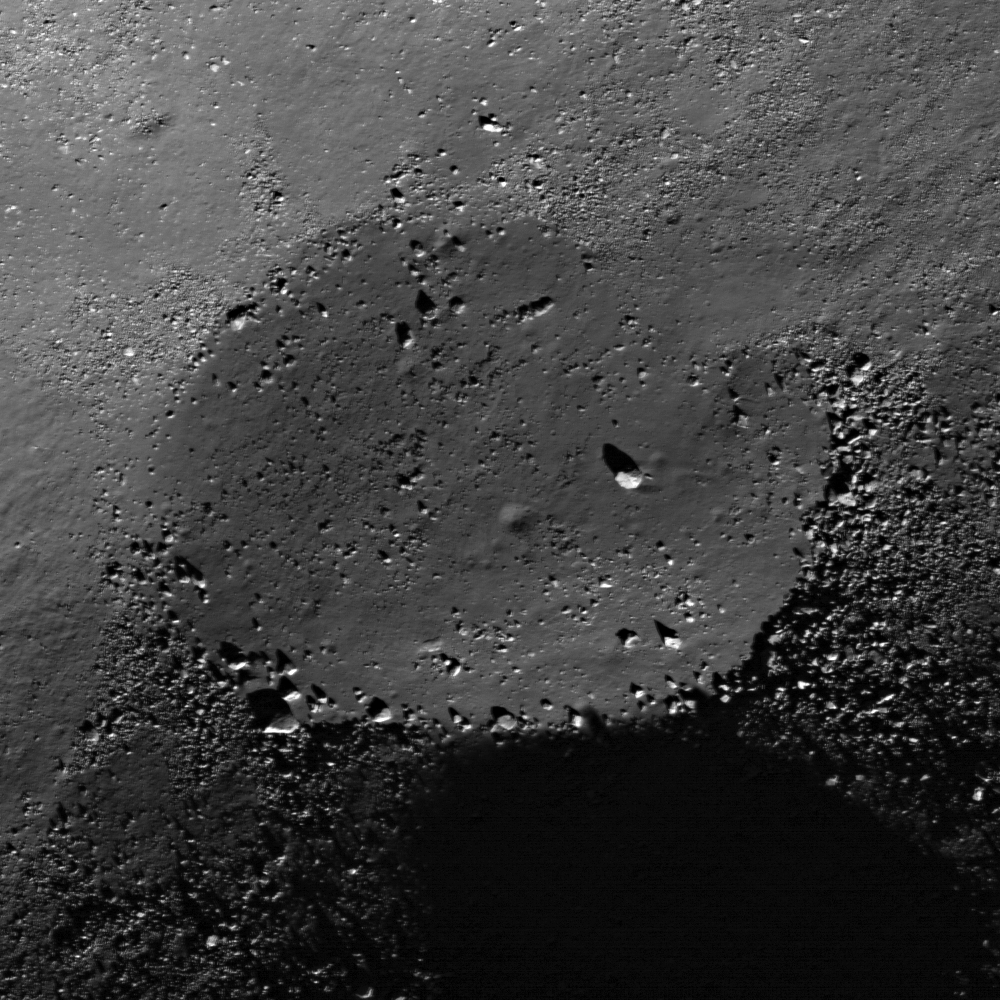
Unnamed crater (2.2784°N, 116.2125°E) southwest of King, presenting a unique albedo variation in 1.8 km-wide field of view from LROC NAC observation M123812230R, LRO orbit 3380, March 21, 2010; 8.3° incidence angle, resolution 57 cm from 55.36 km over 2.25°N, 116.16°E [NASA/GSFC/Arizona State University].
Hiroyuki Sato
LROC News System

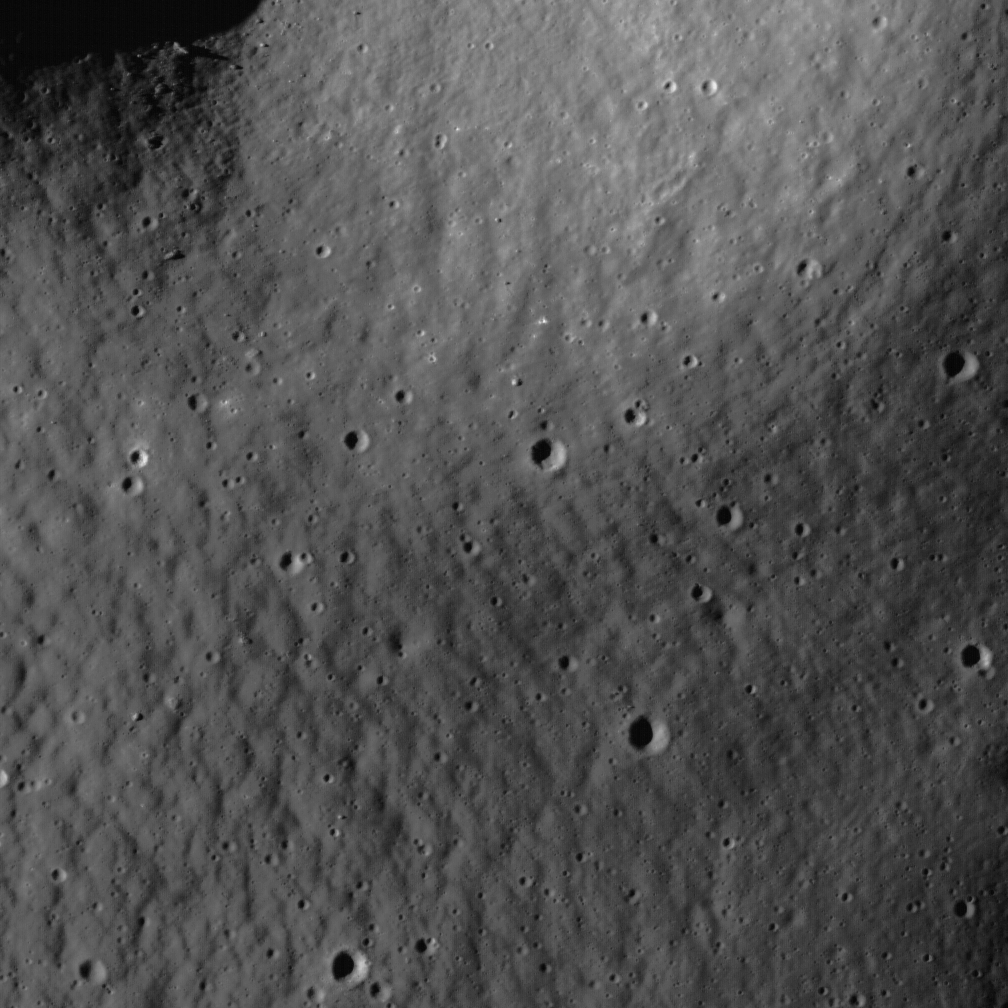
Impact craters routinely excavate subsurface materials, exposing them in crater walls and in ejecta. The Featured Image highlights an unnamed fresh crater (480 meters in diameter) with numerous dark splotches.

Inside the crater cavity, dark splotches (low reflectance materials) occur from the middle to the trim of the crater and spread outward beyond the rim crest.

Several small craters (less than 100 meters in diameter) with similar dark splotches also occur in this region (outside the area shown above, see next image), suggesting that the dark materials were likely excavated from an extensive subsurface layer. The distribution of the dark halo craters informs us about the horizontal extent of these subsurface materials.

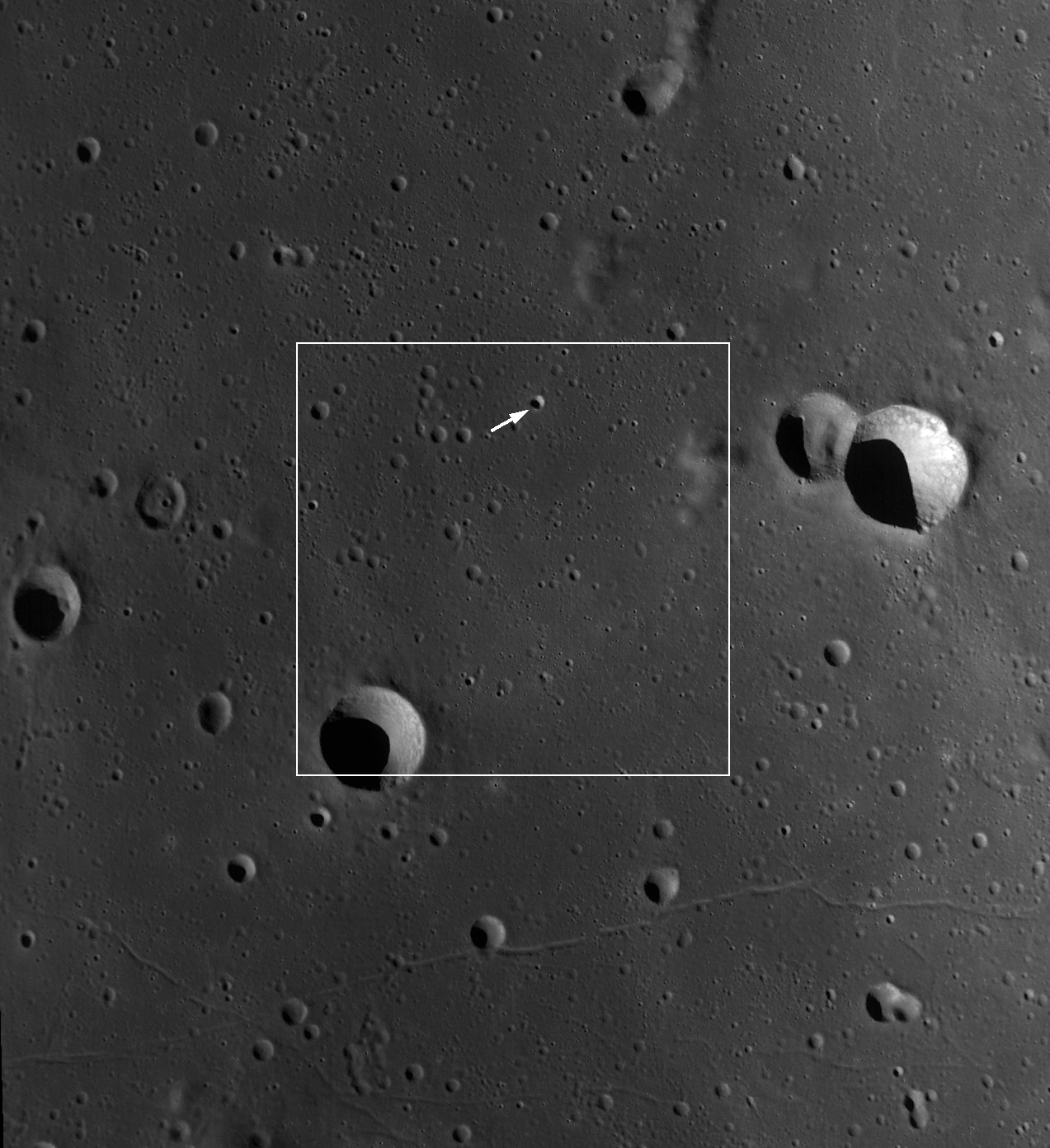
Small craters a few thousand meters north of the dark halo crater (DHC) of interest, above, from the same LROC NAC frame M123812230R. Note the crater right of center bottom may be superposed on the rim of a more ancient depression [NASA/GSFC/Arizona State University].
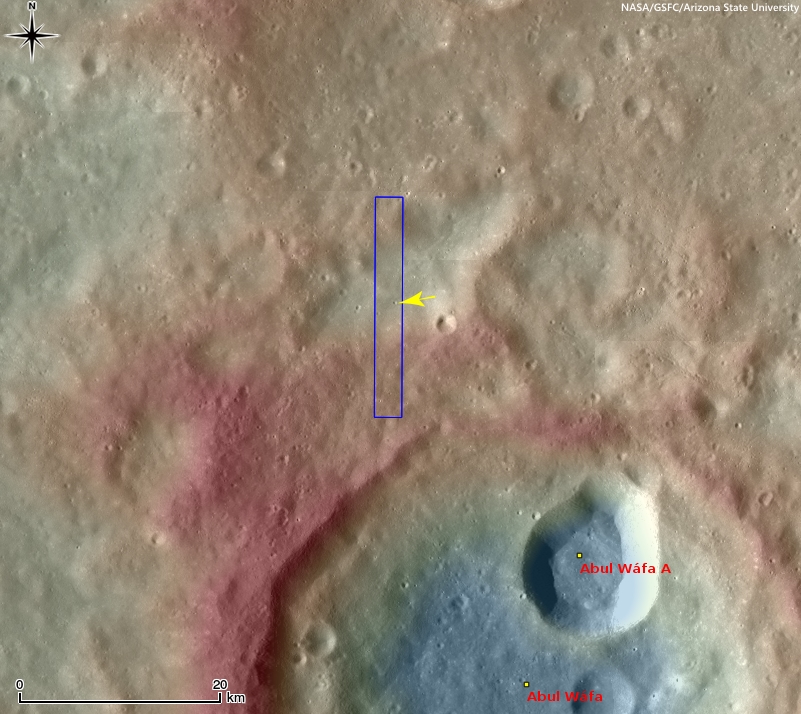
The crater in the opening image is found 116 km from the southwestern rim of King crater (76.2 km; 4.96°N, 120.49°E), located in the farside highlands. Unlike in the mare, pyroclastic deposits are unlikely to be the low-reflectance material (seen in the opening image) here in the middle of the highlands with no indication of volcanic activity near here. So, what is this low reflectance layer?

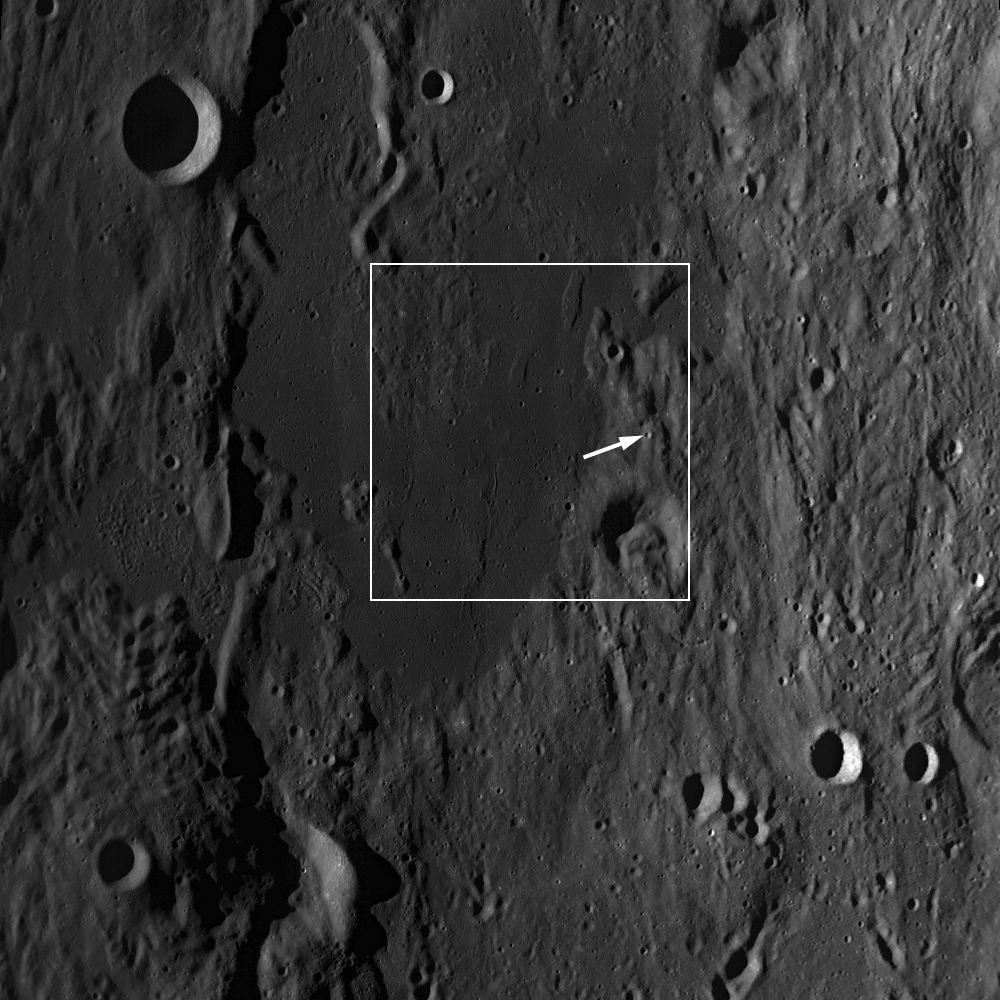
Context view of the location of today's Featured Image in WAC monochrome mosaic (100 m/pix) overlayed by WAC stereo DTM (GLD100, Scholten et al., 2012). The NAC footprint (blue box) and the exact location of the opening image (yellow arrow) are indicated [NASA/GSFC/Arizona State University]. 
The rays of Necho crater (36.87 km; 5.25°S, 123.24°E) extend out around 680 kilometers (see image below) crossing over King crater and the area in today's Featured Image. Since the area of opening image is crossed by the Necho ray deposits the excavated dark layer might be the original mature surface (now covered by Necho's high reflectance rays).  

Context view of the area of interest in an orthographic LROC WAC mosaic of low-angle observations of the surrounding hemisphere. Arrow points to the location of the crater of interest, within range of ejecta from King, Necho or perhaps, less likely, Giordano Bruno or Goddard A craters, (not unlike the magnetic anomaly east of Firsov) [NASA/GSFC/Arizona State University]. 
Due to the lack of atmosphere on the Moon, the photometric effect is very strong. Thus, it is hard to identify the relationships between the different layers using low-Sun images (images with large incidence angles, near sunrise or sunset); however, high-Sun images (those with low incidence angles, near noon) display clearly the relationships between units, which helps us reconstruct the resurfacing history of this area.

View full-size view of the LROC NAC frame, HERE.

Related Posts:

Tuesday, April 29, 2014

Jagged rim on the southwest limb

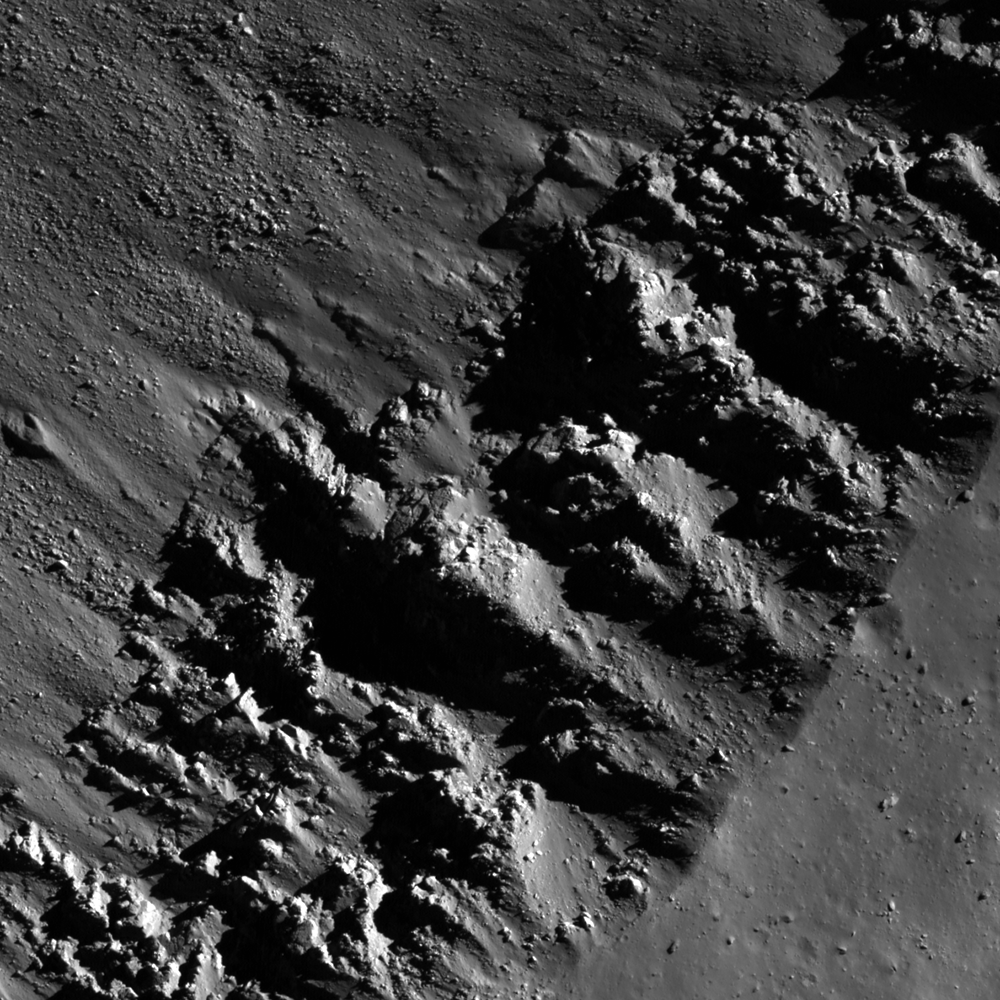
The upper southeastern rim of Piazzi H (8 km; 40.185°S, 294.237°E) 800 meter field of view from LROC NAC observation M1152277932L, LRO orbit 21794, April 16, 2014; 59.17° incidence angle, resolution 75 cm from 72.25 km [NASA/GSFC/Arizona State University].
Raquel Nuno
LROC News System

The rocks that form Piazzi H's (40.185°S, 294.237°E) beautifully textured upper crater wall hang precariously from near the crater rim. Under the action of gravity and time, material from crater walls continuously slough off. This fall to a lower gravitational potential is one of the reasons why old craters have a smoother appearance (the other reason is bombardment by micrometeorites which pulverize craters into fine grained dust). 

Why do these overhanging rocks not succumb to the force of gravity? Perhaps this is telling us that this crater is young, gravity has not had enough time to pull those rocks down. One way to determine if a crater is young is to look for high reflectance ejecta, and the WAC 643 nm normalized reflectance map allows us to do just that.

The image below, on the left, is the from a WAC 643 nm normalized reflectance mosaic showing the high reflectance ejecta of Piazzi H. We also see a similar pattern with from the nearby crater Lacroix B, implying they are of similar ages. But we don't find the same rock overhangs on the walls of Lacroix B.

The roughly 93 km distance between Piazzi H and LaCroix B craters is shown comparatively, using the LROC Quickmap application, rolling from LROC Wide Angle Camera (WAC)-derived 643 nm normalized reflectance through the LROC WAC digital elevation model, a very fast way to demonstrate how granularity can be overwhelmed or shown in stark relief, depending on the angle of illumination or the range of wavelengths presented [NASA/GSFC/Arizona State University].
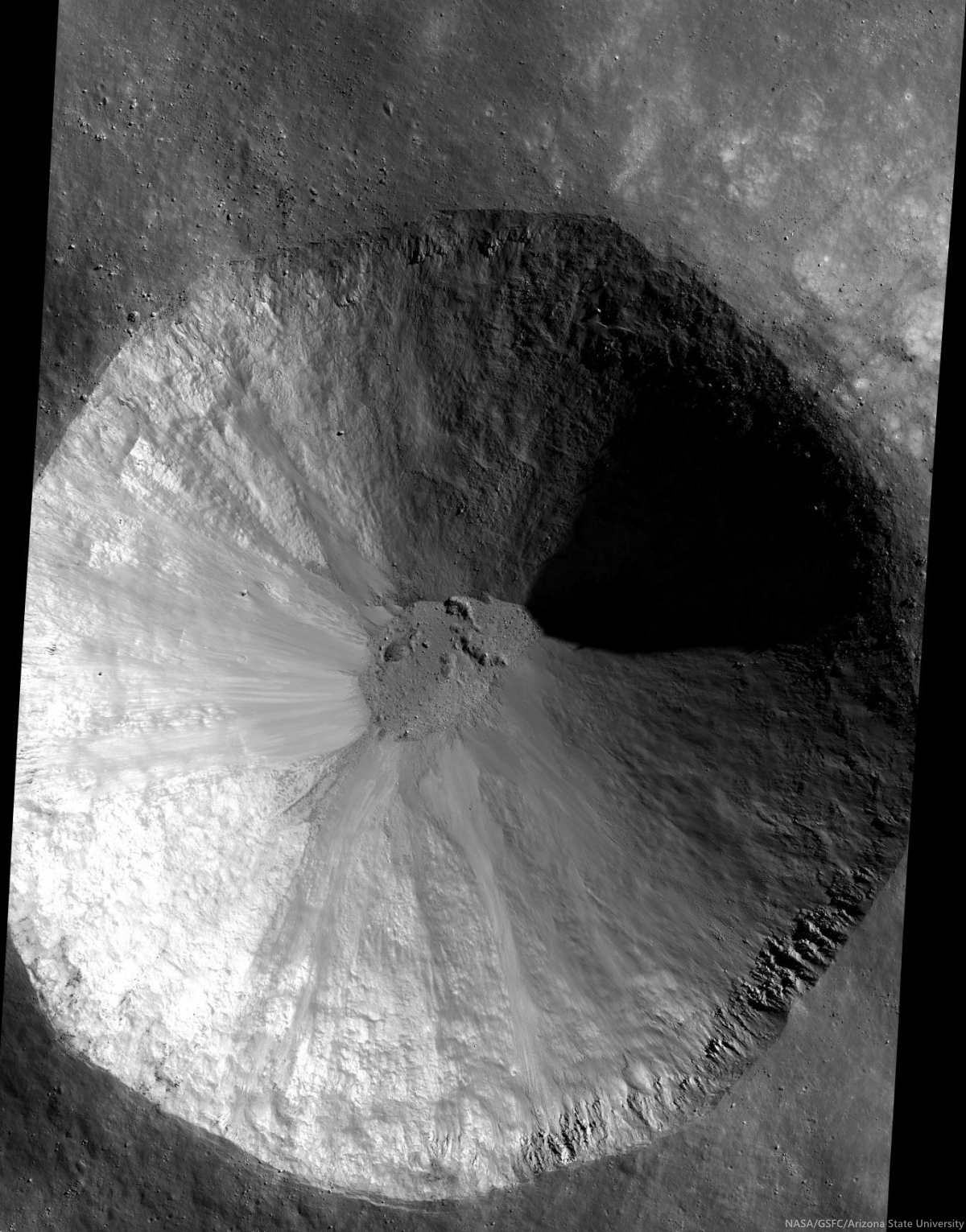
One possibility is that the structure we are seeing are the ragged edges of a bedrock layer. A strong coherent layer might have enough resistance to stress to better support these overhangs. Lunar scientists use measurements of layered deposits (see image below) to understand ancient lava flows on the Moon.

Crater rim outcrops hang onto the southeastern rim and wall of Piazzi H (7.7 km; 40.185°S, 294.237°E), from a mosaic including the left and right frames of LROC NAC observation M1152277932 [NASA/GSFC/Arizona State University].
Even though this crater is located in the lunar highlands, what we may be seeing is uncovered cryptomare. A recent study on rock outcrops on lunar crater rims use measurements to understand the flow of material during crater excavation.

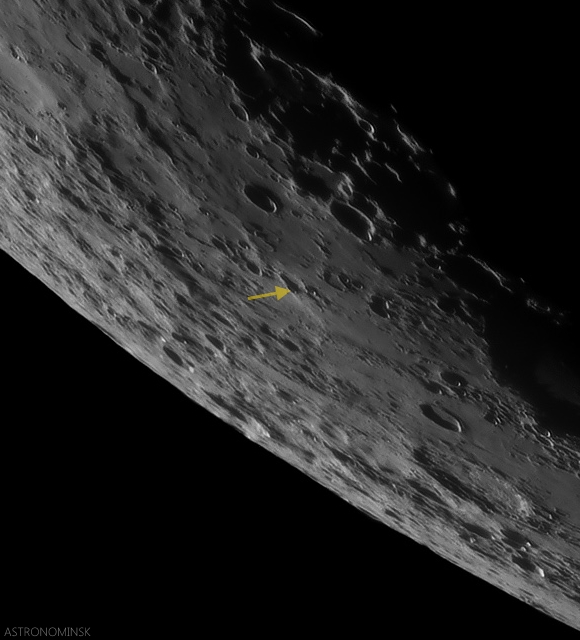
Piazzi H, on the west rim of a larger, previously unrecognized and far more ancient crater, can be seen from Earth after a Full Moon, or in relief about 5 days following. Here the crater is picked out from a full disk mosaic of 25 images captured before dawn, August 26, 2011. The entire dramatic crescent, by Yuri Goryachko, Mikhail Abgarian, Konstantin Morozov of Minsk, Belarus can be seen in their gallery HERE [Astronominsk].
Explore the full resolution NAC mosaic of crater Piazzi H, HERE. The shadows cast by the textured crater wall make this crater a particularly beautiful one.

Related Posts:
Layering in Euler Crater

Context for the inset shown at full resolution immediately above (yellow box), the late crescent mosaic of 25 images of a very late crescent Moon, photographed before dawn August 26, 2011. By Yuri Goryachko, Mikhail Abgarian, Konstantin Morozov, Minsk, Belarus [Astronominsk].

Thursday, October 31, 2013

Dark ejecta, clue to cryptomare

M1115555142L_1k
A 78 meter diameter crater with distinct dark ejecta surrounding its rim, in the farside southern  highlands (31.131°S, 147.536°E) north of Jules Verne. LROC Narrow Angle Camera (NAC) frame M1115555142L, LRO orbit 16629, February 16, 2013; 40.36° angle of incidence, 74 cm per pixel resolution from 71.92 km [NASA/GSFC/Arizona State University].
Jeffrey Plescia
LROC News System

Impact crater ejecta is typically brighter than the surrounding material because it is fine-grained and immature (unweathered); even on the dark mare, fresh craters usually have bright ejecta. Craters with distinctly dark ejecta do occur, but they are rare (e.g., Shorty Crater at the Apollo 17 landing site). When craters have dark ejecta, the interpretation is that a layer of low reflectance rock or soil at depth was excavated and distributed around the margin of the crater. In the case of Shorty Crater, the conclusion is that a layer of dark pyroclastics was hidden just beneath the surface; in other cases, dark halo craters are interpreted to indicate mare material at depth (cryptomare). Several of the craters formed by the impact of spacecraft hardware, such as the Apollo 13 S-IVB, into the surface also have dark ejecta rays, and this observation is not yet well understood.

Details of the crater morphology can be seen in this expanded view from LROC NAC M1115555142L [NASA/GSFC/Arizona State University].
Our dark halo crater (31.131°S, 147.536°E) has a diameter of about 78 m, although it is slightly elongate in the north-south direction. Rays of dark ejecta extend for almost 200 m from the crater rim. Morphologically, the crater is not the normal simple bowl shape for a crater of this size. Rather, a depression on the crater floor in the center is surrounded by a low ridge about 33 m in diameter; beyond that annular ridge to the crater wall the floor appears to be flat. Boulders are scattered on the crater floor and on the ejecta to the east; the largest boulders on the east side are as large as 6 m across.
dark_ejecta_reg_sm
Regional view of the dark ejecta crater. Note the crater formed on the western flank of an older, larger crater. Relatively low albedo, smooth plains spread out immediately to the south. These plains (see next image) may be mare material and may underlie the area of the small impact. LRO NAC frame M167241339R (spacecraft orbit 9780, August 6, 2011; 55.96° angle of incidence, 65 cm per pixel resolution from 62.95 km)  [NASA/GSFC/Arizona State University].
LROC Wide Angle Camera (GLD100) context, at 64 meters per pixel resolution, shows the location of the crater of interest in relation to the arc of exposed mare material to the south and west [NASA/GSFC/Arizona State University].
This crater formed on the outer flank of a larger older, degraded 635 m crater. Highlands ejecta (higher reflectance than mare) from this larger crater buried the mare. Later the impact that formed the younger dark halo crater punched through the bright highland ejecta and brought up mare from 10 meters or more depth.

Explore this region of the Moon in the full NAC image, HERE.

Related Posts:
Bright and Dark Ejecta (September 11, 2013)
Excavating Dark Deposits (September 3, 2013)
Dark haloed crater in Mare Humorum (June 7, 2011)
Dark Halo Crater in Orientale (March 4, 2011)
Dark craters on a bright ejecta blanket (November 17, 2009)

Tuesday, September 25, 2012

A cluster of dark-haloed secondary craters

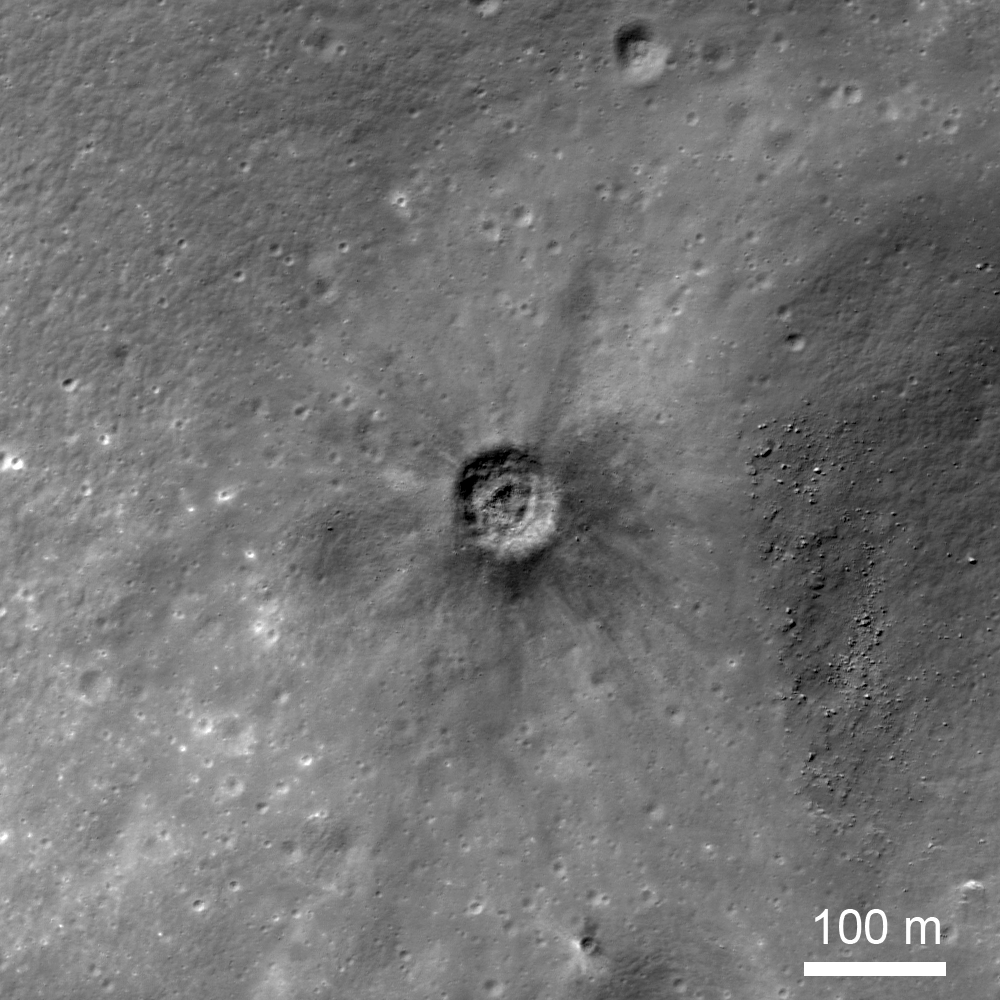
A collection of dark-haloed craters lines a sloping crater rim southwest of Sklodowska crater (19.21°S; 93.56°E). North is up; illumination is from the west-southwest, field of view image is about 625 meters. From LROC Narrow Angle Camera (NAC) observation M174665969R LRO orbit 10974, October 31, 2011; full resolution 0.65 meters from 63.53 km [NASA/GSFC/Arizona State University].
James Ashley
LROC News System

The explanation for the origin of dark-haloed craters on the Moon is usually straightforward: Low-reflectivity material (rock or regolith) is overlain by more reflective and more recent deposits (usually ejecta from a relatively fresh impact), and then the underlying deposit is exhumed by even more recent impacts.

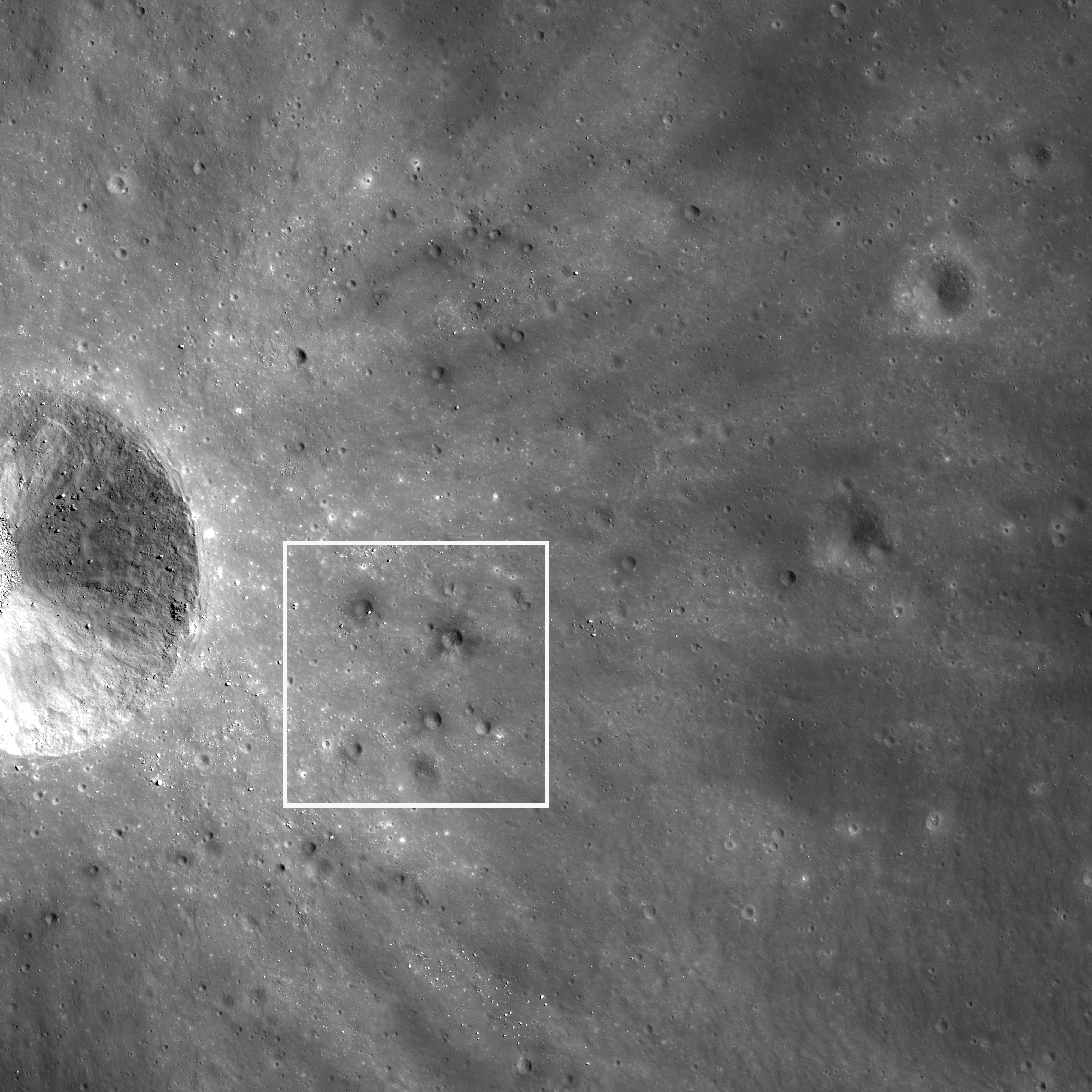
This stratigraphy tends to present the darker material as ejecta overlying the lighter material in high contrast. Such is the case for the dark-haloed craters in today's Featured Image.Zooming out to the context frame below reveals their relationship to the crater responsible for the light ejecta.

But why do we see such a high number of these features here, and why do they seem to be grouped close to the rim of this small, unnamed crater located outside Sklodowska crater?

The wider NAC frame around the field of view selected for the LROC Featured Image (white square) in broader context. Field of view ~2.7 km [NASA/GSFC/Arizona State University].
The similarity in ejecta albedo suggests that the time between individual crater impacts was not great, and they are therefore likely to be secondary craters having a single larger impact as their source. The main question is whether the bolides that formed this group of craters arrived from an impact some distance away, or whether they are examples of so-called "self-secondaries." In the latter case, the blocks that created these features would have been ejected almost vertically during excavation of the large crater in the context image. They would have remained aloft long enough for the main ejecta blanket to be emplaced before returning to the surface and creating the pattern we see. Some recent studies are suggesting that more self-secondary craters are to be found closer to the main crater rim. This new finding can explain why there appear to be more of these dark-halo craters closer to the main crater rim, if they are indeed self-secondaries.

If, however, these secondary impacts originate with another, more-distant impact, then the clustering we think we see may be illusory. Perhaps this apparent grouping depends more on the location of the low-reflectance deposits than on the locations of the impacts. In that case many other craters in the region might also be related by formation time to these dark-haloed craters, but do not show dark haloes because they missed those deposits.

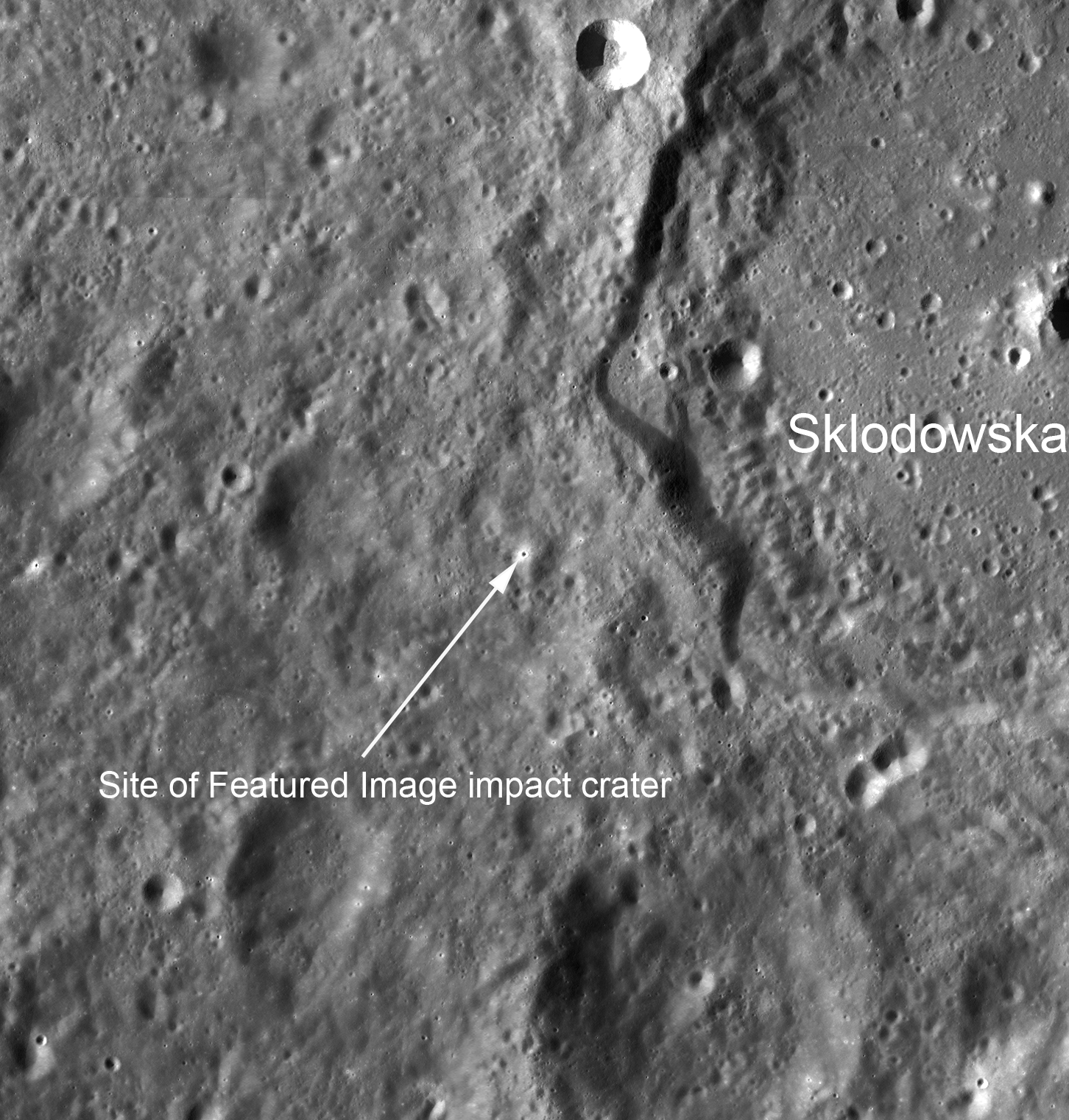
A wider view of the full LROC NAC frame with the local elevation, derived from LROC Wide Angle Camera (WAC) interferometry, puts the bright crater in context with the wide ejecta blanket outside Sklodowska, from 222 meters above to 132 meters below global mean elevation  [NASA/DLR/GSFC/Arizona State University].
The WAC mosaic context image shows few bright-rayed craters in the region; field of view 144 km, north is up [NASA/GSFC/Arizona State University].
The WAC mosaic reveals the broader context of the Featured location. What other craters can you find in this area that might be responsible for the secondary impacts? Why or why not? Which theory seems to have the most validity? Can you think of other scenarios that could account for today's Featured Image?

Click HERE to review the full NAC image. Additional examples of secondary features can be found in The Rays of Messier A, the Chain of Secondaries in Mare Orientale, and in Scouring Secondary Ejecta.

Simulated orbital view of the vicinity of southwest Sklodowska crater, from 37 km over a point 70 km from the bright unnamed crater (below center) outside the older crater rim. NASA ILIADS application, LMMP [NASA/GSFC/LMMP/Arizona State University].

Thursday, November 24, 2011

LROC: Polka-dot ejecta

A small fresh impact crater, among a number of others equally juvenile (yellow arrow) has saved future explorers a lot of expensive excavation work among some far older heavy-hitters in the west farside lunar highlands, just south of the equator and north of the vast 4 billion year-old South Pole-Aitken (SPA) basin. Notional oblique view courtesy of the LMMP and LROC Wide Angle Camera 100 meter Global Mosaic [NASA/GSFC/LMMP/Arizona State University].
LROC QuickMap NAC and WAC mosaic (reproduced from 16 meter per pixel resolution level) shows a distinctive low optical maturity characteristic of youthful craters [NASA/GSFC/Arizona State University].
A blanket of fresh ejecta from a relatively new crater (9.083°S, 161.337°E) on the floor of farside landmark Keeler, dotted with smaller low albedo craters. LROC Narrow Angle Camera (NAC) observation M123513537R, LRO orbit 3335, March 18, 2010; incidence angle 15.16° on a field of view 560 meters wide, resolution 56 cm per pixel from 54.87 kilometers. See the full size original LROC Featured Image HERE [NASA/GSFC/Arizona State University].
Drew Enns
LROC News System

Impact crater ejecta is usually distributed semi-uniformly around an impact crater. Immature ejecta from a fresh crater has a higher albedo than the mature material on the surrounding surface, and so fresh craters easily stand out against the mature background.

So why do the smaller craters in today's Featured Image have a lower albedo? On the Moon this is often due to a cryptomare located underneath the bright ejecta blanket. 

Taking a step back and looking at this area in the WAC context image gives us a better idea of how to interpret this scene.

LROC Wide Angle Camera context for their Featured Image, November 23, 2011, of ejecta from a fresh impact crater located within much larger Keeler crater (8.75°S, 161.37°E). The subject crater is two pixels left of direct center of the above 50 km-wide field of view at the full 87.86 meter per pixel resolution of LROC WAC observation M134130438C (604 nm), LRO orbit 4900, July 18, 2010 [NASA/GSFC/Arizona State University].

This fresh crater is actually located in the much larger 160 km diameter Keeler crater. Keeler crater is located in the highlands and instead of having a mare flooded floor, Keeler's floor is covered in impact melt. It is possible that the small craters are exposing buried impact melt under the immature ejecta. However, it is more likely that the small craters expose the mature regolith that is only thinly covered by the bright ejecta. The end result is a polka-dot laden ejecta blanket.

How many low albedo craters are there in the full NAC frame?

Related Posts:
Dark Craters on a Bright Ejecta Blanket
Dark halo crater
Intricate young ejecta blanket in ancient Murchison Crater

Friday, May 14, 2010

Regolith patterns in Mendel-Rydberg ROI


Regolith patterns in the Mendel-Rydberg Constellation Region of Interest (51.14°S, 266.93°E), from Lunar Reconnaissance Orbiter (LRO) Narrow-Angle Camera (LROC NAC) M118090761LE; field width = 0.64 km [NASA/GSFC/Arizona State University].

Peter Thomas
LROC News System

Regolith detail in the Constellation region of interest Mendel-Rydberg. Much of this region of interest is located in a terrain known as a "cryptomare." Cryptomaria are mare basalt volcanic deposits obscured by superposed materials usually of higher albedo. The obscuring materials are typically the ejecta of later-forming craters and basins, which blanket the older mare basalt. In the case of Mendel-Rydberg, much of the material covering the older mare may have been ejecta from the Orientale basin-forming impact event, which occurred hundreds of kilometers to the north.

The covering by ejecta of varying compositions, thicknesses, and albedos complicates the task of making an inventory of the amounts, composition, and history of lunar volcanism, and thus cryptomaria are of high scientific interest (see also the Balmer Basin region).


LRO (LROC) Wide-Angle Camera monochrome context image showing the Mendel-Rydberg Constellation Region of Interest and approximate location (arrow) of the Narrow-Angle Camera detail above. The smooth region to the west (left) of the arrow is the Mendel-Rydberg cryptomare. LROC WAC M118104209ME, click here for the full scene, 118 km across [NASA/GSFC/Arizona State University].

The full-resolution NAC view above illustrates the complexity of the highlands surface in the eastern portion of the Constellation region of interest. Here the cover of fragmentary material, or "regolith," displays the so-called "elephant skin" texture (also seen here and here) which is probably the result of slow movement involving thermal cycles of the lunar day-night and seismic shaking from meteorite impacts. The high resolution LROC images and accurate topographic information will help sort out the causes of this long-known surface characteristic of parts of the lunar surface.

Browse the full-resolution NAC image here.

Friday, May 7, 2010

LROC: Mare Frigoris Constellation ROI


The floor of an unnamed 1.2-km-diameter crater in the Mare Frigoris Constellation Region of Interest. Samples of material in and around this 'excavation' could help us understand the complex geologic history of this part of the Moon. See the full-sized LROC Featured Image HERE. (LROC NAC M126752534RE; scene width is ~500 meters [NASA/GSFC/Arizona State University].

Brett Denevi
LROC News System

Samples from small, relatively fresh craters like the one above may someday help us learn more about Mare Frigoris and its place in lunar geologic history. Mare Frigoris is located on the lunar nearside, to the north of the Imbrium and Serenitatis basins. Instead of being low in reflectance like typical mare basalts, its reflectance is intermediate between the mare to the south and highlands terrain to the north. This is likely due to a lower iron and titanium content than any of the sampled mare basalts, making it an intriguing end-member in the spectrum of lunar mare volcanism.


Zooming out to an approximate field width of 7 km, the subject crater appears quite typical on the main population line of lunar crater morphology, just large enough to have a flat floor. The proof is in the elemental analysis, however. The low titanium signature contrasts with the landing site of Apollo 11, for example, where titanium oxide is common.

Portions of Mare Frigoris, like the area near the Constellation region of interest outlined below, are so high in reflectance they're considered "light plains." Light plains can form in several different ways: through volcanism, with a composition even lower in iron and titanium; as the result of impact basin ejecta, which acts as a fluid, filling in topographic lows; or as ancient volcanic plains that were subsequently covered with a thin layer of highlands material ejected from nearby craters or basins which masks the true basaltic surface (a hidden, or "cryptomare").


For more information on LROC's observation campaign for the Constellation program regions of interest read this Lunar and Planetary Science Conference abstract, and visit the LRO Science Targeting Meeting website (look for summary sheets for each of the fifty Constellation Regions of Interest, Tier 1, Tier 2).

Small craters like the one in the LROC Featured Image up above are excavations where material from below the surface has been brought up to the rim. Sampling can help discern whether or not the material there is distinct in composition (as would be expected for cryptomare). Sampling this material would also provide a definitive resolution to the geologic history of this fascinating region.


A WAC image showing the 40x40 km box centered on the Frigoris region of interest. Arrow indicates the location of the NAC image above. Image number M119673851ME [NASA/GSFC/Arizona State University].

Explore the full-resolution LROC Narrow-Angle Camera (NAC) image HERE, the full-sized Featured Image Wide-Angle Camera (WAC) contextual Image HERE, and the full-sized close-up LROC Featured Image HERE.

Saturday, March 27, 2010

LROC: Two-toned impact crater in Balmer Basin


Materials excavated during formation of this ~450 meter diameter impact crater have an unusual two-toned character, likely a reflection of heterogeneity in the target materials. Situated in Balmer Basin (18.341°S, 69.950°E), the crater is in an area thought to harbor a type of cryptomare an ancient volcanic surface later covered with lighter hued impact ejecta. The darker material may be basaltic rock excavated from deeper parts of the impact. The scene is a 540 meter subset of LROC NAC M111138159LE [NASA/GSFC/Arizona State University].

Sandra Wiseman
LROC News System

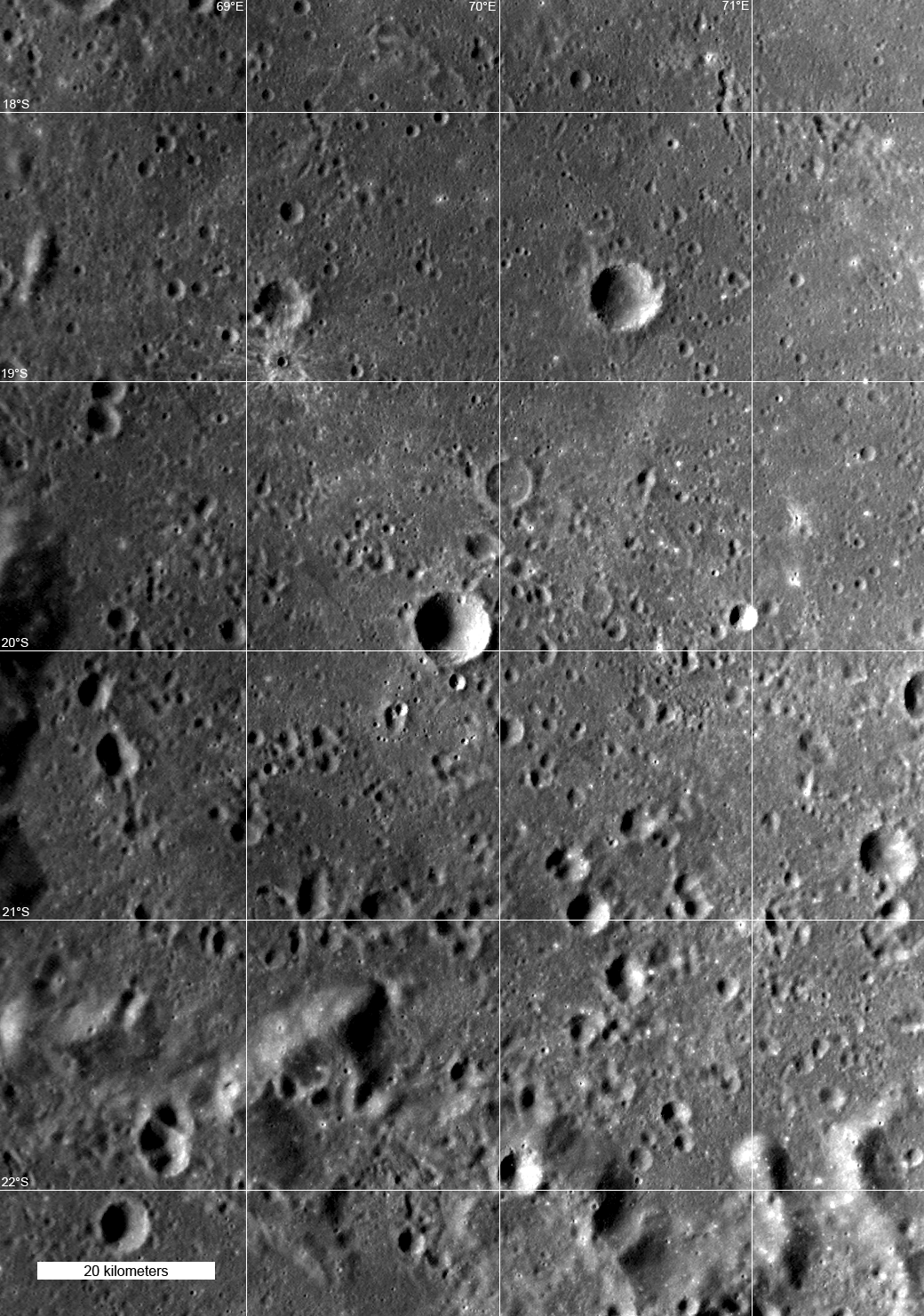
The Balmer Basin Exploration Region of Interest (ROI) lies within the Balmer Crater, centered at about 20°S latitude and 70°E longitude. Balmer is an old, highly degraded crater some 110 kilometers across and is part of a larger basin structure called the Balmer-Kapteyn Basin, which has 225 km and 450 km diameter outer rings. Scientifically, this area is interesting because it contains a type of 'light plains deposit' that appears to lie on top of an ancient basaltic surface. Building on earlier studies of these deposits, Hawke et al. [2005] concluded the deposits formed by the deposition of material ejected by later-formed impact basins mixed with regolith that had developed on the old Balmer volcanic lava flows. This conclusion was based on the occurrence of numerous 'dark haloed' impact craters, such as one seen in the LROC featured image of August 31, 2009.


LROC WAC mosaic of central Balmer crater, M104054832CE and it's location, as seen in a "departure angle" view of the lunar globe available in Google Earth [NASA/GSFC/Arizona State University].

Perhaps dark-haloed craters are not the only types that reflect this dichotomy. Two-toned deposits are evident in the crater shown in today's featured image. This distinctive two-toned appearance is seen in some other similar-size craters in Balmer, but is not common. The regolith here is probably fairly thick, perhaps 50 to 100 m in many places. The regolith is a zone of mixing between the light-toned basin ejecta deposits and the underlying basalts. This crater appears to have excavated both types of materials.
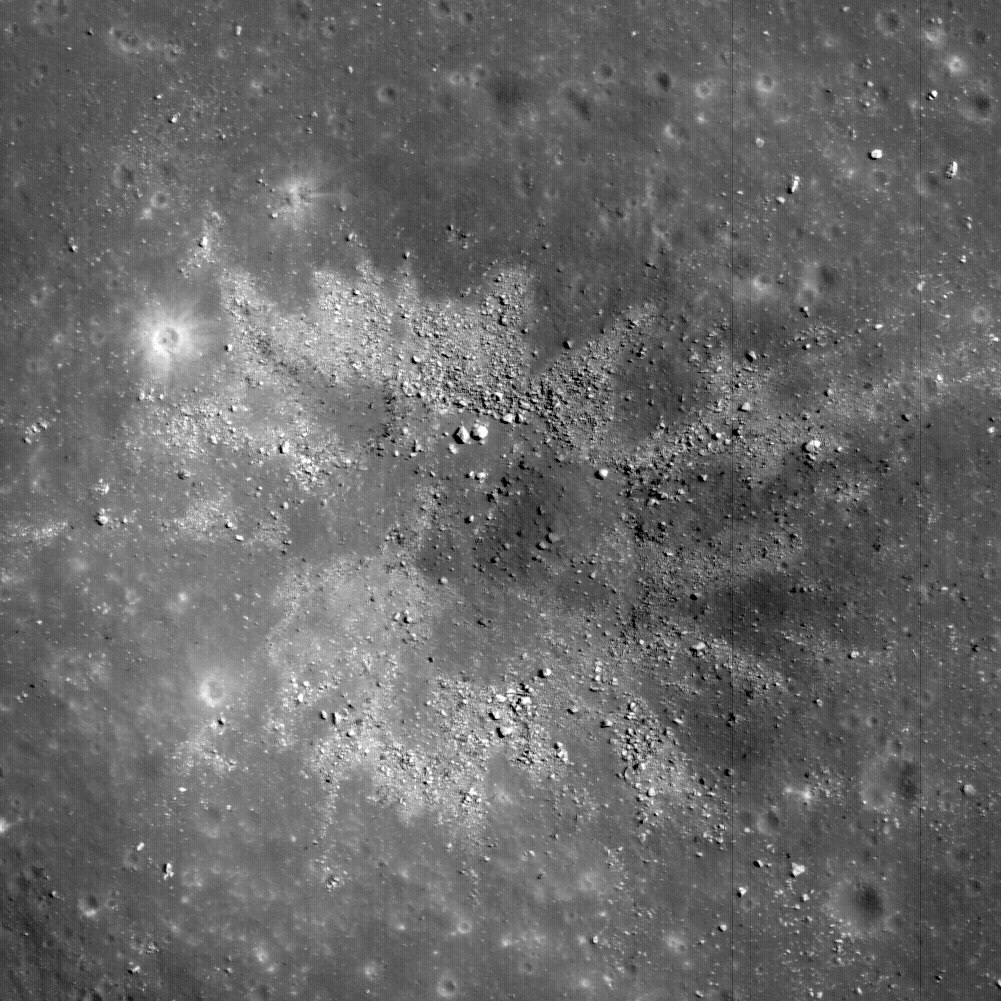
Buried volcanic deposits such as the ones in the Balmer region have been called 'cryptomare' after Head and Wilson [1992], who defined geologic features such as this as "covered or hidden mare deposits that are obscured from view by the emplacement of subsequent deposits of higher albedo." [see also the November 16, 2009 featured image release]

Compositional information gleaned from orbital remote sensing supports the interpretation that the light plains are underlain by mare basalt, particularly by the presence of higher iron oxide (FeO) and magnesium oxide (MgO) content than is typical of the surrounding highlands deposits.

Narrow-angle Camera (NAC) images show the detail of the crater ejecta from bright relatively young craters over a range of sizes that serve as natural drill holes into the light plains deposits. Explorers, whether human or robotic, visiting the Balmer region would determine the composition of the regolith excavated by these craters to test for a mixture of highlands and mare rock components. The age and composition of the basaltic components would reveal new insights into the volcanic history of the Moon.

Explore the Balmer Exploration region of interest for yourself, HERE.

Hawke, B. R., J. J. Gillis, T. A. Giguere, D. T. Blewett, D. J. Lawrence, P. G. Lucey, G. A. Smith, P. D. Supdis, G. J. Taylor (2005) Remote sensing and geologic studies of the Balmer-Kapteyn region of the Moon, J. Geophys. Res., 110. doi:10.1029/2004JE00283.

Head, J. W. and L. Wilson (1992) Lunar mare volcanism: Stratigraphy, eruption conditions, and the evolution of secondary crusts, Geochim. Cosmochim. Acta, 56, 2155-2175.