Showing posts with label Commercial Space. Show all posts

Thursday, January 29, 2015

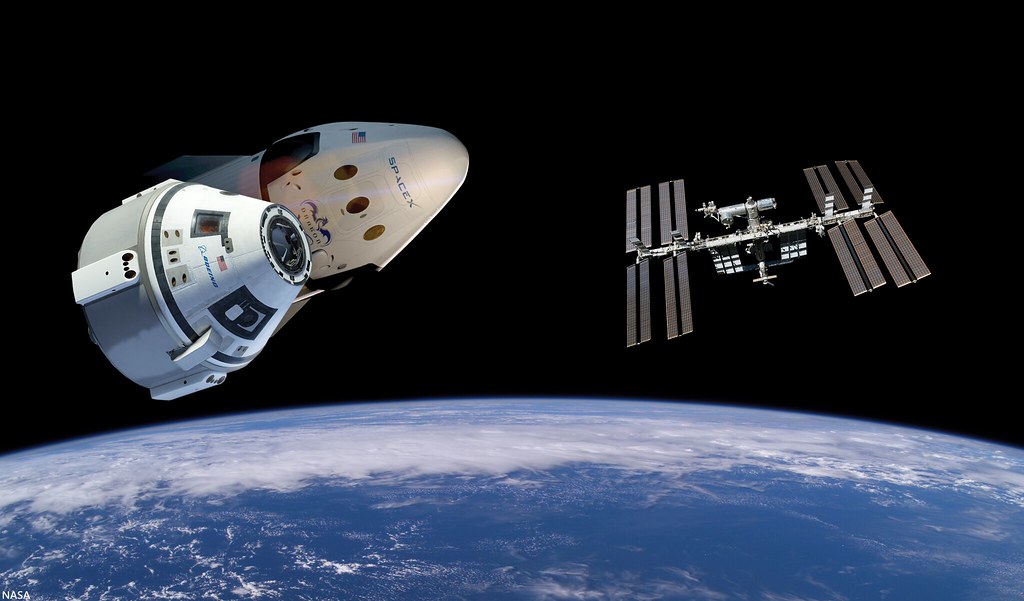
Boeing and SpaceX to launch crews to ISS in 2017

Boeing CST-100 and SpaceX Dragon V2 will orbit manned spacecraft and rendezvous and supply the International Space Station starting in 2017, NASA announced Monday [NASA].
Ken Kremer
Universe Today

After a hiatus of six long years, US astronauts will finally launch to space in a revolutionary new pair of private crew capsules under development by Boeing and SpaceX, starting in 2017, that will end our sole source reliance on the Russians for launching our astronauts to the International Space Station (ISS).

Two years from now, crews will start flying to space aboard the first US commercial spaceships, launching atop US rockets from US soil, said officials from Boeing, SpaceX and NASA at a joint news conference on Monday, Jan. 26. The human rated spaceships – also known as ‘space taxis’ – are being designed and manufactured under the auspices of NASA’s Commercial Crew Program (CCP).

A two person mixed crew of NASA astronauts and company test pilots will fly on the first test flights going to the space station in 2017.

Read the full report, HERE.

Thursday, May 9, 2013

Northrop Grumman Completes Golden Spike Lunar Lander Study

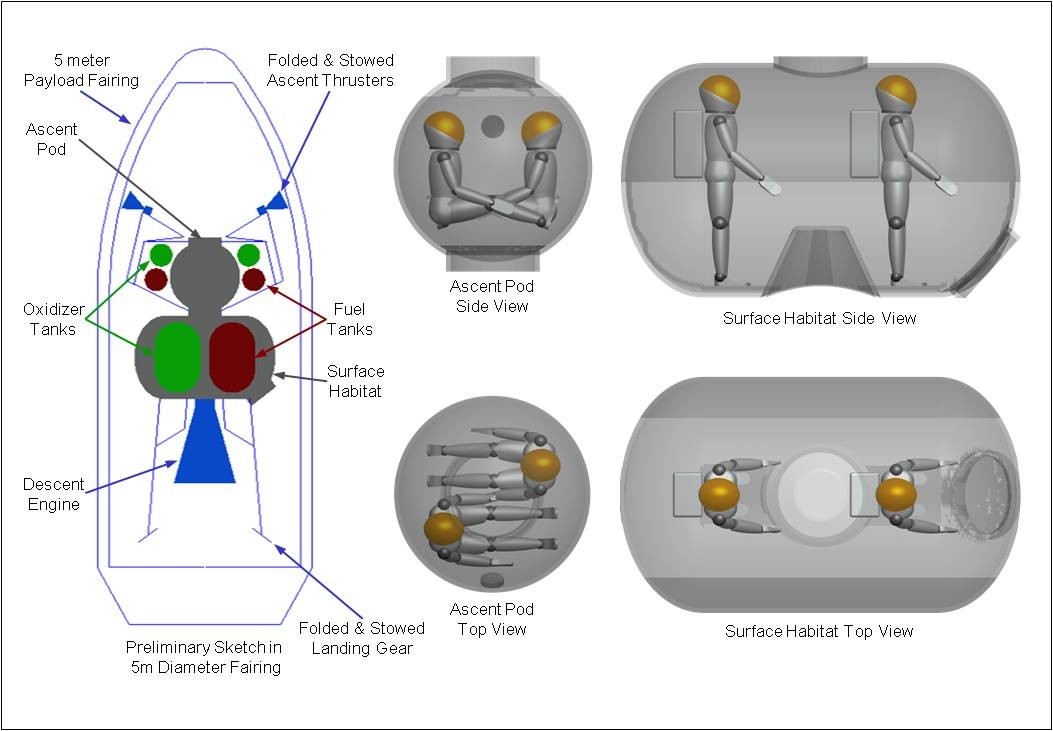
Northrop Grumman preliminary schematic shows a 'minimalist' ascent pod with surface habitat concept packaged in a 5-meter payload fairing. The pressurized compartments and propellant tanks easily fit in available space. Ascent thrusters are mounted on outriggers that are folded up to fit in the payload fairing and the landing gear is folded inward. Also shown are initial side and top views of the ascent pod “Pumpkin” and the surface habitat with crew members in pressure suits [Northrop Grumman].
Ben Evans
AmericaSpace

More than four decades since its last human-piloted craft touched down on the Moon, Northrop Grumman has concluded a feasibility study of a new commercial landing vehicle for the Golden Spike Company. It includes a novel, low-mass ascent stage concept, dubbed “Pumpkin”, and centers on the need to be packaged within a 5-meter payload fairing envelope, as well as offering insights into the kind of propellants necessary to accomplish Golden Spike’s goal of bootprints on the lunar surface by 2020.

Unveiled to the world last December, after several months of excited speculation, Golden Spike was founded by Alan Stern, associate administrator for NASA’s Science Mission Directorate in 2007-2008 and principal investigator for the agency’s New Horizons voyage to Pluto, and includes former Apollo flight director Gerry Griffin as chair of the board. It seeks to develop a capability to send astronauts from U.S. and foreign space agencies, corporations, governments and even private individuals on two-person expeditions to the Moon, at a cost of $1.5 billion. Within weeks, in January 2013, Golden Spike announced that it had contracted with Northrop Grumman to begin lunar lander design studies.

It was a notable move, for the Falls Church, Virginia-based aerospace and defense contractor is the only organization in the world to have successfully developed and flown a piloted craft to the surface of the Moon. Its Apollo lunar module ferried six pairs of astronauts to the dusty surface of our closest celestial neighbor between July 1969 and December 1972.

Tuesday, April 16, 2013

Golden Spike, no longer 'Waiting for Godot'

Rather than continuing to wait on a traditional government space exploration program, Golden Spike believes it’s time to turn to commercial ventures to enable human space exploration. In their scenario, using the lunar orbit rendezvous and return method, a single stage lander would be launched separately from crews and remain in lunar orbit for future expeditions [Golden Spike].
S. Alan Stern and Homer Hickam
The Space Review

We’ve both had long careers in the space field. And almost all of that time, most people in our industry have been waiting for government space agencies to return humans to the Moon and to go on to Mars—boldly exploring new worlds, inspiring a new generation, and creating a robust future for space exploration.

It hasn’t happened.

 Why? The reasons are many, but after observing a long series of false starts and dashed attempts, we’ve concluded that relying on the 1950s and 1960s model of space exploration led primarily by central governments, is a little like Samuel Beckett’s play Waiting for Godot. In that story line, two characters, Vladimir and Estragon, endlessly wait in vain for the arrival of a character named Godot. Well, it’s not just in Beckett’s novel, because in space exploration the 1950s–1960s model, Godot isn’t coming either.

Fortunately, 21st century industry and entrepreneurs are stepping up to the plate, creating exciting new models for how human space explorations can be launched commercially.

Just read the papers, it sounds like science fiction—companies planning suborbital space lines, private space stations, and a private expedition to fly past Mars. In the case of our company, Golden Spike, privately mounted lunar surface expeditions to be sold primarily to foreign space and science agencies, but also to US and international corporations, and wealthy individuals.

And why not? Back in the heady days of Apollo’s Moon race, the hard part was the technologies that had to be invented to make it all possible. Today, those technologies are well in hand. The hard part of today’s Moon shots and other commercial space exploration is raising the capital for large ventures.

Read the full article, new this week at The Space Review, HERE

Monday, March 18, 2013

Golden Spike and LPI schedule 2013 conference

Notional view of NASA's recently-abandoned Altair lunar lander, on a pad in the Moon's high northern latitudes formed from sintered regolith. Golden Spike Company announced in January Altair's designer Northrup Grumman to initiate design work on a manned lunar lander to return to the Moon by 2020.
The Golden Spike Company of Boulder, Colorado has announced an international workshop next October "to explore the kinds of landing sites, experiments, and geological traverses their astronauts should undertake on the Moon starting in 2020."

The two-day seminar will be held at the Lunar and Planetary Science Institute (LPI) in Houston, October 3-4, 2013.  

The program committee includes Alan Stern, Golden Spike CEO and President, Steve Mackwell of the Lunar and Planetary Institute, Clive Neal of Notre Dame, William McKinnon of Washington University, Amand Mahesh of Open University, Dr. Daniel Durda of the Southwest Research Institute (SwRI) and James Carpenter of the European Space Agency.

“We’re excited to announce this workshop, which will seek input from lunar researchers from across the world regarding scientific priorities for Golden Spike expeditions, Stern said. "We also expect this workshop to multiply interest in our missions from science and space agencies across the globe.”

“It is great to be part of the beginning of a new age of space exploration where commercial entities step up as key enablers of manned exploration of the solar system, and it is so appropriate this first meeting will be held at the Lunar and Planetary Science Institute, with its roots in the Apollo era,” Mackwell added.

The workshop will consist of plenary and a poster sessions organized around topical themes, invited presentations, and discussion panels. Stern and Golden Spike’s board chair Gerry Griffin, former director of the Johnson Space Center in Houston, will offer a public presentation about Golden Spike, Thursday evening, October 3.

More information about this workshop, including an opportunity to provide an expression of interest in attending and potentially speaking, can be found HERE.

Related Posts:
Golden Spike taps Northrup Grumman to design manned lunar lander
(Ben Evans, AmericaSpace, January 13, 2013)
Turning science fiction to science fact (Jeff Foust, The Space Review, December 11, 2012)

Tuesday, December 11, 2012

Turning science fiction to science fact: Golden Spike makes plans for human lunar missions

Golden Spike proposes to land humans on the surface of the Moon commercially as soon as 2020, for a price tag that has raised eyebrows—and some skepticism [Golden Spike Company].
Jeff Foust
The Space Review

The last 12 months has seen the unveiling of a number of commercial space ventures whose audacious plans can’t be immediately dismissed given the technical and financial pedigree of their founders and backers. Almost exactly a year ago, Microsoft co-founder Paul Allen announced the formation of Stratolaunch Systems, an air-launch system that requires the development of the world’s largest airplane. Allen assembled a team that included Scaled Composites and, originally, SpaceX (since replaced by Orbital Sciences), with a board that included Burt Rutan and former NASA administrator Mike Griffin (see “Stratolaunch: SpaceShipThree or Space Goose?”, The Space Review, December 19, 2011). In April, Planetary Resources announced plans for a series of robotic missions to prospect and, eventually, mine asteroids. That company has an impressive list of investors, including Google’s Larry Page and Eric Schmidt as well as Ross Perot Jr. and former Microsoft executive and two-time space tourist Charles Simonyi (see “Planetary Resources believes asteroid mining has come of age”, The Space Review, April 30, 2012).

Yet, the goals of these startups—a giant air-launch system and missions to prospect and mine asteroids—pale in comparison to the goal of another new space startup: sending people to the surface of the Moon. That feat has been accomplished only six times, and by one nation, the United States, with the last such mission, Apollo 17, flying 40 years ago this month. At the time, it was a potent symbol of America’s capabilities, and one of the signature achievements of the 20th century. The scale of that accomplishment, in many respects, grows as the decades stretch on without anyone else repeating it.

Given those factors, the idea that a human landing on the Moon could be done commercially, and for a fraction of the cost of Apollo or any more recent proposal, hardly seems credible. However, like those other firms, the plans of Golden Spike, the company that formally announced last week its desire to carry out such missions starting as soon as 2020, can’t be easily dismissed. The company has assembled an impressive team, including an Apollo veteran and others with experience in technology, science, policy, and finance. But can this lunar A-team overcome what are likely to be giant technical and financial obstacles?

Read the full article at The Space Review, this week, HERE.

Thursday, December 6, 2012

Golden Spike Company's formal announcement, plans privately-funded commercial exploration of the Moon


Golden Spike Company announces plan for privately-funded commercial exploration of the Moon.

From the December 5 press release:

On the eve of the 40th anniversary of the launch of Apollo 17, the last human exploration of the Moon, Former Apollo Flight Director and NASA Johnson Space Center Director, Gerry Griffin, and planetary scientist and former NASA science chief, Dr. Alan Stern, will unveil "The Golden Spike Company" – the first company planning to offer routine exploration expeditions to the surface of the Moon by the end of the decade. The executives will describe its team of leading aerospace engineers and world-class scientists, the mission architecture, and the business model at a media conference at the National Press Club, Bloomberg Room, from 2-3pm on December 6. The Golden Spike Company is a US-based commercial space company incorporated in 2010. It is named after the ceremonial final spike that joined the rails of the First Transcontinental Railroad across the United States, on May 10, 1869, and opened up the frontier to new opportunities. Similarly, Golden Spike intends to break new ground and create an enduring link to the next frontier, providing regular and reliable expeditions to the Moon at prices that are a fraction of any lunar program ever conceived of before.

Sunday, September 9, 2012

Free Enterprise and 'New Space'

Enterprise in space: Free markets or government subsidies?
Paul Spudis
The Once & Future Moon
Smithsonian Air & Space

Free Enterprise:  Business governed by the laws of supply and demand, not restrained by government interference, regulation or subsidy – also called free market.

Rick Tumlinson of the Space Frontier Foundation published a “free-enterprise” critique of the Republican platform in regard to the American civil space program. Indeed, the text of the space plank is vague (no doubt intentionally, so as to give the candidate maximum flexibility to structure the space program to align with his vision and goals for the country).  But what I found most interesting was the underlying premise and assumptions in Tumlinson’s article, a worldview that I find striking.

In brief, Tumlinson approves of the current administration’s direction for our civil space program.  The U.S. has stepped back from pushing toward the Moon, Mars and beyond and redirected NASA on a quest for “game-changing” technologies (to make spaceflight easier and less costly), while simultaneously transitioning launch to low Earth orbit (LEO) operations to private “commercial space” companies selected by our government to compete for research and development funding and contracts.  Many see this as gutting NASA and the U.S. national space program.  To be clear, the term “commercial space” in this context does not refer to the long-established commercial aerospace industry (e.g., Lockheed-Martin, Boeing) but to a collection of startup companies dubbed “New Space” (typically, companies founded by internet billionaires who have spoken much and often about lofty space plans, but have actually flown in space very little).

Tumlinson criticizes the Republican space plank because it does not explicitly declare that a new administration would continue the current policy.  In his view, the very idea of a federal government space program, including a NASA-developed and operated launch and flight system, is a throwback to 1960’s Cold War thinking.  Instead, he envisions space as a field for new, flexible and innovative companies, untainted by stodgy engineering traditions or bloated bureaucracy.  Many space advocates on the web hold this viewpoint – “If only government would get out of the way and give New Space a chance, there will be a renaissance in space travel!”  But travel to where?  And why?

The idea that LEO flight operations should be transitioned to the commercial sector is not new.  It was a recommendation of the 2004 Aldridge Commission report on implementing the Vision for Space Exploration (VSE).  NASA itself started the Commercial Orbital Transportation Services program (COTS) in 2006, designed to nurture a nascent spaceflight industry by offering subsidies to companies to develop and fly vehicles that could provision and exchange crew aboard the International Space Station.  That effort was envisioned as an adjunct to – not a replacement of – federal government spaceflight capability.

The termination of the VSE and the announcement of the “new direction” in space received high cover from the 2009 Augustine committee report, which concluded that the current “program of record” (e.g., Constellation) was unaffordable.  The Augustine Committee received presentations with options to reconfigure Constellation whereby America could have returned to the Moon (to learn how to use resources found in space) under the existing budgetary cap, but they elected to start from first principles.  Hence, we have something called Flexible Path, which doesn’t set a destination or a mission but calls on us “to develop technology” to go anywhere (unspecified) sometime in the future (also unspecified).  With target dates of 2025 for a “possible” human mission to a near-Earth asteroid and a trip to Mars “sometime in the 2030’s,” timelines and milestones for the Flexible Path offer no clarity or purpose.  Try getting a loan or finding investors using a “flexible” business plan.

Tumlinson argues that both political parties should embrace this new direction because New Space will create greater capability for lower cost sooner.  He also makes much about the philosophical inclinations of the Republican Party (the “conservative” major party in American politics) – Why don’t the Republicans support free enterprise in space?  Why are they putting obstacles in the way of all these new trailblazing entrepreneurs?  As to those obstacles, it is unclear exactly what they are.  True enough, there are regulatory and liability issues with private launch services, but not of such magnitude that they cannot be handled through the traditional means of indemnification (e.g., launch insurance).

The COTS program record of the past decade largely has not been a contract let for services, but a government grant for the technical development of launch vehicles and spacecraft.   Close reading reveals the real issue:  Tumlinson wants more of NASA’s shrinking budget to finance New Space companies. He is concerned that a new administration might cut off this flow of funding.  However, what will cut off the flow of funding is having no market, no direction, and no architectural commitment – regardless of who occupies the White House.

The belief of many New Space advocates is that once they are established to supply and crew the ISS, abundant and robust private commercial markets will emerge for their transportation services.  Although many possible services are envisioned, space tourism is the activity most often mentioned.  Whether such a market emerges is problematic.  Although Richard Branson’s Virgin Galactic has a back-listed manifest of dozens of people desiring a suborbital thrill ride (at a cost of a few hundred thousand dollars), those journeys are infinitely more affordable than a possible orbital trek (which will cost several tens of millions of dollars, at least initially).  Nevertheless, there will no doubt be takers for a ticket.  But what will happen to a commercial space tourism market after the first fatal accident?  New Space advocates often tout their indifference to danger, but such bravado is neither a common nor wise attitude in today’s lawsuit-happy society (not to mention, the inevitable loss of confidence from a limited customer base).  My opinion is that after the first major accident with loss of life, a nascent space tourism industry will become immersed in an avalanche of litigation and will probably fully or partly collapse under the ensuing financial burden.  We are no longer the barnstorming America of the 1920’s and spaceflight is much more difficult than aviation.

Despite labeling themselves “free marketers,” New Space (in its current configuration) looks no different than any other contractor furiously lobbying for government sponsorship through continuation of its subsidies.  True free-market capitalists do not seek government funding to develop a product.  Rather, they devise an answer to an unmet need, identify a market, seek investors and invest their own capital, provide a product or service and only remain viable by making a profit through the sale of their goods and services.

Tumlinson bemoans the attitude of some politicians, ascribing venal and petty motives as to why they do not fully embrace the administration’s new direction, e.g., the oft-thrown label “space pork” to describe support for NASA’s Space Launch System.  In regard to New Space companies, Tumlinson asserts that, “[We] have to both give them a chance and get out of the way.”  But in fact, he does not want government to “get out of the way” – at least not while they’re still shoveling millions into New Space company coffers – nor when they need (and they will) a ruling on, or protection of, their property rights in space.  Any entity that accepts government money is making a “deal with the devil,” whereby it is understood that such money comes with oversight requirements (as well it should, consisting of taxpayer dollars).

"Questions about the vision boil down to whether we want to incorporate the Solar System in our economic sphere, or not.” – Presidential Science Advisor John Marburger, 2006

Successful commercialization of space has occurred in the past (e.g., COMSAT) and will occur in the future.  But the creation of a select, subsidized, quasi-governmental industry is not by any stretch of the imagination what we commonly understand free market capitalism to mean.  It is more akin to oligarchical corporatism, a common feature of the post-Soviet, Russian economy.  True private sector space will be created and welcomed, but not through this mechanism, whose most worrisome accomplishment to date has been to effectively distract Americans from noticing the dismantling of their civil space program and preeminence in space.

Originally published at his Smithsonian Air & Space blog The Once and Future Moon, Dr. Spudis is a senior staff scientist at the Lunar and Planetary Institute. The opinions expressed are those of the author and are better informed than average.

Tuesday, July 31, 2012

Newt Space

Paul D. Spudis
The Once and Future Moon
Smithsonian Air & Space
  
During a recent talk to a gathering of students, former House Speaker Newt Gingrich spoke of his longstanding interest in space by mentioning the dust-up over comments he made about a Moon colony during the GOP primary.  He expanded this episode into a teaching moment about the nature of innovation and progress in space.  Gingrich is vigorous in his enthusiasm for space exploration but is not a devotee of the current agency and its programs.  In his considered opinion, we need to re-think our approach to space exploration and use more innovative, non-bureaucratic approaches to develop space systems and capabilities.

A historian by training, Gingrich often uses historical analogies to illustrate his point.  On this occasion, he spoke of the experiences of the Wright Brothers and Samuel P. Langley in the development of the first airplane.  As Gingrich relates it, after several failed attempts the Wright brothers finally achieved flight on December 17, 1903, spending in total about $500.  In contrast, Langley (the recipient of a $50,000 government grant) failed in his attempt to fly when his “aerodrome” crashed into the waters of the Potomac River (the actual amounts spent were “less than $1000” and $70,000 respectively, according to James Tobin’s excellent book on the subject).  That powered aircraft might have military use was not a new idea and the then-recent war with Spain led to a re-examination of our defense posture, with the military eager to fund Langley’s aeronautical experiments.

Gingrich contrasts the “faster, cheaper, better” (and successful) approach of the Wrights to the supposedly bureaucratic, measured failure of Langley and suggests that this incident parallels the current differences between the approach of “New Space” (an umbrella term referring to the variety of current efforts by the private sector to develop spaceflight capability) and our federal civil space program.  In other words, it’s not the lack of resources or technology that’s holding us back – it’s our business model.  He suggests that many of the central tenants of “New Space” (including the offering of prizes as technical incentives and “lean” management models) will accomplish more in space than we’ve received through government programs and for much less expenditure.

First flight of Langley's aerodrome - one second after launch and one second before impact
The historical story is interesting but did Gingrich draw the correct conclusion?  Should the success of the Wright brothers be attributed to how they approached the problem or to how much it cost?  In contrast to Gingrich’s suggestion, Samuel Langley did not represent an enormous, bloated and hidebound bureaucracy.   At the turn of the century, the Smithsonian Institution was not the behemoth it is today.  Langley had been hired as an assistant secretary for international affairs at the Smithsonian.  Secretary Spencer Baird died eight months after Langley reported for work, leaving open that position, which Langley accepted.  He wanted to continue his aeronautical experiments and used the facilities of the Smithsonian (including its shops and technicians) to build and test his flying machines.

Langley built a high-powered internal combustion engine for his aircraft, producing greater horsepower per unit weight than any other effort of the time, including the one used by the Wright brothers.  The failure of Langley’s aerodrome largely resulted from its design; the dihedral cross-section of its wings led to instability in any type of wind.  Wilbur Wright described this problem in a June 1903 talk – an understanding that came from the brothers’ experiments with wing shapes on kites at Kitty Hawk.  The Wright flyer used wing-warping to create control surfaces, which made it possible for a pilot to steer the airplane in variable wind conditions.  The Langley aerodrome was naturally unstable; with its wing shape, any gust or cross-wind rendered the aircraft uncontrollable.  In other words, the success of the Wright brothers was due to a superior technical approach, not to their management model.

For anyone who has dealt with bureaucracy, freedom from the ponderous administrative overhead of a government agency is always an enticing vision.  But in many ways, it is orthogonal to the real issue – what are you trying to accomplish and by what means or mechanism?  The Wrights and Langley both knew what they were trying to do, but only one of them had the correct technical approach.  Their technical choices determined the outcome of their efforts, not the total amount of money spent nor the managerial structure of their respective projects.  If so, can we draw any conclusions from this and apply it to the current model of our national civil space program?  The idea that government cannot do anything right is understandably attractive and in vogue, but not completely borne out by the evidence.

As a counter-example to Gingrich’s history of early aviation, consider a technical development project closer to us in time and memory.  A nuclear ship that has to refuel only every few years has an enormous advantage over one that needs near-constant refueling.  The United States possesses a nuclear navy (both aircraft carriers and submarines) largely because of the vision and persistence of one man, Admiral Hyman Rickover.  A true visionary, Rickover believed that nuclear reactors could be made small enough to fit into a ship and safe enough to entrust the lives of thousands of men to such vessels.  For years he fought the navy and the Defense Department to sell the advantages of nuclear sea power to the Congress and President.  Today we have such a fleet largely because of his vision and determined efforts.  And nobody ever took a poll to see if a nuclear navy would “excite and engage” the public.

Newt Gingrich is a true believer of humanity’s future in space.  I admire his dedication and courage in speaking the truth as he sees it.  However, in this case, I believe he has drawn the wrong lesson from history.  Compelling national interests sometimes require the marshaling of our combined will and resources.  We need a dedicated federal space program with a clear strategic direction and the know-how to pull off difficult technical tasks.  No cult of management or prize money will have us walking again on the Moon or using its resources.

For our country to remain vibrant and strong, it is vital that Americans be called upon to engage in the mental and physical challenges of a national space program, coupled to the realities and challenges inherent in an expanding cislunar territory and new markets.  Our pioneering space legacy needs to be embraced and celebrated through a renewed commitment from our government.  If Americans forfeit this direction and opportunity because their government cannot see the danger in the current path, we will have grievously failed in our promise as a nation and our obligation and duty to future generations..

Originally published at his Smithsonian Air & Space blog The Once and Future Moon, Dr. Spudis is a senior staff scientist at the Lunar and Planetary Institute. The opinions expressed are those of the author and are better informed than average

TASC: NASA 'essential for national security'

Support for NASA and Space Exploration in the U.S., as essential public policy and vital to national security, is not expressed as often or as acutely in the 21st century as it was when the civilian space agency was founded in 1958. Instead, considering the agency in the context of the Cold War, as part of an arms race with the former Soviet Union, is often dismissed as ancient history. The agency's role in serving an essential national security interest is usually, at best, remembered only as secondary to its contributions to the quality of life of Americans.

But in the background, in congressional cloakrooms and committee hearings, NASA's role in service to American national security is paramount, even over and above pork barrel politics, and more now as budgetary constraint becomes less abstract with each increase in the national debt ceiling.

The public voice in support of NASA being vital to American national security is rarely heard above the noise of debates over NASA's future exploration roadmap and over the self-continuity concerns of a vested bureaucracy.

Former U.S. Senator and Apollo veteran Harrison Schmitt and  others, have, on occasion, reminded us that NASA's most basic constitutional reason-for-being is still the role it plays as a vital arm of America's national security.

Now a study has been released by The Analytic Sciences Corporation (TASC) expressing this national security raison d'etre in the context of the 21st century. As a think-tank arm associated with the aerospace industry the think tank behind the study may not be a totally dispassionate one, but it at least puts forward the effort as justifying NASA's expense not as either a museum curator or an enabler purely of the dreams of academia or futurists, but as a federal arm serving an over-arching "compelling state interest."

"For the United States," the study's introduction reads, "maintaining a leadership role in space is an essential component of national security, providing the U.S. and our allies “unprecedented advantages in national decision-making, military operations, and homeland security.”* NASA is essential for national security, not only because of its role in developing new space capabilities and technologies, but also because it is explicitly excluded from military activity by the National Aeronautics and Space Act of 1958. Simply stated, NASA is uniquely positioned to facilitate international collaboration on peaceful uses of space in ways the military cannot.

"This paper explores the important roles of international cooperation, cost-reducing technology development and game-changing innovation, as well as NASA’s role supporting a strong commercial space industry. NASA can improve its national space security posture even during times of budget austerity."

The paper can be read online, HERE, or downloaded as an Adobe Reader (pdf) file, HERE.

* National Security Space Strategy, January 2011, DOD and ODNI

Monday, July 23, 2012

The Tale of Falcon 1

Liftoff of Flight 4 of the Falcon 1 from Kwajalein, September 28, 2008. SpaceX achieved an elliptical orbit (621 x 643 km) at 9.3° inclination and carried into orbit a dummy payload at 165 kg designed and built for the mission [SpaceX].
Paul D. Spudis
The Once and Future Moon
Smithsonian Air & Space

  
Elon Musk founded Space Exploration Technologies Corporation (SpaceX) in 2002.  Its stated business objective was the development of launch services for a fraction of the cost of the then-available commercial launch providers – to the greatest extent practicable, they would create reusable pieces of its launch system, thereby greatly lowering the cost of space access.  Toward that end, SpaceX sponsored the development of its own launch vehicle and engines, using a vertically integrated business model in which SpaceX would design, fabricate, prepare and operate a launch system.

Alan Boyle’s recent review of commercial efforts to supply the International Space Station naturally included coverage of the successful flight of SpaceX’s Falcon 9 rocket and Dragon’s delivery demonstration.  The article focused on the way commercial space is financed, specifically how NASA is sponsoring the development of some of these capabilities.  This financial arrangement is the basis for a point repeatedly voiced by critics of the heralded vision of “New Space” replacing “government” space – a company like SpaceX is not actually commercial in the traditional free market sense, but simply another government-funded contractor using a different procurement model.

Falcon 1 was the first rocket developed by SpaceX.  It is a two-stage launch vehicle capable of putting a metric ton (1000 kg.) into low Earth orbit.  Falcon 1 uses a single Merlin, a SpaceX-developed, LOX-kerosene rocket engine producing ~570,000 newtons of thrust (for comparison, a single Shuttle main engine burns LOX-hydrogen fuel and produces about 2,300,000 newtons of thrust).  The Falcon 1 was designed to put relatively small satellites into low earth orbit.  With such payload capacity, it is also capable of sending 100-200 kg microsats beyond LEO, into cislunar space.

Much of the private start-up capital for SpaceX was used to develop the Falcon 1.  They also received some government funding from other than NASA.  The Department of Defense (DOD) had need for reliable, quick, and cheap space access for small payloads.  To that end, SpaceX received funding from several DOD entities, including several million dollars from the U.S. Air Force under a program to develop launch capability for DARPA (a defense research agency).  Space X was given access to and the use of DOD launch facilities at the Reagan Test Site (formerly Kwajalein Missile Range) in the Marshall Islands.

The early days of Falcon 1 development were not pretty.  The first launch failed after 25 seconds of flight.  The second flight successfully launched and staged, but did not reach orbit.  After the third attempt at flight failed during staging, a review board looked in detail at SpaceX’s launch processing stream and made recommendations for some significant changes.  The next launch was successful in putting a dummy payload into orbit.  In July 2009, six years after Falcon 1 development had begun, SpaceX achieved its first (and so far, only) commercial space success with the launch and orbit of the Malaysian RazakSAT imaging satellite on a Falcon 1 launch.

Typically when a space company finally achieves a long-sought success, it moves rapidly to exploit the new vehicle’s operational status and begins to aggressively market and sell its new launch service.  However, no Falcon 1 launch has occurred since the success of RazakSAT.  A visit to the SpaceX web site describes the Falcon 1 vehicle, but at the bottom of the page it states that a Falcon 1 launch is no longer available for purchase.  Instead, small, one-ton class payloads will be accommodated in the future through “piggyback” rides on the new, Falcon 9 medium-class launch vehicle.

For a company to spend six years and start up money developing a needed launch system, only to abandon it just as success and profit is at hand, is difficult to sort through.  One could be forgiven for imagining that the development of the Falcon 1 as a commercial launch system was never intended but rather a pretext to flight qualify the pieces (specifically the Merlin 1 engine) used in the nine-engine cluster that powers the Falcon 9 launcher.  Interestingly, others have noted that the now-cancelled NASA Constellation Ares I launch vehicle (“The Stick”), purportedly designed to launch the new Orion spacecraft to LEO, likewise appeared to be more of a development effort than a flight project, in that its various pieces (e.g., cryogenic upper stage, five-segment SRB) were all needed to build the large Ares V heavy lift rocket.

Meanwhile, customers in need of low-cost options for launching small payloads are out of luck.  Falcon 9 has yet to launch an ounce of commercial payload and Falcon 1 is not for sale.  Of course, one can launch small satellites using Orbital’s Taurus launch vehicle, but its ~$50-70 M cost and recent record of unreliability (e.g., the Glory satellite launch failure) engender neither comfort nor confidence.  More significantly, after investing in the R&D effort of a new, unproven company that was offering a low cost, small launch vehicle, SpaceX’s original DoD customers, banking on the creation of a quick, inexpensive capability to launch small satellites, saw their support of Falcon 1 go by the board.  It appears that SpaceX dropped their initial operational vehicle for the promotion and promise of far more ambitious and distant goals.

Artist's rendering of the Falcon 9 heavy-lift launch
plans for which are expected in 2013
[SpaceX].
That template seems to work for them – NASA has “invested” more than $500 million in the Falcon 9 over the last five years.  Now, SpaceX holds court to advance their founder’s Mars fantasies and plans for a Falcon “heavy” launch vehicle – designed and marketed as sending very large payloads into space, at unbelievably low prices.  (As an aside, I thought that a New Space article of faith is that heavy lift is a boondoggle and that fuel depots are the way to go beyond LEO.)

When New Space advocates characterize old NASA contractors, legacy launch companies and politicians with NASA centers in their districts as “pigs at the trough of government funding,” they’d be wise to watch out for a “pig” donning falcon feathers.  Debate, like competition is good and helpful but only useful when advocates honestly pitch their abilities, services, products and intentions.   Money is an important consideration, however our nation’s ability to compete in the arena of space must be the overriding concern.  In light of the current situation, that ability is slipping further and further away.  We need to honestly assess what we’re buying before nothing remains of our decades long investment and leadership role in space.

Originally published at his Smithsonian Air & Space blog The Once and Future Moon, Dr. Spudis is a senior staff scientist at the Lunar and Planetary Institute. The opinions expressed are those of the author and are better informed than average

Wednesday, May 16, 2012

"The Flight of the Dragon"

The Falcon 9 launch vehicle [SpaceX/Chris Thompson].
Paul D. Spudis
The Once and Future Moon
Smithsonian Air & Space

If things go according to plan Tuesday, the world will witness SpaceX launch its first Dragon cargo supply mission to the International Space Station.  As this flight has been heralded as the dawn of a new age in spaceflight – a paradigm shift in the way the spaceflight is approached – it is appropriate to step back for some reflection and perspective on what this flight may or may not represent.  As noted by many, this particular cargo flight has a lot riding on it – with overarching concern for success (even if a bit unfair), created in part both by vociferous advocacy and excessive public pronouncements.

1.  A successful or unsuccessful result from this flight neither confirms nor negates the value and/or viability of commercial spaceflight.

This proposition should be obvious.  Launch to orbit is an inherently difficult and risky endeavor.  Even launch vehicles with long histories of reliable flight fail, sometimes with distressing frequency.  We tend to think that space access should be routine but that appearance is deceiving; spaceflight is never routine, simply because orbital flight is possible only on the very edge of our capability.  Think of it as carrying a heavy load of luggage while ice skating – you may know how to do it and you may even pull it off successfully a number of times, but if you start taking it for granted, a fall on the posterior is quite likely (with this eventuality more probable in the early stages of the endeavor).

Looked at in another way, a successful mission does not “prove” the case for commercial human spaceflight (the case for commercial unmanned space launch has long since been proven) nor does it negate its feasibility.  The real issue with commercial human spaceflight is the existence of a market.  Right now, such a market does not exist.  New Space advocates have unlimited faith that one will emerge, but hope is not a business plan.  It will take years of successful commercial launches (and safe returns) for the creation of a genuine commercial market.  The uncertainties in the future legal status of commercial human spaceflight is enough to give one pause – contemplate the likely consequences following the first fatal accident in a commercial human spaceflight, after the ambulance chasers get their teeth into the flesh of every company who ever had anything whatsoever to do with the flight.

2.  The creation of SpaceX capability is not “commercial” in the sense that we in the capitalist United States of America understand it.  Likewise, a government space program is not “socialism.”

The word commercial has been re-branded.  Previously, in most entrepreneurs’ way of thinking, “commercial” enterprise meant that a person or group drew up a business plan, raised private capital and shouldered the financial risk in an attempt to make a profit by providing a product or service.  The understanding of the term “commercial space” has been stretched to encompass a business plan where a start-up company requests (and expects) government subsidies on their promise of future delivery of a product and/or service.  Because it’s not “run” by the government, this form of government-sponsored crony capitalism is now deemed “commercial.”   Financial tweaking is not how most would understand or define a new paradigm in space travel.

Typically during the last 50 years of our federal civil space program, we were working toward some clearly articulated, reachable (that adjective is important) goal on some kind of timetable.  Because spaceflight, particularly the manned variety, was considered to be dangerous and technically cutting edge, the program was more of an engineering research program than the deployment of an operational transportation system.  Such R&D has important national security and economic ramifications and as such, fits perfectly under the constitutional requirement for the federal government to provide for the common defense and promote economic development.  If that’s “socialism,” then America has been a socialist country from its founding.

3. True commercial space firms exist, but they are pursing their goals quietly and generally without excessive hype.  They do not rely on government money to support their R&D costs.

Burt Rutan developed Space Ship One for Paul Allen in order to win the Ansari X-Prize (and did) and is currently developing a new spacecraft for Richard Branson’s Virgin Galactic suborbital spacelineRobert Bigelow’s company took a discarded NASA design for inflatable spacecraft and is developing a future commercial space station, available for sale of lease (it’s the transportation problem to and from his station that’s holding him back.)  None of these efforts are taking the King’s shilling – they are developing hardware and capability themselves.  It’s interesting that unlike some New Space firms, they tend to make fewer public pronouncements and the ones they do make are both substantive and realistic (you tend to operate that way when you’re risking your own nickel).

4.  The process of contracting with “commercial” firms to carry payloads into orbit is not a space policy.

This last item is obvious, but only if you’re not getting your news exclusively from the space media.  Even if SpaceX is completely successful, all we will have done is to add another player to the existing roster of supply vehicles that enable the occupation and use of the ISS.  Since discarding the Vision for Space Exploration over two years ago, we have no long-term goal or strategic direction for our civil space program.  The pre-existing Commercial Crew and Cargo Program has been billed as a “new direction” but it is simply a utilitarian effort to keep an existing program going, not a new path or direction to follow.  Mirages of human missions to asteroids and following a “flexible path” will produce pointless viewgraph engineering – and no missions getting off the ground.  At least with the VSE, the nation knew where, when and why we were going.

Even as we hope for a successful SpaceX launch and return, it is vital that America recognize that our government has no space policy or strategic direction – commercial or otherwise.  From both a security and an economic perspective, this is a dangerous situation for our nation.

Originally published at his Smithsonian Air & Space blog The Once and Future Moon, Dr. Spudis is a senior staff scientist at the Lunar and Planetary Institute. The opinions expressed are those of the author and are better informed than average.

Friday, May 11, 2012

SpaceX joins Bigelow in marketing LEO stations

Exterior camera view of the unmanned inflatable Bigelow Genesis orbital station, in low Earth orbit April 27, 2009 [Bigelow Aerospace].
Hawthorne, California and Las Vegas, Nevada – SpaceX and Bigelow Aerospace have agreed to conduct a joint marketing effort focused on international customers. The two companies will offer rides on SpaceX’s Dragon orbiter, using the Falcon launch vehicle, carrying passengers to Bigelow habitats in low Earth orbit.

Bigelow president and founder Robert T. Bigelow said, “We’re very excited to be working with our colleagues at SpaceX to present the unique services that our two companies can offer to international clientele. We’re eager to join them overseas to discuss the substantial benefits that BA 330 leasing can offer in combination with SpaceX transportation capabilities”.

The BA 330 is a habitat that will provide roughly 330 cubic meters of usable volume and can support a crew of up to six. Bigelow Aerospace plans to connect two or more BA 330s in orbit to provide national space agencies, companies, and universities with unparalleled access to the microgravity environment.

NASA signed off on the 7 passenger Dragon seating layout, May 8
[NASA].
“SpaceX and BA have a lot in common. Both companies were founded to help create a new era in space enterprise,” said SpaceX President Gwynne Shotwell. “Together we will provide unique opportunities to entities -- whether nations or corporations -- wishing to have crewed access to the space environment for extended periods. I’m looking forward to working with Bigelow Aerospace and engaging with international customers,” Shotwell explained.

SpaceX’s Dragon spacecraft will be capable of carrying seven passengers to orbit. With the company’s Falcon family of rockets, SpaceX is working to create the world’s safest human spaceflight system.

The companies will kick off their marketing effort in Asia. Representatives from Bigelow and SpaceX will meet with officials in Japan shortly after the next launch of the Falcon 9 and Dragon spacecraft.

Wednesday, May 2, 2012

Should miners target the Moon or the asteroids?

Rand Simberg
Popular Mechanics

"So does it make more sense to try to mine an asteroid, as Planetary Resources wants, or our own natural satellite?"

Read the analysis, HERE.

Tuesday, May 1, 2012

First, kill all the lawyers*

A low tech alternative to rail guns or explosive kinetics.
Paul D. Spudis
The Once and Future Moon
Smithsonian Air & Space

There’s quite a buzz in space policy circles over the recent announcement of the creation of a new company that intends to survey, study and mine near Earth asteroids (NEAs).  Given my previous advocacy regarding the desirability of learning how to extract and use off-planet resources, many people have asked me to weigh in with my opinion of their proposed business plan.  I’d like to frame my remarks around Michael Listner’s recent piece on the possible legal issues involved in the plan as he has illuminated an interesting angle on the project.

The roll-out of the business plan of Planetary Resources Inc. made a big media splash, as is typical for many of these “New Space” private operations.  Close examination reveals the outline of a plan, but the technical details are rather fuzzy.  Given that no business should reveal too much detail about their plans lest they lose their competitive advantage, the company’s reticence is not too surprising.  To summarize it in broad terms, the plan is to launch a space-based telescope, dedicated to identifying candidate NEAs; at least initially, the main interest seems to be metal asteroids (presumably those rich in metallic elements of economic value, including gold and platinum) and water-bearing asteroids.  The former would have significant economic value in terrestrial markets, providing the possibility of high, near-term payback for investors.  The latter would have value for future in-space operations and could be sold to both national governments and to the private sector, presuming that such markets develop.

NEA 433 Eros [NASA].
The next step involves sending robotic prospectors to the best candidate bodies to survey them, determine their physical, chemical and mineralogical make up, and identify the best targets for resource extraction.  The last step involves snagging a small asteroid (possibly several tons in total mass) and tow it back to cislunar space where Earth-based, teleoperated robotic machines can process and refine the material for sale.  This last step contains the most open questions.  Although such a mission can be envisioned in principle, it is technically out of reach at the present time.  However, I envision no particular show stoppers here – practical details of the material processing and handling these materials in microgravity are the biggest unknowns, but even these issues can be addressed and mitigated before any NEA is retrieved through the execution of some carefully designed experiments in low Earth orbit.

But then what?  This – as always is the case when human endeavors begin in earnest – is where the lawyers come in.

Listner’s article suggests that the proposed activity of capturing and processing an asteroid falls outside the current bounds of any outer space legal regime.  He recalls that the terms of the 1967 Outer Space Treaty (to which the United States is a signatory) prohibits claims of national sovereignty over extraterrestrial objects.  Space mining companies will be subject to the laws of the nation in which they are incorporated and thus, bound to the terms of any international treaty that nation has ratified.  While national ownership of outer space assets is prohibited by the 1967 treaty, the treaty is silent on private ownership.  Thus, the treaty is open to interpretation and subject to the philosophical and economic predilections of the parties involved.  One thing is certain however – if anyone ever does this, they are guaranteed to face protracted litigation that will no doubt take years (and many billable hours) to wind its way through the courts.

Listner goes on to describe issues with liability, mostly in relation to possible damages caused by future space operations or to existing space-based assets.  However, other more alarming scenarios are possible (e.g., suppose a retrieved NEA collides with the Earth during its arrival in cislunar space?)  Although no specific conclusions are drawn, the foreshadowing is a prerequisite for private companies to post a surety bond, one potentially of enormous scale.  If nothing else, such a requirement would certainly put a crimp in many new commercialization plans.

The infamous (at least in space circles) Moon Treaty is the last legal issue discussed by Listner.  In brief, this treaty prohibits private ownership of space bodies and demands that any profits from resource extraction from these bodies be “distributed” amongst the nations of the world.  This document was submitted to the United States Senate in 1980 for ratification and was defeated, thanks to a vigorous educational campaign by the L-5 Society.  Thus, thirty-two years ago, the United States (and also other major space faring nations, including Russia and China) rejected the Moon Treaty.  However, from the standpoint of most lawyers, the treaty has been ratified by 17 nations, giving it the full force of international law.  Considering the multinational make-up of many companies and that their corporate assets can be frozen or in some extreme cases seized (sometimes for entirely specious or arbitrary reasons), the legal status of the use and ownership of extracted space resources must be considered seriously.

Where does this legal confusion leave the prospects for the economic development of the Solar System?  That is unclear at the moment.  In broad terms, business does not like legal uncertainty to a degree usually in direct proportion to the amount of money involved.  For both technical and legal reasons, it is highly unlikely that there will be a “gold rush in space.” The technical issues are substantial (particularly for the Planetary Resources Inc. plan) but the legal ones are no less so.  In part, this is why I favor making the determination of how to extract and use off-planet resources a central goal of the American civil space program.  Note well: I do not say that we should turn NASA into a space mining company.  Rather, the role of government is to undertake technically risky ventures with the aim of determining how difficult they might be and to settle any thorny legal issues that may arise.  Questions of international law can only be addressed and settled by national governments – through agreements, treaties, new law and if need be, by stronger actions.  No private sector corporation has this inherent ability – only national governments can resolve these issues.  If such issues are resolved, the private sector can then successfully proceed and grow their businesses and governments will profit too.

I applaud both the vision and the chutzpah of Planetary Resources Inc.  For now, their plan to launch and operate a space-based telescope to map asteroids and locate promising prospects is a good start.  They may even manage to eventually send a probe of two for a close-up examination of a couple of NEAs.  As for the last piece of their plan, at this writing, color me skeptical.

* Henry VI Part 2, Act 4, Scene 2.  Yes, I am aware lawyers claim that this phrase is taken out of context (i.e., it is actually an ironic assertion that if one wants a poorly run, bad society, eliminate the rule of law), but it is simply too good not to use here.

Originally published at his Smithsonian Air & Space blog The Once and Future Moon, Dr. Spudis is a senior staff scientist at the Lunar and Planetary Institute. The opinions expressed are those of the author and are better informed than average.

Saturday, April 21, 2012

The Gap in U.S. manned spaceflight

The drop tests of the Enterprise Space Shuttle test platform, beginning in 1977 and four years before Columbia finally launched, were dreary teasers of a program long on promises and short on funding. The original manned spaceflight 'gap,' according to David S. F. Portree, colors the end of the Shuttle program with unnecessary dread. The "Gap" of the present day is hardly a gap at all in comparison. The needless dread attaches itself to an all-too-human inability to fully prepare one's self for the "wholly new" [NASA].
David S. F. Portree
WIRED

July 1979 was the busiest month for American spaceflight I could remember, and it was a mixed bag. On the one hand, Skylab fell from orbit, pelting Australia with debris. Where the heck was the Shuttle, which was supposed to have saved it? That was bad. On the other hand, Voyager 2 zipped through the Jupiter system, returning more breathtaking (and freaking weird) views of the planet’s intricate zones and bands and crazy moons. (Voyager 1 had flown by Jupiter earlier in the year, making new data from Voyager 2 eagerly anticipated.) That was terrific.

July 1979 also marked four years since Americans had flown in space, three years since Viking 1 had landed on Mars and found no recognizable life, and 10 years since the first men had walked on the moon. The Shuttle was late, I couldn’t get a date, and the first Star Trek movie wouldn’t be out until Christmas.

Much has been made of the current “gap in U.S. spaceflight.” Some even bemoan “the end of U.S. spaceflight.” Poppycock. You call this a gap? I’ll tell you about a gap. I was in 6th grade when the last crew left Skylab (February 1974). A year and a half later Apollo-Soyuz flew. Then, nothing – no Americans in space at all – until April 1981, when I was a sophomore in college. On the plus side, somewhere in there I got a date.

There was no Internet then and no cable TV. Unless a mission was happening, space news was tough to come by. Heck, even if a mission was happening, it was hard to find out what was going on. NASA published infrequent mission updates on paper, and wasn’t always good about sending them via snailmail to space-cadet teenagers. I remember specific issues of magazines that contained a lot of space news because that made them unusual. They were like freak rain squalls in the space cadet desert.

Being able to remember the Apollo landings made the 1970s gap worse. Even though I had been about to start 2nd grade when Neil and Buzz cavorted on the Sea of Tranquillity, I had sensed that we were at the beginning of something magnificent. I lacked the words to express how terribly wrong it seemed when, just three and a half years later, Apollo 17 returned to Earth and the moon missions ended.

During The Great 1970s Gap, humans continued to fly in space. Soviet cosmonauts worked on board Salyut space stations, but their program was deeply mysterious. They claimed that they had never intended to send men to the moon. We had, they said, spent a lot of money and risked astronaut lives to race ourselves. Many spaceflight opponents repeated that propaganda on the 10th anniversary of Apollo 11.

Skylab’s untimely demise happened 11 days before the 10th anniversary of the Apollo 11 landing, spoiling the party. Not that anyone threw a party to celebrate Apollo 11′s 10th anniversary; there was nothing like Yuri’s Night in 1979. It seemed that no one mentioned Apollo 11 without also mentioning Skylab, as if the latter had diminished the epic significance of the former. They didn’t mention Voyager 2 much on the Apollo 11 anniversary, as I recall, even though it was inside the Jupiter moon system when Skylab fell. After all, the Voyagers were just machines operated on behalf of goofy scientists (this was before Cosmos and planetary scientist Carl Sagan’s rise to pop culture icon).

Thursday, April 12, 2012

Staking a claim on the Moon


Jeff Foust
The Space Review

A long-running cause célèbre of some elements of the space advocacy movement has been the issue of private property rights, or the lack thereof, beyond Earth. Despite the existence of many private ventures that are happy to sell you plots of land on the Moon or other worlds, there are no recognized claims of property on those celestial bodies. The Moon Treaty of 1979, for example, explicitly prohibits any entity, government or commercial, from claiming any territory on the Moon.

While that treaty has been ratified or acceded to by only a handful of countries, the older Outer Space Treaty (OST), widely accepted by all major spacefaring countries, prohibits countries from making any claims of national sovereignty over the Moon or other celestial bodies. Without any nation claiming territory on the Moon, the conventional wisdom goes, there is no national government that can register or recognize claims made by individuals or companies to property there. Changing that situation would require amending the OST, a process that would likely be drawn-out, messy, and unpredictable.

Or does it? A white paper released last week argues that private property claims to territory in outer space could be consistent with the OST, provided the US passed legislation to recognize those claims. Such legislation could enable private entities inside and outside the US to claim property of the Moon, thus enabling greater private development in space. Others, though, while acknowledging the need for private property rights on the Moon, say the loophole that this proposal exploits doesn’t actually exist.


A loophole in the OST? Read the article HERE.

Bolden: Moon to be a private colony

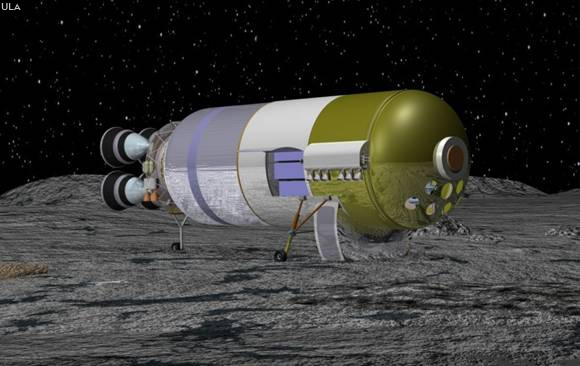
The Crewed United Launch Alliance DTAL (Dual Thrust Axis Lander), as proposed in 2010 [ULA].
Doug Conway
The Australian/AAP

When mankind colonizes the moon, it's likely to be led by a commercial enterprise rather than a government. So says NASA administrator Charles Bolden, who believes nations will no longer venture into space alone, but in collaboration with each other and with private industry.

Maj-Gen Bolden, who flew into orbit four times on the US space shuttle program which ended last year, says governments will lead the way in space exploration, but not in getting access to space.

"We have now got to the point where NASA should have nothing to do with it (access to space)," he said in an address today at Sydney University.

"We have run the tests, we have been flying for 50 years, we know basically how to get humans off the planet and into low-earth orbit. Our private industry partners have built every single space craft we have ever flown.

"NASA has never built a single human-rated space craft."

Read the article HERE.

Tuesday, April 12, 2011

A Rationale for Cislunar Space


Hughes communications satellite HGS-1, left in a useless transfer orbit by launch vehicle failure in 1997, finally reached GEO in 1998 by using lunar flyby gravity assists, the first commercial use of the Moon in history [Hughes].

Paul D. Spudis
The Once & Future Moon
Smithsonian Air & Space

At a recent workshop on lunar return, a critical part of the discussion focused on the need for a statement of purpose – a value proposition for the Moon. Over the years I’ve attempted to distill my rationale for lunar return (my “elevator speech” if you will) into a clearly stated and persuasive argument about the need for enabling human reach beyond low Earth orbit – into all the areas between Earth and Moon (cislunar space) where all of our satellite assets reside. So, as the elevator doors are closing, I will state my Rationale for Cislunar Space:

1. Space satellite assets in orbit beyond LEO benefit society. Modern industrial life depends on satellites of various types and purposes – space assets for global communications, weather monitoring, scientific exploration and national security.

2. Earth’s deep gravity well is a significant cost deterrent to expanded activities in space. Beyond LEO mission launch mass is mostly propellant. We remain mass- and power-limited and therefore capability-limited as long as we are tied to the current spaceflight template of launching everything we need from Earth’s surface. Regardless of launch costs, the size and capability of a given space asset is dictated by the size of available launch vehicles.

3. Human- and machine-assembled satellites can be as big and as capable as needed and unlimited by launch vehicle size. The advent of human servicing and assembly in space, for which we now have documented proof (after 30 years of the Shuttle program and construction of the International Space Station) gives us options and frees us from launch vehicle constraints on volume and mass. Once we are able to get people and machines to those places in space where assets are needed, we can build expanding, maintainable and extensible space systems on site.

4. Currently we cannot routinely access orbits beyond LEO with people and machines to build and maintain such satellites. We use all the propellant of a given launch vehicle just getting people to LEO. At LEO, a new vehicle – already fueled – will be needed to reach various “high” orbits of cislunar space (home to current and future satellites) including geosynchronous orbit, the 36,000 km high orbits at which communications and other global monitoring satellites orbit. At these spots, a single orbit takes 24 hours, the same time as the rotation period of Earth. Such satellites appear to “hover” over one spot on the ground and a dish antenna pointed at their location in the sky never has to be moved to track it.

5. The manufacture and use of propellant made from lunar materials allows for a system that will lower the cost for new space activities, enable routine access to and from the surface of the Moon – give access to all other points in cislunar space, including GEO and other orbits useful for space assets – and open up an avenue for routine human interplanetary flight (i.e., to Mars and beyond). Making propellant from water retained at the lunar poles permits us to set up a logistics base on the Moon, creating routine access throughout cislunar space. In terms of energy, there is very little difference between going from LEO to the aforementioned geosynchronous orbit and lunar orbit.

6. The Moon offers other material and energy resources needed to create new space faring capability, including regolith aggregate, glass and ceramics, metals and solar cell fabrication. We can make composite and ceramic materials from lunar soil by sintering the regolith into parts and structures. Metals can be extracted from lunar rocks and used for construction on the Moon and in space. Engineers have created a roving vehicle that uses lunar soil to make in-place solar cells for the generation of electricity. This ability allows us to create vast photovoltaic arrays for the generation of gigawatts of electrical power. These resources, in addition to the water used for propellant production, are all present and available on the Moon.

7. Both robotic and human presence is required on the Moon to enable and maintain production from lunar resources. I’ve worked in “unmanned” spaceflight for over 30 years. While a firm believer in the utility and possibilities of robotic operations controlled from Earth, I also know that sometimes these robots require human ingenuity and interdiction to work properly. The servicing of the Hubble Space Telescope by Shuttle astronauts has shown us how important people can be to the success of space operations. We can start a lunar return through the use of teleoperated robots, but ultimately people will be necessary to creatively manage operations as well as for getting them back on track when they falter.

8. By establishing a permanent presence on the Moon, we create a “transcontinental railroad” for cislunar space – a reusable, extensible and maintainable (thus, affordable) transportation system. Virtually any scenario for human missions beyond LEO requires a spacecraft carrying hundreds of tons of propellant. This propellant can be made off-Earth from lunar resources and launched from the Moon’s weak gravity well to depots in cislunar space. No rational technical argument can be made that the Moon is a roadblock. And from a monetary perspective, building an extensible cislunar transportation infrastructure gives us both capability and return on our investment.

9. Developing a program to utilize off-planet resources will drive new technology, expand economic growth and assure democratic pluralism survives on the frontiers of space (neither totalitarianism nor corporatism). For fifty years the U.S. civil space program has served national prestige, launched massive economic and scientific growth through technological innovation, and nurtured international cooperation in many areas. We cannot however, continue to assume that free market capitalism will remain the dominant political paradigm in space. There are other space powers that do not share our views about individual freedoms and economic opportunity, nor do they necessarily care about the importance or need for property rights and contract law – values needed to maintain free societies. There may be no individual liberty or free market enterprise if America does not maintain a strong leadership presence on the growing space frontier.

The report of the Augustine committee concluded that human expansion into space was the ultimate (and in fact only) rationale for manned spaceflight. I agree. The elevator doors are opening now so I hope my argument for lunar return has persuaded you that America has the opportunity to prosper, to create a space economy and help shape humanity’s future by utilizing the Moon to develop cislunar space.