Showing posts with label Ina. Show all posts

Monday, October 13, 2014

LRO: widespread evidence of young lunar volcanism

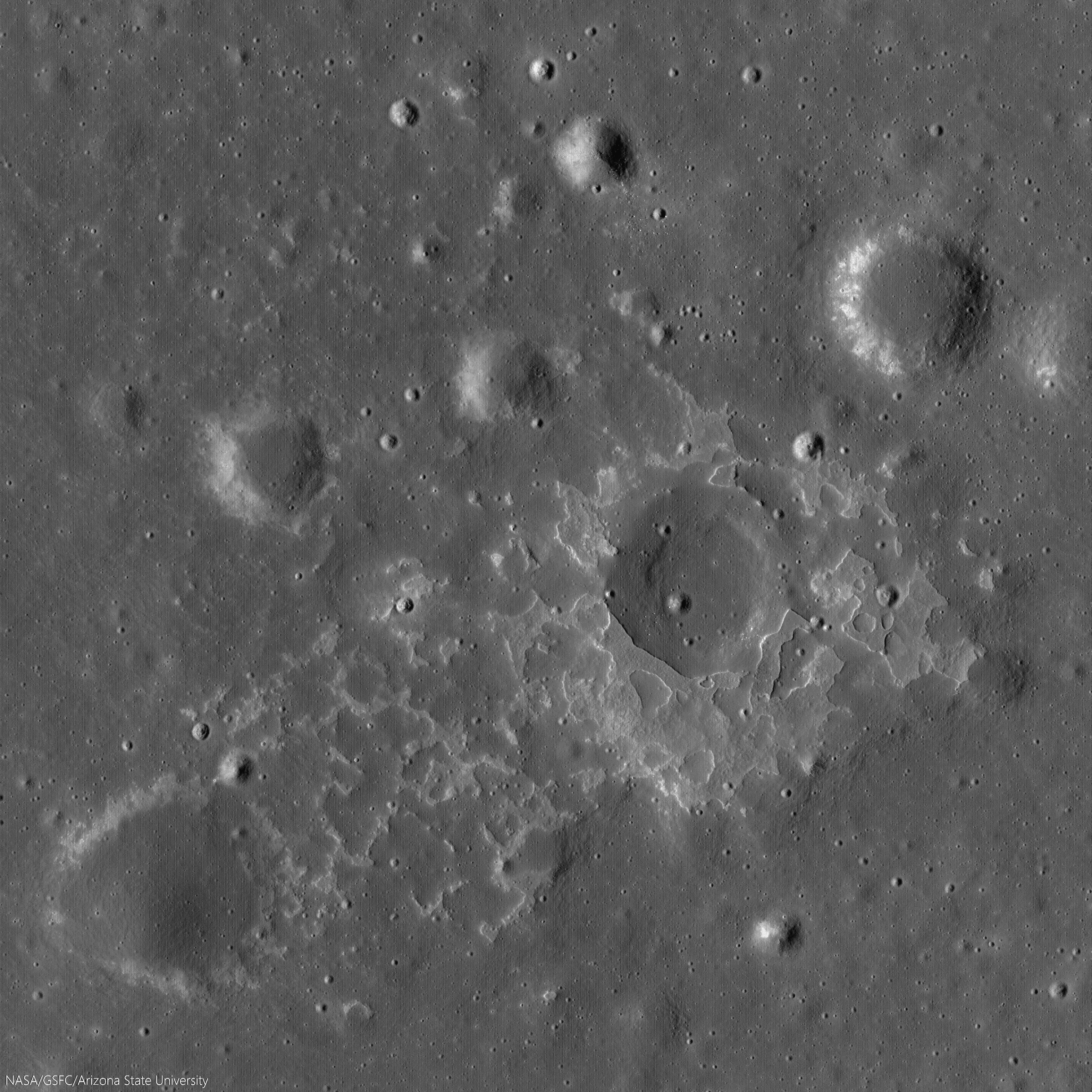
The feature called Maskelyne is one of many newly discovered young volcanic deposits on the Moon. Called irregular mare patches, these areas are thought to be remnants of small basaltic eruptions that occurred much later than the commonly accepted end of lunar volcanism, 1 to 1.5 billion years ago [NASA/GSFC/Arizona State University].
Dwayne Brown
NASA HQ

NASA’s Lunar Reconnaissance Orbiter (LRO) has provided researchers strong evidence the moon’s volcanic activity slowed gradually instead of stopping abruptly a billion years ago.

Scores of distinctive rock deposits observed by LRO are estimated to be less than 100 million years old. This time period corresponds to Earth’s Cretaceous period, the heyday of dinosaurs. Some areas may be less than 50 million years old. Details of the study are published online in Sunday’s edition of Nature Geoscience.

“This finding is the kind of science that is literally going to make geologists rewrite the textbooks about the moon,” said John Keller, LRO project scientist at NASA’s Goddard Space Flight Center in Greenbelt, Maryland.

The deposits are scattered across the moon’s dark volcanic plains and are characterized by a mixture of smooth, rounded, shallow mounds next to patches of rough, blocky terrain. Because of this combination of textures, the researchers refer to these unusual areas as irregular mare patches.

The features are too small to be seen from Earth, averaging less than a third of a mile (500 meters) across in their largest dimension. One of the largest, a well-studied area called Ina, was imaged from lunar orbit by Apollo 15 astronauts.

Ina appeared to be a one-of-a-kind feature until researchers from Arizona State University in Tempe and Westfälische Wilhelms-Universität Münster in Germany spotted many similar regions in high-resolution images taken by the two Narrow Angle Cameras that are part of the Lunar Reconnaissance Orbiter Camera, or LROC. The team identified a total of 70 irregular mare patches on the near side of the moon.

The large number of these features and their wide distribution strongly suggest that late-stage volcanic activity was not an anomaly but an important part of the moon's geologic history.

The numbers and sizes of the craters within these areas indicate the deposits are relatively recent. Based on a technique that links such crater measurements to the ages of Apollo and Luna samples, three of the irregular mare patches are thought to be less than 100 million years old, and perhaps less than 50 million years old in the case of Ina. The steep slopes leading down from the smooth rock layers to the rough terrain are consistent with the young age estimates.

In contrast, the volcanic plains surrounding these distinctive regions are attributed to volcanic activity that started about 3 1/2 billion years ago and ended roughly 1 billion years ago. At that point, all volcanic activity on the moon was thought to cease.

Several earlier studies suggested that Ina was quite young and might have formed due to localized volcanic activity. However, in the absence of other similar features, Ina was not considered an indication of widespread volcanism.

The findings have major implications for how warm the moon’s interior is thought to be.

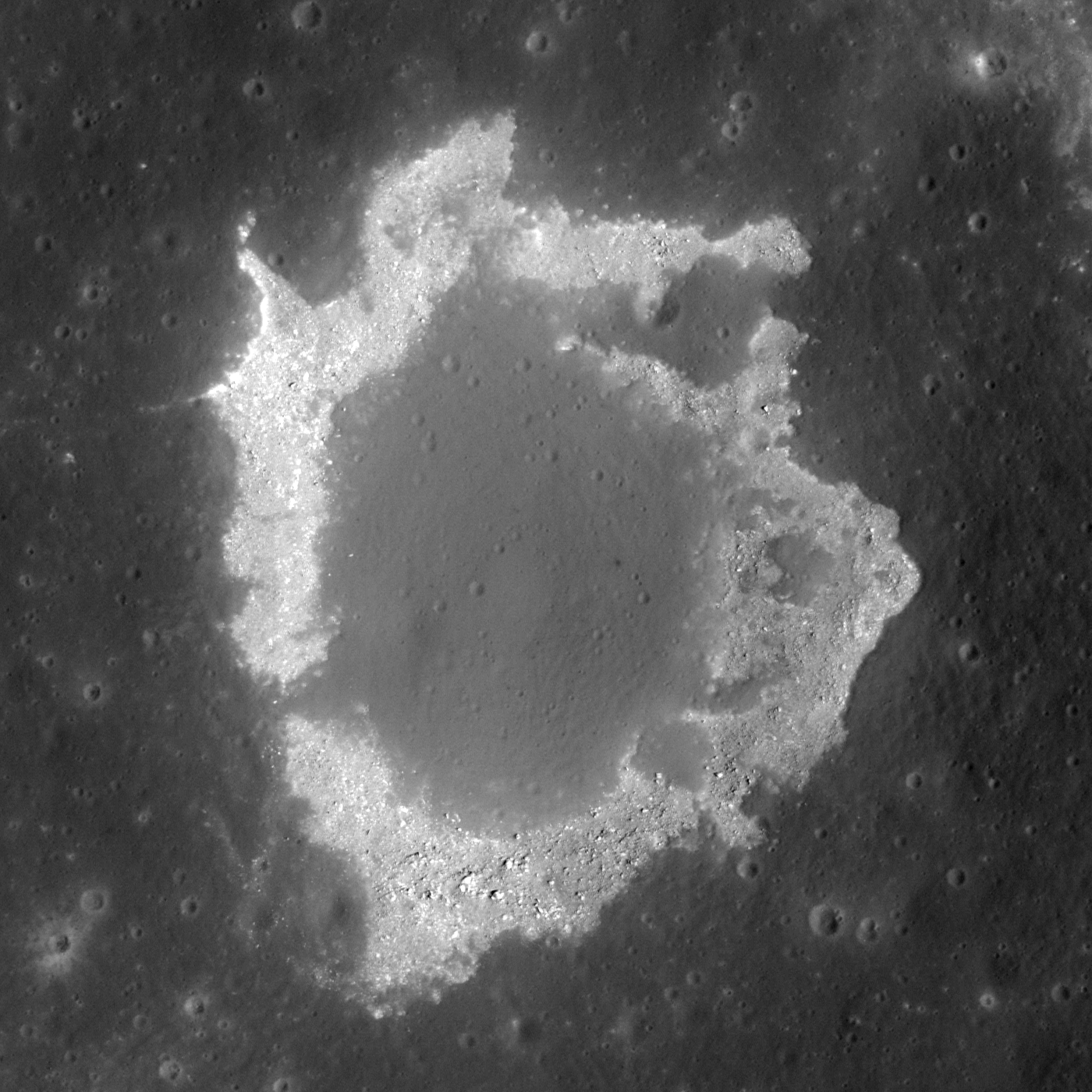
An oblique, novel view of the Ina formation (3 km across, 18.65°N, 5.3°E) from the LROC narrow angle camera (resolution 2.5 meters per pixel [NASA/GSFC/Arizona State University].
“The existence and age of the irregular mare patches tell us that the lunar mantle had to remain hot enough to provide magma for the small-volume eruptions that created these unusual young features,” said Sarah Braden, a recent Arizona State University graduate and the lead author of the study.

The new information is hard to reconcile with what currently is thought about the temperature of the interior of the moon.

“These young volcanic features are prime targets for future exploration, both robotic and human,” said Mark Robinson, LROC principal investigator at Arizona State University.

LRO is managed by Goddard for NASA’s Science Mission Directorate at NASA Headquarters in Washington. LROC, a system of three cameras, was designed and built by Malin Space Science Systems and is operated by Arizona State University.

To access the complete collection of LROC images, visit http://lroc.sese.asu.edu/

For more information about LRO, visit http://www.nasa.gov/lro

Some Related Posts:
Hansteen α -   January 15, 2014
Small-scale volcanism on the lunar mare, July 13, 2013
Unassuming volcanic vent north of Aristarchus Plateau, April 1, 2013
New views of the hollows of Rimae Sosigenes, March 28, 2013
Inside Rima Hyginus, June 12, 2012
Ina of the Meniscus Hollows, March 21, 2012
LUNAR MENISCUS HOLLOWS. P. J. Stooke, Department of Geography and Centre for Planetary Science and Exploration, University of Western Ontario, London, Ontario, Canada; 43rd Lunar and Planetary Science Conference (2012), #1011.
Whale of a Hollow, March 20, 2012
It's a gas, man, Paul Spudis, Smithsonian Air & Space, October 6, 2011

Sunday, October 12, 2014

New evidence for young lunar volcanism

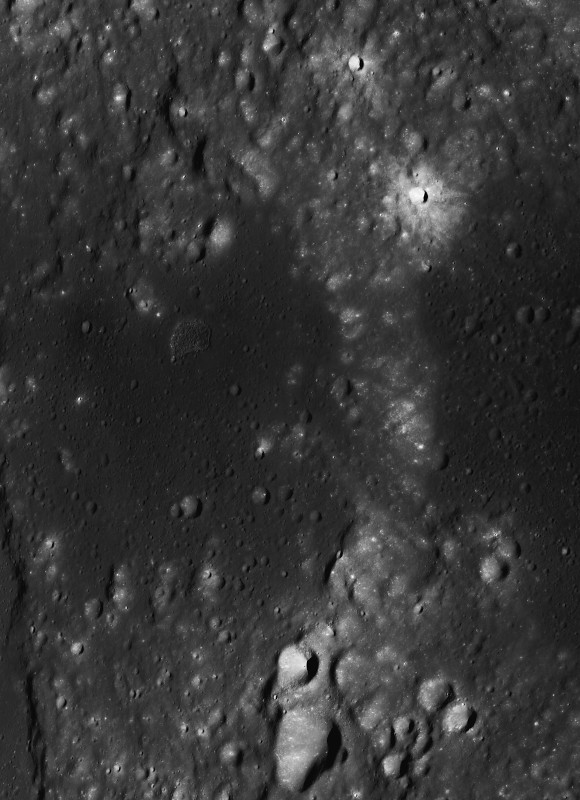
One of many newly-discovered young volcanic deposits on the Moon (4.330°N, 33.750°E), this example is near the crater Maskelyne, in south central Mare Tranquillitatis. Illustration from from "New evidence for young lunar volcanism," Mark Robinson, Oct. 12, 2014. LROC NAC observation M1123340138R, LRO orbit 17730, May 16, 2013; slew 3° from orbital nadir, incidence 66.55° resolution 1.04 meters from 102.5 km over 4.26°N, 33.97°E [NASA/GSFC/Arizona State University].
Mark Robinson
Principal Investigator
Lunar Reconnaissance Orbiter Camera (LROC)
Arizona State University

Many young volcanic deposits were recently identified in LROC NAC images. Their sharp nature and general lack of superposed impact craters greater than 20 meters in diameter indicate these deposits probably formed in the last 100 million years, perhaps even more recently than 50 million years ago. An amazing result!

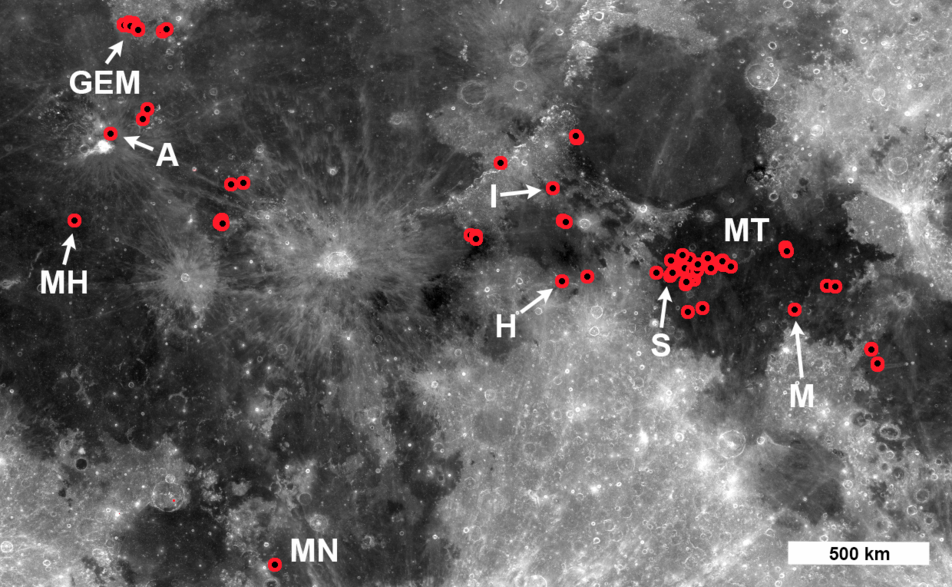
A new paper, (Evidence for basaltic volcanism on the Moon within the past 100 million years, Nature Geoscience 7, 787-791; 2014) presents 70 topographic anomalies, informally called Irregular Mare Patches, or IMPs, most of these occurrences were previously undocumented. The IMPs are thought to be remnants of small basaltic eruptions that formed significantly after the commonly accepted end of lunar volcanism (1 to 1.5 billion years ago).

Locations of IMPs. Red circles indicate either a single IMP greater than 100 meters in diameter, or a cluster of smaller IMPs. The area extends from 28.0° N to 40.6° N latitude and 58.0 ° E to 50.3° E longitude, LROC WAC 643nm mosaic. IMP labels: Aristarchus (A), Gruithuisen E-M region (GEM), Hyginus (H), Ina (I), Mare Nubium (MN),  Mare Tranquillitatis (MT), Marius Hills (MH), Maskelyne (M), Sosigenes (S) [NASA/GSFC/Arizona State University].
Pursuing a Decades-old Puzzle

The best-known IMP, called Ina (or Ina-D), was originally spotted in Apollo 15 orbital photography, and was unlike anything else previously discovered on the lunar surface. Beginning with Apollo era investigations, Ina was interpreted as a collapsed caldera at the summit of a low-shield volcano. Previous interpretations of impact crater densities within and around Ina suggested that this enigmatic landform was much younger than the surrounding mare basalt unit in Lacus Felicitatis (Lake of Happiness).

Not only does the NAC provide excellent resolution, but after 5 years of operation has covered well over 75% of the surface. This combination led to the discovery of many new IMPs in locations across the nearside of the Moon. Ina is not simply a one-off oddity – but rather a signature of volcanic processes that actually occurred in multiple places across the nearside.

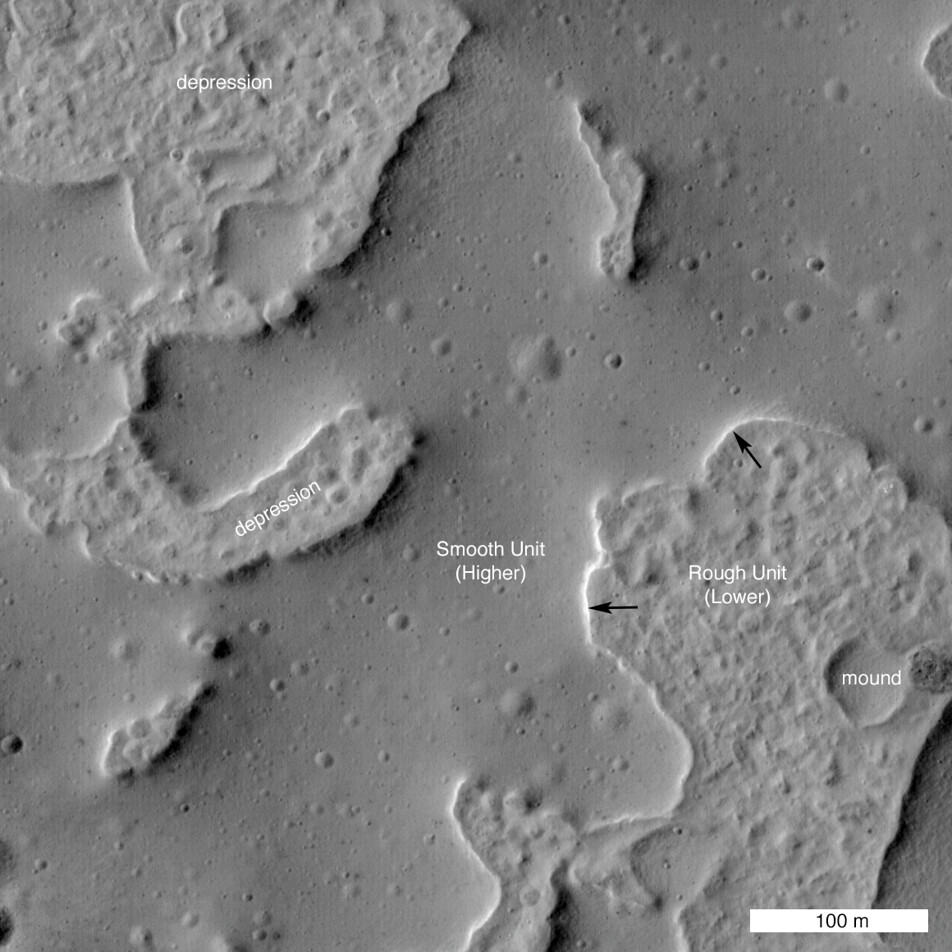
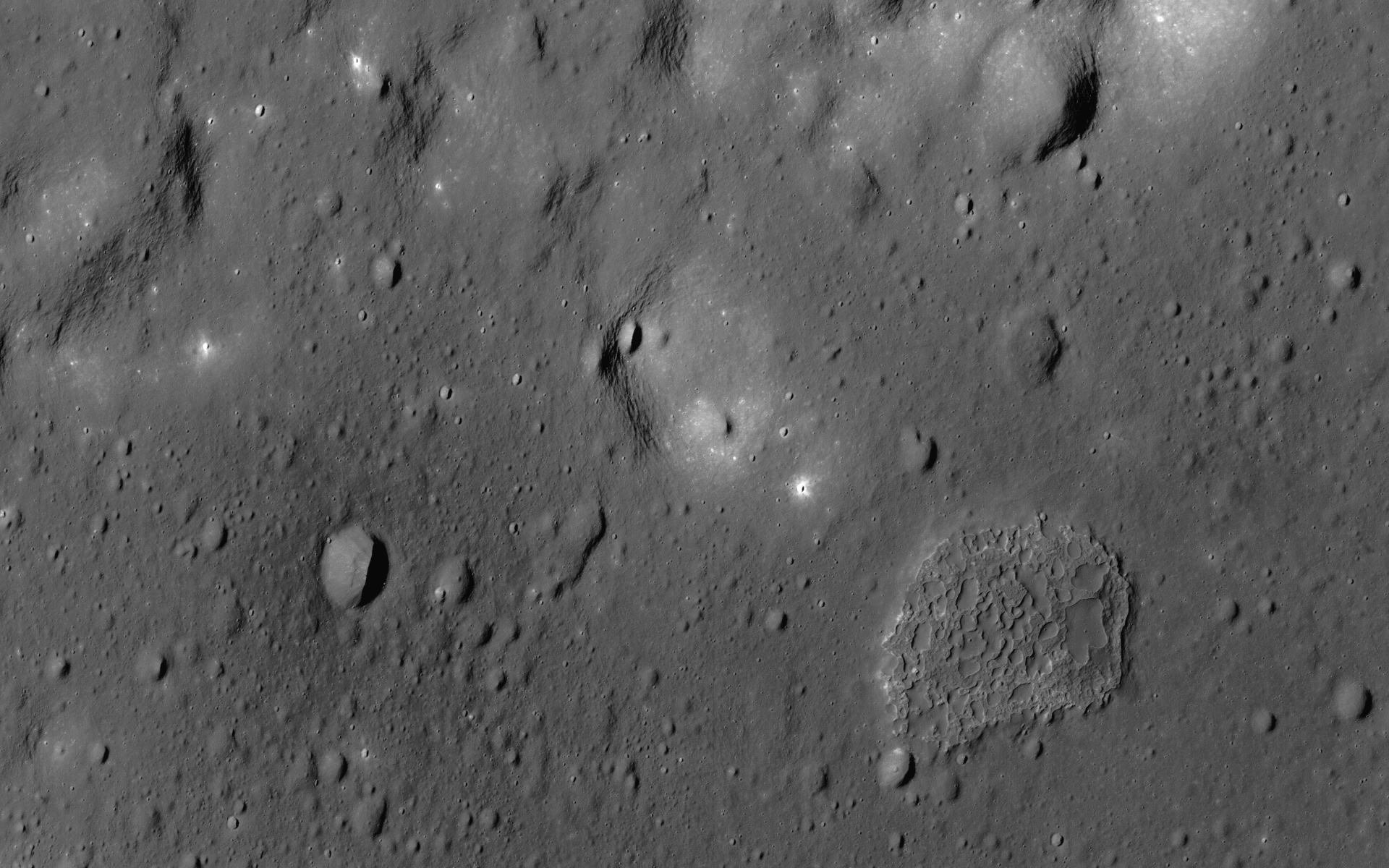
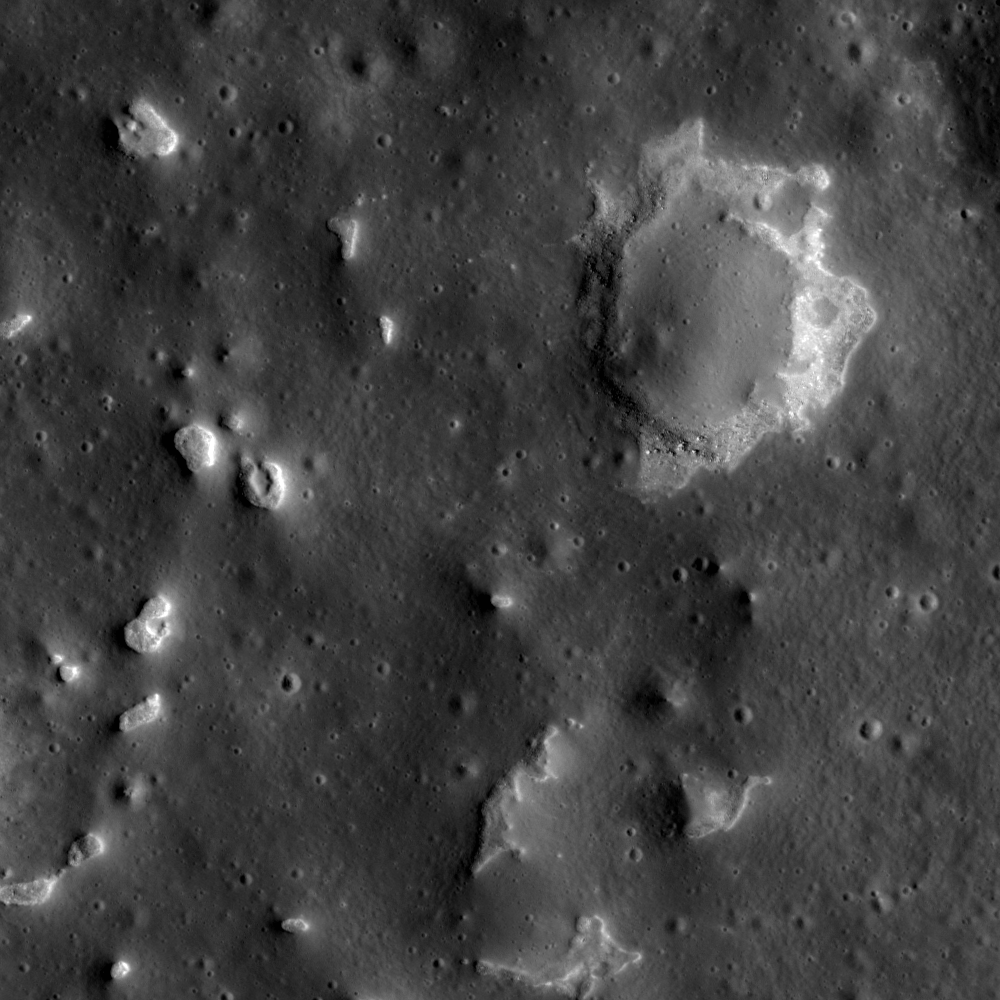
Close up of a small 464 meter wide section of the "IMP" familiarly known as Ina. This area is a great example of the difference between the rough and smooth units that make up the new family of IMP structures. The smooth unit is composed of mounds over the rougher units. The Sun is from the East, the black arrows show a Sun-facing cliff of one of the mounds. LROC NAC M175246029LR, LRO orbit 10960, November 6, 2011; 45.6° incidence, resolution 44 cm from 24.54 km over 18.91°N, 4.76°E [NASA/GSFC/Arizona State University].
New Discoveries

All of the lunar landforms identified as IMPs exhibit two distinct morphologies: smooth deposits, which are sometimes connected to the surrounding mare basalt, and uneven deposits (rough-looking) which usually end abruptly at the steep edges of the smooth deposit; it is likely that the smooth materials are covering portions of the rough material.

To estimate the age of IMPs the LROC team measured the sizes and numbers of impact craters on the smooth deposit surfaces (geologists use the crater size-frequency distribution (CSFD) as a metric for estimating the age of a surface). The resulting crater distributions from the three largest irregular mare patches imply ages younger than 100 million years. Indeed, the new crater counts confirmed that Ina is very young, perhaps as young as 33 million years.

IMP north of Aristarchus crater (25.044°N, 313.233°E). Compelling evidence of the youth of this feature and its apparent origination from active processes within the Moon. As a matter of stratigraphy, the phenomena that caused this occurred after the formation of Aristarchus crater, a late Copernican age crater itself superposed on some of the Moon's youngest basaltic volcanic plains. 650 meter-wide field of view from LROC NAC observation M168509312R, LRO orbit 9967, August 20, 2011; incidence 42.67° at 40 cm resolution from 25.59 km over 24.7°N, 313.21°E [NASA/GSFC/Arizona State University].
Another key set of observations came from digital topographic maps derived from NAC stereo pairs that enabled quantitative relief and slope measurements of six larger IMPs. Measurements of the smooth deposit relief compared to the underlying uneven deposit revealed that the thickness of the smooth deposits (on average 8 meters, with a range of 2-20 meters) is consistent with the previously established thickness of lunar basalt flows.

Topographic slopes were measured at the edges of the smooth deposits where they contact the uneven deposits. Slopes that exceed the angle of repose, which is 30-35°, are evidence of relatively young surface features, because over time impacts and moonquakes will smooth over steep cliffs. Slopes on the edges of many of the smooth deposits exceed the angle of repose, providing more evidence for very young surfaces.

Changing the Way We Think About the Moon

Not only are the IMPs striking landscapes, they also tell us something very important about the thermal evolution of the Moon. The nearside has extensive mare basalt flows covering much of its surface, however we know from analysis of Apollo samples and crater counts that the bulk of lunar volcanism occurred from 3.9 to 3.1 billion years ago, and shut-off sometime around 1 billion years ago. However the IMPs seemed to have formed significantly after the canonical cessation of lunar mare basalt volcanism indicating the interior of the Moon is perhaps hotter than previously thought.

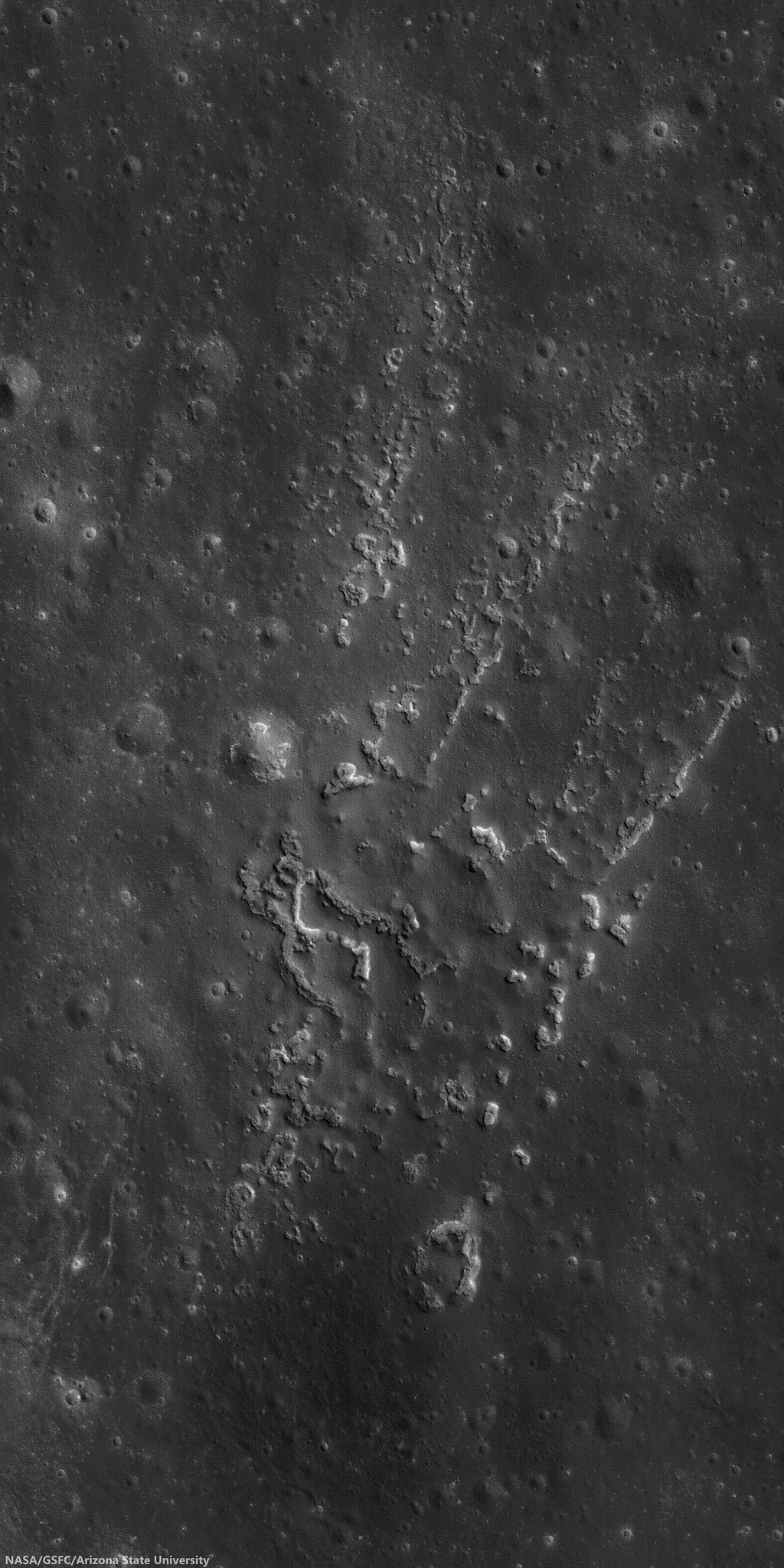
The contrast between the smooth and rough units stands out in this oblique view of Ina. The floor of the depression is about 50 m below the surrounding plains and is about 2 km wide. LRO oblique mosaic M1108203502LR, LRO orbit 15596, November 22, 2012; 52.18° slew from orbital nadir, resolution 3.75 meters from 127.29 km over 18.77°N, 11.64°E [NASA/GSFC/Arizona State University].
Full-width reduction of LRO oblique mosaic M1108203502LR, showing the interesting contextual features, some related, others likely not, subject of decades of speculation [NASA/GSFC/Arizona State University].
The new study of IMPs extends our knowledge of the extent of these fascinating deposits as well as their young age. What does it all mean? The young, small-volume extrusions of mare basalt imply a thermal history of the Moon where volcanism did not end abruptly, but rather decreased gradually over time (and may not be done!). With these newly discovered young volcanic features, scientists must consider that the Moon has a bit more heat in it that previously thought, an important new constraint for future models of the Moon's thermal evolution. Perhaps the abundance of radioactive elements (which provide heat as they decay) is higher -- important knowledge when figuring out how the Moon formed and evolved over time.

A provocative side note to the new thermal constraints — perhaps the Apollo heat flow measurements were spot on? Astronauts buried thermometers in the regolith during the Apollo 15 and 17 missions. The temperatures recorded were a bit higher than models predicted. At the time, scientists proposed that perhaps the two landing sites were in areas with higher heat flow than the average Moon, or perhaps there was an instrumental effect. The discovery of IMPs and their young age is certainly consistent with the higher temperatures measured by the Apollo crews.

Apollo 15 cmdr. Dave Scott working at the west Heat Flow hole (with St. George crater in the background). The drill is sitting on the ground next to the hole. Increased understanding of IMP phenomena increases the likelihood readings taken using the Apollo Heat Flow Experiments (HFE) during the Apollo 15 and 17 surface expeditions were not, afterall, anomalous. Apollo 15 EVA-2 AS15-92-12408 [NASA/JSC].
The IMPs are a fascinating part of the story of lunar volcanism over time, and now they must be considered high priority targets for future exploration. A sample return mission from one of these enigmatic deposits would tell us so much about the Moon as a whole. When did these lavas erupt? Is their chemistry different than the basalts returned by the Apollo astronauts? Is it likely that volcanic eruptions may occur at some point in the future?  A highly accurate age date for the IMPs would also serve as a much needed calibration point for the lunar cratering chronology; a crucial improvement not only for lunar studies but also for Mars and Mercury investigations.

Closer look at the IMP at Rimae Sosigenes - image follows below - Demonstrations Supplementary to "Evidence for basaltic volcanism on the Moon within the past 100 million years," Nature Geoscience 7, 787-791; 2014

Fig. 7 (top) Profile across a contact between smooth and uneven deposits, southeast feature. The relief of the smooth deposit is measured as the difference in elevation between the average flat surface of the smooth deposit (-1504 meters below global mean elevation; Sosigenes Graben NAC-DTM) and the base of the uneven deposit at the contact (-1514 meters). For this particular profile the smooth deposit is 10 meters thick. Note the lobate margin of the smooth deposit at the contact.

Fig. 5 (bottom) Craters on the smooth deposit of the Sosigenes IMP. The red circles are impact craters superposed on the smooth deposit of the Sosigenes IMP, delineated by the blue line; field of view roughly 5 km [NASA/GSFC/Arizona State University].
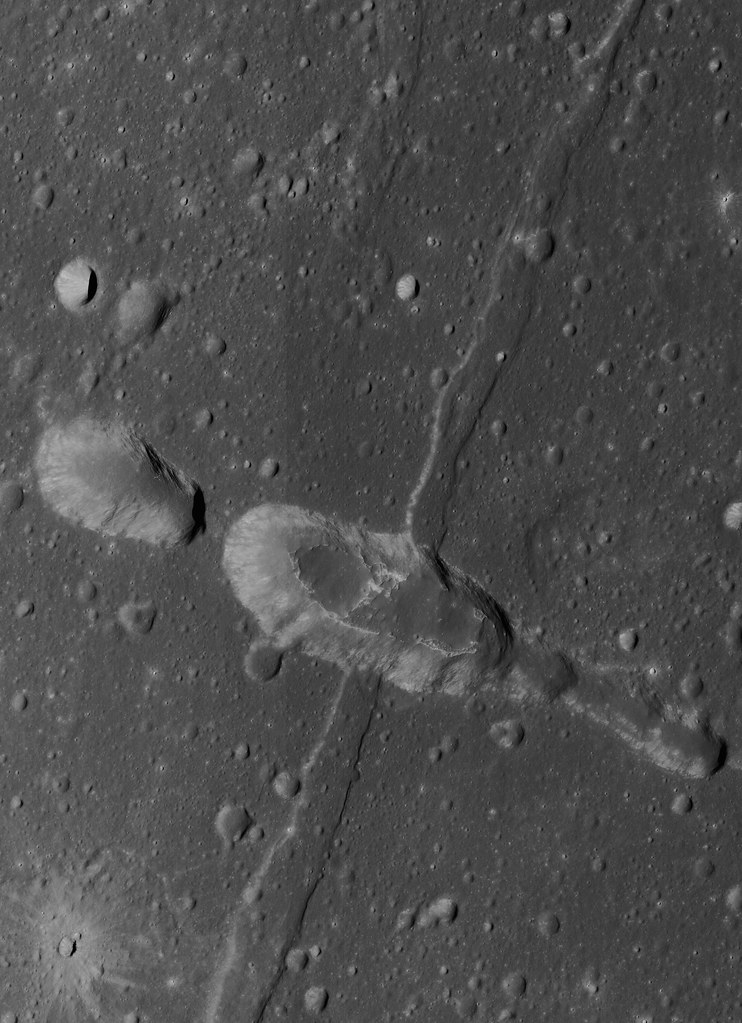
Spectacular oblique mosaic of the Sosigenes graben with it's large collapse pit, 2800 meters long and 300 meters deep, and floored with an IMP.  LROC NAC oblique observation M1108117962LR, LRO orbit 15584, November 21, 2012; 70.37° incidence, spacecraft and camera slew 55° resolution 2.5 meters from 114.87 km over 8.63°N, 24.9°E [NASA/GSFC/Arizona State University].
View full-window: Spectacular oblique NAC mosaic of the Sosignes graben with a large collapse pit (2800 meters wide, left-to-right; 300 meters deep) floored with an IMP.

Wider field of view from a spectacular oblique LROC NAC mosaic M152750200LR, LRO orbit 15584, November 21, 2012; 70.37° incidence, spacecraft and camera slew 55° resolution 2.5 meters from 114.87 km over 8.63°N, 24.9°E [NASA/GSFC/Arizona State University].
Inspect a variety IMPs using the LROC Quickmap: Cauchy-5, Nubium, GEM-30, Aristarchus North

Related Posts:
Inside Rima Hyginus (June 12, 2012)
Ina of the Meniscus Hollows (March 21, 2012)
Spectral properties of Ina (February 7, 2011)

Wednesday, June 13, 2012

LROC: Rock silde in Rima Hyginus

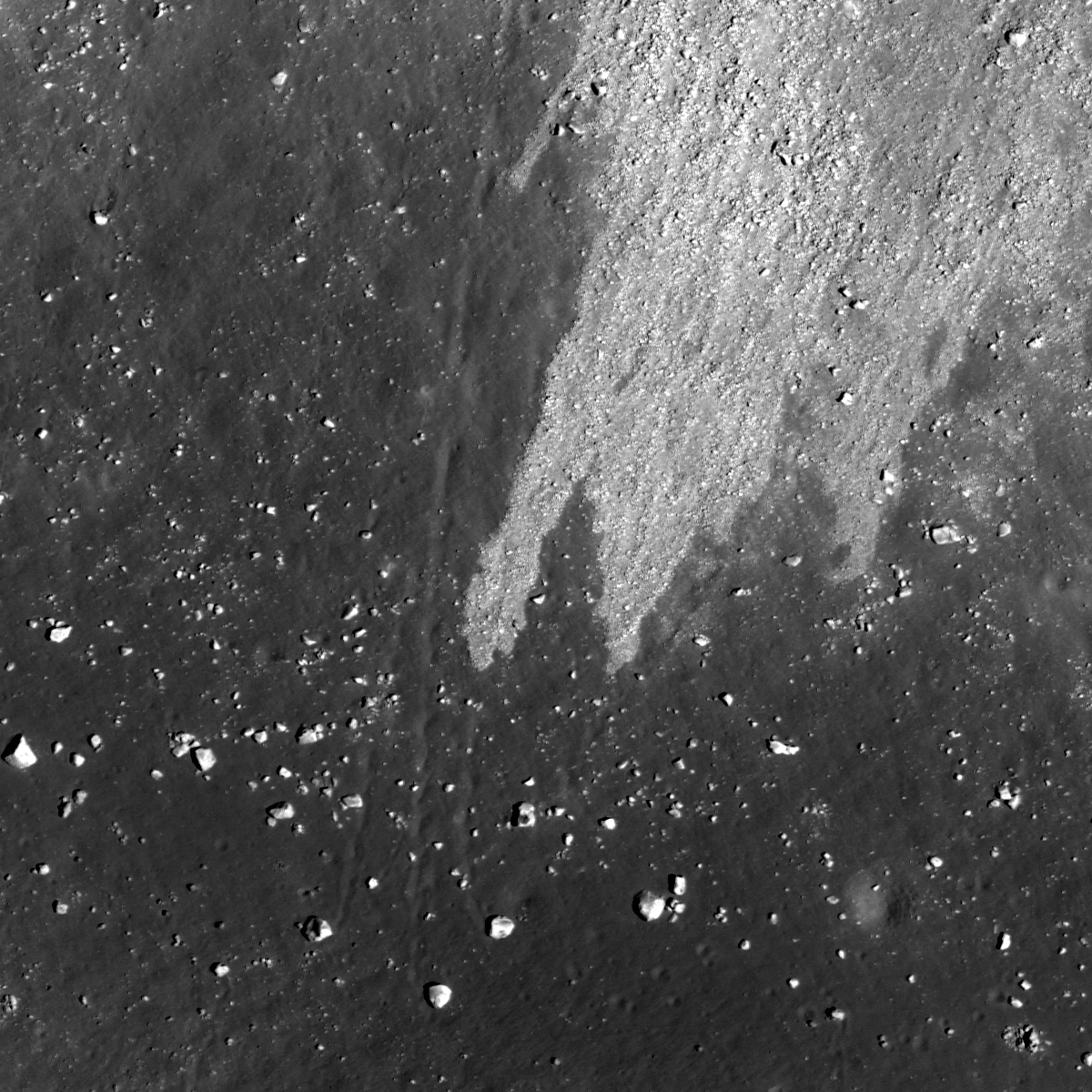
A rock slide along a section of the northern wall of Rima Hyginus. LROC Narrow Angle Camera (NAC) observation M111545012R, LRO orbit 1572, October 30, 2009; angle of incidence 27.62° at a native resolution of 0.48 meters from 47.28 kilometers. See the 576 meter-wide field of view of the area in the LROC Featured Image HERE [NASA/GSFC/Arizona State University].
Sarah Braden
LROC News System

Rima Hyginus is a linear rille which branches to the northwest and east of Hyginus crater.

The rock slide shown in the Featured Image is located on the northern wall of the eastern branch of Rima Hyginus at 7.393°N, 7.954°E. Bright boulder-rich material from the edge of the rille slid down the wall, possibly during a period of tectonic shaking due to a moonquake or forces associated with a nearby impact.

A trio of large boulders also left trails as they tumbled down the rille's wall.

LROC NAC and WAC mosaic overlay showing a cross-section of Rima Hyginus at the point of the rock slide of interest, LROC QuickMap at 4 meters per pixel resolution [NASA/GSFC/Arizona State University].
Rima Hyginus formed through faulting, and is actually a graben. A graben is a section of the crust that sunk as two parallel faults pulled apart. Remember, the term linear rille is just a fancy way of saying a graben. After the graben formed Rima Hyginus, the landscape changed again due to volcanic activity, specifically the collapse craters easily seen in the the WAC context image here. The craters follow the slight curve of the rille, which indicates that they are not simply a chain of secondary craters that happened to land on top of the existing graben. These craters also do not have raised rims, and they probably formed when the volcanic structures underlying the graben collapsed.

Branch of Rima Hyginus trailing away east from the Hyginus crater, with the subject rock slide designated with the yellow arrow. Cropped at its full 52.5 meter resolution from LROC Wide Angle Camera monochrome (604nm) observation M177582468C, LRO orbit 11306, December 3, 2011, from 38.58 kilometers [NASA/GSFC/Arizona State University].
Examine more of Rima Hyginus in the full LROC NAC frame HERE.

Related Images:

Read more about the Hyginus region in the Icarus paper, "An igneous origin for Rima Hyginus and Hyginus crater on the Moon."

Tuesday, June 12, 2012

LROC: Inside Rima Hyginus

Collapse features within Hyginus Crater. 1240 meter-wide field of view from LROC Narrow Angle Camera (NAC) observation M104476560L, LRO orbit 556, August 9, 2009; resolution 1.24 meters from 122.77 kilometers. View the LROC Featured Image, released June 12, 2012 HERE [NASA/GSFC/Arizona State Univeristy].
Sarah Braden
LROC News System

Most craters posted to the LROC Featured Image page are impact craters, however, Hyginus Crater (located at 7.75°N, 6.27°E, in Sinus Medii) is a volcanic crater known as a caldera. Two main pieces of evidence suggest that Hyginus Crater formed through volcanic processes. First, Hyginus lacks a raised rim typical of impact craters. Second, the rim of Hyginus is irregular (not circular), which is typical for volcanic craters caused by collapse. Also, if you look closely with the LROC NAC, the interior of Hyginus has a number of small irregular depressions which are most likely collapse features, indicating a volcanic origin for Hyginus. These irregular depressions are in the Featured Image, distinguished by rough, high reflectance material around their edges.

Eight meter per pixel resolution view from LROC QuickMap shows the "meniscus hollows" features in context with the eastern interior of Hyginus [NASA/GSFC/Arizona State University].
The entire Hyginus region, shown in the LROC context image below, is a complex piece of lunar real estate. Not only do you have the volcanic crater Hyginus, but also Rima Hyginus, a linear rille, more volcanic collapse craters aligned with the linear rille, and a pyroclastic deposit around the crater Hyginus. How do all the geologic features relate to one another? The Hyginus region is so amazing that it was a candidate landing site for the canceled Apollo 19 mission. Had events turned out differently, we might know much more about the pyroclastic materials and the Hyginus caldera. Continue reading below for a summary of the scientific theory of how the Hyginus region formed.
An almost oblique view (spacecraft and camera slewed 19.57° east from nadir), LROC WAC view from 42.29 kilometers over an area west of Rima Hyginus. The caldera, particularly its east walls, can be seen here in some relief, without the high angle of incidence seen in the next image. LROC WAC observation M165814883C (604nm), LRO orbit 9570, July 20, 2011; native resolution 62.94 meters [NASA/GSFC/Arizona State University].
In a recent paper, scientists proposed a model of formation for Hyginus crater and Rima Hyginus. First, a body of magma from the mantle rose vertically through the lunar crust. The magma stopped rising near the surface and spread out laterally. This introduction of new material beneath the surface caused stress on the crust, which resulted in faulting. Eventually, gasses from the magmatic material still underneath the surface built up and increased the gas pressure, further increasing the stress on the crust.

LROC Wide Angle Camera (WAC) monochrome (689nm) observation of the Hyginus region. The yellow arrow marks the location of the collapse feature, the meniscus hollow, within Hyginus caldera seen at high resolution in the LROC Featured Image and the white arrow designates a small dome feature brought to attention by Maurice Collins. LROC WAC M117447052ME, orbit 2442, January 6, 2010; incidence angle 81.75° and a 62.6 meter resolution from 41.63 kilometers [NASA/GSFC/Arizona State University].
This stress eventually caused graben to open along the faults, and the same release of stress initiated an eruption, including pyroclastic materials. After the eruption of magmatic material an empty cavity beneath the surface was left behind. This cavity collapsed, creating Hyginus crater. The collapse craters along the linear rille also formed in a similar way.
LROC NAC image M126887222L gives another look at the largest collapse feature in the main image. This image field of view is 487 meters wide (588 meters in the LROC Featured Image release), and has a lower illumination incidence angle, which emphasizes albedo differences over the kind of relief visible in the LROC WAC image immediately above. LRO orbit 3833, April 26, 2010; incidence angle 28.28° with a resolution of 0.48 meters from 40.55 kilometers [NASA/GSFC/Arizona State University].
Explore more of the Hyginus caldera in the full LROC NAC, HERE.

Related Posts:
LPOD: Another Ina?
It's a gas, man
Brayley G
Sinuous Chain of Depressions
It's the Moon's Fault

You can read more about the Hyginus region in the Icarus paper, "An igneous origin for Rima Hyginus and Hyginus crater on the Moon."

The central and western Hyginus and Rima Hyginus region and points immediately north and beyond under mid-morning illumination, as seen from around 100 kilometers over the south , a forward-looking HDTV still captured by Japan's lunar orbiter SELENE-1 (Kaguya) in 2008 [JAXA/NHK/SELENE].

Wednesday, March 21, 2012

Ina of the Meniscus Hollows


Joel Raupe
Lunar Pioneer


Before my daughter left for college I tried to pass along a little advice Kurt Vonnegut once tried to impress upon me. I paraphrase: "warn your little Grade A students whom they shall inevitably meet on campus, no matter how gifted they may be. His name is Wolfgang Amadeus Mozart."
Such was the case yesterday only a few hours after posting "Whale of a hollow," which became an excuse to post a perspective shot of an extrusion dome on the geologically interesting southwestern edge of Mare Serenitatis.

The hollows perched on this isolated, but otherwise typical, mare extrusion dome resemble similar features discovered early in the Messenger survey of Mercury. We had a lot of images left over after a thorough study of this one site on the Moon from five months ago. And after simply stumbling on the "whale" structure, while we were examining a newly-released LROC Narrow Angle Camera (NAC) frame showing the Ranger 6 impact, we jumped on an excuse to discuss the Aratus-Serenitatis dome in that context; with the Ina structure and its distant cousin that also happens to resemble a cave dweller's rendition of a whale, or perhaps something one might see from the air flying over the plains of Nazca.

One of the better images of the Aratus-Serenitatis extrusion dome (24.77°N, 7.98°E), before LRO, is this 1971 Mapping Camera view (AS15-M-0410) from the Apollo 15 Service Module, 104 kilometers overhead. For a 21st century look at this dome, and in relief, an animated image demonstrating changes in the landscape during the long lunar day can be seen HERE [NASA/GSFC/Arizona State University].
Which brings us to "Mozart," who manifested almost immediately, first in the form of Phil Stooke, of Western Ontario University, a selenographer well-known for startlingly accurate maps of the Apollo landing sites before these were photographed for the first time in four decades from LRO. He also shares our interest in using the new and deep reservoir of LROC imagery to document the artifacts of human activity on the Moon, and he Emailed us after presenting a fairly comprehensive paper on the topic of lunar "meniscular hollows" at the 43rd Lunar and Planetary Science Conference underway in The Woodlands, Texas. Stooke gently recommended his paper, presented that very evening,
LUNAR MENISCUS HOLLOWS. P. J. Stooke, Department of Geography and Centre for Planetary Science and Exploration, University of Western Ontario, London, Ontario, Canada; 43rd Lunar and Planetary Science Conference (2012), #1011.
My first impression was how ridiculous the context view shown in yesterday's post appeared, one showing the location in Mare Tranquillitatis of the "whale" structure in its "serendipitous" relation to a nearby crater created by the 1964 impact of Ranger 6. That part of the floor of western Tranquillitatis, around the Ross and Arago crater and dome groupings, is crowded with these out-gas-formed "hollows." It will require some revision, to say the least. 

Figure 1. from LUNAR MENISCUS HOLLOWS, P.J. Stooke, U. Western Ontario, #1011, 43rd Lunar and Planetary Science Conference (2012), "Twenty Lunar Meniscus Hollows. Scales vary, image widths are between 300 and 1000 m, approximately." View a full-sized version of the plate HERE [Phil Stooke].
Of course, that's what's being said of all the lunar maps and textbooks these days, and that's a good thing.

The second question is an unfair one. Are there any such "blow-outs" on the Moon's farside? Even the Lunar Reconnaissance Orbiter Camera hasn't photographed the entire Moon in high-resolution, but it's close.

While examining his impressive catalog of 27 nearside hollows, as we prepared to show it off beyond the narrow confines required by the conference, YouTube videographer jayem4646 , who's work has appeared in these pages before, followed up on Stooke's note by calling attention to perhaps the best attempt so far to digest what's been so recently learned about the Ina structure, the "D caldera," and most famous of the lunar meniscus hollows.

It's seen in the embedded video above, way ahead of the Scientific Visualization Studio (SVS) at Goddard, and definitely in their class. 

We missed attending the LPSC this year, but it's warmed more than one heart knowing someone attending that grand meeting found the website useful, or at least amusing!

Tuesday, March 20, 2012

Whale of a hollow

"Another Ina," a 'hollow on the Moon resembling a cave-dweller's representation of a whale, located on the western floor of Mare Tranquillitatis (8.89147°N, 21.48729°E) near the February 1964 impact of Ranger 6. LROC Narrow Angle Camera (NAC) observation M177494593R, orbit 11293, December 2, 2011; incidence angle 62.5° and at a resolution of 0.46 meters per pixel from 38 kilometers [NASA/GSFC/Arizona State University].
Joel Raupe
Lunar Pioneer

Hollows, as distinct from pit craters, have been discovered during the course of the Messenger survey of Mercury. As such, these new discoveries heightened awareness of similar features on the Moon, some of these well-known and others also newly discovered by LRO science teams.

Two hollows, or hollow clusters, for example, have been confirmed in LROC high-resolution images not far from the Moon's most famous example, "Ina," the "D Caldera" well-known to telescope observers looking for the challenging feature from Earth.

All three of these features are presumed to result from outgassing, though details of the dynamic remain elusive. Ina is the most studied, and a small cluster of hollows to its north, situated on an extrusion dome on the edge of the Serenitatis basin is the next most well known. The Ina formation had been thought to be unique, but another smaller version has turned up in three LROC Narrow Angle Camera frames showing the area in Mare Tranquillitatis where Ranger 6 made its impact in 1964.

The whale in the Sea of Tranquility (yellow oval) doesn't stand out like Ina, but even in this simulated oblique view of the LROC WAC 100 meter Global monochrome mosaic, overlaid on am elevation model assembled from LOLA laser altimetry, displayed in the NASA ILIADS application reveals how easy it is to find, if you know where to look [NASA/LMMP/GSFC/Arizona State University].

"Ina," (18.65°N, 5.3°E) an extremely young and unusual 3 by 2 km depression that may represent a gas eruption site on the Moon. LROC Narrow Angle Camera (NAC) observation M119815703, LRO orbit 2791, February 3, 2010 [NASA/GSFC/Arizona State University]
Three examples, each in very different areas of the Moon, seem to represent a range of possibilities. Ina appears very young, and it rests on a wide and flat zone at a relatively high elevation above the Serenitatis basin to its north, in the midst of hills etched deep by the primeval blast that formed Mare Imbrium. There seems to be little sign of an explosive debris field though a rivulet of melt may have run from Ina downslope to the east.

Ina, , north of Mare Vaporum, before local sunset in a roughly 46 kilometer-wide LROC Wide Angle Camera (WAC) color (689 nm) mosaic stitched from sequential observation opportunities; January 6, 2010. The feature is situated in on a high, wide and flat mesa still carrying the scars of the Imbrium impact, eons before Ina took shape. Down slope from the feature, to the east by southeast, younger surface material may be a hint of pyroclastic flow [NASA/GSFC/Arizona State University].
In contrast, a smaller version of Ina, shaped more irregularly and resembling a whale, photographed by the LROC Narrow Angle Camera (NAC) at least three times, is located in western Mare Tranquillitatis. The "Whale," about twelve kilometers south of the Ranger 6 impact (and easier to locate). Though situated on a vast mare plain and at a lower elevation the "Whale" has the tapered edges and "beads" characteristic of Ina.

The "whale" formation under a high local sun, LROC NAC
M139768545R, orbit 5731, September 22, 2010, incidence angle
13.6°, res. 0.5 meters from 44.3 km
[NASA/GSFC/Arizona State
University].
Spectral analysis of Ina, along with crater counts and analysis of space weathering has led to speculation that the feature may be less than 10 million years old, and may enen be reforming periodically. The explosive nature of most lunar morphology does not lend itself well to imagining anything forming on the Moon from something like a slow leak in a tire, but this may be just what has occurred. Despite the apparent youth of its relief Ina (and perhaps the "Whale" in Tranquility, also) don't show much sign of "optical maturity" beyond their borders, a contrasting bright and reflective debris fields we associate with craters. Ina's interior surface does show immaturity, much less of the fusing with nanophase iron from eons of bombardment by highly kinetic atomic nuclei typical of the Moon's exposed surface most everywhere else.

The inevitable reddening, the darkening, of the outer 3 cm. of the lunar surface, from relentless bombardment of solar and extra-solar radiation (particularly cosmic rays) should cause brilliant 109 million year-old Tycho, for example, to fade into the background in just shy of a billion years. But if outgassing formed, or continues to form, Ina or the "whale," both of which show compelling signs of sprightly youth in their exposed interior, where is a fallout field of ejected material beyond?

Though these features may be the result of sporadic or even continuous "slow leaks," this outgassing probably occurred at some pressure. It wouldn't take much for nearly all of this evacuated material to reach escape velocity. And yet, though it's more obvious to the human eye just beyond the lip of the "whale," there actually is a fine "spray" of accumulated, more reflective (less optically mature) material in their immediate vicinity. Just not the macro-jumble of shocked rocks and blocks of every size we are used to seeing around impact craters.

Close up of the lunar hollows that gained the most immediate interest after the discovery of similar features on Mercury, perhaps because they most closely resembled those first located there, though these vents near the apex of a shallow dome on the southwestern edge of Mare Serenitatis (24.48°N, 7.99°E) are considerable smaller.  LROC NAC M104469044R, orbit 555, August 9, 2009; incidence angle 57.65° resolution 1.45 meters per pixel from 145.5 kilometers [NASA/GSFC/Arizona State University].
A third hollow in the lunar catalog is, again, different from Ina or "the whale." The closest view we presently have of the cluster of vent associated with an extrusion dome on the southwestern edge of Mare Serenitatis may not allow us the kind of spectral analysis of their interiors now available for Ina. Disappointingly, the only high-resolution LROC NAC observation in the Planetary Data System (PDS) was captured very early in the LRO's Commissioning Phase, from 145 kilometers overhead.

How old is this extrusion dome, just inside Mare Serenitatis (right)? The southwestern part of the larger basin exhibits a lot of interesting features. The well-known basins of the nearside tend to be lower in elevation than their circumferences. For some reason, however, moving from the interior toward the southwestern edge, elevations slope in the opposite direction. What does this cluster of hollows have in common with the "open" hollows, Ina and "the whale, if anything? [NASA/JAXA/SELENE/LMMP].
It's tempting, anyway, to "see" a fine haze of less optically mature material in wisps outside these hollows, but such a leap would definitely be immature.

The "trough" on the immediate edge of southwestern Mare Serenitatis. The hollows on the apex of an extrusion dome (yellow arrow) are invisible at this scale, though the area boasts a wide anatomical variety of features testifying to the activity that happened here, probably beginning with the Imbrium impact event (over the Apennine front, upper left). A very close examination of this area's surface is needed to see if those hollows, and perhaps other features like Aratus CA, are of a more recent origin. LROC WAC monochrome (604nm) mosaic [NASA/GSFC/Arizona State University].
Related Posts:
Spectral Properties of Ina
(February 7, 2011)
It's a gas, man - (October 8, 2011)
The closest of lunar close-ups, now available (December 16, 2011)
Some LROC Highlights, M. Robinson and the LROC Team (.pdf)
LEAG Conference, December 3, 2009

Friday, December 16, 2011

The closest of lunar close-ups, now available

Go the the LROC QuickMap "and grow wise." Select the NAC footprints overlay from the left side of the QucikMap interface and study their individual patterns. Logically, the larger the footprint the higher the vantage point. If you look very closely, in a few places, more in one hemisphere than the other, there are the most narrow and smallest of NAC footprints. Those are the very closest of close-ups of the lunar surface, captured during a brief low-perigee phase in the LRO mission last August, part of the 8th release of LROC imagery to the Planetary Data System, December 15 [NASA/GSFC/Arizona State University].
It's a storied challenge for the most talented and best equipped amateur telescopes. The much studied nearside 'caldera' "Ina" is seen above prior to local sunset on January 6, 2010; a roughly 46 kilometer-wide LROC Wide Angle Camera (WAC) color (689 nm) field of view stitched from sessions in sequential orbits. (Down slope from the feature, to the east by southeast, younger surface material may be a hint of pyroclastic flow). A window of very low pass orbits LRO took over the lunar surface last August allowed LROC team members to take a few extreme close-ups, among those released December 15. One of these is detailed below [NASA/GSFC/Arizona State University].
Joel Raupe
Lunar Pioneer

LRO data collected June 14 - September 15, 2011 is now available through the Planetary Data System (LRO Node), the 8th such consecutive release. Details on its size and scope should be posted by the Lunar Reconnaissance Orbiter science teams shortly.

Among these data are the latest available images collected in those 90 days by the Lunar Reconnaissance Orbiter Camera (LROC) team at Arizona State University. The LROC QuickMap and other web-based indexes have been updated to include this newest set, though the LROC News System has been unusually quite, so far, announcing their availability.

From February 2010 (LRO orbit 2791) "Ina" (18.65°N, 5.3°E) is seen here in a montage of 10000 lines taken from both the left and the right frames of Narrow Angle Camera (NAC) observation M119815570. Ina is "an extremely young and unusual 3 by 2 km depression that may represent a gas eruption site on the Moon" [NASA/GSFC/Arizona State University]
Scientists are busy people. The image some of us have of Einstein, Bohr and Schrödinger lounging around a smoking salon or discussing the impossible melding of Quantum Mechanics and Special Relativity in a random walk in the park, relates with modern science as well as John Wayne's earliest movies match up with the real Wild West.

And it's an unusual set of images. Last August, for a brief period, LRO was brought closer to the lunar surface, to perilune heights sometimes below 24 kilometers. As discussed at the time the spacecraft afterwards returned to it's mission profile, low-eccentricity polar orbit of around 50 kilometers, but next month, to save fuel for its extended mission, the orbiter will be raised to the longer-term stability of a 100 kilometer polar orbit. As such, we're not likely to see LROC Narrow Angle Camera close-ups of the lunar surface as detailed as some collected in August until End of Mission.

It's a little misleading to post this latest, somewhat oblique raw LROC NAC August close-up of Ina. It's from the left frame of M168170208, and with a somewhat oblique resolution of 40 centimeters per pixel, from 24.19 km in altitude, it does not seem much more detailed than what the eye first sees looking at the same field taken from the left side of M119815570, from nearly twice the altitude. Other than for dramatic affect, the only reason to add the image above to the sequence is to provide some context.
 After spending a few hours looking through a sample of the LROC August close-ups, I'm reminded of something Charles Wood (LPOD) wrote after the first releases of LROC NAC images in 2009. He looked forward to the release and assembly of the mission's Wide Angle Camera imagery, he said. As breathtaking and beautiful as the NAC images were, they seemed almost too difficult to interpret without context. The science of the mission was not readily available to the unassisted human eye. The contact between one's nose and face is easy to see, but an inch away it can all seem like the same skin.

The full 40 centimeter per pixel close-up of the southern "contact" between Ina and "that which is not Ina" from LROC NAC M169170208L, orbit 9917, August 16, 2011. Incidence angle 43.28° The field of view above is around 230 meters across.
There may not be a lot of eye-candy in the LROC August 2011 close-ups, but those who are patient and observant, those who understand at least some of the context of what they are seeing in these images, will undoubtedly make new discoveries.

Saturday, October 8, 2011

It's a gas, man

"Ina," (18.65°N, 5.3°E) an extremely young and unusual 3 by 2 km depression that may represent a gas eruption site on the Moon. LROC Narrow Angle Camera (NAC) observation M119815703, LRO orbit 2791, February 3, 2010 [NASA/GSFC/Arizona State University]

Paul D. Spudis
The Once and Future Moon
Smithsonian Air & Space

There are times when seemingly unrelated discoveries about other planets come forward to enlighten us about the history and processes of the Moon. A recent paper, using data from the orbiting MESSENGER mission mapping Mercury, describes a number of newly discovered rimless pits and depressions.  These pits (called hollows by the mission team) are difficult to explain by impact processes and are hypothesized to be the products of outgassing from the planet’s interior.  They are often associated with color anomalies (which implies compositional differences from the surrounding terrain) and frequently found on the floors of impact craters and basins.

Impact craters come in a wide variety of sizes, but within selected size ranges, they all appear more or less similar.  Small craters are nearly perfectly round and bowl-shaped with smooth rims that are raised above the surrounding terrain.  Craters with irregular shapes and no raised rims suggest that processes other than impact might be at work.  It has been suggested that on Mercury, these “hollows” were created by the violent release of volatile substances.  Such a release of gas under pressure accompanies volcanic eruptions called pyroclastic, meaning “fire-broken” (fine liquid rock (magma) fragments spewed into space and cooled during flight).

We’ve known about pyroclastic eruptions on the Moon for many years, evidenced by the green glass of the Apollo 15 site and the orange-black glass from Apollo 17.  Careful search of the images taken from lunar orbit reveal the rimless pits that served as vents for the pyroclastic eruptions that produced these Apollo glasses.  They are distinct from impact craters and often are found on the floors of craters and basins along fractures, the conduit by which volcanic magma travels to the lunar surface.

Sometimes pit craters or “hollows,” found across the surface of the Moon, take unusual form.  The kidney-shaped feature shown above is named Ina; after its discovery in one of the Apollo orbital images, it was informally named the “D-caldera” after its shape and the interpretation that it represented a volcanic collapse feature.  Ina is about 3 km across and consists of a series of small platforms, mounds and holes within a larger irregular depression.  Other similar pits and hollows occur elsewhere on the Moon (e.g., on the floor of Rima Hyginis).  And while not major features, they have been found often enough to bother many lunar scientists, who had no good explanation for their origin.

About five years ago, we got a clue as to the possible origins of these features.  Pete Schultz and associates from Brown University published a paper showing Ina displayed unusual spectral reflectance characteristics.  The slow micrometeorite bombardment of the Moon adds craters to the surface and also makes small iron-rich glass particles that darken and redden the surface.  As these glass particles build up in the soil, a soil is said to “mature.”  Fresh surfaces are more “blue” in color (actually, less red) and become redder with time as the soil matures.  Most lunar features show age or “become mature” on timescales of millions of years.  Ina shows very few impact craters on top of it, meaning that geologically, it is very young.  Moreover, the soils associated with Ina are much bluer than surrounding areas.  Both of these observations suggest that Ina is young with immature surfaces.

Perspective view of Ina looking NW based on coaligned M3,
Kayuga and LOLA topographic data. Bright optically immature
deposits on the floor of Ina appear green in this M3
(Chandrayaan-1) color-ratio composite due to a strong 1 m ferrous
band relative to surrounding deposits (B=460/750, G=750/990,
R=750/460) [Fig. 3 from LPSC XLII, #2499].
How are these features created?  Significant volcanism on the Moon largely stopped at least a couple of billion years ago.  The Brown team thought that the combination of young age, low maturity and unusual morphology suggested a relatively uncommon pit-forming process.  They proposed that the explosive release of volatile substances from the lunar interior would have disrupted the surface, created a chaotic mixture of rock and soil, exposed fresh surfaces (creating the immature spectral signature), and formed a collapse depression caused by the instantaneous removal of mass from below.

Now we can see that the new Mercurian hollows have morphologies displaying spectral anomalies similar to the lunar collapse pits such as Ina.  The new data suggest that Mercury contains significant volatile substances.  These volatiles must be present at some depth, accumulated under high pressure until crustal failure ensues and a massive gas release results in an “eruption.”  This explosive event leaves behind a chaotic, disrupted surface (“immature,” with fresh bedrock and deep regolith “newly” exposed to space).

In the case of Ina on the Moon, its extreme youth is suggested both by the lack of overlying impact craters of almost any size, as well as the sharp preservation of topography in its cliff and pit interior morphology.  This extreme youth may be on the order of thousands to hundreds of thousands of years, not the millions and billions of years that typify most lunar landforms.  Such youth and the widespread distribution of Ina-like collapse pits across the lunar surface implies that outgassing events are occurring on the Moon now; it is highly unlikely that we were just lucky enough to find a singular or unique occurrence.

For context and depth of field, Ina is shown prior to local sunset north of Mare Vaporum, in this roughly 46 kilometer wide LROC Wide Angle Camera (WAC) color (689 nm) mosaic stitched from two sequential observation opportunities, from LRO orbits 2443 and 2444, January 6, 2010. Down slope from the feature, to the east by southeast, younger surface material may be a hint of pyroclastic flow [NASA/GSFC/Arizona State University].
What might these volatile substances be?  Before the recent lunar missions flew, it was common to declare that water was not a possibility.  However, we recently discovered from study of the lunar samples that water was present in the deep interior of the Moon during the epoch of mare volcanism three billion years ago; water could still be present in the subsurface.  There are many other volatile substances that could be responsible as well, including carbon monoxide, hydrogen sulfide, gaseous sulfur, as well as other more exotic gases.  Because the compositions on Mercury are poorly known, the possibilities for exotic materials there are even more extensive.

The explosive release of gas from the deep interior (without the eruption of magma) appears to be an ongoing lunar process.  This gas release could provide at least a partial answer to two vexing lunar problems: the accumulation of volatiles at the poles of the Moon (discussed in my blogging many times, most recently HERE) and the infamous phenomena of Lunar Transient Phenomena (LTP), described as glowing reddish “clouds” hovering over the lunar surface that mysteriously appear and disappear.  Telescopic observers have reported seeing LTP for many years.

Unfortunately, we have not been able to verify and document these events, largely because they are transient.  Now we have direct morphological evidence for the venting of gas from both planets, making it possible that at least some LTP might be related to gas release from inside the Moon.  Stay tuned – the book of the Moon continues to be rewritten and expanded with new and interesting discoveries.

NOTE: The latest version of the paper Tony Lavoie and I wrote on using lunar resources to create a cislunar space faring system has been published in the Proceedings of the AIAA Space 2011 Conference.  A copy is available for download HERE.

Originally published October 8, 2011 at his Smithsonian Air & Space blog The Once and Future Moon, Dr. Spudis is a Senior Staff Scientist at the Lunar and Planetary Institute in Houston. The opinions expressed are those of the author and are better informed than average.