Showing posts with label Buzz Aldrin. Show all posts

Wednesday, October 10, 2012

'Once in a Blue Moon,' Our Satellite's True Color

"True" color (left) and "false" color (right) images of the near side of the Moon from Clementine. "Blue" units in Mare Tranquillitatis (right middle of false color image) are ilmenite-rich lavas.
Paul Spudis
The Once & Future Moon
Smithsonian Air & Space


The color of the Moon has been studied for years.  Lunar color is a subtle, yet fascinating phenomenon.  Just when it seemed that we had an explanation, complications would arise.  We now think we have a reasonable explanation for it.  So, why is the Moon gray?  Or to ask the question “scientifically”— What factors account for the range of spectral reflectance seen on the Moon?

Early Apollo astronauts were very impressed with the Moon’s lack of color.  During Apollo 8 (first mission to orbit the Moon in 1968) Jim Lovell remarked, “The Moon is basically gray – no color.”   The Apollo 10 crew was struck by the numerous brownish hues exhibited by the Moon – from a bright tan to a dark, chocolate brown.  When the first astronauts landed and walked on the Moon (Apollo 11), they had an even closer view.  Buzz Aldrin mentioned that although the surface color was basically gray, he could see interesting colors within some rocks outside the LM window.  During the EVA, Aldrin mentioned to Neil Armstrong that he had seen “some purple rocks.”  Purple? — perhaps so.

The Apollo 15 crew was surprised on their 1971 mission to catch a fleeting glimpse of green on the surface (in film shot earlier by crews on the lunar surface, color was too subtle to be seen). When they raised the sun visors of their helmets to again see that the soil was gray, the disappointment in their voices was palpable.  But then, at the very next station, they again saw a flash of green and this time, it was still green when the visors were raised.  Despite the predictable remarks about “green cheese,” this lunar material – consisting of volcanic glass erupted from deep (> 400 km depth) within the Moon under high pressure – was still green when brought back to Earth.

During their second lunar traverse in 1972, the crew of Apollo 17 found orange soil at Shorty crater.  Also volcanic glass, this soil is made up of tiny (~50 micron) beads of orange glass, again erupted from great depth.  It is orange (as opposed to the Apollo 15 green glass) because of its relatively high titanium content.  It is mixed with black glass beads, of identical composition, but in this case, partly crystallized.  Subsequent study of the Apollo samples have found volcanic glass fragments in almost every color in the spectrum, from red to yellow and brown in addition to the two described above.

True colors of some selected lunar samples. Top left - green glass pyroclastics from the Apollo 15 landing site. Top right - orange and black glass from Apollo 17. Bottom left -- troctolite showing yellow-brown olivine crystals. Bottom right - brownish crystals of orthopyroxene in Apollo 17 norite sample.
At this point, it is tempting to ascribe lunar color seen at a distance to the intimate mixing of a variety of colors present at fine scale.  But this is not quite correct.  Most returned lunar samples are also gray, ranging from a very dark charcoal to a light, almost white-gray shade.  Minor variations can be seen as a result of the presence of certain minerals.  In particular, the mineral olivine (an Mg- and Fe-rich silicate) is abundant in the lunar crust and is often green or a brownish yellow.  Ilmenite (and iron- and titanium oxide) is bluish-black and probably the source of the  “purple” Aldrin saw in some rocks during the Apollo 11 EVA.  Moreover, the astronauts could sometimes see significant color units from space.  After his surface visit, Apollo 17 astronaut Jack Schmitt (in orbit) saw orange material, excavated by small craters on the southwestern rim of the Serenitatis basin.  He suggested that this material might be related to the orange soil collected at the landing site a few days earlier.

Interestingly, one can detect subtle color differences on the Moon with telescopes and from spacecraft.  Although the Moon appears gray at first glance, one notices different hues of gray in certain places.  The dark Mare Tranquillitatis on the eastern near side is a noticeably darker and “bluish-gray” compared to the dark mare plains just to the north in Mare Serenitatis.  Part of the reason the Moon looks whitish-gray in the sky can be attributed to the fact that it is the brightest object in the night sky – dazzling the eye when first looked at (either with your naked eye or through a telescope).  Spacecraft views also reveal color differences.  It is common practice for lunar scientists to work with “false color” composite images, where color variations are “stretched” to extreme degrees to exaggerate differences in order to make them easier to work with.  The typical “false color” version of the near side of the Moon shows brilliantly colored “blue” and “red” maria; these color units do not coincide with mare-highland boundaries.  The received wisdom is that the different color units in the lunar maria represent lava flows of differing composition. That some lavas are enriched in titanium was a major finding from the Apollo sample studies.  Interestingly, these high-titanium lavas come from “blue” regions in the maria.  Initially, this was only an empirical correlation but we now know that it is the presence of ilmenite (the iron-, titanium-rich oxide) in these basalts that makes them “blue.”

It should be noted that color differences on the Moon are extremely subtle, requiring intensive image processing to display them clearly.  Typically, color differences on the Moon are less than about one percent or so.  We are able to see these differences with a careful look, but mapping the detailed boundaries of individual lava flows requires image processing to make the “false color” composites.

Lunar soil from the Apollo 11 landing site. Mostly gray, the fine material shows splashes of colors, including green, red and brown. Image by Randy Korotev, Washington Univ.

The “true” color of the Moon is a brownish (i.e., reddish) gray, but overall, the surface is fairly neutral in tone.  If the Earth had no atmosphere, hydrosphere or biosphere, it too would be largely a brownish-gray, as its crust is made up (more or less) of the same silicate and oxide minerals as the Moon (in slightly different proportions).  It is the weathering effects of air and water and biological activity at the Earth’s surface that makes it so colorful.  The Moon – having none of these processes – displays the “true color” of the rocky planets of the Solar System.  The dominant mineral in the lunar crust is plagioclase, a calcium/aluminum-rich silicate mineral.  Plagioclase is gray.  Thus, the dusty surface of the Moon, derived from plagioclase-rich rocks, is likewise gray.  When we talk about “red” and “blue” in lunar terms (as in “blue mare basalts”), we mean bluer, or less reddish, than comparable mare deposits elsewhere on the Moon.  So in reality, lunar color differences are really just varying degrees of reddish gray, some more so than others.

And what of the blue Moon?  As Conan the Barbarian might say, “But that is another story…..”

Originally published at his Smithsonian Air & Space blog The Once and Future Moon, Dr. Spudis is a senior staff scientist at the Lunar and Planetary Institute. The opinions expressed are those of the author and are better informed than average.

Tuesday, September 18, 2012

Aldrin speaks to large crowd in Rockford, Illinois

Buzz Aldrin in Rockford, Illinois, September 17, 2012 [WREX-TV 13].
Matt Groves
WREX 13

An American icon finds his way to the Rockford area to show support for the Winnebago County Salvation Army.

The star struck audience listened to every word as a man who has walked amongst the stars, Buzz Aldrin, gave a detailed account of his lunar landing and life after the spotlight.

"It was 66 year from the Wright brothers to Neil and I landing on the moon," remembered Aldrin.

As Buzz Aldrin recalls his experience before, during and after his moonwalk, some listeners wonder what it was like living during such a monumental moment in American and World history.

Others reach back in their memories pulling out their own special piece of what happened during the first moon landing.

"Everybody seemed happy, everybody seemed to be very excited.  Something that had never been done before was being done.  Didn't realize until years later, the magnitude of that feat," said Rudy Valdez.

Rudy Valdez has met Aldrin before.  He works with many astronauts through United Technologies, formerly Hamilton Sunstrand.

He says Aldrin brings more than just a story to the table.

Read the article and view the video, HERE.

Friday, September 14, 2012

Replay of Armstrong rites at National Cathedral

Neil Armstrong, the first man on the lunar surface, passed away August 25. His remains were interred at sea after private memorials in his native Ohio earlier this month.   On Thursday morning, September 13, Dr. Armstrong's family, his fellow astronauts along with notables in American government attended a state memorial conducted at the National Cathedral in Washington.

C-SPAN in the United States broadcast the service live, and they have scheduled re-plays of that coverage through the weekend and in days following. The entire service is now available on-line HERE, together with past interviews with Dr. Armstrong and other relevant information. The re-play runs 1 hour and 19 minutes.


Monday, July 23, 2012

Charlie Duke commemorates Aldrin communion

Apollo 11 capcom and Apollo 16 lunar module pilot Charlie Duke addresses Monte Sano Methodist Church in Alabama, July 22, 2012. Congregants snacked on Moon Pies and Tang before heading into the sanctuary to commemorate Buzz Aldrin's "lunar communion" 43 years ago, Friday [Glenn Baeske/The Huntsville Times].
Steve Doyle
The Huntsville Times
 

"It seemed only appropriate that astronaut Charlie Duke - the 10th human to set foot on the moon - was the guest of honor at the church's "Lunar Communion" service Sunday morning.

Pastor Dale Clem said Monte Sano United Methodist is one of just two U.S. churches that commemorate astronaut Buzz Aldrin taking communion on the moon July 20, 1969 - 43 years ago Friday. Aldrin's church, Webster Presbyterian in Houston, is the other.Before heading into the sanctuary, worshipers snacked on Moon Pies, crescent-shaped cantaloupe slices and, of course, Tang.

Selected for the astronaut program in 1966, Duke was in mission control as Aldrin and Neil Armstrong delicately maneuvered their Apollo 11 lunar landing module toward the moon's surface.

"Roger, copy you down, Eagle...We're
breathing again." As Apollo 11 capcom,
Duke was first to talk directly with
another on the Moon [NASA].
Duke, the lunar landing module pilot, said his heart was racing at 144 beats per minute as the Saturn V took to the heavens. Commander John Young, making his second space voyage, was a relaxed 70 beats per minute.

When Duke's heart finally stopped hammering, wonder took over. He said he'll never forget the first time he gazed back toward home from 20,000 miles away.

"That jewel of Earth - the browns of the land and the crystal blue of the oceans and the pure white of the snow and clouds - is indelibly imprinted upon my mind."

Duke said he didn't have a spiritual experience, per se, during the 20 hours he spent combing the moon's surface.

But after returning to a hero's welcome and diving back into the business world, he said he began longing for something more.

Duke said he found what he was looking for when he reluctantly agreed to attend a three-day Bible study at a tennis club in New Braunfels, Texas.

Read the full article, HERE.

Thursday, March 8, 2012

LROC's Closest look yet at Tranquillity Base

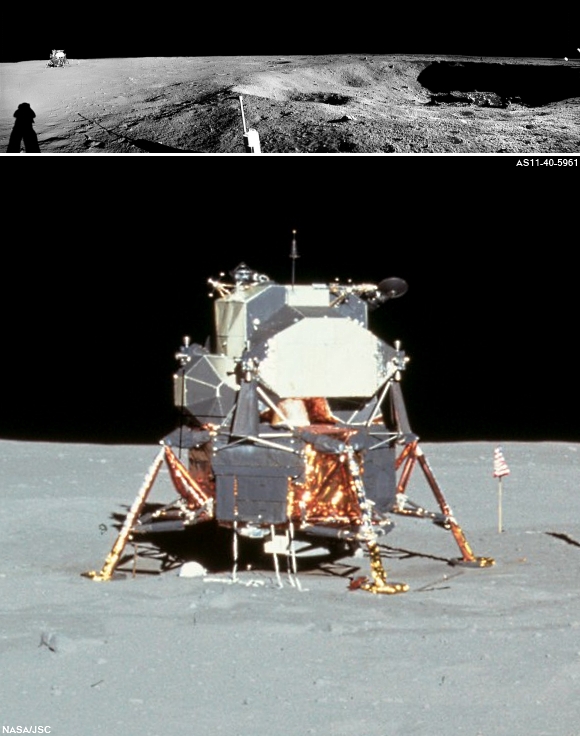
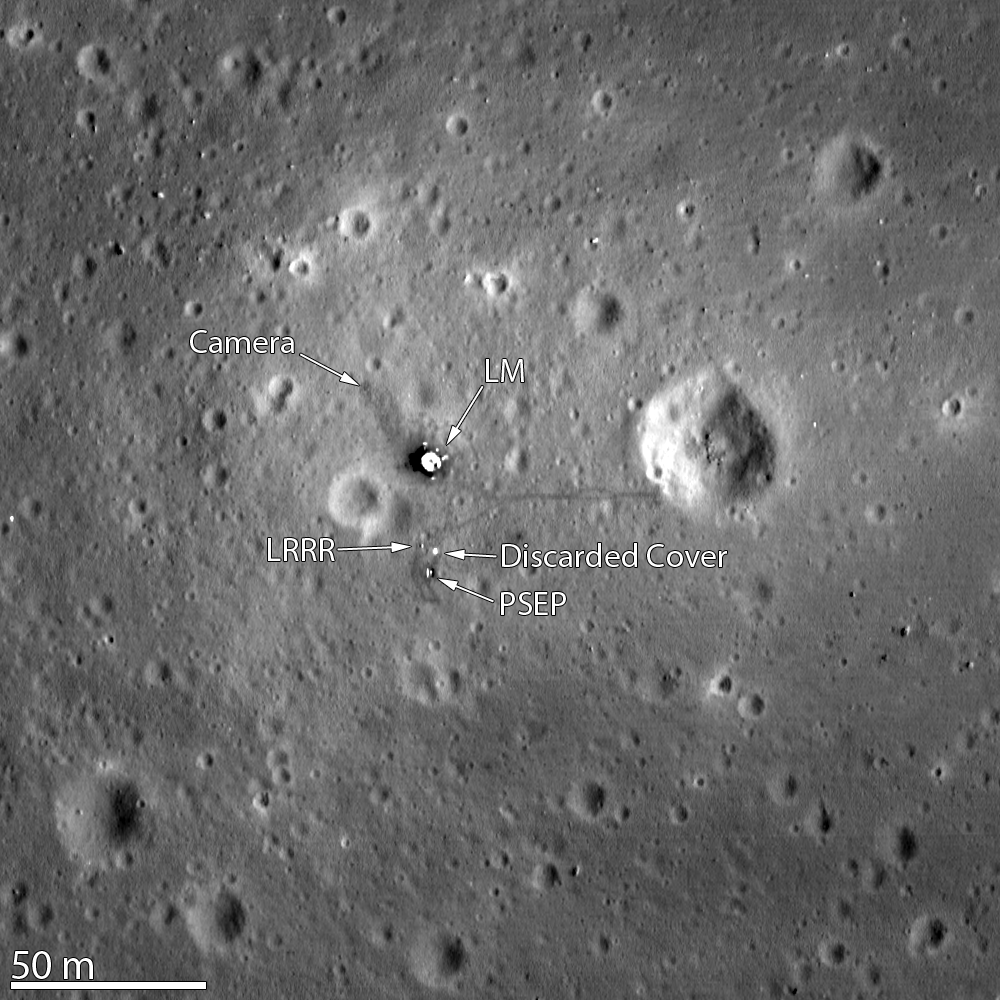
A Stark Beauty All Its Own, Apollo 11 from low altitude (~25km altitude), LROC's best look yet at the July 20, 1969 landing site (0.672°N, 23.483°E) in the southwestern corner of Mare Tranquillitatis - Remnants of Armstrong & Aldrin's historic first steps on the surface are clearly visible in darker paths around the Lunar Module Eagle Descent Stage, Lunar Ranging RetroReflector (LRRR) and Passive Seismic Experiment Package (PSEP) and Aldrin's short path behind the lander to the rim of Little West crater. LROC Narrow Angle Camera (NAC) observation M175124932R, LRO orbit 10,942, November 5, 2011; resolution 25 centimeters per pixel. View the wider field of view in the LROC Featured Image HERE  [NASA/GSFC/Arizona State University].
Mark Robinson
Principal Investigator
Lunar Reconnaissance Orbiter Camera (LROC)
Arizona State University

This image of the Apollo 11 landing site captured from just 24 km (15 miles) above the surface provides LRO's best look yet at humanity’s first venture to another world. When Neil Armstrong took his famous first steps onto the lunar surface, he kicked around the soil. “Yes, the surface is fine and powdery.” Gazing at the flat horizon, he took in the view. “Isn’t that something! Magnificent sight out here.” After collecting a contingency sample Neil looked around and observed, "it has a stark beauty all its own. It's like much of the high desert of the United States. It's different, but it's very pretty out here." A few minutes later Buzz Aldrin descended the ladder and joined Neil on the surface of the Moon!

You can see the remnants of their first steps as dark regions around the Lunar Module (LM) and in dark tracks that lead to the scientific experiments the astronauts set up on the surface. The Passive Seismic Experiment Package (PSEP) provided the first lunar seismic data, returning data for three weeks after the astronauts left, and the Laser Ranging RetroReflector (LRRR) allows precise measurements to be collected to this day. You can even spot the discarded cover of the LRRR.

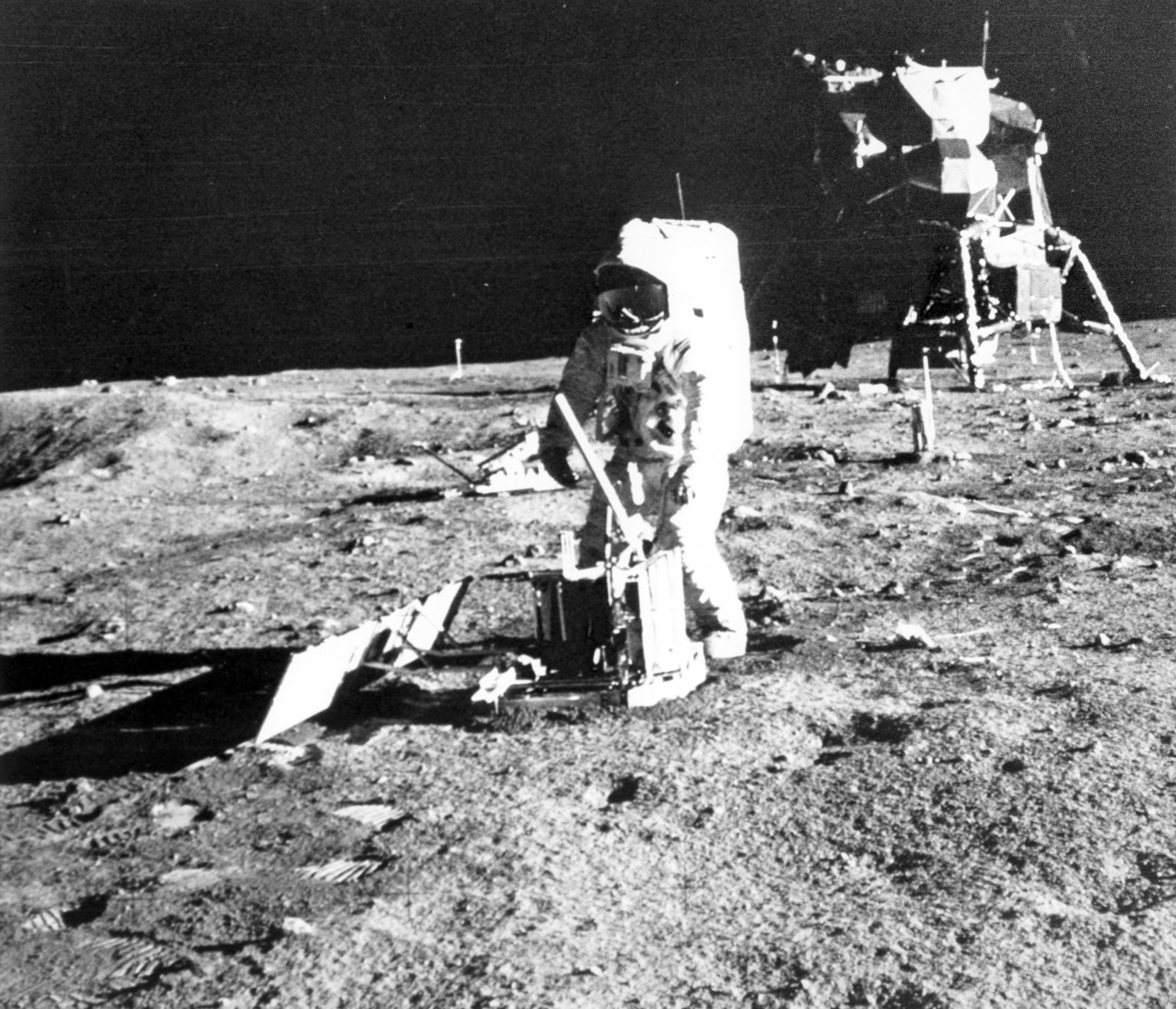
Aldrin deploys the solar array of the Passive Seismic Experiment Package (PSEP) at Mission Elapsed Time (MET) 111 hours, 6 minutes and 40 seconds, July 20, 1969. Behind him are other items noted in the LROC orbital close-up imaged 42 years later, including the lunar ranging retro-reflector (LRRR), Discarded Cover and television camera (AS11-40-5947) [Neil Armstrong/NASA JSC/ ALSJ].
Another trail leads toward Little West crater around 50 meters (164 feet) to the east of the LM. This was an unplanned excursion near the end of the two and a half hours spent on the surface. Armstrong ran over to get a look inside the crater, and this was the farthest either astronaut ventured from the landing site. Compared to Apollo 12 and 14, which allowed for more time on the surface, and Apollo 15, 16, and 17, which had the benefit of a Lunar Roving Vehicle, Armstrong and Aldrin's surface activities were quite restricted. Their tracks cover less area than a typical city block!

Full resolution detail from AS11-40-5961, part of a lunar surface "early-morning" down-sun panorama stitched from a series of photographs taken from the rim of Little West crater (MET 111:11:31). A very short Moon walk, the The entire area covered by Armstrong & Aldrin would fit in a standard basketball court [Neil Armstrong/NASA/ALSJ].
Not only was the landscape a place of "stark beauty", but also the source of rocks that revealed the Moon’s fiery past for the first time. The samples showed that the Apollo 11 landing site in Mare Tranquillitatis was once the site of volcanic activity, and the flat surface that afforded such an incredible vista was due to broad, thin flows of lava that flooded the region.

Check out past views of the Apollo 11 site at lower resolution (but complementary illumination angles):


Browse the full resolution NAC image HERE.

Wednesday, June 8, 2011

Spending time in the Apollo Surface Journal


Neil Armstrong and Buzz Aldrin, back in lunar orbit flying the ascent stage of the Apollo 11 lunar module, approach Michael Collins in the command module for their return to Earth, following the first manned expedition to the lunar surface in July 1969 [NASA/ASJ].

Saturday, August 28, 2010

Aldrin 'shares experience, strength and hope'

Buzz Aldrin, 80, whose autobiography "Return to Earth" following the first manned landing on the Moon in 1969 pioneered the removal of the public stigma once attached to alcoholism and depression, spoke about that struggle in Yakima, Washington, August 26 [Sara Gettys-Yakima-herald.com].


Ross Courtney
Yakima Herald-Republic

Buzz Aldrin applied the same patience and commitment he used to reach the moon to battle the depression he faced after returning.

The second man to walk on the moon was in Yakima on Thursday to give the keynote address at the 25th annual Merrill Scott Symposium on Alcoholism and Other Chemical Addictions.

Aldrin talked briefly with reporters in the lobby of the Hilton Garden Inn before speaking to about 450 people at the annual event, sponsored by the Sundown M Ranch chemical dependency treatment facility in Selah.

The 80-year-old former astronaut said he planned to share his personal story about the depression he suffered after returning from the historic 1969 moon landing with Neil Armstrong.

Aldrin said he struggled to cope with his sudden fame and lack of structure, after spending years in a meticulously structured environment during his astronaut training.

"The challenges that faced me were not going to the moon, but it was the aftermath of a tremendously changed lifestyle," he said.

Aldrin detailed many of his struggles -- which also included mental illness, alcoholism and a divorce -- in his 1973 book "Return to Earth."

Aldrin is one of the highest on a list of high-profile speakers to keynote the annual workshop, said Scott Munson, executive director of Sundown M Ranch.

Peter Yarrow of the folk trio Peter, Paul & Mary headlined last year. He, like many of the other speakers, related personal stories of addiction, Munson said.

With reporters Tuesday, Aldrin also shared a few strong opinions on the nation's current space endeavors.

He criticized plans to terminate the space shuttle program later this year with nothing to replace it, but does not believe the U.S. should send another man to the moon.

Read the full article, HERE.

Thursday, January 21, 2010

Aldrin is 80


Ian O'Neill
Discovery News

On July 20, 1969, Buzz Aldrin became the second man to set foot on the Moon, following mission commander Neil Armstrong. That historic moment was over 40 years ago. Today, Aldrin is celebrating another milestone, his 80th birthday.

Although the famous Apollo 11 mission was over four decades ago when NASA was in its infancy, Buzz continues to be very vocal in matters of human spaceflight. He is an outspoken critic of spaceflight policy and an expert in communicating all things space to the public.

INTERVIEW: Find out what Buzz had to say to Discovery News correspondent Irene Klotz during the Apollo 11 anniversary in July 2009.

Read the Interview HERE.

Friday, November 27, 2009

Aldrin calls Orion a step backwards

Doug Messier
Parabolic Arc

Buzz Aldrin writes that NASA is making a mistake by replacing the winged shuttle with smaller ocean-landing Orion:

"Two Shuttle accidents — each caused by NASA hubris — combined with a tight budget have caused NASA to retire the fleet. Understandable, I think. But in a move that truly makes no sense, they will be replaced by…the space capsules we long ago outgrew. And to save even more money, these cannon-ball-like capsules would land once again in the ocean, not on dry land. To recover Orion will require deployment of ships in several landing zones. How much will that cost? Much of the Orion will be expendable, such as the heat shield. It seems we have decided to throw away our Shuttle experience and go “back to the future”.

Wednesday, November 18, 2009

Aldrin urges Brazil to invest in Space

Rio De Janeiro (AFP) — The second man to set foot on the moon, Buzz Aldrin, urged Brazil to start investing in manned space flights if it doesn't want to miss out on huge economic potential.

It would be an "unforgivable mistake" if a country in full development like Brazil failed to plan for its future in space, Aldrin, 69 told Globo.com in a telephone interview Tuesday shortly after arriving here for a visit with his wife.

Aldrin said human space flight holds enormous potential, and Brazil should put its money into beneficial ventures such as monitoring its jungles and climate from space.

The rest of the story, HERE.

Wednesday, October 14, 2009

Aldrin: World should build Moonbase


Noted al.com space sciences reporter Shelby G. Spires has noted an entry in the HuffingtonPost.com blog credited to Buzz Aldrin. The lunar module pilot for Apollo 11, second man to walk on the Moon writes, "Instead of duplicating -- at great cost and effort -- the lunar competition that Neil Armstrong, Mike Collins and I won more than four decades ago last summer, I propose instead America call the world to the Moon. In a new global effort to use the Moon to establish a global space consortium with a lunar surface facility as its epicenter, America can gain new leadership, international respect, and technological progress by collaborating with emerging space powers, not merely competing with them."

Read the full entry by Aldrin, HERE.

Wednesday, August 19, 2009

Aldrin to accept Farmsworth Emmy

Buzz Aldrin, lunar module pilot on Apollo 11, will accept the Philo T. Farnsworth Emmy award, August 22. The special engineering achievement Emmy award, named after the man many credit for developing the analog television technology used in the United States from 1939 to 2009, is given for outstanding achievement on the technical side of television, ahead of the more popular entertainment ceremony, Sept. 20.

Read the Story HERE.

Saturday, August 8, 2009

Shooting for More Moon Travel

Senator, Astronaut and NASA Advisory Council Chair Harrison Schmitt on "A Trip to the Moon," Pardee Center Conference, (Boston University, April 12, 2007)

Geologist and former U.S. Senator from New Mexico Dr. Harrison H. "Jack" Schmitt, former chairman of NASA's Advisory Council and a Director of Orbital Sciences Corporation, wrote to the Washington Post, July 30, and respectfully differed with the U.S. Space Policy direction strongly advocated by fellow Apollo veteran and lunar module pilot Dr. Buzz Aldrin.

(Full Disclosure: Dr. Schmitt's position on these matters, like that of lunar and planetary scientist Paul Spudis posted below, is essentially the same as Lunar Pioneer, sponsor of the Lunar Networks blog.)

My fellow Apollo astronaut and lunar module pilot, Buzz Aldrin, favors Mars over the moon ["Time to Boldly Go Once More," op-ed, July 16]. His vision for space policy, however, requires clear thinking instead of just "bold thinking," and Mr. Aldrin missed on several points.

The moon is hardly a "dead end." If that were true, China and other countries would not be so interested. Rather than being "a poor location for homesteading," the moon is ideal for that purpose. Its soils provide resources necessary to support settlements, including an economic base of exports of helium-3 as a potential fusion fuel.

The fact that the "moon is a lifeless, barren world" means that it is the only place with a scientific record of the early history of the solar system.

Returning to the moon gives the fastest path to Mars. Without lunar water resources, radiation protection may not be feasible. Without lunar operational experience, risk on early Martian flights greatly increases.

Without lunar oxygen and water, payloads to Mars may be prohibitively large. Without lunar rocket fuel resources, we might not be able to even land on Mars.

Mr. Aldrin stands correct on one thing: Geologists need to be aboard the first flights to Mars.

HARRISON H. SCHMITT
Director
Orbital Sciences Corp.
Albuquerque

The writer was a U.S. senator from New Mexico from 1977 to 1983 and was the last man to set foot on the moon as Apollo 17's geologist.

Saturday, June 27, 2009

Buzz Aldrin's candor has saved many lives

Colonel Edwin E. "Buzz" Aldrin, Jr. (USAF, Ret.), Apollo 11 lunar module pilot and second to set foot on the Moon, wanted to be first.

He and Dr. Neil Armstrong share the distinction, of course, of being first to land on the Moon but Buzz Aldrin still thinks the tradition of a junior officer going ashore ahead of a mission commander ought to have been followed on that precedence-setting mission. He clearly holds no grudge, however. He's just remarkably honest about his feelings of the protocol he still believes ought to have been followed on that first trip to the lunar surface.

And this lack of resentment may be a key to understanding much about Colonel Aldrin. His attitude clearly follows the traditions of Alcoholics Anonymous, those that were recommended by that organization's co-founder Bill Wilson, "neither to dwell upon the past nor shut the door entirely" on an A.A. member's personal experiences" as integral to a lifestyle of recovery, one requiring "rigorous honesty."

There are still some members of A.A., however, ones hold fast to A.A.'s Twelve Traditions and who will argue to this very day about Buzz Aldrin's appearance at a "controversial" press conference that featured celebrities who tested the envelope of those tradition by going public about their recovery. There are some A.A. members who insist this violated their Program's tradition of Anonymity.

It's a fine line, perhaps as fine an edge as repeated "601" alarms sounding clarion calls from a remedial flight computer, overloaded with information as Neil Armstrong and Buzz Aldrin and the computer monitored the parameters of the first landing of a lunar module anywhere, let alone the Sea of Tranquility.

Anonymity is the name of the game, the name taken from the Big Book after which the Program, itself, was named, in 1935. Those who don't take the precepts seriously, as a matter of life or death, don't belong in the Program. Anonymity is encouraged, in the canon of A.A. to protect the reputation of the Program. The same protection it affords to its Membership is an added benefit only.

Aldrin, actor and comedian Dick Van Dyke, and many others attended this well-publicized press appearance highly aware of this interpretation of an important A.A. tradition. Each of those who came forth were respected individuals who led very public lives. They were careful not to mentioned A.A. when they went public about their alcoholism. Still, there was little question that it was within A.A. where each of those present had found each other and found a working method to follow for recovery.

Since July 1969, Neil Armstrong's well-known reticence clearly contrasted with Colonel Aldrin's openness, a willingness to talk with just about anyone at any time about nearly anything, and this continues to this very day as the Colonel makes almost daily public appearances and travels during these days heading up to the 40th anniversary of that first landing on the Moon on July 20.

Colonel Aldrin looks remarkably fit for a man 79 years old. He has a new autobiography in print, with a title taken from his own first words he spoke after following Neil Armstrong out onto the lunar surface.

"Magnificent Desolation."

Aldrin's personal ordeal upon his return to Earth, clinical depression and alcoholism became the central them of his autobiography, appropriately entitled "Return to Earth," an inspirational best seller published in 1973.

As controversial as his public affirmation about his difficulties was, for only a brief time within the far flung meetings of millions of members of A.A. ultimately did nothing to threaten the reputation of A.A., primarily because both he and Dick Van Dyke stayed sober and both still "share experience, strength and hope" with countless others searching for survival as they suffer from what was once considered completely hopeless.

The fact there is today such little stigma associated with the admission and, more importantly, the acceptance of alcoholism is something else our civilization owes to Colonel Aldrin, as much as the similar earlier public declarations made by former First Lady Betty Ford, Van Dyke and many others who challenged public perceptions of what a person who attends A.A. meeting looks like.

A great many people owe Colonel Aldrin their lives. Even if I am not in accord with his vision of putting Mars ahead of unfinished business on Earth's Moon, I will never forget the fact that I owe him my life just as surely as if he had saved me from drowning.

Wednesday, June 24, 2009

Snoop Dogg & Master Buzz

Explains Hip-Hop Stance in Hong Kong Photo Op, where Buzz Flings Bling

Veteran Rap personality Snoop Doggy Dogg & Edwin M. "Buzz" Aldrin, who teamed with Dr. Neil Armstrong 40 years ago on-board Apollo 11, have joined east and west coast with Deep Space, pulling gig "Rocket Experience" -- Original Symbol of MTV in MTV News.

What Buzz Aldrin was doing in Hong Kong

The Hong Kong Space Museum saw a massive surge in traffic this weekend as over 10,000 people visited the "Beyond Time" exhibition by the Museum and OMEGA during a three-day run that ended Sunday, June 21. "Beyond Time," held in celebration of the 40th anniversary of the Moon Landing, featured a collection of space travel equipment and memorabilia such as a space suit, cameras, flight plans, and a range of OMEGA Speedmaster watches, the only watch approved by NASA for manned space missions.

In the accompanying photograph, Aldrin proudly shows off a watch on both wrists, though some commented it was a new pose in practice for the former astronaut's new joint project with Rapper Snoop Doggy Dogg.

Highlighting the event, Dr. Aldrin and NASA Aerospace Engineer James H. Ragan engaged in a 20-minute Q&A session with nine Hong Kong space enthusiasts.

Miss Jenny Lee Cheuk Wing, a six-year-old primary student who won the Science Fantasy Drawing category in the Hong Kong Youth Science Technology & Invention Competition 08-09, asked Aldrin, "If you could go to the moon again, who would you like to travel with, and why?" Aldrin responded that his choice would be his wife of more than 20 years, Lois, before adding, "But I think I would forfeit my seat to you, and I hope you would choose a very fine person to go with you."

Two secondary school students representing the 1990s, Lau Tak Kin and Lau Tak Shing, who won multiple local and international awards for their invention of the "miracle anti-bump lock", asked Mr. Aldrin what kind of difficulties he had walking on the Moon. Aldrin replied that stepping down from the ladder and getting back up was more difficult than he anticipated due to the distance between the last rung and the lunar surface. "I thought it would be easy, but it wasn't. It was hard, and I missed, and I had to try again. And I was so disappointed that I had not succeeded in the first thing I needed to do!"

Dennis Huen, a scientist and Vice-Chairman of the Hong Kong Science Talent Society who was representing the 1980s, asked Mr. Ragan why NASA decided astronauts needed their own wristwatch and chronograph in space and on the Moon. Ragan, who led the chronograph testing for NASA, responded that NASA determined it was a "requirement for helping astronauts get to the Moon." He then added that after putting a range of off-the-shelf chronographs through a rigorous battery of tests, the OMEGA Speedmaster was the only one to pass, with the added benefit of needing no additional modifications.

Hong Kong University of Science and Technology Professor Chan Kwing Lam, a former NASA researcher who has also advised the Chinese space program and representing the 1940s, asked the final question, "Do you think that space exploration can one day help unite humankind?" Aldrin replied, "I think there is something special about space ... up there is great hope." He concluded that the leader of any nation embarking upon space exploration would be "very kindly remembered by history."

Following the launch event, the exhibition was immediately opened to the public, resulting in a steady flow of museum-goers and photographers for the remainder of the weekend.

Monday, June 8, 2009

An untold story of Apollo 11: The Silicon Disk

The silicon disk that almost wasn't left behind
on the lunar surface by Buzz Aldrin

Forty years ago, the Apollo 11 astronauts were completing their checklist to leave the Moon when they discovered that they had forgotten something. Buzz Aldrin had already climbed back into the lunar module, Eagle, when Armstrong reminded him about a small package that contained encrypted messages on a tiny disc. Aldrin quickly remembered that he had it in his sleeve pocket, removed it, and threw it onto the Moon's Sea of Tranquility.

The astronauts left the Stars and Stripes, a plaque declaring "We Came in Peace for All Mankind," and a tiny silicon disc with goodwill messages in native languages from world leaders. As U.S. State Department officials scrambled to solicit messages of goodwill from many nations, engineers used the latest technology in 1969 to enshrine the messages on material suitable for the harsh lunar environment. NASA officials also wanted to make it clear that this was an American accomplishment while balancing "good taste" from a world perspective, without implying U.S. sovereignty on the Moon.

One such message from Ivory Coast stated: "I also hope that he would tell the Moon how beautiful it is when it illuminates the nights of the Ivory Coast. I especially wish that he would turn towards our planet Earth and cry out how insignificant the problems which torture men are, when viewed from up there."

Another message from Eric Williams of Trinidad and Tobago warned: "It is our earnest hope for mankind, that while we gain the Moon, we shall not lose the world."

These are some of the topics that are explored in the acclaimed book "We Came in Peace for all Mankind: The Untold Story of the Apollo 11 Silicon Disc" by Tahir Rahman. Rahman reveals the messages from leaders such as Pope Paul VI, Indira Gandhi, and the Shah of Iran that are enshrined on the disc.

In a recent interview, Buzz Aldrin stated, "Neil Armstrong and I almost forgot to leave the silicon disc on the Moon, but no one should forget the messages beautifully portrayed in Rahman's book 'We Came in Peace for All Mankind.' The disc will last on the lunar surface for 1000 years."

For more information, email info@silicondisc.com. Rahman's book is available at Barnes and Noble, Amazon and the Smithsonian. - Source: Silicon Disk, LLC

Friday, June 5, 2009

Hackers leave lunar lander on MIT Dome


Photo by Eric D. Schmiedl—The Tech
Hackers placed a half-scale model of the Apollo 11 “Eagle” Lunar Module on top of the Great Dome on May 17, in advance of the 40th Anniversary of the historic Apollo 11 moon landing.

"After Facilities staff removed the lander, hackers bequeathed it to the Department of Aeronautics and Astronautics as a prop for events celebrating the upcoming 40th anniversary of the Apollo 11 lunar landing, said David M. Barber, MIT’s hack-removal czar.

The donation came after Edwin “Buzz” Aldrin, Jr. ScD ’63 saw the hack and mentioned to the department that he liked it, Barber said.

Barber said he didn’t know of any other hacks that had ever been given to an MIT department. Many are donated to the MIT Museum."

The Article is HERE.

Thursday, June 4, 2009

Buzz Aldrin promotes Speedmaster Moonwatch

From Pain Pill Prison
Irving DeJohn - New York Daily News

It's been 40 years since Buzz Aldrin followed Neil Armstrong's one small step off Apollo 11 - and not every memory from the historic lunar landing is fond.

"It's not a very pleasant place to set up housekeeping," the legendary astronaut joked Wednesday in a visit to New York.

There was a rank reality to those romantic, grainy images from video archives.

"It got pretty dusty, pretty smelly and by the time they came back they were pretty tired and hungry," he said of man's first footsteps on the moon.

The July 20, 1969 landing forever linked Aldrin and Armstrong the planet's storied space history.

But Aldrin, 79, admits the two haven't spoken in years.

"I'm an egg head from MIT with combat experience," said Aldrin. Aldrin said his Air Force background conflicted with Armstrong's Navy roots - and the differences made them "not always all that compatible."

He insists there's no grudge that Armstrong got to step off the lunar module first.

"I'm not jealous of anybody else, why should I be?" he said.

Aldrin was in town Wednesday to donate a watch for display at the Omega flagship store at 711 Fifth Ave. Aldrin wore an Omega similar to the one he donated when he stepped onto the moon.

Reflecting on his achievements, the humble hero noted that he attributes some of his success to sheer luck.

"It's not always the best person selected; you just happen to be in the right place at the right time," he told reporters.

Monday, June 1, 2009

Iconography, in a handbag

They are only human, after all. Talented Talent, and it is a reminder marketing and those who market are talented people, also. People in politics who are smart, admittedly rare though they may be, catch on to the fact and depart from orthodoxy, sooner or later. Business is about survival not discretionary spending. Even if you make handbags, the product may be a discretionary item for the consumer but sales must be a recurring thing if you are to survive.

Entertainment, not information, is the coin of the realm.

Heads up WSJ Speakeasy