![]() |
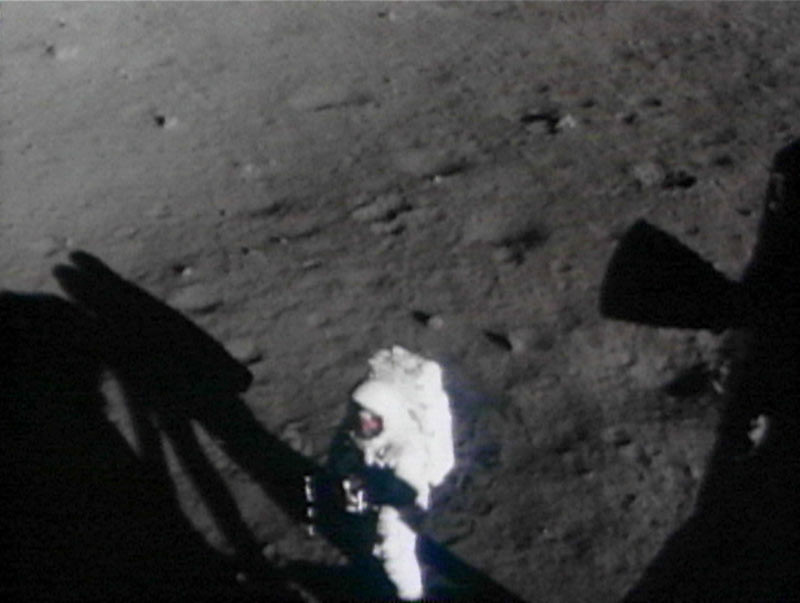
| Still from the Apollo 11 16mm DAC film camera shows Armstrong (with visor up) taking his initial, halting steps out onto Mare Tranquillitatis, still tethered to the spacecraft. |
Sunday, February 8, 2015
Armstrong's treasure of Apollo 11 artifacts found
Saturday, January 5, 2013
Armstrong did not lie about 'one small step'
The controversy stems from a comment made by Armstrong’s brother Dean, who says in the film that Neil shared his famous "one small step" quotation with him shortly before the mission. The problem, in some people’s minds, is that this seems to conflict with Neil’s own statements over the last 40 years about when and where he composed what became an immortal sentence when he took his first step onto the moon. So let's look at the facts.
Friday, September 14, 2012
Replay of Armstrong rites at National Cathedral
![]() | ||
| Neil Armstrong, the first man on the lunar surface, passed away August 25. His remains were interred at sea after private memorials in his native Ohio earlier this month. On Thursday morning, September 13, Dr. Armstrong's family, his fellow astronauts along with notables in American government attended a state memorial conducted at the National Cathedral in Washington. C-SPAN in the United States broadcast the service live, and they have scheduled re-plays of that coverage through the weekend and in days following. The entire service is now available on-line HERE, together with past interviews with Dr. Armstrong and other relevant information. The re-play runs 1 hour and 19 minutes. |
Tuesday, August 28, 2012
Passing of an Era
Paul Spudis
Smithsonian Air & Space
Because of his flying career and the life that he led, Neil Armstrong’s passing has many recounting his place in the history of spaceflight and remembering a life well lived. He holds a special place in our hearts and a unique place in history – and he always will.
I met Neil Armstrong at a conference, an encounter I won’t forget. A quiet, unassuming man of medium height and build, pleasant and genial, surrounded by a horde of admirers and well-wishers, I could tell he was slightly uncomfortable with (but resigned to) the adulation he received. In his mind, the 1969 flight of Apollo 11 was simply another professional assignment he flew as a test pilot – the landing on the Moon was of more significance than his first step on it. He was an aviator, in every sense of that word. The landing was an accomplishment for humanity – a giant step for mankind.
My glimpses of Neil come not from personal encounters with him, but from others who knew him. During a discussion several years ago with Dave Scott (Apollo astronaut and Commander of the 1971 Apollo 15 mission), I inquired about an obscure incident during the 1966 flight of Gemini 8 (flown by Neil and Dave). That mission conducted the first docking of two spacecraft in space and I wanted to know some details of the emergency experienced by the crew on that flight.
The incident had occurred shortly after the docking, when the Gemini-Agena spacecraft began to roll slightly. The rate of rotation became greater with time and it was evident that something was very wrong. Neil, as commander, was responsible for “flying” the spacecraft but couldn’t get the rolling under control. Thinking that the Agena (their unmanned target vehicle) was responsible, the crew made the decision to undock from it (they were out of contact with Mission Control at the time). As soon as they did, the Gemini spacecraft started to roll and tumble at an ever increasing and alarming rate. Dave recalled with a chuckle that Neil looked over at him, pointed at the attitude control stick and said “See if you can do anything with it!” Dave’s recollection of their exchange gave me a glimpse of a very human moment in a life and death situation. This was serious – if they couldn’t regain control, they would black out from the centrifugal forces in the tumbling vehicle. Neil kept his cool, activated the re-entry thrusters and soon stabilized the bucking Gemini spacecraft. The solution saved their lives but ended the mission, sending them home prematurely but safely.
The story of the first lunar landing is well known. The automatic systems of the Apollo 11 Lunar Module Eagle were targeting the vehicle into a large crater filled with automobile-sized boulders. Landing there would be disastrous, as the LM would likely topple over on touchdown, eliminating the crew’s ability to liftoff from the Moon and return home. Taking manual control, Neil (with Mission Control advising the crew they had thirty seconds of fuel left) guided the LM over the hazardous debris field to a safe touchdown a few hundred meters beyond the original landing site. Tension during the agonizingly long pause in the air-to-ground communications was palpable. Relief could be heard in Capcom Charlie Duke’s voice as Neil calmly announced that the Eagle had landed. Yet again, a critical situation expertly handled by a test pilot just doing his job – the calm and collected decision making necessary when flying finicky machines near the edges of their performance envelopes.
Neil’s scientific work on the Moon during his EVA warrants special mention. Being the first humans to land on another world, it is understandable that the crew had many ceremonial duties to perform. Although they had been carefully instructed to stay close to the LM, without informing Mission Control, Neil walked back a hundred meters or so to Little West crater (overflown earlier) to examine and photograph its interior. Those photos showed the basaltic bedrock of Tranquility Base – documenting that the Eagle had landed amidst ejecta from that crater thereby establishing the provenance of samples collected during the crew’s limited time on the surface. According to Gene Shoemaker and Gordon Swann, both of the U.S. Geological Survey, Neil was one of the best students of geology among the Apollo astronauts. Through his work on the Moon, he showed an ability beyond mere mastery of the facts of geology – he intuitively grasped its objectives, as well as the philosophy of the science. Like every other facet of the mission, Neil understood and took this role seriously. No matter what topic was addressed or which role was taken, he could always be counted on to turn in his best performance.
Armstrong understood the historic role of being the first man on the Moon but he never succumbed to the siren call of fame. He could have cashed in on his status but choose a different path. He was the quintessence of quiet dignity, possessing the “Aw shucks, t’weren’t nothin’” Gary Cooper-ish manner of understated heroism. After retirement, he lived happily in his home state of Ohio, taught aeronautics (his first love) at the University of Cincinnati, and advised on various engineering topics and problems for both government and industry. Throughout NASA’s post-Apollo efforts – without fanfare – he often and freely lent his efforts to the space program. He served his country with honor and dignity.
As a test pilot, Neil routinely showed his ability to make quick, life saving decisions in dangerous situations. As a senior spokesman for space, he clearly voiced his concern over the dismantling and destruction of our national space program. Neil understood that our civil space program is a critical national asset, both as a technology innovator and a source of inspiration for the public. Who would recognize this more clearly than Neil Armstrong? From long experience, he knew what kinds of government programs worked and what kind didn’t. He knew his fellow man. In appearances before Congress in recent years, he outlined specific objections to our current direction in space. A true patriot, Neil did not hesitate to voice his opinions, whether they aligned with current policy or not.
It’s become cliché to say that Neil Armstrong holds a unique place in history. On this occasion, we should pause to consider just how singular his place is. No one – not the first human to Mars nor the first crew to venture beyond the Solar System – will ever achieve the same level of significance as the first human to step onto the surface of another world. The flight of Apollo 11 was truly a once in a lifetime event – and by that, I mean in the lifetime of humanity. That first step was indeed one to “divide history,” as the NASA Public Affairs Office put it at the time.
Goodbye, Neil Armstrong – and thank you. We’ve lost one of our most authoritative and articulate spokesmen for human spaceflight. I mourn him and share his valid concerns for our dysfunctional national space program.
"Houston, Tranquility base here."
![]() |
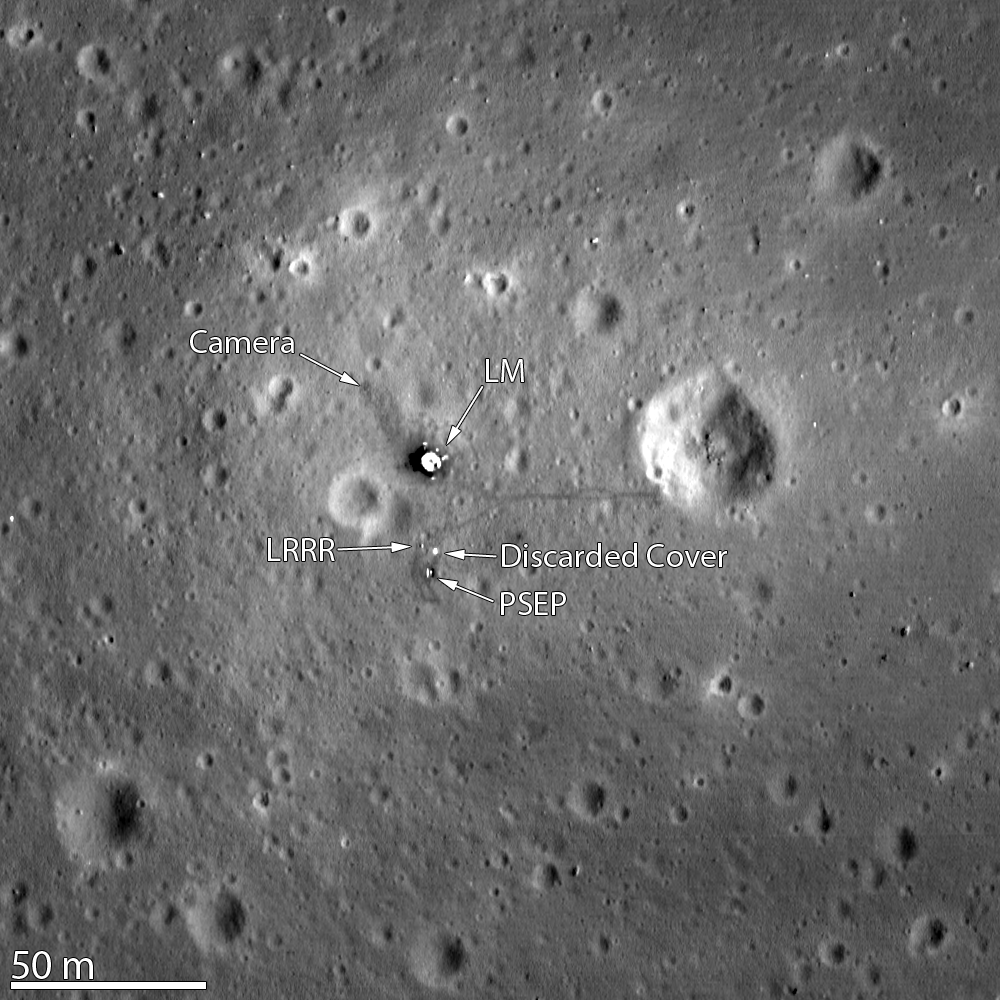
| Apollo 11 landing site, as Armstrong and Aldrin left it some 43 years ago, LROC Narrow Angle Camera (NAC) observation M175124932R , LRO orbit 10942, November 5, 2011; angle of incidence 40.98° at 40 cm per pixel resolution from an altitude of 24 kilometers [NASA/GSFC/Arizona State University]. |
Principal Investigator
Lunar Reconnaissance Orbiter Camera
Arizona State University
"Houston, Tranquility base here. The Eagle has landed."
With those words Neil Armstrong let the world know that the Apollo 11 lunar module Eagle had set down safely on the surface of the Moon (20 July 1969). They did it! A nearly impossible task, yet there they were, starkly alone, but in a real sense in front of millions of people back on Earth. Only ten other humans would follow Neil Armstrong and Buzz Aldrin to the lunar surface over the next three years. We have not been back since.
![]() |
| First picture from the surface! First picture taken by a human being on another world. View out the lunar module left window, taken by Armstrong shortly after landing. One of the LM thrusters protrudes into the image at the bottom, scattered light from the Sun appears in the upper left, AS11-37-5449 [NASA]. |
![]() |
| Armstrong collects contingency sample - Armstrong collecting a contingency sample with a specially prepared scoop on a stick. Frame grab from Johnson Space Center digital scan of 16-mm film [NASA]. |
![]() |
| Armstrong stowing sample - Armstrong stowing contingency sample. Frame grab from Johnson Space Center digital scan of 16-mm film [NASA]. |
| American flag goes up! Armstrong and Aldrin deploying the American flag. Frame grab from Johnson Space Center digital scan of 16-mm film [NASA]. |
Listen to noted author Andrew Chaikin recall his conversations with Neil Armstrong.
Jump to the NAC frame showing Tranquility base. Scroll through all the LROC images of this historic site.
Previous Apollo 11 LROC Featured Images:
LROC's First Look at the Apollo Landing Sites
Apollo 11: Second Look
High Noon at Tranquility Base
A Stark Beauty All Its Own
Thursday, March 8, 2012
LROC's Closest look yet at Tranquillity Base
![]() |
| A Stark Beauty All Its Own, Apollo 11 from low altitude (~25km altitude), LROC's best look yet at the July 20, 1969 landing site (0.672°N, 23.483°E) in the southwestern corner of Mare Tranquillitatis - Remnants of Armstrong & Aldrin's historic first steps on the surface are clearly visible in darker paths around the Lunar Module Eagle Descent Stage, Lunar Ranging RetroReflector (LRRR) and Passive Seismic Experiment Package (PSEP) and Aldrin's short path behind the lander to the rim of Little West crater. LROC Narrow Angle Camera (NAC) observation M175124932R, LRO orbit 10,942, November 5, 2011; resolution 25 centimeters per pixel. View the wider field of view in the LROC Featured Image HERE [NASA/GSFC/Arizona State University]. |
Principal Investigator
Lunar Reconnaissance Orbiter Camera (LROC)
Arizona State University
![]() |
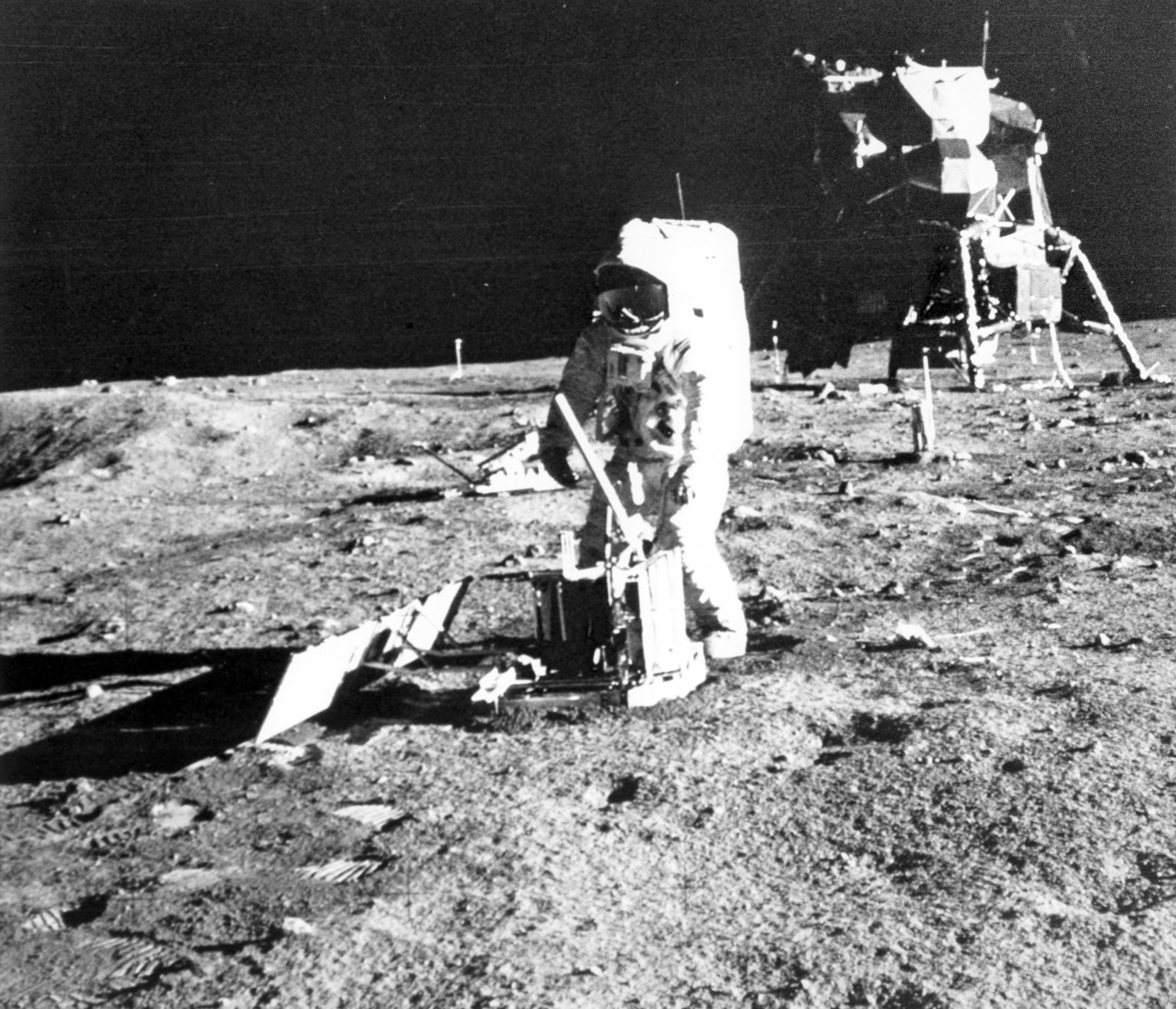
| Aldrin deploys the solar array of the Passive Seismic Experiment Package (PSEP) at Mission Elapsed Time (MET) 111 hours, 6 minutes and 40 seconds, July 20, 1969. Behind him are other items noted in the LROC orbital close-up imaged 42 years later, including the lunar ranging retro-reflector (LRRR), Discarded Cover and television camera (AS11-40-5947) [Neil Armstrong/NASA JSC/ ALSJ]. |
![]() |
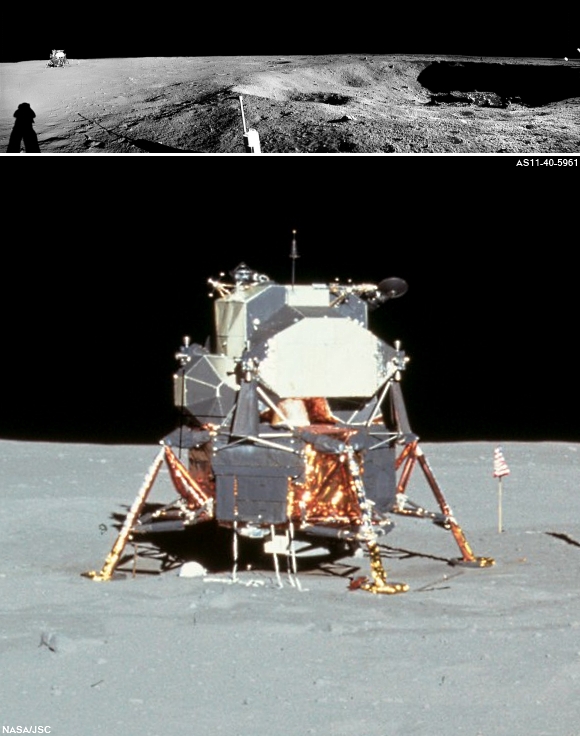
| Full resolution detail from AS11-40-5961, part of a lunar surface "early-morning" down-sun panorama stitched from a series of photographs taken from the rim of Little West crater (MET 111:11:31). A very short Moon walk, the The entire area covered by Armstrong & Aldrin would fit in a standard basketball court [Neil Armstrong/NASA/ALSJ]. |
Wednesday, June 8, 2011
Spending time in the Apollo Surface Journal
Thursday, August 5, 2010
Happy 80th Birthday, Dr. Armstrong
Andrew Sumereau
American Thinker
For over half of his life now, Neil Armstrong has gracefully enjoyed and endured the appellation "First Man on the Moon." And, although his popularity is currently way below the likes of Lady Gaga (whoever that is), it can be reasonably argued that over the next millennia, when the history of the Twentieth Century is written, his name will stand out over all others. When the Obamas, Stalins, and Churchills have gone the way of just so many Caesars and Pharaohs of old, when the great movements and wars are forgotten, Neil Armstrong's name will live on, not for who he was, but for what he did. And, as with so many of the great, his attributes will probably be appreciated far more after he is gone.
A son of an Ohio state government worker, Armstrong enjoyed a comfortable small-town Depression upbringing distinguished only by an unusual passion for flight. He took to flying at a young age, earning his pilot's license at sixteen, he joined the Navy, and flew Panther jets from aircraft carriers by the time he was twenty. A member of the famous "Screaming Eagles" all-jet Fighter Squadron 51, he flew hazardous combat missions over North Korea and China. Armstrong was one of the few to make over 100 carrier landings, his squadron's exploits were later dramatized from the work by James Michener in the feature starring William Holden, "The Bridges at Toko-Ri (1954).
Returning to Purdue University after Korea to finish his degree in aeronautical engineering in 1955, civilian Armstrong was recruited to pilot and test the newly developed experimental rockets and jets at Edwards in California. Contemporary of the celebrated and colorful Chuck Yeager, test pilot Armstrong set records for speed and altitude with a quiet workman-like demeanor that was to characterize his entire professional life. Brushing the edge of space at 63.25 km altitude, in the X-15 experimental hypersonic spacecraft, Armstrong tested the limits of aerodynamics over the western desert just as Sputnik was rocking the scientific (and political) world.
Assigned to the now largely forgotten Dyna-Soar project, which developed airplane-like space vehicles and competed with early NASA rocketry like that used in Project Mercury, Armstrong remained active and busy as "pilot-engineer" while the space race heated up. To the surprise of many of his friends and co-workers, he applied for the second group of openings for NASA's growing astronaut corps in 1962, after Kennedy's call for a moon landing "before the decade was out." Selected as the very first civilian astronaut, he trained with the extraordinary group of nine men who joined the legendary "Right Stuff" Original Seven astronauts; men of the highest caliber, (names every schoolchild should know, but alas, does not,) -intelligent, educated, fearless, and destined for challenges of the highest order, triumphs, disasters and death: Lovell, White, Borman, Conrad, Young, See, Stafford, and McDivitt.
Named commander of Gemini VIII, Armstrong gained repute for his coolness under pressure when his malfunctioning capsule began turning end-over-end at a sickeningly and dangerously fast rate after the first successful docking of spacecraft in orbit. Aborting the mission after bringing the spacecraft to safety, a depressed Armstrong dismissed any hint that his actions were heroic, regretting the missed opportunities, focused as he was on the mission and the consequences to Project Gemini and its follow-up, Project Apollo.
Of the moon mission, and the drama over landing at Tranquility Base, as Buzz Aldrin coolly counted down the fuel readings while Armstrong piloted the Lunar Module over boulders and craters, more is known. The entire world watched as history unfolded that July night in 1969; the dramatic landing, the other-worldly television show, the snowy black and white picture revealing two Americans bouncing along the lunar surface and speaking to Nixon via telephone. The nation, the world, was thrilled and inspired, and then, as always, moved on to the ephemeral and mundane, and, ultimately, forgot.
After the ticker-tape parades and banquets and public honors across the globe, Armstrong moved on to what many consider the most exemplary part of his life. For the unique contribution of the first man on the moon may not lie in his courage or his resourcefulness or his patriotism, but rather in his bearing and dignity over forty plus years of exposure and fame.
In 1971, after retiring from NASA, Armstrong began teaching Aerospace Engineering at the University of Cincinnati. He avoided offers from many businesses to act as spokesman until Chrysler, in financial difficulties and backed by a loan from the federal government, successfully approached him to advertise its renewed commitment to automotive engineering excellence. Subsequently, he quietly served on the boards of several companies, and was asked to serve on the Rogers Commission investigating the Challenger Shuttle disaster in 1986. Much of his time has been spent avoiding the spotlight and preserving his name, image and reputation.
In his private life he has known great happiness and great struggle. Losing his two-year old daughter to a rare brain cancer in 1961, and divorcing his wife after 38 years of marriage, the trials of his profession have left scars. "Most of my adult life," he said, "has been spent saying goodbye to friends and colleagues." He suffered a heart attack in 1991 and recovered to find a new bride in 1994. "Retired" in 2002, Armstrong celebrates his 80th birthday today.
Perhaps the modern world, and especially modern America, enjoys creating celebrities and heroes out of nothing almost as much as tearing them down. A man like Neil Armstrong, a hero of deeds and courage and character, stands out as a rarity to say the least. How lucky we are that the person chosen by fate to be the first to walk on the moon was such a man.
Saturday, May 15, 2010
Apollo Astronauts: Future of Human Space Flight
United States Senate
Committee Commerce, Science and Transportation
Dr. Neil Armstrong, Captain Eugene Cernan & Hon. Norm Augustine
May 12, 2010
Monday, March 15, 2010
Dr. Armstrong visits Intrepid Air & Space Museum
Neil Armstrong was a speaker at 'Legends of Aerospace' at the Intrepid Sea-Air-Space Museum.Talk about star power.
The Intrepid Sea-Air-Space Museum seized on a visit by the first man on the moon Sunday to ramp up its bid to bring a space shuttle to New York.
The museum collected signatures for a petition in favor of bringing a shuttle to the Intrepid from the hundreds of schoolkids and their parents who showed up for a talk by Neil Armstrong.
Wednesday, October 14, 2009
Aldrin: World should build Moonbase

Friday, July 10, 2009
Why Dr. Armstrong is still elusive hero
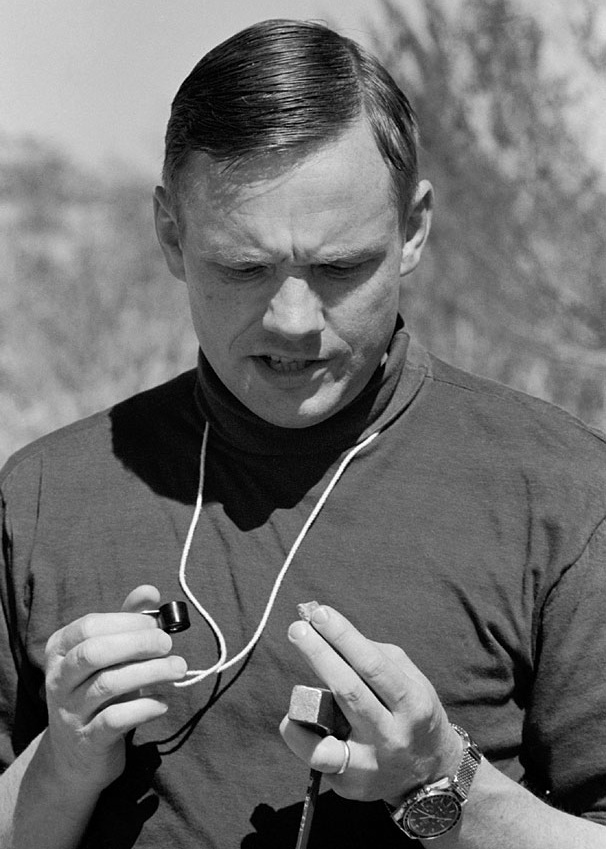
Dr. Neil Armstong, cmdr., Apollo 11 andfirst human to walk on the lunar surface
Monday, June 8, 2009
An untold story of Apollo 11: The Silicon Disk
The astronauts left the Stars and Stripes, a plaque declaring "We Came in Peace for All Mankind," and a tiny silicon disc with goodwill messages in native languages from world leaders. As U.S. State Department officials scrambled to solicit messages of goodwill from many nations, engineers used the latest technology in 1969 to enshrine the messages on material suitable for the harsh lunar environment. NASA officials also wanted to make it clear that this was an American accomplishment while balancing "good taste" from a world perspective, without implying U.S. sovereignty on the Moon.
One such message from Ivory Coast stated: "I also hope that he would tell the Moon how beautiful it is when it illuminates the nights of the Ivory Coast. I especially wish that he would turn towards our planet Earth and cry out how insignificant the problems which torture men are, when viewed from up there."
Another message from Eric Williams of Trinidad and Tobago warned: "It is our earnest hope for mankind, that while we gain the Moon, we shall not lose the world."
These are some of the topics that are explored in the acclaimed book "We Came in Peace for all Mankind: The Untold Story of the Apollo 11 Silicon Disc" by Tahir Rahman. Rahman reveals the messages from leaders such as Pope Paul VI, Indira Gandhi, and the Shah of Iran that are enshrined on the disc.
In a recent interview, Buzz Aldrin stated, "Neil Armstrong and I almost forgot to leave the silicon disc on the Moon, but no one should forget the messages beautifully portrayed in Rahman's book 'We Came in Peace for All Mankind.' The disc will last on the lunar surface for 1000 years."
For more information, email info@silicondisc.com. Rahman's book is available at Barnes and Noble, Amazon and the Smithsonian. - Source: Silicon Disk, LLC
Saturday, December 27, 2008
Dr. Armstrong answers WSJ editorial
Dr. Neil Armstrong, commander of Apollo 11 and first man to walk on the Moon, has written a response to an editorial appearing in the Wall Street Journal Online, December 17. Surprisingly, Dr. Armstrong seems to suggest NASA's recommendations are, on their face, based not upon political expediency but are an end result of the scientific method. Even in the context of NASA policy based on the mostly sound and rightly-respected opinions issued by the National Academies, there are more than a few who would disagree. Had anyone other than Dr. Armstrong issued such a statement it would have immediately become controversial. But respect for Dr. Armstrong's opinions arises from more than just his having been commander of the first manned mission to the lunar surface.
Always a civilian, with a well-deserved reputation for plain and instinctive brilliance and cool, Dr. Armstrong's opinion carries a lot of weight, and all the more because his is not an opinion he issues often.
Off the record, I can't help but wonder if his apparently blanket respect for NASA as an institution and creature of Congress is shared by the only scientist to visit the surface of the Moon, former New Mexico Senator Dr. Harrison Schmitt.
You recently reported on the decisions that the new administration will face in connection with the American manned space program ("Tough Decision Looms on Space Shuttle's Fate," U.S. News, Dec. 17). Your article indicated that President-elect Barack Obama's transition team "faces a tough early choice between extending the life of the aging space shuttle and accelerating its replacement."
I certainly hope that isn't accurate, in that the transition team should play no part in such decisions. While these men and women are experienced and enthusiastic space program veterans, they are neither aerospace engineers nor former program managers and cannot be sufficiently knowledgeable to make choices in the technical arena.
The transition team does have the responsibility to collect information to assist President-elect Obama in understanding the issues and decisions he will be facing. The making of decisions of such import, however, is the responsibility of the president and should be guided by the best advice from the most able and skilled experts on the subject. He should have no difficulty receiving high-quality information from NASA. Engineers are painfully honest and insist on presenting any assumptions used in their decision process. Therefore a conclusion can only be challenged when an erroneous assumption can be identified. Because this approach is somewhat unfamiliar in business and politics, its importance is often overlooked.
A great deal of thought and analysis has gone into NASA's program to return to space exploration as the principal focus of the agency. The breadth of NASA's creative thinking was limited by the funding constraints, and compromises had to be made. Even so, the agency has fashioned a challenging but credible program to return to the moon and go on toward Mars.
NASA's management is very strong and its engineering and scientific talent extraordinary. I believe they can be counted on to deliver new knowledge, excitement and inspiration as they continue their expansion of the human boundary.
Neil Armstrong
Former Astronaut
Cincinnati
Wednesday, March 19, 2008
Dr. Armstrong to receive honorary degree from Edinburgh University
An Unusually ebullient Dr. Armstrong, immediately after the very first strollon the Moon, back inside Eagle - Buzz Aldrin, July 21, 1969