Showing posts with label Apollo 8. Show all posts

Thursday, May 15, 2014

Earth rising

The vastness of space, and the inviting terra firma of Earth and Moon. LROC Featured Image, May 7, 2014. LROC WAC M1145896768C, LRO orbit 20898, February 1, 2014 [NASA/GSFC/Arizona State University].
Paul D. Spudis
The Once and Future Moon
Smithsonian Air & Space

The LRO Camera Team recently released a newly obtained, beautiful image of the Earth above the north pole of the Moon.  In the history of lunar exploration, Earthrise photos have always been widely displayed and admired. Capturing the iconic image of a magnificent blue and white Earth hanging over the barren, gray surface of the Moon is one of the most memorable moments of man’s first flight to the Moon by Apollo 8 in December 1968.

This picture graced the covers of newspapers and magazines everywhere; it inspired a million words of prose and created the modern environmental movement as we know it. Few single images have had such pervasive and lasting power.
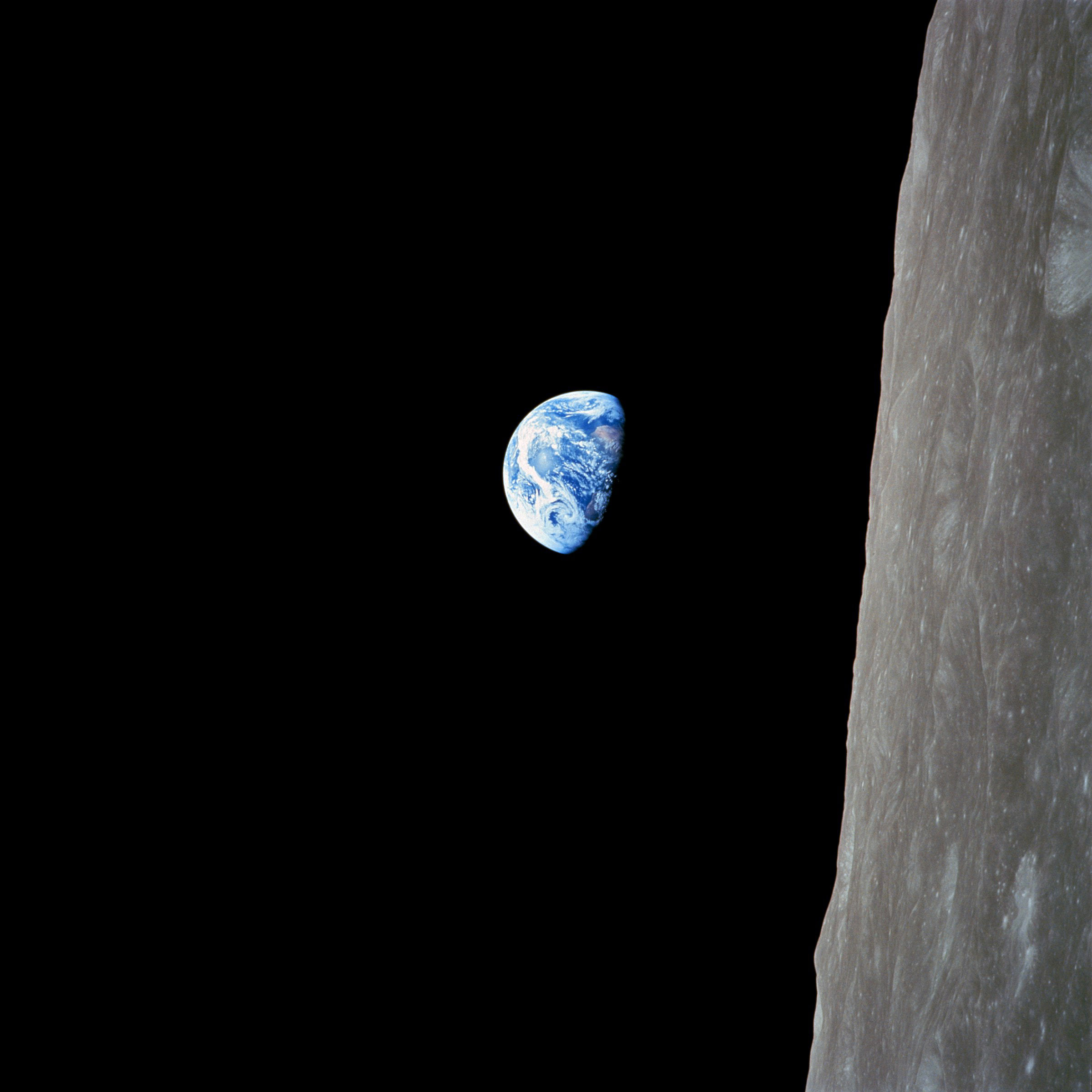
Apollo 8's overview effect: Iconic Earthrise image, AS08-14-2383, Bill Anders' serendipitous photograph of Earth as the first manned flight to the Moon swung around from the farside, December 24, 1968 [NASA/JSC].
The Apollo 11 crew landed on the lunar surface a few months after that Earthrise photo was circulated. During this and subsequent missions (all on the central near side of the Moon), it was reported by the media that Earth always appears stationary in the same part of the sky as seen from the Moon’s surface.

In November 1969, the Apollo 12 crew put up a large inverted umbrella antenna to improve communication data rates from the lunar surface; it had to be set-up and aligned, but once pointed at Earth, it remained pointed at it forever.

Simulated time-lapse view of Earth from the vicinity of the Moon's north pole, where the significance of the Moon's libration creates changes in a notional viewers perspective. Earth appears to swing through a Lissajous figure in the sky. Three lunar days are squeezed into 1:45 using Celesta.

Because the Moon orbits the Earth and is in synchronous rotation with its orbital period, we always see the same side.  Hence, there is a near side (the hemisphere we see from Earth) and a far side (the side we cannot see from Earth; it is often mistakenly called the “dark side”).

A consequence of this synchronous rotation is that from the Moon, the Earth appears stationary in the sky, just as the hub of a bicycle wheel remains stationary from the viewpoint of one of its spokes. Thus, while the Sun rises and sets according to the slow rotation rate of the Moon (one complete rotation every 708 hours, half day and half night), the Earth is always in the same spot in the sky. Of course, because it is illuminated by the Sun, it changes its phase on the same timescale as does the Moon as seen from Earth, although reversed (a full Moon on Earth is a new Earth from the Moon and vice versa.)  From the far side of the Moon, one does not see the Earth at all.

Are spectacular views of Earthrise only visible from spacecraft in orbit about the Moon? Not quite.

Two points about the Moon’s orbit make the story a bit more complicated. First, the Moon’s orbit around the Earth is not circular but elliptical, its distance ranging from 363,000 km up to 405,000 km from the Earth. Second, the plane of the Moon’s orbit is inclined about 5 degrees to the ecliptic (the plane of the Earth-Moon system’s orbit around the Sun). These two facts mean that the Moon librates, or “wobbles” both left and right (an effect of its elliptical orbit) and up and down (an effect of the inclination of its orbital plane). These librations are not overwhelmingly significant, but result in some interesting effects around the limb of the Moon – the great circle made up by the 90 degrees east and west longitude lines, including both poles.
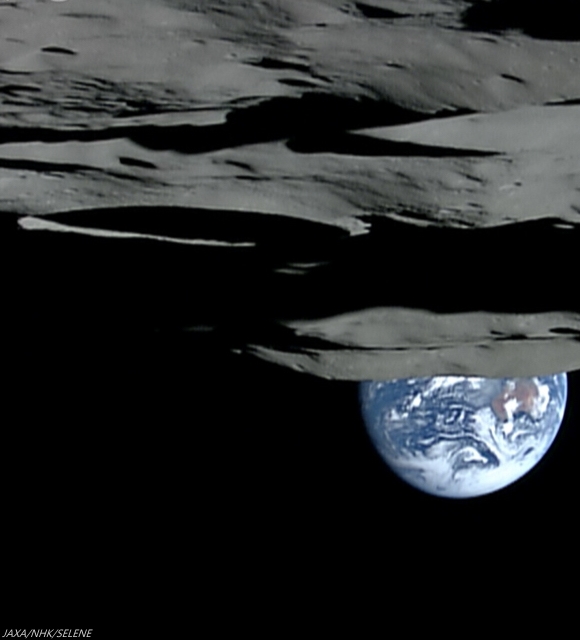
Earthset, from 1080p video captured from Japan's lunar orbiter SELENE-1 (Kaguya) October 31, 2007, as spacecraft and camera, in polar orbit, began its track north from the south pole (on the rim of Shackleton crater, center left) over the Moon's farside, leaving Earth to set behind Malapert massif, a nearside fragment of the rim of immense South Pole-Aitken impact basin [JAXA/NHK/SELENE].
The Earth as seen from the Moon is about 2 degrees in angular width (about 4 times the apparent diameter of the Moon and Sun as seen from Earth). Earth’s disk is roughly equivalent to the size of a quarter held out at arm’s length; the Moon’s apparent disk is pea-sized. Because of the Moon’s longitudinal libration, the “limb” areas near the 90 degree meridians are sometimes visible to Earth and other times not. Thus, the Earth will sometimes appear in the sky and sometimes be hidden below the Moon’s horizon – in other words, an observer along this line of longitude will see an Earthrise and an Earthset.

The longitudinal libration is about 8 degrees, so the observer on the lunar limb would see the Earth slowly rise above the horizon and clear it by its apparent diameter, then slowly sink below the horizon by the same amount. That Earthrise will be slow indeed – it will take a couple of days for the full disk of the Earth to rise above the horizon. This cycle would repeat on a monthly timescale, as the Moon completes one revolution around the Earth.

Similarly, one would also see the Earth rise and set at the poles of the Moon, although to a different magnitude. The polar view is almost completely dominated by the latitudinal libration, caused by the inclination of the Moon’s orbital plane. This variation is about 6.5 degrees (it includes the Moon’s spin axis obliquity of 1.5 degrees) and would vary on a similar monthly timescale. These variations will become important if future lunar inhabitants live at the poles, as I think likely. As the Earth will sometimes be out of direct view, it is likely that we will depend on relay satellites for continuous communication. Polar inhabitants will also see a “different” Sun from what they’re accustomed to on Earth – at the lunar poles, the sun rotates around the horizon, rather than rising and setting.
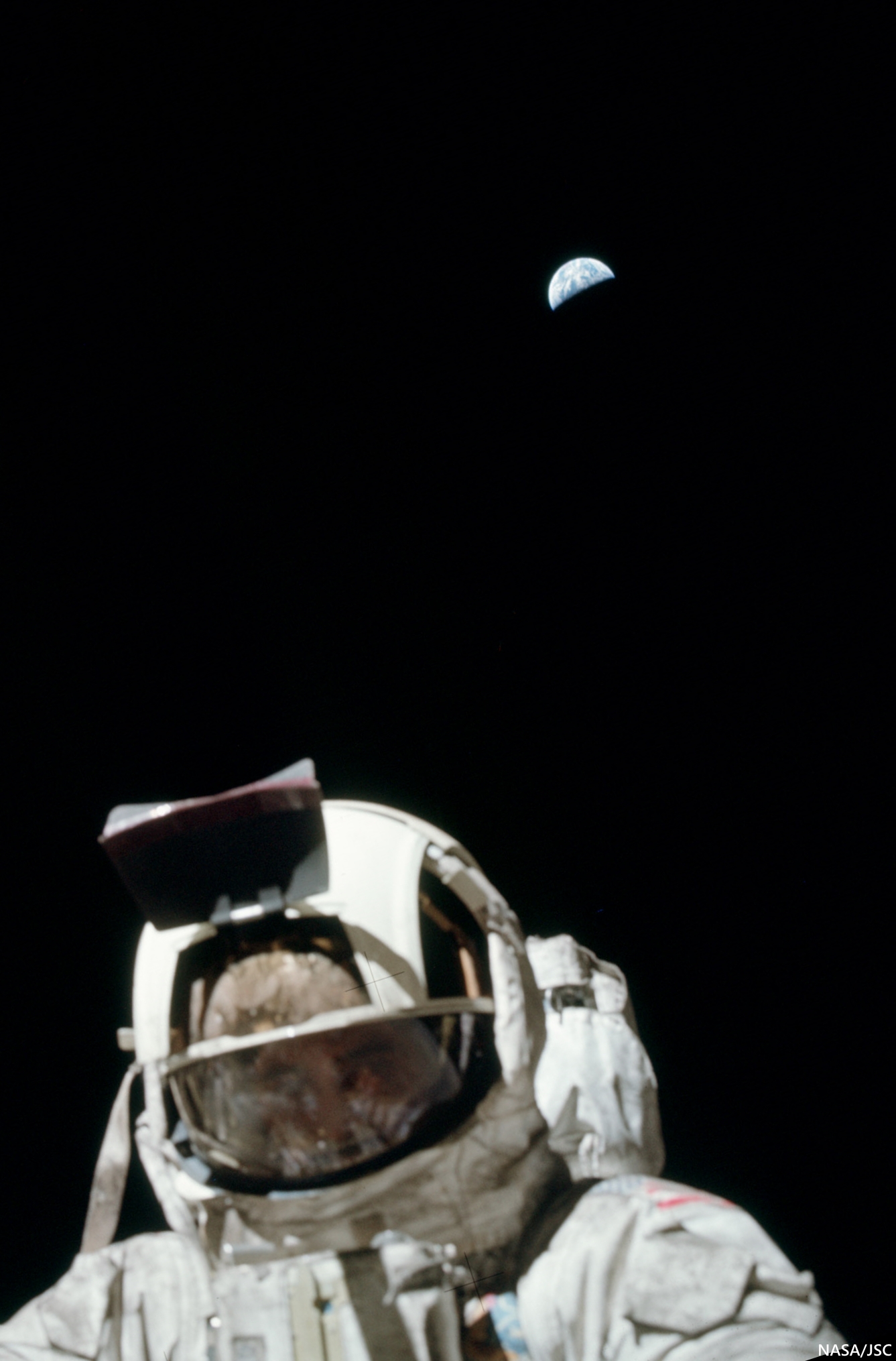
Cernan and Earth. At Taurus Littrow, Earth maintains its position. Ground controllers did occasionally admonished Apollo 17 Cmdr. Gene Cernan's partner Jack Schmidt for lifting his solar visor to get a better look at a rock, from time to time, during the last walks on the Moon. But at this point, however, as he traded poses with Schmidt using Earth as a backdrop, Cernan did briefly lift his visor halfway, allowing posterity an atypical view of an actual human face on the Moon in December 1972 (AS17-134-20471) [NASA/JSC].
Thus, there are places on the Moon from which we can stand and contemplate the sheer beauty and magnificence of a slowly rising Earth. Given the sea change in global perspective provided by the famous Earthrise picture taken by the Apollo 8 crew almost fifty years ago, what societal impacts will occur when a human being stands on the lunar surface and watches the Earth slowly rise above the horizon? I suspect that a similar shift in planetary perspective will occur. If history is any guide, such a shift will have profound psychological and political implications  – both positive and negative – in our reach for the stars.

Dr. Paul D. Spudis is a senior staff scientist at the Lunar and Planetary Institute in Houston. This column was originally published by Smithsonian Air & Space online, and his website can be found at www.spudislunarresources.com. The opinions he expressed here are his own, but these are better informed than most.

Monday, January 31, 2011

IAU names craters to honor Columbia crew

Columbia crater group, Apollo basin (Chang'e-2)
Craters in this grouping on the southeast side of the ancient Apollo basin have been preliminarily named in honor of the crew members of Space Shuttle Columbia, who perished during re-entry February 1, 2003.  Though some in the group seem to be large secondary craters from the same event Husband, formerly Borman L, is older than the others  Field of view from Chang'e-2 global high-Sun mosaic [CAS/CNSA/CLEP].
Keith Cowing, at the Lunar Orbiter Image Recovery Program (LOIRP) website "Moonviews" reports a crater grouping in Apollo basin (35.7°S, 208.0°E) has been provisionally designated by the International Astronomical Union to honor of each of the seven astronauts who died in the catastrophic failure of Space Shuttle Columbia February 1, 2003.

Columbia group, Apollo basin
Columbia crater group, in context with Apollo basin and craters there named after the Space Shuttle Challenger group, among others. The larger crater at center left, named in honor of Apollo 1 crew member Roger Chafee, is roughly 50 km across  [NASA/USGS/ASU].
Columbia crater group, lunar farside (LROC WAC DTM)
Locating the Columbia crater group (arrow) in Apollo basin, itself nested near the edge of the South Pole-Aitken basin, on an orthographic projection of the lunar farside. False color elevation map from LROC Wide Angle Camera digital terrain model (WAC DTM) [NASA/GSFC/ASU].

Sunday, November 22, 2009

Anders: We can return to the Moon

Maj. General William A. Anders (USAF, Ret.) was keynote speaker at a private luncheon hosted at the Museum of Flight in Tukwila in Washington, by the Seattle Symphony on the 40th anniversary of the launch of Apollo 12 – the second mission to land men on the moon.

When the United States eventually returns to space after the shuttle program is retired next year, “we can go back to the moon and on to other planets,” the Apollo 8 veteran said.

Read the post HERE.

Thursday, July 30, 2009

Apollo 8-type test for Orion considered

Like Apollo 8 in December 1968, mission planners are considering a test-flight in lunar orbit for Orion, as part of the run-up to surface expeditions, in tandem with Constellation's Altair lander.

Shelby G. Spires, The Huntsville Times

Engineers and managers at Marshall Space Flight Center have been conducting initial studies that would configure the in-development Ares V heavy lift rocket into a vehicle that could be used to take a crew to orbit the moon or place large probes in space, Marshall managers said this afternoon.

"We are back in the concept stage," Ares V managers Steve Creech told members of the Augustine review panel, which is chartered to look at NASA's future. "It is cheap to look at different alternatives, and we continue to look at options."

Currently, NASA chief plan is to use a smaller Ares I rocket for crew missions, and the larger Ares V for cargo missions. This plan would use only the large rocket.

Read the Article HERE.

Thursday, December 18, 2008

Forty years since Apollo 8

At the risk of becoming unnecessarily nostalgic, David S.F.Portree of Flagstaff is among those best equipped to keep the fires burning when comparing the vision of tomorrow from yesterday with the realities of today, when examining the fifty year history of manned space exploration.

"A new look on Space History," David's "ALTAIR VI" was where, after some deductive reasoning and post-Apollo history he once discussed, I was led to discover the amazing similarity between manned space architecture some at NASA tried to sell Congress and President Nixon as alternatives to the Space Shuttle strongly resemble the ATV program now in use by ESA.

Along with David's rememberence of the largely forgotten effect Apollo 8's first manned trip to the Moon had on so many of us who were but children, forty years ago this month, his use of the famous image that soon appeared on Life magazine's cover, at the end of 1968, reminded me of what a joy it is that we have a restored version.

Astronaut Bill Anders, Command Module Pilot on-board Apollo 8, shot the image forty years ago, and like all the Apollo images in the years that would follow, it was reproduced into a blurry, bleeding inprecise print media at far below their potential quality.
Now, however, through the Apollo Surface Journal and elsewhere, the HR versions of the Apollo suites of images are being made available, and with an average to good monitor, four decades of patience has finally paid off.
It's like those images were taken yesterday.

As I've written before, when the day arrives that NASA can finally understand the purely entertaining value of space exploration, they will no longer need to worry about funding.

Tuesday, December 16, 2008

Frank Borman to Address EAA

Apollo 8 commander to speak to
Experimental Aircraft Association
40th Anniversary of
First Manned Mission to the Moon.

OSHKOSH - Cmdr. Frank Borman will give the keynote address Wednesday at the Wright Brothers Memorial Banquet, sponsored by the Experimental Aircraft Association.

Borman was commander of Apollo 8 in December 1968 when it became the first manned craft to orbit the moon. The 40th anniversary of that launch is Dec. 21.

Borman and Jim Lovell and William Anders spent six days in space and orbited the Moon 10 times, conducting research that ensure the success of Apollo 11 seven months later.

Coming as it did at the end of what many believe to have been the "incredible year," highlighted by the assassinations of Dr. Martin Luther King and Senator Robert Kennedy, the Apollo 8 crew read from Genesis, during a Christmas Eve broadcast from lunar orbit.

Saturday, December 13, 2008

40 Years After: Impact of Apollo 8 Remembered

San Diego Union-Tribune
Like most astronauts in the 1960s, the Apollo 8 crew members were Cold War warriors. Their mission was to fly to the moon, scout landing sites and return safely to Earth.

But on Dec. 24, 1968, as Apollo 8 completed its third orbit around the moon, James Lovell Jr., Frank Borman and William Anders saw something that made the mission more than another battle to prevail over the Soviet Union.

They saw the Earth, emerging from the lunar horizon as their spacecraft flew 69 miles above a dead, monochromatic moonscape.

“The Earth was the only thing in the universe that had any color,” said Borman, now 80. “It was a long way away.”

The sight was one of the few uplifting moments in a year pummeled by war, assassinations and civil unrest.

The three men were nearly a quarter million miles from home – the farthest anyone had yet ventured. Their mission would clear the way for Neil Armstrong and Edwin Aldrin to land on the moon seven months later.

Read the rest HERE.

Thursday, April 10, 2008

No Retreat from Tomorrow

Without question, the best commentary inspiring of perspective, meditation, and sound thought on present day space exploration is The Space Review. It makes no claim of being the repository of the best archives or science, but what it does provide is didactic in the form of good writing and timely, well-informed commentary. It is always difficult to recommend which article of the week needs to be read first. But for entertainment's sake, I turned first today to They were warned, by Taylor Dinerman.

Mr. Dinerman's piece reminded me that Congress was not the only group to be warned, over and over, of the inevitable end of the Space Shuttle, and "The Gap" looming ahead for workers at KSC and JSC particularly. The rest of us were warned, also. And ultimately, Congress derives its power from you and me. We, too, were warned, and the fate of NASA's worker and plant investments are ultimately our responsibility, and not only the responsibility of the next president or, more importantly, the Congress.

One rare example of representative government being successful at long-term planning was the Apollo program, and it's sustained, persistent and ultimately successful manned lunar landings.

Political Will (without which, nothing is ever accomplished) combined with the Cold War's "battle for men's minds" and kept real funding for NASA's missions going steady through an escalating and expensive Vietnam War and a general social upheaval not seen since before Appomattox, rivaling Depression and World War, through three presidential administrations from 1961 until 1972.

It is astounding this funding was sustained from the 86th Congress through the 92nd, through six congressional elections.

Those of us experienced with this sorts of things often say your average legislator "has the attention span of a circus monkey."

It was not always this way, but in modern times, as you might expect of what is still the most productive nation on Earth, Congress has "a lot on its plate," and, for good or ill, they are required to be extraordinary people (or must surround themselves with extraordinary people) just to keep their reception schedule straight.

Congress costs us more than a billion dollars per year to operate, prioritizing new and more clever ways to define their generosity by its prior claim on our paychecks.

So, as cringing as it has been to hear the cries of outrage from Florida's impacted federal representatives over the arrival, at long last, of a long-overdue end to the experimental platform called the Space Shuttle, it is understandable.

Not because it plays well at home. The folks back home, especially those impacted by the loss of real jobs, their own jobs, ahead, with the $500 million retirement of Atlantis, Discovery and Endeavour, have seen it coming for a long time.

As hard as it might be to believe, the outrage and squeals you've been hearing from the Florida delegation in Washington reflects genuine surprise, or at very least a purposeful tone of rhetoric those using it hope will arouse their colleagues and boost the signal over the unprecedented noise level to be heard in the marketplace.

NASA is a creature of Congress, after all. For the rightful credit given John Kennedy for Apollo, Lyndon Johnson was more influential in his desire not to "sleep by the light of a communist moon" when he lead the U.S. Senate in 1957 that gave birth to NASA fifty years ago. He was the reason the Vice President, serving in that role under President Kennedy, is still chairman of the National Space Council (and why Dan Quayle, in that same role sixteen years after Johnson's death, prevailed upon NASA to restore the traditional blue "meatball" as its logo, setting aside the "snake" of the 1980's).

Lyndon Johnson was the most successful president in history in getting his agenda passed in Congress, even if his Civil Rights initiative required Republican votes to win out over the opposition of southern Democrats. Mercury, Gemini and through the Apollo 1 fire in January 1967, in 1968, less than a month before he left office, the crew of Apoll0 8 became the first men to leave Earth orbit and return from the Moon.

I credit President Johnson not to raise sympathy for an admittedly enigmatic historic figure or to claim this friend of my father was misunderstood or his historic role under-appreciated, though with regard to Apollo, it clearly was and is.

I'm as ambivalent toward this man as the next guy.

My point is to cast light on an often hidden reality about the exercise of real political power, the kind that escalates an increasingly unpopular war, declares another "unconditional war on poverty," and shepherds Civil Rights legislation, bill after bill, through an increasingly hostile Congress.

Ronald Reagan understood the principle, having on his desk the engraved words, "Anyone can get anything done if they don't care who gets the credit."

Ronald Reagan was a product of Labor and Hollywood, however. Lyndon Johnson was a creature of Congress, like NASA, and he never really quit being the Senate's majority leader until he left Washington physically and politically exhausted and handed it all over to the neo-socialist anti-communist and equally complex Richard Nixon in January 1969.

In the "vesting clause" of the U.S. Constitution, we read, "All legislative Powers herein granted shall be vested in a Congress of the United States..."

For all the concern united in the election of the American President, it is just a president, after all, that will also be elected this year, along with the next Congress, where all the money and power originates. Divided as it is among 538 accidents and Alphas, both men and women, it is the embodiment of the apparent chaos of representative government.

"Find a better country," as they say. (Good luck with that.)

When decisions are made about "ramping up" or eliminating Constellation after the election in November, it will not be an expression of the charisma of the next president. The decision will be made by the lumbering sausage factory on Jenkins Hill in the Potomac swamp.

No building inside the limits of the District of Columbia can be built higher than the U.S. Capitol Dome for a reason. That's where decisions are made about what should actually be done, and how, with that prior claim on your wages.

Rather than ask Senators Obama, Clinton or McCain their positions on Constellation or COTS or the very real threat of regulation of NewSpace when you exercise the responsibility of casting your federal ballot, it might be a better idea to know what your congressional representatives plan to do when the 111th Congress convenes next January.

Better still, why not clue them in on what you want them to do.

Thursday, April 3, 2008

Fred Haise keynotes Mississippi Economic Council Meeting

Fred Haise
Jackson Clarion-Ledger Biloxi native and Apollo 13 LM pilot Fred Haise will keynote the annual Mississippi Economic Council meeting, May 7 at the Jackson Marriott.

"Failure is Not an Option," will be the topic of Haise's speech. More than 1,000 people are expected to attend.

Haise, who was one of the 19 astronauts selected by NASA in April 1966, gained fame as crew member on the infamous Apollo 13 mission in 1970. Haise was backup to Jim Lovell, later his commander on Apollo 13, as LM pilot for Apollo 8 in 1968 and for Buzz Aldrin on Apollo 11 in 1969. After Apollo 13 returned safely in April 1970, he served as backup for John Young as commander of Apollo 16 in 1972.