|
| Students learn about the ongoing Chang'e-3 mission at a primary school in Ganyu, Jiangsu province, on Tuesday. Designers are pleased with the mission's success so far, as experiments have gone more smoothly than expected [Si Wei/China Daily]. |
Emily Lakdawalla of The Planetary Society has performed a herculean labor, today, pulling together many threads to deliver what might be the best possible description of a "lengthy press briefing by several members of the Chang'e 3 science team," Wednesday.
"I found it to be quite informative," Emily wrote, "not just about the mission but also about attitudes about Chinese space exploration and foreign cooperation. It was useful background for my participation in an hour-long panel discussion on China Radio International's "Today" program."
Wang Fan
China Daily
Six out of the eight pieces of scientific equipment deployed to the moon with the Chang'e-3 lunar mission have been activated by scientists and are functioning properly, according to scientists working on the mission.
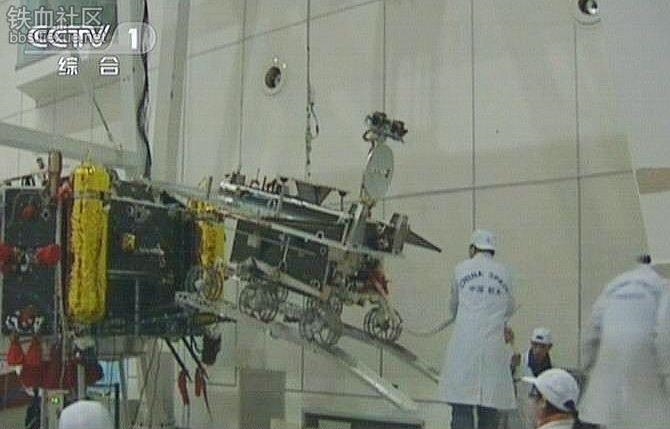
Speaking at a news conference on Tuesday, scientists said that the equipment aboard the Yutu lunar rover and the Chang'e-3 lander had so far been functioning as hoped, despite the unexpectedly rigorous conditions of the lunar environment.
"Except for the alpha particle X-ray spectrometer and the visible and near-infrared imaging spectrometer, the instruments have all been activated and are undergoing tests and adjustments," said Su Yan, deputy designer of the Chang'e-3 ground applications system.
Zhang He, deputy designer of the probe, said though the temperature disparity is greater than scientists had anticipated, all the equipment on the moon is in "perfect" condition, and optical and ultraviolet-imaging experiments are under way.
Scientists with the ground applications system are expecting to receive a colossal quantity of original data from the rover and lander, which have independent channels to send signals, Su said. The earlier Chang'e-1 and Chang'e-2 craft only had one channel each, he said.
The mission's success so far has been a relief to Wu Weiren, chief designer of China's lunar probe program. He said the whole process, including the launch, the soft landing, the separation of the rover and lander and the ongoing experiments, have gone "much smoother" than he had expected.
"I found it to be quite informative," Emily wrote, "not just about the mission but also about attitudes about Chinese space exploration and foreign cooperation. It was useful background for my participation in an hour-long panel discussion on China Radio International's "Today" program."
A link to her detailed summary follows the official China Daily description, below:
Wang Fan
China Daily
Six out of the eight pieces of scientific equipment deployed to the moon with the Chang'e-3 lunar mission have been activated by scientists and are functioning properly, according to scientists working on the mission.
Speaking at a news conference on Tuesday, scientists said that the equipment aboard the Yutu lunar rover and the Chang'e-3 lander had so far been functioning as hoped, despite the unexpectedly rigorous conditions of the lunar environment.
"Except for the alpha particle X-ray spectrometer and the visible and near-infrared imaging spectrometer, the instruments have all been activated and are undergoing tests and adjustments," said Su Yan, deputy designer of the Chang'e-3 ground applications system.
Zhang He, deputy designer of the probe, said though the temperature disparity is greater than scientists had anticipated, all the equipment on the moon is in "perfect" condition, and optical and ultraviolet-imaging experiments are under way.
Scientists with the ground applications system are expecting to receive a colossal quantity of original data from the rover and lander, which have independent channels to send signals, Su said. The earlier Chang'e-1 and Chang'e-2 craft only had one channel each, he said.
The mission's success so far has been a relief to Wu Weiren, chief designer of China's lunar probe program. He said the whole process, including the launch, the soft landing, the separation of the rover and lander and the ongoing experiments, have gone "much smoother" than he had expected.
Read the full article at China Daily, HERE.
Big HT: to Emily Lakdawalla at The Planetary Society, for her well-translated transcription of Wednesday's press conference posted HERE.